San Francisco 49ers: Is Drafting a 1st-Round Wide Receiver Too Risky?
One of the most commonly mocked positions for the San Francisco 49ers in the first round of the 2015 NFL draft is wide receiver. Considering the 49ers could lose Michael Crabtree, Brandon Lloyd and Stevie Johnson to free agency or salary-cap considerations, stocking up on early talent isn’t the worst idea in the world.
Some 49ers fans, however, are worried about picking a receiver early. They point to high-profile failures such as A.J. Jenkins and Jonathan Baldwin and worry that the risk of a first-round flameout is too high. Better, the theory goes, to pick a safer pick such as an offensive or defensive lineman early and then gamble on a receiver later in the draft.

Does this theory have any merit, or is it a case of once-bitten, twice-shy when it comes to the disastrous Jenkins pick? To try to answer that question, I went back into the history of the draft to look for patterns and trends regarding the success of draft picks.
I pulled up the careers of every player drafted in the first 100 picks from 1970 through 2010. I limited the search to players in the first 100 because after a certain point, you stop worrying about risk versus reward—you’re not expecting any solid value out of a fifth-round pick, so any return you get is a nice surprise.
A first-round pick, on the other hand, carries with it certain expectations—that is, a first-round pick can be a bust, while someone picked at the end of the draft really can’t be.
I started in 1970 with the NFL merger and the beginning of the truly modern NFL. I only went up through 2010, so each player would have five potential years of NFL performance under his belt for the analysis; it’s not fair to simply judge a player such as Jarvis Landry on one season.
To compare players across positions, I’m using Pro Football Reference’s Approximate Value statistic. It attempts to dilute the performance of any player at any position in era into one easily comparable number.
While it’s not perfect, it’s the best system for comparing receivers to, say, offensive linemen or kickers. By adding up the AV each player produced in his first five seasons in the league, we can see which draft picks end up historically being safer than others.
The overall chart is a little muddled, as drafting isn’t precisely an exact science. However, we can still get some basic information from it:
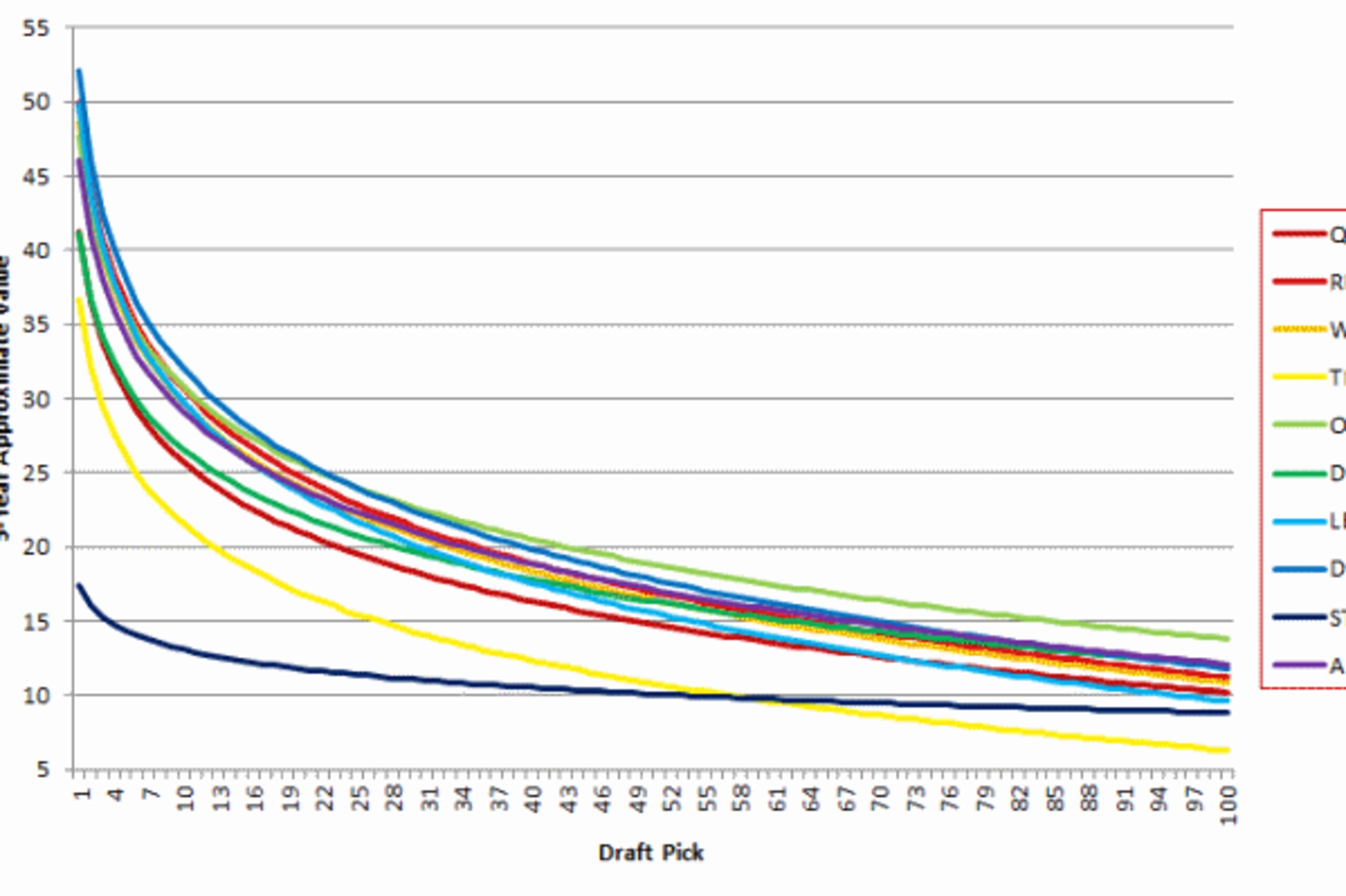
You can see that the success of the draft picks drops off exponentially, which makes sense. The difference between the first and 11th picks is much, much more significant than that between the 50th and 60th picks.
You can also see that, in the later rounds, offensive linemen begin to out-distance the other positions in terms of value. Basically, that means that linemen maintain value for longer than other positions do.
This makes sense, too—plenty of the top linemen in the league were found in the middle rounds of the draft, including Marshal Yanda, Josh Sitton and Jahri Evans. Yes, on the whole, first-round picks are better than second-rounders and so forth, but the drop-off on the offensive line is less than other positions.
When it comes to the range right around the 49ers’ first-round pick, at No. 15, we can see that it’s actually defensive backs who have been the most successful picks—players such as Darrelle Revis, Earl Thomas and Rod Woodson have been selected in that area.
Receiver is more of a middle-ground selection, overall. While this is where players such as Jerry Rice, Michael Irvin and Marvin Harrison were drafted, you also see less inspiring players such as J.J. Stokes and Kevin Dyson taken in this range. Still, it falls right in the middle, so a receiver would be an average pick, right?

Of course, it’s more complicated than that. Yes, the average of a Jerry Rice and a Mike Williams is an average player, but in the same way that sticking one hand in a fire and the other in a freezer means you are, on average, comfortable.
A better way to look at risk versus reward is to see what percentage of players significantly overperform and underperform the predicted value.
With over 40 years of draft picks to choose from, we can see where the risk-versus-reward ratio can really be found. Players who are more than 25 percent better than the “average” pick at their draft slot are labeled as “booms,” and players who are more than 25 percent worse than average are labeled as “busts.”
I’ve split this into a few categories to get a clearer picture. The following chart shows the bust and boom rates for all top-100 picks, all first-round picks and all picks in the 10-20 range, where the 49ers are slated to pick in 2015.
| QB | 30.8% | 49.5% | 36.5% | 32.9% | 57.9% | 42.1% |
| RB | 30.8% | 50.4% | 32.2% | 42.4% | 28.6% | 42.9% |
| WR | 34.1% | 46.1% | 37.2% | 31.7% | 37.7% | 32.1% |
| TE | 30.8% | 47.3% | 37.0% | 37.0% | 44.4% | 27.8% |
| OL | 34.0% | 37.6% | 26.7% | 29.3% | 29.5% | 20.5% |
| DL | 33.2% | 39.1% | 28.9% | 30.0% | 35.0% | 30.0% |
| LB | 44.8% | 38.1% | 36.3% | 28.8% | 39.0% | 22.0% |
| DB | 35.0% | 41.5% | 30.3% | 29.4% | 26.9% | 26.9% |
| ST | 44.0% | 36.0% | 50.0% | 50.0% | 33.3% | 66.7% |
| OVERALL | 35.0% | 42.2% | 31.9% | 32.0% | 34.1% | 29.3% |
There are a few things that we can take away from this chart:
- Don’t draft special teams. Ever.
- Quarterback is the ultimate risk-versus-reward position, especially in the middle of the first round. Eighteen of the 19 quarterbacks taken in the 10-20 range either qualify as a boom or a bust; the only exception is Kyle Boller.
- The common wisdom that offensive line is a safe pick is borne out by the numbers; linemen nearly always come off the board in the order of their talent. It’s rarely going to be an exciting world-changing pick, but you can generally trust that an offensive lineman is going to be a solid selection.
- Running backs, on the other hand, offer a lot of flash, but they tend to end up crashing and burning more often than not—they’re a very high-risk pick.
What about receivers, then? They’re not nearly on the same level as the risk of drafting a quarterback or running back, but the skill positions, as a whole, have a higher hit-and-miss ratio than, say, the offensive line or linebackers. If you’re going to draft a skill-position player, receiver’s the position to grab.
People saying its higher risk than taking a lineman or a linebacker, however, are absolutely right. For one reason or another, scouts have historically been able to identify next-level talent on the front seven and offensive lines with much greater success.
Perhaps this is in part due to the fact that linemen tend to have one ideal body type, while multiple, different sorts of receivers can succeed. Perhaps it's draft rooms getting blinded by college statistics. Whatever the reason, they fail more at identifying top skill positions.
Is that useful information for the 49ers this season? Perhaps not. The offensive linemen currently ranked in the teens by ESPN are offensive tackles, which is not a position of need for the 49ers. The top guard is down toward the end of the first round, meaning a selection at No. 15 would be a reach.

Similarly, the defensive linemen in that position fit better in a 4-3 defense than San Francisco’s 3-4. While Dante Fowler, for example, looks like a very solid selection, he fits more as an outside linebacker for the 49ers, which is a much smaller position of need. Arik Armstead is the exception, but he might well be taken before the 49ers get on the clock.
That leaves receivers and cornerbacks in San Francisco’s wheelhouse. Cornerbacks are, historically, a little safer, but the need is greater at receiver. While the trepidation over taking a receiver is somewhat justified, this might be the right time to take the risk for the chance of getting the bigger reward.
San Francisco fans are, justifiably, worried about a receiver pick being the next A.J. Jenkins or Rashaun Woods. At the same time, it could just as easily result in the next Jerry Rice or Michael Irvin. Sometimes, you have to gamble in order to take the final step for a championship. The 49ers would be wise to gamble on a receiver in the first round.
Bryan Knowles is a Featured Columnist for Bleacher Report, covering the San Francisco 49ers. Follow him @BryKno on Twitter.


.jpg?w=2560 "Donald Works Out For Rams 🫨")