
Tale of the Tape for NFL Week 4
Throughout the 2014 regular season, former NFL defensive back Matt Bowen will bring you an X's-and-O's look at the pro game. Here are his five key plays from the Week 4 Sunday NFL schedule.
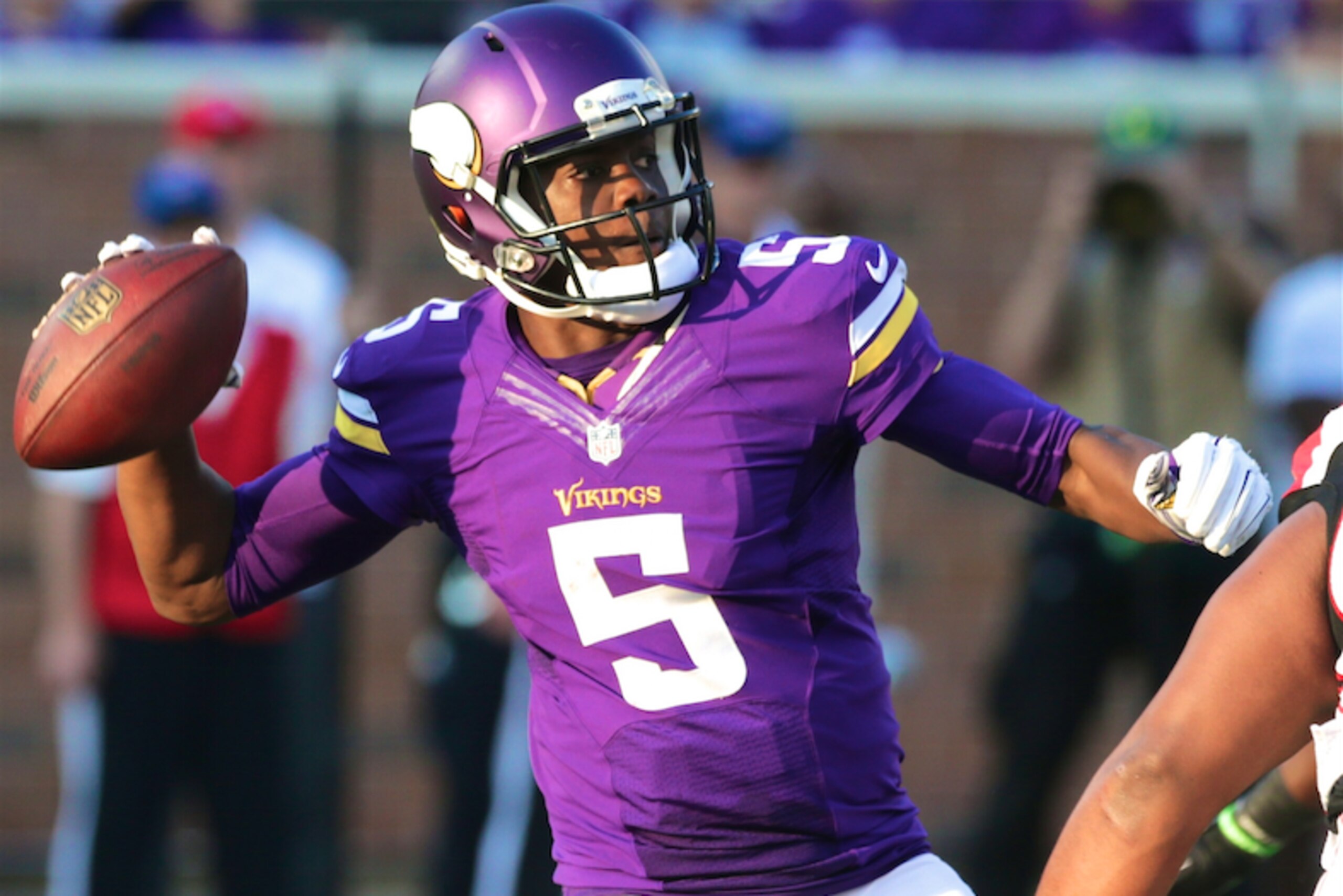
Teddy Bridgewater Produces in Vikings' Packaged Plays
The rookie quarterback threw for 300-plus yards and produced a touchdown on the ground in his first NFL start during the Minnesota Vikings' 41-28 win over the Atlanta Falcons at home.
.jpg?w=2560 "Colts Football")
.jpg?w=2560 "Panthers Buccaneers Football")
Looking back at this game, the Vikings' ability to create throwing windows for Bridgewater off play action and packaged plays (multiple run/pass reads within the scheme) allowed the rookie to find his primary targets and go to work on the Falcons secondary.
Let’s break down Bridgewater’s pass to Jarius Wright (packaged play) that set up the eventual game-winning touchdown while focusing on the throwing window generated off the mesh-point action in the backfield.
Personnel: Posse/11 (3WR-1TE-1RB)
Formation: Doubles Gun Near
Offensive Concept: Packaged Play (Slant)
Defensive Scheme: Cover 1
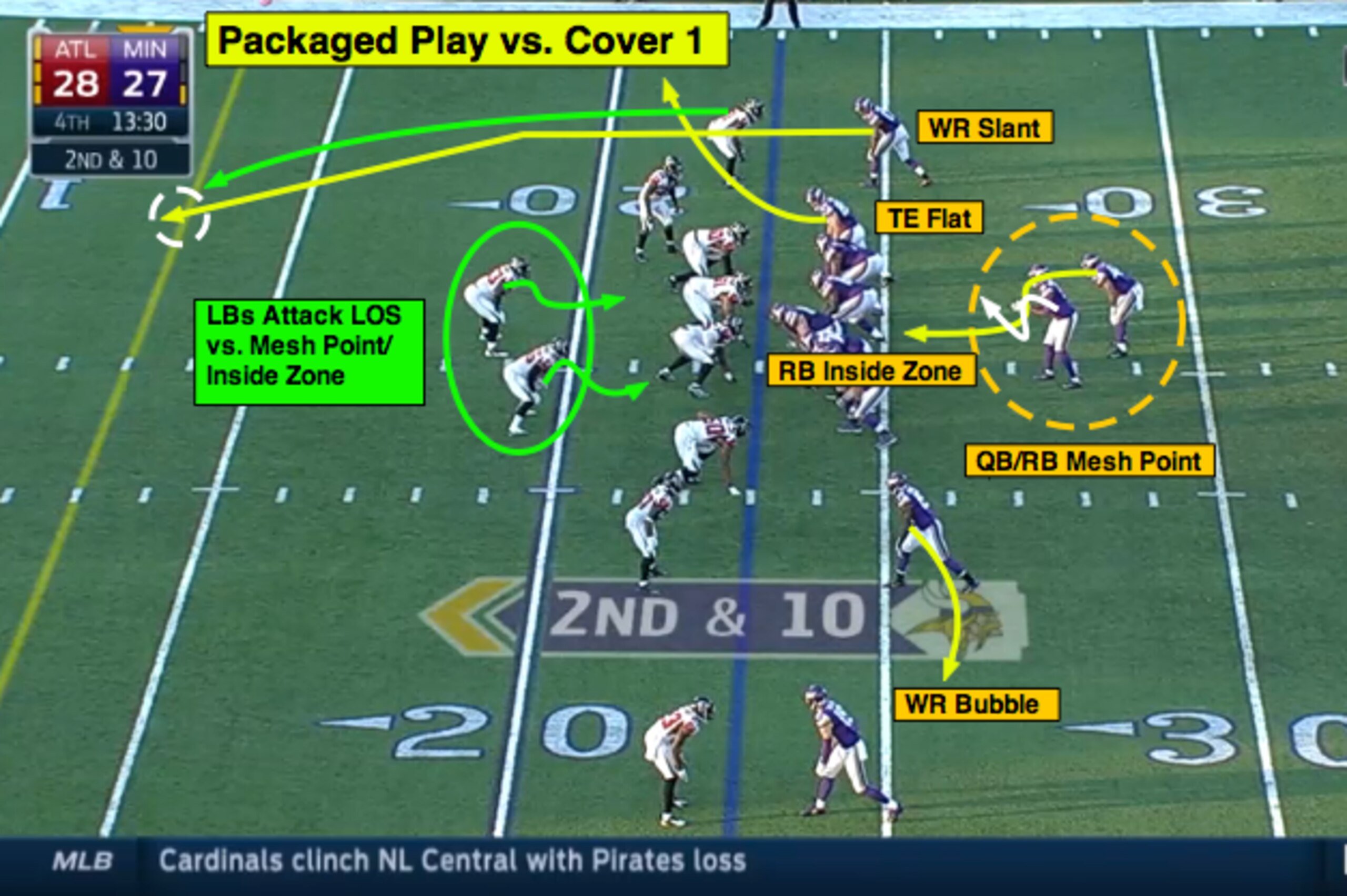
Packaged plays show up on the tape across the league every Sunday, as they put stress on the defense’s run/pass keys at the second level because of the multiple options within the offensive scheme.
Here, Bridgewater can hand off to the running back on the inside zone, target the wide receiver “bubble” screen to the open side of the formation, throw the flat route to the tight end or hit the quick slant/skinny post to Wright.
With seven defenders in the box, Bridgewater will ride the running back through the mesh point (quarterback-running back exchange) and read the second-level linebackers (run/pass).
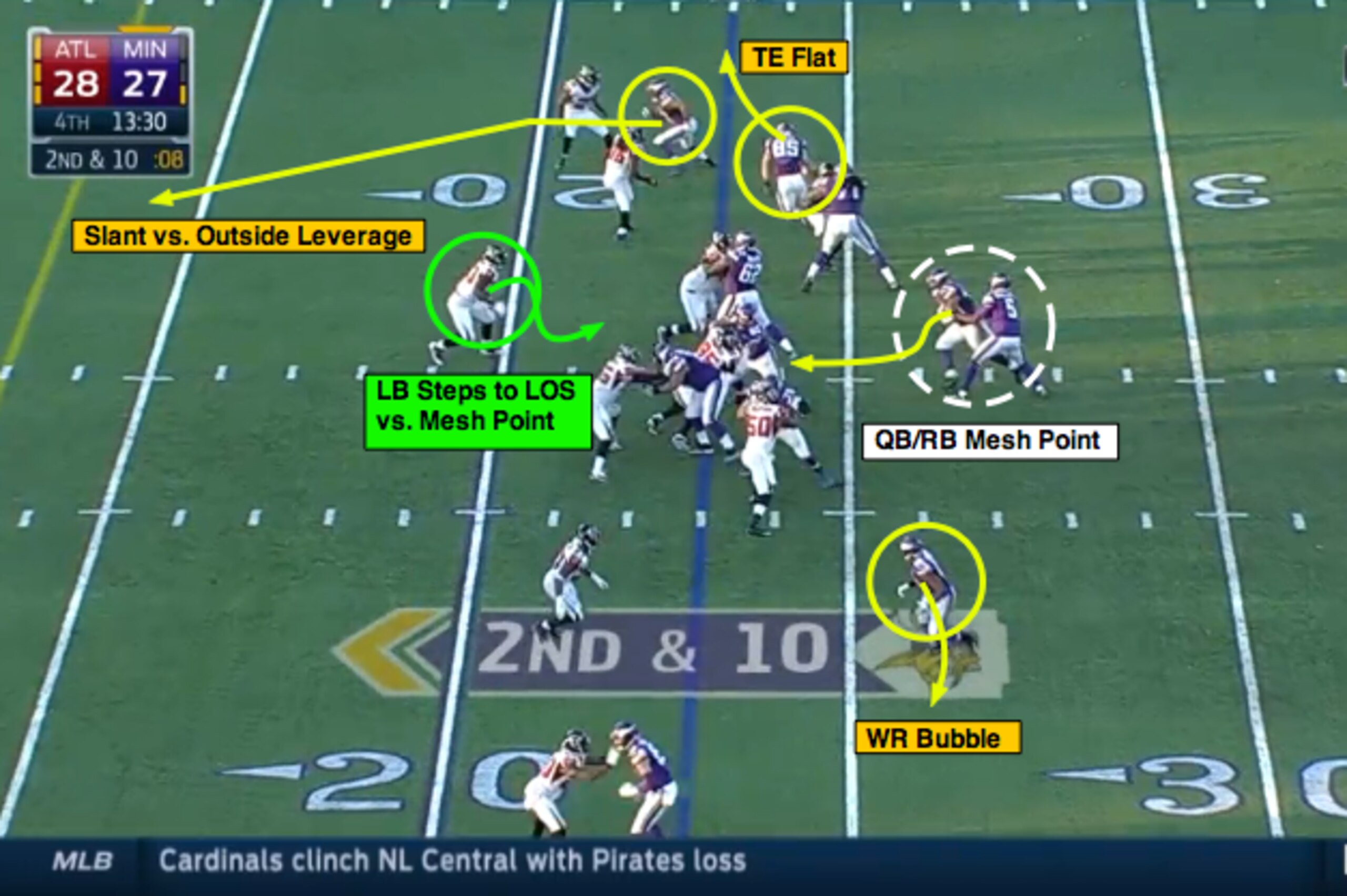
At the mesh point, both linebackers attack downhill versus the inside zone with Bridgewater now in a position to pull the ball and target the front side of the formation (slant-flat combination).
With the Falcons playing Cover 1 (man-free) and the defensive backs in an outside-leverage position (funnel receivers to free safety help), Wright can release up the field and work away from the cornerback’s leverage on the inside stem to the slant.
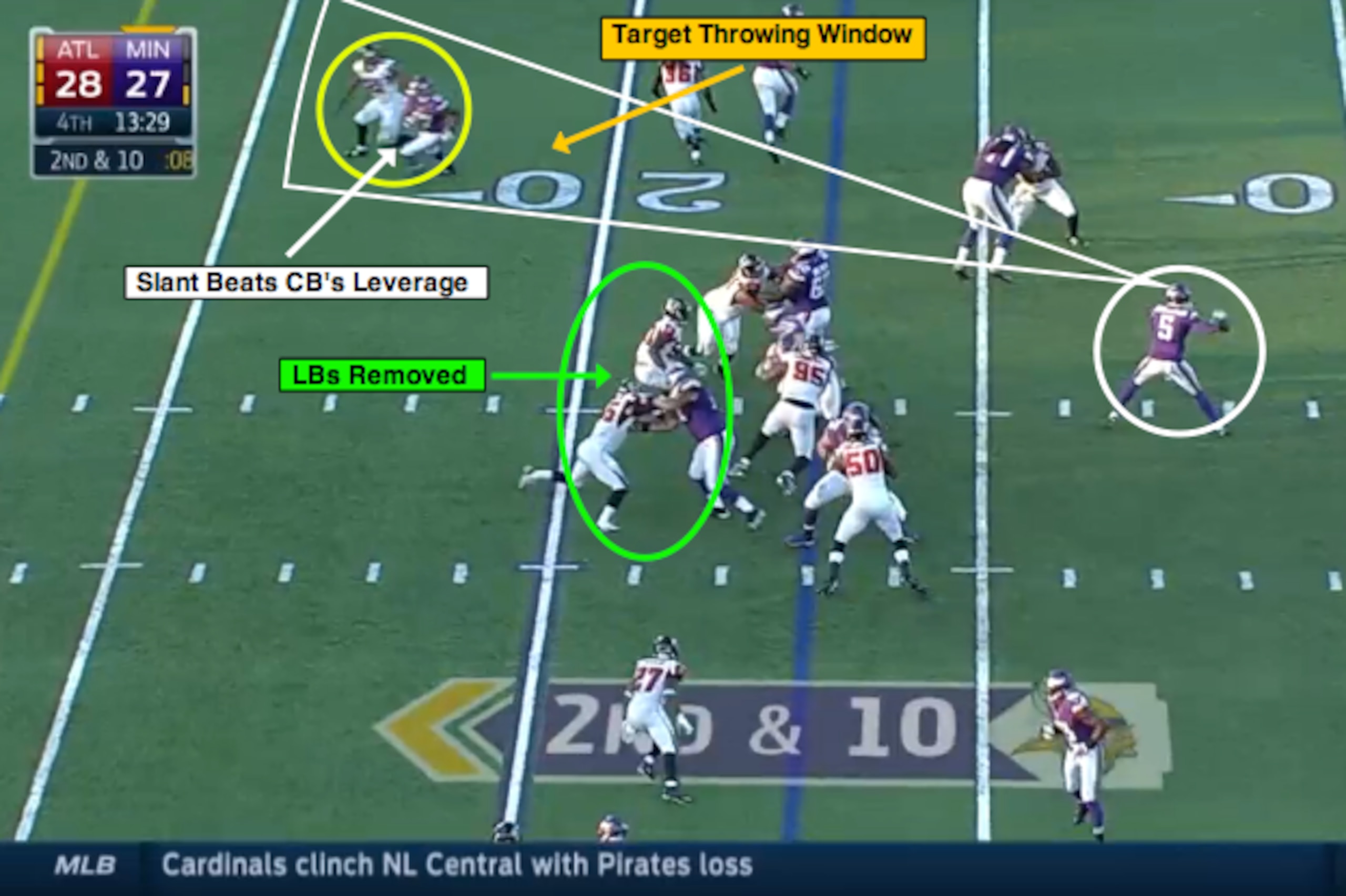
This is what I mean by creating a throwing window for the quarterback, as the safety matches to the tight end (flat) with the linebackers attacking downhill.
Bridgewater has a clear window to target Wright, with the receiver stemming this route inside of the numbers and the cornerback stuck playing from outside leverage. The rookie connects on this throw and puts the Vikings in a position to score the game-winning touchdown in the fourth quarter.
This will be a good tape to watch this week, and I hope the rookie can get back on the field for the Thursday night matchup with the Green Bay Packers after turning an ankle late in the win over Atlanta.
J.J. Watt’s Pick-Six vs. EJ Manuel, Bills
The Houston Texans defensive end continues to make plays that jump off the tape while reminding us he is the best defensive player in the league.
On Sunday, Watt intercepted Buffalo Bills quarterback EJ Manuel and took the ball back 80 yards for a score when he stepped into the throwing lane on the flat route from his defensive end position in the Texans' 23-17 win.
Here’s a look at how the Texans forced Manuel to throw hot versus a nickel zone pressure based on their pre-snap disguise.
Personnel: Posse/11 (3WR-1TE-1RB)
Formation: Doubles “Orange” Gun Near
Offensive Concept: Spot Route
Defensive Scheme: Nickel Fire Zone (Trap Technique)
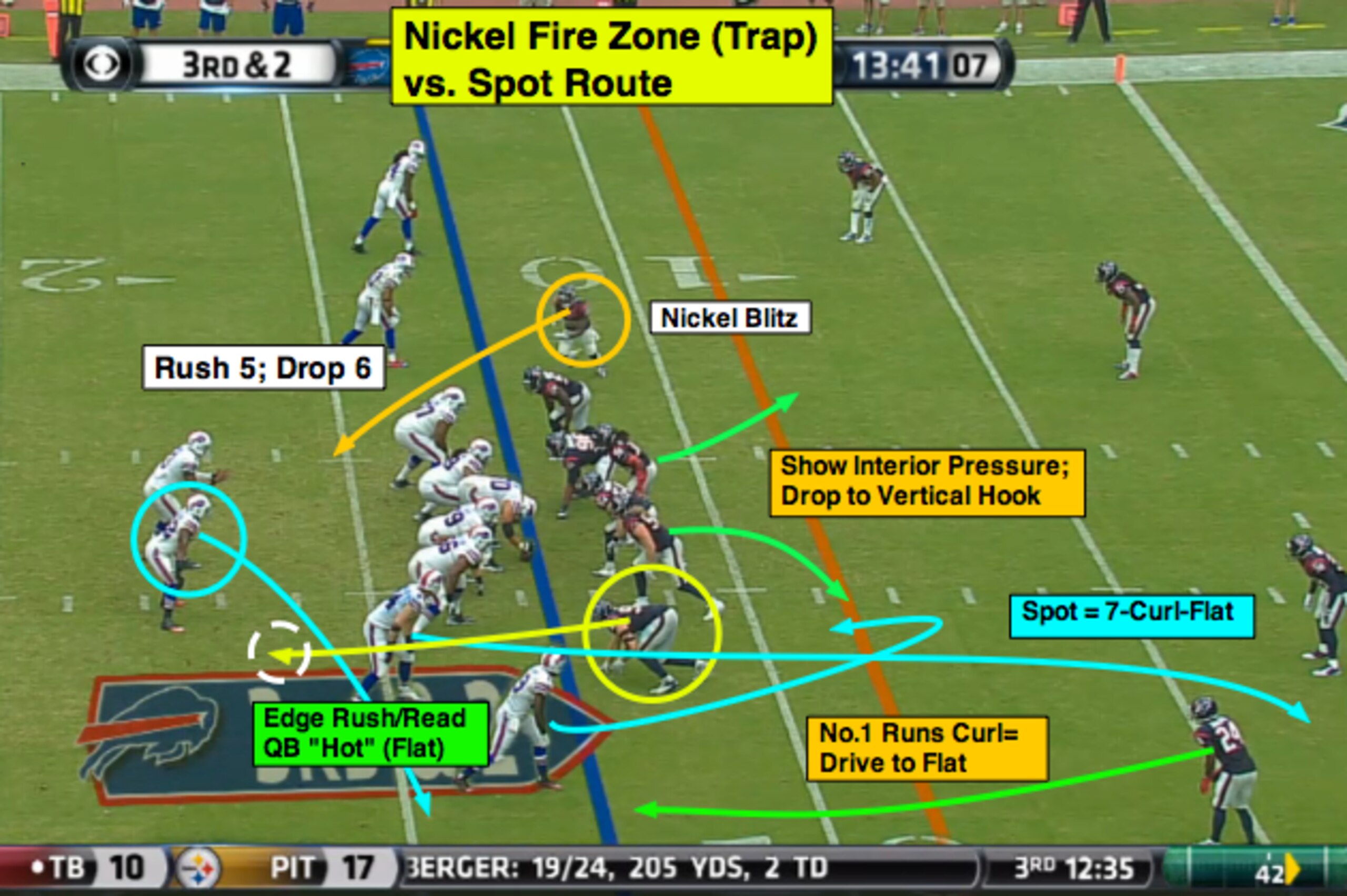
This is only a five-man blitz scheme from the Texans (nickel pressure) with two inside-vertical hook defenders (match to No. 2) dropping at the snap and a “trap” scheme to the closed side of the formation.
That allows the Texans to play the “spot” route (7-curl-flat combination), with the closed-side cornerback reading No. 1 to No. 2 (trap/drive the flat), the vertical hook defender matching to the inside curl (or spot) and the safety playing the tight end on the 7 route.
However, with Manuel immediately looking to dump this ball off to running back Fred Jackson in the flat, Watt can read through to the quarterback and adjust his initial rush path to step into the throwing lane.
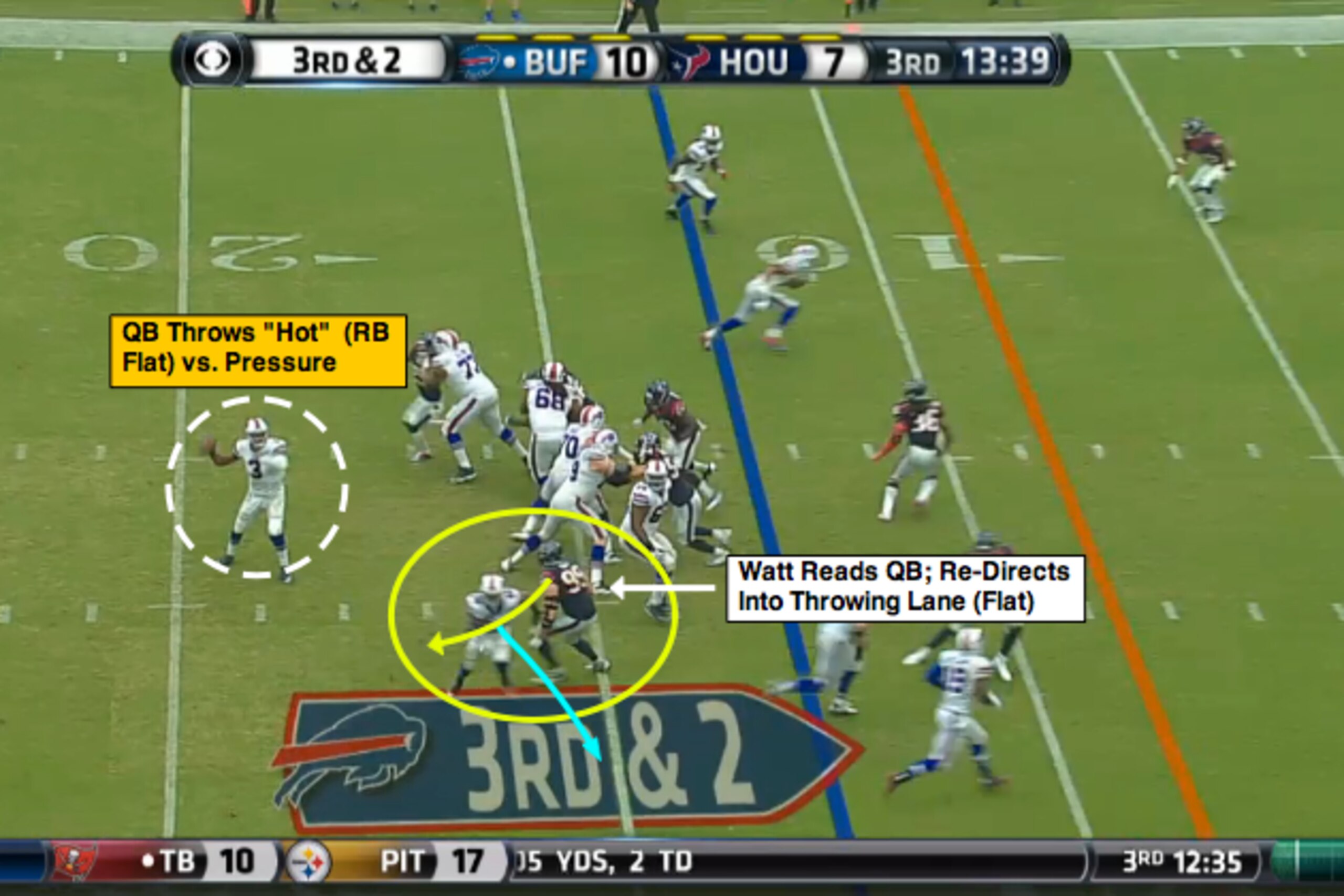
This is an example of smart, veteran play as Watt works up the field instead of continuing his rush path to the quarterback.
With Manuel targeting the flat route quickly versus the pressure look, Watt doesn’t have a chance to get home on the rush. This is why we see him redirect and push up the field to impact the throwing lane.
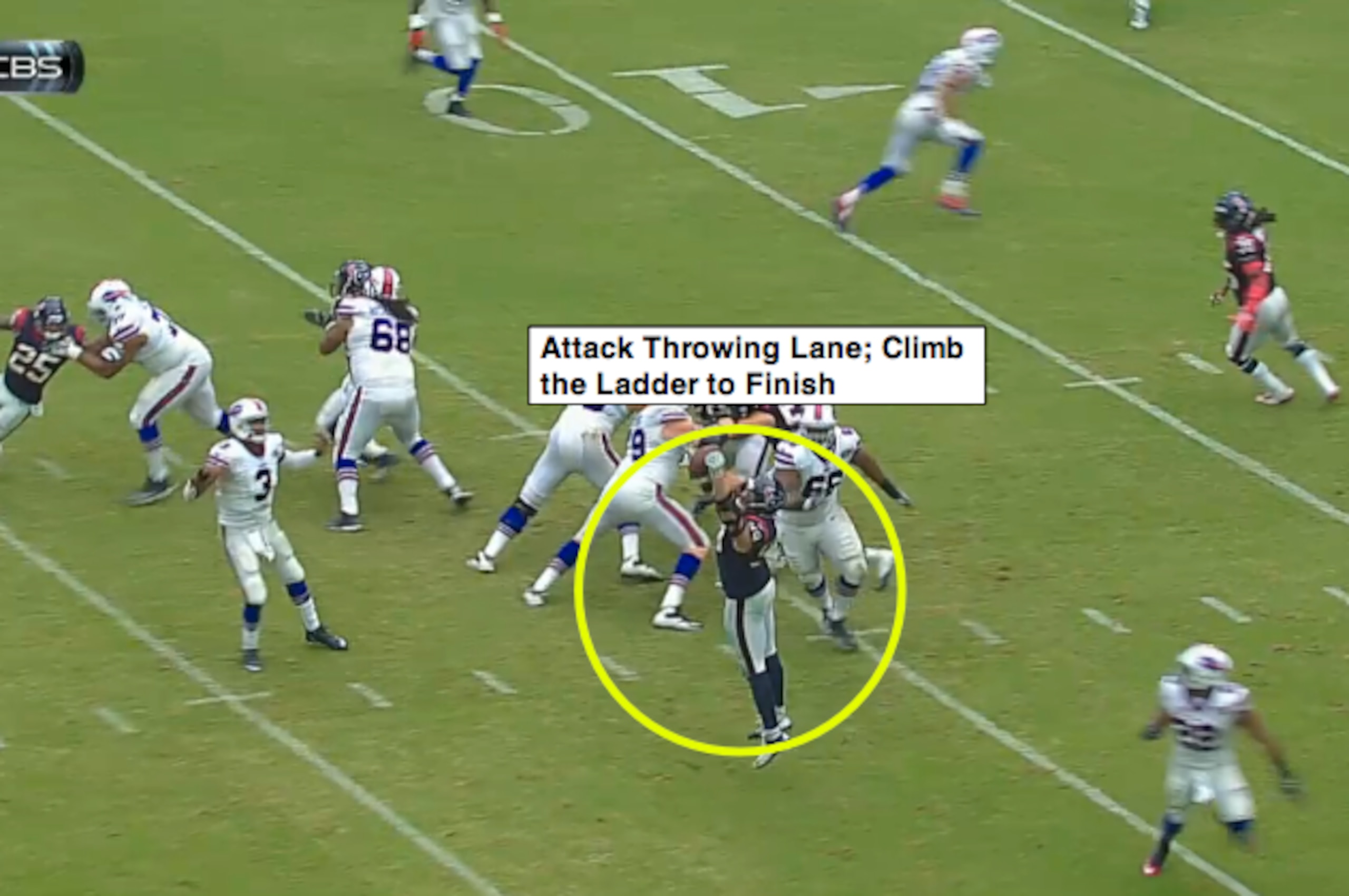
The idea here is to create a “ball disruption” by altering the throw from Manuel (put air under the ball, knock it down). That’s a common technique from defensive linemen in the NFL to get their hands up (left hand versus right-handed quarterback) when they can’t get home on the rush.
However, because of Watt’s athletic ability on the edge (and his initial read of the quarterback), he's able to climb the ladder and make a play to secure the catch.

What’s the first thing defensive players are taught after an interception? Get the ball to the numbers—and find the quarterback. Defensive back Kareem Jackson (who was blitzing off the edge) picks up Manuel and gives Watt the open field to return this ball for six points.
Another ridiculous play from Watt as the Texans move to 3-1 on the season.
Aaron Rodgers Targets Bears' "Zero" Pressure in the Red Zone
Rodgers gashed the Bears defense on Sunday (22-of-28, 302 yards, four touchdowns) as the Chicago front four failed to generate pressure while the secondary leaned on its core zone coverages (Cover 2, Cover 3).
Down inside the red zone, Mel Tucker’s defense showed more man coverage and brought pressure, but that created positive matchups for wide receiver Randall Cobb inside the numbers.
Let’s check out Rodgers’ second touchdown pass to Cobb versus "zero" pressure (blitz man with no safety help) that put the Packers up by three scores on their way to a 38-17 win at Soldier Field.
Personnel: Posse/11 (3WR-1TE-1RB)
Formation: Doubles Slot Gun Far
Offensive Concept: Double Smash-7 (Corner)
Defensive Scheme: Zero Pressure
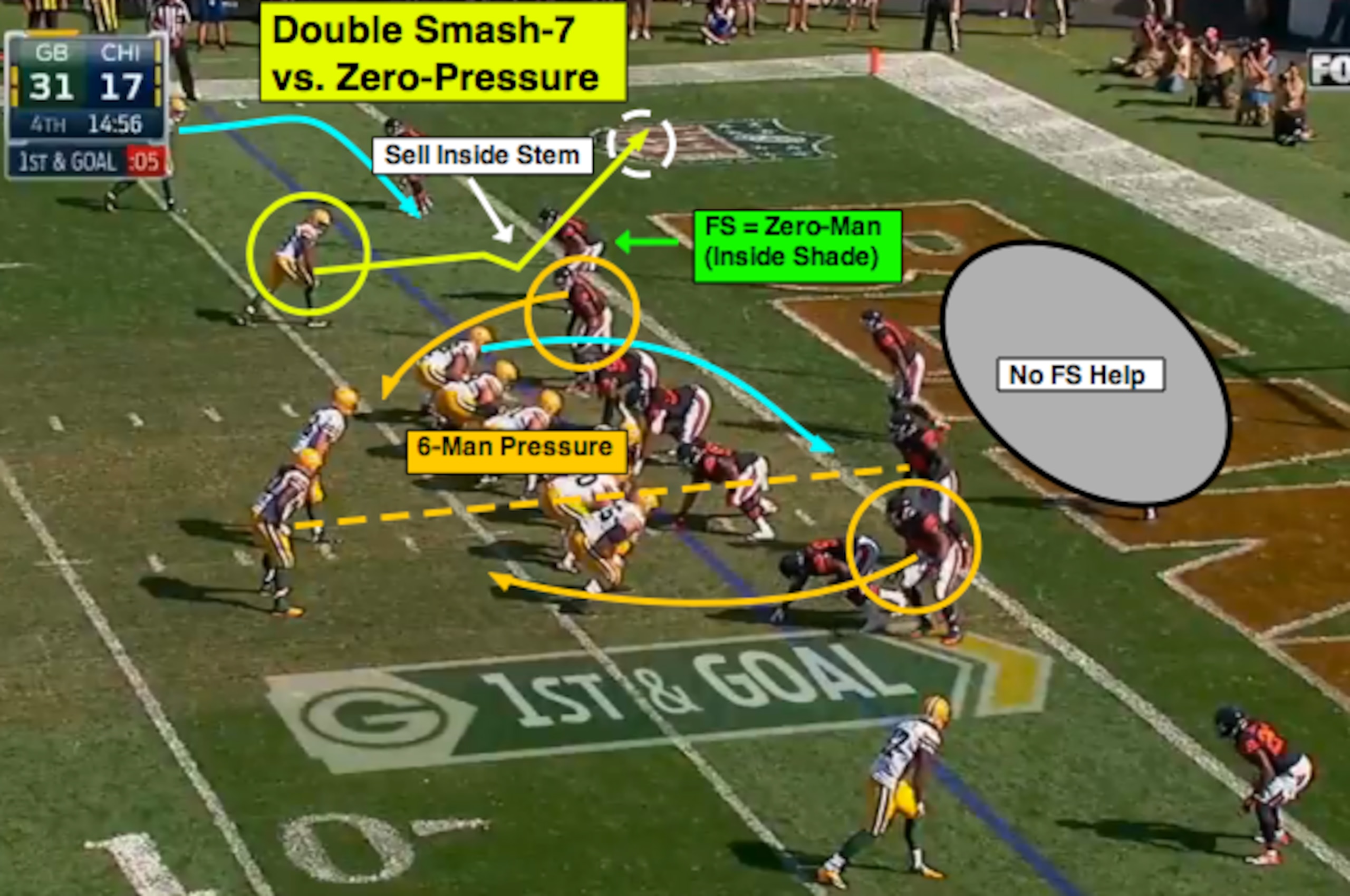
With the Bears keeping their base 4-3 defense on the field versus the Packers' Posse/11 personnel, free safety Chris Conte has to walk down over the slot in the zero-pressure look. That forces Conte to play blitz-man technique (inside shade) versus an outside breaking route (7 cut) with the Bears sending six-man pressure (no help over the top or in the middle of the field).
The idea is to force the ball to come out quickly with the defensive backs in a position to drive on the throw.
However, with Cobb's matchup advantage in the slot (and the route stem to beat blitz-man technique), Rodgers can throw the quick 7 route (away from the defender’s leverage), while the outside smash route occupies the cornerback.
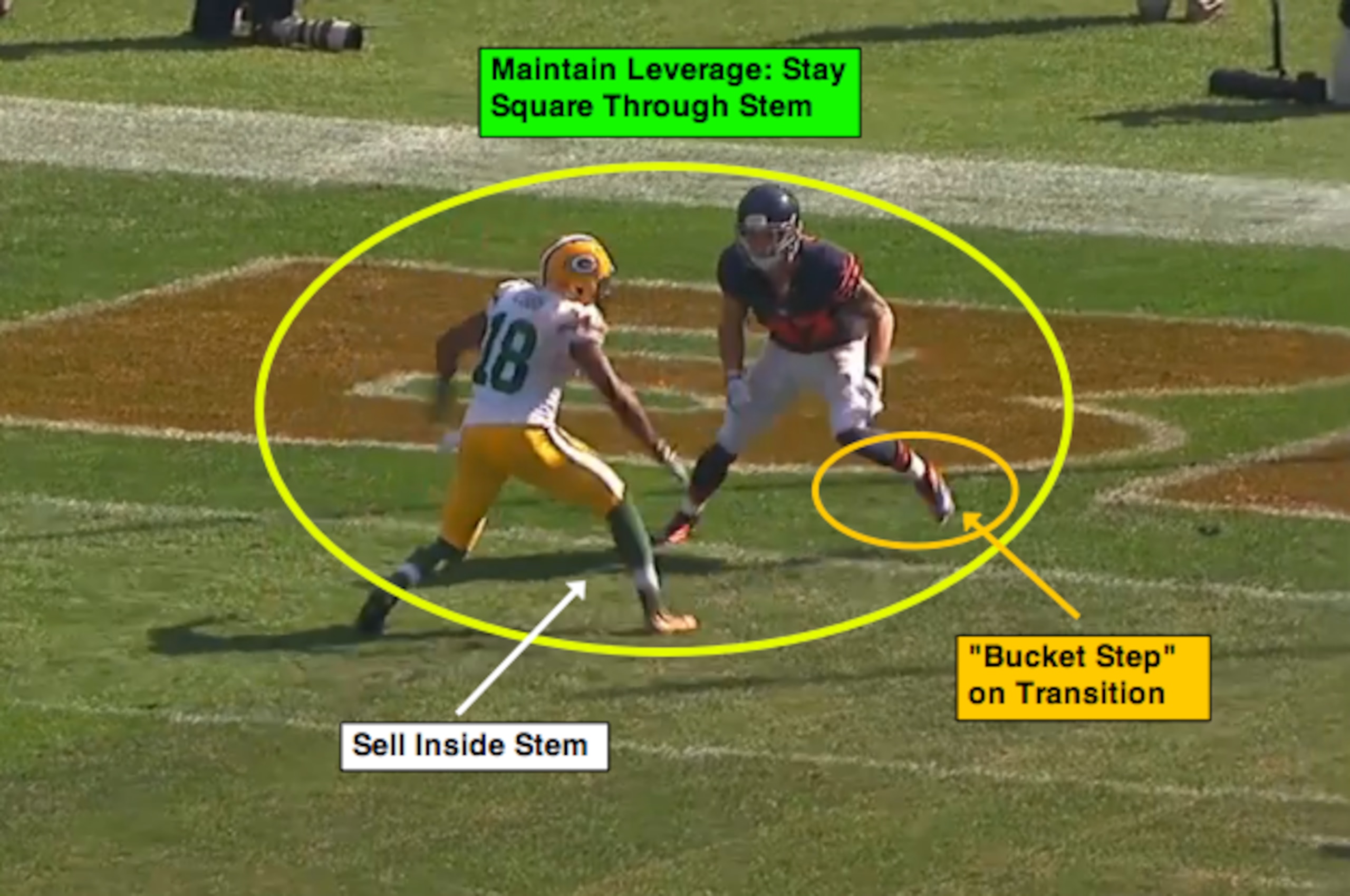
Focusing on the matchup in the slot, Conte maintains his inside leverage and keeps his shoulders square to Cobb through the release.
But once Cobb sells the inside stem/stutter, Conte takes a “bucket step” (step behind) and plays for an inside breaking route (slant, post). He guesses on the route in this situation as the receiver never opens his hips to the inside.
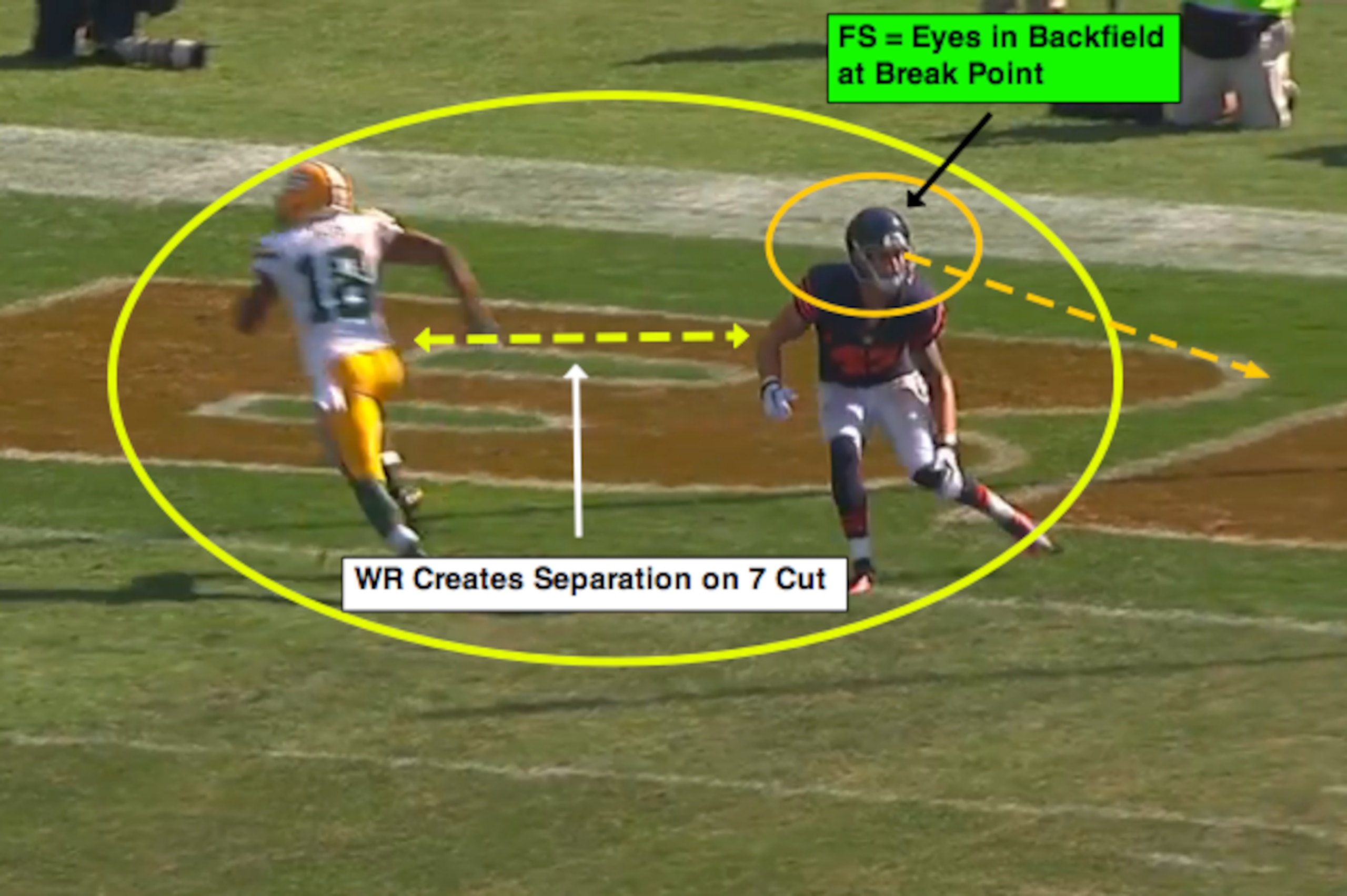
Even with Conte taking the bait on the inside stem, the safety can recover if he plays with the proper eye discipline and drives to the upfield shoulder of the receiver.
Instead, Conte sticks his eyes in the backfield.
That creates immediate separation in a one-on-one situation, with the receiver now putting Conte in a trail position versus an outside breaking route.

This is a quick look at the finish from Cobb to show you the amount of separation he has to work with on the 7 cut.
This was a favorable matchup for the Packers with Cobb drawing Conte in the slot. And without the proper technique from the Bears safety, this turned into an easy read for Rodgers to target Cobb on his fourth touchdown pass of the day.
Mike Glennon’s Game-Winning Pass to Vincent Jackson
After Louis Murphy set up the Tampa Bay Buccaneers deep in the red zone on a 40-yard catch-and-run during the final minute of the game, Glennon targeted Vincent Jackson on the “whip” route to beat the Steelers in Pittsburgh.
Here’s a look at the route from Jackson, with a focus on the receiver’s ability to initiate contact and create separation to finish versus man coverage.
Personnel: Posse/11 (3WR-1TE-1RB)
Formation: Doubles “Orange” Gun Far
Offensive Concept: “Whip” Option
Defensive Scheme: Cover 1
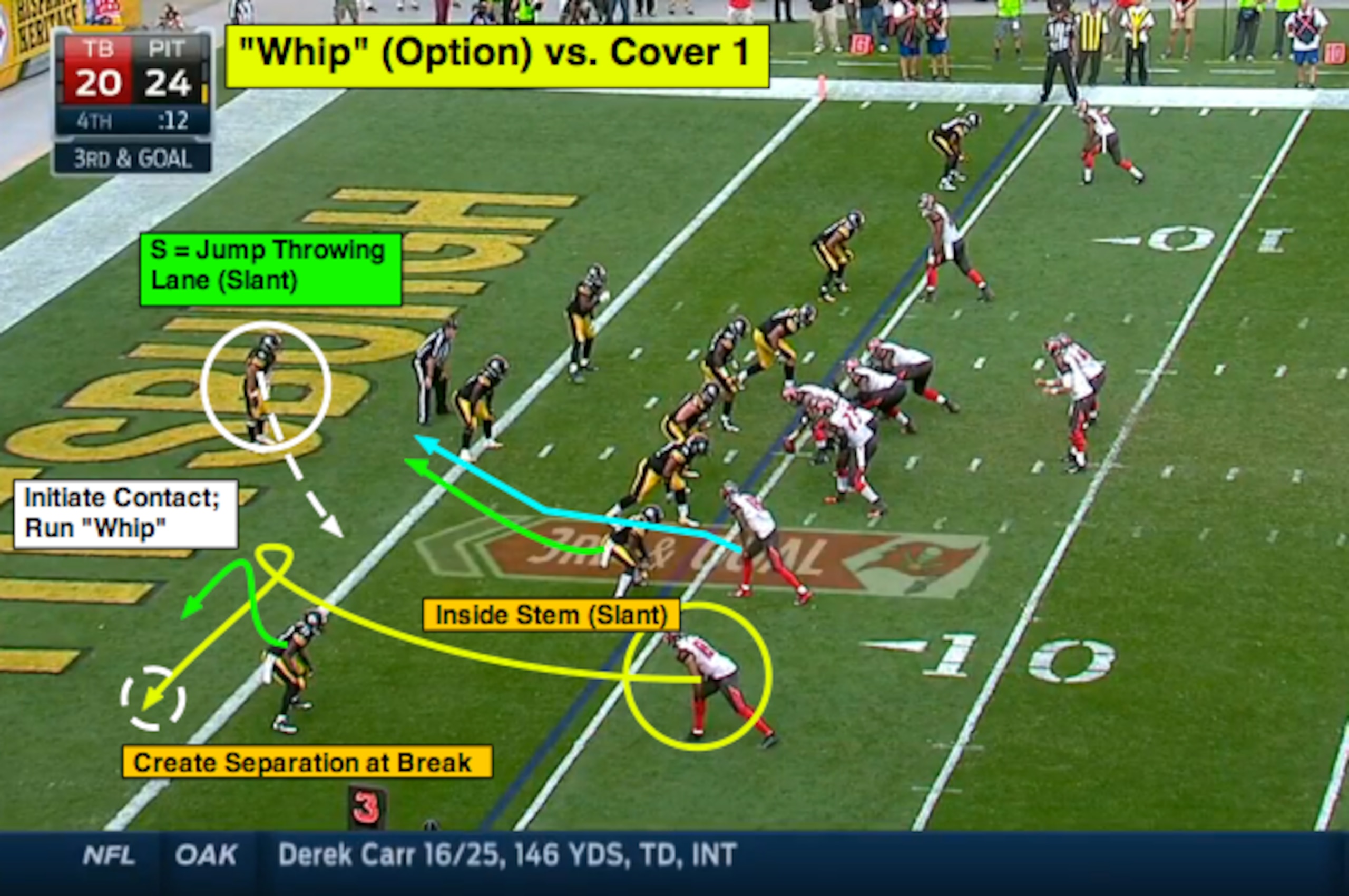
With the Steelers playing Cover 1, the Bucs run No. 2 on an inside slant and Jackson on the “whip” route (press inside, break back to the flat).
This allows Jackson to stem inside, while cornerback William Gay squeezes the route and safety Troy Polamalu drops down to take away the inside throwing lane.
Jackson is trying to initiate contact versus the cornerback while forcing him to overplay the inside stem. And with no help to the outside, this is an opportunity for the Bucs receiver to use his size/strength at the point of attack to create enough separation for Glennon to target the “whip” route.

As you can see here, Gay plays to Jackson's upfield shoulder and is in a position to take away the slant with Polamalu now sitting inside.
However, with Jackson initiating the contact at the top of the route, he can use a veteran push-off to separate from Gay while working back to the open-side flat (whip).
That creates the space Glennon needs to target a receiver who is now working away from the defender’s leverage.
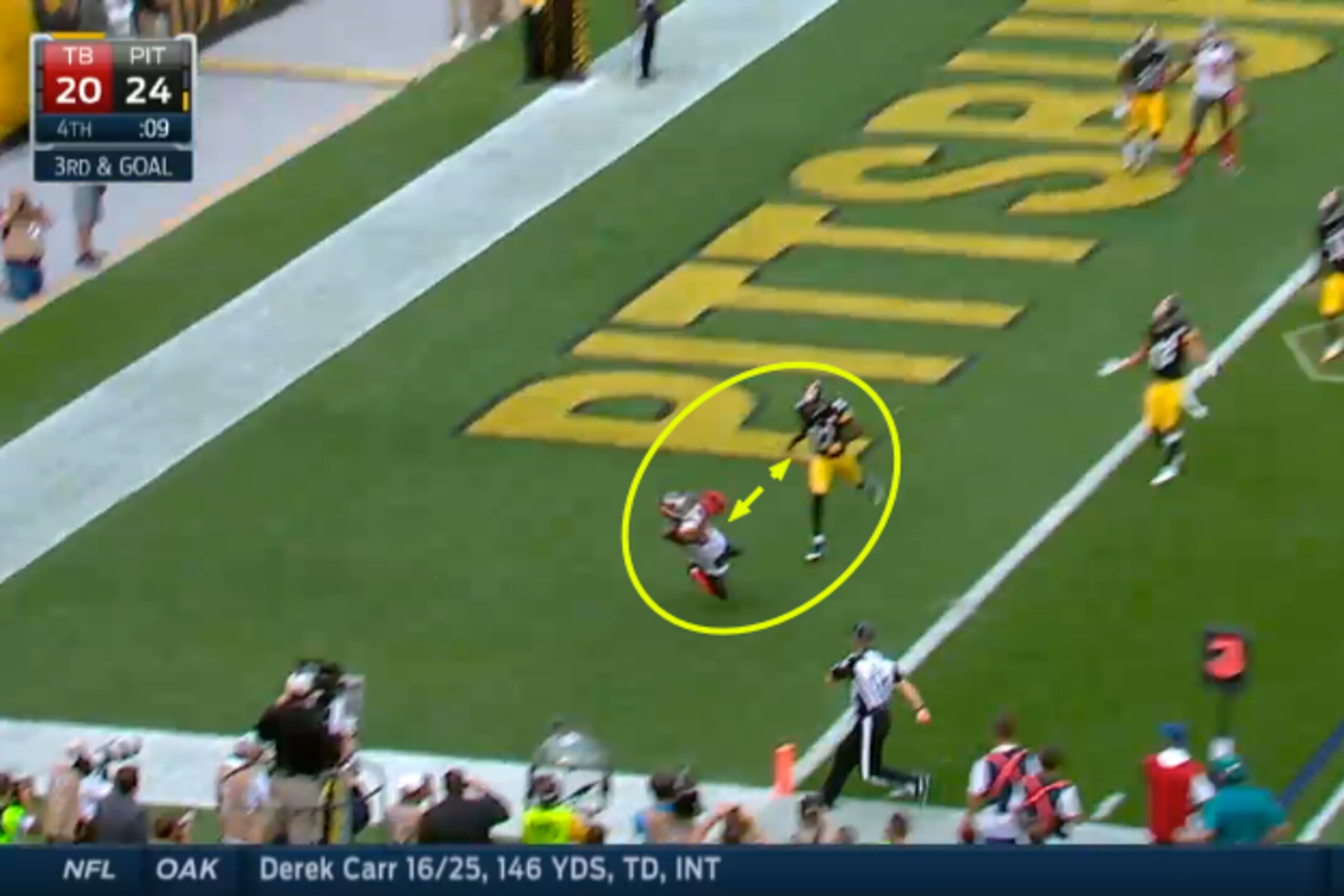
Look at the separation Jackson creates off the contact at the top of the route to stem back to the flat.
This ball has to be thrown to the upfield shoulder—away from the defensive back—and Jackson showcases his ability to finish as he brings this pass in for six points to close out the Steelers in the Bucs’ comeback win.
49ers Establish the Power Run Game in Win over Eagles
Looking at the 49ers' 26-21 win over the Eagles, my takeaway focused on the ability of Jim Harbaugh’s offense to establish the two-back power-running game again with Frank Gore (24 carries, 119 yards).
Let’s break down the G-Lead (front-side guard pull) that produced an explosive play out of Regular/21 personnel to highlight the blocking scheme and the crack split in one of the 49ers’ core power-run concepts.
Personnel: Regular/21 (2WR-1TE-2RB)
Formation: Pro Strong I (Y-Off)
Offensive Concept: G-Lead
Defensive Scheme: Cover 1
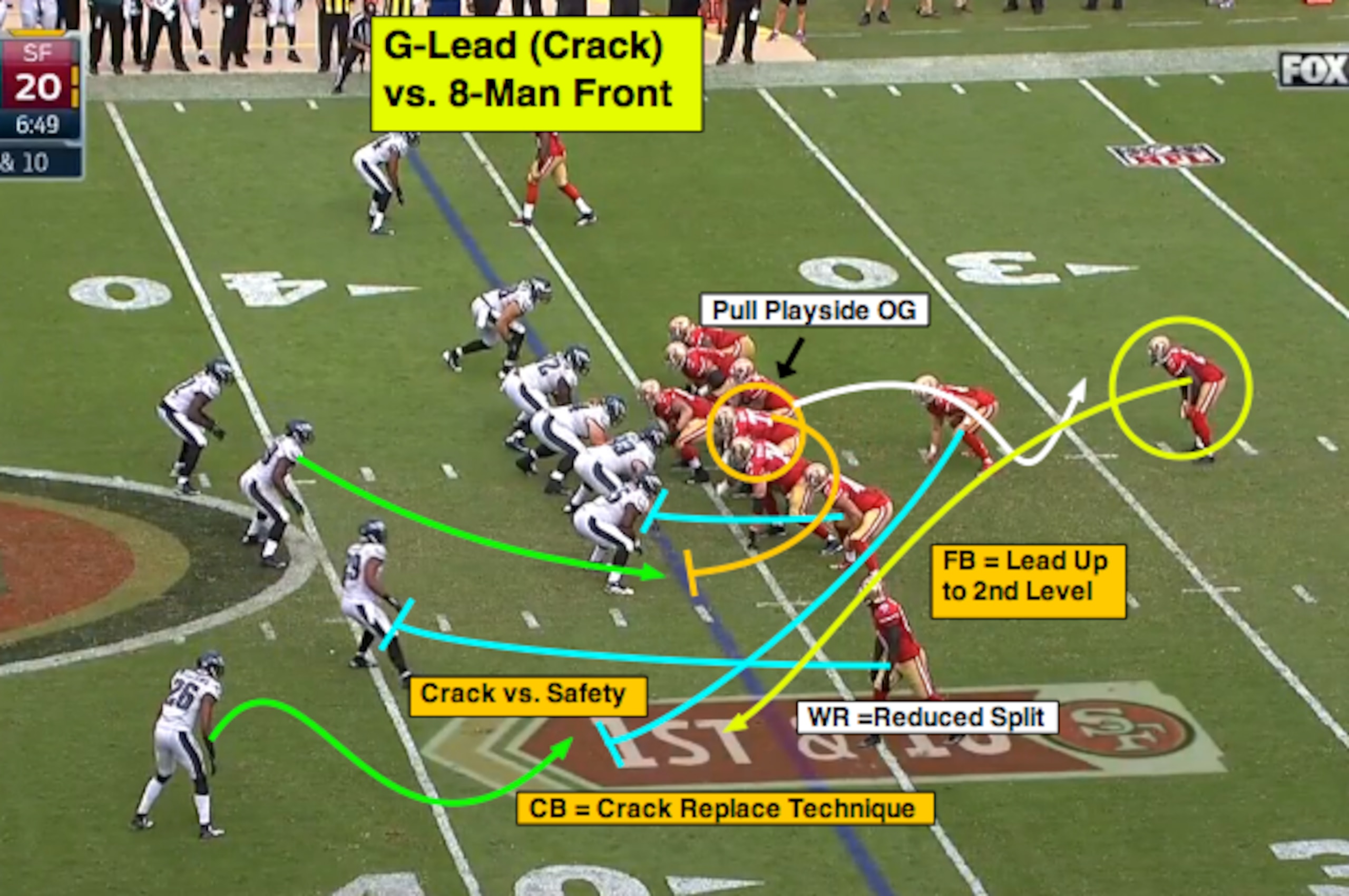
In the G-Lead scheme (similar to a "Power O" scheme), the 49ers block down on the edge (tight end), lead with the fullback and pull the front-side (or play-side) guard to fit up on the linebacker scrapping to the ball.
Plus, with wide receiver Anquan Boldin in a reduced split (tight to the core, inside the numbers), the 49ers can crack on the safety walked down into the run front while forcing cornerback Cary Williams to utilize a “crack replace” technique (replace safety as edge support).
Williams has to be quick with his run/pass keys, identify the scheme and come downhill with speed to squeeze/contain the ball (force inside to pursuit).

With Boldin cracking on the strong safety and the play-side guard pulling to account for the linebacker scrape, fullback Bruce Miller can lead up to the second level of the defense.
However, Williams is late to replace on the edge. He must be quicker with his initial read and come downhill to attack the run. This allows Gore to bounce the ball to the outside, with Miller now working up the field as a lead blocker.
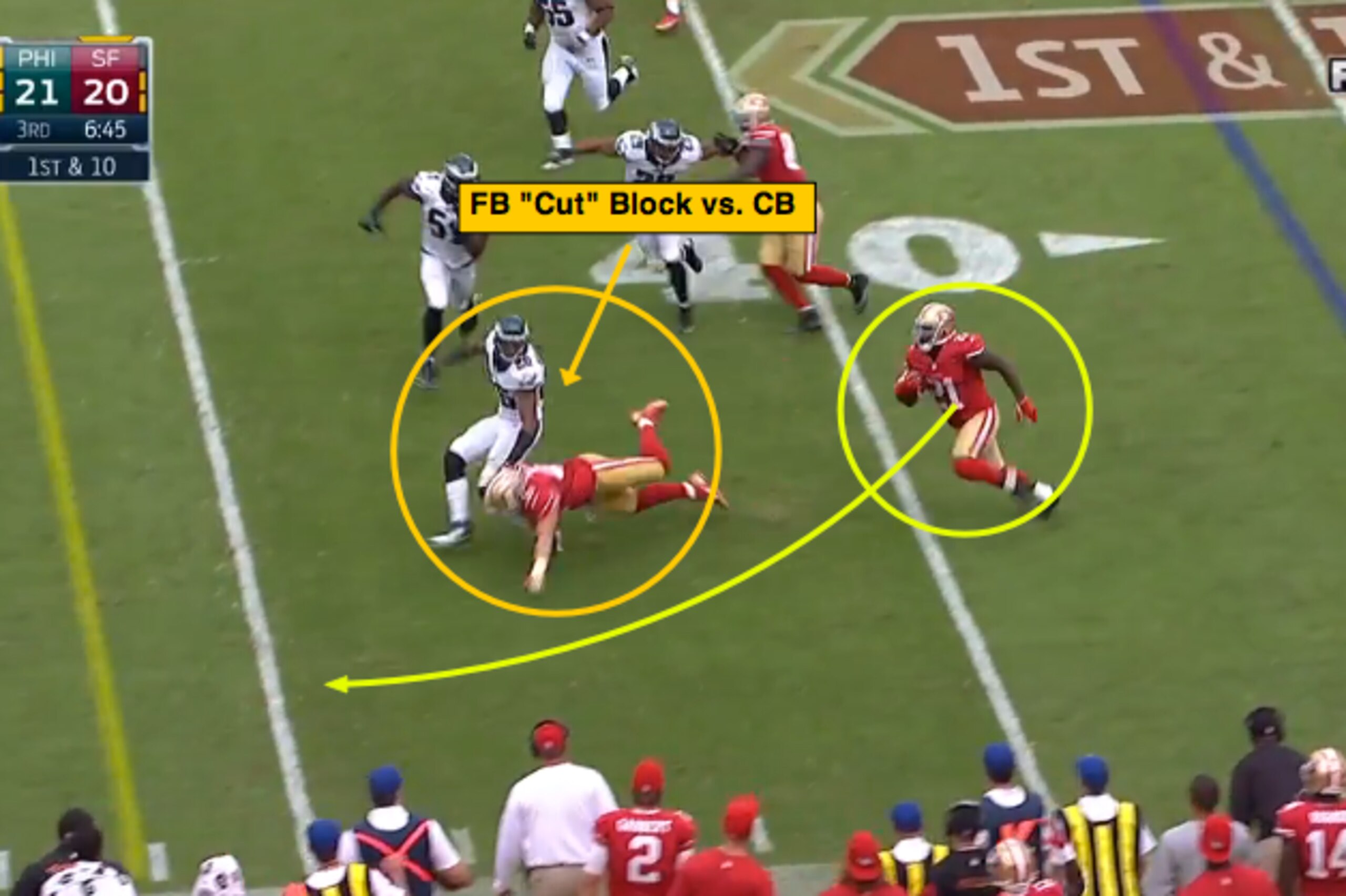
Williams shows late as secondary support (instead of primary edge support) and fails to get his hands down on the cut block from Miller as the fullback chops his legs.
This creates a running lane to the outside for Gore to push the ball up the field for an explosive gain on a day where the 49ers leaned on the running game and situational defense to avoid a 1-3 start with the win over the Philadelphia Eagles.
Seven-year veteran Matt Bowen is an NFL National Lead Writer for Bleacher Report.
.jpg?w=2560 "Jets Camp Football")
.jpg?w=2560 "Browns Camp Football")