Tristan Thompson's Bet on Himself Is Catch-22 for Cleveland Cavaliers
Tristan Thompson has the Cleveland Cavaliers in quite the pickle, and it's going to be difficult for them to relish any of the possible outcomes.
The 24-year-old power forward burst onto the scene during the 2015 playoffs, replacing an injured Kevin Love with aplomb and sparking the Eastern Conference's No. 2 seed on its run to the NBA Finals. Though the Cavs were ultimately unsuccessful against the Golden State Warriors, Thompson still managed to completely change his reputation.
Entering the postseason, he was coming off a year in which he averaged 8.5 points and 8.0 rebounds while shooting 54.7 percent from the field. He was a threat on the offensive glass, but his struggles protecting the rim and overall lack of dynamic scoring potential severely limited his impact.


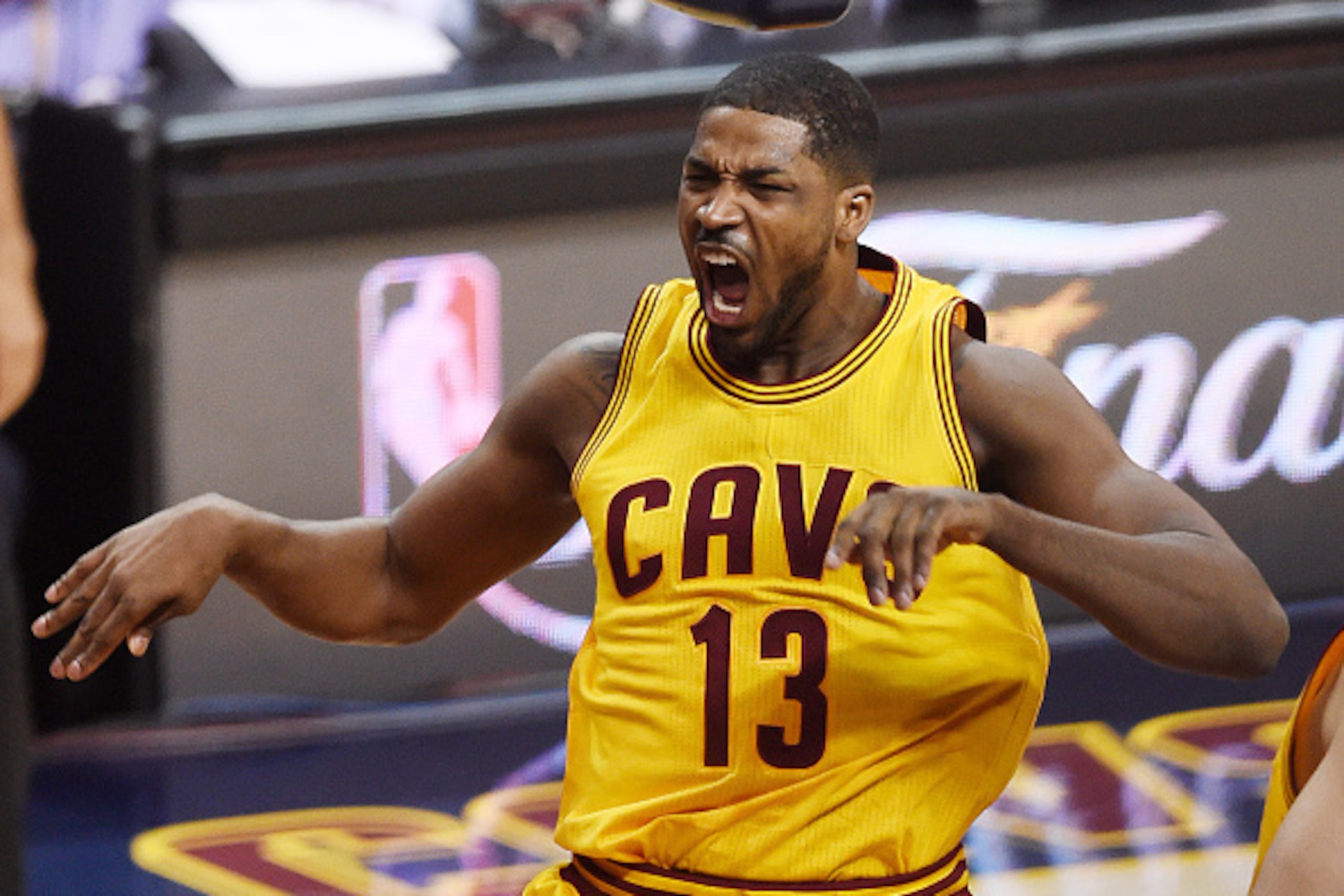
After stepping into the starting five, the Texas product proved what he could do. Even though he couldn't average double digits in the scoring column, he was a game-changing presence, imbuing Cleveland with newfound levels of energy that stemmed largely from his never-ending reserve of hustle plays.
Back in January, we learned that Thompson had turned down a four-year extension worth $52 million—a move that was widely deemed rather nonsensical at the time. Adrian Wojnarowski, who broke the news for Yahoo Sports, was particularly harsh:
"Thompson's a rebounder, a defender, an energy guy. He isn't a starter on a playoff team, but he has a good attitude, a good motor and could be a role player anywhere in the NBA. [Rich] Paul isn't the first agent to leverage a more prominent client's extension against another, nor the last.
Even so, at what price? Within the NBA, officials expected maybe $10 million a year, perhaps $12 million if Klutch [Sports] wanted to push it. Well, they kept pushing it. Thompson turned down a $13 million-a-year extension offer – four-years, $52 million, league sources told Yahoo Sports.
For a player of Thompson's stature, this is an incredible risk. An injury could cost him lifetime security. Nothing close to that money exists on the restricted free-agent market this summer, but with James on a one-year deal, Klutch can try to leverage the Cavaliers all over again to get the deal they want – or simply take the one that was already offered.
"
As it turns out, Thompson had a crystal ball.
Now, instead of shooting down an offer of $52 million, he's refusing to budge as he awaits a max contract offer from the Cavaliers. He's even turning up his nose at offers that are reportedly sitting at $80 million.

"I'm not really sure what the outcome will be, but all I know is Rich Paul is asking for five years and $94MM and the Cavaliers are $14MM short of that figure," Chris Haynes of the Northeast Ohio Media Group told HoopsRumors.com's Chuck Myron. "That's Randy Moss-type separation. There's limited to zero communication because of that tremendous gap."
So long as Thompson is betting on himself, he doesn't have to budge. And that's terrifying for the Cavs, especially on the heels of similar wagers working out for players such as Kawhi Leonard, Jimmy Butler and Greg Monroe. The ex-Detroit Pistons big man serves as the closest comparison after playing on the qualifying offer in the Motor City and signing a max deal with the Milwaukee Bucks during the subsequent offseason.
If Thompson does cave, then all this worrying is for naught. But again, he doesn't need to do so. He can either wait for Cleveland general manager David Griffin to throw him as much money as possible or just accept the qualifying offer and drop the "restricted" tag next summer.
Neither option is particularly promising for Cleveland.
Accept the Max Demands
With great money comes great responsibility.
If Thompson gets paid as much as the NBA's collective bargaining agreement allows, he's inevitably going to want a role that matches the price tag. But how exactly is that going to happen? Unfortunately, there are only so many frontcourt minutes that can be divvied out during any given game, and the Cavaliers have a number of players who need to spend time on the floor.
The former Longhorn can't possibly play at the 3; that would turn into a spacing nightmare for everyone involved. Instead, he's limited to his typical position at power forward and suiting up at the 5 in some small-ball lineups.
Problem is, he's not going to start at his normal spot. Not when Love is healthy, as the second-year Cavalier remains an All-Star talent who should fare much better after a full season gaining comfort alongside LeBron James and Kyrie Irving.
Thompson experienced legitimate success after Kelly Olynyk dislocated Love's shoulder during the first-round series against the Boston Celtics. But it doesn't indicate that he's suddenly more valuable than Love, especially because we have no idea how much better the Cavs could've played with their starting unit fully intact.
Throughout the entire regular season, Love was the more impactful player. According to my FATS model (based on historical comparisons and explained in full here), Love's on/off differential trailed only James' on the entire roster:
Thompson is certainly valuable to this team, but that doesn't mean he's a more crucial piece than Love. Cutting into the incumbent starter's minutes would be detrimental to the quest for a championship.
And down the route, another problem would loom if Thompson were locked in at a max deal.
Love already signed a huge extension this offseason, one that guarantees him slightly more than $21 million for the 2016-17 campaign. Anderson Varejao is also on board, set to make $10.4 million, though "only" a bit more than $9 million is guaranteed.

Now, let's throw in the assumed max contract Thompson would be getting in this situation.
Together, that trio would account for about $50 million of the 2016-17 cap, and the number would go down just slightly if the team waived Varejao. Even with the NBA's new television deal helping the cap explode, that's a substantial percentage of the projected cap ($89 million, per DraftExpress.com), and it doesn't even include Timofey Mozgov.
The Russian center is playing on an expiring contract during the coming season, and signing Thompson to a max deal before the start of the 2015-16 campaign would make it awfully difficult to retain Mozgov when he hits the open market. After all, too much money would already be committed to the frontcourt.
Thing is, Mozgov was incredibly valuable to Cleveland once general manager David Griffin acquired him from the Denver Nuggets in a midseason trade. Presumably, the intent was never to give up two first-round picks for a year-and-a-half rental, but that's what he could turn into if Thompson gets the deal he's seeking.
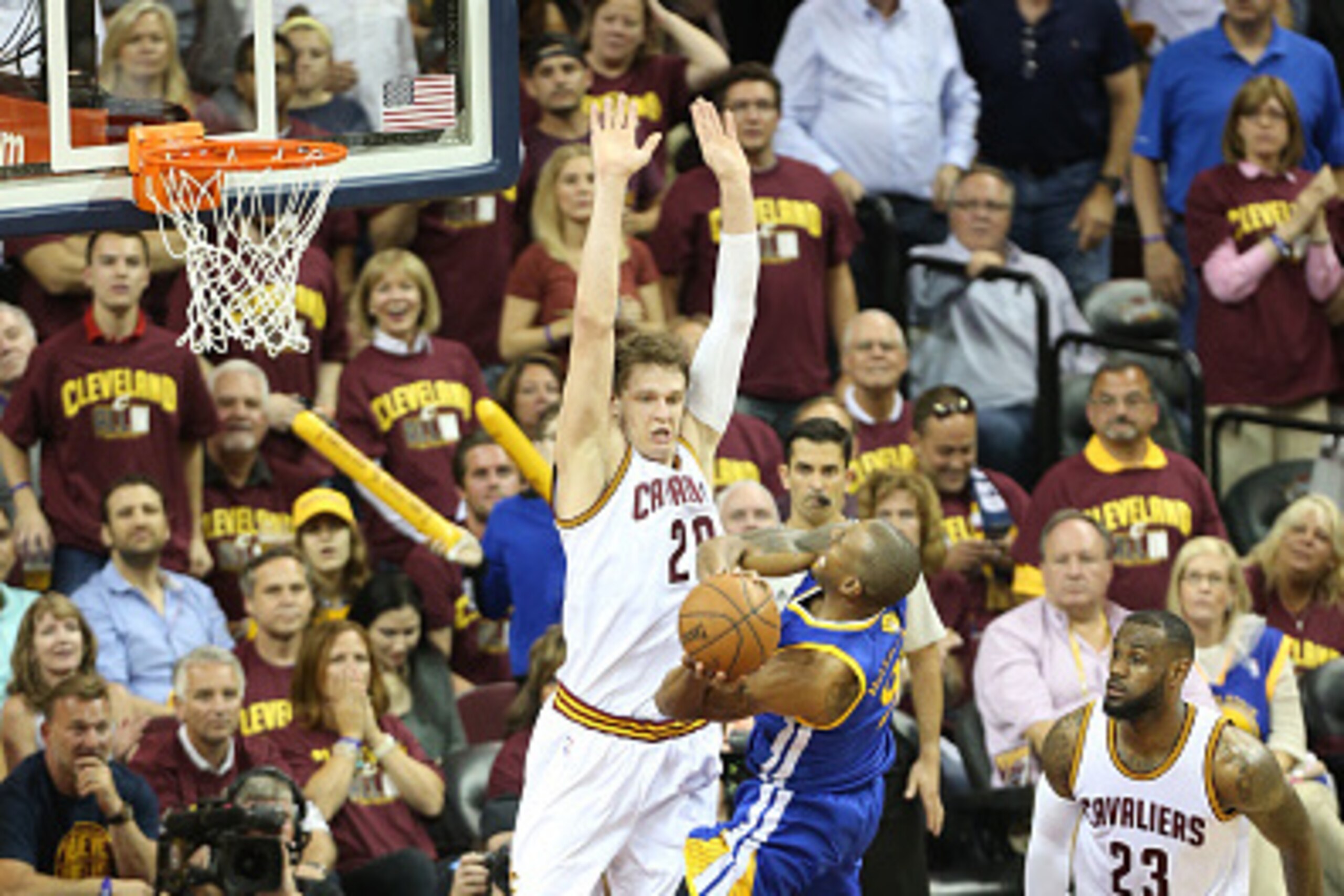
Even if he spent a lot of time on the bench when the Cavaliers needed to match Golden State's small-ball strategies during the Finals, the 29-year-old is squarely in the midst of his physical prime. He offers something no other Cleveland big can boast—rim-protecting skills. Only five returning members of the roster faced at least two shots per game at the basket, per NBA.com's SportVU data, and Mozgov was rather easily the standout:
| Timofey Mozgov | 7.7 | 46.6 | 5.8 | 38.8 |
| LeBron James | 2.1 | 49.3 | 3 | 47.5 |
| Tristan Thompson | 6.5 | 52.2 | 7.8 | 52.3 |
| Kevin Love | 7.1 | 52.6 | 5.2 | 42.9 |
| Anderson Varejao | 7 | 54.6 | N/A | N/A |
If Mozgov is lost, no preexisting roster member can replicate that impact around the hoop. There aren't even any exceptions buried on the depth chart, waiting for their opportunities to shine.
Since Cleveland figures to pick at the tail end of the NBA draft whenever it actually has a first-round selection, it likely won't be adding any immediate impact rookies into the mix. Additionally, the current salary commitments preclude signing any prominent big men from the free-agency pool.
Thompson's energy and prowess on the glass are certainly valuable to his squad, but that doesn't mean he's worth paying the max with all these potential problems looming in the not-so-distant future.
Committing to him is tacitly admitting that the old guard isn't enough, because there's a strong likelihood either Mozgov would walk in free agency or Love would be traded in the near future. Even though Cavaliers owner Dan Gilbert has deep pockets, there's a limit to how much he can reasonably spend on the frontcourt.
Of the three, Thompson is arguably the most expendable, as well as the most likely to cause some buyer's remorse on a new deal.
The issue is that refusing to splurge could lead to the qualifying offer, and there are also serious downsides if Cleveland chooses to travel down that road.
Let Him Play for the Qualifying Offer
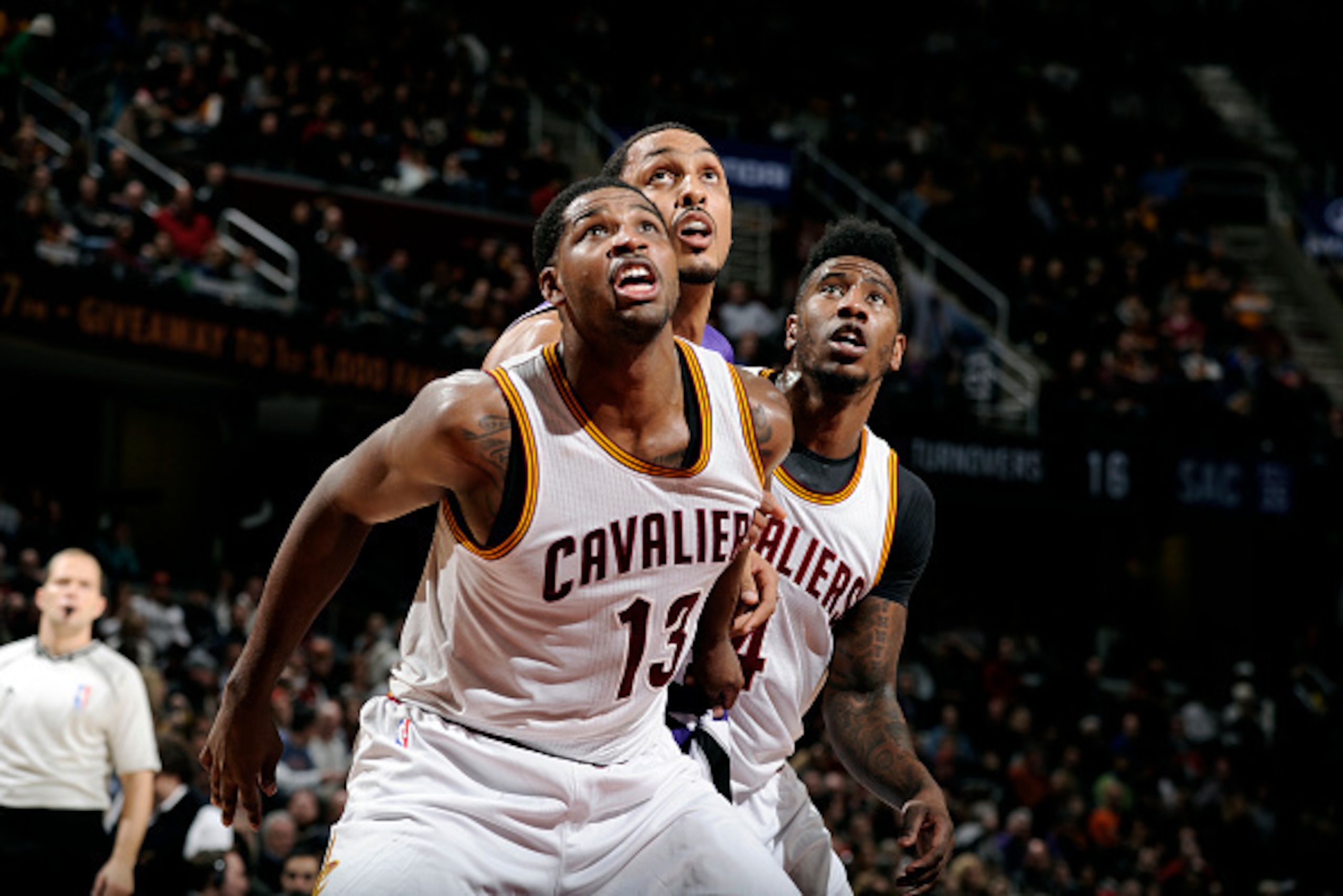
Though there's a decent chance Thompson's agent (Rich Paul) is posturing here—using the qualifying offer as nothing more than an idle threat meant to increase his client's leverage—the threat still exists. Up to this point in the negotiations, we've heard Thompson is indeed willing to play without a long-term deal this season, and that would allow him to become an unrestricted free agent next summer.
As Paul explained, doing so would also basically spell the end of his tenure with the team that drafted him at No. 4 in 2011.
"We are a long way from it, but it's clear, yes," the agent told SBNation.com's Brendan Porath and Mike Prada. "If [Thompson] plays on the [qualifying offer], it will be his last year with the Cavs."
The qualifying offer Cleveland extended to Thompson is worth $6.8 million, so it's far less than he'd receive by settling for the current reported offer—an average annual value of $16 million per season. Leaving that much money on the negotiating table is fraught with risk, but it could be a gamble that pays off for the big man if he continues to play well and prove his value.
But that's inherently problematic for the Cavaliers.
Sure, it would be nice for him to excel throughout the 2015-16 campaign, performing at the same level he was at during this last postseason run. Doing so would allow Cleveland to rise up to the No. 1 spot in the NBA's weaker half with relative ease, then potentially have a shot at redemption during the 2016 NBA Finals.
Then, he'd hit the open market ready to make good on Paul's words. Plenty of teams around the league would covet him—especially his hometown Toronto Raptors, as ProBasketballTalk's Dan Feldman speculated. And at that point, the only advantage the Cavaliers would have is the ability to offer a little extra money—money Thompson would have already shown isn't his first priority, given the cash he turned down to use the qualifying offer.

Cleveland would be back to square one, except this time there's no option that sees it holding on to Thompson without acquiescing to his astronomical demands. Once more, losing Mozgov is back in the picture, but so too is watching as both incumbent bigs leave for a new destination.
The alternative here is that a number of less opportune situations play out. Deadspin's Kevin Draper went over some of them while explaining why Thompson's threat of using the qualifying offer would make for such a risky endeavor:
"Of course, this still carries enormous risk. Thompson could break his leg or tear his Achilles. Kevin Love could turn in a monster season, keeping Thompson on the bench and causing his value to diminish. Another season of record-breaking three-pointers could convince general managers that a power forward who can’t shoot isn’t nearly as valuable as they thought. So the question remains, is Thompson really willing to entertain the risk of accepting the one-year qualifying offer?
"
This is the biggest catch-22 of all.
If Thompson does opt to play out the 2015-16 season for just under $7 million, the Cavaliers need him to perform well in order to succeed. But his doing so would make it harder for them to retain his services down the road. Conversely, if he struggles, it's easier to hold on to him with a new long-term deal, but it's going to be nigh impossible to end the championship drought in Northeast Ohio.
There's no overwhelmingly positive solution here.
Most teams would probably turn green with envy at the thought of having James, Irving and Love on the roster with a chance to keep someone as talented and uniquely impactful as Thompson. But in reality, the situation isn't so simple.
By betting on himself, Thompson is putting his team firmly between the proverbial rock and a hard place.
All stats, unless otherwise indicated, come from Basketball-Reference.com.
Adam Fromal covers the NBA for Bleacher Report. Follow him on Twitter: @fromal09.

.jpg?w=2560 "NFL House in Paris Closes for Protests")
.jpg?w=2560 "Trevon Diggs Cut by Seahawks")