MLB Rumors: 10 Shortstops Who Could Replace Jimmy Rollins After 2011
Since his debut in 2000, Jimmy Rollins has been the driving force for the Philadelphia Phillies both on and off the field. He's the rare type of ball player that doesn't come along all too often. He has been a vocal leader off the field and has the talent on the field to back that up.
Though he had been one of the best shortstop's in the game in years prior, Rollins catapulted himself into Phillies' lore in 2007. Before playing a single game, he told the media: "The Mets had a chance to win the World Series last year [2006]. Last year is over. I think we're the team to beat in the National League East, finally. But, that's only on paper."
Rollins and the Phillies quickly took care of that last part. In 2007, Rollins had the best season of his career, posting a slash line of .296 / .344 / .531, with 30 home runs and 41 stolen bases, on his way to narrowly being voted in as the National League MVP. The Phillies, of course, would stun the Mets in September before being eliminated in the first round of the playoffs.
Following their elimination, Rollins predicted that the Phillies would win 100 games and go deeper into the playoffs the following season, and they haven't looked back since.
After seeing the level of talent that their young shortstop possessed, and how hard it was to find an All-Star caliber short stop around the league, the Phillies quickly extended their young star. In June of 2005, the Phillies signed Rollins to a five-year, $40 million extension.
Now 32, Rollins is entering the final year of that extension with the Phillies, and things aren't looking all too great for the veteran shortstop. He has been plagued by injuries over the last few seasons, and as a result, his performance suffered. Combined with the current state of the Phillies' payroll, their options seem to be limited at the shortstop position moving forward. Surely, they wouldn't want to commit to another injury plagued shortstop, like Jose Reyes, who would cost more annually than Rollins did.
Rollins, who is set to earn $8.5 million in the upcoming season, will likely set the bar. If he isn't able to rebuild value for himself, it may be time for the Phillies and their prodigy shortstop to part ways. With that in mind, who could replace Rollins following the 2011 season?
Wilson Valdez
1 of 10
Wilson Valdez may not be the most glorious of options, or the youngest, but he will bring a few things to the table that the Phillies can certainly respect: he'll be inexpensive, play above-average defense, and remain under team control.
The Phillies have had to sit through several Rollins injuries over the past couple of seasons, making deals in the event of just that to hope to catch lightning in a bottle. After parting ways with Eric Bruntlett, the middle infielder acquired by Philadelphia in the same deal that brought closer, Brad Lidge, to Philadelphia, General Manager Ruben Amaro made an under-the-radar signing, bringing minor league depth into the system by signing former Met, Wilson Valdez.
When Rollins hit the disabled list, interim utility infielder, Juan Castro, replaced him, and Valdez replaced Castro on the bench. However, the former played to terribly both in the field and at the plate that the latter saw increased playing time. When the Phillies were forced to make their next roster move, they chose to release Castro, as opposed to sending Valdez back to AAA.
After playing his way into the starting lineup while Rollins recovered on the disabled list, Valdez posted a large unimpressive slash line of .258 / .306 / .360, with four home runs and seven stolen bases. However, the Phillies' didn't expect much out of him offensively. What was more attractive was the fact that he was proving to be a solid injury replacement while costing them just the league minimum. By the time the season ends, Valdez will just be entering salary arbitration, and will probably never become expensive.
The Phillies were able to put up with his offense because he played above average defense for the team throughout his duration replacing Rollins. He made just two errors at shortstop while showcasing one of the league's strongest arms from in the hole, and posting an Ultimate Zone Rating (UZR) of 1.4, while saving around six defensive runs. Not shabby, for an inexpensive, surprise replacement.
Finally, Valdez, who hasn't entered salary arbitration yet, has several years of team control remaining before he reaches free agency. The next couple of years will be relatively weak, in regards to shortstops, on the free agent and trade markets, so that could be a large benefit.
He may not be the most ideal replacement at shortstop, but the Phillies could use him as leverage in their negotiations. At the very least, they could depend on Valdez to pay strong (and cheap) defense, while upgrading other areas of the club that could use an offensive boost, like left field, as Raul Ibanez's contract also expires following the 2011 season.
Michael Martinez
2 of 10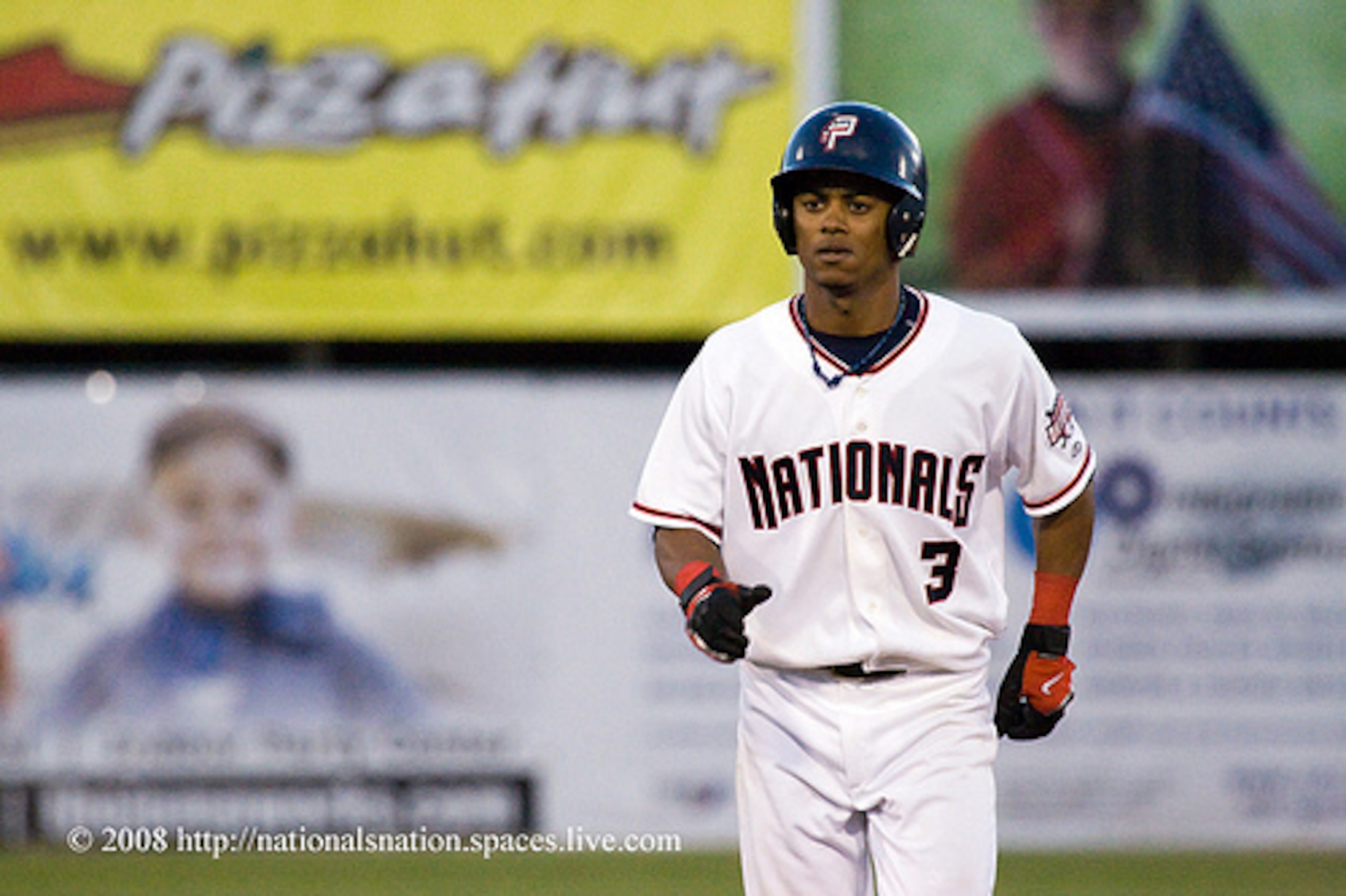
Continuing with in-house options, we now take a look at one of the newest Phillies in the middle-infield—2010 Rule 5 Draft selection, Michael Martinez.
Martinez, 28, has spent the entirety of his career in the Washington Nationals' minor league system. He was taken by the Phillies in the major league portion of the Rule 5 Draft, meaning that in order to remain with the club beyond the 2011 season, the Phillies will have to either keep him on the major league roster for the entirety of 2011, or work out a trade with the Nationals guaranteeing the Phillies his rights.
Playing in the middle infield, Martinez has never done anything exceptionally spectacular. He was your run of the mill contact-shortstop with little power when drafted and proved to be just that over the course of his minor league career. He struggled offensively at times, and the Nationals never decided to add him to their 40-man roster.
The Phillies, on the other hand, decided to take a chance. In 33 games with the Nationals' AAA club in 2010, Martinez posted a slash line of .325 / .353 / .452, with three home runs and eight stolen bases. With little middle infield depth in their system, it was a necessary, calculated risk for the Phillies.
While he'll never become the type of shortstop that Rollins is, Martinez could be a solid major league player. He isn't the greatest of offensive prospects, but he can make good contact in the zone, though he has little power. Good speed and defense are the keys to Martinez's game.
Who knows, if in Spring Training he manages to make the big league club as a player off the bench, he could spend the 2011 season grooming himself to compete for a spot as the top shortstop in the Phillies organization in 2012.
Freddy Galvis
3 of 10
As stated in previous slides, the Phillies middle infield depth / talent in the minor league system, as far as prospects are concerned, is incredibly shallow. The top middle infield talents in the system are Cesar Hernadez, Freddy Galvis and Harold Garcia. Garcia has the lowest ceiling, of the the three, and some scouts believe that Hernandez could be the heir apparent to interim second baseman, Chase Utley. With that in mind, both of those guys are projected to play second base. That makes the system's top shortstop prospect Galvis.
Though he'll be just 22-years-old by Opening Day in 2012, Galvis could provide the Phillies with some of the same qualities as the previous two infielders—cost certainty, good defense and price. If they were going to choose their shortstop based on potential, Galvis is the way to go.
Like Martinez, he has never been all too impressive with his bat. He spent the entire 2010 season with the Phillies' AA affiliate, and posted as slash line of just .231 / .274 / .309, with five home runs and 15 stolen bases. Offensively, he is a bottom of the order hitter with little potential.
On the other hand, Galvis could be the best defensive shortstop listed to this point. According to Baseball America, he is the best defensive infielder in the Phillies' system, and has the best infield arm, to boot.
Once again, while he isn't the most ideal option, he could be a serviceable everyday major leaguer.


J.J. Hardy
4 of 10
Outside of their own system, the Phillies' options for potential replacements don't improve all too greatly. On the free agent market, there are only three to four options that could be realistic fits for the Phillies, the best of which is current Baltimore Orioles' shortstop, JJ Hardy.
Hardy, 28, spent the 2010 season with the Minnesota Twins, after beginning his career with the Milwaukee Brewers. En route to helping the Twins capture the American League Central division, Hardy posted a slash line of .268 / .320 / .394, with six home runs.
His offensive production took a hit, after transitioning to the American League. For whatever reason, Hardy's numbers in the National League were much better. With the Brewers in 2007-09, he hit 26 and 24 home runs, respectively. The closest he has come since was 11, in an injury ravaged 2009 season with the Brewers.
On the other hand, Hardy has played well above average defense over the course of his career, in both leagues. He made just 11 errors with the Twins in 2010, posting a UZR of 8.1 and saving four defensive runs, roughly.
Slotting him into a loaded Phillies' lineup could pay dividends for the shortstop. As long as he continues to play above average defense, the Phillies would be happy—but moving into Citizens' Bank Park couldn't hurt either.
Marco Scutaro
5 of 10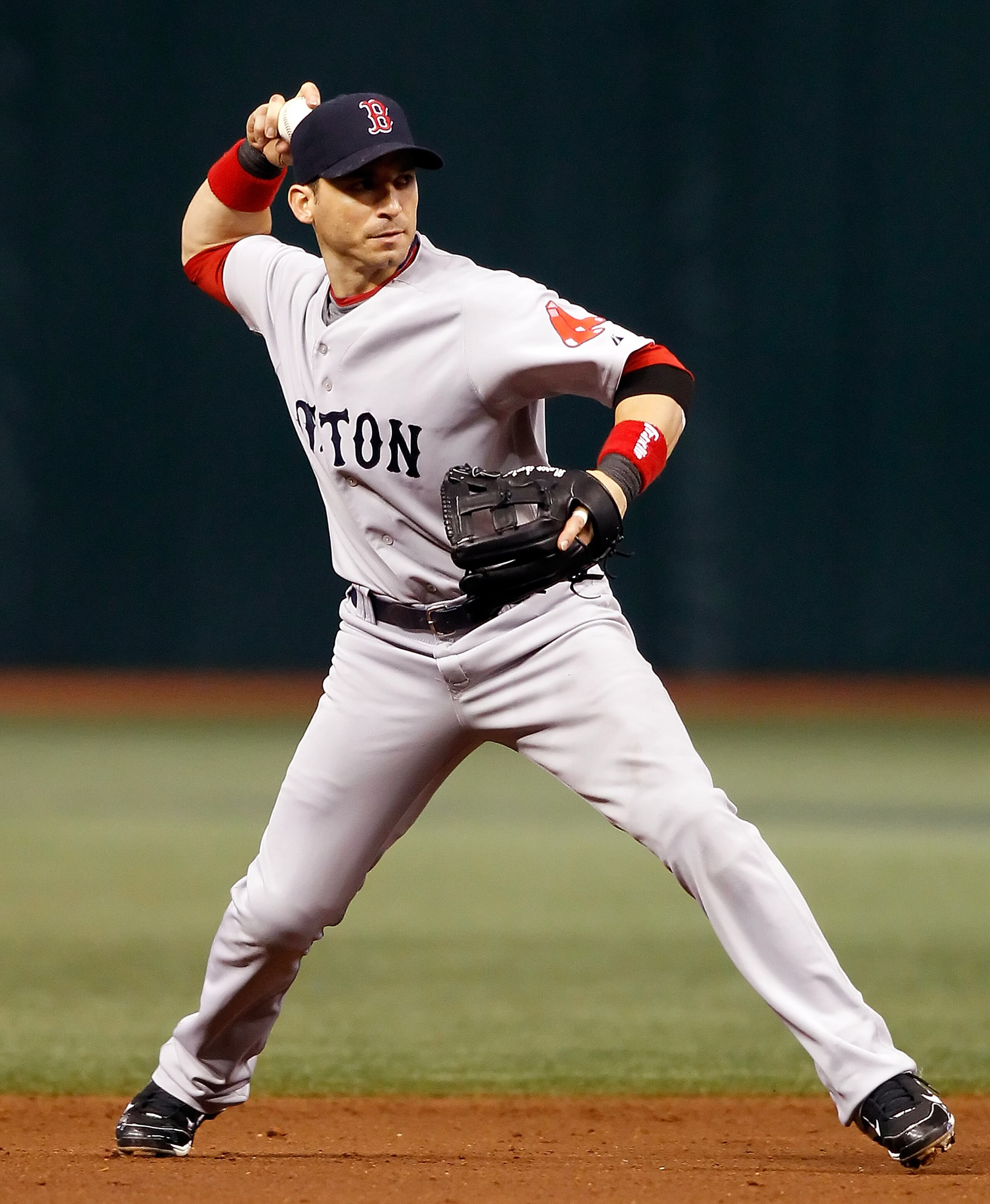
Though he'll likely be shopped around before that, thanks to the emergence of other Boston Red Sox shortstops like Jed Lowrie and Jose Iglesias, the Phillies could turn their attention to another defensively sound shortstop, Marco Scutaro, who could become a free agent following the 2011 season.
Scutaro, 35, would likely only appeal to the Phillies on a one year deal, in the event that some of their in-house options aren't ready or won't pan out, and they are unwilling to commit to a multi-year deal with another free agent shortstop. Scutaro, is more of a traditional shortstop, posted a solid offensive slash line of .275 / .333 / .388, with 11 home runs in 2010.
Scutaro, who owns a $3 million player-option for the 2012 season, would have to survey the market cautiously. All things considered, he may not find a multi-year contract, or a one-year deal that surpasses $3 million. He may be better off exercising his option, but if he doesn't, he'll become a free agent, and the Phillies could show some interest in the veteran infielder.
Of those listed, Scutaro is the worst defender, but still a capable shortstop. According to FanGraphs, he posted a negative UZR in 2010 (-2.9 at second base), and cost the Red Sox seven defensive runs. According to Ruben Amaro, the Phillies' philosophy moving into the future will be pitching and defense, so Scutaro may not be the ideal fit.
However, he is one of the top shortstops on an unusually weak market. If the Phillies don't want to settle for weak options like Adam Everett, John McDonald or Alex Gonzalez, Scutaro may be worth a one year contract. It's highly unlikely, however, that the Phillies would offer to pay him more than $3 million.
Omar Infante
6 of 10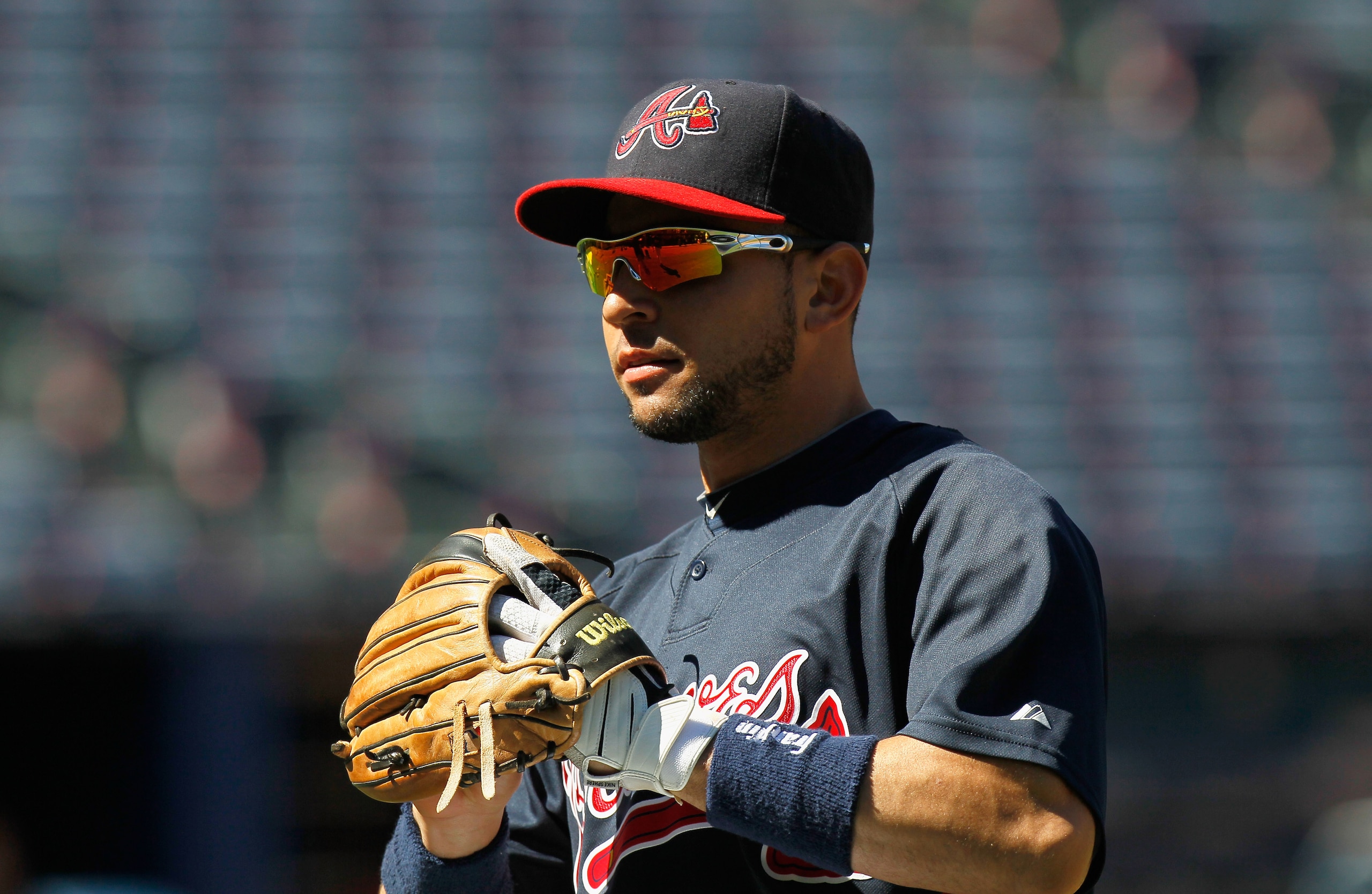
Moving forward, new Florida Marlins' super-utility man, Omar Infante, could find himself in an interesting situation. Last season, with the Atlanta Braves, Infante found plenty of starting time in the middle infield, filling in for Chipper Jones and Martin Prado, who experienced lengthy injuries. As they returned, and the Braves looked for an offensive upgrade, they sent Infante to the Marlins in the deal that sent another All-Star second baseman, Dan Uggla, to Atlanta.
With Hanley Ramirez in the fold in Florida, Infante figures to find little playing time at shortstop, but he has played there in the past. In a weak free agent market, if he hits anything like he did in the past two seasons in 2011, he and his agent would be wise to market themselves as a shortstop, where he could make more money.
In 2010, Infante posted a slash line of .321 / .359 / .416, with eight home runs. For those SABRmetrically inclined, that is a .775 OPS out of a utility infielder in limited playing time. Not too shabby. Any team looking to add a second tier shortstop like Infante would be wise to give the man a chance to play everyday.
Infante, 29, hasn't played shortstop regularly since his days with the Detroit Tigers in 2005, and even then, his role with the Tigers was akin to the one Valdez played with the Phillies in 2010. However, he has played shortstop in every season since, albeit, with limited playing time. If the price was right, the Phillies would be more than willing to give him a shot at shortstop. After all, it wouldn't be the first time they signed another player to play a position that was out of his comfort zone, and Placido Palanco (10 UZR at third base in 2010) worked out rather nicely.
Infante probably wouldn't be as good as Polanco was defensively, but he would manage. Overall in 2010, he posted a UZR of -0.2 in 19 games for the Braves at shortstop. In other words, he was average.
In a thin free agent market, guys that have been tabbed as "second basemen" could test the market as a shortstop. However, I find it highly unlikely that anyone outside of Infante will actually stick there. Could be a great pick-up for a team looking to pay less than top dollar, but get top dollar performance. Infante will earn just $2.5 million in 2011.
Jason Bartlett
7 of 10
Some of those previous slides are home to some lackluster shortstops, but the same word could be used to described the state of the Phillies' middle infield depth and the market for free agent shortstops following the 2011 season—they both severely lack luster. If the Phillies are going to find an above average shortstop to replace Rollins, it will most likely be on the trade market, and a few interesting names come to mind.
One of those names was traded during this off-season. After being drafted by the Minnesota Twins and spending most of his career with the Tampa Bay Rays, Jason Bartlett found a new home this off-season, when the re-tooling Rays shipped the shortstop to the San Diego Padres for a couple of bullpen arms. Consequently, after acquiring the shortstop, the Padres avoided arbitration with their new middle infielder, signing him to a two year, $11 million deal, with an option for a third year.
For the Padres, that could mean very little. After trading away the face of their franchise, Adrian Gonzalez, this off-season, it's looking more and more like the new face of their franchise, Heath Bell, will be moving on after this season when he becomes eligible for free agency. Despite making his will to stay in San Diego public, the Padres will likely be unable to afford his asking price. With that in mind, you wonder what the state of the Padres will be entering the 2012 season.
One thing is certain—for the right price, the Phillies would love to have their shortstop. He experienced a down year in 2010, posting a slash line of .254 / .324 / .350, with four home runs. However, in 2009, he was one of the best offensive shortstops in baseball, posting a slash line of .320 / .389 / .490, with 14 home runs. If the Padres were to sell low on him, as the Rays did in 2010, the Phillies could be in for a bargain.
Though his defense has never been top of the line, his contract would make that fact bearable. If the Phillies were to acquire him before the 2012 season, they'd be on the hook for one guaranteed year and $7 million, with an option for a third year.
Michael Young
8 of 10
Before moving to third base to make room for one of the league's most promising young shortstops, Michael Young was the face of the Texas Rangers franchise, and one the American League's top shortstops. Though a hefty contract and a full no-trade clause (Young gains 10-and-5 rights in May 2011, allowing him to veto a trade to any and every major league club) make a deal unlikely, a possible Young to Phillies trade is worth a look, and should it happen, pay dividends for Philadelphia.
Young, 34, turned in another solid season for the American League Champion Rangers in 2010. He posted a slash line of .284 / .330 / .444, with 21 home runs. As a third baseman, those numbers aren't all that bad, but as a shortstop in the Phillies' lineup, that's added production to an infield that already includes Placido Polanco, Ryan Howard and Chase Utley. Even more so, assuming that the left handed Domonic Brown takes over in right field, his right handed bat with good pop would be a perfect complement to a left handed heavy Phillies' offense.
His defense, on the other hand, is a different story. Even in his days as the Rangers' starting shortstop, Young was never a whiz with the glove. He posted positive UZR's in just two seasons of his ten year major league career, and wouldn't be joining the Phillies until the age of 35, in this scenario. That, combined with the following deterrent, may block a potential deal from happening.
Thanks to his offense, Young's defense is bearable. However, his contract, at least to the Phillies, would not be. Before the 2009 season, Young signed a five year, $80 million extension with Texas, paying him $16 million annually until after 2013. Seeing as he now is a utility player with the Rangers, you can chalk that up as a deal they'd like to have back.
However, that isn't synonymous with saying that his days as an every day player are behind him. This season, Young isn't a fit for Philadelphia. However, next year could be a different story. The Phillies will have some money coming off the books, and if the Rangers were willing to compromise, could be willing to hammer out a deal.
That being said, two years and $32 million would be far too much for the team to stomach. The Rangers would likely have to eat around $14 million, and at that price, they may want to keep him around.
Stephen Drew
9 of 10
In a perfect world, the Phillies would be able to work out a trade for Arizona Diamondbacks' shortstop, Stephen Drew.
Drew, 27, has been the subject of numerous trade rumors over the past year or so, but that didn't stop new D'backs General Manager, Kevin Towers, from signing his shortstop to a two year, $13.75 million deal to avoid arbitration. At the very least, he extended some cost certainty control over his young star, but signing one of the game's best young shortstops to a relatively friendly deal isn't all too terrible either.
In his fourth full season as the D'backs' shortstop, Drew posted a slash line of .278 / .352 / .458, with 15 home runs. Over the course of those four years, he's shown a little of everything—the ability to hit for average (.291 in 2008), on-base percentage (.352 in 2010), slugging percentage (.502 in 2008) and power (21 home runs in 2008). If he can put all of those together in a single season for a sustained period of time, this kid is in for a much bigger deal than the one he just signed.
Just to put the cherry on top, he's an excellent fielder as well. After an understandable two year adjustment period, Drew has made incredible strides to improve defensively. He posted a 2.7 UZR in 2009, and followed that performance up by posting an 8.7 UZR in 2010, fourth best among qualifying major league shortstops.
While his contract and potential are through the roof, I'm left baffled wondering how he would be recepted here in Philadelphia. After all, his older brother, JD, isn't exactly the most beloved player in the city of Philadelphia. Like his brother, he's represented by mega-agent, Scott Boras, and a potential deal could end in deja vu.
If the Phillies were to replace Rollins, however, you'd think this would be the guy. After all, the world isn't perfect.
Jimmy Rollins
10 of 10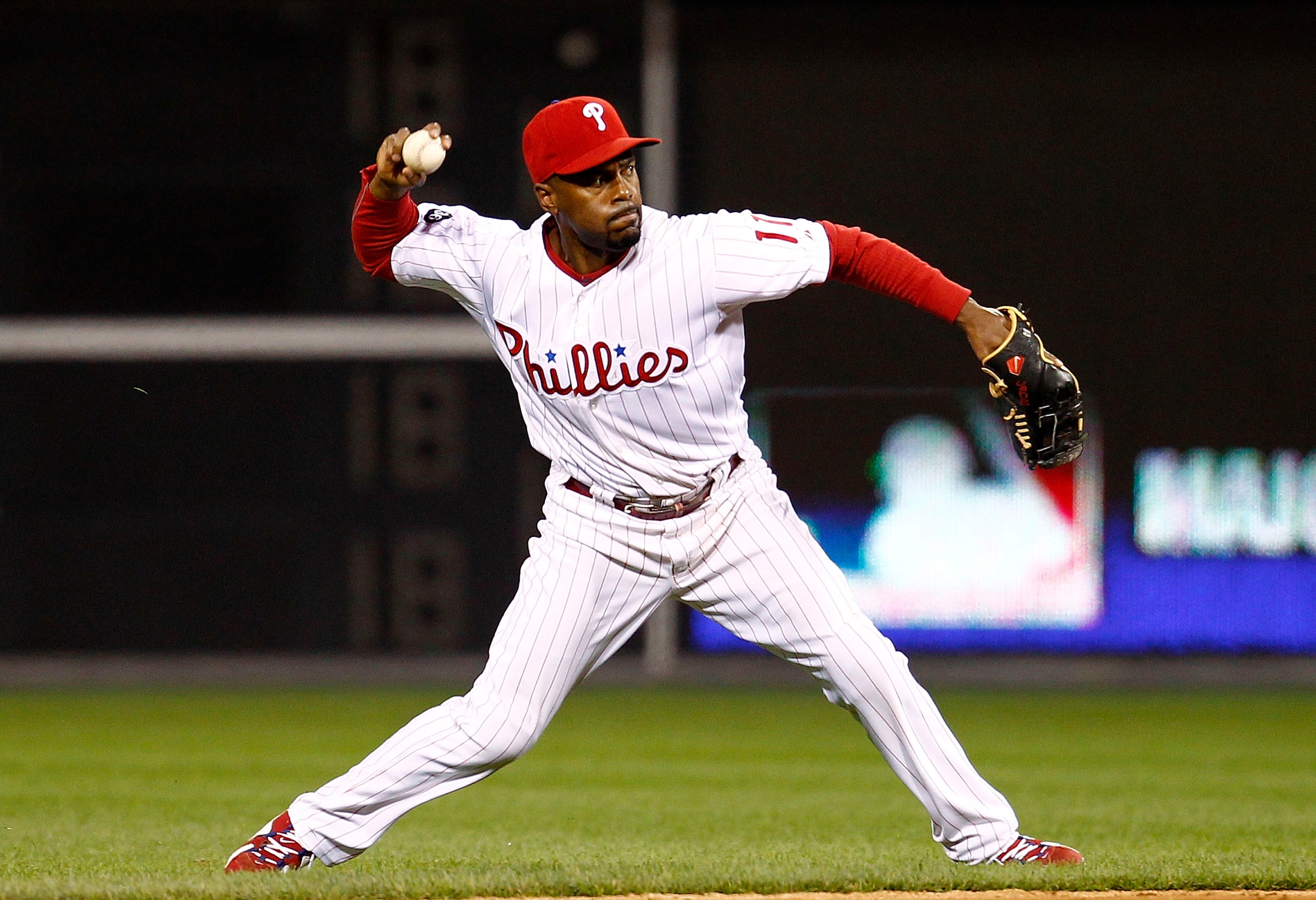
In the long run though, the new shortstop in Philadelphia is likely to be the old shortstop, and why not?
Over the course of his career, Rollins has certainly been no slouch offensively. He has a lifetime slash line of .272 / .328 / .435 to go with 154 home runs, 993 runs scored and 343 stolen bases. As long as he stays healthy throughout the entire season, the Phillies are in a position where even an average year from Rollins would be beneficial to the lineup, as even an average Rollins season is more productive than an above-average Valdez season.
Defensively, once again, as long as he is healthy, the Phillies know what they'll be getting out of Rollins. The man has made just 105 errors over the course of his career, and has not posted a negative UZR since 2002. Even in an injury shortened 2010, he posted a UZR of 6.9. Defensively, he is one of the best options on this slideshow, and a healthy Jimmy Rollins will most likely out-defend the likes of Stephen Drew.
In the long run, as most things do, whether or not Rollins remains in Philadelphia will be centered around money. How much money are the Phillies willing to pay for a 33-year-old, injury prone shortstop?
Using his past few seasons as a reference point, not much. As I pointed out earlier, Rollins' last extension with the Phillies was for five years and $40 million. This time around, there won't be a single team in baseball willing to pay him anything close to that. Set to make $8.5 million in 2011, the Phillies likely will not give Rollins a raise on his 2011 salary, but he won't accept much of a pay cut either. A three year, $24-27 million deal seems fair, but even that seems like it would be an overpay for Rollins. At this point, negotiations could become tricky.
However, if there is any bright side, the Phillies and Rollins have a great relationship, and benefit from each other. Rollins is deeply rooted in the city through charity, and if he can't play with the Oakland A's, where he grew up idolizing Rickey Henderson, he's the type of player that is hard to imagine in another uniform.
If I was a betting man, I'd say Rollins was a Phillie in 2012, and the forseeable future.
.jpg?w=2560 "2 NFL Officials Suspended")



.jpg?w=2560 "Mahomes' Wife Trolls Kubiak 💀")

.jpg?w=2560 "Love's Body Already 'Tired'")
.jpg?w=2560 "Injury-stricken Seahawks signing veteran RB")