
2018 NFL Draft: Top Sleepers Still Flying Under the Radar with a Month to Go
Draft-eligible players can be overlooked despite their talent for a host of reasons.
Sometimes there's a backlog of great players at a position, and there isn't enough time in the pre-draft hype space to talk about everybody enough. Sometimes small-school players get dinged because the thought is their strength of competition hid potential liabilities.
Sometimes a player isn't dynamic enough in an obvious sense to merit the attention he deserves. That could be a drive-sustaining running back or a run-stopping defensive tackle without epic pass-rush potential, among others.
Though the NFL has become a hybrid league, where versatility is prized as never before, sometimes it's tough to see a player for what he can be because he's lining up at multiple positions and the professional transitions aren't obvious.
In any case, sleepers can define their NFL teams.
Bengals linebacker Carl Lawson led all rookies with 8.5 sacks, and he wasn't taken until the 116th overall pick. And you can imagine teams would like do-overs on the evaluation process that left running backs Kareem Hunt and Alvin Kamara available until the third round.
Cooper Kupp of the Rams and JuJu Smith-Schuster of the Steelers were among the most productive rookies last season, and neither was taken in the first round.
Here are 12 of the most promising sleepers in this class—players who could have major impacts on their pro teams despite their lack of recognition.
Nic Shimonek, QB, Texas Tech
1 of 12
A transfer from Iowa, Shimonek rode the bench in favor of Patrick Mahomes until the 2017 season. He replaced the Chiefs' first-round pick admirably, completing 66.5 percent of his passes for 3,963 yards, 33 touchdowns and 10 interceptions. He also hit Houston's Steven Dunbar for the winning touchdown in the East-West Shrine Game, completing a season in which he came out of nowhere to impress.
Shimonek's Cinderella campaign continued at the scouting combine, where he was originally supposed to be one of the extra passers, simply to ensure that every receiver got his fair share of passes in the drills. But he was added to the list of throwing quarterbacks and looked especially good on intermediate and deep passes—better than some of the more high-profile quarterbacks at Lucas Oil Stadium.
Yes, Shimonek completed a ton of short passes in Kliff Kingsbury's system, but Texas Tech quarterbacks are asked to do more than simple Air Raid stuff. When he had to, Shimonek showed a good grasp of lower-body mechanics on the deep ball, as well as excellent touch and velocity.
Pro Football Focus charted 27 of 54 passes of 20 or more air yards for 1,049 yards, 13 touchdowns and no interceptions, and Shimonek's adjusted completion percentage of 55.6 on deep passes was good for second in the FBS last season.
The 6'3", 220-pound Shimonek is mobile enough in the pocket to reset and throw out of pressure, and he's more than a one-read quarterback. He probably projects as a career backup to spot starter, but ask the Philadelphia Eagles about the value of a capable backup quarterback these days.
Nyheim Hines, RB, North Carolina State
2 of 12
The modern NFL running back must do a ton to stay on the field. Gone are the days of the 350-carry feature back who just bulls his way through gaps.
Now, when every down is a passing down and schematic versatility is more prized and important than ever, the back who can run inside and outside zone and then flare out into the slot or out wide to become a plus-level receiver is more valued than the one-dimensional player.
The San Francisco 49ers' recent financial commitment to ex-Minnesota Vikings back Jerick McKinnon is the most prominent recent example, and in a recent tape piece, I pointed out why the 5'9", 205-pound McKinnon could be the primary rushing and receiving threat in Kyle Shanahan's multifaceted offense.
Given that, it's surprising North Carolina State's Nyheim Hines isn't getting more attention. He rushed for 1,112 yards and 12 touchdowns on just 197 carries for the Wolfpack last season, adding 26 catches for 152 yards. When Matt Dayes was the team's primary rusher in 2015 and 2016, it was up to Hines to get his reps though receiving yards, which he did, catching 63 passes for 781 yards and a touchdown.
Hines might be downgraded as a top back because of his size (5'8" and 198 lbs), but again, one must look at the landscape of the modern NFL and match talent to scheme. Hines runs powerfully and decisively, sifting through gaps in zone blocking, and he's electric when he gets to the edge. He's also an outstanding blocker for his size.
He has the potential to do a lot.
Rashaad Penny, RB, San Diego State
3 of 12
Penny didn't do much in 2017, his first season as the Aztecs' true starting running back. He just led the nation with 2,248 rushing yards and 23 touchdowns on 289 carries, adding 19 catches for 135 yards and two more scores for good measure.
Some may ding Penny for doing what he did against marginal opponents, but how do you factor in the 175 rushing yards he had against Stanford or the 216 he had against Arizona State?
Yes, he also beat up the defenses of Nevada-Las Vegas and San Jose State, and his 53 yards on 21 carries against Boise State is a bit of a red flag. But when you watch Penny's tape, his potential ascent looks seamless.
At 5'11" and 220 pounds, Penny has the strength and build to be a professional back, and he rolls through contact; Pro Football Focus has him averaging 3.32 yards per carry after contact and leading the NCAA in missed tackles caused with 80 rushing and two more as a receiver.
He's a quick, decisive runner through gaps, which would make him ideal behind just about any blocking scheme. Though he's more a rumbler than a pure speed rusher, he can hit the second level with impressive acceleration.
Had Penny played for a more prominent program, he would be among the most coveted running backs in this class. The team that overlooks strength of opponent in this case could get the best bargain at Penny's position in this draft class.

.jpg?w=2560 "Senior Bowl Football")
Michael Gallup, WR, Colorado State
4 of 12
Gallup played just two seasons for the Rams after going the junior college route, but his production was undeniable. He caught 176 passes for 2,685 yards and 21 touchdowns, including a five-catch, 81-yard game against Alabama last season that set the tone for showing his attributes against the best defense in the NCAA.
Stymied early in the game by Alabama's aggressive press coverage, Gallup adjusted brilliantly with subtle route adjustments and excellent movement skills. While he's not a speed receiver by any means, he understands how to match up against physical cornerbacks and win using technique.
At 6'1" and 205 pounds, the Biletnikoff Award finalist had 200-yard games against Hawaii and Nevada, and he caught six passes for 68 yards against Marshall's defense in the New Mexico Bowl. He also lit up Boise State's excellent defense for 11 catches, 102 yards and a touchdown, though it's the Alabama game that will no doubt have evaluators wondering just how much he can do in the pros.
Gallup has a bright future as a receiver similar to Allen Hurns, the former Jacksonville Jaguar who just signed a two-year, $12 million contract with the Dallas Cowboys. Like Hurns, Gallup is more physical and technical than fast, but he has potential as an ideal contested-catch and red-zone target both outside and in the slot.
Alex Cappa, OT, Humboldt State
5 of 12
It's not automatically a huge issue for an offensive lineman's professional future if he comes from a small school; however, the strength of opponent is a larger factor along either line than at some positions.
Last season, the Houston Texans selected Bucknell's Julien Davenport in the fourth round, and the Carolina Panthers took Western Michigan's Taylor Moton in the second. And though he missed his rookie season due to injury, Western Kentucky guard Forrest Lamp was impressive enough to have the Los Angeles Chargers take him high in the second round.
In this draft class, Cappa may be the most intriguing small-school blocker.
He looked great during Senior Bowl week as he was asked to ply his trade against stronger and more advanced pass-rushers than he had faced in college. There were some technical issues to overcome, but Cappa showed the brute strength he had so often exhibited in his Division II tape.
While he wasn't able to throw his opponents around as he did in college, Cappa is one of the more physically imposing tackles in what has turned out to be an iffy class overall.
That could give Cappa the leverage he needs to hear his name called on the second day of the draft, especially on a power-blocking team that is fine with adjusting to his technical fixes at left tackle or has a plan to move him inside to guard.
Braden Smith, OG, Auburn
6 of 12
Unlike the offensive tackle class in 2018, the guard group is stacked with clear first-round talent.
Notre Dame's Quenton Nelson might be the best player in this class, and Georgia's Isaiah Wynn has the strength and easy movement that should make him a top-20 pick. Texas-El Paso's Will Hernandez is a pure mauler, perfect for a power-based scheme.
If your NFL team misses out on those guys, the sleeper pick among guards might be Auburn's Braden Smith.
The 6'6", 315-pound right guard and right tackle plays with great physicality and intensity, getting low in his stance and dragging defensive tackles around once he gets his hands on their jersey numbers. But the aspect of his play that's most impressive—and sorely lacking among many young interior linemen—is his ability to hit the second level and target a linebacker with an accurate block.
Too often, draft-eligible guards and centers haven't been taught how to move up to take on next-level targets, and it shows in the way they rumble around without a plan.
Smith is a different breed of cat—an interesting combination of mauler and technician—and if he can clean up his occasionally sloppy hand placement and show footwork, he could show first-round talent.
Olasunkanmi Adeniyi, EDGE, Toledo
7 of 12
A lightly recruited high school standout in Houston, Adeniyi signed with the Rockets and amassed 28 tackles for loss and 12.5 sacks in his two seasons as a starter.
At 6'2" and 248 pounds, he may be seen as a tweener—too solidly built to be a pass-rushing "endbacker" and too small to be a plug-in defensive end. There's also the strength of competition factor to consider, as Adeniyi did his thing against far more Ball States and Western Michigans than Power Five schools.
But when you watch his tape, you'll see that Adeniyi plays bigger than his measurements—that is to say, he plays with impressive power when kicking inside to stop the run.
As an edge-rusher, he uses his alleged height disadvantage to his favor, frequently getting under the arms of offensive tackles and displaying an excellent "dip and rip" move to get to the quarterback. As for the strength of opponent argument, he did have two tackles for loss against Miami in 2017.
No, Adeniyi isn't a traditional "plug-in" player, but teams running hybrid defenses and looking for young defensive linemen who know how to skirt the edge and penetrate the pocket would do well to think outside the box and figure out the best way to use this player.
Harrison Phillips, DT, Stanford
8 of 12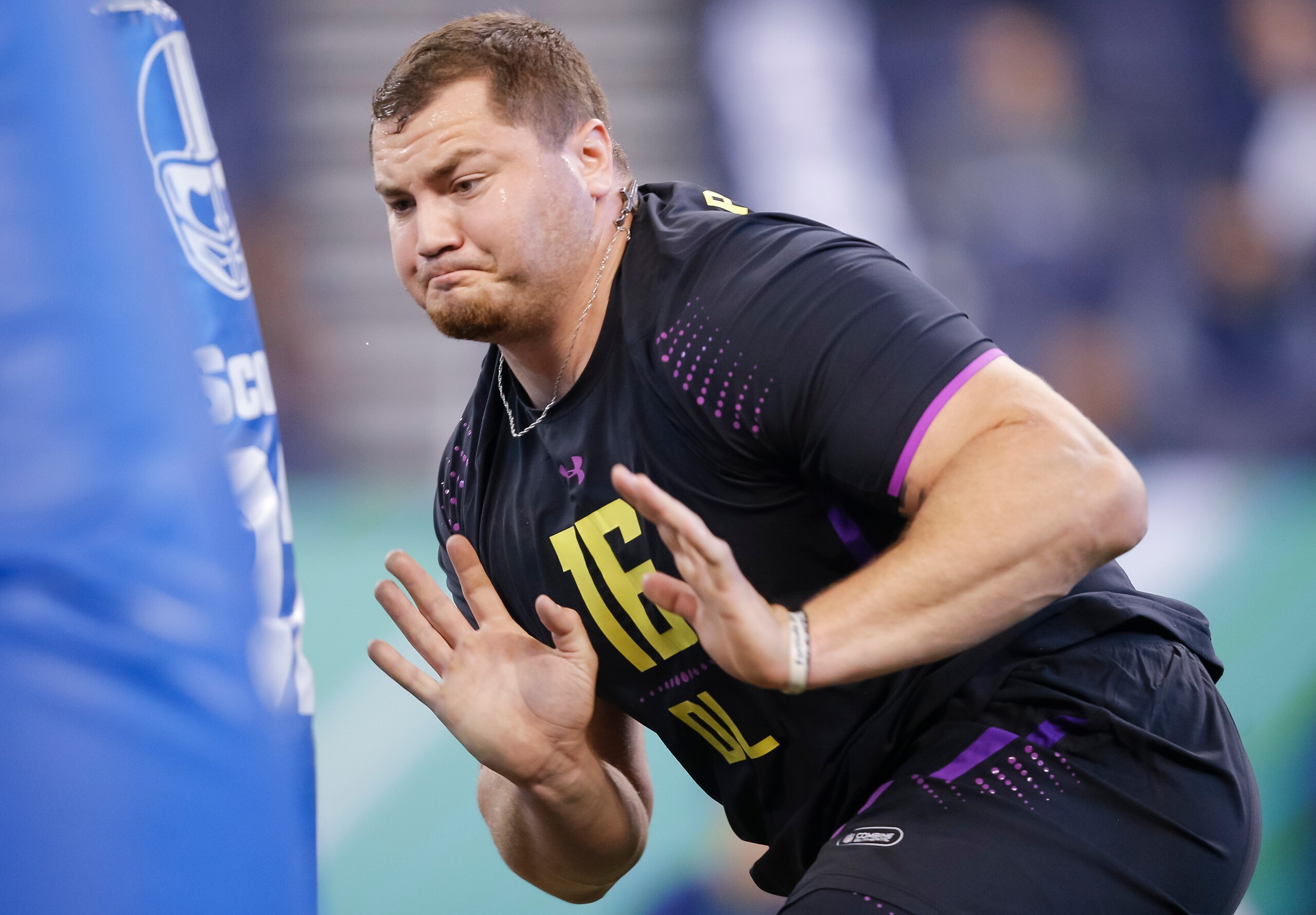
The Cardinal had a lot to replace when defensive lineman Solomon Thomas left, and it was up to Phillips to pick up a lot of that slack. This he did with aplomb.
He amassed 17 tackles for loss and 7.5 sacks despite his frequent positioning at defensive tackle (and his equally frequent status as the point of focus for every offensive line Stanford faced), leading to a ton of double-teams.
Perhaps Phillips' most impressive 2017 game came against Notre Dame, where he put up two sacks and three tackles for loss, wrestling top guard Quenton Nelson to a draw more often than not and occasionally getting the best of the guy who might be the best player in the draft.
As a 1-tech nose tackle, Phillips wins by bull-rushing centers and guards back, as well as moving off blocks to rush past the blocker to the quarterback or running back. As a 3-tech pursuit tackle, he excels at using his hands to knife through blockers.
Occasionally, he'll lose leverage when he stands too tall, and he can be pushed off to either side. But for the most part, he has the base attributes to be one of the best run-stopping tackles in this class, with a healthy side of pass rush.
Phillips isn't flashy, but he plays to and through the whistle with a ton of intensity.
Nathan Shepherd, DT, Fort Hays State
9 of 12
Regardless of position, Shepherd has one of the more fascinating stories in this draft class.
Once a linebacker for Division II Simon Fraser University in British Columbia, he left the program and worked odd jobs for two years to help his family financially.
As a walk-on at Fort Hays State in 2015, Shepherd put enough impressive tape together to merit a Senior Bowl invite, and he was one of the more impressive defensive linemen on the field in Mobile, Alabama.
What the NFL will do with a raw player who turns 25 this season is up for conjecture, but the tape doesn't lie: Shepherd is one of the more aggressive, violent and active defensive tackles in this class.
At 6'4" and 315 pounds, he comes off the ball with great explosiveness. When he gets his hands on a blocker, he's just as effective with a bull rush as he is using his natural agility to move around protections to create pressures.
Where his lack of experience comes up is in his occasional inability to maintain leverage—at times, Shepherd is so hellbent on getting to the pocket that he loses his balance and strength advantage along the way. But there are few defensive linemen in this class with more intriguing tools, and over time Shepherd could be a difference-maker at multiple points along the line.
Al-Rasheed Benton, LB, West Virginia
10 of 12
With the swift rise of nickel and dime personnel groupings as base defenses in the NFL, teams are in more need than ever of linebackers who can not only fire forward to stop the run but also credibly jump back into coverage against tight ends and slot receivers. Intelligent coverage is one of the many reasons that Georgia's Roquan Smith is seen as a foundational first-round talent.
Among the linebackers later in this class, it's tough to think of a better pure coverage player than Al-Rasheed Benton. At 6'1" and 235 pounds, he fits the physical prototype of the modern inside linebacker: quick to adjust to the ball, showing strength in the run game and moving smoothly in coverage.
He'll get beaten in strength battles with offensive linemen, but as is the case with all successful lighter inside linebackers, he's learned to adapt by waiting for gaps to open inside and moving quickly to stop run plays to the edge. That's how he racked up 13.5 tackles for loss and three sacks in 2017.
Perhaps more importantly for his NFL future, Benton looks like a natural in coverage. If his NFL team treats him as a dime linebacker in the Mark Barron or Deone Bucannon mold, he could be a special player in a flexible defense.
Mike Hughes, CB, UCF
11 of 12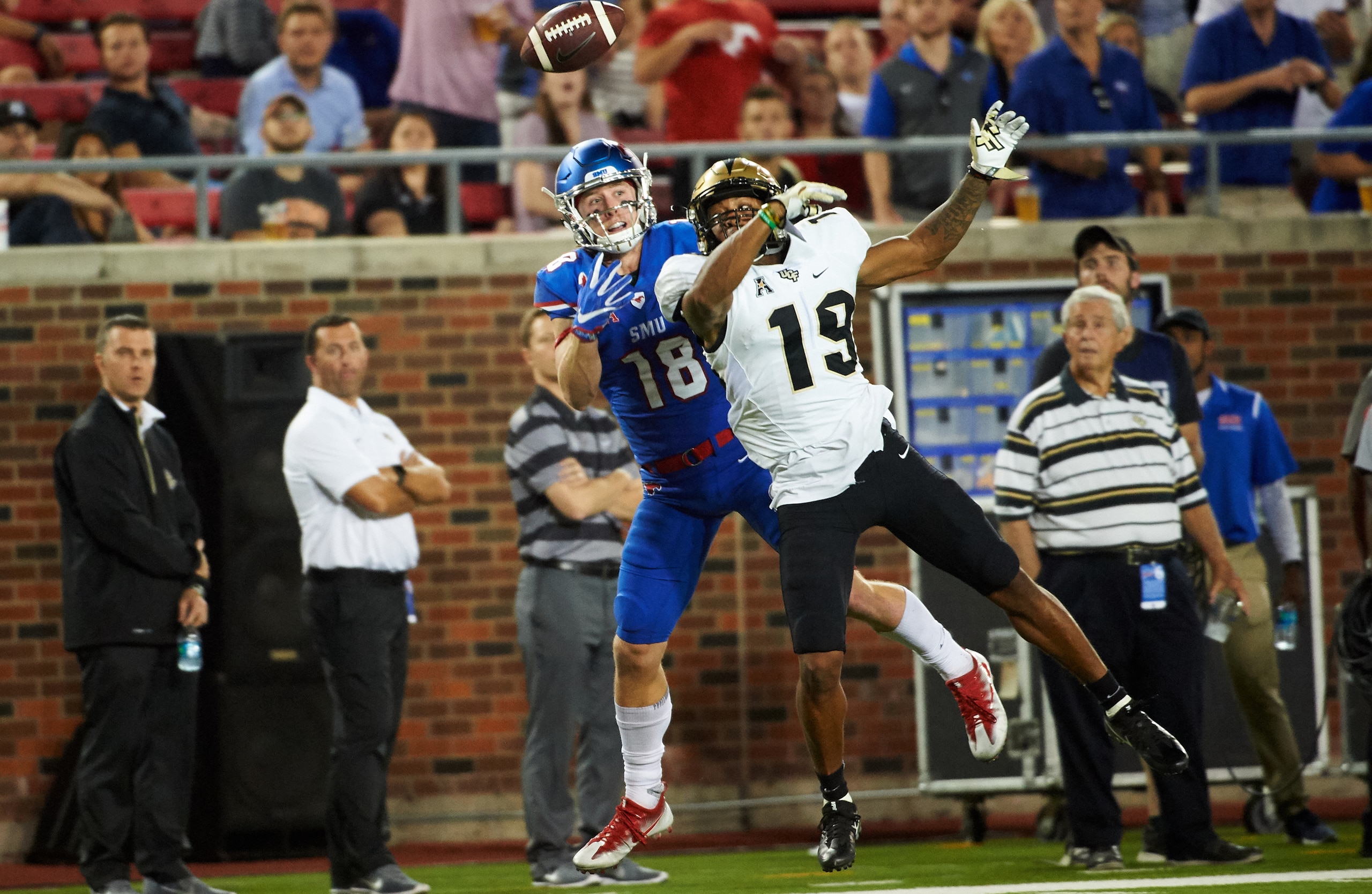
Alabama's Minkah Fitzpatrick is the best multiposition defensive back in this class. Iowa's Josh Jackson may be the best pure cover cornerback. Ohio State's Denzel Ward looks like the best athlete. Every promising defensive back class has players who aren't talked about as much, and UCF's Mike Hughes fits the bill this year.
The lack of buzz surrounding Hughes is especially weird because he fits the prototype of the modern NFL cornerback in his aggressiveness and ability to mirror and shadow deep receivers downfield. Incredibly tough at the line of scrimmage, Hughes forces every receiver he faces to earn his release with physical press coverage. He's fluid in his backpedal and highly technical and intelligent when adapting his body to route changes.
The only reason Hughes isn't talked about more is his size; he's 5'10" and 189 pounds, which may put him down the boards of some teams when it comes to playing outside corner on a regular basis. But he was a major reason for the Knights' 13-0 season, and Pro Football Focus has him charted as one of the better lockdown cornerbacks in this class.
Targeted 66 times in 2017, he allowed just 34 receptions for 301 yards. He allowed a preposterous opposing quarterback rating of 20.8 on deep vertical routes and a 43.8 passer rating overall. That was 46.6 rating points below the NCAA average.
While he may have issues with taller receivers at the next level, he's proved everything he needs to about his coverage skills.
Siran Neal, S, Jacksonville State
12 of 12
If his eventual NFL team wants to move him around the defensive backfield, Neal will have already had experience with that.
As a roving linebacker in 2016, Neal switched to cornerback in 2017, amassing an interception and 11 pass deflections. He also looked good during Senior Bowl week, showing his quick movement skills and adjustments against some of the better receivers in this class.
Neal's positional designations are filmy. While he has the capacity to play outside cornerback, he's perhaps more adept in the slot, converging over tight ends and slot receivers and shutting them down. He can also cover as a deep-third safety or dart down to stop the run.
As an outside cornerback, he's physical and occasionally grabby, and like most bigger, more aggressive cornerbacks, he can get beaten by quicker receivers on angular routes.
But overall, he's a natural fit for an NFL that wants its defensive backs to play all over the field. Neal is a small-school guy, but he looks big-league in his coverage and tackling ability. And at 6'0" and 206 pounds, he'll bring a physical presence to any team that drafts him.

.png?w=2560 "Ranking the Best Shooters of All Time 🎯")