

2017 MLB Draft Results: Biggest Winners and Losers of the Entire Draft
The 2017 MLB draft is in the books, and while we won't know exactly what to make of this year's crop of incoming talent until years from now, it's always fun to make some surface assessments on the biggest winners and losers.
Ahead we've highlighted four players and six teams that fall into one of those two categories based on draft slot relative to expectations in the case of the individual players and overall talent haul in the case of the teams.
For good measure, we also added in a bonus winner from the college ranks.
Just remember, more than any other draft in professional sports, the MLB draft is a crapshoot, and we won't truly know who won the three-day event until years down the road.
Honorable Mention Winner: Florida Gators Baseball
1 of 11
College baseball recruiting is unavoidably tricky, with so many of the nation's top high school talents never making it onto campus and instead beginning their pro careers after being selected in the early rounds of the draft.
The University of Florida entered the draft with a 16-man recruiting class that featured six players ranked among the top 100 prospects nationally and 12 total inside the top 200, according to Perfect Game.
From that group, only right-hander Sam Carlson (No. 25 HS prospect) and catchers Sam McMillan (No. 95 HS prospect) and Zach Jackson (No. 167 HS prospect) were selected within the first 10 rounds.
That means the following players will likely be headed to campus in the fall (draft prospect ranks included in parenthesis):
- No. 29: SS Brady McConnell (Baseball America-39, MLB.com-75)
- No. 45: RHP Jack Leftwich (BA-173, MLB.com-169)
- No. 55: RHP Hunter Ruth (BA-135, MLB.com-151)
- No. 72 RHP Tommy Mace (BA-88, MLB.com-144)
- No. 102: C Calvin Greenfield (BA-307)
- No. 111: LHP Jordan Butler (BA-251)
- No. 136: C Brady Smith
- No. 168: OF Justin Farmer
On top of that recruiting haul, it also appears that slugger JJ Schwarz will be returning for his senior season after he slipped to the 38th round.
He looked like a potential first-round pick after a monster freshman season, but a move from catcher to first base and steadily declining offensive numbers killed his stock. Still, he posted an .838 OPS with 12 home runs this spring and his bat will be welcomed back to the middle of the lineup with open arms.
So while Alex Faedo, Dalton Guthrie, Mike Rivera and a handful of others will begin their pro career, the Gators program looks to be in great shape for 2018 and beyond.
Loser: Evan Skoug
2 of 11
Evan Skoug was ranked as the No. 96 prospect in the 2014 MLB draft coming out of Libertyville High School in Illinois but slipped to the 34th round due to a strong commitment to TCU.
After a solid freshman season, he hit .301/.390/.502 with 21 doubles and nine home runs last spring, earning the starting catcher spot for USA Baseball's Collegiate National Team during the summer.
He looked like a potential Day 1 pick and perhaps the top catcher in the class heading into his junior campaign, but his spring began with a brutal slump at the plate and his stock never recovered.
While he rebounded in conference play to finish the season with a .277/.385/.562 line that included nine doubles and 20 home runs, he also struck out at a 29.9 percent clip and continued to show fringe skills defensively.
The Chicago White Sox finally selected him in the seventh round at No. 207 overall, where the pick holds a slot value of $201,700.
Compare that to the $2.2 million slot value at the end of the first round and $1.1 million at No. 60 overall, and it's clear that Skoug cost himself considerable money this spring.
Still, he has a chance to make an impact with his bat if he can shorten up his swing and cut down on the strikeouts because the power is for real.
Winner: Reynaldo Rivera
3 of 11JUCO stats always have to be taken with a grain of salt.
That being said, it's impossible to ignore just how dominant a season Reynaldo Rivera put together for powerhouse Chipola College this spring.
The hulking 6'6", 250-pound slugger hit .438/.534/.865 with 20 doubles, 20 home runs and 77 RBI in 238 plate appearances to help lead the Indians to an NJCAA championship.
Despite those eye-popping numbers, he wasn't viewed as a Day 1 pick by most evaluators, with MLB.com (No. 150 prospect) and Baseball America (No. 191 prospect) slotting him in the fifth/sixth round range.
Part of that has to do with his defensive profile, as he'll be limited to first base and DH duties as a pro despite solid athleticism for his size.
The other red flag was his 43 strikeouts this spring, as an 18.1 percent strikeout rate against lesser JUCO competition is troubling, to say the least.
However, in a rapidly thinning crop of college bats, the Detroit Tigers pulled the trigger on drafting him in the second round at No. 57 overall.
That pick carries a $1.1 million slot bonus, and even if he signs for slightly below slot, it'll still be for significantly more than he would have gotten in that fifth/sixth round range.

Loser: Tristan Beck
4 of 11Last spring, the San Diego Padres selected Stanford right-hander Cal Quantrill with the No. 8 overall pick despite the fact that he made just three starts during his sophomore season and missed his entire junior season following Tommy John surgery.
Still, scouts saw enough during his stellar freshman season (7-5, 2.68 ERA, 1.12 WHIP, 98 K, 110.2 IP) and in predraft workouts to identify him as a top 10 talent.
Tristan Beck watched all of that unfold firsthand as his teammate, and he was no doubt hoping for a similar resolution to his own injury-plagued Stanford career.
Beck went 6-5 with a 2.48 ERA, 1.03 WHIP and 76 strikeouts in 83.1 innings last season to earn First Team Freshman All-America and First Team All-Pac-12 honors.
As a draft-eligible sophomore, he entered the spring as a potential first-round pick, but a stress fracture in his back sidelined him for the entire season.
Still, it looked like there was a chance he could still go off the board within the first 75 picks to a team willing to roll the dice on his medical situation.
That wasn't the case, though, as he slipped to the New York Yankees in the 29th round and will now almost certainly return to campus for his junior season.
A healthy 2018 season could put him right back in the mix to be a Day 1 selection next June, but for now, he's taken as big a hit as anyone in the 2017 class.
Winner: Clarke Schmidt
5 of 11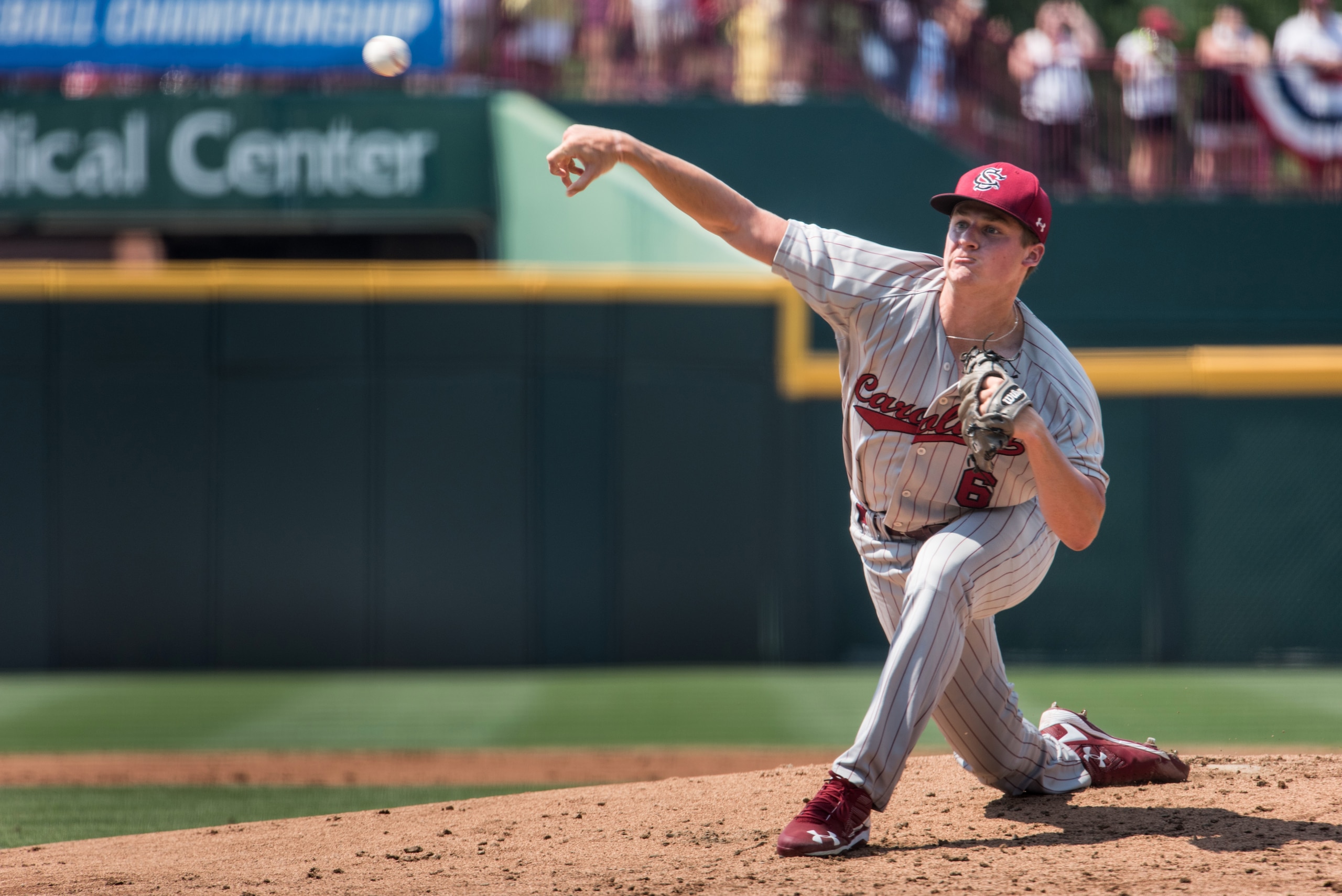
It wasn't all bad news for players with injury red flags.
South Carolina right-hander Clarke Schmidt underwent Tommy John surgery in May, but that didn't stop the New York Yankees from selecting him with the No. 16 overall pick.
Yankees vice president of domestic scouting Damon Oppenheimer had nothing but good things to say about Schmidt while talking with Brendan Kuty of NJ.com:
"Schmidt's got four pitches that at times are all plus. He has command, he has makeup. We really like his delivery. He's got a chance to be a top end of the rotation type of guy who combines pitchability with power stuff. And you always like it when they're the Friday night guy, pitching and having success in that conference.
"The results were positive and we feel really good about the rehab. He should be back pitching at full strength in approximately 12 months."
Schmidt had been one of the fastest-rising players in the class prior to the injury, going 4-2 with a 1.34 ERA, 0.98 WHIP and 70 strikeouts in 60.1 innings over nine starts and showing the advanced pitchability to move as quickly as anyone in the class.
The Yankees have as deep and talented a farm system as any in baseball, so they can afford to take this kind of chance and not rush their first-round pick into action.
Simply put, it was the best-case scenario for Schmidt.
Losers: Chicago White Sox
6 of 11The Chicago White Sox did well to add to their farm system during the offseason when they traded Chris Sale and Adam Eaton in a pair of blockbuster deals.
That being said, the franchise is still very much in the early stages of rebuilding, so it was in a prime position to take some chances on high-ceiling developmental guys in this year's draft.
Instead, the White Sox only selected one high school player in the first 20 rounds.
Missouri State slugger Jake Burger was their first pick at No. 11 overall, and his offensive upside is obvious after he hit .328/.443/.648 with 22 home runs and 65 RBI.
However, he's limited athletically and will likely need to move over to first base at the next level. Jeren Kendall (Vanderbilt) and Evan White (Kentucky) were both still on the board here if they wanted a college bat, and passing on those two is something the franchise could wind up regretting.
That was followed by a similar prospect in Gavin Sheets, who posted a 1.063 OPS with 20 home runs for Wake Forest this summer but is also a first base-only player defensively.
Their only high school selection in the first 20 rounds—first baseman Sam Abbott in the eighth round—was not even ranked among Baseball America's top 500 prospects.
New Mexico outfielder Luis Gonzalez in the third round and TCU catcher Evan Skoug in the seventh were nice values relative to slot, but they don't save this draft.
It was a safe approach for a team in position to be bold.
Winners: Atlanta Braves
7 of 11
Just what the Atlanta Braves needed, more high-ceiling pitching talent.
Vanderbilt ace Kyle Wright was thought to be the Minnesota Twins' target with the first overall pick just weeks before the draft.
Instead, he slipped to No. 5 where the Braves were happy to add him to what might already be baseball's deepest stable of young pitching.
They weren't finished on Day 1, either.
With the No. 41 overall pick, they selected Etowah High School outfielder Drew Waters.
The switch-hitter won Gatorade Player of the Year honors in a deep crop of Georgia prep talent, and he could quickly emerge as one of the top position-player prospects in the Atlanta system.
He possesses some of the best raw power in the class with enough hit tool to tap into it, and while he's athletic enough to play center field, he also has a strong enough arm to fit in right field depending on how he develops physically.
The Braves love drafting out of their own backyard, and considering there were some who believed Waters might sneak into the back of the first round, they had to be thrilled he was still on the board for their second selection.
As far as potential steals later in the draft, keep an eye on Michigan catcher Drew Lugbauer, who was taken in the 11th round.
He hit .288/.401/.518 with 13 doubles, 12 home runs and 60 RBI this spring, and he has the defensive tools to stay behind the plate.
The Braves' status as winners here is all about those first two picks, though.
Losers: San Francisco Giants
8 of 11Despite not having a first-round pick last season, the San Francisco Giants still managed to draft three players who now rank among their top 15 prospects, per MLB.com:
- No. 3: OF Bryan Reynolds (second round, 59th overall)
- No. 7: OF Heath Quinn (third round, 95th overall)
- No. 12: LHP Matt Krook (fourth round, 125th overall)
That's been their calling card over the years—finding high-value college talent in the early rounds of the draft and developing those players.
That made this year's approach somewhat puzzling.
With the No. 19 overall pick, they selected Puerto Rican outfielder Heliot Ramos, one of the most polarizing players in this year's draft.
It's easy to dream on his power potential, but his offensive game is not without its question marks.
Baseball America ranked him as their No. 30 prospect, while MLB.com had him at No. 40 and wrote the following:
"There is no question that Ramos has a big, strong athletic build and has legitimate power potential. It's after that the debate begins. Those who really like him see a solid hit tool and the ability to tap into that raw power consistently, keeping the barrel of the bat in the zone a long time and creating backspin. Others question the bat speed a bit more and wonder if he can turn on balls enough to reach that power."
Meanwhile, second-round pick Jacob Gonzalez might have been the biggest reach of Day 1, as he was taken at No. 58 overall.
The high schooler has the bloodlines as the son of slugger Luis Gonzalez, and there's intriguing raw power, but his hit tool and approach need a lot of work and he would have been there in Round 3.
Those two reaches on Day 1 could have been a precursor to an above-slot target on Day 2, but no such strategy unfolded, leaving the Giants with a questionable haul, to say the least.
They're pretty good at proving the detractors wrong when it comes to their draft strategy, so this could all look foolish a few years from now, but on the surface, it doesn't look like a great draft.
Winners: Pittsburgh Pirates
9 of 11The Pittsburgh Pirates had four picks inside the top 75, as they received a Competitive Balance selection and the No. 42 pick for failing to sign Nick Lodolo last year.
Their strategy: Draft high-upside high school players and worry about how they're going to sign them all when the time comes.
It started with the selection of right-hander Shane Baz at No. 12 overall.
After Hunter Greene and MacKenzie Gore, most viewed Baz as the top high school arm in this year's class, but a strong commitment to TCU made him something of a wild card heading into the draft.
MLB.com wrote:
"Baz may have the deepest arsenal in the 2017 high school class. His fastball has kicked up a notch to 92-96 mph with a peak of 98 this spring, and he has shown the ability to run and sink it while maintaining its velocity throughout a game. His 84-88 mph cutter generates a lot of swings and misses, and he also can turn the cutter into more of a true slider, spin a curveball that's a distinctly different pitch and unveil a changeup that could develop into a solid offering."
That was followed by right-hander Steven Jennings (BA-49, MLB.com-47), outfielder Cal Mitchell (BA-74, MLB.com-79) and outfielder Conner Uselton (BA-89, MLB.com-46) who were all highly regarded prospects.
Jennings and Uselton were both standouts on the football field at various points in their high school careers and were among the biggest risers in the class, while Mitchell looked like a potential first-round pick after the summer showcase circuit but slid after an inconsistent spring.
If the Pirates can find a way to sign all four guys, this class has the potential to go down as one of the best in franchise history. Uselton might be the toughest sign—he's already 19 years old and will, therefore, be draft-eligible again in two years.
Selecting Florida State third baseman Dylan Busby, Vanderbilt catcher Jason Delay and St. Joseph's catcher Deon Stafford at the start of Day 2 should save them some money.
Overall, love the uber-aggressive approach, and even if they only sign Baz and two of the other guys, this draft still deserves to be commended.
Losers: St. Louis Cardinals
10 of 11
The St. Louis Cardinals were forced to pay $2 million and give their top two draft picks to the Houston Astros as punishment for the Chris Correa hacking scandal.
Since the Cardinals gave up their first-round selection to sign Dexter Fowler in free agency, that meant sending the No. 56 and No. 75 picks to Houston.
That all left the Cards without a Day 1 selection, and they finally got in on the action when they took Cal State Fullerton outfielder Scott Hurst at No. 94 overall.
Hurst had a standout prep career that included a stint with Team USA but struggled mightily in his first two seasons on campus. However, he rebounded nicely with a .332/.424/.585 line that included 15 doubles and 12 home runs this spring.
Ranked as the No. 152 prospect by Baseball America and unranked by MLB.com, he was a reach in the third round, but it's a reach that could pay off.
The reaches continued from there, though, as St. Louis took LSU shortstop Kramer Robertson and St. Mary's second baseman Zach Kirtley with its next two picks.
Both players ranked in the 300s on Baseball America's prospect list, putting them in the 10th to 13th round range based on perceived value.
The Cardinals draft and develop as well as anyone in the league, so perhaps they deserve the benefit of the doubt.
Still, paying the price for that breach scandal has to be factored into the overall assessment of this year's draft, and they did little to offset those draft pick losses with some questionable early selections.
Winners: Cincinnati Reds
11 of 11
Hunter Greene might not have gone No. 1 overall, but there's no question he has the highest ceiling of any prospect in this year's draft.
High school arms always carry a certain amount of risk, but his combination of electric stuff and uncanny command for a prep power pitcher will go a long way in helping him reach his ceiling.
MLB.com gushed about the 6'3" right-hander:
"It all starts with a plus-plus fastball that has touched triple digits consistently this year. Greene will regularly be 97-101 mph early in starts and then settle into sitting in the 95-98 mph range, and he does it without a ton of effort. He'll throw two breaking balls, and they'll run into each other occasionally, with some thinking he'll focus on a slider in the future, with a chance for that secondary pitch to be at least Major League average. He doesn't need to throw his changeup much, but he'll mix in some good ones in every start. He is always around the strike zone and rarely walks batters, especially impressive given how hard he throws."
He has a chance to be a generational talent, plain and simple.
The Reds weren't finished there, either, as they took one of the best shortstops in the class in Jeter Downs with the No. 32 pick and one of the top collegiate outfielders in Stuart Fairchild at No. 38 overall.
Both players could have climbed into the first round without it being a surprise. Downs might have the best toolbox of any shortstop selected this year, and Fairchild was one of the biggest climbers among college bats after hitting .359/.438/.645 with 18 doubles, 17 home runs and 20 stolen bases this spring.
Further down the board, the Reds also rolled the dice on a trio of prep pitchers who are expected to be tough signs in third-rounder Jacob Heatherly (BA-63, MLB.com-45), 12th-rounder Tommy Mace (BA-88, MLB.com-144) and 19th-rounder Seth Lonsway (BA-127, MLB.com-148).
If they can find a way to sign two of those guys along with Greene and Downs, this could be a franchise-changing haul of talent.
They were already winners the second the Minnesota Twins took Royce Lewis at No. 1 overall, and they didn't look back from there.
College stats courtesy of The Baseball Cube.
_2.png?w=2560)

.jpg?w=2560 "Consensus Mock Draft 📋")
.jpg?w=2560 "NFL Panic Meter for Every Fanbase's Anxiety Levels")