NFL1000: What Happened to the Once-Feared Arizona Cardinals Offense?
In 2015, the Arizona Cardinals, led by head coach Bruce Arians and captained by quarterback Carson Palmer, had the most varied and effective deep passing game in the NFL.
The 13-3 Cards ranked second in the NFL in points and first in total yards and had a formidable receiving trio in Larry Fitzgerald, Michael Floyd and John Brown. Moreover, the rise of rookie running back David Johnson gave the team a balance it had not previously had in the Arians administration.
Palmer was the primary beneficiary. In 2015, at age 36, he led the league in yards per attempt, adjusted yards per attempt, yards per completion and game-winning drives. He posted career highs in passing yards (4,671) and touchdowns (35) while throwing just 11 interceptions in 537 attempts.
TOP NEWS
.jpg?w=3840 "Pro Bowl Football")
Watch: Jerry Rice Chases After Heckler
.jpg?w=3840 "Commanders Football")
Overlooked Rookie RBs Who Can Make NFL Impact in 2026
.jpg?w=3840 "Giants Cowboys Football")
Cowboys Removing Grass 🥲
It all fell apart in the Cardinals' NFC Championship loss to the Carolina Panthers.
Palmer had one of the worst games in his 13-year career, throwing four interceptions and completing just 23 passes in 40 attempts in a 49-15 shellacking. But it could be argued that things started to go awry in Arizona's incredible 26-20 overtime divisional-playoff win against the Packers. Palmer was dealing with an injured index finger on his throwing hand, and though the Cardinals won the game, Palmer's lack of accuracy didn't escape notice.
In 2016, the Cardinals' lack of efficiency and explosiveness in the passing game has been evident. Arians' 4-4-1 squad is hamstrung most of all by an aerial attack in which passes are clearly overthrown, quarterback and receiver aren't communicating and pressure is causing the bubble to burst.
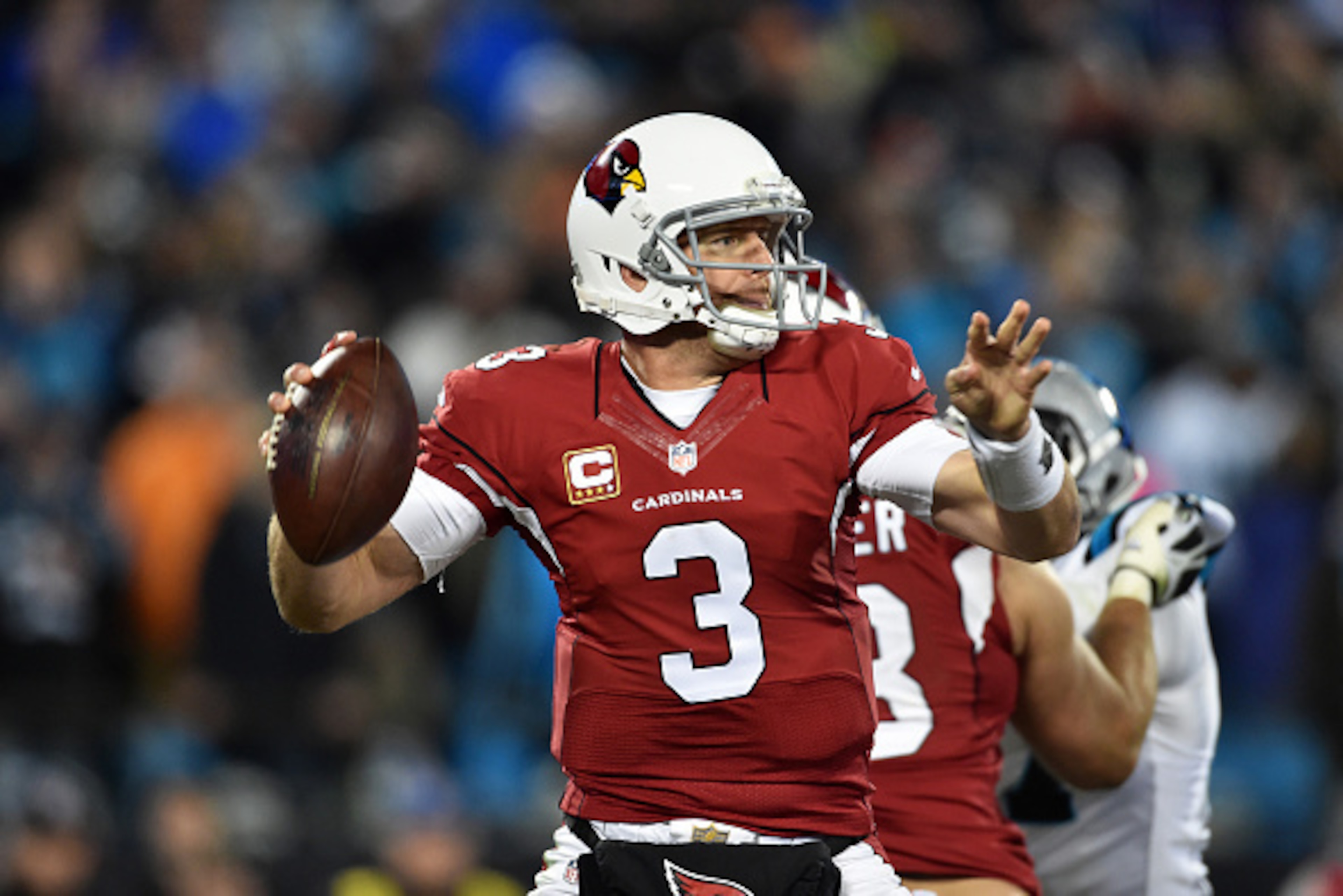
Palmer has thrown just 11 touchdowns to eight interceptions, his league-leading numbers from last season are all way down, and it begs the question: Is this a matter of an injured team trying to fight its way out of the malaise, or is Carson Palmer done as a top-level NFL quarterback?
One thing's for sure: Arizona is not implementing Arians' game plan to ideal effect. Not even close. At its best, his passing game is based on a principle that goes back to the old Sid Gillman Chargers of the American Football League in the 1960s. It features a vertical receiver to one side, with multiple receivers to the other side, breaking off into routes that give the quarterback easy reads, and an inside receiver running an angular route over the middle as a bailout.
When it's on, it works like a charm.
"Yeah, I mean, it's not just everybody run a go [route]," Palmer told me last November. "There's always player control and something underneath the route for every coverage possible. So it's not just, 'Hey, let's just take a big, long seven-step drop and everybody run a go.' There's always ways to check the ball down and get the ball out of your hands quick and make a defense turn and recover to the ball."
Whatever the reason, the effective deep ball has been the biggest casualty this season. In the 2015 regular season, Palmer was one of the more prolific downfield passers in the NFL, with 33 completions in 85 attempts for 1,074 yards, 10 touchdowns and six interceptions on throws traveling 20 or more yards in the air, according to Pro Football Focus. In the postseason, with that finger injury, things were different—one completion in 11 attempts for 32 yards, no touchdowns and three picks.
2016 has seen more of the same on the downside. Palmer has completed just 13 of 42 deep passes for 370 yards, one touchdown and four interceptions.
The risk/reward component of Arians' offense is broken. I asked NFL1000 quarterbacks scout Cian Fahey for his take on Palmer's 2016 season, and he confirmed my findings:
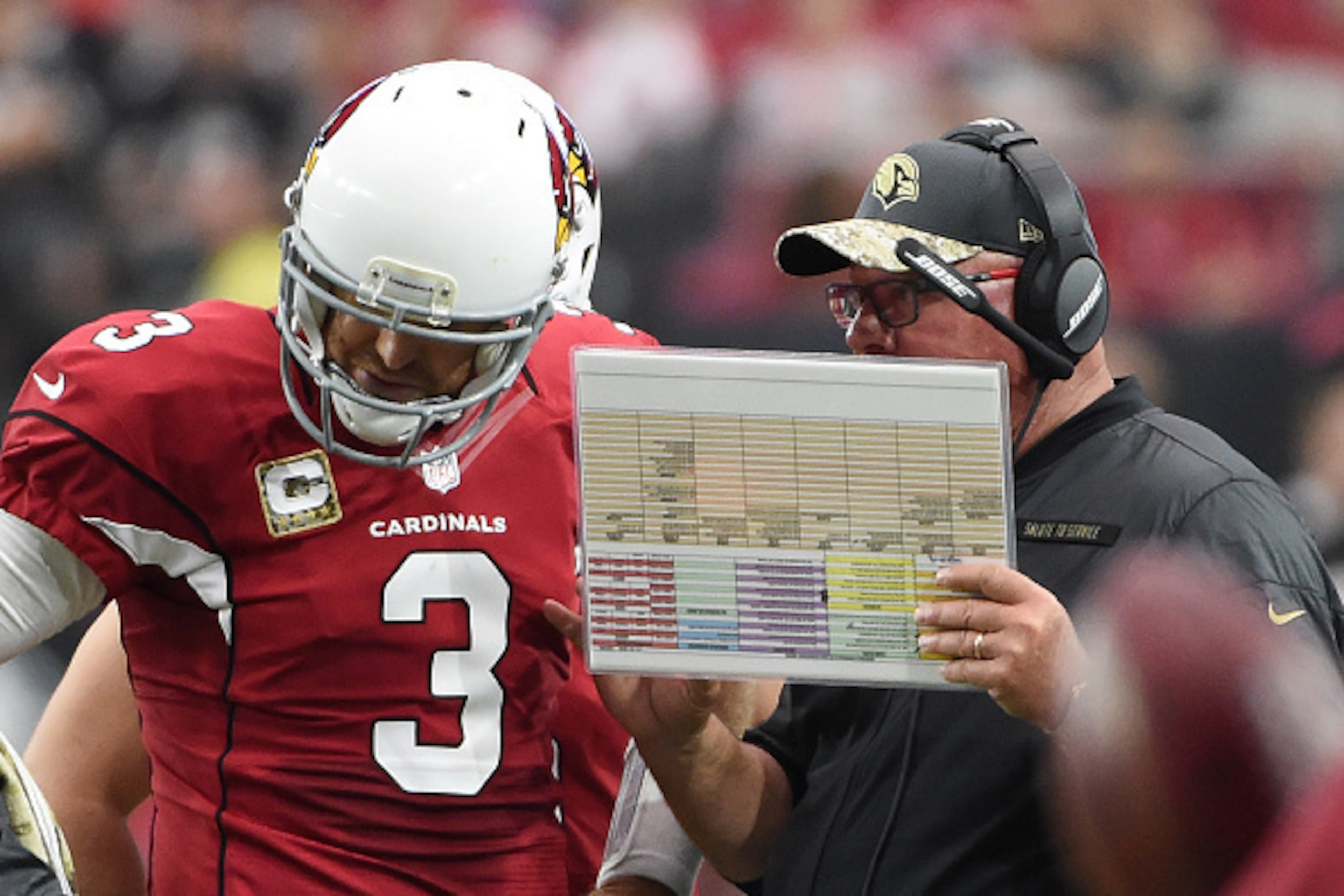
"Carson Palmer has never been a quarterback who emphasized ball security. He is a strong-armed, stand-in-against-pressure starter who attacks tight windows without any fear. That is what has made Palmer valuable, but it's also what has made him less consistent than his peers.
"In 2015, Palmer hit tighter windows with more consistency than he has so far in 2016. That's likely a result of a weakening arm at this stage of his career, but it's also a result of how much pressure he is facing.
"Any Bruce Arians quarterback faces pressure, and Palmer isn't actually bad against pressure (he faced plenty last year too), but he's struggling to overcome the smaller margins for error his offense is giving him this year."
The pressure component is, as Cian says, not a major problem. From my self-charting, Palmer has completed 54 of 100 passes for 590 yards, five touchdowns and just one pick under pressure this season. The bad numbers, oddly enough, come when he has a clean pocket.
That leads me back to the deep ball. How is this a problem? Let's take a look.
We'll start with the second of Palmer's two interceptions against the 49ers last Sunday. Here, he had a shallow Twins right look, and John Brown as the Iso backside receiver. At the snap, Brown runs a deep in-breaking route in which he cuts at about the 20-yard point.
It looks like the planned route, but for whatever reason, Palmer makes an intermediate throw right to Gerald Hodges. There's nobody in that area—Brown is yards upfield, and Fitzgerald ran a shorter seam route to the other side.
For more deep-ball trouble, let's go back to Arizona's Week 4 game against the Rams and watch this deep boundary throw to Brown.
The setup for Palmer is promising; Fitzgerald clears out the coverage to the right side, so it's Brown and cornerback Trumaine Johnson, with Johnson playing bail coverage. Most likely, if Brown takes Johnson away from the boundary, he has a better shot. Leaving the inside position to Johnson as he does requires a perfectly thrown and timed pass from Palmer, and that doesn't happen.
The combination of an underthrow and a disadvantageous route leads to yet another pick.
Palmer's worst game this season came against the Bills in Week 3. In the 33-18 loss, Palmer threw interceptions on each of Arizona's last four drives. It was a catastrophic turn of events, and this interception—the second—was a bad look for the veteran.
It was a 3-by-1 set with the receiver group on the left side, Fitzgerald outside and Jaron Brown in the outside left slot. At the snap, Fitzgerald took his defender inside, and Palmer assumed the coverage would go with him. But slot cornerback Nickell Robey-Coleman did a fantastic job of pushing Brown to the boundary (inside position for the cornerback again), and safety Corey Graham was tracking the ball all the way.
The Bills disguised their coverage to a point, probably guessing the intent was for Fitzgerald to clear coverage for the quicker outside receiver. It's a common construct of the Arians passing game, and it's not working right now.
So, how to fix this problem? It's possible Arians and offensive coordinator Harold Goodwin need to stop treating Palmer as a quarterback who can throw deep as he used to and adjust the game plan accordingly. Palmer's lone touchdown against the 49ers was a simple, but effective, example of formation diversity and timing yielding optimal results.
Pre-snap, this looked like a Twins left concept, but Johnson motioned from the backfield to the formation, giving Palmer a bunch left look and telling him the 49ers were in man coverage through the movement of linebacker Nick Bellore. Based on that coverage, Palmer knew he had a live one, and Bellore couldn't catch up to Johnson on the quick pass.
It was perhaps the easiest touchdown pass Palmer has thrown all season, and it should be instructive.
Going to less of a deep attack could be a successful approach for the Cardinals. They have the receiver and running back talent to give Palmer the targets, and quicker throws would mitigate the damage done to Arizona's injury-plagued offensive line.
Great deep-passing offenses require a multitude of things to come together; it's why you don't see too many of them for long at any point in NFL history. Right now, the Cardinals are dealing with many factors that minimize the effectiveness of their aerial attack, and though it may put more defenders in the box, Arians would be wise to focus on designed openings in the short to intermediate game.
The Cardinals' season could depend on it.
.jpg?w=3840 "Steelers Ravens Football")
.png?w=3840 "Every City's 2000s Mt. Rushmore 🤩")