NFL1000 Scouting Notebook: What's Happening to NFL Kickers, Blake Bortles & More
Welcome to Bleacher Report's NFL1000 Scouting Notebook, a weekly series where we'll use the power of the 16-man NFL1000 scouting department to bring you fresh insights into the game and explain some of the more interesting (and potentially controversial) grades we give players every week.
The full list of NFL1000 grades will be released Thursday, and we will attempt to preview some of what we are seeing in our film analysis here.
Let's start this week with a closer look at Blake Bortles, who has gone from a blossoming young quarterback who threw for 4,428 yards and 35 touchdowns in his second season to a bottom-of-the-barrel QB in his third year.
TOP NEWS
.jpg?w=2560 "49ers York Arrested")
York Responded to Ad on Prostitution Site Before Arrest
Joey Porter Jr. Trade Packages 📦
💀 McVay's Quote on CFB Returns
The All-22: What in the World Has Happened to Blake Bortles?
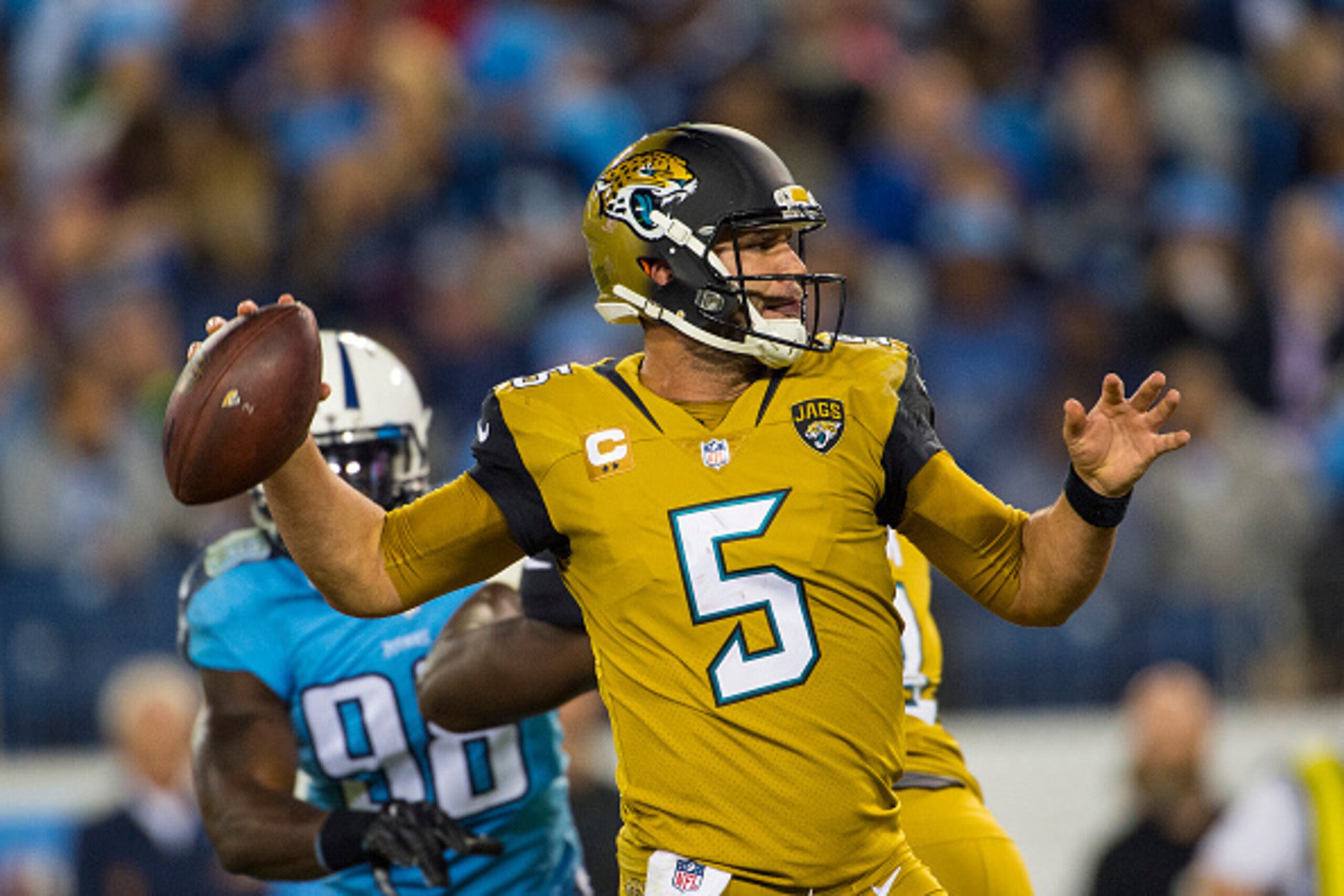
Written by Cian Fahey
Blake Bortles' 2015 season was misleading. The then-second-year quarterback averaged 7.3 yards per attempt and threw for 35 touchdowns, but he also tossed 18 interceptions while completing only 58.6 percent of his passes. Bortles' weekly performances were underwhelming to say the least.
| 10/25 | 16/25 | 9/20 | 9/20 | 10/10 | 54/100 |
According to the Pre-Snap Reads Quarterback Catalogue 2016, Bortles was accurate on just 73.5 percent of his throws. Thirty of 35 charted quarterbacks had a higher accuracy percentage than him. Furthermore, while Bortles threw 18 interceptions, he was lucky to have only tossed that many. Bortles threw 30 interceptable passes last year—only one quarterback had more—and tossed an interceptable pass once every 19.9 attempts; only four quarterbacks threw an interceptable pass as often.
Even when Bortles was connecting with his receivers for big plays, more often than not the protagonist for the positivity was playing receiver. Allen Hurns and Allen Robinson carried Bortles to his big numbers by consistently making difficult adjustments at the catch point against tight coverage.
Now that his receivers aren't playing to the same level in 2016, Bortles' fatal flaws are being exposed.

Against the Tennessee Titans on Thursday night, Bortles threw the ball 54 times for 337 yards and three touchdowns with no interceptions. His stats were overly flattering, with most coming when the game was out of reach. In the above image, Bortles faces a 3rd-and-3 during the first quarter. This play is indicative of what is holding him back at this level.
The Titans show a double A-gap blitz with both linebackers between the defensive tackles of a four-man line. The Jaguars respond by keeping a tight end in-line to the right and a running back in blocking position behind the line of scrimmage.
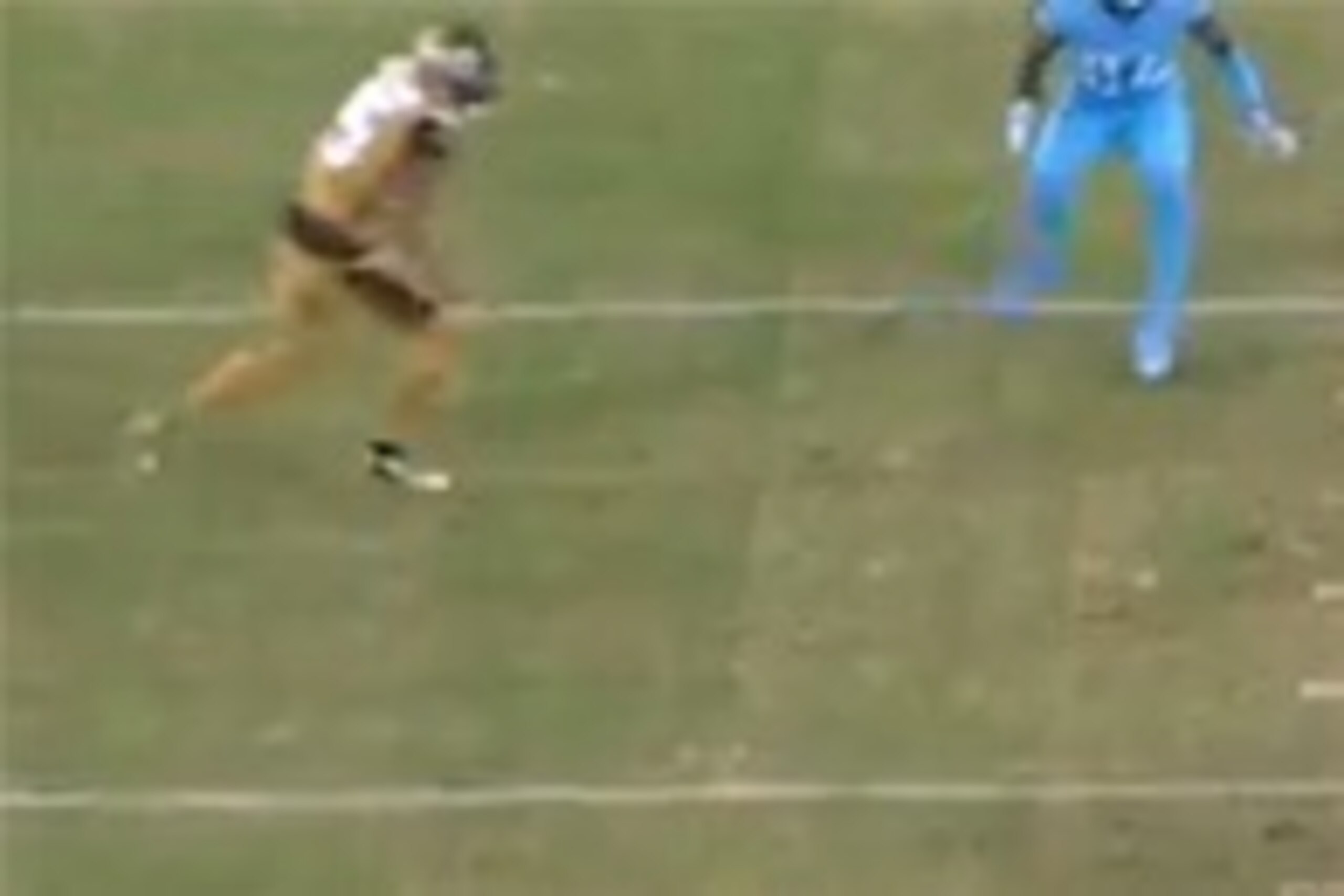
Since the Titans defense is coached by Dick LeBeau, it's no surprise that what they show before the snap isn't what they carry out after the snap. Both of the linebackers threatening to blitz drop into coverage. The Jaguars protection isn't confused. The offensive line comfortably picks up the four-man rush to give Bortles time and space in the pocket.
Bortles should be able to stand tall, survey the field and deliver the ball unobstructed from this position. Instead, he immediately loses his discipline. His shoulders hunch, and his eyes drop while his feet widen. Doing this makes it impossible for him to read the coverage downfield or throw the ball accurately once he locates an open receiver.
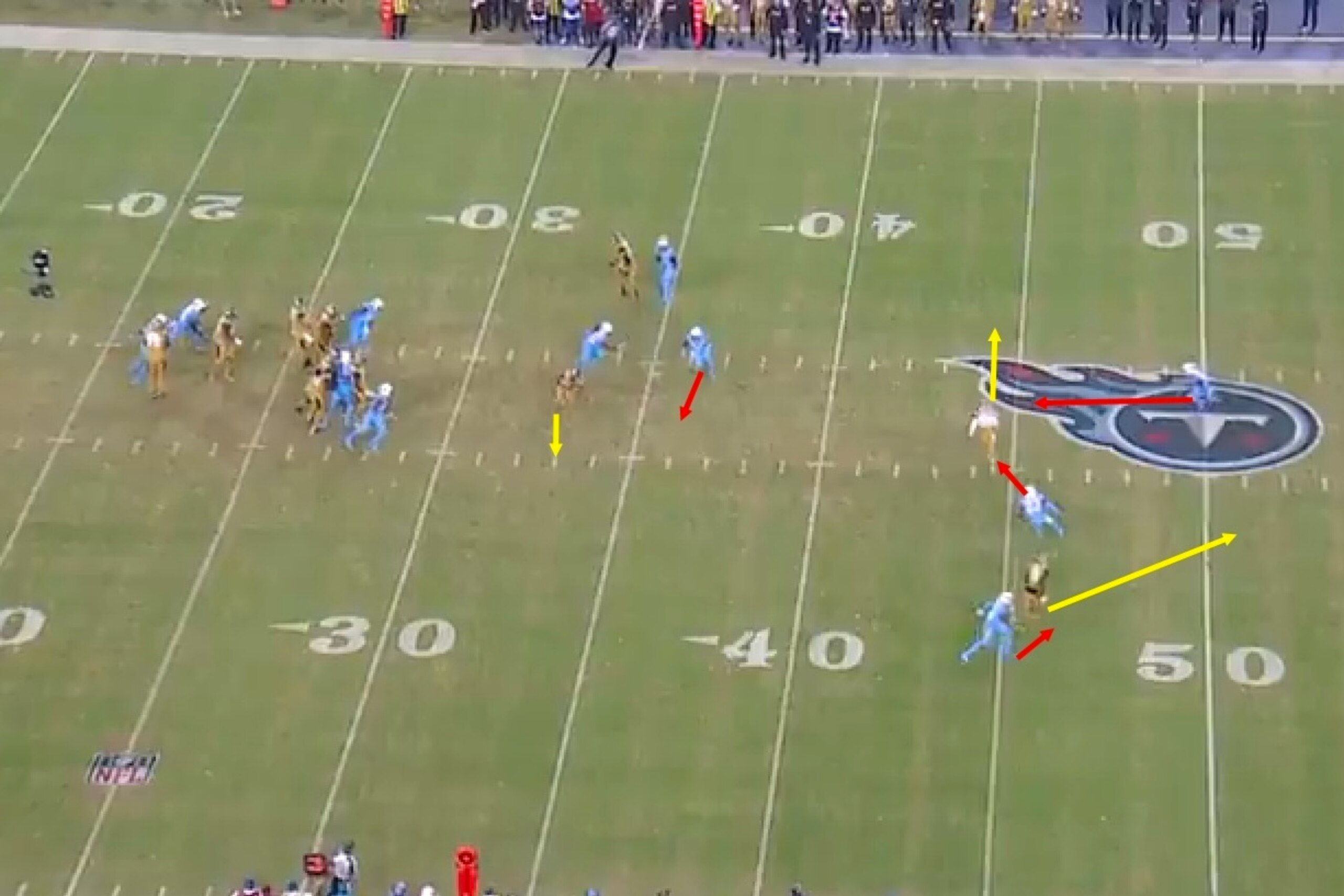
Had Bortles stood in the pocket and acted like a good quarterback should, he would have seen two great open receivers. The post route downfield is the obvious option. It's also the most beneficial one, as the receiver is running free in behind the deep safety who has been drawn forward by the intermediate crossing route. The second open receiver is a shallow crossing route for a first down underneath. Bortles ultimately takes the easy option having never recognized the big-play opportunity downfield.
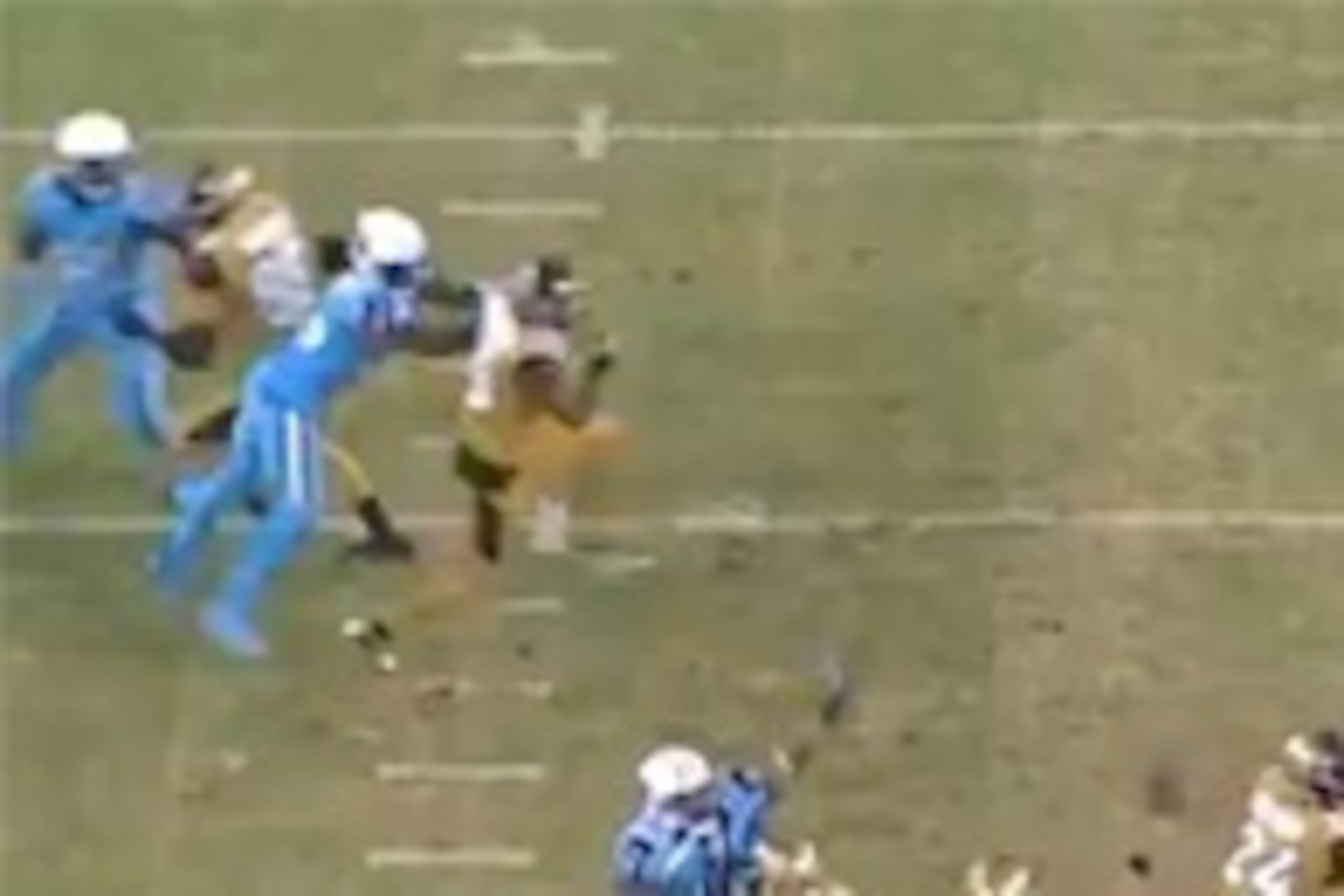
Despite locating the easy throw, Bortles can't make a four-yard pass to an open receiver right in front of his face. Robinson, a receiver with a wide catch radius, stretches fully to try to reach the ball, but he can't even touch it as it whips past him. This is a spectacularly bad throw.
Bad throws and bad process in the pocket have marred Bortles' career. He is incapable of executing the offense as designed, which is why the Jaguars are on their third offensive coordinator with him in three seasons. Incredibly, the man hired to replace Greg Olson, who was fired after Thursday's game, is none other than quarterbacks coach Nathaniel Hackett—the man who has been most responsible for Bortles' complete lack of development.
General manager David Caldwell and head coach Gus Bradley have their careers invested in Bortles, so they will continue to change everything around him until they are fired or something magically clicks. Rationally, you can't expect him to turn his career around. Bortles may look like what scouts and coaches want in a quarterback, but he doesn't play like what they need from a quarterback.
What's Going on with Kickers?
Written by Chuck Zodda

From the first game of the 2016 NFL season, kickers have made headlines this year, often for the wrong reasons. The Carolina Panthers were poised to take down the Super Bowl champions in the season opener, but Graham Gano hooked his 50-yard attempt wide left as the Denver Broncos notched a win in the season opener. Chandler Catanzaro of the Arizona Cardinals followed this up three days later with a miss that sent Cardinals fans home distraught with a two-point loss to the New England Patriots.
The Patriots have seen their own share of issues with the usually reliable Stephen Gostkowski, who struggled throughout the first seven weeks of the season on both field goals and extra points. High-profile chip-shot misses from Steven Hauschka and Catanzaro in the Week 7 Sunday Night Football battle in overtime drew focus to kickers once again, bringing us to the age-old question asked at some point every season.
Are NFL kickers worse than ever?
Through Week 8's games, NFL kickers have made 83.7 percent of their field-goal attempts, with the average kick coming from 37.75 yards. Over the 2015 season, they connected on 834 of 987 attempts, good for 84.5 percent accuracy, with a slightly longer distance of 38.15 yards.
Had kickers made just two more kicks this year and two fewer last year, this year’s accuracy would be slightly higher. I ran a number of statistical tests to see if there is any meaningful change from last year to this year, and every one comes up negative, suggesting that the slightly lower accuracy is the result of fluky performance.
So what has been happening?
In the fourth quarter and overtime this season with their team leading by three or fewer points or down by three or fewer points, kickers are just 42-of-57 (73.6 percent) on field goals, compared to 100-of-127 (78.7 percent) last year. While this is a slightly worse performance, it is still within two kicks of being nearly identical to last year’s accuracy.
However, an interesting occurrence happens with the names that performed poorly in these situations last season: Robbie Gould, Greg Zuerlein, Jason Myers and Sebastian Janikowski. All of these kickers had at least four attempts and were at or below 75 percent in these situations. All of them also came from teams that missed the playoffs in 2015.
Now fast-forward to 2016. The list of kickers on pace to meet those qualifications this year is as follows: Wil Lutz, Dustin Hopkins, Hauschka, Mike Nugent, Catanzaro, Janikowski, Roberto Aguayo and Cody Parkey.
First, the list is bigger, suggesting that rather than clustering problems among a small number of kickers, a larger number are having issues initially this season. Second, and more importantly, four of those kickers are on a playoff team from 2015, making them far more likely to be playing during prime-time games with big audiences.
In fact, last year’s kickers who struggled in these situations appeared in just five prime-time games over the season, whereas this year’s list of kickers has already participated in eight prime-time games. They are appearing in prime-time games at over triple the rate of last year.
So what is the verdict?
Kickers are performing slightly worse than last year, but such a small decline wouldn't normally be noticeable. However, more kickers on strong teams are struggling, putting them front and center because of the NFL’s scheduling of those teams on more prime-time games.
While there have been several painful results, including the tie between the Seahawks and Cardinals that left no one happy, this year’s kickers appear to be largely the same as the bunch last year who put up the second-best field-goal accuracy in NFL history.
Kickers will miss. The only hope of fans, coaches and kickers themselves is that it happens during the first quarter of a Sunday afternoon game with only part of the country watching, rather than a tight fourth quarter on Monday night with everyone tuned in.
Terrelle Pryor Is Not a Fluke at Wide Receiver
Written by Alex Kirby

Terrelle Pryor has been a lot of fun to watch this season. People look at me weird when I say this, but the Browns have been so much fun to watch and dissect week after week, because you can tell Hue Jackson is laying the groundwork for something special. Pryor has become a big part of that.
Pryor is not a “complete” receiver, but then again, the Browns aren’t asking him to be. His route tree is what you’d expect from a receiver who specializes in the vertical game, but it’s his impressive body control and large catch radius that make him so dangerous.
Pryor has worked with several QBs this season, so he hasn’t always had the luxury of getting lots of practice reps with whoever happens to be throwing him the ball that day.
NFL passing offenses rely on timing and precision, and Pryor’s ability to go high or low gives the quarterback that day a bigger margin for error.
Cleveland’s offense routinely splits Pryor out to the backside of trips, and he's often matched up against the opponent’s best defensive back. He’s not relying on a lot of stacked receiver sets or rub routes to get himself open; it’s simpler than that, and it’s been working for him, including against corners such as Darrelle Revis and Josh Norman.
The route tree isn’t complex, but it’s complementary. And because of Cleveland’s injuries at receiver this year, Pryor has gotten a lot of passes thrown his way, and he’s made the most of them.
Speaking of a complementary route tree, one of Pryor’s best routes this season has been the back-shoulder throw. Because of his threat as a vertical receiver, he’ll often see a lot of soft coverage or corners who come up tight on the line, only to bail at the snap and try to take away any downfield throws in his direction.
The back-shoulder throw is one great answer to that, and when you have the size and the ability to change direction at the top of a route the way Pryor does, all the quarterback has to do is get it close enough, and Pryor usually has an excellent shot at it.
The vertical and sideline routes thrown to Pryor have masked a good (but not great) ability to accelerate after the catch. Put another way, when you’re catching a lot of back-shoulder throws, running a lot of out routes and having to come back to underthrown vertical routes, you’re not really being set up to make plays after the catch. This is not one of his strengths, but he has shown potential in the past to burn teams who can’t get him to the ground quickly.
Finally, let’s talk about the intangible part of this whole equation. The fact is that between the coaching staff and Pryor himself, there’s a plan for him, and everyone has bought in.
One word that might strike you as odd when talking about this team is “continuity.” This is a winless franchise with a brand-new coaching staff helping a guy transition to a brand-new position. Actually, Jackson, Pryor and his position coach, Al Saunders, are familiar with one another from their days together in Oakland, and this no doubt has had an effect on their approach.
In a league where so many players are viewed as replaceable cogs in a machine and where roster limits and minimal practice time have made it harder to develop players, it’s that much more impressive that Pryor is having this kind of success.
Scouting with Schofield: Dez Bryant Returns
Written by Mark Schofield
| 20/25 | 21/25 | 13/20 | 12/20 | 9/10 | 75/100 |
Dez Bryant returned to action for the Dallas Cowboys this week and was instantly a factor in their offense. Dak Prescott and Jason Garrett looked to get the receiver involved early, as Bryant was targeted on 14 of Prescott’s 39 attempts. Dez caught four passes for 113 yards and a touchdown, the score coming late in the game to help send the contest to overtime.
Looking at just a handful of plays, you can see what he means to this offense and how the Cowboys will use him going forward. With Bryant back and causing havoc on the outside and deep, the Cowboys have the ability to put pressure on every level of the defense, from sideline to sideline.
Ask the Scouts
Question: In a move that surprised most of us, the New England Patriots agreed to trade inside linebacker Jamie Collins to the Cleveland Browns on Monday for a conditional third-round pick. Collins ranks as the No. 1 overall inside linebacker in NFL1000 this year. Do you think a third-round pick is enough value for Collins? And what have you seen from Elandon Roberts and his ability to step in for Collins in New England?
Answer from Jerod Brown, ILB Scout: It's not wise to question Bill Belichick. He always seems to have the correct answers and, perhaps more importantly, a cohesive plan for how to continue fielding a competitive team.
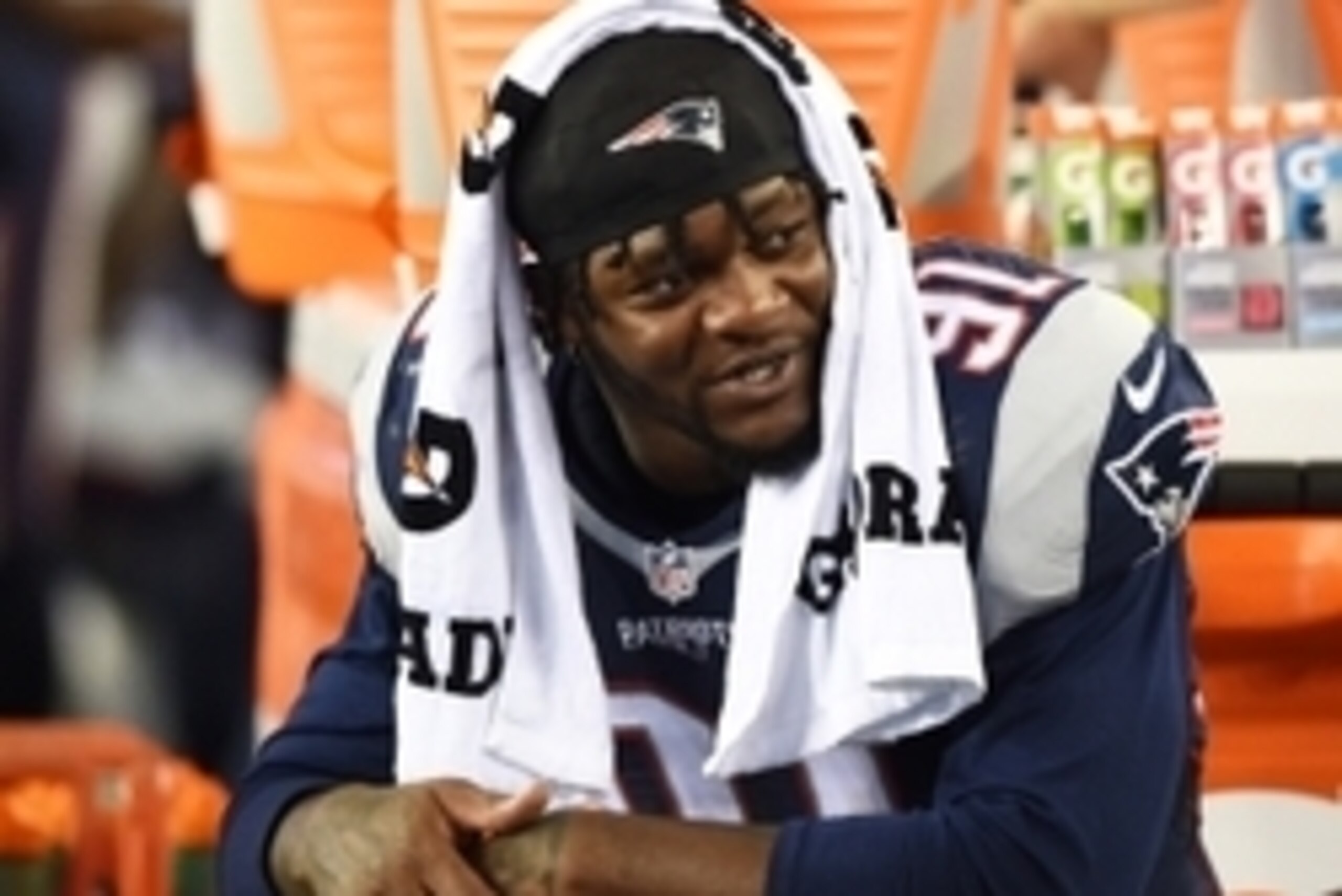
That being said, Jamie Collins has been impressive this year for many reasons, most notably his high-level athleticism. Collins is able to run the seam against any tight end in the league, and he also possesses the strength at the line of scrimmage to be effective in the run game. Many of the inside linebackers who suit up are effective in one particular phase, whereas Collins is able to make an impact against the run, in coverage and as a pass-rusher.
As far as the trade, a third-round pick for Collins seems like a bargain for the Browns at first glance, but it’s important to note that he is set to become a free agent following this season. The Patriots may not value him at the price tag that he and his agents have set. If they weren’t sure they could retain him—and may not have wanted to anyway—then it’s wise to get something in return while you can. The Patriots would have likely landed a third- or fourth-round compensatory pick in 2018 for losing Collins, but this way they control compensation and bump it up a year by grabbing a 2017 pick.
Belichick loves to stockpile draft picks as capital, and moving Collins gives them another mid-round selection to play with. Additionally, Dont’a Hightower—the other excellent Patriots linebacker—is still around, reducing the impact of the loss of Collins.
With Collins gone, the starting inside linebacker role will likely transition to Elandon Roberts, a rookie from the University of Houston. Prior to the regular season, I considered Roberts a rookie sleeper at inside linebacker and figured he’d be a stud once he saw consistent playing time.
Like most, I didn’t foresee it coming quite so soon. Nonetheless, Roberts is hyperaggressive and loves to take on any block in any gap.
Whereas many players work laterally to avoid contact, Roberts works right through it. That tenacity will put him out of place sometimes, but Belichick likely sees an athletic, aggressive player he can mold to be a top-tier defensive starter in the league.
Question: Saints rookie wide receiver Michael Thomas has exploded in recent weeks, catching 21 of 24 targets for 271 yards and a touchdown over his past three games. The 23-year-old rookie seems to have developed a solid rapport with Drew Brees. What have you seen from him over the past few weeks, and how high is his ceiling?

Answer from Mark Schofield, WR Scout: Thomas has been a pleasure to watch the past few weeks, and he is on the same page with quarterback Drew Brees. He is smooth off the line of scrimmage and is able to evade most jams at the line and work into his route quickly. There were some questions regarding his route-running ability coming out of Ohio State, but he has provided a number of routes for Sean Payton's offense in his rookie season.
Thomas is effective on slants and vertical routes, and because of his ability on vertical routes, he can use his change-of-direction ability to cut routes short (such as on curls or comeback routes) and gain good separation. He has also been great after the catch, and that ability and his short-area quickness were on full display against the Chiefs in Week 7.
The New Orleans offense is fun to watch with Thomas, Brandin Cooks and Willie Snead. Given his athletic ability, the way he runs routes and his skill after the catch, it won't be long until Thomas is listed among the upper tier of receivers in the NFL.
.jpg?w=2560 "Seahawks Camp Football")
.jpg?w=2560 "Giants Nabers Surgery Football")

.jpg?w=2560 "WWE NXT Results, Winners, Live Grades, Reaction, Highlights Before Heatwave 2026")
.jpg?w=2560 "Players with Shocking Career Earnings 😳")