Mike Tanier's Combine Notebook, Day 3: Ezekiel Elliott Makes His First-Round Bid
INDIANAPOLIS — Here's a ridiculous thought: Ezekiel Elliott, top running back in the 2016 draft class and one of the standouts of Friday's NFL Scouting Combine workouts, plugging along as a lowly fullback.
Crazy, right? Well, it happened.
"When I first started playing football, I was a fullback," Elliott said. "My first job was to block."
TOP NEWS
.jpg?w=2560)
Deshaun slams Browns fans after blowout loss
.jpg?w=2560 "Steelers Football")
Steelers To Keep Allar, Howard
.jpg?w=2560 "Lions Bengals Football")
New Fantasy 1st-Round Mock 📋
Elliott became a fullback when he was seven years old.
"When you are seven years old, you run a wishbone. So a fullback is a fullback, but he's not really a true fullback." Translation: The young Elliott took handoffs and hammered the line over and over again against unlucky fellow second-graders.
When he entered Ohio State, Elliott was back at the least glamorous position in the backfield.
"I realized I wasn't going to be the biggest or fastest guy," Elliott said. "I was only 17 playing with a bunch of 22- and 21-year-old guys, so I was trying to find something that would set me apart."
It's a good thing Elliott moved to running back. He rushed for over 1,800 yards in back-to-back seasons with the Buckeyes. Lead-blocking and playing special teams would be a considerable waste of Elliott's talent. If he was still somehow grunting away at fullback, we would be wondering whether Elliott would be drafted at all.
Instead we are asking a more interesting question: Will Elliott be a first-round pick?
He helped his cause Friday with a blistering 4.47-second 40 time, plus a round of exceptional positional workouts. Elliott is 225 pounds and can run fast and hard. He's productive, and his developing receiving skills are good enough to contribute. He is well-respected by his teammates.
"He's definitely one of my favorite guys," Ohio State tackle Taylor Decker said this week.
"He was just fun to block for," Decker added. "I'd say the No. 1 thing was regardless of what he was doing on a play, he was going to go full speed."
First-round running backs have become rare in the NFL, though Todd Gurley and Melvin Gordon bucked that trend last year. Talent is plentiful in the middle rounds, and many teams favor committee approaches to an investment in a three-down workhorse running back. Elliott hopes to help reverse that trend.
"I think the guys last year that were first-round picks like Todd Gurley," Elliott said. "They set a standard for the younger generation coming up. I feel we're going to bring it back."
The key to the first round may come down to the running back needs of teams like the Packers, Colts and Chiefs, and to what happens in free agency to veterans like C.J. Anderson. But Elliott has another ace up his sleeve: the blocking skills he learned as a fullback.
Pass protection is what keeps many top running back prospects off the field early in their careers. Elliott isn't a phenomenal pass protector—few elite college runners are—but he has some experience and the proper mentality.
"He always talks about how he wishes he could be a lineman," Decker said of Elliott.
Linemen are more likely to earn first-round nods than running backs, but that's besides the point. Forces beyond Elliott's control may result in a later draft selection than a player with his skills and resume would like. But Elliott took care of all the forces within his control Friday.
Size Matters
Derrick Henry caused some early-week commotion when he weighed in at a whopping 247 pounds.
"I was kind of shocked I was 247 this morning, but it'll go down by tonight," Henry said. "I don't really stay at that weight."
Henry estimated that he would drop to 241 or 242 pounds from Wednesday morning to Wednesday evening. It's best not to think about where those five or six pounds would suddenly go.
Henry is huge by the standards of modern NFL running backs, but he showed just what he could do at or around 247 pounds during Friday's workouts. Henry ran a 4.54-second 40, jumped 37 inches vertically and had a broad jump of 130 inches. Those would be excellent numbers for a 220-pounder.

Freakish workout numbers aside, Henry faces the dual specters of a pair of disappointing recent Alabama running backs. Weight issues hampered Eddie Lacy's effectiveness last year, so sudden jumps to 247 pounds are a real problem. And Trent Richardson, selected third overall in the 2012 draft, was unable to translate size, speed and production into even a minimally successful NFL career.
Henry has limited value as a receiver. He carried the ball 395 times last season, so wear and tear are potential issues. He's not an exceptional cutback runner. Like Richardson (who was smaller but more versatile), Henry may be best suited barreling through the huge holes plowed open by the best offensive line outside of the NFL.
And yeah, Henry has the kind of biceps you expect to see in Asgard. But running backs don't run with their biceps.
That said, a size-athleticism combination like Henry's is rare. He's worth a look for team with a role for a sledgehammer running back.
He just might be better off trimming down to about 230 pounds. And staying there.
Standing Still (But Not Falling)
Laremy Tunsil of Ole Miss, considered by many to be the top prospect in this year's NFL draft, decided not to run the 40-yard dash or participate in the jumping drills Friday.
Tunsil also got tied to Robert Nkemdiche's intoxicated tumble from a fourth-story window in December when Nkemdiche wilted under the principal's-office level questioning of the media. "Um, yes. Laremy was there," Nkemdiche said when asked who was in the hotel room with him.
Here's a complete impact analysis of Tunsil's decision not to run and Nkemdiche's revelation:
• They have no impact.
Here's an even more complete impact analysis of Tunsil's decision not to run:
• The 40-yard dash is of limited-to-nonexistent usefulness for an offensive lineman.
• A prospect of Tunsil's caliber cannot possibly help his stock by running an exceptional 40 or jumping really high. He can, however, conceivably hurt his stock with unimpressive workout numbers.
• If Nkemdiche can't handle a softball question about his December incident without crumbling, rest assured the NFL has known for quite some time Tunsil was with Nkemdiche.
• Being in the vicinity of a friend doing something ridiculously stupid, even with alcohol and/or marijuana involved, ranks really low on the list of "character issues" the NFL is coping with right now.
Tunsil is among a tiny group of legitimate choices for the first overall pick, along with Ohio State defensive end Joey Bosa, North Dakota State quarterback Carson Wentz, Florida State defensive back Jalen Ramsey and perhaps one or two others. The Titans possess the first overall pick and Marcus Mariota, so they will not draft Wentz. Ramsey projects as a safety, an unlikely position for a first overall pick.
Tunsil is in a two-player race with Bosa. Any preference between them will come down to organizational priorities of the Titans, not a workout result or tangential involvement in a teammate's problem. And the Titans have the direction of a lily pad on a stagnant swamp, so a bold, blockbuster trade to shake up the top of the draft is hard to imagine.
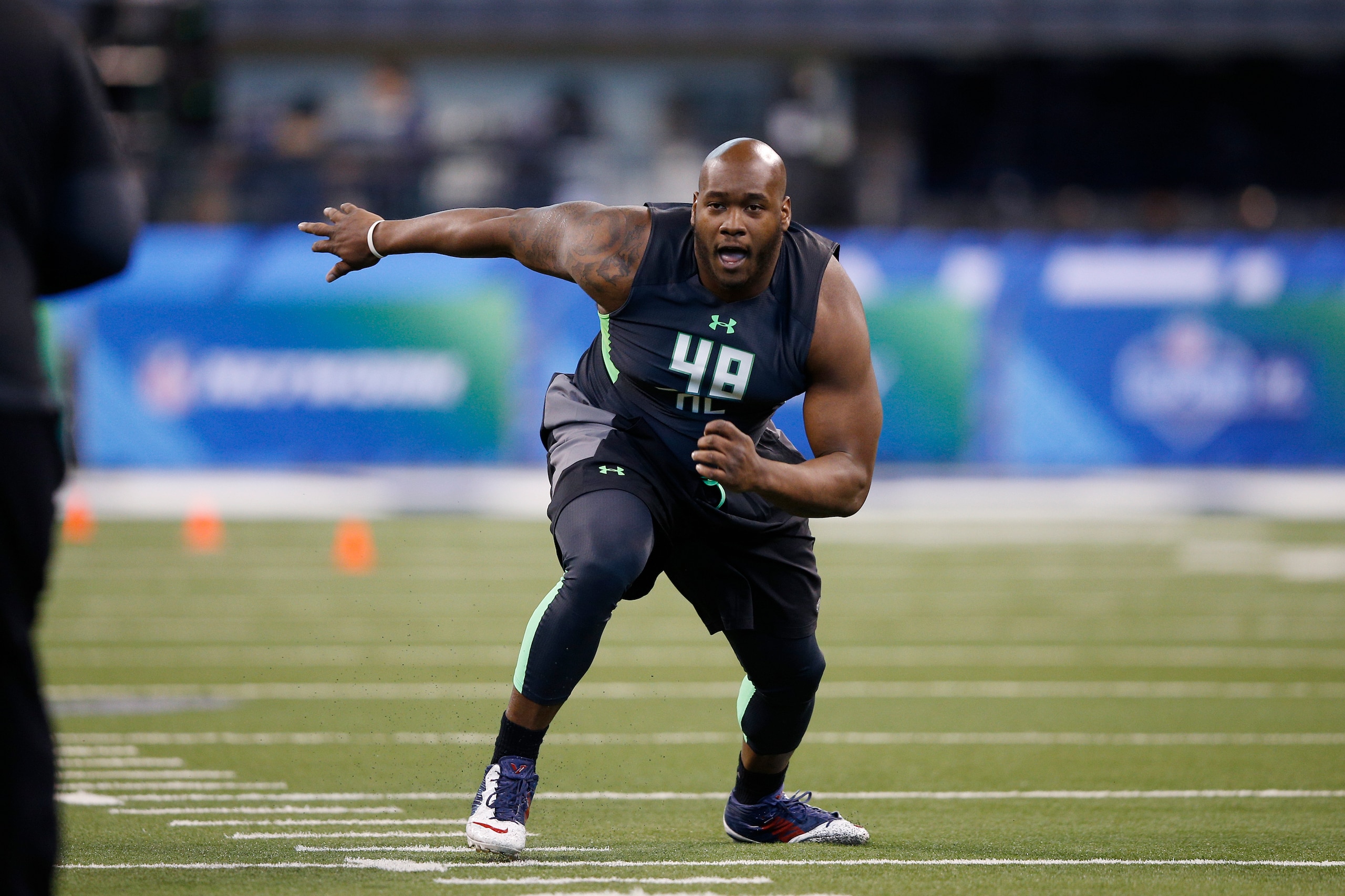
Tunsil did participate in his positional drills, the ones with some relationship to actual football skills. As he did consistently at Ole Miss, Tunsil demonstrated exceptional footwork and balance. The soft-spoken Tunsil said early in the week: "I think I have the great feet, the great frame. I just think I'm the best."
Mike Mayock gushed on NFL Network that Tunsil had "ballerina feet" and compared him to Pro Bowl left tackle Trent Williams.
So Friday can hardly be deemed a failure for Tunsil. Even though it got a little weird.
Dashing onto the Radar
Here is how not to react when a running back blows up the combine with a 4.31-second 40-time:
He's the next Chris Johnson. No, wait: the next Herschel Walker! Move him from the bottom of the seventh round to the top of the first! Start a petition for your team to draft him! Demand the resignation of any general manager that chooses a defensive tackle instead!
The other extreme—combine results are totally meaningless; this guy will be teaching middle school phys-ed by October; ho-hum, whatevs—is also not very productive.
The proper reaction to a blazing sprint is to reopen the homework folder on that running back. It's what teams do: Revisit past evaluations, double-check opinions, perhaps spool up some game film for a second look. It's what I did when Georgia's Keith Marshall ran a 4.31-second sprint at a healthy 219 pounds.
Marshall was off my radar after a pair of injury-ruined seasons for the Bulldogs. An ACL tear ended his 2013 season after five games. The injury did not heal properly, limiting him to just 12 carries in 2014. He was limited to a situational role last year, usually getting three to five carries behind Sony Michel and Nick Chubb.
That's how it goes in the major programs: Lose two years, and a younger back or two will take your place. And once a player slips from the starting lineup, he becomes a low-priority player for scouts, meaning he can slip through the cracks to a very logistically complicated player-evaluation process.
"Player-evaluation process?" Three days at the combine, and I am starting to spout cliches like a general manager. But the point is valid.
Marshall did carry 14 times for 62 yards against Penn State in a bowl game when Chubb was injured at the end of this season. It's not much, but it gives us a glimpse of Marshall beyond his 40-yard dash. He is smooth and quick, a one-cut guy with a burst through the hole and some tackle-breaking capability in the open field. Fourteen carries aren't enough for even the skeleton of a full scouting report, but they hint at the type of back Marshall can be given more opportunities.
The folks at NFLDraftBreakdown.com posted a cutup of Marshall against Penn State, so you can see for yourself!
Marshall's blistering dash proved one thing: He is back to full speed after the 2013 injury. Because Marshall was a prized recruit who ran for 759 yards as a true freshman, that makes him intriguing. He did not vault into any particular round Friday. He vaulted back into the NFL conversation.
And you thought 40-yard dashes were meaningless.
Mike Tanier covers the NFL for Bleacher Report.

.jpg?w=2560 "Rams Chiefs Football")