Malcom Brown to New England Patriots: Full Draft-Pick Breakdown
Because of their reputation, the New England Patriots are one of those organizations that will usually get the benefit of the doubt from the public when it comes to personnel evaluation. Picks like Texas defensive tackle Malcom Brown, who unexpectedly fell to No. 32, are the type of excellent values that only enhance that perception.
The Boston Globe's Shalise Manza Young originally reported that the Pats had traded out of the 32nd spot with the Houston Texans, an ostensibly reasonable move that I had actually written about earlier. The Texans, picking in the middle of the second round, would offer a spot where the Pats could extract better value from positions like wide receiver and guard.
TOP NEWS
.jpg?w=2560 "Commanders Eagles Football")
Commanders May Change Logo 👀
.jpg?w=2560 "Chargers Mack")
Most Tradeable Players on Every Team
.jpg?w=2560 "Seahawks Football Owners")
Seahawks Have No Plans to Move
But perhaps Bill Belichick and Co. pulled the offer when Brown was still sitting around. For while he's not exactly a Vince Wilfork prototype, Brown should do quite well for himself in Foxborough.
What Brown Brings
At 6'2" and 319 pounds, Brown possesses the size to play anywhere from the 0-technique nose spot (head up over the center) to the 5-technique slot (head up over tackle). That kind of versatility is his top calling card, as his skill set is ideal for the type of hybrid fronts the Patriots like to run. Bleacher Report's Erik Frenz suggested that Brown resembled one of the league's more underrated interior linemen:
Though he really only entered the first-round radar in 2014, Brown showed enough improvement to leave after his junior campaign in Austin. Defensive tackles are often imbalanced, in part because of their unusual anatomical composition by normal human standards, but Brown is really complete throughout his body. From his active hands down to his quick footwork, there really aren't any holes in his physical game.
At the same time, though, Brown will need further development to harness his three-down potential. As Pro Football Focus' Michael Mountford notes in his breakdown of Brown's game, the ex-Longhorn doesn't possess the first-step quickness of a 3-tech, meaning he'll need to develop more creative countermoves to rush the passer or else risk losing right away off the snap against NFL-caliber guards and centers:
"With the ability to beat blocks in the run game, you would expect more production from him rushing the passer, but with linemen not coming toward him, he struggles to use his hand ability in the same way since he does not have the explosion to couple with it. If Brown doesn’t win with his hands, he does not have a quick enough step off the ball to get to the outside on a consistent basis, nor does he have a second move that causes offensive linemen any stress.
"
Brown's biggest assets will be on early downs—at least at the start of his career. Mountford also noted how Brown's 10.4 percent run-stop percentage was the fourth-best among all FBS interior linemen. Thus, look for Brown to start off mostly as a 0- or 1-tech in his early career.
How Brown Fits
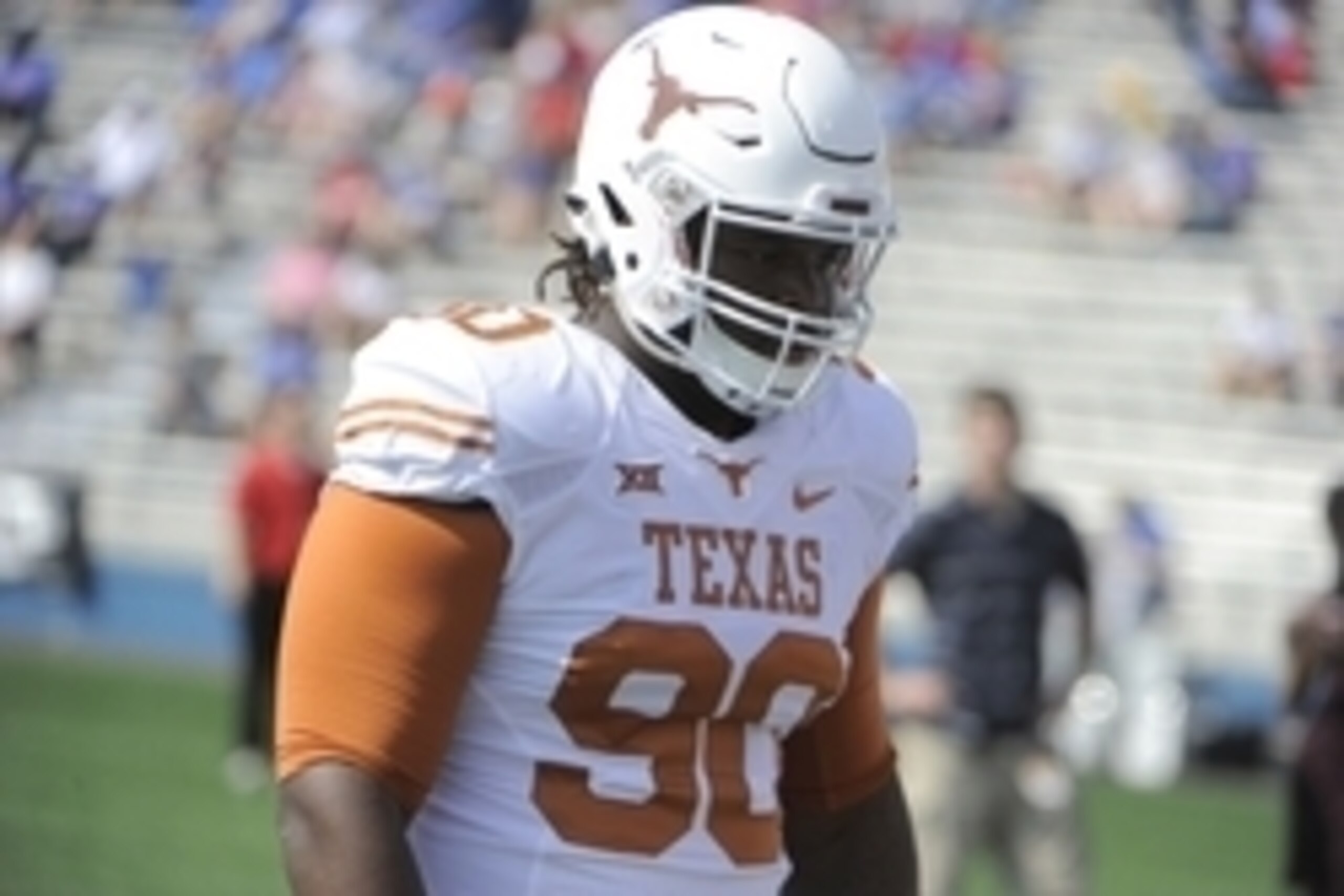
Brown will compete with Sealver Siliga and Alan Branch for interior run-stuffing roles next to presumptive 3-techniques Dominique Easley and Chris Jones. That five-man rotation should be deep enough to carry the Patriots through the season, though much of the unit's success will depend upon the progress of young DTs Easley and Brown.
Despite that uncertainty, the proposition of those two together should excite Patriots fans. Easley's development as an interior pass-rusher will in part depend upon his partner's ability to absorb blocks and keep opposing interior linemen off the 3-tech. Brown is an NFL-ready two-gapper, and the general sentiment was that the Patriots were astounded at his availability:
Brown is also one of the maturer players in the draft despite being an underclassman, making him an ideal program fit. Though there's no guarantee that he'll develop into the three-down game-changer that Wilfork was in his prime, ESPN Boston's Mike Reiss indicated that the selection reminded him of the Wilfork pick 10 years ago:
"Brown is the type of beefy, athletic, versatile lineman who should fit well in the scheme because he can play a variety of techniques -- from holding the point against the run to penetrating in the pass rush. He has three-down potential down the line. In 2004, the Patriots were surprised when Vince Wilfork was available at No. 21 and pounced. Not saying Brown is the next Wilfork, but this pick reminds me a bit of that one.
"
That Brown was available probably speaks to the league's aversion to players who might only have two-down futures. Brown will never accumulate double-digit sacks, but he's capable of pushing the pocket and giving his teammates juicy one-on-one situations, much like Wilfork did. With his expected development path, it won't be surprising if Brown becomes a similar type of player.
Bottom Line
Overall, this feels like the high-floor, high-character type of prospect the Patriots typically opt for in the first round. Brown won't be the headline act, especially early in his career, but he profiles as the type of three-down, above-average contributor against both the run and the pass that every great defense needs.
On a larger scale, the Patriots are clearly investing resources in their front seven and attempting to build a cost-controlled base there to compensate for the free-agent defections in the secondary. Between Brown, Easley, Chandler Jones, Dont'a Hightower and Jamie Collins, the Pats have five players drafted over the first two rounds who are all on their rookie contracts.
Even as the league moves toward a more spread-based approach, winning the trenches has not been any less important. Brown fills a Wilfork-sized hole, and while he'll probably split snaps with Siliga and Branch in 2015, it would be surprising if he doesn't become a fixture in Foxborough.
.jpg?w=2560 "Green Bay Steelers Football")
.jpg?w=2560 "Giants Football")