In Free Agency's Discount Phase, Ahmad Bradshaw Is 1 of the Best Options
A darkness settles when the annual NFL free-agency period enters its third week. It’s a post-apocalyptic fog, and don’t you dare look at the flowers.
The increasingly shallow free-agency pools at each position start to overflow with green sludge. They’re home to the discarded, decaying and Michael Crabtree. They’re home to those who didn’t cash in on potential, and those who don’t have any more of it. They’re home to the injured, perhaps permanently.
But if you can stand the smell for long enough, there are still possible gems to be found. Chief among them is running back Ahmad Bradshaw.
.jpg?w=2560 "Bengals Steelers Football")
.jpg?w=2560 "Falcons Steelers Football")
You just groaned. Was that a reflex after hearing Bradshaw’s name, or an imitation of what his body does after every movement?
Bradshaw has missed 19 games over the past two seasons, both spent with the Indianapolis Colts on one-year contracts. He’s easily breakable, which describes most of his fellow free-agent running backs in a depleted market. Namely, Stevan Ridley with his recovery from a torn ACL and MCL, or the likes of Chris Johnson and Steven Jackson and their recoveries from being old.
At 29, Bradshaw isn’t young either, so there’s another strike. He could also face discipline tied to marijuana possession.
Usually you head back to the dugout in shame after three strikes, which goes for both baseball and NFL free agency in late March. But with Bradshaw, more whiffing means a price that had already fallen to peanut levels is plunging even further.
The reward? A running back who’s as flawed as his free-agent peers. He’s also far more talented, and recently, far more productive in a unique and coveted role.
| Le'Veon Bell | 943 | 83 | 854 |
| Matt Forte | 1,006 | 102 | 808 |
| Fred Jackson | 563 | 66 | 501 |
| Ahmad Bradshaw (pace over 16 games) | 627 | 60 | 480 |
| Roy Helu | 382 | 42 | 477 |
Bradshaw caught 38 passes in 2014 for 300 yards before suffering a fractured fibula in Week 11. He was only 15 yards short of a new career single-season high. Please note again that Bradshaw appeared in a mere nine complete games.
His effectiveness as a pass-catcher is a product of something that becomes painfully clear when you flip on Bradshaw’s game film. And I do mean painful in the literal, bodily harm sense.
| Le'Veon Bell | 29 |
| Eddie Lacy | 24 |
| Matt Forte | 20 |
| Pierre Thomas | 20 |
| Fred Jackson | 19 |
| DeMarco Murray | 18 |
| Ahmad Bradshaw | 16 |
Bradshaw totaled 725 yards from scrimmage even in his limited playing time while ceding the lead running back role to Trent Richardson. He averaged 5.7 yards per touch, with many of the largest chunks coming as a receiver. He also logged six receiving touchdowns, and prior to 2014, Bradshaw had scored only three times through the air over seven seasons.
That’s what drew attention to Bradshaw the receiver. Finishing only three receiving touchdowns short of Marshall Faulk’s single-season running back record of nine will have that effect.
Touchdowns are circumstantial and a team-dependent metric when we’re discussing a running back who wasn’t targeted as a receiver beyond nine yards downfield, per Pro Football Focus. So to really see Bradshaw’s difference-making ability, we need to look beyond the red zone and at how he creates yards both after the catch and after contact.
A fine example of the latter came in Week 1 of the 2014 season during a loss to the Denver Broncos. Nothing special here: On 2nd-and-6, Bradshaw was Colts quarterback Andrew Luck’s final read as the bailout option in the flat and had room to run for the first down.
He took advantage of that space and set himself up with a sharp angle, minimizing the force of an oncoming tackle attempt from Broncos safety T.J. Ward. That was the first step to success and a first down, but it’s not what I want you to notice.
No, instead notice what happens when Ward makes contact.
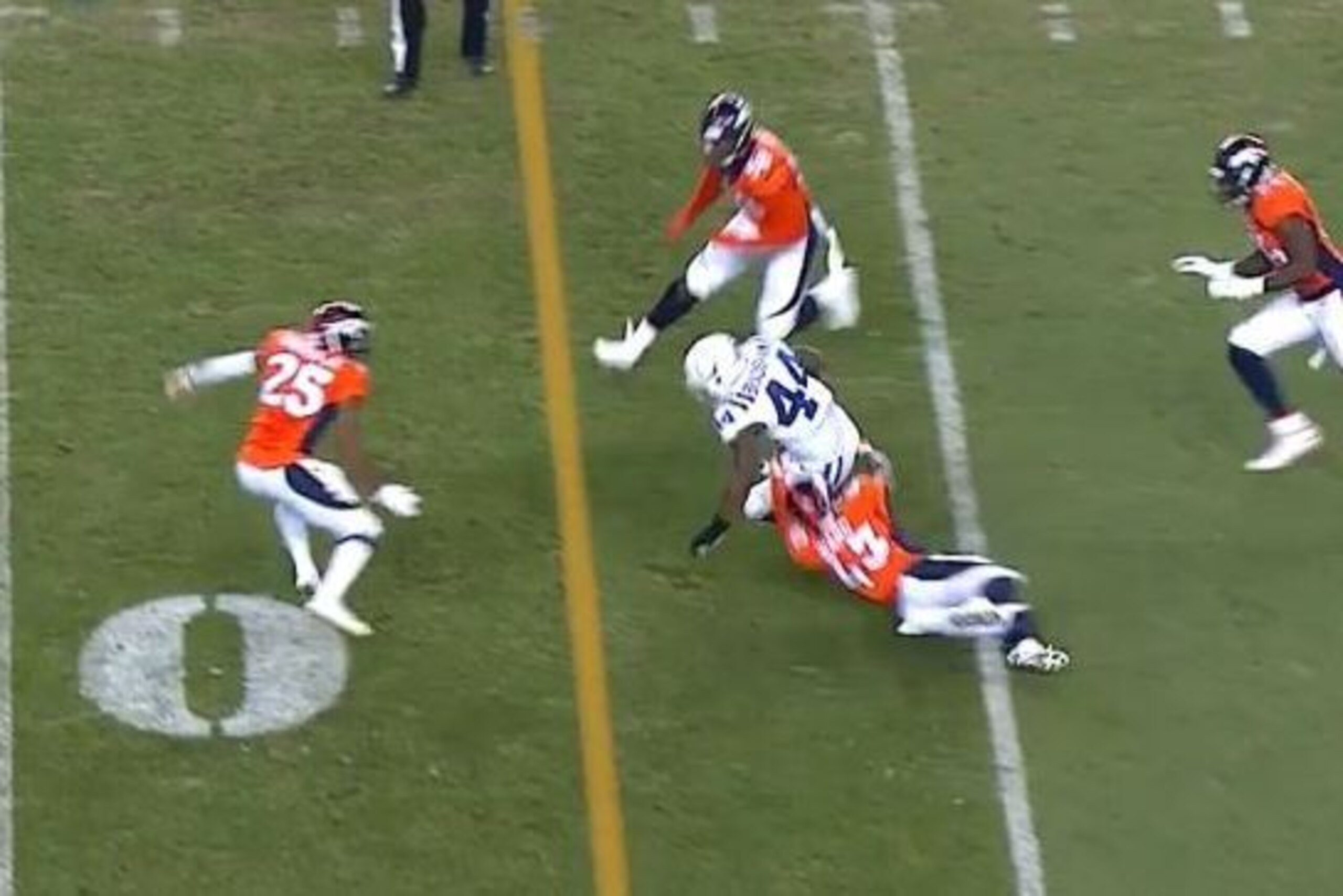
Even though he took a good angle and then acted decisively, Bradshaw was still staggered when Ward tried to drag him down from the side. He faced that first contact at the Broncos 46-yard line, and his knee fell toward the grass below while he was still a full yard shy of the first-down marker.
But balance and a powerful lower body can lead to some serious feats of strength.
Bradshaw didn’t crumble because his legs kept churning. With his left foot planted and his hand on the ground, he now braced for contact coming from the other side as linebacker Nate Irving approached.

He absorbed it while still maintaining his balance, and somehow Bradshaw still had enough force in his legs to drive forward into cornerback Chris Harris.
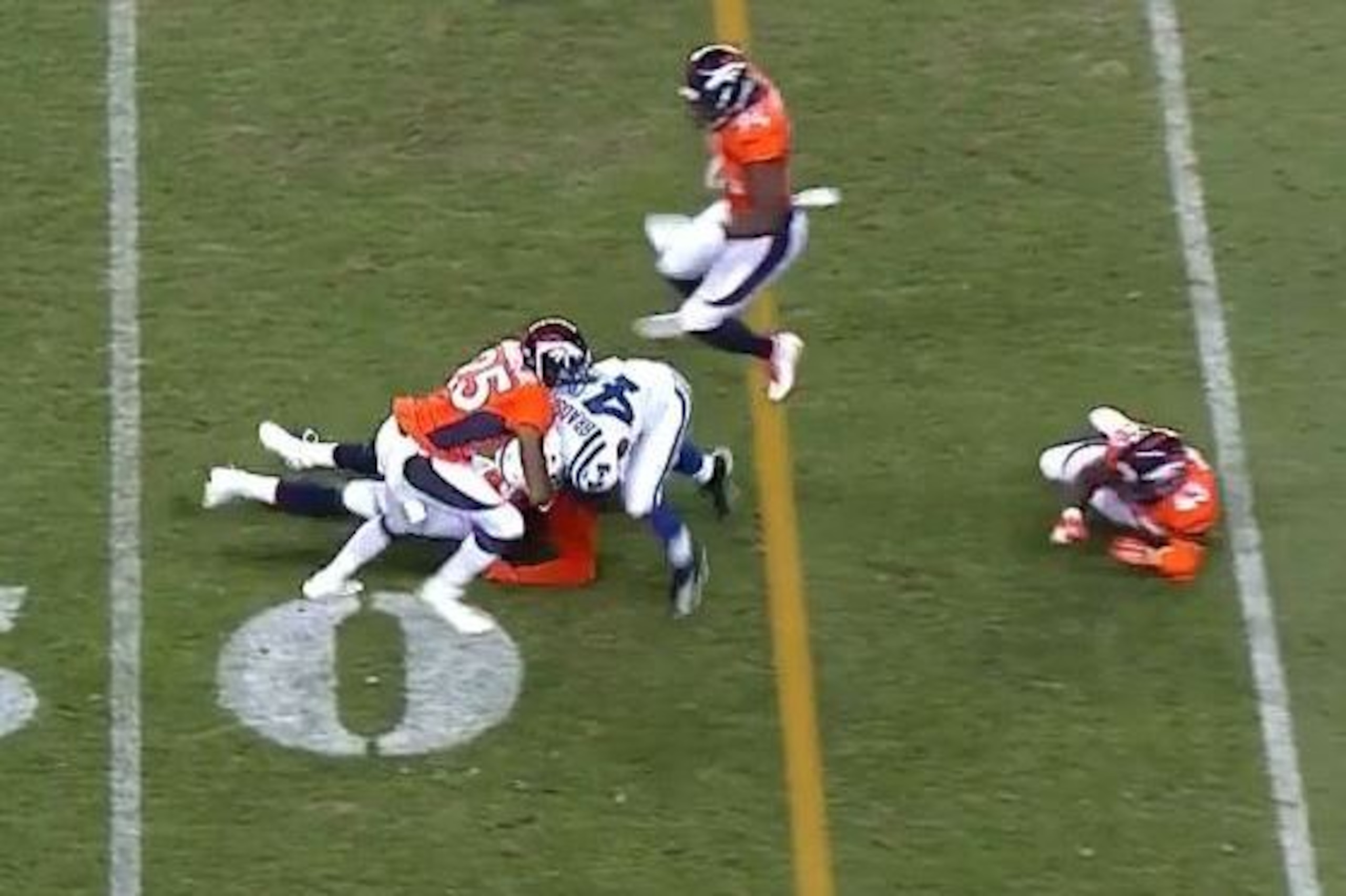
Irving bounced off, joining Ward as another sprawled defender in Bradshaw’s wake after being physically punished. Meanwhile, Harris kept moving backward until the play finally ended five yards and two missed tackles after Bradshaw faced first contact. He averaged 2.86 yards after contact per carry in 2014, per PFF.
He’s a broad-shouldered pinballing frustration for opposing defenses, and he often sends would-be tacklers tumbling in the opposite direction. When 217 pounds of running back gets chugging in the open field, halting that momentum is both difficult and painful.
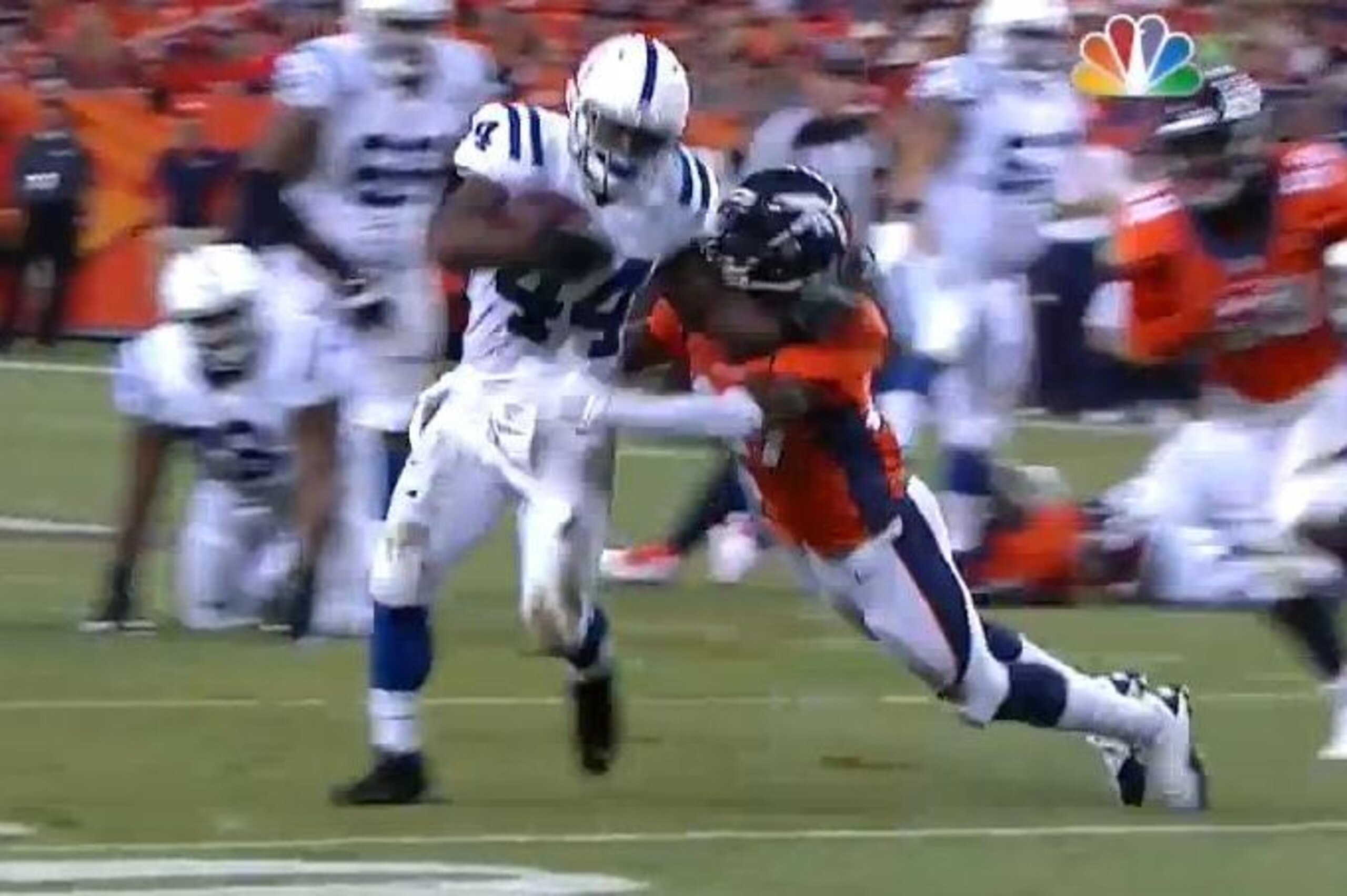
Against the Broncos alone, he created three missed tackles. Another one came two steps after running an out route from the backfield, and catching Luck’s short check down at the Colts line of scrimmage (Denver’s own 32-yard line). Bradshaw was immediately harassed by Broncos cornerback Bradley Roby.
It was a play that should have been a blip in the game log, possibly going for no gain. Instead, Roby ate first shoulder pad, then arm and finally grass while Bradshaw kept running for 16 yards.
Bradshaw shattered one career receiving high in 2014 and was on pace to do more smashing. Prior to the injury, he had plotted a course for 60 receptions, which would have been 13 more catches than his previous single-season best.
But when healthy, Bradshaw isn’t restricted to only that one trick. He can still run with power, and more importantly, with vision and patience too.
Before his season ended early Bradshaw averaged 4.7 yards per carry in 2014. He did that while taking on some serious defensive punches and counter punches, running against four defenses that would go on to be top-10 run-defending units.
His success as a runner is, of course, rooted in what makes Bradshaw thrive as a pass-catcher. He can identify space, and either take the right angle to get there before anyone else or muscle his way to it.
A prime example of Bradshaw’s ability to read his blocks and make the right decision came during a Week 2 loss to the Philadelphia Eagles.
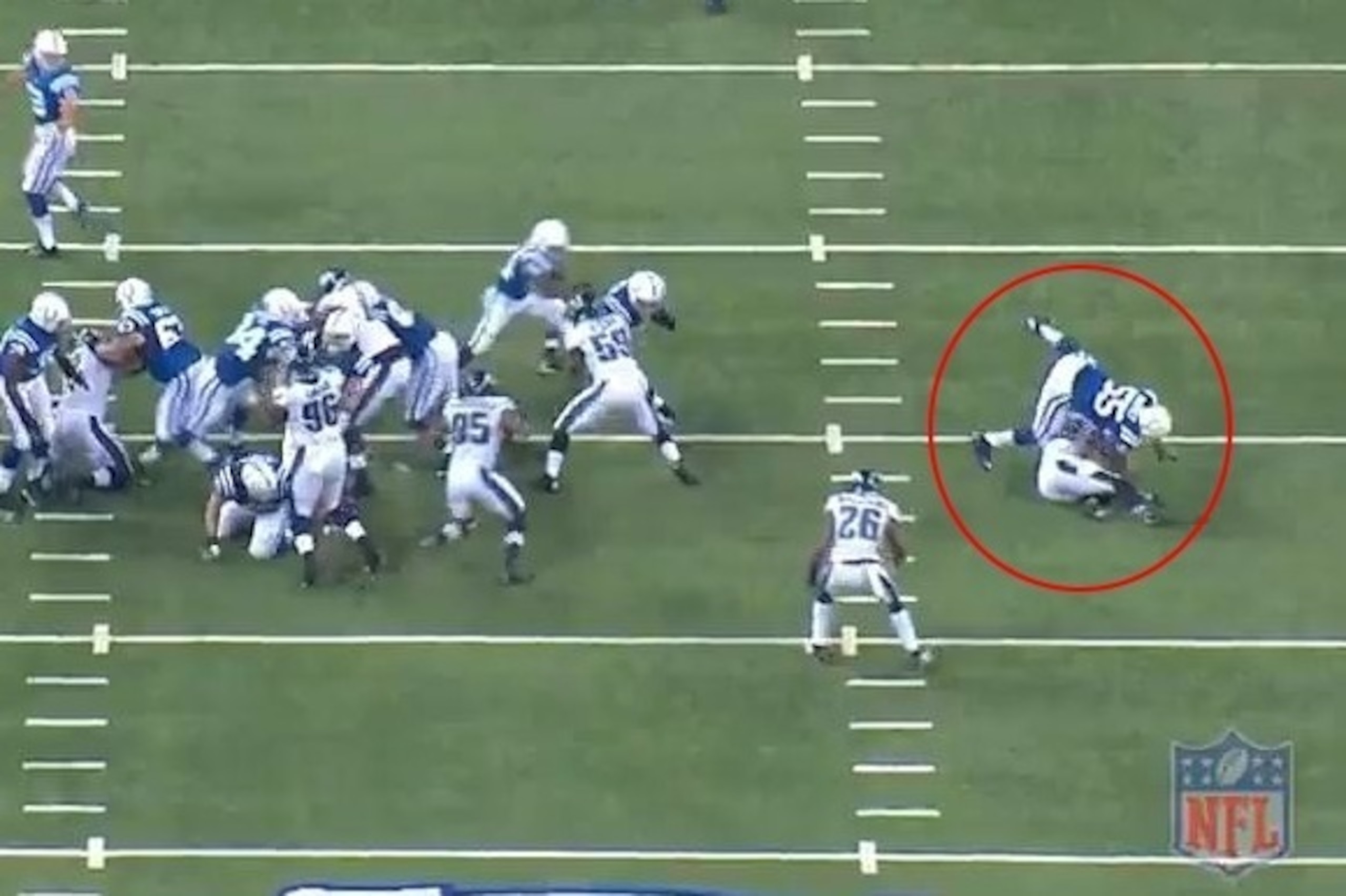
In the first quarter, Indianapolis faced a 3rd-and-1. The short-yardage situation called for a jumbo set, with more beef up front for the Colts, and consequently a crowded line of scrimmage. The Eagles brought eight men into the box.
The play was a power run to the outside. It required Bradshaw to be patient amid the chaotic mess of bodies while relying on pulling guard Hugh Thornton to impede Eagles linebacker DeMeco Ryans, who was crashing downhill fast.
Doing that meant staying disciplined and reading where his blocker had the best opportunity for leverage.

The answer? To the outside, clearly, where Colts linebacker Mario Harvey—acting as fullback Mario Harvey on this play—had already steamrolled his assignment.
With a quick stride, Bradshaw bounced to his left, going wide and taking the run outside. He wasn’t pushed out of bounds until 29 yards later, his longest run of the season.
Bradshaw’s brittle nature means he can’t carry the entire backfield load. Trying to fit him into anything even somewhat resembling a featured-back role would be poor roster management. More importantly, it would go against what goals should be during this phase of free agency.
We’re far past the second wave of free agency. The third and fourth waves are a memory, too. What’s left? A football yard sale, and Bradshaw is that dusty, buried item in between the original Battleship game (keep it real with the 1975 edition) and a bunch of novelty wine stoppers.
He’s a dice roll, one that will cost little or no guaranteed money. If he’s somehow blessed from the heavens above and able to stay healthy, then Bradshaw can be an ideal complement and secondary option alongside another younger running back.
He would slid right in with the Arizona Cardinals then, a team that needs to support Andre Ellington and has a habit of squeezing key contributions out of flawed or injured veterans on short-term deals.
A return to the Colts also can’t be ruled out, and the cap-crunched Dallas Cowboys still need some more cheap sizzle to support Darren McFadden, who comes with his own injury issues and far less recent production than Bradshaw.
The cost for Bradshaw will be slightly more than nothing after two straight injury-shortened seasons. He was paid only $855,000 on a one-year contract in 2014. For that pittance, the Colts received a player who finished tied for 14th among all running backs in touchdowns while appearing in 10 games, and playing only 50.7 percent of the snaps even when he wasn’t broken.
Bradshaw is a defective product. He’s aging, he’s injury prone and, to complicate matters further, he even has some minor off-field concerns.
He’s also the best opportunity to cash in on a free-agency lottery ticket that’s already paid out once.

.jpg?w=2560 "Eagles Bears Football")