Can Trent Richardson's Game Be Fixed?
Trent Richardson said something that prompted an instinctive eyebrow raise Thursday after the running back was finally released by the Indianapolis Colts.
He had a few interesting comments while speaking to ESPN.com’s Mike Wells, actually, so go ahead and take your pick. An apparent miscommunication over his playing weight was among them. In a few words, that disagreement perfectly summarized a rotten union between a franchise and a player who’s the product of a horribly failed trade that cost Indianapolis a first-round pick.
"We had made an agreement where I'd weigh 230 pounds, but it turns out that I was supposed to be 227 pounds, and they didn't tell me that,” Richardson told Wells. A team doesn’t quibble over three pounds with a player if he meets even the most average standards of productivity.

But there’s an easy winner for the most curious comment from Richardson. It came when he dipped deep into his bag of delusion.
“I’ll be one of the top running backs from here on out,” he said to Wells. “They ruled Marshawn Lynch off in his third year. Look what he’s doing now. My next stop, I’ll be the starter.”
The line between self-confidence and completely ignoring the reality laid before you can be a tricky one to navigate. And Richardson is clearly lost in that effort, unaware of the depth-chart burial that lies ahead.
The future could be a frightening place for Richardson, as it takes a pretty creative mind to imagine a Marshawn Lynch ending here. Without a swift course correction and the sudden ability to see the most basic developing running lane, Richardson will be out of the league soon.
Bleacher Report NFL Draft Analyst Brent Sobleski noted the distinction between how Richardson played at the college level compared to how he has played in the NFL:
The end is well within reach for Richardson. He’ll likely be signed to a minimum contract as a free agent and given an opportunity to make a roster purely because of two factors: his age at the start of next season (25), and his running back odometer that reads only 727 touches.
To put that workload in perspective, Washington Redskins running back Alfred Morris was also drafted in 2012 (incredibly, 170 picks after Richardson). After three seasons he has nearly 200 more career touches than Richardson.
Or even better, Pittsburgh Steelers running back Le’Veon Bell was drafted one year later in 2013, and his 662 career touches are closing in on Richardson's total. Of course, Bell has received those touches because he’s gone about the business of not being awful.
Many of Bell's 2013 running back draft peers have done that, too. Put them next to Richardson and we get the ultimate statement on his already-fizzled career.
| Trent Richardson | 3.3 | 2,944 |
| Giovani Bernard | 4.1 | 2,238 |
| Le'Veon Bell | 4.2 | 3,474 |
| Eddie Lacy | 4.4 | 3,001 |
| Andre Ellington | 4.1 | 2,078 |
Youth and a lack of physical pummeling are still two prime selling points for any running back in today’s NFL, and the reasons why Richardson will land somewhere as a free agent eventually. The crumbling and short athletic life at the position leads to a constant search for low-cost, plug-and-play pieces.
Mostly, that's fueled by hope. And with Richardson it will take only one general manager who looks back fondly on his effectiveness in college while at Alabama (2,017 yards from scrimmage during his final season) to see a glimmer of life.
It seems the Tennessee Titans may be Richardson’s first chance for some wishcasting, according to Terry McCormick of TitansInsider.com:
But age and workload-based dreaming will merely give Richardson an opportunity. It’ll be a fleeting one, and it’ll come in the form of a contract that doubles as a lottery ticket. If he makes a roster and can contribute anything of meaning, he’ll do it for nearly no guaranteed money while having to claw up a depth chart.
Richardson is quick to blame a “bad marriage” with general manager Ryan Grigson for his decline in Indianapolis, as he said to Wells. He’s unwilling to point the finger in his own direction where it belongs.
A running back who has been deemed worthy of two first-round picks in his career (the first from the Cleveland Browns to draft him and the second in the trade to Indianapolis) doesn’t get benched during a playoff game due to a disagreement with management. He doesn’t first lose his job to Vick Ballard and then Dan Herron before also falling behind the amazingly named Zurlon Tipton, a practice-squad player.
External forces beyond Richardson’s control can’t be blamed for his failure to record a 100-plus yard rushing game with the Colts. And a sour relationship with management certainly isn’t the cause of this odor-emitting history: Richardson has the second-worst yards-per-carry average of any running back with at least 500 carries since 1979, according to NFL.com’s Gregg Rosenthal.
No, Richardson has been the author of his own demise by continually choosing the yellow path, as noted by CBSSports.com's Pete Prisco:
Vision is a fundamental flaw for Richardson as a runner, and it could eventually be a fatal one too.
Throughout his collegiate career at Alabama, he ran downhill decisively with force. He was everything the NFL wanted in a power running back.
But in the pros, Richardson’s lack of natural instincts has been exposed. He keeps choosing bodies instead of wide-open green grass. Rashad Alaiyan provides an example:
"Trent Richardson's career summed up in one photo. pic.twitter.com/I773ndcAYd
— Rashad Alaiyan (@rashadalaiyan) March 12, 2015"
Moments of blindness are scattered throughout Richardson’s game film. Some are more egregious than others, but a common thread remains: A running back with plenty of bulk and sufficient speed to hit holes hard while muscling through tackles turns the opposite way when given the chance for a productive gain.
Let’s flip to Week 4 of 2014. Indianapolis beat the Titans 41-17 with little help from Richardson, who averaged 2.35 yards per carry. Late in the second quarter, the Colts ran a counter play that called for Richardson to cut back to his right.
A hole was emerging there. Not a gaping one and maybe only enough daylight for a four-yard gain. But that’s not an opportunity you pass on as a running back—especially not on first down and especially not in the red zone.
Yet there was Richardson, choosing the yellow path again.

Richardson should have planted himself and then accelerated with power to the right side. That’s where Titans defensive tackle Jurrell Casey was partially blocked. With a surge in that direction, Richardson had the space to build momentum and a far better chance to either drive past or through Casey.
The play offered him something on the right, which was intended in its design. There was absolutely nothing to the left, which is where the play died when Richardson completely stopped in the backfield and juked toward an unblocked linebacker.
With Richardson there’s always backfield hesitation. He can’t act on what’s in front of him without identifying it first, which always seems to be a struggle. He waits in the backfield so often that even when he has a legitimate opportunity to bounce outside, it also goes completely unnoticed.
In Week 6 against the Houston Texans, Richardson took a handoff on a play designed to go up the middle, with tight end Dwayne Allen acting as his fullback. Almost immediately he stopped after Texans defensive end J.J. Watt and linebacker Whitney Mercilus were closing in off both edges.
He shouldn’t have stopped. But since he did, there was a decision to make: either keep pushing ahead to gain any yardage possible or quickly jump to the outside, where much more space was suddenly available.
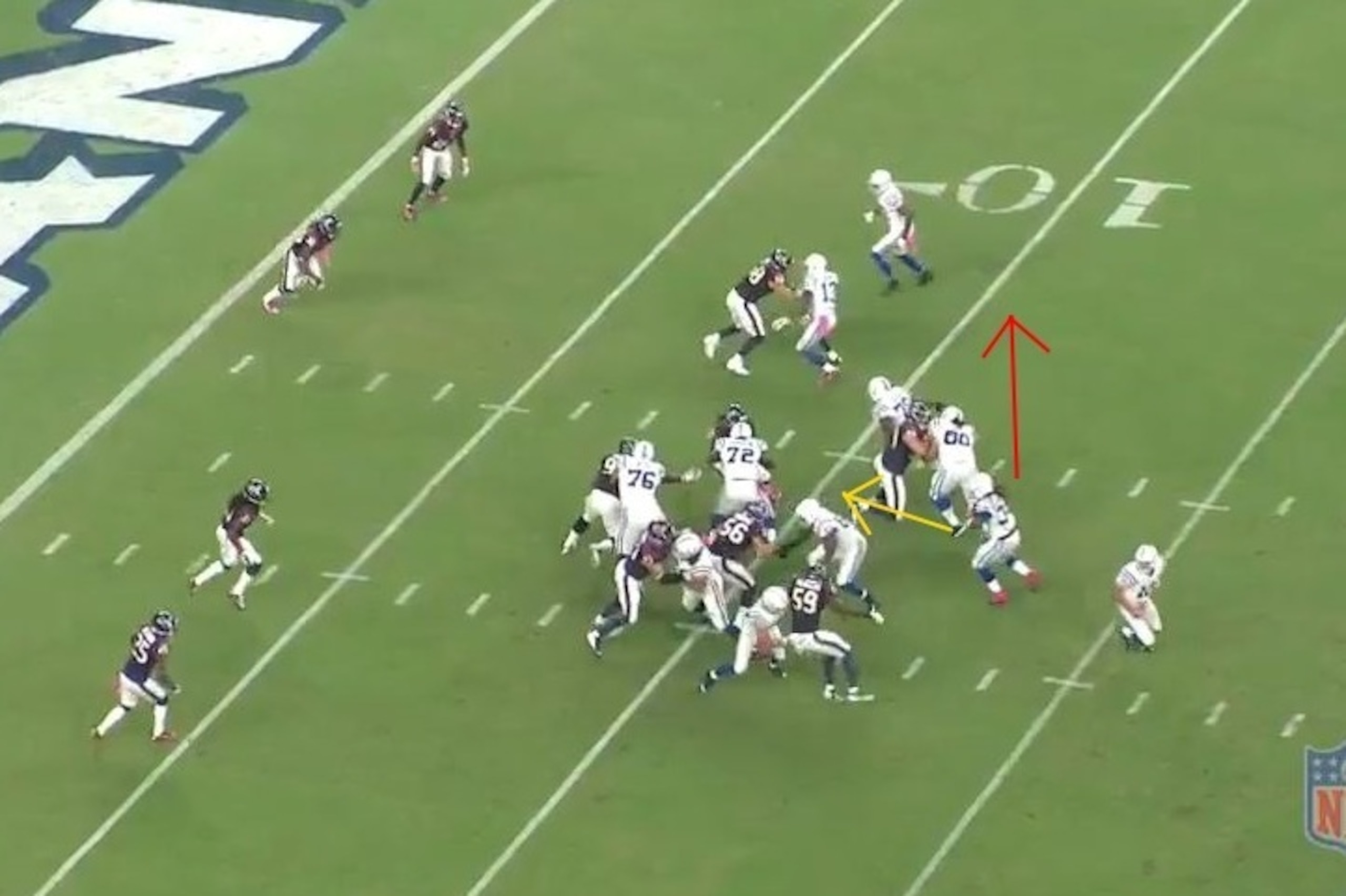
Richardson didn’t have the vision or athleticism to pursue the red path, and he didn’t follow the yellow arrow with authority either. Instead he stutter-stepped some more and then braced to be swarmed.
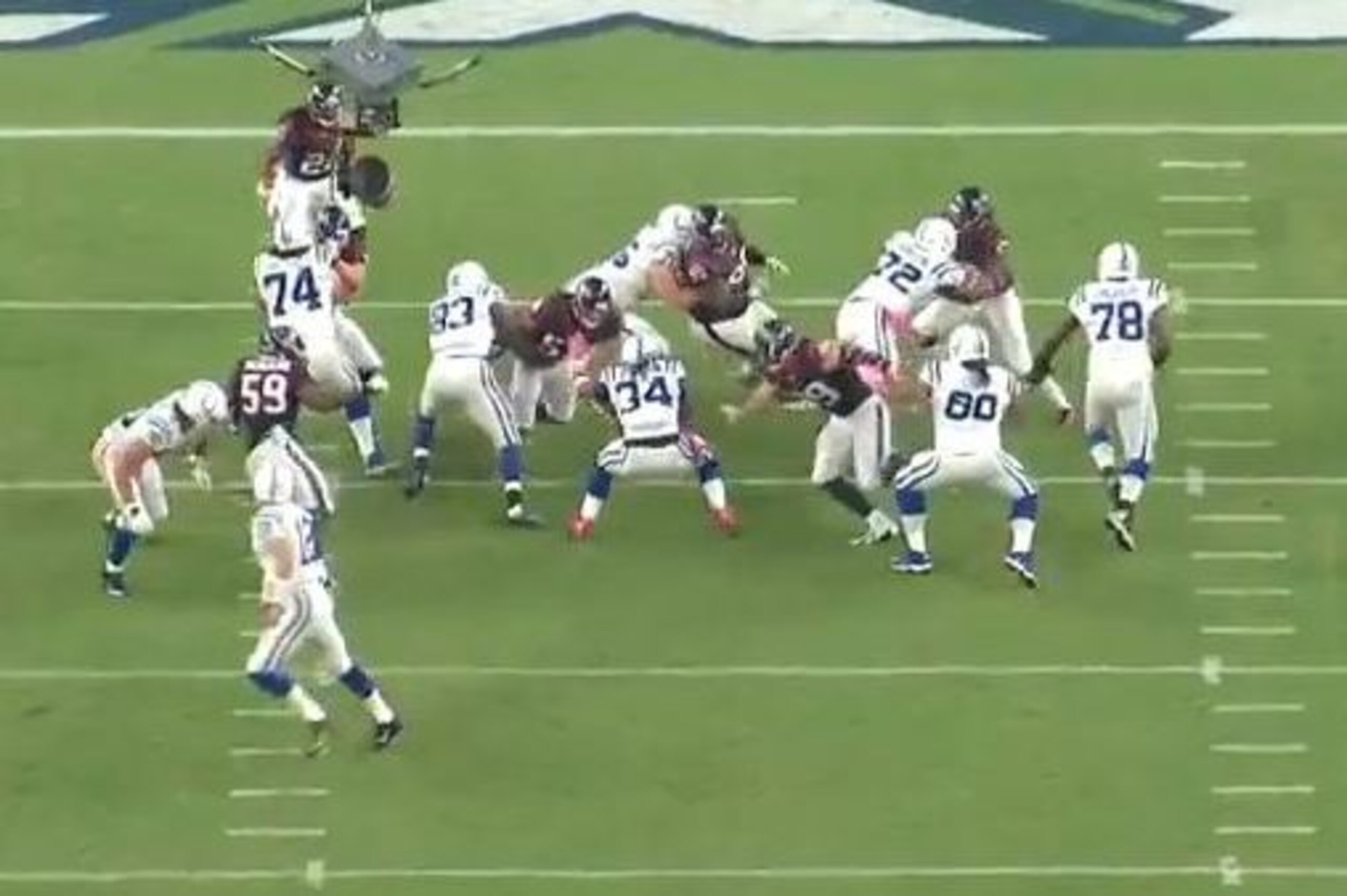
Richardson’s body type says he’s a power running back, but he lacks power instincts and the willingness to barrel through a hole with full force.
His actions often say he wants to be a creative running back, one who weaves and jukes before exploiting an opening. But his movements are cumbersome, and he doesn’t have the fluid footwork to dangle around traffic and reach the outside.
Mentally, Richardson is somewhere in the space between those two running styles of power and finesse. Wherever he plays next, repairing a running back who’s strayed far from what made him a coveted draft prospect will require instilling more decisiveness.
It’ll be a process of returning him to fundamentals and teaching what should be a natural skill for any NFL running back, especially one worthy of being a first-round pick: vision.
Executing isn’t possible when sight is absent. That is why Richardson’s core problem could prove to be an insurmountable challenge.
Sean Tomlinson is an NFL Analyst for Bleacher Report. Follow him on Twitter.
.jpg?w=2560 "Cowboys Giants Football")
.jpg?w=2560 "Grading WWE Raw 🔠")