What Can We Expect from Adrian Peterson in Potential Return to the NFL?
Adrian Peterson is a Minnesota Viking again...soon, probably.
Judge David Doty ruled in favor of Peterson and the NFLPA on Thursday, vacating his suspension. Per Michael McCann of Sports Illustrated, the ruling puts Peterson's suspension back in the hands of Roger Goodell, who put the running back on the commissioner's exempt list once more as the league appeals the decision. There's no knowing how long he'll stay there or if he'll ever be a Viking again.
Some in the Vikings organization have been clear they want him back, as this press release on the team's official site makes clear. Some might instead prefer to get the massive amount of cap room back, allowing a player who brought considerable stress and shame to the House of Wilf to be someone else's problem.
.jpg?w=2560 "Broncos Chiefs Football")
Whether he stays or goes he'll be playing NFL football in 2015. How well will he play, no matter where he ends up?
When fans think about Peterson they conjure up "All Day," an unstoppable force of nature who rushed for a stunning 2,097 yards and 12 touchdowns en route to the league MVP just eight months after rupturing an ACL.
Even by Peterson's lofty standards, his 2012 season was exceptional. He averaged a whopping 131.1 yards per game and 6.0 yards per carry. Those figures are up from still-outstanding averages of 92 yards per game and 4.74 yards per carry across the rest of his career.
Peterson has been remarkably consistent from the first day he laced up NFL cleats. After that monster 2012 season, he had a 1,266-yard, 10-touchdown campaign that's nose-on his career averages.
Lest you think this is something special about Minnesota, remember how wildly different the Vikings have been since Peterson's arrival.
He's played alongside quarterbacks like Tarvaris Jackson and Gus Frerotte, Brett Favre and Donovan McNabb, Christian Ponder and Matt Cassel. Fifteen different offensive linemen have started at least one game blocking for Peterson, per Pro-Football-Reference.com, and he's done it for two different head coaches (and no matter where he plays will play under a third). The Vikings have ranked as high in scoring as third and as low in scoring as 28th.
Throughout it all, Peterson has been Peterson.
He's made the Pro Bowl every season in which he played at least 13 games (six out of eight) and has been named first-team All-Pro three times. Going into the 2014 season, B/R scouts graded Peterson out as the No. 1 running back in the NFL. He's a rock, a franchise cornerstone.
Well, he was.
Since Peterson's well-below-par 2014 debut (21 carries, 75 yards, no touchdowns), we haven't seen him play at all. He turns 30 years old on March 21, and he's already carried the ball a whopping 2,054 times. Only 35 backs in NFL history have more carries. Per Pro-Football-Reference.com, 15 of the 25 eligible runners that prolific are already in the Pro Football Hall of Fame.
Peterson's yards-per-carry average of 4.96 puts him third-best among this group behind only Jim Brown and Barry Sanders and ahead of legends such as Tiki Barber, Eric Dickerson and Marshall Faulk. What do those Brown, Sanders and Barber have in common? They famously retired at the top of their game, well before their skills started to diminish.
It's commonly understood that tailbacks age faster than any other position group. Trying to predict exactly when they fall off has been one of football analytics' oldest hobby horses.
Football Outsiders proposed the Curse of 370 over a decade ago, noting running backs tend to crash back to earth after 370-plus-carry seasons. Aaron Schatz walked it back a little in 2007 to a general principle: Backs who approach or exceed 370 carries (like the Dallas Cowboys' DeMarco Murray did in 2014) rarely remain healthy and productive the next season.
In 2012, Chase Stuart of FootballPerspective.com looked at a group of quality tailbacks' "RYO2.0," or per-season rushing yards above and beyond a 2.0 yards-per-carry average. Any street free agent should be able to average at least two yards a carry; it's the yardage beyond that that makes a quality back.
Stuart found 36 backs who rushed for at least 5,000 yards with at least a 4.0 yards-per-carry average, all of whom came into the league no earlier than 1990 and retired no later than 2012.
Counting only active players, the RYO2.0 average fell about 20 percent from age 28 to age 31 then nosedived to almost half that much from age 31 to age 32. The average took another massive nosedive at age 34 to nearly zero.
Counting backs who dropped out of the league entirely as zeroes, their collective RYO2.0 collectively fell by half from age 28 to age 31, fell by roughly 60 percent from age 31 to age 32 and hit zero by age 34.
ESPN Stats & Information looked at every back since 2001 who played at least four seasons—a much broader group—and saw a long, general decline following a peak at age 27.
Stuart followed up in 2014 with a compelling model of running back performance by age built on every running back since 1970 with back-to-back seasons of at least 150 carries. With a couple of tweaks, we can compare Peterson's real-life statistics with Stuart's model:
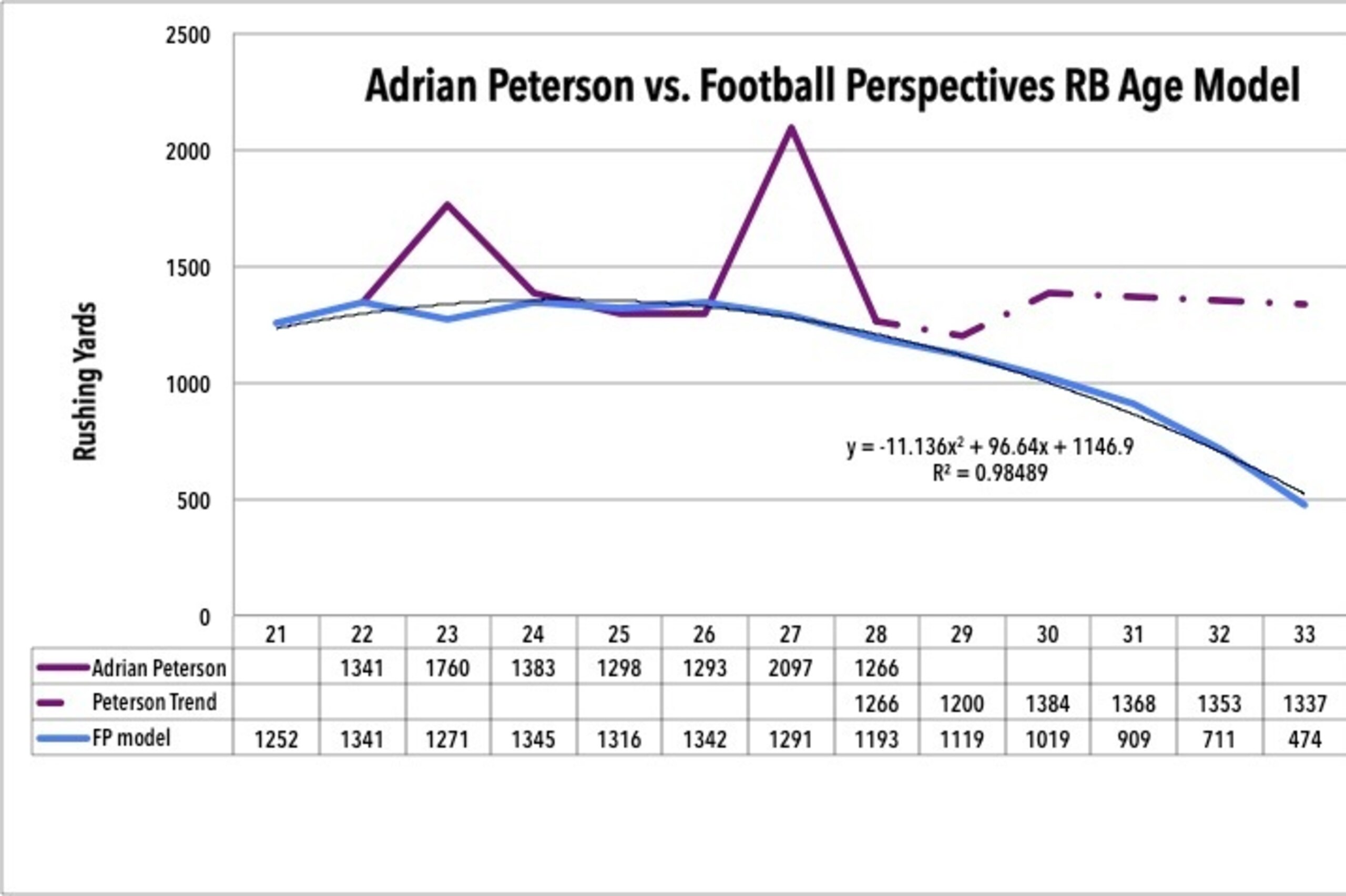
First, we adjust the start point of that model from 1,000 yards to 1,252 yards so the age projection is correct for Peterson's rookie season. Then, we extrapolate Peterson's 2011 and 2014 seasons out to their 16-game average. Statistically, that wouldn't normally be sound, but they fit right in with his career norms.
The dashed line is future projections based on Peterson's personal trend. His two incredible peak years at age 23 and 27 are way out of line with the average progression, and they push his latter-year projections way up. As the chart shows, he is on track to break 1,200 yards for as long as he feels like it.
However, besides those two peak years, Peterson is almost spookily on track with Stuart's model, which projects a 1,019-yard season for him in 2015 and a 909-yard season in 2016. If he follows the same trend most primary running backs do, he'll hit the wall almost as soon as he hits the field.
How can Peterson's 2015 team stave off the inevitable?
It helps that his effectiveness doesn't dwindle with a higher workload, nor does he necessarily need many carries to be effective. In fact, he averaged 5.6 yards per carry as a rookie in 2007, the second-highest mark of his career, with a career-low 17 carries per game.
Maybe the best solution for whichever team ends up with Peterson in 2015 is to pair him with a Chester Taylor-esque player—someone who can "vulture" about 100 attempts for 400 yards or so with 40-50 catches as Taylor did in 2008.
Obviously, a team with a strong offensive line and viable pass game would be an ideal fit for Peterson. The Cowboys, for whom interest already seems to be mutual, the Baltimore Ravens and Chicago Bears leap immediately to mind.
Will Peterson regress to the mean or continue to defy the odds and chase Brown, Sanders, Walter Payton and Emmitt Smith for the all-time records?
The truth will likely be somewhere in the middle. Peterson is a truly special back, and his recovery and pain tolerance have proved to be exceptional. But Father Time comes for all of us, and it seems unlikely Peterson will hold up over 2.15 times his current carry total, as Smith did.
Whichever team pays Peterson to play football in 2015 will almost certainly get great production from him. After that, however, it's betting against history.


.jpg?w=2560 "Week 1 Fantasy Duds 👎")