
Why Duke Johnson Will Be 2015 NFL Draft's Best Value Pick
Every NFL draft forces difficult decisions on general managers and head coaches.
This year, some of the more difficult decisions are going to involve running backs. Running backs have been devalued more than ever in the NFL over the past two years, but the 2015 class boasts a huge amount of talent.
After two years with no back going in the first round, two players are regularly being mocked as first-round picks this year.
.jpg?w=2560 "Broncos Chiefs Football")
Todd Gurley of Georgia was possibly going to go in the top 10 of the draft before he tore his ACL in November. Melvin Gordon of Wisconsin is fully healthy and coming off a hugely productive season in which he showed off all of his explosiveness.
Both Gordon and Gurley could conceivably go in the first round. Both players have the talent to be first-round picks, but part of the decision to draft either player that high is the potential value in later rounds.
Past the perceived top two backs of this class, there is a group of players at the position who will likely go in the second round and eventually become quality starters. One of the players regularly included in that group is Duke Johnson.
Johnson is arguably the most well-rounded running back coming out this year if you include health to discount Gurley.
Vision
The difference between a high-quality college running back and an NFL starter is often non-physical.
Backs who primarily rely on their speed or power to be productive at the college level find it harder to translate to the NFL because the professional level boasts a significantly better caliber of athlete from top to bottom.
You still need to be physically gifted to be effective in the NFL, but vision, decision-making, footwork and poise become even more important. Fortunately for Johnson, his technical ability is as good as, if not even better, than his physical ability.
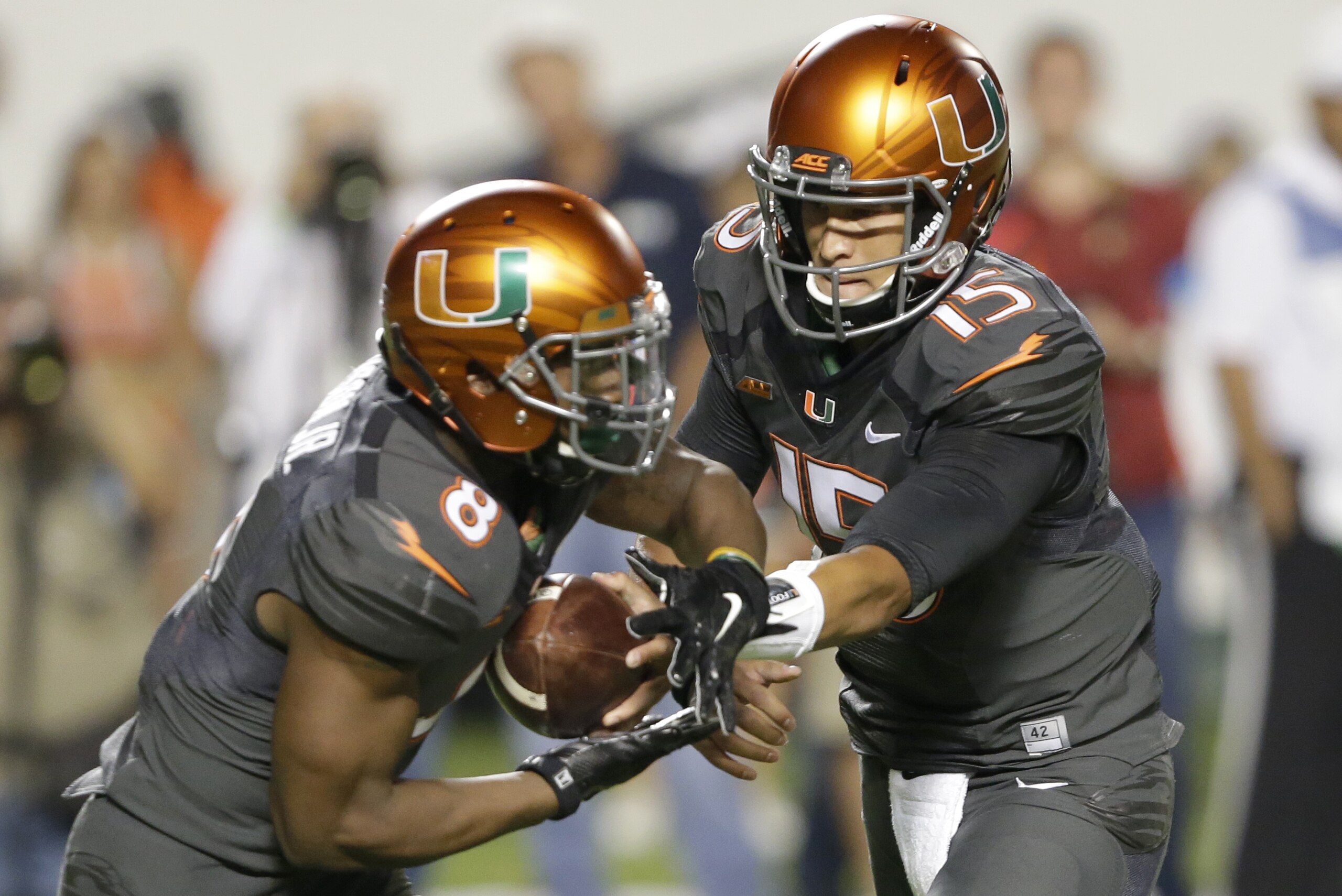
Johnson has proved to be an intelligent runner in college. On his way to setting a Miami record for rushing yards, 3,519 yards over three seasons, Johnson was often the best player on the field. He wasn't simply stockpiling yardage while playing behind a dominant offensive line or in an offense that pulled all of the attention away from him.
Instead he was regularly put in tough situations where the defense was focusing on him, and he needed to create yardage at every level of the play.
Before the line of scrimmage, Johnson often did his best work when he was asked to set up and attack cutback lanes. While he shouldn't be limited to being a one-cut runner behind a zone-blocking line in the NFL, that may be where he would excel the most.
This play is running at half speed so we can recognize how Johnson reads the defense.

At the snap, the offensive line doesn't slide to either side in a zone approach. Instead, the interior of the line attempts to double down on both defensive tackles. The right defensive tackle is aggressive against the left guard's outside shoulder, though, so the center never really engages the defensive tackle.
When the center continues downfield instead of sealing off the right defensive tackle, Johnson is met by an opponent at the line of scrimmage directly where he was running toward.
Johnson is quick to recognize this defender's presence in his immediate running lane. He turns back toward the other side of the field before pushing hard toward his right tackle when he reaches the line of scrimmage. This hard push allowed Johnson to escape away from the linebacker who had aggressively filled the area the center had vacated.
With his quickness and balance, Johnson is able to show off his vision by getting to the second level of the defense without being touched.
Too often quicker running backs are too aggressive in pursuit of cutback lanes or opportunities to run toward the sideline. They leave yardage on the field by not being aggressive between the tackles or by not pressing holes that already exist in front of them when running stretch plays.
Johnson has a natural ability to be a disciplined runner. He doesn't force cutback plays, but he is still aggressive in pursuit of them when the play calls for it. Because of that, he was regularly able to exploit space when his offensive line effectively executed on zone runs.


On both of these plays, Johnson recognizes the cutback opportunity and perfectly times his cut to prevent any defenders from impeding his route to the second level. With his short-area quickness and his straight-line burst, it's easy for Johnson to adjust in tight areas or reverse his momentum faster than bigger front-seven players.
Physicality
It's clear that Johnson isn't a big back who will be able to punish NFL players as a runner.
Yet, despite his relatively lean frame (5'9", 206 lbs), the young back has the strength to shed tackles and the power to withstand hits between the tackles. Johnson has shown off the ability to break arm tackles of linebackers and defensive linemen, hand off linebackers and shrug off defensive backs' tackle attempts in space.

On this play, the running back is met by an incoming outside linebacker who penetrates past the tight end to the right of the formation. That linebacker is still being contacted by the tight end as he hits Johnson, but Johnson still needs to break through his tackle attempt.
With his robust running style, Johnson is able to run through the tackle attempt. However, from there he accelerates into his own blocker.
Accelerating into his own blocker stopped Johnson's momentum. The Miami back had to reaccelerate before hitting his next tackler five yards past the line of scrimmage. After kicking his leg away from the linebacker on the ground, Johnson runs into two players.
He falls sideways more than forward, but it's significant that he wasn't hit heavily or punished by being knocked backward at the end of the play.
It's unlikely that Johnson will be able to run directly over any NFL players. Save for some cornerbacks, most NFL players should expect to take Johnson down in tight situations such as the one above. Johnson's effectiveness is greater when he can use his hands to fend off tackles.

On this play, Johnson is immediately put in more space, working one-on-one against a linebacker. When that linebacker attempts to extend low toward Johnson's waist, the running back pushes him away with his right arm.
Johnson got his hand on the linebacker's inside shoulder to control his movement and push off so that he could continue downfield.
He doesn't need to be exceptionally strong as a back. Instead, Johnson just needs to be strong enough to take advantage of his speed advantages in space. His balance and quickness will keep linebackers second-guessing in situations like these, whereas defensive backs are more likely to slide off of him at speed.
That is what happened on this play.

Johnson initially attacks the right side of his offensive line, but the defense is aggressive in attacking his first running lane. When he breaks outside, a deep safety from the opposite side of the field closes on him behind the line of scrimmage.
Although that safety is able to bring Johnson down, his tackle doesn't bring Johnson down before he can reach across for the first down.
Having enough strength to stay upright on this play was impressive because many smaller backs would have been taken down. Even though it didn't occur between the tackles, it's this kind of resilience that allows Johnson to be a well-rounded back who can succeed both inside and outside at the NFL level.
Explosiveness
In this draft, Todd Gurley exists as a power-based running back, and Melvin Gordon exists as a speed-based running back. Both players are expected to go ahead of Johnson. While Gurley can match and better Johnson in most areas, the biggest difference between him and Gordon is speed.
Gordon is the definition of a home run hitter.
The Wisconsin running back is the kind of player who threatens the end zone no matter where he is on the field. His quickness and acceleration are impressive, but his long speed separates him from his peers. Johnson's quickness and acceleration are comparable, but his long speed is a notch below Gordon's.
Johnson will likely never rip off an 80-yard run in the NFL, but that doesn't mean he can't be an effective big-play threat.

Long speed is often overrated in the NFL for all positions, and running back is no exception. The 21-year-old should only need to prove capable of running for 30 or 40 yards when opportunities present themselves. As the above play shows, Johnson has the ability to eat up space quickly.
Receiving
Johnson is a pro-ready running back. He likely won't immediately become a feature back in the NFL, but he should be a valuable receiving option in a rotation.
His ability in pass protection is relatively impressive, and he can line up out wide if required. What makes Johnson such a valuable receiver is his natural receiving ability and his comfort working in space against linebackers and defensive backs.
Although he doesn't have a great catch radius, Johnson is able to adjust to the football when it isn't perfectly thrown to him.


On both of these plays, Johnson has to adjust to the football like a wide receiver. He can't simply run through his route and catch the ball in stride. By locating the football early and effectively tracking it through the air, Johnson is able to protect the ball and make clean catches on both plays.
Because of these abilities, Johnson can immediately be a high-volume receiving option out of the backfield in the NFL.
That ability to move the chains consistently is obviously valuable. As Darren Sproles has shown over the past two years in particular, providing an outlet from the backfield for the quarterback can elevate the passing game as a whole.
When that outlet is able to threaten the defense deep on a regular basis, it becomes even more valuable.

On this play, Johnson threatens to run into the flat before decisively and quickly cutting upfield. He breaks past the inside shoulder of the linebacker attempting to cover him before catching the ball down the seam. Johnson makes a catch that is routine for a wide receiver but less natural for a running back.
After securing the football, he is able to make the deep safety miss in space before running into the end zone for the long touchdown run.
As a second- or third-round pick, Johnson offers plenty of value to his potential suitors. He can immediately become a key contributor on a competitive team, or he can act as a foundation piece for an offense that is rebuilding.
He may not be the most talented back in the draft. But if he allows a team to save its first-round pick while still landing a quality starter he could easily prove to be the most valuable player in the draft as a whole.


.jpg?w=2560 "Week 1 Fantasy Duds 👎")