Randy Gregory Wants to Play in Certain Scheme, Ideal for Teams in Draft's Top 5
Top NFL draft prospects are so coached up throughout the evaluation process that it's refreshing when one speaks openly about exactly what he wants in a team and the scheme it employs.
In a recent interview with the Associated Press, via The News Tribune, Nebraska's Randy Gregory didn't shy away from the fact he prefers to play in a 3-4 defensive scheme because the system best fits his skill set.
"I like standing up," Gregory told the Associated Press' Eric Olson. "It serves my body better, my physical traits better, being able to see the play form and stay in an athletic stance and make plays. At the same time, if a 4-3 team comes around, I feel I can help them and play that spot."
.jpg?w=2560 "Rams 49ers Football")
At 6'6" and a listed 240 pounds, the Nebraska product is a long and angular pass-rusher who isn't best used when lined up tight across from an offensive tackle or tight end. Gregory even admitted his weight varied during his time in Lincoln.
According to Olson, the defensive end played anywhere from 230 to 255 pounds. He expects to be near 250 pounds by the start of the NFL combine on Feb. 17.
Gregory wrote a draft diary for USA TODAY, via Tom Pelissero, that discussed his attempt to add weight:
"Right now, I'm about 242 pounds. But I've been at Nebraska at over 255 pounds before and looked great, still move the same way I do now. I think I can weigh anything between 255 and 270 depending what scheme I'm in in the NFL. One of the biggest things for me is just focusing on my diet, figuring out different ways that I can help maintain my weight. I think the teams will be surprised when they see me combine day and then first day of camp.
"
The defensive end basically admitted he struggled to maintain weight, and it's unlikely he'll carry much more at the NFL level. He's a long and lean edge-rusher, and a lack of bulk could prove to be problematic for some teams that prefer larger defensive ends.
Nor should Gregory be asked to add too much weight. At 22 years old—he won't turn 23 until November—the defensive end will naturally add a few pounds as he matures and spends time in an NFL weight room.
But it can't be at the detriment of what he does best: rush the passer. It's Gregory's ability as an edge player that sets him apart and why he carries a very high draft grade as the combine approaches.
Four games against the Miami Hurricanes, Michigan State Spartans, Rutgers Scarlet Knights and USC Trojans in the Holiday Bowl were broken down to show how Gregory was used:
| Opponent | 2-point stance | 3-point stance | Pressures | Sacks |
| Miami | 64.6 | 35.4 | 2 | 2 |
| Michigan State | 10.0 | 90.0 | 2 | 0 |
| Rutgers | 7.3 | 92.7 | 2 | 2 |
| USC | 64.6 | 35.4 | 3 | 0 |
Not only does the defensive end read the play better from a two-point stance, it allows Gregory the opportunity to set up his pass rush and use his hands more effectively.
When Gregory played from a three-point stance, he generally fired straight off the ball into the blocker and struggled to disengage. From a two-point stance, he was already in position to counter the initial punch from an offensive lineman.
If those previous statistics are broken down even further during the four-game sample provided, it's obvious where Gregory's comfort level lies:
| Stance | Snaps | Pressures | Sacks | Percent of pressure |
| 2-point | 75 | 7 | 3 | 13.3 |
| 3-point | 143 | 2 | 2 | 2.8 |
What's interesting about the difference in stances is that it wasn't dependent on a particular situation. For example, Gregory didn't simply use a two-point stance during obvious pass-rush situations, which improved his numbers. It depended on the game and his apparent comfort level.
While the numbers will be skewed to a degree due to the amount of snaps taken, it's still clear that Gregory's basic numbers were better in limited opportunities.
It's now up to the teams considering Gregory to place him in the right situation for him to succeed.
All but one of the draft's top five teams could prove to be a good fit for the dynamic pass-rusher.
1. Tampa Bay Buccaneers
The one team that isn't necessarily a good fit for Gregory is the organization that's already on the clock with the first overall pick.
Buccaneers head coach Lovie Smith is well known for his usage of the Tampa 2 defense, and he wants his front four to apply pressure with little to no blitzing.
At the surface level, it would seem to be perfect for Gregory. The talented defensive end even wrote that he wants to be the top pick, and he is deserving of the choice:
"I think I'm worthy of the No. 1 pick. I would hope anybody in the draft would want to be the No. 1 pick. I know how I am as a player. I know my potential. I know what I can do. I know what I bring to a team. And I understand that this position is a premium. Everyone wants someone that can get to the quarterback. Everyone wants a quarterback. Everyone wants a left tackle that can block that guy that wants to get to the quarterback. I understand the game and where it's headed, and I understand that there's a big need, a big demand. I definitely think I'm worthy. And I definitely think I'll show that at the combine and when I get out there in the NFL.
"
However, Gregory's admission that he prefers to play in a 3-4 defense almost takes Tampa Bay out of the running. Plus, the organization is desperately searching for a quarterback, and it makes little to no sense to pass on one for Gregory with all things being considered equal.
No one can fault a prospect for trying to increase his draft value, though.
2. Tennessee Titans
This is where it will start to get real for Gregory.
The Titans transitioned to a base 3-4 defense under coordinator Ray Horton a year ago. It didn't go too well.
Tennessee finished 27th in total defense, 31st in run defense and 15th in pass defense.
Most importantly, the team didn't apply enough pressure on opposing quarterbacks in a scheme that is predicated on creating confusion, thus generating hits on those signal-callers. Tennessee finished 16th overall in sacks, and only one defender, Derrick Morgan, finished with more than five.
The Titans' problem is that the franchise didn't have the right talent in place to make a full-scale switch from their traditional four-man defensive front.
Kamerion Wimbley is an experienced 3-4 outside linebacker, but he's on the decline and didn't produce in 2014. Despite leading the team in sacks, Morgan isn't an ideal athlete as a 3-4 outside linebacker.
In order for the team to take the next step defensively, it needs a talent like Gregory to apply pressure off the edges. With the tremendous hire of Dick LeBeau as linebackers coach, Gregory could develop into the next Joey Porter, Kevin Greene or any number of highly productive linebackers to previously play in this particular system.
It all comes down to whether or not the Titans actually value the Nebraska product highly, or if they eventually decide to go in another direction. Quarterback remains a major concern, which could trump every other decision.
3. Jacksonville Jaguars
While the Jaguars manufactured far more pressure on quarterbacks than the Titans—Gus Bradley's squad tied for sixth in the category—the team's philosophy is to build a defense similar to the one its head coach left with the Seattle Seahawks.
One of the most crucial aspects of Bradley's vaunted defense is the role of "Leo." The "Leo" is the team's primary pass-rusher and its most athletic defensive lineman. Chris Clemons currently fills the role in Jacksonville, but the 12-year veteran will be 34 years old this fall. He can't be expected to maintain the primary role as the defense continues to evolve.
This is one of those situations where it doesn't appear to be ideal for Gregory, but it's closer to what he prefers than initially indicated.
The "Leo" can be used in a variety of ways—much like Gregory was at Nebraska—including rushing the passer from a two-point stance. While the defensive end wouldn't convert to full-time linebacker in Jacksonville's scheme, it would provide an opportunity to take full advantage of his natural ability.
There would also be the possibility of Bradley converting Gregory to the role of "Otto" in the scheme, which is a hybrid linebacker. It's the same position the Seahawks originally drafted Bruce Irvin to play with the 15th overall pick in the 2012 draft.
4. Oakland Raiders
Nearly everything that was written about the Jaguars' defensive system is applicable to the Raiders.
New head coach Jack Del Rio recently hired Ken Norton Jr. to serve as the team's defensive coordinator. Like Bradley, Norton is a Pete Carroll disciple. The one difference between the two is that Norton's tenure with Carroll dates back to their days with the USC Trojans.
The biggest difference between the two teams, though, is the Oakland Raiders aren't in need of a "Sam" (or "Otto") in their scheme due to the presence of Khalil Mack.
Norton raved about Mack in a recent interview, courtesy of The Score's Arun Srinivasan:
"Khalil Mack is a guy, with Bruce Irvin and the rest of my SAM linebackers, guys on the strong side, just watched his explosion, his speed, his combination of size and his strength … He's a really smart player and he loves playing ball. I've done really well with young men who have a knack of making plays and really love playing football.
"
What the Raiders lack is edge presence along their defensive line. Justin Tuck led the team with five sacks in 2014, but he should serve as a base end on the left side of the defense in Norton's scheme.
Oakland simply lacks the type of athleticism Gregory presents along its defensive line, which will make the Nebraska product a very intriguing option if he's available with the fourth overall selection.
5. Washington Redskins
Jay Gruden's squad is yet another team with a new defensive coordinator. Joe Barry is the man tasked with improving the league's 20th-ranked defense.
Barry indicated during an interview on FOX Sports 1360 San Diego that he won't be changing the team's base 3-4 scheme.
"The big names, obviously—the [DeAngelo] Halls, and the Ryan Kerrigans, and the Jason Hatchers—we’ve got good players here," he said. "We really do. And that part of it’s exciting. It’s my job and the staff’s job to get those other guys to play a little bit better than they’ve played in the past."
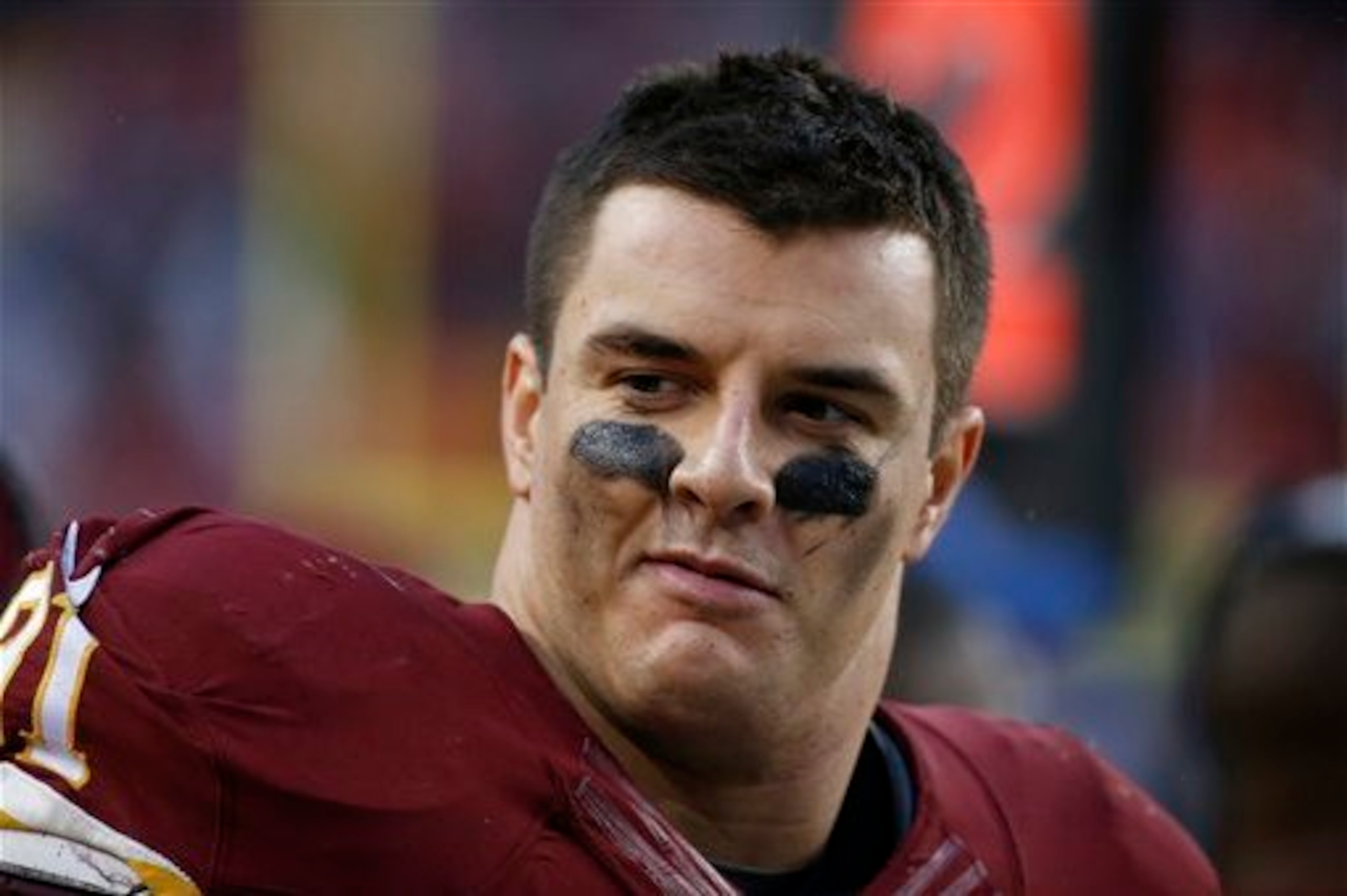
This is a good thing for Gregory on two levels. First, it's the exact scheme he wants to play in, and he would play opposite one of his idols.
Gregory originally committed to Purdue before former head coach Danny Hope was fired. But there was another person behind that decision.
"I really liked the coach at Purdue when I committed, Danny Hope," Gregory wrote. "They also had Ryan Kerrigan, and he probably didn't know this, but he's one of the guys I really looked up to coming out of high school. He's one of the main reasons why I wanted to go to Purdue."
Kerrigan has led the Redskins in sacks two of the last three seasons, and Washington needs a new bookend at outside linebacker since Brian Orakpo is an impending free agent.
There may not be a more perfect fit for Gregory than the Redskins.
Outside of the Top Five
If Gregory somehow slides on draft day, the next four teams to select—the New York Jets, Chicago Bears, Atlanta Falcons and New York Giants—could all use pass-rushing help. Those first two teams also employ 3-4 fronts.
While Gregory's preferences are clear, he also owns the type of talent that can help him excel in any scheme.
But one overlooked aspect of the NFL draft is the situation in which top talents are placed. Very talented football players fail every year because they're not in the right scheme or play for the right coaches.
Gregory is being quite savvy by stating his preference early in the process.
Teams will have to plan accordingly to use him properly. If there is an obvious comfort level—and there seems to be in this case—the team would be either obstinate or completely obtuse by trying to utilize him in another fashion.
And that's in no one's best interests after spending a potential top-five pick on an individual.
Brent Sobleski covers the NFL draft for Bleacher Report. Follow him on Twitter.

.jpg?w=2560 "Grading Dynamite From Mexico City 🔠")