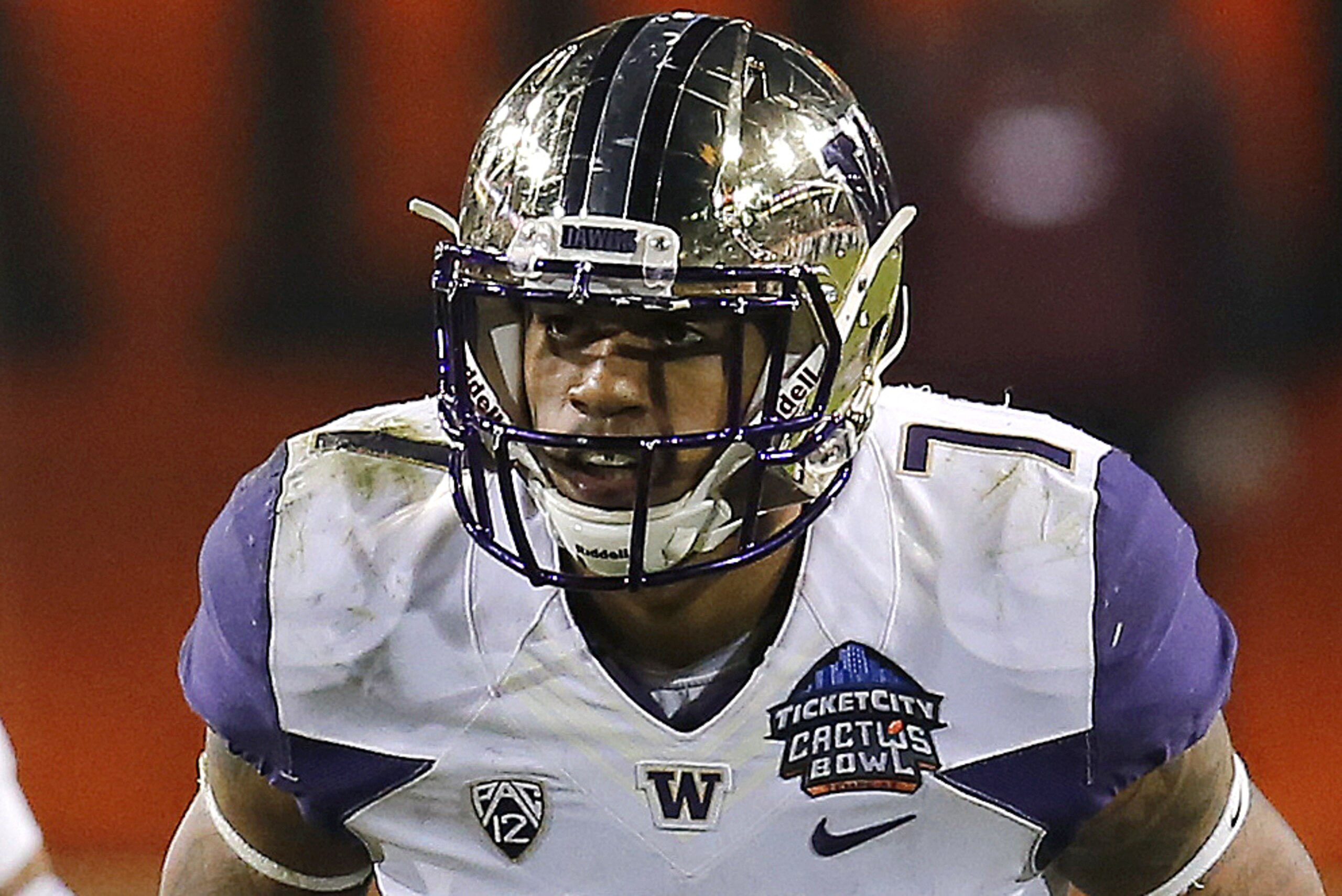

Shaq Thompson's Unique Skill Set, Versatility Makes Him Rare Defensive Talent
One of the hottest debates in the draft community revolves around a member of the 2014 Washington Huskies. The Huskies, who finished 8-6 on the year, weren't exactly must-see television this season. One player stood above the others, though: Shaq Thompson.
Explaining what Thompson did for that team is a bit of a struggle, because he did a little bit of everything. Recruited as a defensive back, he played his first year in Seattle as a hybrid nickel defender and safety. His brother, Syd'Quan, was a corner for the Denver Broncos for three seasons after he graduated from the University of California.
.jpg?w=2560 "Patriots Football")
During Thompson's sophomore season, though, his role was flipped. Instead of playing as a defensive back near the line of scrimmage, Justin Wilcox, now the defensive coordinator at the University of Southern California, made the decision to make him a weak-side linebacker.
As a junior, the team went through a coaching change, and with that came a change to Thompson's role once more.
In the 3-4 defense, he flexed back and forth between linebacker and safety but was generally attributed as a starting linebacker for the squad. He also played on the offensive side of the ball.
The Huskies ranked second to last in passing yards per game in the Pac-12 with a 200-yard average. For example, the leader, the Washington State Cougars, averaged 477 yards per game through the air, well over double the Washington total.
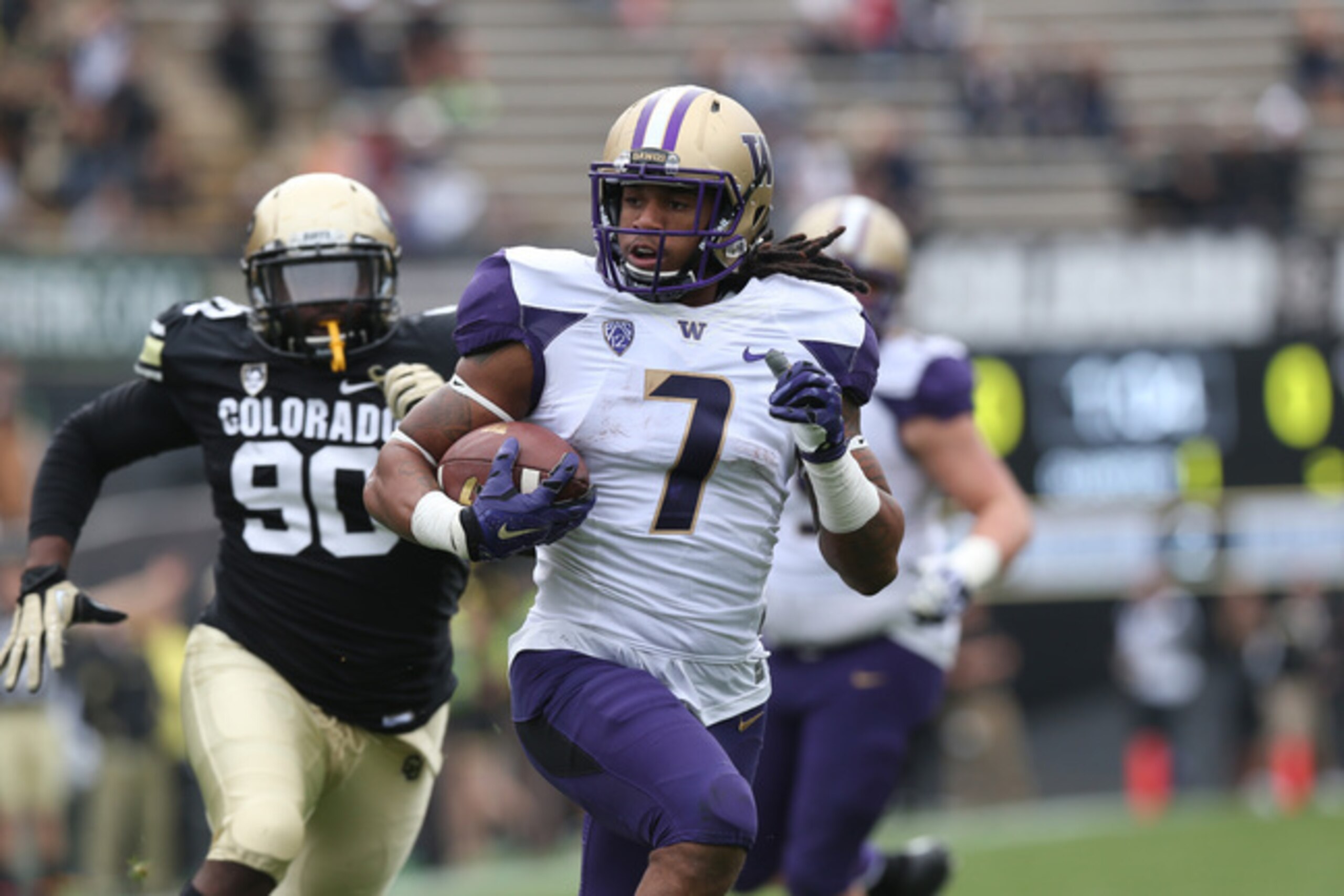
That offense obviously couldn't move the ball through the air, as evidence of the team's offensive-efficiency numbers and its record, so Thompson started seeing the ball as a running back. There, he rushed for 456 yards and scored two touchdowns. Amazingly, he had twice as many touchdowns, four, on defense than he had on offense this past season.
This is where the question arises: "What position do you see Shaq Thompson playing at the NFL level?"
To me, you have to look at why he was moved around. He obviously had the background of a defensive back in his lineage and played there his first year, but why did the Washington coaching staff, which largely is the same one that got a promotion and is now coaching at USC, move him from the position?
When looking at the broadcast footage of his 2014 season, the reason that sticks out to me is his instincts.
At safety this past year, he was mostly playing a two-high role, giving offenses a Cover 2 or Cover 4 look. There, that far off the line of scrimmage, his greatest traits cannot be of maximum value. When he's 15 yards off the ball, it doesn't matter how fast he reacts to a ball-carrier, as he still needs to close all that ground before meeting him.
As a weak-side linebacker, he breaks on a ball almost before the runner gets it, shifting gears quickly and hitting max speed almost off the jump. Well-timed because of his quickness, Thompson can routinely make tackles for losses on carries ran to the opposite side of the field at the next level if he's playing as a 4-3 "Will" linebacker.
As a safety, those tackles for losses become five-yard gains, as even a downhill high safety needs to make up for all the grass ahead of him. That to me is the biggest difference between his two defensive positions.
Above is a video by The Sideline View, which illustrates the very real and rare Pro Bowl potential Thompson displays on film.
He's a bit small at 6'1" and 228 pounds, per Washington's athletics site, but many said the same about Telvin Smith, who, at 6'3" and 218 pounds, fell to the Jacksonville Jaguars in the fifth round of the 2014 NFL draft. He eventually posted the fifth-best Pro Football Focus grade for the team's defense as a Day 3 rookie selection who only started nine games.
So, when NFL Network's Daniel Jeremiah says he doesn't "know one personnel guy that views him as first-round player" or that "a lot of NFL folks think Shaq will end up at running back," it's no surprise to me.
Analysts have made the same mistake in the past with guys like Smith and even more so with Lavonte David, a nearly perfect college linebacker who was simply undersized. Drafted in the second round in 2012, David was a first-team All-Pro by 2013.
As a running back, Thompson does well, but it's not to the point where he should be viewed as a Day 1 selection, like he would be as a linebacker. After all, he had fewer than 500 rushing yards in his entire college career.
Another factor that would go into that transition would be if he even wants to be viewed as a running back. Even other two-way players in college who have played running back, such as Myles Jack at UCLA, who is also a linebacker like Thompson, seemingly liked playing defense. In November 2013, UCLA head coach Jim Mora made it sound like Jack's future was one without a ball in his hand to ESPN.
In November 2014, Bleacher Report's Matt Miller and Michael Felder agreed that the pair of two-way players were likely going to play defense as professionals.
Remember, this is the NFL. Players are generally locked into their rookie contracts until they expire. Even running backs like DeMarco Murray, who lead the NFL in rushing yards this past season, are put into the perspective of "he's already got wear on his tires" before they hit their second contract, the real pay day for players.
According to Spotrac, there are 20 linebackers who have a base salary next season of $5 million or more. At running back, there's only five, one-fourth of the opportunities.
It just seems unrealistic on paper that Thompson would declare early from college with limited film with the ball in his hand to run into the league with the expectation that he wants to play a position which many believe a 30-year-old has virtually no value, therefore making it hard to cash in on talent under the current collective bargaining agreement.
There are plenty of people who believe his future, a bright one, is at linebacker, and I align myself with them. For example, Optimum Scouting, Sporting News' NFL draft affiliate, ranks Thompson as the 13th player overall in the class. Behind him are some big names, such as Dante Fowler of Florida, Shane Ray of Missouri and Danny Shelton, Thompson's teammate at Washington.
There are two landing spots very early that make sense for him. The first is Chicago at No. 7 overall. Under new defensive coordinator Vic Fangio, who comes to the Bears via San Francisco, the team could transition to a 3-4 defense, not Thompson's ideal role, but still it's more than manageable, as he spent his last two years playing in an odd front.
In a 3-4 defense, Thompson can play similar to a Will linebacker role as the weak-side inside defender. Years ago, Dom Capers went to Chicago's divisional rival, Green Bay, and did the same transition with A.J. Hawk, who was drafted sixth overall in 2006 as a weak-side outside linebacker.
Moving inside in 2009, he was a Pro Bowl alternate in 2010 and is credited as a Pro Bowler for the year as the Packers were ineligible to play in the all-star game as they were set to play in the Super Bowl, which they won 31-25 over the Pittsburgh Steelers.
That Will role for Chicago last season in their 4-3 defense was filled by Lance Briggs, a 34-year-old linebacker, who is set to be a free agent, and Shea McClellin, who was a 2012 first-round selection as a defensive end and transitioned to the role as a last-break shot at salvaging his draft value. McClellin is set to be a free agent after next year.
Starving for a playmaker on defense, with no future locked in at Thompson's position and in transition, this is the perfect time for the Bears to pull the trigger on an athlete like him.
The other great spot is in New York. The Giants pick two slots behind the Bears and have ignored the linebacker position for years. Finishing 6-10 last season, it looks like it's finally caught to them.
Needing to win now, Thompson could provide a much-needed spark on defense. Scoring four touchdowns on defense last season at the college level, if he could have brought that production to the Giants' four single-score losses in 2014, they would have finished 10-6. That's the kind of impact he can bring out of the gate.
Overall, Shaq Thompson is more than athletic enough to play linebacker, safety or running back at the next level. Based on the premium put on defense over ball-carriers in today's NFL, plus Thompson's very short history at the position, it's hard to see him playing in a backfield in the league.
As far as the safety versus linebacker debate, it needs to be viewed logically. There's a safety drought in the league, but Thompson flashes very rare traits and polish for the linebacker position, where as at safety, he's just another two-high safety. If anything, he can be a very good linebacker who is also great in coverage, like DeAndre Levy, CBS Sports' Rob Rang's comparison to Thompson.
It's time to close the book on this conversation. Not only should he be drafted as a front-seven player, but the former Washington Husky also has the talent to potentially make the Pro Bowl one day with the skills that so many are confused about quantifying.