Is Georgia RB Todd Gurley the NFL's Next Steven Jackson?
At the head of a deep and talented running back class in the 2015 NFL draft sits former Georgia Bulldog Todd Gurley. Three seasons of dominant play in the Southeastern Conference earned Gurley respect, hype and lofty comparisons to NFL greats.
When Gurley was able to stay on the field, he knifed through defenses on a weekly basis. Various injuries, including a torn ACL in Week 10 of his junior season, and a four-game suspension for an NCAA violation kept him from participating in every contest throughout his career.
It's his special talent that has led to many comparing Gurley to future Hall of Fame running back Adrian Peterson. A simple Google search brings up pages of scouting reports or comments that trace the two together. In college, the comparison isn’t far off. Both missed numerous games due to injuries, but when on the field, they were revered by opposing fanbases.
TOP NEWS

New NFL contenders starting to emerge after Week 4
.jpg?w=2560 "Cardinals Giants Football")
NFL investigating 2 referees for separate viral exchanges

Deion Playbook Found at Hotel
But, looking deeper than that, the similarities between the two are more of a reach than some might expect. Linking Gurley and Peterson is a convenient argument because Peterson has been so extraordinary throughout his career, and aesthetically, Gurley is the closest thing since “All Day” hit the NFL.
Coming out of Oklahoma, Peterson was an athletic freak. At 6’2”, 217 pounds, his 40-yard dash, vertical and broad jump were each in the 90th percentile. That type of size and athleticism is impressive enough, but it translated perfectly on the field as well. He’s a transcendent talent that creates no matter the limitations of his surrounding cast.
Looking at Gurley’s most productive collegiate games, there’s no question he’s a very talented athlete. But, he doesn’t play like Peterson. The best comparison for Gurley is former St. Louis Rams star and current Atlanta Falcons back Steven Jackson. Although Gurley cannot participate at the NFL combine drills, his numbers would likely be similar to Jackson’s.
| Height | Weight | 40-Yard dash | Vertical Jump | 3-Cone |
| 6014 | 231 | 4.55 | 37.5" | 7.03 |
Jackson was a highly touted playmaker out of Oregon State taken with the 24th overall pick in 2004. Despite playing on some terrible teams, Jackson produced eight consecutive 1,000-yard seasons, and he has averaged 333 receiving yards a season.
He may end up as a Hall of Fame player as well. His argument will be a strong one based off his accomplishments on the gridiron.
The difference between Jackson and Peterson is more about style and level dominance, so the comparison for Gurley to Jackson is not a slight, at all. Let’s take a look into Gurley’s games to see where he wins and what makes him more like Jackson.
Balance Over Power
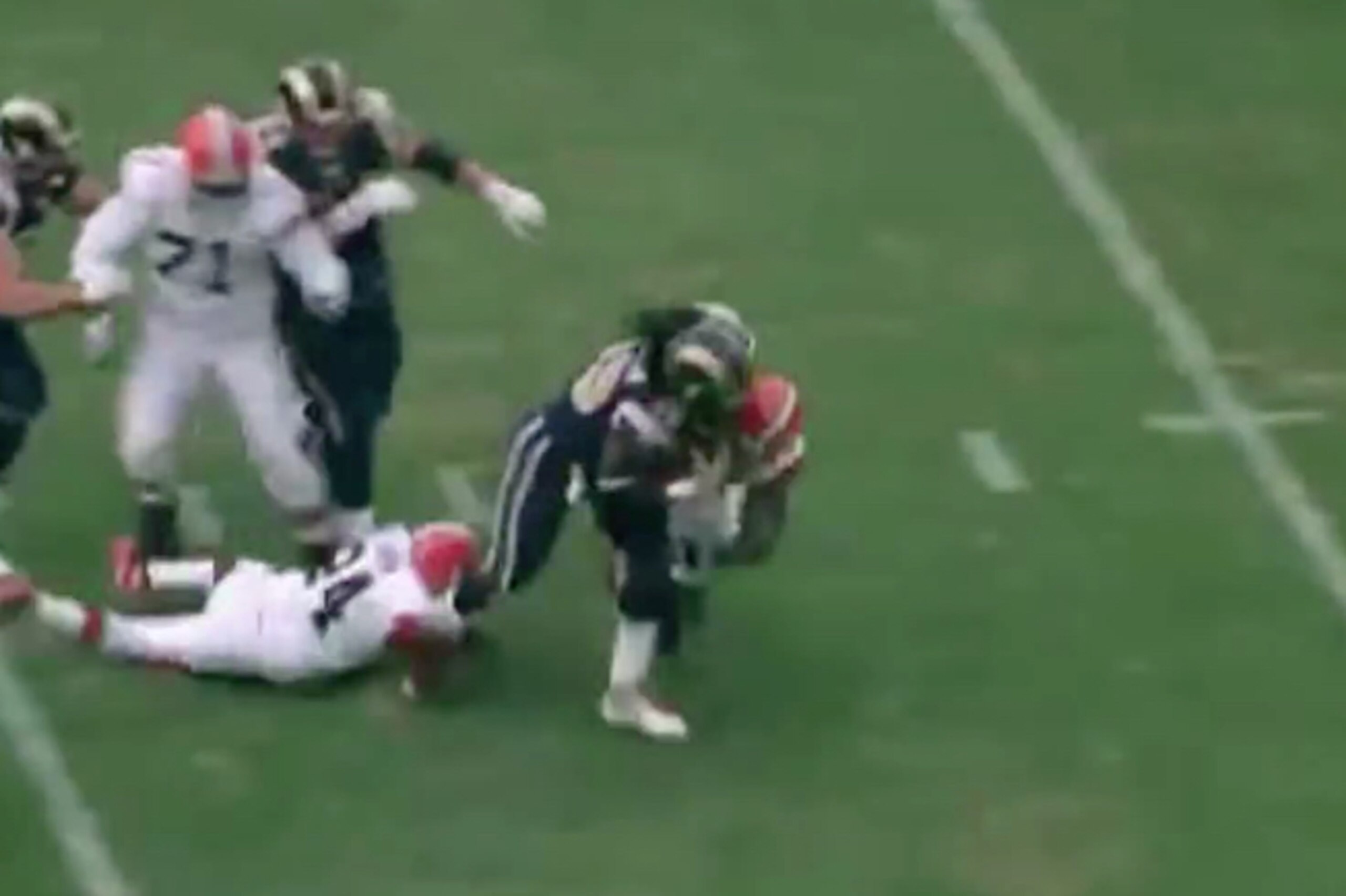
Determining the difference between a broken tackle that stems from power and one that stems from balance requires an understanding of normal pad level for a player, as well as consistency in similar situations. Both Gurley and Jackson are listed at 6’1”, so their pad levels are naturally high, but neither particularly excels at bulldozing through opponents.
Being able to take a hit on one side of the body and stay on two feet is a great example of balance. On the screenshot above, Jackson takes a hit from a defender on his left side, but he’s strong and balanced enough to absorb the hit and shed the tackle. If he'd been using pure power, his pad level would be as low as his attacker.
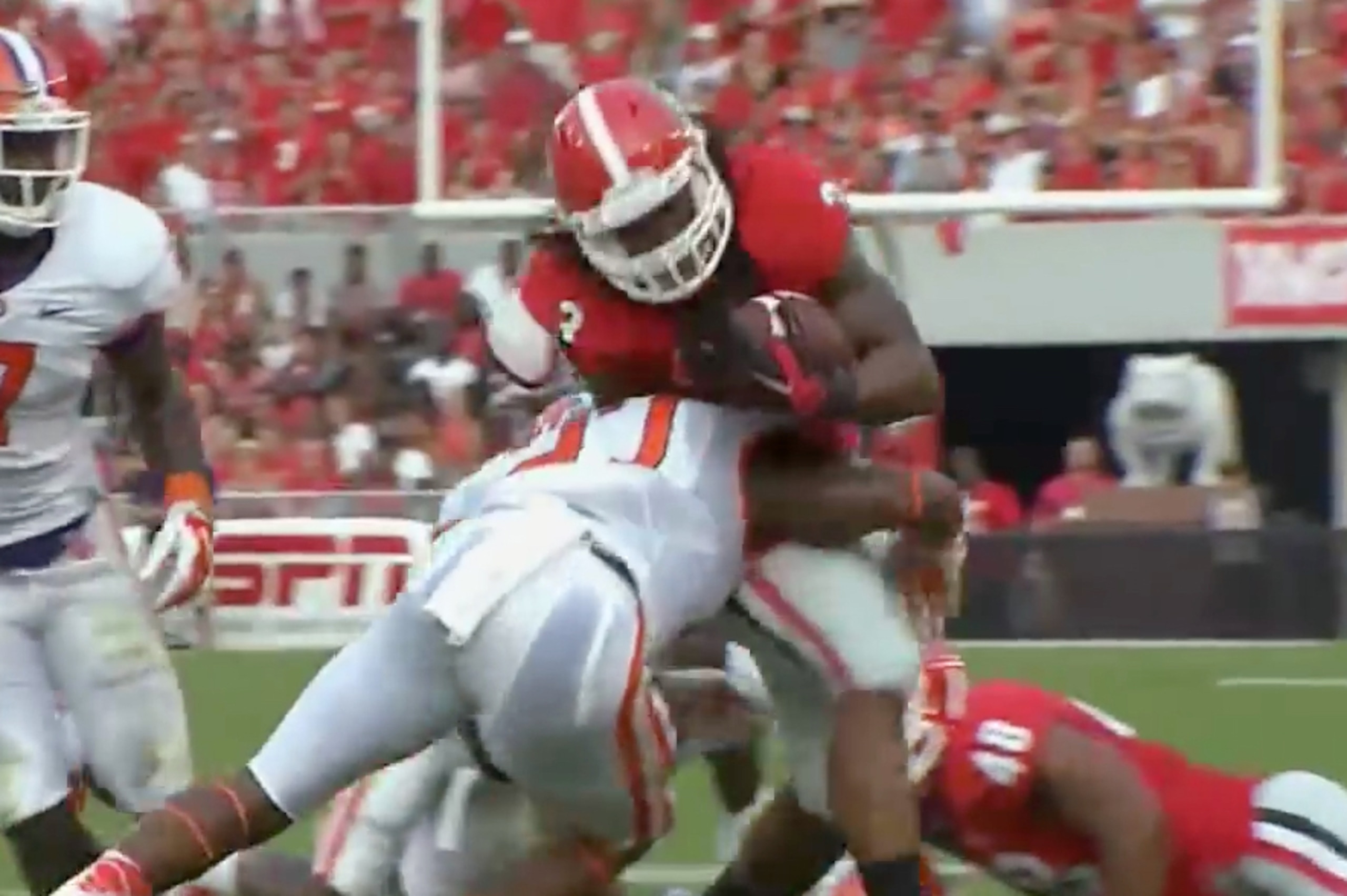
Relying on balance helps shed arm tackles and hits from the side, whereas a low pad level and power will lead to more head-on tackles being broken. Peterson really has exquisite power, balance and athleticism. He shows the ability to run through defenders at any level. It’s what makes him that special.
Gurley consistently shows that he has excellent balance but high pad levels. He can blow through arm tackles but struggles to push through more straight-on attempts. His inability to sink his hips and lower the boom on a defender means that he will go down often on direct contact.

Using balance and efficient movements is certainly translatable to the NFL. On the gif above, watch as Gurley subtly steps to the left as he approaches the line of scrimmage. This sets up his burst downfield, and he sheds two tacklers as he makes his way downfield. The key to the play is his vision and footwork, which brings us to his next positive trait.
Vision and Burst
To get a feel for how Gurley produces so many 15-yard-or-more gains, I charted his three best games of 2014. The goal was to see in which blocking schemes Gurley excels. Most NFL teams feature some power-blocking and zone-blocking methods but use each to varying degrees based on personnel.
Collegiate programs like Georgia often use power-blocking tactics because they have athletes on the offensive line who are dominant enough to do so. Take a look at the running lane below for Gurley in such a scheme.
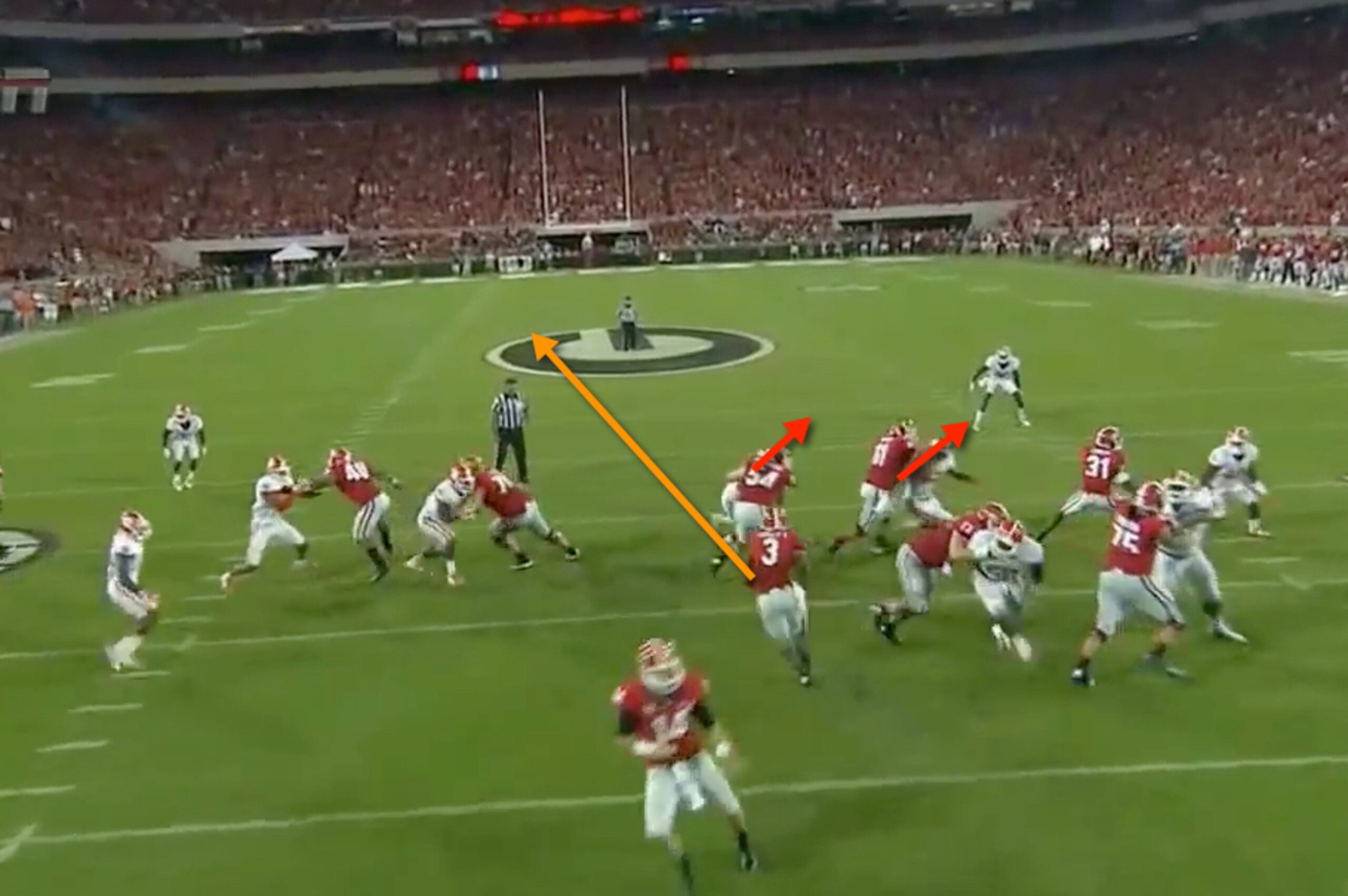
There are numerous examples of these huge running lanes. Georgia deserves credit for executing so well, but these lanes are easy for any back to exploit. Huge lanes like this rarely happen in the NFL because the hash marks are wider, and the competition is consistently great.

When the running lanes were tight, Gurley really struggled to create for himself. His tight hips make it difficult for him to jump when he sees a lane developing at the last second. He’s a downhill runner who struggles having to go laterally too much, and defenders can swarm him.
When given space to work with, Gurley is very good at setting up defenders. As Gurley nears the line of scrimmage, Gurley gets close to his blockers to sell that he is close to cutting upfield. This is called pressing the linebackers because the second line of defense is likely to cheat toward the line to get to the ball-carrier quicker. Gurley has the burst to take advantage of the new angle created, and he does so very well.
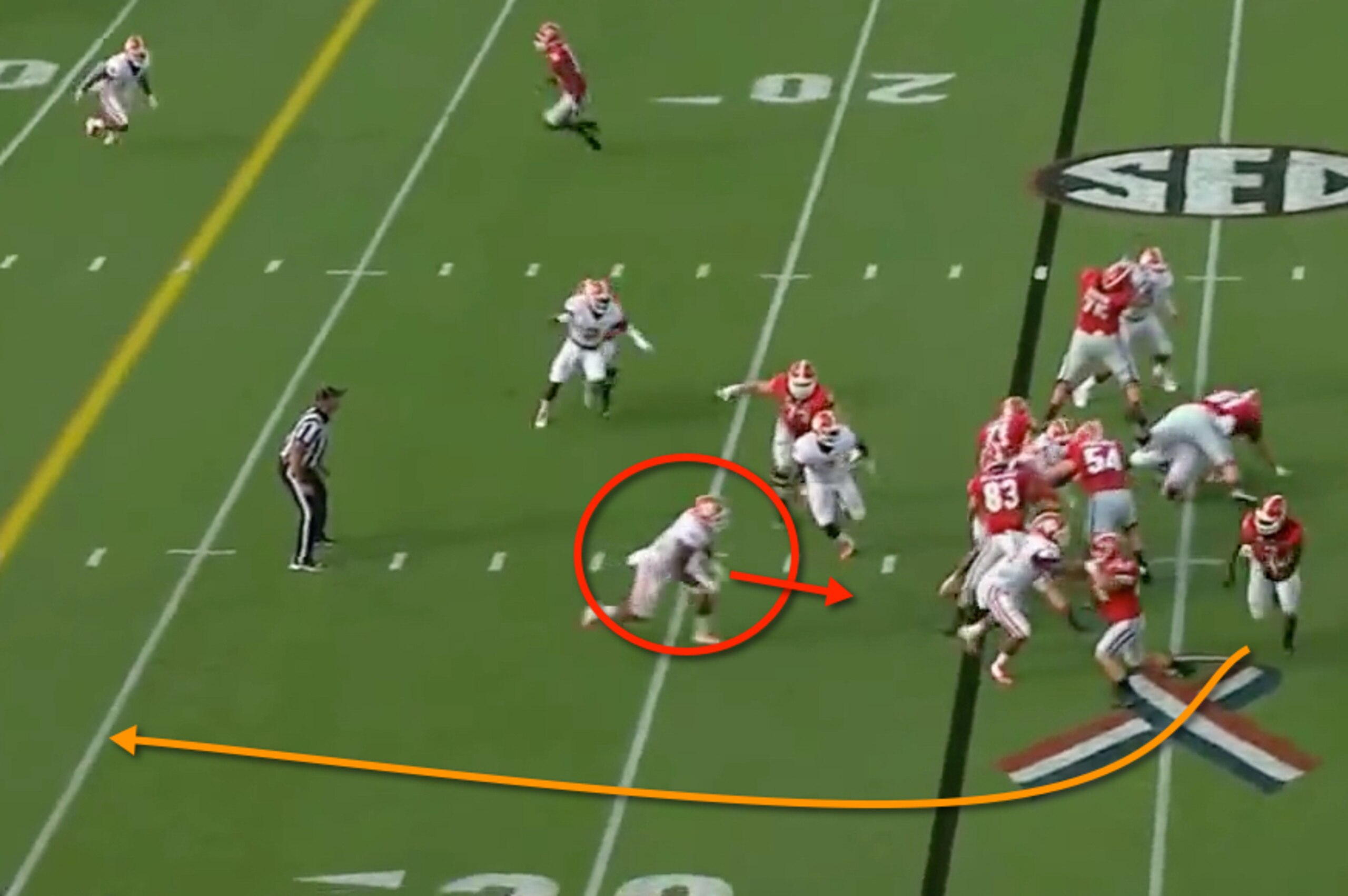
Gurley accelerates quickly to eat up yards. He isn’t a burner, but like Jackson, he wins when he finds cutback lanes.

Unsurprisingly, Gurley was most effective when his line worked to create the backside running lanes that the zone-blocking system aims to provide. As the line works toward one direction, the defense will follow unless a defender can penetrate the gap. This leaves the back with the decision to either follow his line or, if the defense doesn’t stay disciplined, reverse course and hit the wide-open cutback.
Gurley is tremendously good at seeing these openings as they unfold. He wastes little to no time to chop his feet and reverse course. Sometimes, the cutback will go for a moderate gain, but eventually, a chunk can turn into an opportunity for a home run play.

Of the 14 explosive plays charted, seven were considered to be translatable to the NFL. These include zone reads and power dives that Gurley was able to gain 15 or more yards on. The rest came via pitches or read-option calls.
Although the NFL has adapted and began using the read-option, it is not nearly as dangerous as it is in the collegiate game. Seattle is one of the few teams that are reliant on its effectiveness weekly, but it also possesses an elite running back and mobile quarterback.
Collegiate plays that are completely reliant on being more athletic than the opponent shouldn’t be considered the same as more traditional methods of execution. The NFL doesn’t have vast talent gaps like Georgia had many games. Expecting Gurley to replicate six big gains in three games off the read-option isn’t reasonable because the read-option isn’t a consistent source of production on a down-by-down basis.
Durability
The more hits that a running back takes, the more likely an injury can occur. Unlike Peterson, all of Gurley’s injuries were due to contact or running style. He missed six games in college due to injury, and he participated in 30. That trend cannot continue as he enters the NFL.
Longevity and durability are major factors for running back success, but it’s hard to be confident that Gurley’s track record of nicks and bruises will suddenly end. The ability to absorb or avoid contact is important for health purposes.

Yes, Peterson returned from an ACL and MCL tear with incredible speed, but he was an anomaly. Again, he’s a physical freak who is incomparable. Gurley is a great athlete but not to the level of Peterson.
It wouldn’t be surprising if Gurley is 100 percent when he returns from his ACL tear, but his risk to re-tear it is greater, and he’ll be just 21 when the regular season starts. Coming back from one ACL tear isn’t abnormal, but two is, and the odds of it happening again in the first 24 months after rises by 15 percent.
Future Projection
There is no doubt that Todd Gurley is a tremendously talented football player. He’s strong, quick, smart and explosive. His ability to be an impact runner and receiver for an NFL franchise shouldn’t be doubted.
To reach his potential, Gurley will need to stay healthy and have his strengths accentuated as much as possible. He may do well for a power-blocking team, but his best fit is with a team that will allow him to use his vision and burst more often in a zone-blocking system.
Some of the NFL teams that are primarily zone are Seattle, Denver, Miami, Washington and Cleveland. Most franchises utilize zone reads for at least part of their game plan, so wherever Gurley lands, he’s very likely to produce at a high level.
All stats used are from sports-reference.com.
Ian Wharton is a Miami Dolphins Featured Columnist for Bleacher Report, contributor for Optimum Scouting and analyst for eDraft.
.jpg?w=2560 "Hill Injury Update Football")
.jpg?w=2560 "Titans Giants Football")
.jpg?w=2560 "Tyreek makes another cryptic post amid Chiefs rumors")