

2015 NFL Draft: Biggest Red Flags in Early Scouting Process
You can call them red flags, off-field questions or character concerns, but in a new age of increased awareness and punishment for crimes away from the field, NFL teams are hyperfocused on the character side of scouting.
In my talks with agents, scouts, personnel directors and general managers this year, there has been one common theme: recruit and/or draft the most talented players who are good people.
With the Baltimore Ravens, Carolina Panthers and Minnesota Vikings—not to mention the NFL office—going through terrible public-relations nightmares, thanks to off-field issues, the background and integrity of every draft prospect will be weighed more than ever in the upcoming class.
.jpg?w=2560 "49ers Eagles Football")
.jpg?w=2560 "Jets Dolphins Football")
That doesn't mean that every anonymous scout quote we see between now and the draft deserves merit. There are times when a competing agent or even NFL teams will spread false or exaggerated information with the hopes of moving a player down the board.
But with each NFL team employing its own security department to do background checks on players, there will be documented cases (with facts, not hearsay) that affect players on draft day.
Which players are currently carrying red flags on their scouting report—and what can they do (if anything) to rehabilitate their perception?
JAMEIS WINSTON, FLORIDA STATE
- 2012, stopped at gun point during a BB gun battle near the FSU campus
- Nov. 2013, accused of rape in a case The New York Times says was full of errors; FSU is currently investigating Winston for this charge
- Apr. 2014, cited for shoplifting crab legs from a Publix store in Florida
- Sept. 2014, suspended for one game after jumping on a table and yelling obscenities in student union
Winston's rap sheet is now very well-known due to his status as a Heisman Trophy winner, national champion and a player many expected to be a future No. 1 overall pick. That has changed, though, as repeated incidents continue to put Winston's name in the papers for all the wrong reasons.
Even Winston's friends are speaking out against him this week. Nebraska running back Ameer Abdullah, who has known the FSU quarterback since eighth grade, told The Associated Press (via USA Today) that Winston needs to "think before you act. Understand the bigger picture." Abdullah would go on to say, "You should see yourself as a young guy but hold yourself to a higher level of maturity. Definitely he has a long way to go."
NFL scouts and general managers are likely to agree. With increased attention on the NFL right now following Ray Rice, Adrian Peterson and Greg Hardy's messy situations, it's important that teams are properly investigating college players before they invest millions of dollars into their development and their futures.
Winston's public rap sheet is bad enough, but are there skeletons hiding in his closet that haven't come out yet? It's common for dirty laundry to be aired as players get ready for the NFL draft, and it's tough to imagine Winston's draft stock surviving any more bad news.
When NFL commissioner Roger Goodell unveiled his new domestic- and sexual-violence policy, it indicated that players who had arrests or accusations in college would essentially enter the NFL with one strike against them.
If Winston does indeed come into the NFL with one strike (what would normally be a six-game suspension), any future run-ins would carry an indefinite suspension. As the memo states, "Among the circumstances that would merit a more severe penalty would be a prior incident before joining the NFL..."
What can Winston do to rehabilitate his stock? First and foremost, that's secondary to any crime that might have taken place in 2012 when he was accused of rape. If NFL investigators find out that the Tallahassee prosecutor did err in failing to press charges—and there's a good chance NFL teams are already working on this information—he shouldn't be drafted. Period.
But let's assume that the justice system is right, and Winston did nothing that merited charges. The implication of rape is bad enough, and players such as Ben Roethlisberger are still hounded by fans, even though no charges were pressed in their cases. Winston may be innocent, but public perception will hurt him there.
There is nothing Winston can do to make people forget that he was accused and investigated. He can, though, make the other, smaller issues go away by keeping his nose to the ground and staying out of trouble from this day until his name is called in the NFL draft.
Distance is a healer of many things, and for Jameis Winston the best thing he can do is make an effort to clear his name by staying out of trouble for an extended period of time. As you can see above, that's been a problem for him, but right now it's his only hope of regaining that No. 1 overall player status.
DEVONTE FIELDS, TRINITY VALLEY COMMUNITY COLLEGE
- July 2014, accused of punching an ex-girlfriend and threatening her with a gun; no charges were pressed
- July 2014, suspended by the school after surrendering to authorities on an assault warrant
- Aug. 2014, permanently separated from TCU before enrolling at Trinity Valley Community College in Texas
Devonte Fields was a budding superstar, selected as the preseason MVP of the Big 12 and was a Bronco Naguski Trophy candidate in 2014. His status as an elite defensive player and pass-rusher was becoming a national fact, and his draft stock as a redshirt sophomore was soaring, too.
Fields' case is exactly what the NFL cannot afford to have right now. Not only was he accused of punching a woman but also threatening to shoot her while holding a gun. This is similar in many ways to Greg Hardy's case—and he's been deactivated by the Carolina Panthers because of it.
Whether or not an NFL team will overlook these allegations remains to be seen. The Chicago Bears drafted Ka'Deem Carey out of Arizona in the fourth round, despite being charged with domestic violence after his pregnant ex-girlfriend accused him of pushing her to the floor and slamming her fingers in the door.
The charges were eventually dropped, and Carey's name hasn't been a hot topic, even with increased scrutiny in the NFL right now.
Fields may be able to rest his NFL hopes on the fact that no charges were pressed, but the dismissal from TCU is telling for his future.
Fields looked like a potential first-round-pick before the allegations, and if he's able to get to a Division I school and stay out of trouble in 2015, that's still a possibility. But like Winston, the NFL's new policies on domestic violence could hurt him. The new rules not only mention "a prior incident before joining the NFL" but also "violence involving a weapon..." as something that would merit a more severe penalty.
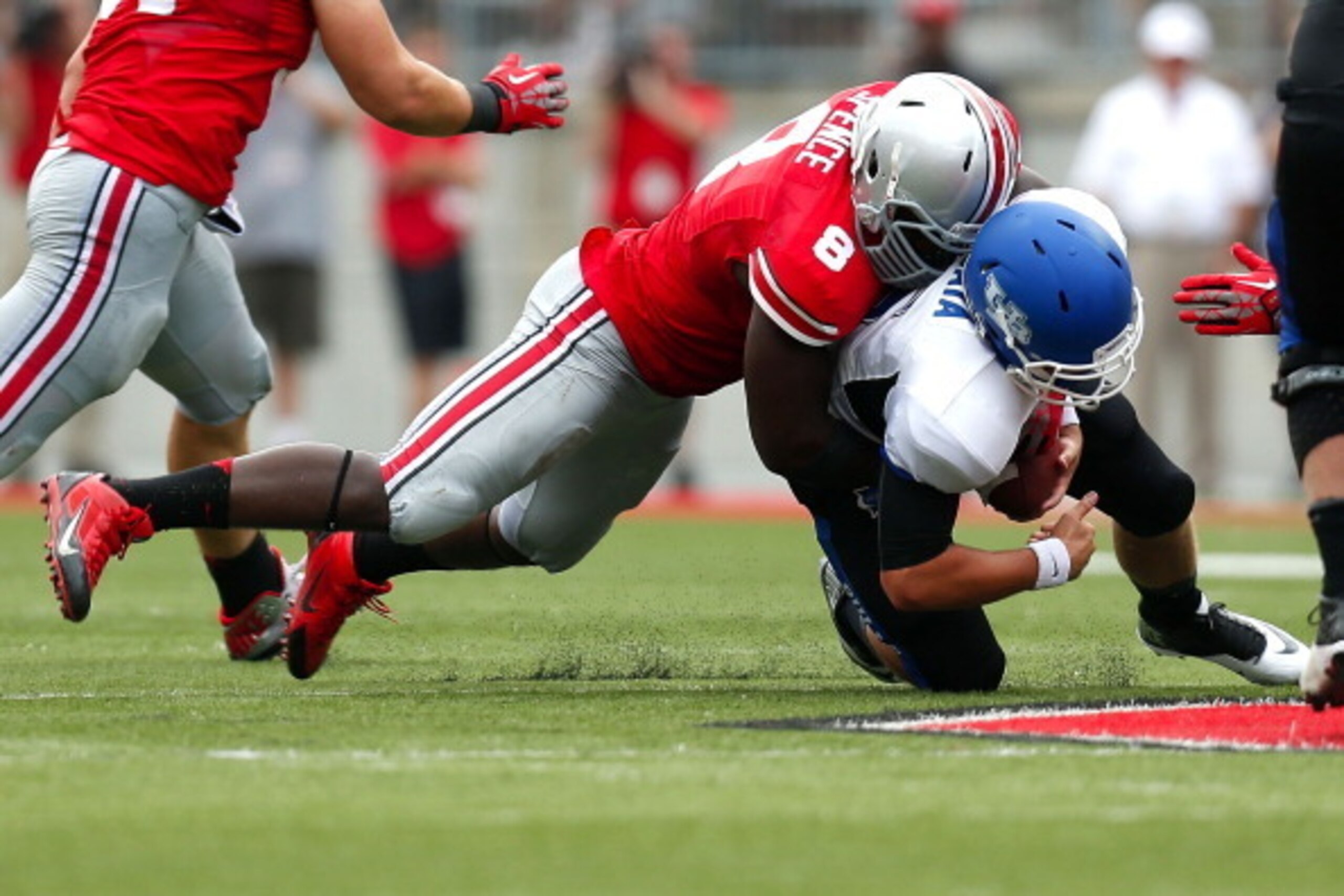
NOAH SPENCE, OHIO STATE
- Jan. 2014, suspended by the Big Ten for three games after testing positive for ecstasy
- Sept. 2014, suspended indefinitely for failing a second drug test; Spence was initially allowed to practice with the team
Noah Spence is a talented edge-rusher with the body type and skill set that the NFL wants in space, but two drug tests make his future in the league a big question mark.
Drug use has long been an issue in the NFL, but we've recently seen the threshold for marijuana tests raised. That won't help a player like Spence, though, who failed at least one test for ecstasy use.
Both Wes Welker and Orlando Scandrick were suspended this summer for ecstasy—or MDMA—only to see those suspensions overturned due to the new performance-enhancing drug policy. Ecstasy is no longer considered a PED violation. That's good news for Spence's future employer.
The key for Spence is getting back on the field and proving he can be a reliable part of a team. NFL general managers will draft players with a drug history but not if that player is thought to have a problem that will keep him from playing consistently.
Spence is a very raw player, though, and could stand to use more seasoning before taking on the NFL. If Ohio State will take him back, it would be wise for the junior to return to school for the 2015 season with a chance to rehabilitate himself and his draft stock.
DORIAL GREEN-BECKHAM, OKLAHOMA
- April 2014, named a suspect in a burglary case where he was alleged to have forced his way into an apartment and pushed a woman down the stairs
- April 2014, victim declines to press charges after allegedly being pressured to not hurt Green-Beckham's future, as detailed by Deadspin
- April 2014, dismissed from the University of Missouri before transferring to Oklahoma; the NCAA denied his attempt to play in 2014
Dorial Green-Beckham was a huge recruit for Gary Pinkel's Missouri football team and looked like a surefire first-round pick. But like the other players highlighted here, domestic violence is a cardinal sin in the NFL right now (and rightfully so).
The DGB case is also unique in that the victim appears to have been pressured to not press charges. While that may be the case in other incidents, that it has been documented will carry weight when the NFL comes to the point of investigating Green-Beckham.
While uniquely talented, Green-Beckham is not a finished product as a player. Spending a year away from football at Oklahoma may help him mature as a person, but he needs more experience as a player before anyone can feel good about his transition to the NFL. The best thing for him is to stay out of trouble and work in 2015 to improve as a receiver.
Will the NFL give these players another chance? History has shown that the 32 teams are forgiving if the talent is good enough, and each of these four players has the ability to be a highly talented professional football player. How serious the NFL takes off-field issues will be on full display in the upcoming NFL draft classes.
.jpg?w=2560 "Top 5 Running Backs Football")
.png?w=2560 "Ranking the Best Shooters of All Time 🎯")
.png?w=2560 "Lane's Son Trolls His QB Play 😭")
.jpg?w=2560 "Lindor Trade Packages 📦")