Suddenly the Cavs Aren't Doomed in a Post-LeBron Scenario
With Tuesday's Kyrie Irving-centered blockbuster trade, the Cleveland Cavaliers managed to improve their current roster while simultaneously laying a foundation for the future.
Swapping Irving for Isaiah Thomas and Jae Crowder makes them better in the present in the opinion of some around the NBA. As for the future, obtaining rights to the Brooklyn Nets' unprotected 2018 pick—which the Celtics obtained in return for Paul Pierce, Kevin Garnett and Jason Terry—provides much-needed insurance in case LeBron James elects to leave once again in 2018.
That seems likely given all the noise coming out of Cleveland this summer. There was the July report from USA Today's Jeff Zillgit that the Cavaliers' offseason left LeBron "frustrated and concerned." Then there was owner Dan Gilbert's decision to not re-sign general manager David Griffin, which LeBron responded to with a tweet expressing appreciation for his former GM.
Add in the history between James and Gilbert and a host of other rumblings growing louder by the day, and it seems James is more likely to leave than stay.
So the question becomes: How equipped are the Cavaliers to deal with another LeBron exit? And how would they cope?
To get the latest on the Cavs and LeBron's future—all in one place—download the new B/R app.
Thanks to this week's trade, new Cavaliers general manager Koby Altman now has options.
"You can re-sign Thomas (an unrestricted free agent) and use the Nets' pick to draft a young stud," an Eastern Conference assistant coach told Bleacher Report. "It's not rock bottom."

A core of Thomas, Kevin Love, Crowder and Tristan Thompson would be a playoff team in the East, perhaps capable of winning a postseason series or two. Maybe you hit with a mid-first round draft pick and find other creative ways to inject some talent into your roster. Think of how Boston was able to steal Crowder and Thomas in the first place. Or how the Miami Heat were able to unearth a gem like Hassan Whiteside.
The goal is to mirror what the Celtics have done: Avoid the full tank, satisfy fans with a competitive team but keep an eye fixed on the future at the same time. Do that and hit on one or two gambles, and the Cavs might find themselves in position to pounce on the next available superstar, like the Minnesota Timberwolves did with Jimmy Butler. Or they could build a conference finals contender on the level of the Toronto Raptors or the previous iteration of the Atlanta Hawks that's only a few lucky breaks away from making the Finals.
There'd be risks, sure. Would the Cavaliers really want to hand Thomas the megadeal he made clear he intends on seeking in an interview with CSN New England?
Thomas is one of the league's most dynamic scorers and a proven winner with an inspirational story, yet Boston sensed its ceiling remained too low with Thomas as its top-paid player. His not-even 5'9" stature makes him a liability on defense. Couple that with his age (he turns 29 in February) and an ailing hip, and it's hard to project elite production in the final years of whatever deal he signs.
"He's great, but you're only getting so far with him as your top guy," a Western Conference scout told Bleacher Report. "In the playoffs, teams are always going to pick on him."
Does that mean Cleveland would be better off taking a page out of the Sam Hinkie playbook?
"Look at what Oklahoma City did with [Kevin] Durant, [Russell] Westbrook, [James] Harden and what [the] Minnesota Timberwolves are doing now," said an Eastern Conference front-office member. "There's a clear message if you look around the league, especially for smaller-market teams, to build through the draft."
That's not as easy as it sounds.
For one, there's the fickle nature of prospect-hunting. Nobody's a sure thing—the Cavs need only remember their 2013 nightmare, when the No. 1 overall pick fell into their lap, resulting in all-time bust Anthony Bennett. If that Nets selection falls inside the top two and the Cavaliers are able to land a stud like Michael Porter Jr. or Marvin Bagley III, then they're set for the future and can go about building around those cornerstones. Drop down a few spots, though, and you start playing prospect roulette.
Also, there's a decent chance the Nets' pick winds up landing toward the bottom of the lottery. A plethora of teams (such as the Atlanta Hawks, Chicago Bulls and Indiana Pacers) appear to be tanking. Brooklyn, with no incentive to lose and a roster suddenly flush with veterans like DeMarre Carroll and Allen Crabbe and potential star-in-the-making D'Angelo Russell, will only add to last season's total of 21 victories barring injuries.
Then there's the business end of things.
"You need ownership to be on board with that plan, which isn't always easy," the Eastern Conference front-office member said. "Nobody wants to stink, and even if you hit in the draft, it can take five years for those picks to hit their peaks. That's a long time."
That the Cavaliers followed this path the last time LeBron left—and emerged successful—works in Altman's favor. Remember all those lottery picks that turned into Andrew Wiggins, Irving and Bennett? Irving turned into a star, and even though Bennett was a bust, his status as a No. 1 pick with potential, along with Wiggins, helped get Love.
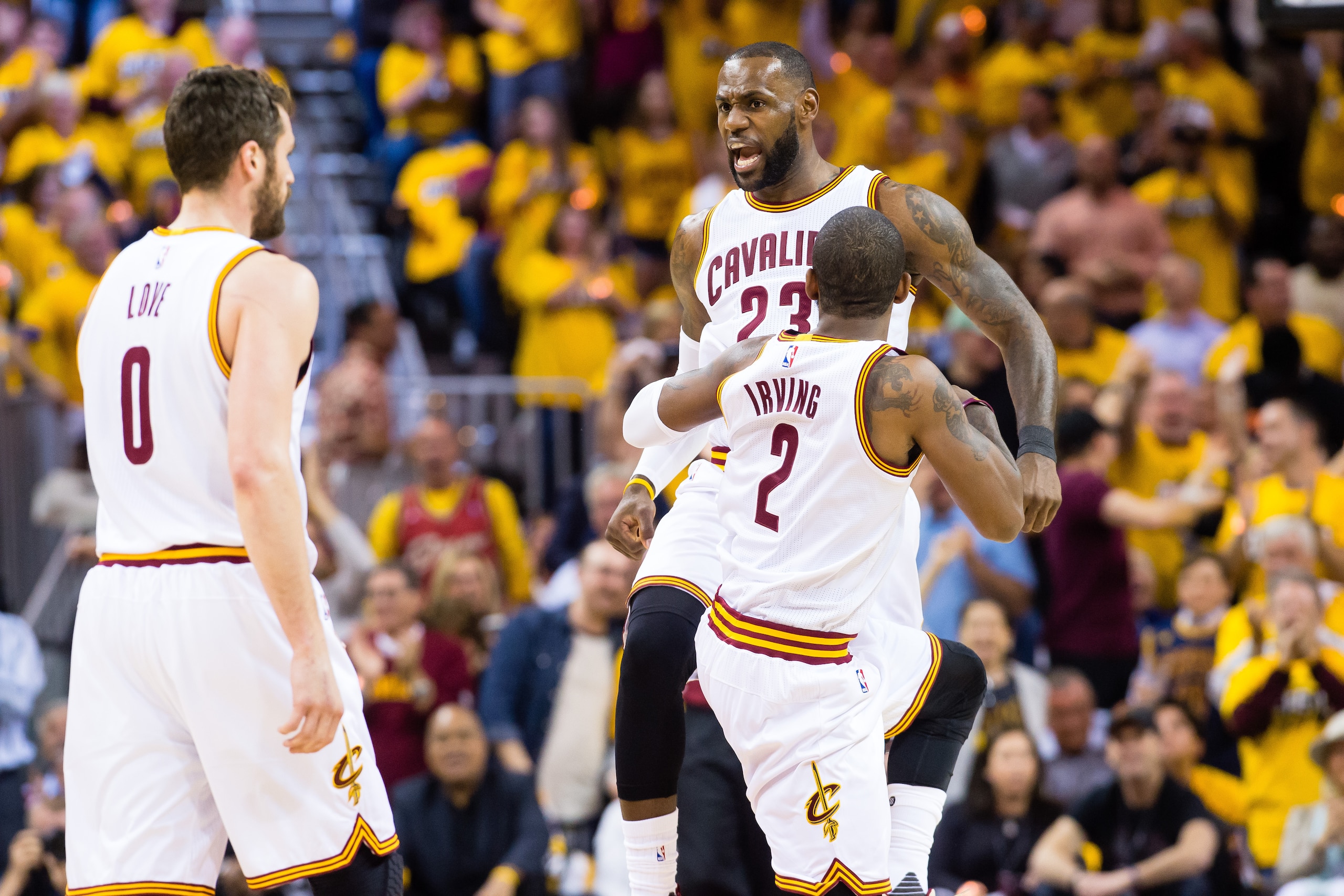
If Gilbert were to give the green light, Altman could begin dangling Crowder, Love and even Thompson. All three would attract interest. Love is still a top-25 player. Crowder, as put by the Western Conference scout, "is terrific and a player everyone would want, and on a great deal." Thompson's skill set as a fluid big man who can switch onto guards perfectly suits the NBA's current pace-and-space style.
It's unlikely any of them would net the Cavaliers a major piece. As pointed out by the Eastern Conference front-office member: "Just look at the market and what Jimmy Butler, Paul George and DeMarcus Cousins went for." But flipping any of those players for some sort of asset would help the Cavaliers restock their war chest, and attaching the Nets' pick could help enhance their return.
Of course, Cleveland doesn't have to make any of these decisions today. LeBron remains in wine and gold, so the focus is still on figuring out how to dethrone the seemingly invincible Golden State Warriors. Come next summer, though, it's possible the Cavaliers find themselves facing a new LeBron-less reality. Losing the best player in the world for a second time in a decade would be a major blow.
But thanks to Altman's savvy dealing, this time the Cavs would have options to combat it.
Yaron Weitzman covers the NBA for Bleacher Report. Follow him on Twitter, @YaronWeitzman, and listen to his New York Knicks-themed podcast here.

.jpg?w=2560 "Cam Ward Says He's Not A Loser")
.jpg?w=2560 "Texans Trade for MHJ")
.jpg?w=2560 "Chargers Fall to 0-5 🤢")

.jpg?w=2560 "Grading MHJ Trade 📝")