

Doc Rivers Digging into His Past to Shape Los Angeles Clippers' Future
For all the advances in scouting and analytics in recent years, there's still no substitute for firsthand knowledge of a player's personality and capabilities in the NBA.
Or, at least, that would appear to be Doc Rivers' modus operandi.
Since leaving the Boston Celtics to take over as head coach and vice president of basketball operations of the Los Angeles Clippers, Rivers has seen his preference for the familiar—friend and foe alike—manifest into a full-fledged trend. If there was someone out there who had either burned or been a productive part of Rivers' squads in the past, that player could almost certainly expect to hear from the former Coach of the Year, assuming the Clippers had a need and a roster spot to fill.
TOP NEWS

LeBron's Special Helicopter Deal

MJ Makes Record-Setting Donation 🙌
Shams: KAT, Hart Could Be Trade Names
Just ask Hedo Turkoglu or Glen "Big Baby" Davis about that.
Once a seemingly haphazard tactic for filling out a depth chart, Rivers' approach has yielded significant dividends this summer, to the extent that his Clippers appear poised to make some serious noise among the West's title contenders after falling short so far on his watch.
Rivers' penchant for picking up tormentors from his past dates back to his earliest days in L.A. Rivers' first move as captain of the Clippers ship was to bring in J.J. Redick via sign-and-trade—and fight hard, against the wishes of former owner Donald Sterling, to keep him, per Yahoo Sports' Adrian Wojnarowski.
Redick earned some of his initial postseason stripes against Rivers' Celtics in 2009. After sealing a starting spot in Orlando with a 15-point performance against Philadelphia in the first round of that year's playoffs, Redick kept his roll going by scoring 27 points on just 13 shots between the first two contests of the Magic's seven-game triumph over Boston. The next year, the Duke product shot into double figures three times in a six-game conference-finals defeat to the C's.
Redick's debut season in L.A. saw Rivers bring on a slew of former foes from the Eastern Conference. Stephen Jackson, signed as a free agent, and Antawn Jamison, acquired from the Atlanta Hawks at the trade deadline, had their fair share of highlights at Rivers' expense dating back to the coach's days in Orlando. Danny Granger, snatched off waivers after the Pacers traded him to the 76ers, made minced meat of Doc's defenses during his heyday as one of the league's most lethal scorers.
During his second campaign with the Clippers, Rivers went back to the well of familiarity. Prior to the season, he signed Hedo Turkoglu, who averaged 16.3 points and 5.3 assists against the Celtics in the 2009 playoffs. When L.A.'s locker room needed a lift, Rivers turned to Dahntay Jones, a physical defender who'd made his mark against Boston while playing for the Pacers.
Rivers, though, didn't completely limit his pickings to those who hailed from the East. In February 2014, he sought out more shooting in the form of Sasha Vujacic, who'd poured in 20 points on behalf of the Los Angeles Lakers in Game 3 of the 2008 NBA Finals. The following summer, he brought in Jordan Farmar, who held his own (and then some) as a Laker during the 2008 and 2010 Finals, to serve as Chris Paul's backup.
Redick and Jones aside, pretty much all of the old enemies Rivers recruited to his side during his first two years in L.A. either flamed out or never gained a foothold to begin with.
Rivers can only hope the same won't happen with Lance Stephenson. The Brooklyn native arrived in L.A. with no shortage of supposed baggage—above all else, a troublingly subpar season (8.2 points, 3.9 assists, 2.1 turnovers, 37.6 percent shooting from the field, 17.1 percent from three) with the Charlotte Hornets in 2014-15 after signing on as their marquee free-agent addition.
Fortunately for the Clippers, they didn't sacrifice too much from a value standpoint (i.e., Spencer Hawes and Matt Barnes) to rescue Stephenson from Charlotte. And if Stephenson proves to be a poor fit in L.A., Rivers can cut ties with him simply by refusing to pick up his team option for 2016-17.
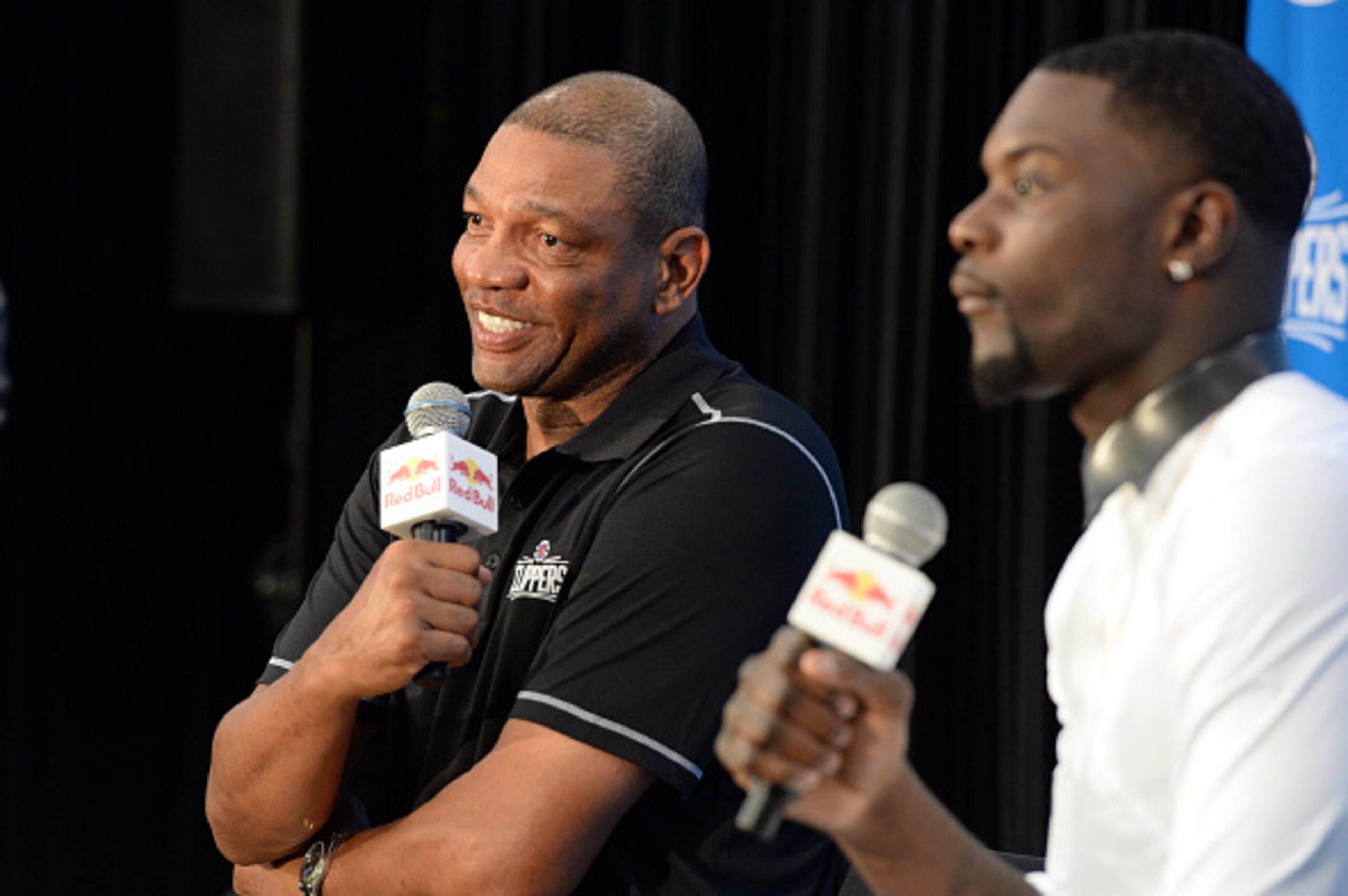
As far as the past between player and coach is concerned, Stephenson didn't come into his own as a multifaceted threat with the Indiana Pacers until after Rivers had already left Boston behind.
Not that Rivers was able to escape the wrath of "Born Ready" by switching coasts. In his first game against Rivers' Clippers in 2013-14, Stephenson stuffed the stat sheet with seven points, 10 rebounds and six assists in a five-point Pacers victory. The second time around, Stephenson really took advantage of L.A.'s lack of size and strength on the perimeter, piling up 22 points, 12 boards and seven assists in a 14-point win for Indy.
Chances are, Rivers didn't snag Stephenson from Charlotte solely on the strength of two games from nearly two years ago. If anything, it's the versatility that Stephenson demonstrated, against Rivers' squads and others, that piqued the Clippers' interest.
"I think he has the ability, defensively, to play three positions: the point, the 2 and the 3," Rivers explained at Stephenson's introductory press conference. "And I think offensively, I think with his ball-handling ability and his ability to play in the open court and his power, I think it fits our team very well."
Likewise, Rivers didn't bring in Josh Smith and Pablo Prigioni simply because of their exploits at the Clippers' expense. In Smith, the Clippers added a veteran playmaker who can defend multiple positions—and at minimal expense, no less. Prigioni will slide in as Chris Paul's latest backup, though Stephenson, Jamal Crawford and Austin Rivers figure to split secondary ball-handling duties.
Still, there's no ignoring the recency of and extent to which these two excelled against the Clippers. Smith played a pivotal part in kicking off the Houston Rockets' comeback from down 3-1 in their second-round series against L.A. this past spring. Despite being a career 28.5 percent three-point shooter, he knocked down four shots from deep to fuel the Rockets' stunning 19-point comeback in Game 6.
Prigioni helped to seal L.A.'s collapse—and Houston's first trip to the conference finals in 18 years—with a slew of smart, Johnny-on-the-spot plays in the Rockets' 113-100 win in Game 7.
Wesley Johnson never had the opportunity to oppose Rivers' squads in the playoffs but probably made a strong impression during the 2014-15 regular season. The now-former Los Angeles Lakers wing scored 31 points over the course of a back-to-back stint between the Staples Center co-tenants.
Given the Clippers' own problems finding consistent depth at small forward, it might've been difficult for Rivers to watch a reclamation project such as Johnson take advantage of his team's lack of reliable wings.
The Clippers won't need Johnson this season as much as they could've used him last year, thanks to the arrivals of Stephenson and Paul Pierce. Even so, it can't hurt L.A. to have another athletic, multi-positional defender to throw onto the court for 10-to-15 minutes a night.
Pierce was never the sort to torment Rivers, save for whatever disagreements player and coach may have had during their days as co-workers in Boston. Pierce's arrival fits another, similar mold for Rivers' signings: those who've gone into battle with him.
No player has ever been through as much with Rivers as has Pierce. The 10-time All-Star played in two NBA Finals and won his only title (and Finals MVP trophy) during the nine seasons he spent with Rivers in Boston.
"I played with Doc longer than any coach I ever played for in my career," Pierce said at his introductory press conference, via Clippers reporter Rowan Kavner,. "Definitely comfortable being around him, being with him. And so that really helps out, especially when you go into a new situation, being around things you're comfortable with."
Pierce should be plenty comfortable in the role he'll fill for the Clippers. His sharpshooting and all-around veteran savvy at small forward will come in handy, especially in crunch time, for a squad that's recently been razor-thin on the wing.
To this point, though, Rivers' Clippers haven't been thin on former Celtics.
In February 2014, he signed Glen Davis, who won a title as a rookie with the 2007-08 Celtics and spent three more seasons under Rivers' tutelage in Boston thereafter, to add depth (and girth) to L.A.'s frontcourt rotation. This past season, he brought in Nate Robinson and Lester Hudson, both of whom spent time in Beantown in 2010, to occupy the Clippers' backup point guard spot.
And while Austin Rivers never played in Boston or pummeled Doc's teams as an opponent, a father bringing in his son to play on his team—as was the case within the Rivers family last season—certainly qualifies as an instance of an executive opting for the familiar.
Despite Austin's contributions, the Clippers' season ended in disappointing fashion, prompting ProBasketballTalk's Kurt Helin to opine, "If the Clippers are going to do anything more than take another baby step forward—one that is likely not enough again—next season they have to get a deeper bench."
They appear to have done just that. They're no longer cripplingly weak on the wing, now that Pierce, Stephenson and Johnson have joined Crawford at that spot. Their frontcourt remains intact, thanks to DeAndre Jordan's change of heart, and now features a forward capable of starting in a pinch (Smith) and a second-string center with solid size and skills (Cole Aldrich, 6'11", 250 lbs).
Much of that fortification came courtesy of Rivers' preference for players he knows—once the source material of many a punchline and now, perhaps, the reason for the Clippers' crucial improvement this summer.
All quotes obtained firsthand unless otherwise noted.
Josh Martin covers the NBA for Bleacher Report. Follow him on Twitter.


.jpg?w=2560 "Viral Rams Coach Vid 🖕")
.jpg?w=2560 "Grading WWE Raw 🔠")
.jpg?w=2560 "Injury-stricken Seahawks signing veteran RB")
.jpg?w=2560 "2 NFL Officials Suspended")
.jpg?w=2560 "Mahomes' Wife Trolls Kubiak 💀")
