

Utah Jazz Becoming NBA's Poster Child for Organic Rebuilds
At any given moment, for any given NBA team, there are numerous ways to rebuild, some of which are more successful than others.
The Utah Jazz's largely internal reconstruction is staking its claim as the foremost fabric of organically occurring restoration projects.
By organic, we are referring to transition periods that are staged naturally, mostly through the draft, without abrupt attempts to accelerate a lengthy process via free agency and trades.
TOP NEWS
Buzz: Knicks' KAT Offer Revealed

Surprise Dubs Trade Idea 💡

Projecting New-Look Lakers Rotation 🧐
Traveling that route nowadays isn't necessarily frowned upon; it's just been butchered and sidestepped to a point where everything is an extreme.
Teams looking to avoid a years-long undertaking will mortgage the future over the present. The Los Angeles Lakers, New York Knicks and Brooklyn Nets have all sold off draft picks and financial flexibility in favor of superstar pipe dreams.
And even now, with the Lakers and Knicks bottoming out, they're still prioritizing cap space and free-agency signings over more meticulous remodeling efforts that rest on patience and prospects.
On the other end of the spectrum, there are teams like the Philadelphia 76ers who, while in a tanking league all their own, are the billboard for stockpiling draft picks by any means necessary—even if it includes unloading one of the players those picks turn into (Michael Carter-Williams).

This, in turn, makes the Jazz unique. They're playing through a more balanced rebuild, one in which they draft or acquire young players and retain them, cultivating each and every talent until their development begins paying measurable dividends.
Such has been their modus operandi since, well, forever. They have never been ones to promote turnover, not even within the coaching ranks. Jerry Sloan occupied the mantle for 23 years, and they gave his successor, Tyrone Corbin, four seasons to figure it out.
Now they have rookie head coach Quin Snyder plying his craft, permitting him the freedom to grow, much like they allow their players to develop.
Eight of the Jazz's top-10 minutes leaders spent their rookie season in Utah, with Trevor Booker and Derrick Favors being the only exceptions. When pulling the trigger on blockbuster trades—a rarity—they have placed a premium on picks and prospects, even if the outgoing assets are proven contributors.
Favors, the No. 3 selection in 2010, and a first-rounder that later became Enes Kanter were the primary forms of compensation for Deron Williams. When they traded Kanter, they opted for a 2017 lottery-protected selection from the Oklahoma City Thunder as the principal payoff.
On the infrequent occasions in which they part with picks, they do so for other picks. They dangled two 2013 first-rounders (Shabazz Muhammad and Gorgui Dieng) for Trey Burke, the ninth overall selection of that year.
Though the jury is still out on that move, it made sense at the time. The Jazz were desperate for serviceable talent at the league's deepest position. They rolled with the unknown rather than flipping those draft choices for a veteran floor general.
All this asset-assembling has culminated into the fast-rising team of today.
Gordon Hayward was drafted at No. 9 by the Jazz in 2009. After struggling through his first season as the featured offensive option in 2013-14, they spun the roulette wheel over the summer, matching the max-contract offer he received from the Charlotte Hornets.
He is now one of just four players averaging at least 19 points, four rebounds, four assists and one steal per game with a true shooting percentage north of 57. The other three are LeBron James, Stephen Curry and James Harden.
Alec Burks was drafted by Utah with the 12th overall pick in 2011. The Jazz handed him an extension this past October. Though a left shoulder injury ended his season in December, he departed as one of just six players averaging at least 13 points, four rebounds and three assists while putting in 38 percent or more of his long balls.
Rudy Gobert, whom the Jazz acquired for a late-second round pick and cash in 2013, has evolved into a defensive mutant. The 22-year-old ranks first in opponent field-goal percentage at the rim among all 83 players contesting at least five point-blank attempts per game. He's also on pace to register the sixth-highest block rate of any sophomore (minimum 1,500 total minutes) in NBA history.
And then there's Favors, who's a machine—an oft-overlooked machine. As Jazz.com's Matt Payne writes:
"For a Jazz team that’s improving every day, it’s easy to pinpoint some of the most obvious storylines—Hayward’s scoring and playmaking; the growth of rookies Dante Exum and Rodney Hood; or Rudy Gobert’s … well, pretty much everything Rudy Gobert does.
But Favors’ improvement has been just as important, and his play has been one of the main catalysts for Utah’s recent success.
"
Favors' scoring has improved like clockwork every season. His production at this point is a given. He joins Anthony Davis as the only other player averaging at least 16 points, eight rebounds and 1.5 blocks on 50 percent shooting, and his 7.6 win shares lead the upstart Jazz.
Exum and Burke remain projects. But they're both also top-nine picks not even two full seasons into their careers.
Hood, selected 23rd overall in 2014, looks like a future catch-and-shoot superhero, a 2-guard who dabbles in small forward-y and will help the Jazz become long-range whales. He's burying 50 percent of his deep balls since January and finding nylon on a blistering 38.9 percent of his spot-up bombs.
That's quite the stable of talent, and it doesn't yet include whomever they draft this year.
Debbie Downers will be quick to point out that the Jazz are south of .500 and miles outside the Western Conference playoff picture. But that doesn't mean there hasn't been enough improvement to wax wonder over what they've done.
It took them 82 games to collect 25 victories last season. They've already surpassed that win total and, given their current streak, are within striking distance of finishing at or even above .500.
Since Feb. 7, when the Jazz ended a three-game losing streak with a win against the Sacramento Kings, they're a league-best 13-3. And during that time, they've had the Association's top defense and net rating, outperforming even the Golden State Warriors.
Some of those victories have come against clearly inferior opponents, but the Jazz have also beaten five of the West's top-eight teams during this stretch.
Not lost in all this are the obvious imperfections.
The Jazz did not get here overnight. They haven't clinched a playoff berth since 2012, an unflattering streak that could continue even beyond this season. They also failed to capitalize on the departures of Al Jefferson and Paul Millsap, two players who could have surely landed them more picks and prospects on the trade market.
So no, they aren't flawless.
Nor is their direction the only one worth traversing.
But the results they're generating are unique.
Two of the most promising rebuilds in the NBA right now, those of the Boston Celtics and Minnesota Timberwolves, don't even stack up. The Celtics have amassed first-round picks while wandering into playoff contention. But as they showed at the trade deadline by acquiring Isaiah Thomas, they're prepared to make external splashes. Minnesota, meanwhile, is at least a couple of seasons away from polishing off its reset.
That's where the Jazz are now—the latter stages of a rebuild nearing completion. We know this not just by their undeniable progress, but their modified train of thought.
"The thought that we could add veterans at the draft time…during the free-agency period is a more prevailing thought than we had anticipated on where we are at now versus where we thought we would be last year," general manager Dennis Lindsey admitted, per Salt City Hoops' Aaron Hefner. "It is something that we are actively debating.”
Pursuing immediate impact players on the open market has been taboo over the last few years. The Jazz weren't ready to shell out sizable contracts to those who could help them win, because they weren't ready to win.
They are now.
In reaching that point, Utah is subsequently on the verge of becoming a viable free-agent destination.
"I definitely want to be back," five-year veteran Trevor Booker said, via The Salt Lake Tribune's Tony Jones. "I love this place. I have great teammates, and I see big things for the team. I want to be a part of that."
Indeed, Booker isn't Kevin Love or Goran Dragic or any of this summer's top free agents. But his thoughts represent a stark shift in perception.
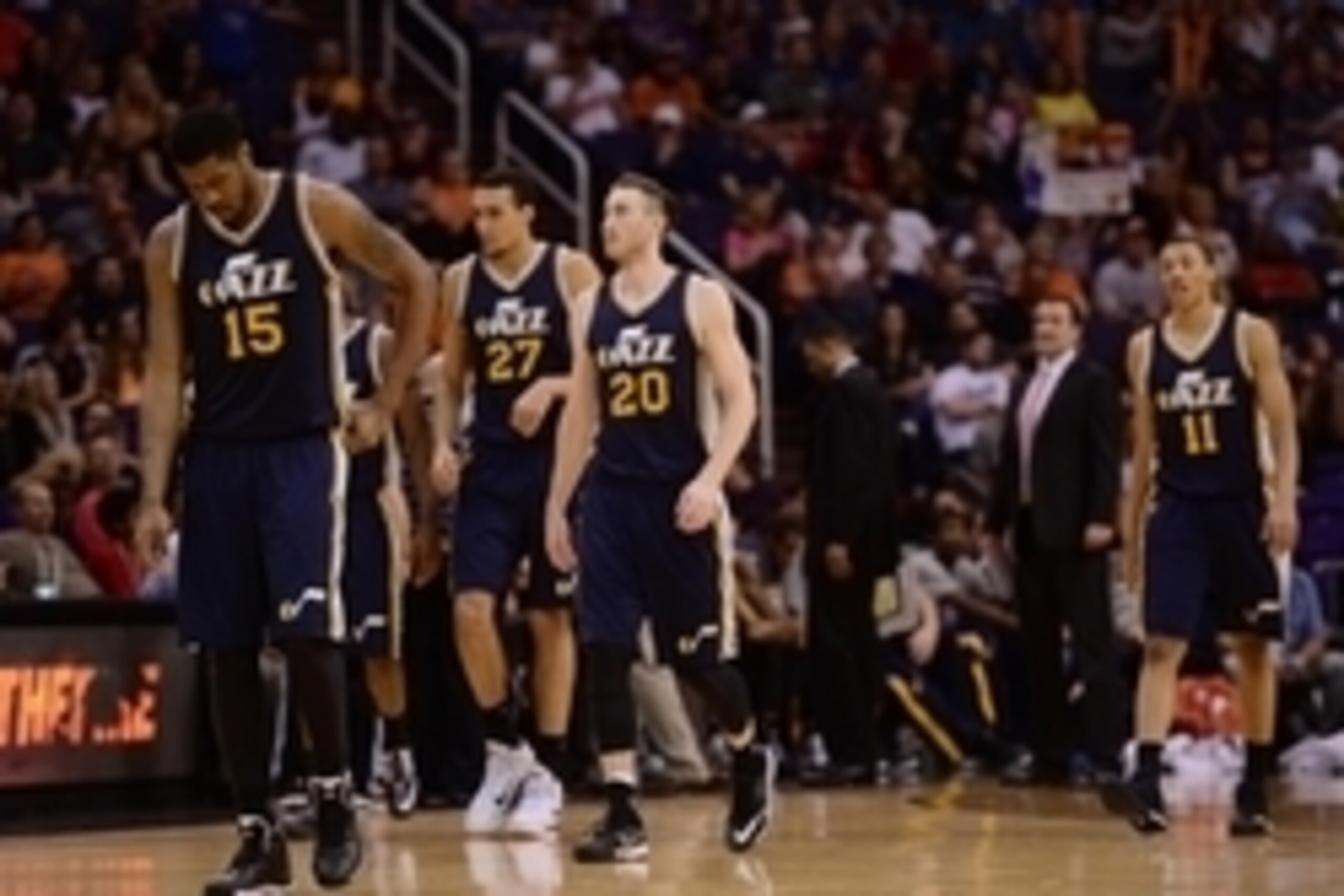
More importantly, the Jazz don't need a Love or Dragic. Sure, they have some serious cap flexibility to work with over the offseason, per HoopsHype. And yes, they're not in a position to turn away interested talent. Utah isn't Los Angeles or New York, after all.
Unlike New York and Los Angeles, though, Utah is already home to a quality basketball team that isn't tethering its hopes to players it doesn't yet have. And in becoming that team, the Jazz serve as a shining example for all rebuilding outfits, as proof that the most drastic approaches—tanking, free-agency coups, etc.—are not the end-alls of reinvention.
Sometimes, the old, time-tattered methods work just fine.
Sometimes patience, minus revolving extremes, pays off.
*Stats courtesy of Basketball-Reference and NBA.com unless otherwise cited and are accurate heading into March 18's games.


.jpg?w=2560 "Love's Body Already 'Tired'")
.jpg?w=2560 "Tyreek Deal May Come Soon")
.jpg?w=2560 "Ward Nearly Walks Out of Presser ▶️")



.jpg?w=2560 "NFL investigating 2 referees for separate viral exchanges")