

What's Behind Inconsistent Brooklyn Nets' Offense?
The Brooklyn Nets offense isn't right, and there's a bunch of fixing to do before it can correct itself.
There's a palpable inconsistency with the Nets attack. One moment, you'll see Brooklyn running a modern-day offense, shooting loads of threes, getting to the hoop like rim assassins and moving the rock around the perimeter as if no one were allowed to hold it for more than a split second.
Then, the team regresses back to square one, looking like a squad copied and pasted straight out of an undeveloped and mediocre offense from 1994.
TOP NEWS

J-Dub, Wallace May Miss Entire Season
Celtics at Fault for JT-JB Beef? 🤔
Melo's Quote on Confidence 😎
Those changes don't just happen between games. We'll see them between halves, quarters, even possessions. It's part of why Joe Johnson called out the team for being selfish earlier in the season.
Brooklyn's underwhelming scoring attack ranks 24th in points per possession on the year and has been majorly slipping of late, complementing poor performances on the inside with under 27 percent three-point shooting during January. And after almost blowing a 23-point lead Wednesday night against the Sacramento Kings, the offense doesn't seem to be showing signs of improvement.
The Philosophy
Effective offense isn't about whether a field goal goes in; it's about how the attempt happened and from where it came.
Just because an attempt goes in the hoop, that doesn't make it a good shot. "Good shots" are ones that have strong odds at getting you points, whether that's at the line or on the floor.
In today's statistical revolution, the good shots are three-pointers and layups or dunks. Actually, Seth Partnow made a note on Twitter of which teams play the most "Moreyball," named after Houston Rockets general manager Daryl Morey, who promotes an extreme strategy of taking as many shots at the rim and from beyond the arc as possible.
"Through yesterday's games, "MoreyBall %" for all 30 teams: pic.twitter.com/xImYLrU2KE
— Seth Partnow (@SethPartnow) January 21, 2015"
See the Nets all the way down in the bottom 10? That shouldn't be a surprise, even if Brooklyn doesn't always play this way.
"Our best games, I think we shoot a lot of free throws," said Mason Plumlee. "We get to the rim. We're the aggressors offensively."
And he's right. The Nets are better when they're driving successfully to the hoop. But the key word there? Successfully.
The Nets have times when they look great getting to the rim, but the team still ranks below league average in free-throw rate and points per drive to the hoop.
"We had a stretch when we played at Orlando where I thought it was the best—we shot the ball really well, but the ball was moving, guys were playing together," Plumlee said. "I think if we could get back to that—not to say we haven't had a good outing since then—but if we can get back to how the ball was moving and [how] everybody was playing together, I think that would really benefit us."
Plumlee was likely referring to the second and third quarters of that game, when the Nets outscored the Magic 64-36 before almost blowing a massive fourth-quarter lead in a remarkably similar finish to what went down Wednesday in Sacramento. It's no coincidence Brooklyn played major Moreyball for those two quarters.
In 40 Nets field-goal attempts during the second and third, 28 of them were either from three or at the rim. But Brooklyn just doesn't replicate those sorts of stretches on anything close to a regular basis, even if that production came against a subpar Orlando defense.
"You can't just play that system because you said you want to play it," head coach Lionel Hollins said of implementing an offensive system into a new team. "I remember a few years back, Marc Iavaroni brought the Phoenix system to Memphis, and he imploded because he didn't have the talent. You look at [Mike] D'Antoni. Took that same system to the Knicks. It didn't work. He took it to the Lakers, and it didn't work. You've got to figure out what your strengths are and try to play to them, because bottom line, you're trying to compete and you're trying to win. It's not really about systems, although today, more is spoken on that, but it's not really about systems. It's about playing to your players' strengths."
So, let's not call it a system, then. For the rest of this piece, let's forget that term, because in the end, Hollins is right. "System" is a buzzword talked about far more often than it needs to be mentioned.
Let's call them concepts, then. Offensive concepts.
You know them: Taking good shots, moving the ball, getting looks at the rim and from three, creating opportunities to get to the line. The usual.
Well, those aren't consistent across the Nets, either.
There are other offenses out there—the San Antonio Spurs, the Rockets, even the Philadelphia 76ers—whose coaches and management make sure players get the looks guys at the top want. Those are, after all, the people paid to discover exactly what is the best way to score.

Hollins, for some reason, doesn't subscribe to that philosophy, believing players are going to take the shots they want.
Sure, offenses are different. Rosters aren't consistent. Skill sets diverge between teams. But there's no scenario in which a contested Jarrett Jack 17-footer with 12 seconds left on the shot clock is good for the offense. It just doesn't exist. Yet, Hollins' laissez-faire attitude toward offense encourages such behaviors, intentionally or not.
It says something that Plumlee has to dig all the way back to a game from three weeks ago to point out a positive. The Nets are 2-8 since the win over Orlando to begin 2015.
The offense doesn't have very much complication or misdirection, and Hollins is fully honest about that (as he is about most everything).
"What concepts?" Hollins responded when asked about his players not potentially picking up on the offensive schemes. "Pick-and-roll. Simple. Stand over there. Stand over there, run pick-and-roll, come behind, get the open shot and make it. It's as simple as that, it's not like we have some complicated offense that nobody's ever seen before."
So, let's get this straight. Systems are overanalyzed and concepts are non-existent?
Plenty of Nets pick-and-rolls are leading to poor shots with the ball in the hands of Jack, who is averaging 4.2 mid-range attempts per game since becoming the starting point guard a month ago. And when a screen-and-roll doesn't work on a first try, when a shot doesn't go up, that's when we see the offense regress into isolation or long-winded post-ups.
Simple isn't always effective. The simpler the mind, the easier it is for the opposition to infiltrate.
The Open Miss
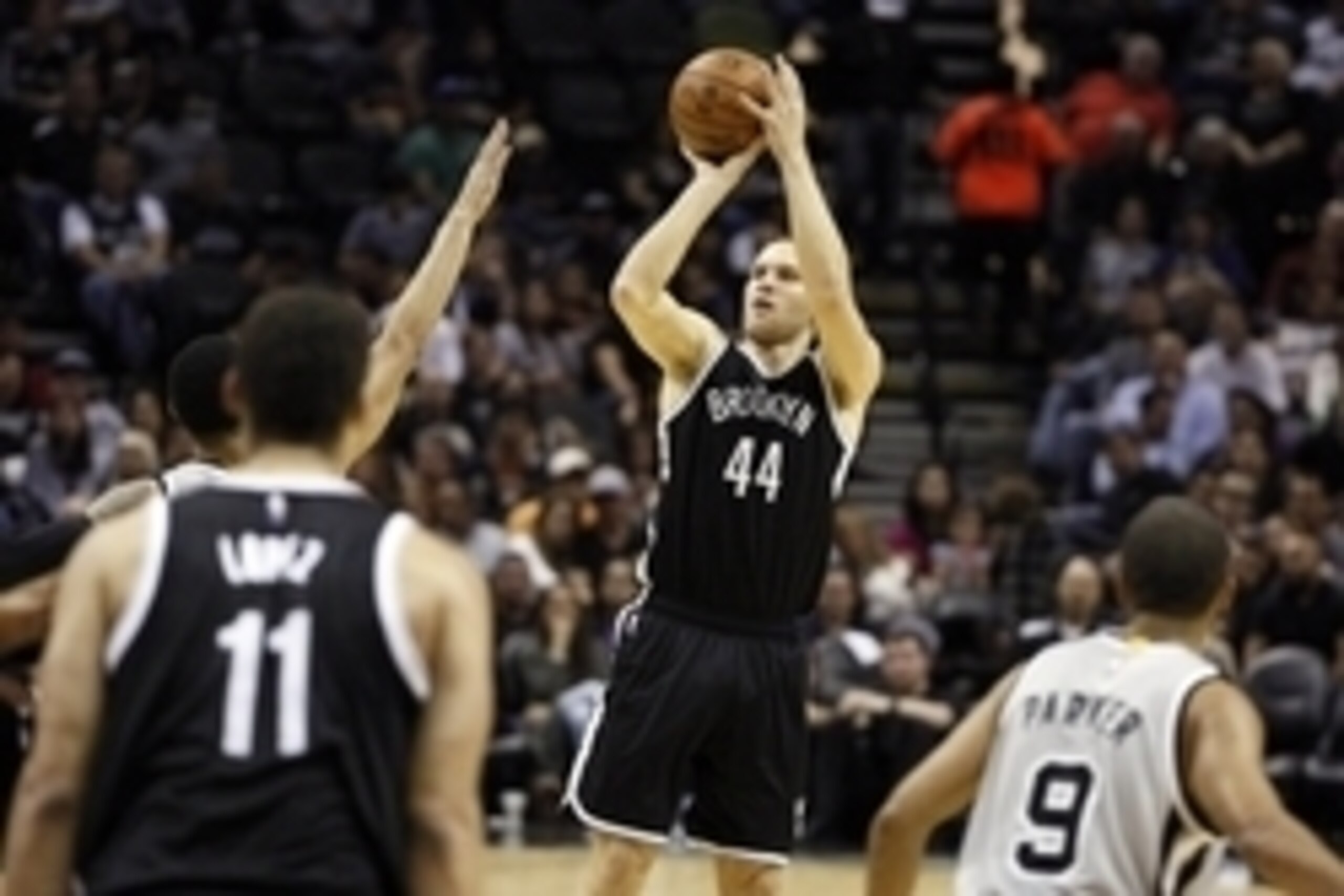
The Nets offense isn't all bad.
Brooklyn's main problem isn't always creating open shots. Actually, the Nets are attempting 16.6 threes per game with at least four feet of room between the shooter and the defender, per NBA.com's SportVU data. The bigger issue here: Brooklyn isn't capitalizing on those opportunities.
Your average NBA team hits about 35 percent of total three pointers. Well, the Nets are hitting a mere 33 percent of their open opportunities.
Defenses have started to catch onto the trend.
One of the reasons Brooklyn is attempting a respectable amount of open threes isn't because their dribblers are so good at creating gravity in the lane, but because opposing perimeter defenders are comfortable leaving the Sergey Karasevs and Bojan Bogdanovics in the corners and on the wings to help.
When a penetrator gets stifled, he has the option of putting up a contested shot or passing out quickly to a guy who, more often than not, won't burn the defense. Those aren't exactly dynamic options.
Maybe that's why some Nets are so reluctant to pass. Or, you know, it's just part of their nature.
It's not just that, though. You can't pass to guys who aren't open, and Brooklyn doesn't really get guys to unguarded spots. There's a difference between guys getting open the way you want them to and players being unguarded because the defense would rather have it that way.
It's not just a moving-off-the-ball issue, either. It's also a screening one.
Where are the Picks?
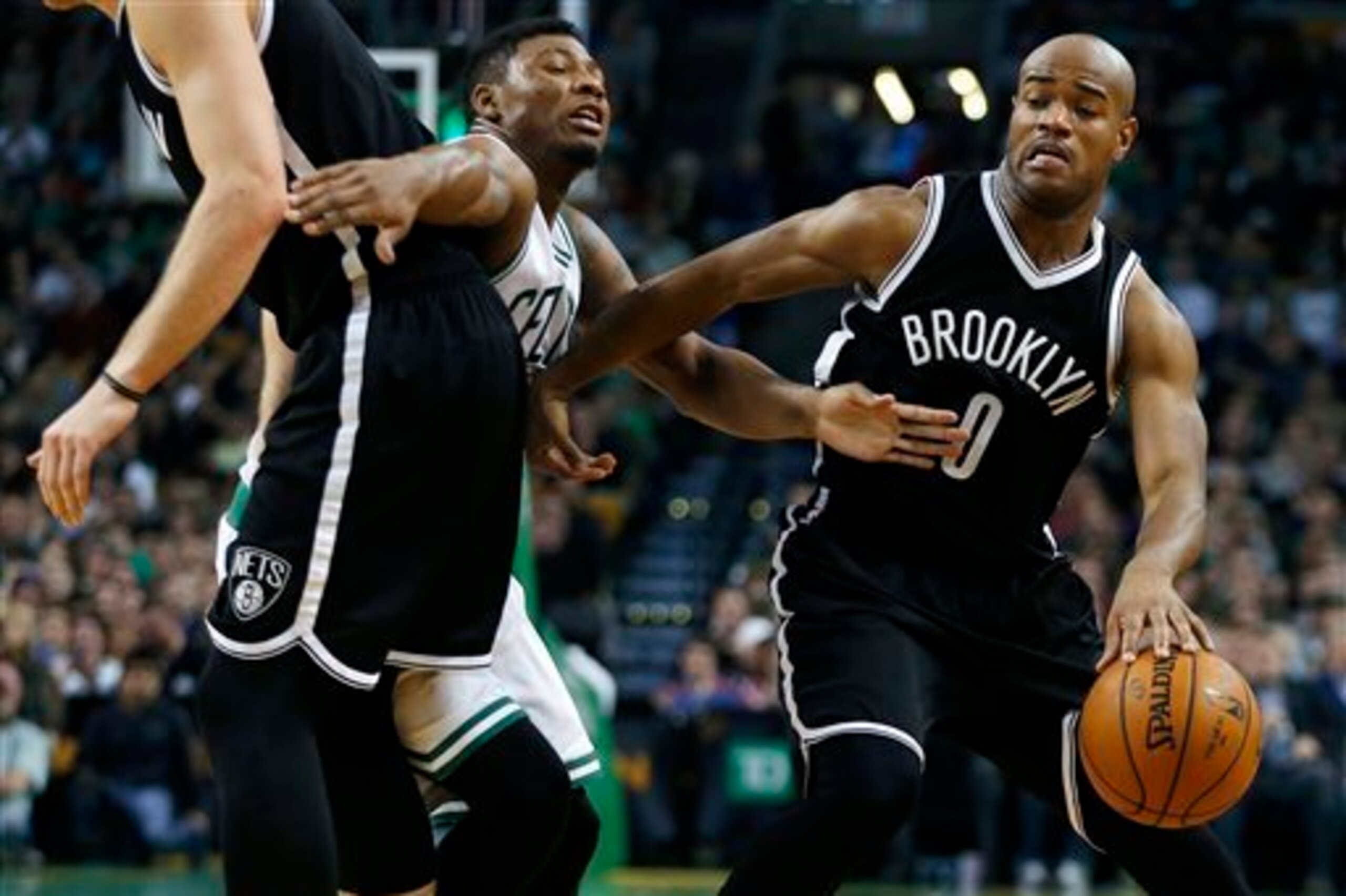
Outside of Kevin Garnett (and let me re-emphasize just so KG doesn't eat me alive: outside of Garnett), the Nets don't set particularly strong screens, and their players don't always brush picks effectively either.
Brushing a pick is a relatively simple concept. When a player runs by a screener, he wants his hip to graze up against his teammate's just barely, a brush if you will, so that there's little to no room for a defender to run through the two players. But the Nets brush so little that it's no wonder why their offense is more of a blank canvas than a Picasso.
Let's rewind to Jan. 9, when the Nets dropped an embarrassing home game to the 76ers 90-88.
3.2 seconds remaining in regulation. Nets ball. Down two. Coming out of a timeout. Here's how the possession plays out:

Sixers coach Brett Brown makes a brilliant move here, having Robert Covington play free safety rather than guard the inbounder. The Nets couldn't recover from that decision.
First, Covington cuts off Jack, Brooklyn's first option, as he runs off a screen, a task made far easier for Covington considering Mirza Teletovic doesn't come anywhere close to bodying his point guard's defender.
Teletovic probably wouldn't be in the game under normal scenarios. Usually, that's KG's screen to set, except Garnett sat out the Philly game on the first night of a back-to-back. But it's fine. The Nets have a second option on the play.
Johnson then curls around Teletovic, except he stutter steps and fails to brush the screener. Once again, Mirza doesn't touch the defender and Covington cuts off a potential passing lane as Johnson creates no room between himself and his man.
It's another instance of Brooklyn's screen game letting the offense down. Even when Lopez sets his pick for Teletovic before flashing to the top of the key to receive the inbounds pass, he doesn't make much contact.
You can say it's an issue with execution, which it surely is, but there are also some funky X's and O's here. Even if the Nets want to run this exact play, there are some pointless moments on the court, like before the inbounds, when Johnson is running around no one as Lopez bends over and watches:
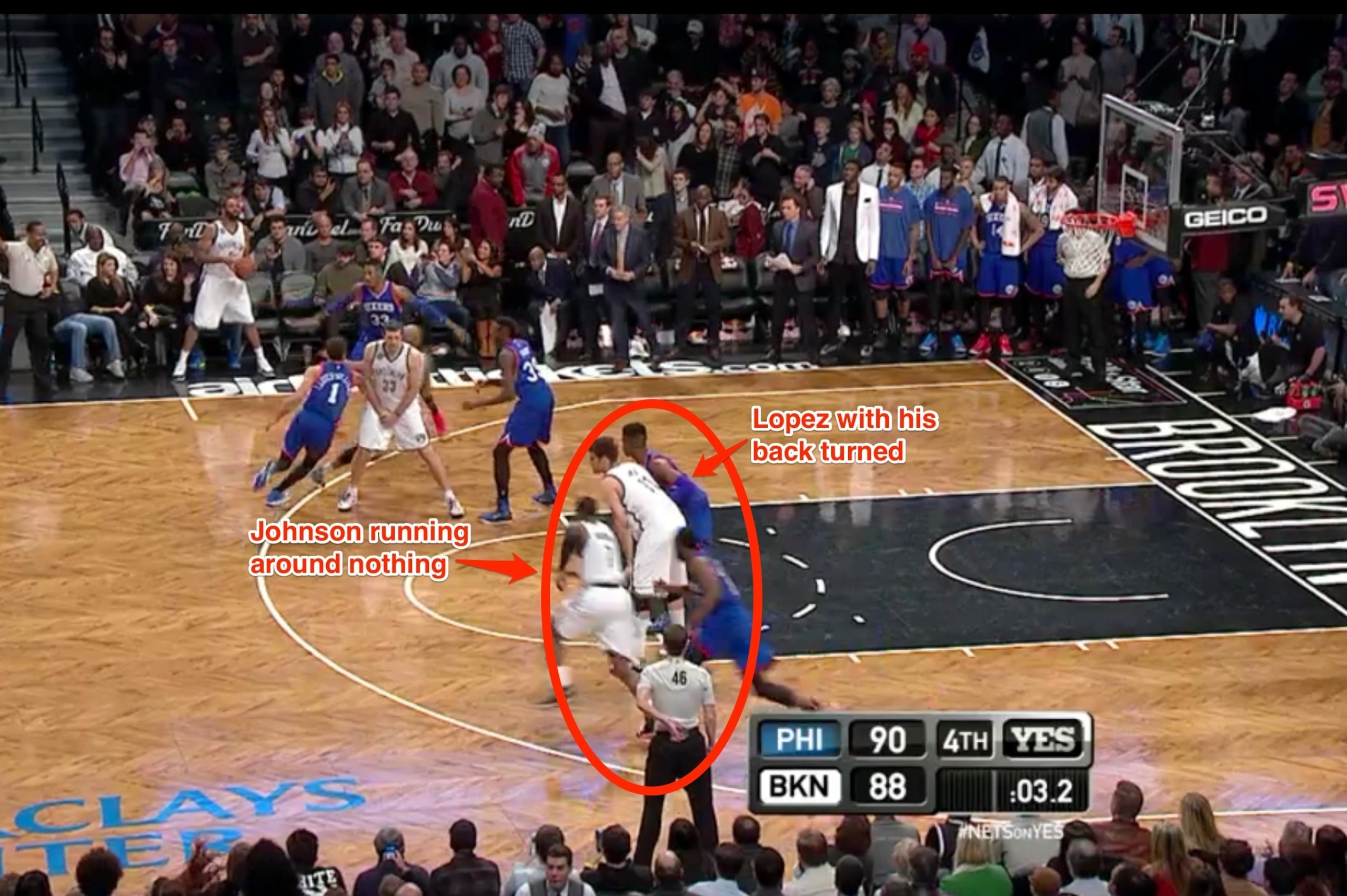
The Nets could have set up a double-screen with Lopez and Teletovic here. Instead, Johnson ends up running around one lazy pick, and that's all Philly needs to stifle the Brooklyn offense.
There should never be someone on the floor doing "nothing" during a final-moment, out-of-bounds play. A player should always be setting a screen, running off one or creating a diversion by letting gravity keep his defender far away from the shot. But we see nothingness here, and we've been witnessing similar failures in Brooklyn all season.
The Options

Lopez is in the midst of his best stretch of the season, averaging 22.9 points and 9.3 rebounds per 36 minutes in a lesser, mostly-off-the-bench role over his past 12 games. But he still promotes concepts which help the Nets offense become stagnant, considering how he treats the ball like a newborn baby after receiving an entry pass, too nervous to trust anyone else even to hold it.
Let's stay in that Philly game, because why the heck not? When you lose at your place to an at-the-time 6-29 team, you deserve to have someone harp on it later in the month.
This time, go back to the play before that game-ending Lopez three-point attempt.
A little more than 30 seconds left now. Nets down a couple with the ball, and this is Hollins' play after the timeout (also known as an "ATO"):

Good, right? Lopez made the shot, tied the game with 25 ticks left on the clock and everyone inside Barclays is happy.
Right?
Right??
Not if you remember to live by the principle that good shots are more important than made ones.
In reality, this is somewhat of a nonsensical play.
The Nets inbound to Johnson, their usual crunch-time ball-handler and scorer, only to let him run a pick-and-roll with Lopez to the corner, where he can easily be trapped.
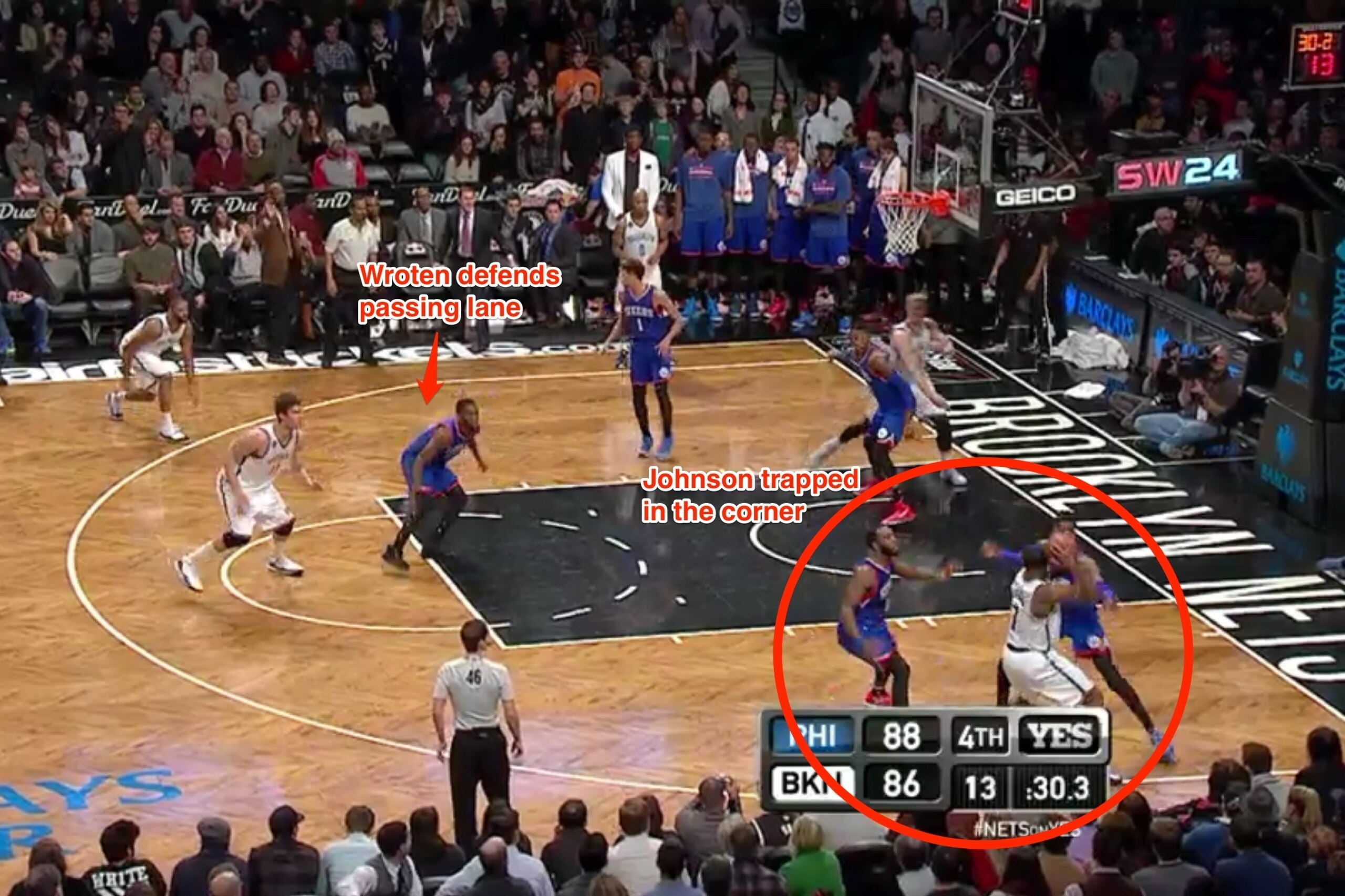
It's significantly easier to blitz in the corner and Lopez doesn't keep his man hung up on the pick (another screening issue for Brooklyn). Mainly though, Johnson heading straight to an easily trappable spot means only Lopez, the nearest teammate, can bail him out, and when only one offensive player can realistically receive a pass, it allows the defense to gamble more comfortably.
"Nothing you do out there happens 100 percent the way you practice it. Nothing offensively or defensively," Hollins said after Tuesday's practice. "You may get one or two plays that you execute and they turn out exactly how you draw them up. Most of the time, you've got to be flexible to play off those plays. And that's why players with high basketball IQ and instincts are important and valuable."
Hollins wasn't referencing this play specifically, but doesn't the above statement apply? Johnson has to know not to go directly into the corner, enticing the obvious trap.
This could have easily been a steal. And even though Lopez made the running floater, you could argue the best shot here was the wide-open left corner three for Jack which never happened because of Brook's tunnel vision.
Why It's Continuing

The Lopez floater play sums up the discombobulation within the Nets offense pretty nicely, actually.
Hollins' ATOs tend to have similar themes, mainly that they have unreliable second options. It's almost never there.
That's why Lopez got the ball late. It's part of why Jack or Johnson couldn't receive the inbounds pass on the buzzer play which eventually turned into the Lopez missed three. And when you add players who aren't always adept at finding space inside a functioning defense to an offense already without much innovation, you're left stuck with this...whatever it looks like.
Hollins may like to call the Nets offense simple, but at some point, simplicity turns into predictability. Brooklyn even remains calculable once teams make adjustments, like when the Washington Wizards switched up pick-and-roll coverages during the final period of Saturday's win over the Nets, one of the main reasons Brooklyn had a fourth-quarter stretch of more than five minutes during which it scored just one basket.
"You try to adjust to the coverage," Jack said. "Regardless of how good a defense is, there's still an option they have to leave open, because they're reacting to our movements."
But when you have the same habits and the movement off the ball isn't exceptionally active, then what?
Jack almost always uses a screen and then turns the corner around it, rarely ever denying it, which makes defending a Jack pick-and-roll far easier. If you know a guy is going one way, you can guard him as such.
Garnett will almost always pop. Plumlee will always roll, and Lopez will do either depending on who exactly is on the floor with him.
Options, spacing and fluidity are the three main components to running a successful offense, and at this point, the Nets are far from perfection in all three.
They can still get better. Deron Williams is yet to return from his rib injury, but the Nets say he is starting to participate in on-court, non-contact work. His presence doesn't mean what it used to, but at least it can shore up the backup point guard spot.
Still, we're not seeing signs of Brooklyn improving schematically. If Hollins believes players are going to take the shots they're going to take, then guess what? There's probably nothing stopping them from doing it.
As long as those attempts are inefficient ones, the Nets offense will likely continue to linger around the bottom of the league.
Fred Katz averaged almost one point per game in fifth grade but maintains that his per-36-minute numbers were astonishing. Find more of his work on ESPN's TrueHoop Network at ClipperBlog.com. Follow him on Twitter at @FredKatz.
All quotes obtained firsthand. Unless otherwise noted, all statistics are current as of Jan. 22 and are courtesy of Basketball-Reference.com and NBA.com.
.jpg?w=2560 "Chiefs, Steelers Eye WR Trades")




.jpg?w=2560 "WWE Raw Live Grades 🔠")
