Los Angeles Lakers in Danger of Repeating History with Kobe Bryant
At age 36, Kobe Bryant is averaging 36 minutes per game and shouldering a heavy burden for a team with a 5-13 record.
Sometimes the end seems to justify the means, such as an overtime win against the Toronto Raptors, 129-122 on Nov. 30, in which Bryant scored a triple-double in 42 minutes. He also became the only player in NBA history with at least 30,000 points and 6,000 assists.
To the delight of Lakers fans, there goes Kobe being Kobe again.
TOP NEWS
.jpg?w=2560 "NBA Gambling Charges")
Malik Beasley Negotiating Plea Deal (AP)

Yaxel: Luka Not MJ 🗣️
Knicks, Spurs On Wrong Side of History
But there’s another conversation to be had as well—about the limits to which an athlete can be pushed, about the time it takes a body to recover and the inevitable way it breaks down over time.
The dance with the devil—the battle with the undefeated Father Time.
At the tail end of the 2012-13 season, the Lakers, under then-coach Mike D’Antoni, were pushing desperately to capture a place in the playoffs. Bryant had averaged 45 minutes for seven games in a row.
It was the seventh one that did him in. At the 45-minute mark of the fourth quarter against the Golden State Warriors, Bryant made a move to go around Harrison Barnes. He felt a pop and went down—his left Achilles tendon had just exploded.
Surgery and a lengthy rehab followed, with the sports world following every painful step of the way.
Bryant made his comeback the following December. Six games in, while running the point for an injury-depleted Lakers squad, No. 24 went down with a fractured knee and would be out for the remainder of the season.
In hindsight, one can say the two injuries were not related, that freak accidents happen—it’s the game of basketball and it’s played hard and fast on a wooden floor.
Not everybody bought that theory, however, including a guy who coached Bryant to five NBA championships.
Last January, Phil Jackson talked about the situation during an interview on NBA TV with Rick Fox:
"Kobe’s minutes he’s played, the time he’s been on the floor, the duress and the way he's played has taken a toll, obviously. And his injury, I think, was part of the chain of events that happened because of his Achilles tendon. And, y’know, unfortunately, it set him back and now he's got a knee injury.
"
Nearly a year after Bryant’s last major injury, the red line is again being toyed with. Except this time, the longtime Lakers superstar has a new coach in Byron Scott, and the idea of reduced wear and tear has been on the table since before training camp.
In an interview with Mark Medina of the Los Angeles Daily News in early September, Scott said: “I have to be real smart that I stick to my guns as far as minutes are concerned, even if it costs us a game or two.”
But has that really been the case? Medina recently revisited the subject of Bryant’s workload, quoting the 19-year veteran as saying: “It’s very challenging but I have to figure it out. We’re on uncharted territory. The example is really ours on how to figure out how to do this.”
Two nights after Bryant’s 6,000th-assist milestone, the Lakers were on the road and up 20 against the Detroit Pistons. With two minutes left in the third quarter, a clearly exhausted shooting guard trudged to the bench—hopefully his night was over.
But his teammates let the lead ebb away and the enduring franchise cornerstone had to come back and help seal the win, 106-96.
Chronos—the mythological figure who embodies the passing of years, the suspension of the normal. Otherwise known as Father Time.
The season is barely a month old, and already, Bryant seems to be running on fumes, battling his own body, averaging 38 minutes per game over his last five games. How does this compare with some of his high-profile fellow elders around the league?
Gregg Popovich of the San Antonio Spurs has long been known for monitoring the wear and tear on his veterans, with limited playing time and games taken off altogether. Tim Duncan, 38, and Manu Ginobili, 37, are averaging 30 and 23 minutes per game, respectively.
Meanwhile, Dirk Nowitzki, 36, of the Dallas Mavericks, is playing 29 minutes per game, while Paul Pierce, 37, of the Washington Wizards, and Kevin Garnett, 38, of the Brooklyn Nets, average 27 and 24 minutes each.
These are not players coasting toward retirement. But each one is being smartly managed because the aging process demands it.
Asked by Mike Trudell in a Lakers.com video segment about ways to get easier minutes for Bryant while still having him on the floor, Scott replied: “Have Wesley (Johnson) guard that guy that’s going to be running all over the place, where Kobe can relax a little bit on the defensive end and rest, and exert more of his energy on the offensive end.”
Scott concluded his reasoning by explaining: “Even though it’s 35 minutes, but actually it might be 28 because of the way we’re using him on the defensive end and the way we’re using him on the offensive end.”
The problem with this reasoning is that switching on defense won’t actually reduce a player’s minutes by 25 percent. Not unless the Mamba were to hang out with his coach after drilling a basket, as his teammates run the other way.
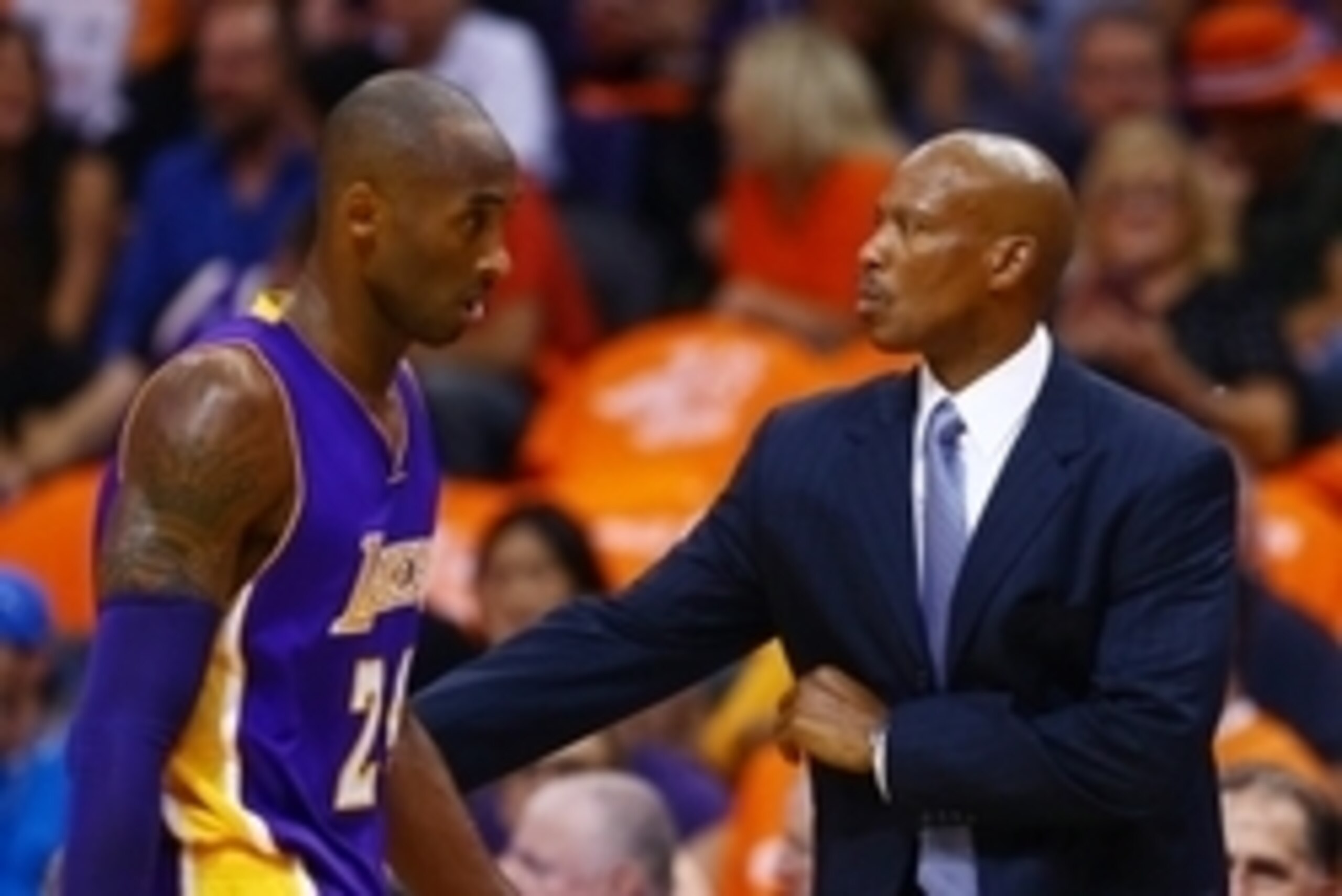
Bryant may indeed exhibit tired legs on defense at times, but they can still be straining under the effort. And are we to assume that Nowitzki, who has never been known as a defensive stopper, is actually playing 22 minutes per game instead of 29?
There comes a point at which production and tolerance have been maxed out. The Lakers’ five-time NBA champion employs every trick in the book, with ice-water immersion, hours of physical therapy and strict dietary habits. His rest and recovery period can last for most waking hours until it’s time to head back on the court again.
He has become a walking, running and scoring medical experiment. And despite the willingness “to figure out how to do this,” he’s really no different from a racehorse who will struggle to cross the finish line after breaking its leg.
If that analogy seems too much, consider that Bryant hobbled to the free-throw line to take his shots, knowing he had a ruptured Achilles tendon.
The trick now, is to make sure he doesn't blow out the other one.
Ultimately, there is just one way to maximize Kobe's final two years in the league. His minutes have to be shortened. That doesn’t mean saving a few here and tacking them on somewhere else.
It doesn’t mean applying a slide rule to defensive assignments. Or letting him skip a few practices.
Scott may feel the clearest path to winning rests on his star’s weary shoulders, but the team’s current record is not a convincing argument.
Management may be selling a product, but where is the entertainment value if Bryant is seriously injured again and misses his own farewell tour?
Those who choose to ignore history are doomed to repeat it.
For now, Bryant soldiers on, and both he and Scott continue to talk about uncharted territory.
But haven’t we been down this path before?



.jpg?w=2560 "Aikman Blasts Cowboys WR 🫣")
.jpg?w=2560 "Jonathan Taylor Landing Spots")