Washington Redskins Going Backwards Under HC Jay Gruden
The Washington Redskins are going backwards with Jay Gruden at the helm. The first-year head coach is somehow managing to cast the Mike Shanahan era in a positive light.
Granted, it's difficult (although sadly not impossible) to go backwards from last season's 3-13 finish. But it's fair to say that under Gruden, who has won just one of six games in charge, the prospects for progress don't look good.
Let's start with some of the obvious warning signs. The primary one is that many of the failings that led to 2013's three-win season are still present.
TOP NEWS
.jpg?w=2560 "NFL Paris Football")
NFL House in Paris Closes for Protests
.jpg?w=2560 "Seahawks Chiefs Football")
Trevon Diggs Cut by Seahawks
.jpg?w=2560)
B/R's Expert Week 7 NFL Picks 🔮
There's the same penalties, propensity for turnovers, dreadful special teams performances and poor offensive line play. Fixing those three is usually a staple of any rebuilding job.
The first thing struggling teams need to learn is how not to beat themselves. That means eliminating the penalties that kill drives and take points off the board. It also means protecting the football to avoid putting the defense in bad positions and giving games away.
Take last season's Kansas City Chiefs as a prime example of how these corrections can quickly turn a franchise around. The Chiefs finished 2012 as football's worst team at 2-14.
Yet they went from that record to 11-5 in just one year. The formula for the quick reversal was simple: an opportunistic defense complemented by an efficient, mistake-free offense and big plays on special teams.
None of that should have been beyond the Redskins in the wake of four depressing, Shanahan-led years. It would be difficult to argue that the roster Gruden inherited is significantly less talented than the one Andy Reid took to the playoffs in year one.
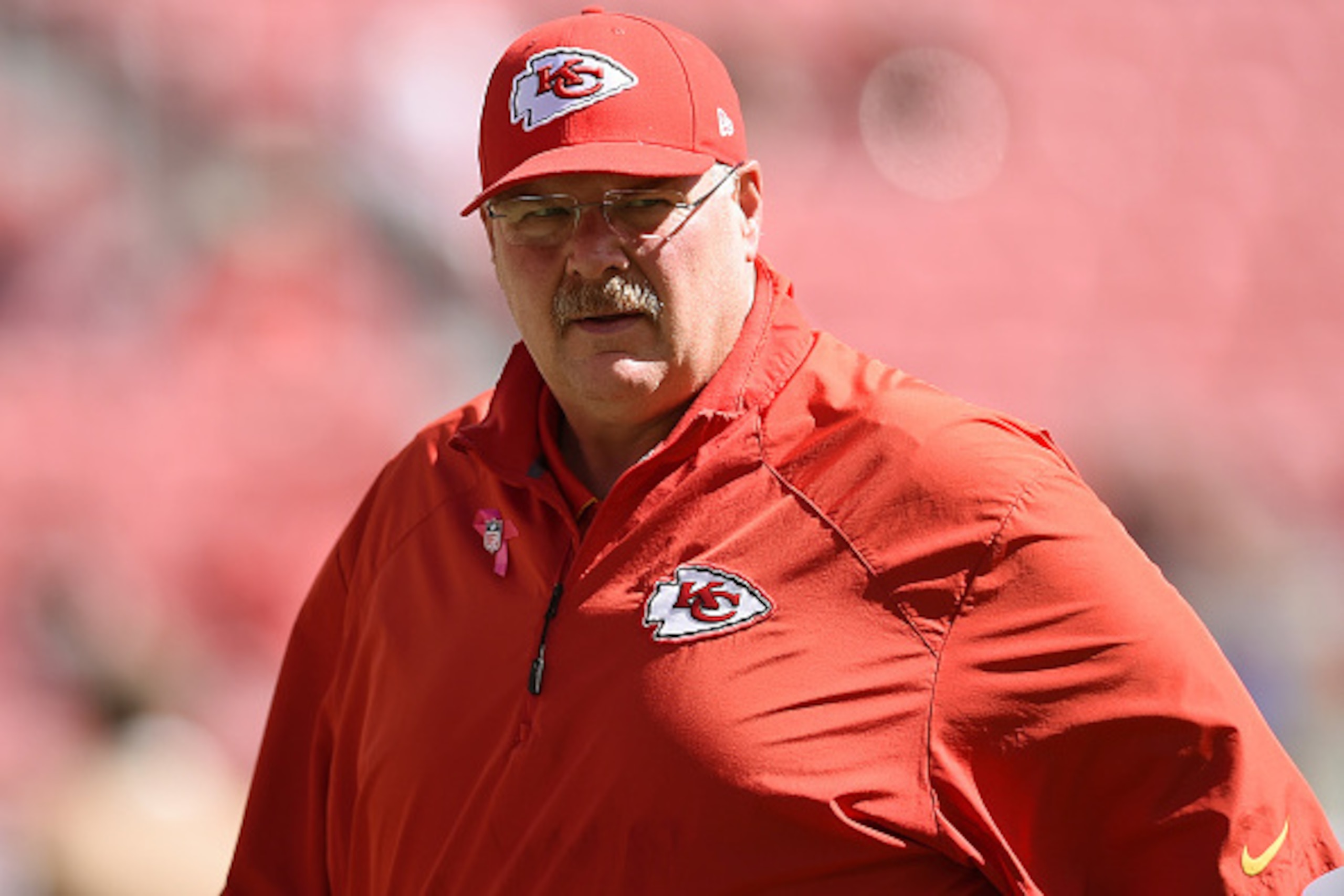
Reid arrived at the Chiefs and found a stellar running back waiting for him in the form of Jamaal Charles. Gruden was given a similar boost by the presence of two-time 1,000-yard rusher Alfred Morris.
Reid found a defense loaded with big-play potential in the shape of outside linebackers Tamba Hali and Justin Houston, along with nose tackle Dontari Poe. Again, Gruden had similar tools to work with in the form of Ryan Kerrigan, Brian Orakpo and Barry Cofield.
If anything, Gruden possibly had a leg up on Reid because he had a competent passing game already in place. Record-breaking wide receiver Pierre Garcon and dynamic "Joker-style" tight end Jordan Reed were available to catch passes from two starter-ready quarterbacks in Robert Griffin III and Kirk Cousins.
So why haven't things gone anywhere nearly as well for Gruden as they did for Reid? It's not as if the former walked into a tougher division.
The NFC East can't compare with an AFC West, where you face Peyton Manning and the Denver Broncos as well as Philip Rivers and the San Diego Chargers twice a season.
The real root of the problem lies in the failure of the new regime to establish a winning mentality, one stemming from a culture of doing things right and accountability.
Apologies if that sounds a little too like the dreaded coach speak. But like it or not, those buzz phrases represent truisms the Gruden-coached Redskins simply haven't embraced.
The culture around the team became a hot-button issue in the wake of Week 5's 27-17 home defeat to the Seattle Seahawks. Apparently, not every Washington player showed the appropriate level of disappointment, as Jason Reid of The Washington Post noted:
Gruden was moved enough to comment on this report, per The Associated Press:
"Hopefully it was taken out of context or what have you, but I have no idea what it was like. If it was upbeat, it shouldn't be, and that is disappointing that it was because they played their hearts out. They played hard, I thought. We lost the game. No reason to be upbeat, though, whatsoever.
When you do lose, you want people to be sick about it. And you want people to try to bounce back from it and move on to the next week and learn from their mistakes and make sure it doesn't happen again and not ever, ever be satisfied after a loss.
"
The fact this issue became news at all is disturbing. It implies Gruden doesn't have a tight enough grip on the locker room, or that many members of the current roster simply have the wrong attitude, or both.
Ultimately, it's up to the coach to create the right attitude. Very often that means making losing so unbearable for his players that they give everything on the field to avoid it.
The key to that has to be continually challenging the players for more. Take Washington's last opponents, the Arizona Cardinals, as a good example.

Despite beating the Redskins 30-20 in Week 6 and gaining sole command of the NFC West, head coach Bruce Arians was far from happy and let his players know it, per Arizona Sports 98.7 FM (h/t ArizonaSports.com writer Kasey McNerney):
"I learned a long time ago that there's nothing you learn from losing that you can't learn from almost losing. We've got a lot of things to learn from that ball game.
...
Taking the ball away four times in the fourth quarter should ice it for you, but our offense couldn't close the deal, and it was very frustrating because we were so close about four or five times.
...
A backside cutoff block, a front side block, throw the ball one foot further to Jaron Brown, that's another touchdown. Those are the plays we're leaving out on the field offensively.
"
Arians' mentality of not being happy even in victory is clearly transmitting to his players. Safety Rashad Johnson chided a defensive effort that produced two sacks, four turnovers, one touchdown and held Washington to 72 yards rushing, per Arizona Sports 98.7 FM (h/t ArizonaSports.com editor Shane Dale):
"There's a lot of plays we left back there on the field -- missed tackles, not in the right defense. And then 30 seconds left in the second quarter and we give up three points -- I mean, that could've cost us the ballgame.
...
We've been doing everything we needed to do all season, but we haven't gotten to that point where we've been selling out for the guy next to us.
"
That's from a member of the defense that's allowed the 10th-fewest points in football and is the NFL's third-toughest unit against the run.
From these comments, it's clear the Cards have a culture, mentality, mindset or whatever label you want to give it, based on never being satisfied and constantly improving. In this environment, it's impossible for players to rest on their laurels.
Sadly, it's just as clear that no such culture exists in Washington. Contrast the postgame views of both Arians and Johnson with Gruden's summary of Brian Orakpo and Jason Hatcher's performances in Arizona.
The duo, who are supposed to be Washington's top pass-rushing threats, were virtual non-factors against the Cardinals, as Mike Jones of The Washington Post noted during the game:
Yet despite their tame efforts, Gruden still praised Orakpo and Hatcher after the game, per ESPN 980 reporter Chris Russell:
Of course, oftentimes coaches want to protect their players, at least publicly. But while that's understandable to a point, calling out underperforming key stars is no crime.
It's that kind of passive talk that makes it seem as though this job is too big for Gruden. And it's not just what he says that strengthens that view, it's also the decisions he makes as a play-caller.
The problems with the Morris-led running game were discussed at length in this article. The heart of the issue isn't Morris himself, it's the play-calling.
When a natural and highly productive workhorse is given fewer than 14 carries in each of his last three games, his coach becomes accountable. The running game was the strength of the team Gruden inherited, yet it's fast becoming one of its biggest weaknesses.

That regression is unacceptable with players as talented as Morris, Roy Helu Jr. and fullback Darrel Young available. The unbalanced run-pass ratio is also wrecking this team's quarterbacks.
Both Griffin and Cousins have excellent potential, but they are also each extremely raw. Forcing them to try to win games behind a very shaky offensive line and without the support of a running game to keep defenses guessing is negligent coaching.
That explains why Cousins piled up the yards in Weeks 2 and 3 before becoming a skittish, interception dispenser in every game since. What happened to the game plan that helped Cousins throw for 427 yards and three touchdowns on the road against the Philadelphia Eagles?
Well, he certainly hasn't had 25 running plays to support him in any game since Week 3.
Cousins obviously has issues. Every interception he throws is making those of us, including this author, who championed him as a season-long starter, look increasingly idiotic. But the fact remains that he should be a better fit for Gruden's pro-style offense than the more dual-threat Griffin.
Cousins just doesn't have coaching that's making the game easier for him. Neither did Griffin.
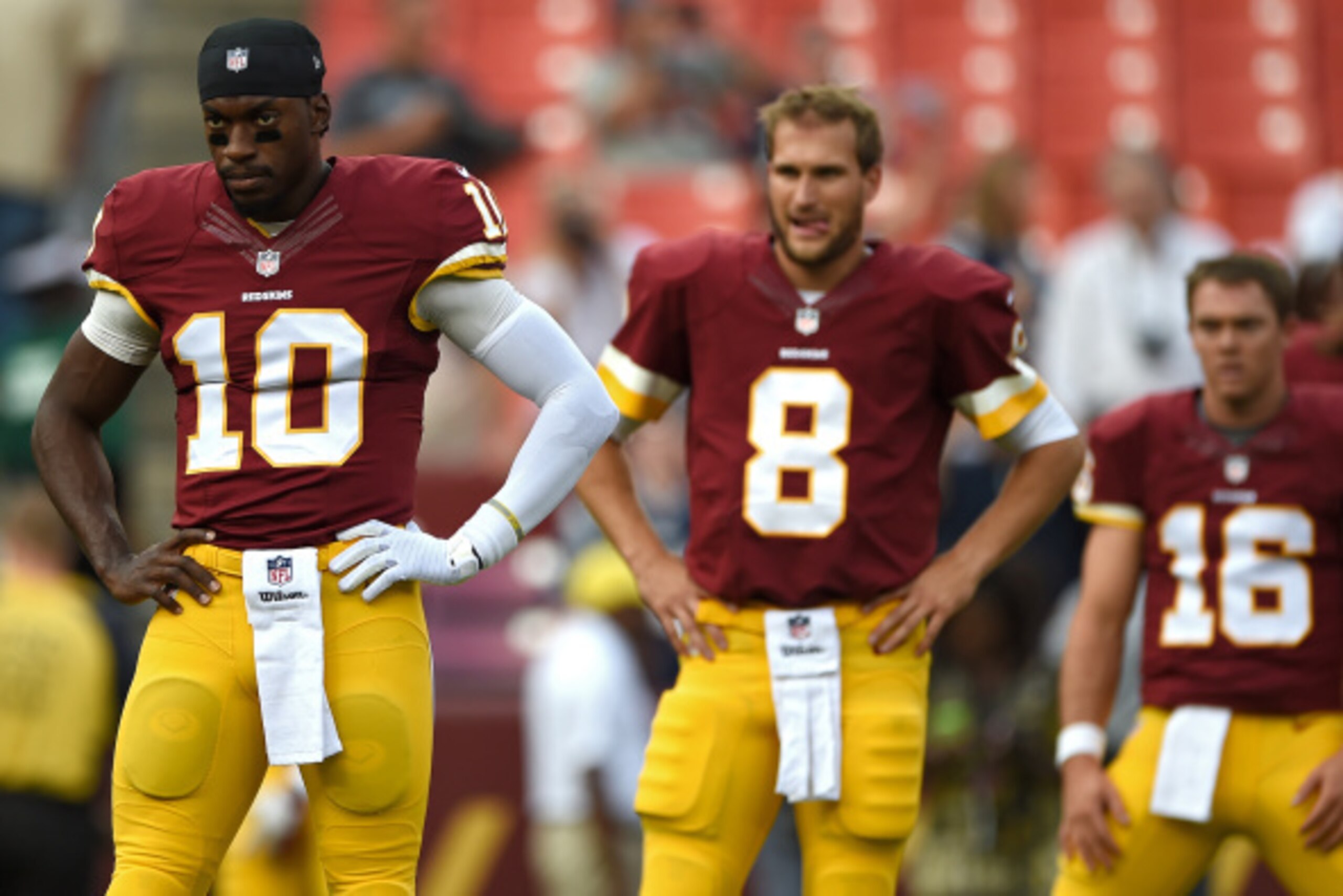
Gruden's quest to immediately reshape a quarterback deeply entrenched in the read-option into a pocket-style passer was ridiculous. It took away the one means Griffin has to challenge defenses, to split coverage and to create easier reads.
That's why Griffin's return form injury may not be the magical Band-Aid many are hoping for. That's something Jason Reid of The Washington Post noted:
"There are many questions about the two players on whom the Redskins are relying to fill the sport’s most important position. Griffin must prove he can stay in the game and excel at it from the pocket. Cousins has shown flashes of being the type of productive drop-back passer Coach Jay Gruden likes. Cousins’s potential, however, likely won’t keep him atop the depth chart if he continues to commit turnovers at an alarming rate.
"
Reid was mapping out the nightmare scenario that neither quarterback proves the answer for this franchise. But if that's the case, Gruden's coaching will be culpable.
There is enough raw talent in both Cousins and Griffin to mold a capable starter with whom this team can win. Considering he was hired because of his quarterback expertise, after tutoring Andy Dalton as offensive coordinator of the Cincinnati Bengals, failing to deliver on this front would be a damning indictment of Gruden.
The worrying thing is there's just too many questionable decisions being made since Gruden took over to feel confident about the future, both immediate and long-term.
At this point, it's appropriate to admonish general manager Bruce Allen for his part in Gruden sinking rather than swimming. Allen never should never have spent free-agency dollars on wide receivers and pass-rushers if it meant returning four of the five starters from last season's O-line.

It's also scarcely believable that anybody could think that ageing free agents Ryan Clark and Tracy Porter along with a fourth-round pick would fix a dire secondary. Yet even with Allen's influence, Gruden has made plenty of choices that are impossible to defend.
Keeping Jim Haslett in place as defensive coordinator was a head-scratching one, after he had failed to produce a stout unit in four years of trying. It's barely surprising that this season's defense lacks an identity.
The decision to sign wideout DeSean Jackson was a similar puzzle. With Garcon and Reed already in the fold and Andre Roberts added early in free agency, was there really a need for Jackson?
His recent big-play scores may scream yes. But his presence means at least one talented receiver isn't going to get the ball enough. So far that's been Garcon, according to Mike Jones of The Washington Post:
The presence of so many pass-catchers has given these young quarterbacks more weapons than they know what to do with. It's also created a sprawling, incoherent system, that's more just a collection of plays designed purely for individuals, rather than an actual plan.
All of these decisions come from the top. They are made by the man patrolling the sidelines on game days.
For now, Gruden is treading that path, but he's treading it backwards. Unfortunately, he's taking Washington with him.
All statistics via NFL.com.
.jpg?w=2560 "Titans Colts Football")