Phast Phorward: A Look at the Philadelphia Phillies' Projected Roster in 2014
There sure has been a lot of banter about the Philadelphia Phillies over the past week, and why not?
The Phillies made a splash in the free-agent market by netting its top prize: left-handed starter and former Phillie, Cliff Lee. While Phillies fans have basked in the glory of pairing him with Roy Halladay, Roy Oswalt and Cole Hamels, and enjoying their chances for a repeat as baseball's team with the best record, Lee and others have firmly stated that they won't settle for finishing second-best.
Anything other than a World Series title will be a disappointment for the Phillies and their fans alike.
With high expectations from your own fanbase comes a lot of negative feedback from those teams that a signing like this will affect. It's not the perfect situation for the Phillies. As those teams and fans have pointed out, this elite Phillies core is aging quickly.
Injuries ravaged the team in 2010, and though they hope for a healthier 2011, they certainly aren't getting any younger. Add that to the largest payroll in the history of the franchise, and a lot of people believe that the Phillies have a limited window to be successful.
Is that the case?
There are no reinforcements on the way in the Phillies' immediate future. The organization's best prospects are all located in the lower levels of the minor league system. The bullpen could possibly benefit from some minor league talent like Scott Mathieson, BJ Rosenberg, Mike Zagurski, Michael Schwimmer and Justin DeFratus in the near future, but that's about it.
An aging core, payroll that is reaching new heights, and lack of upper-level prospects have a lot of fans and foes alike calling for the end of the Phillies in the near future. These factors are somewhat misleading, as many of the Phillies' lower-level minor league talent projects to be quality major league starters over the next few seasons.
As the Phillies' core ages now, an influx of young talent should give the team a nice shot in the arm, and a television contract that expires in 2015 should give the Phillies all the payroll they need. According to one professional scout, the Phillies could go on a "Braves-like" streak of divisional titles.
While the Phillies enjoy their glory days now, the future is always on our minds. So with that, here is a look at Baseball America's projected roster for the Phillies in 2014.
Ace: Roy Halladay
1 of 15
2014 age: 36
Contract Status: Phillies hold 2014 option for $20 million; becomes guaranteed if Halladay throws 225 IP in 2013 or 415 IP combined from 2012-13.
Roy Halladay is an ace among aces. In 2011, he will headline a roation that many fantasy baseball players are drooling over. The 2010 National League Cy Young Award winner and recipient of the GIBBY award for the best starting pitcher in baseball, even if his player friendly option does not vest before 2014, it is hard to imagine that the Phillies won't be exercising it.
In 2010, Halladay was just as good as advertised, if not better. Putting together a record of 21-10 with an ERA of 2.44, he also led the league in wins, innings pitched, and complete games, finishing second in shutouts, WHIP, and win percentage, and finishing third in ERA. Without a doubt, he was fully deserving of the NL Cy Young Award, and in not much of a surprise, was the unanimous winner.
But that's the present. What does the future hold of Roy Halladay?
When the Phillies acquired Halladay from Toronto for Kyle Drabek, Travis D'Arnaud and Michael Taylor, they expected him to become the face of the franchise, and he has. From a pitching standpoint, he is the type of guy that you let figure things out himself. The picture of pitching mechanics, Halladay throws six different types of pitches, but what reallly makes him untouchable at times is the fact that he has pin-point control, misses bats with all of his pitches, and throws from a wide array of arm-slots.
Going forward, control will continue to be the most vital aspect of Halladay's game. Over the course of his 13-year career, he's walked just 485 batters while striking out 1,714.
Halladay has aged well, and one could argue that he's only getting better as he faces more hitters. Over the past four seasons, his fastball has remained remarkably consistent, averaging 92 mph on the radar gun. Aside from his cutter, which has actually gained a few miles per hour over the past season, consistency has been Halladay's motive, and it is safe to assume that Halladay will still be averaging around 90 mph on his fastball well into the 2014 season.
Even if he doesn't, he is the type of pitcher that can kill you in several different ways. When he isn't overpowering guys, he'll use his heavy sinker and sharp breaking pitches to induce ground balls, and with an above-average defense behind him, he should continue to succeed.
#2 Starter: Cliff Lee
2 of 15
2014 age: 35
Contract Status: Fourth year of five-year deal; will earn $25 million.
In many ways, Cliff Lee is the perfect match for Roy Halladay. The Phillies will enter the 2011 season with the best one-two punch in all of baseball, and will keep that dynamic duo together into the 2014 season.
A left-handed version of Roy Halladay, Lee's motive will be much of the same: locate pitches. In 2010, Lee split the season between the Seattle Mariners and Texas Rangers, posting a record of 12-9 and an ERA of 3.18. Not bad for spending the first half of the season with the Mariners, who posted a losing record and had one of the worst offenses in all of baseball.
In 2011, Lee will return to the National League, where he is admittedly more comfortable. In 2009, he pitched in 12 games for the Phillies, going 7-4 with an ERA of 3.39. It was his postseason exploits, however, that made him a hero in Philadelphia.
Lee has an arsenal of six pitches that he has used to varying degrees over the course of his career: the four-seam fastball, two-seam fastball, curve-ball, change-up, slider and cutter. He has come a long way in upgrading his arsenal since 2007, when he threw his four-seam fastball an overwhelming 80 percent of the time.
By 2010, he had balanced out the use of all three types of his fastball, mixing in his three breaking pitches often. The addition of his cutter has made his stuff downright filthy.
So what's the verdict? How will Lee look in 2014?
Like Halladay, Lee isn't going to rely on overpowering hitters to retire them. He'll use location to confuse hitters, moving the ball all over the place, using the inside and outside parts of the plate and changing eye levels. He won't allow hitters to get comfortable or sit on a pitch that they can drive.
If the fact that he only walked 18 batters in 2010 is any indication of how well he'll be able to do this, Lee is in for a long, successful career in the National League.
#3 Starter: Cole Hamels
3 of 15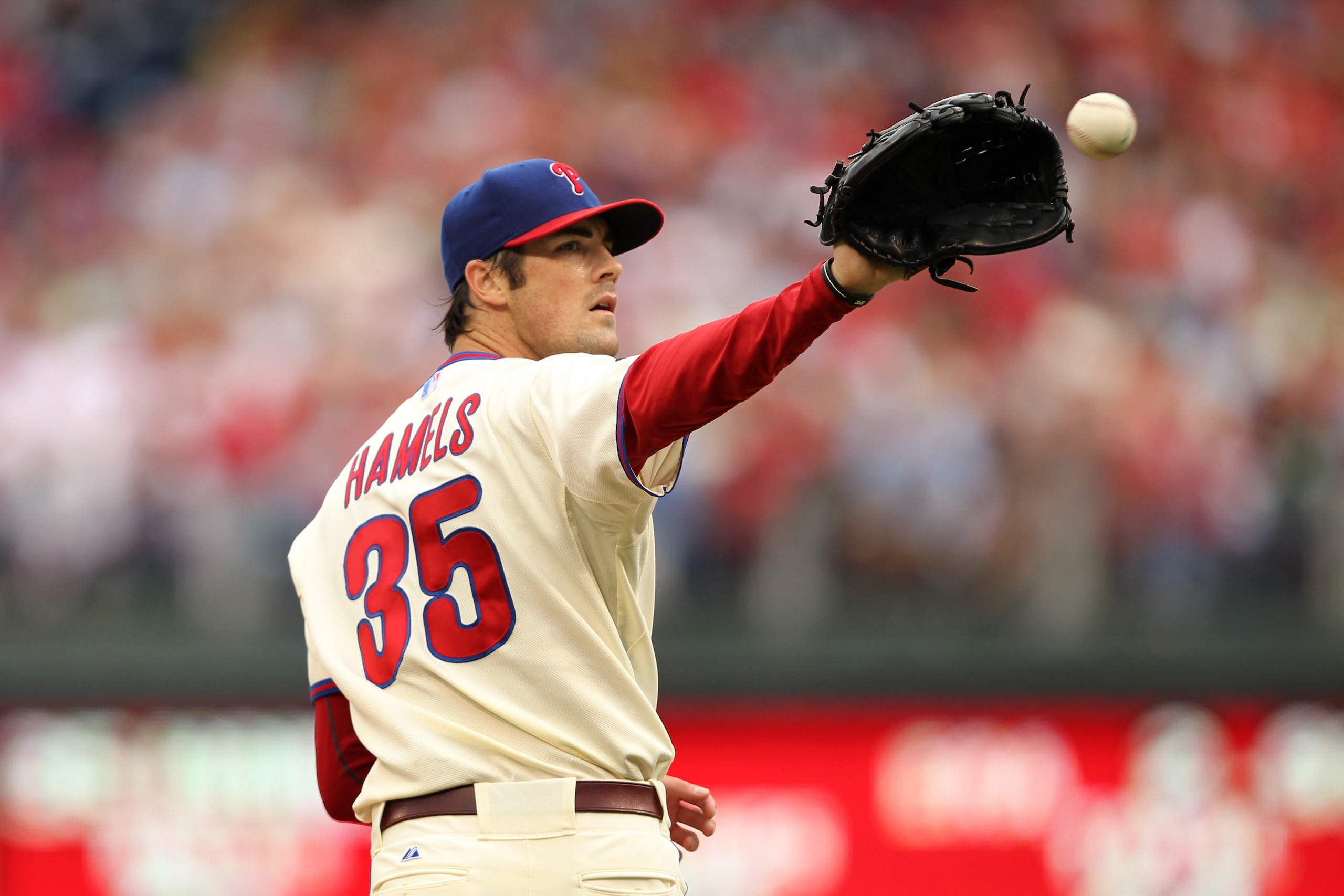
2014 age: 30
Contract Status: Unknown
In the shadows of Halladay, Lee and Roy Oswalt, many people do not realize that Cole Hamels is just 26 years old, and by 2014, he could be just as good, if not better than, Roy Halladay.
Though many people will argue that Hamels really broke into the league in 2007, 2010 was his best year, for a bevy of different reasons. Statistically, Hamels may have arrived in 2007, but in 2010, Hamels developed into one of the best left-handed starters in baseball.
Hamels' 2010 numbers were slightly misleading. He went 12-11 with an ERA of 3.06, and he finished in the bottom half of the league in run support. Had the Phillies provided him with a bit of offense, a 16-win season was not out of his grasp.
Upon breaking into the league in 2007, Hamels threw three above-average pitches: a fastball, a curve-ball, and a change-up. As he became more accustomed to the league, and the league became more accustomed to him, he hit a rough patch in 2009, prompting him to learn to throw a fourth pitch, a cutter, which he mastered under the mentorship of a man known for that pitch, Roy Halladay.
Like Halladay and Lee before him, Hamels is also the type of pitcher that needs to show plus control, but not to the same extent. Out of the three, Hamels may have the best fastball. Averaging around 92 mph with the ability to touch 95 mph, it's the horizontal movement away from lefties and towards righties that makes him most effective.
That's also why his cutter—which will cut towards lefties and away from righties—has become such an imperative pitch. It's the perfect complement to the natural break of his fastball.
Moving forward, Hamels will continue to do what he does best: get hitters to swing at the ball and miss. In the past, he used his fastball a lot, 50.9 percent of the time in 2010. Moving forward, Hamels will mix in his cutter more frequently, and continue to throw that devastating change-up that has a tendency to fall out of the strike-zone at the last possible moment.
As Gary Matthews, Phillies broadcaster, deduced during last season, Hamels is moving away from his curve-ball, throwing it to confuse hitters in fastball counts.
While he is considered the Phillies fourth-best in 2010, by 2014, Hamels could be pushing superstardom as an elite starter.

.jpg?w=2560)
#4 Starter: Roy Oswalt
4 of 15
2014 age: 36
Contract Status: Unknown; free agent after 2011 / 2012, if option is declined.
The fourth horseman. The Phillies' big four projects to be held together into the 2014 season, and they are a special brand of pitchers. Out of the four, Oswalt is the most likely to face regression. Even then, a premier talent like him does not regress into oblivion. He will still be a very good starter well into the latter half of his 30s. Here's why.
In 2010, Oswalt was revitalized after joining the Phillies. In 12 starts for Philadelphia, Oswalt surpassed the success that Lee had in his brief stint, going 7-1 with an ERA of just 1.74. With a new cause and out of the sinking ship in Houston, Oswalt showed why he is still one of the best pitchers in baseball.
He finished the season with a record of 13-13 and an ERA of 2.76.
Unlike the three starters before him, Oswalt's style is a bit different. He has the ability to blow his fastball by hitters, averaging 93 mph and hitting upwards of 96 mph on the gun. His best pitch is a big, looping curve-ball that he'll throw in several different ways and counts.
When stepping in the box, a hitter must consider the fact that Oswalt has the confidence to throw his curve-ball in any count. He'll use it to get ahead, when he's behind, and throw it out of the strike-zone to get a hitter to fish. With the curve at just 73 mph, he'll use the speed of his fastball to his advantage, and throw the curve-ball, as said, in a fastball count.
He'll also mix in a slider, a two-seam fastball, and what he describes as a "Vulcan" change-up.
It isn't Oswalt's "stuff" that makes him less projectable than the first three. It's his injury history. With a history of back problems, there is some concern heading forward. The Phillies can combat this with the strength of their starting rotation, however. By limiting his work-load, he should be able to limit the old man syndrome.
That, paired with the incentive to win a title, should make Oswalt one of the better fourth starters in 2014.
#5 Starter: Brody Colvin
5 of 15
2014 age: 23
Contract Status: Unknown; Current Phillies Prospect
Now, the fun begins.
As stated in the opening slide, the Phillies don't have any real talent in the upper levels of their minor league system, but that isn't the same as saying that the Phillies don't have any talent in their minor league system at all. According to one professional scout, the Phillies have the best lower-level minor league system in baseball, and many of the prospects are on a fast track to the major leagues.
The most projectable of those prospects is 20-year-old Brody Colvin, who could arrive in Philadelphia as early as 2013.
Colvin had a very good year in the Phillies Single-A affiliate in 2010, making 27 starts, logging 138 innings, and posting a record of 6-8 with an ERA of 3.39. Like Hamels in the major leagues, run support was not one of Lakewood's strongest suits. He posted several stats that you like to see in a young pitcher: the ability to strike hitters out (7.83 K/9), limit walks (2.74 BB/9), and stay away from the long ball (0.45 HR/9).
Colvin is a big guy who hasn't completely grown into his pitching frame yet. At 6'3" and 195 lbs, he should see his fastball that averaged in the low 90s when he was drafted move closer to 94-95 mph with a repeated, coached windup.
Though his skill set is a little less impressive, Colvin is most comparable to a former Phillies prospect that was sent to Toronto in the deal for Roy Halladay, Kyle Drabek. The two feature a very similar skill set: fastball, curve-ball, change-up.
Upon being drafted by the Phillies, the first thing that they would go to work on was that curve-ball. Though it could be an above-average pitch in the major leagues, it was very raw, and saw a large improvement to its break in Colvin's first full professional season.
He has top-of-the-rotation talent, and is a lot like a right-handed version of Cole Hamels. If the Phillies are able to keep their big four together into 2014, Colvin would transition very smoothly into the Phillies' rotation as the fifth starter, and the Phillies would easily have the best rotation in baseball, with top-of-the-rotation talents one through five.
Closer: Ryan Madson
6 of 15
2014 age: 33
Contract Status: Unknown; Free agent after 2011 season.
Over the last few seasons, Ryan Madson has really emerged as one of baseball's better relievers. A vital part of that 2008 bullpen that became known as the "Bridge to Lidge," Madson was successful in 2008 and 2009, and became one of the Phillies' most dominant relievers in 2010, despite missing time with a broken toe.
Madson perfected the set-up role in 2010, appearing in 55 games (53 innings), posting a record of 6-2 with an ERA of 2.55, and a FIP of 2.61 that showed he was in control of games that he entered. He also posted impressive strikeout (10.87 K/9) and walk (2.21 BB/9) rates, and gave up less than one home run per nine innings (0.68 HR/9).
He has all the makings of a good closer.
In 2010, Madson averaged 94 mph on his fastball, and has reached the upper 90s on several occasions. When you have a good fastball like that, it makes your best pitch, which is Madson's change-up, even better.
With the change averaging just around 84 mph, there is a 10 mph difference between his fastball and change-up, and with a downward break, it is often confused as a breaking pitch, like a slow splitter or curveball. He'll also mixed in a slider, which he was thrown more in the past two seasons, and a cutter, as well as a two-seam fastball.
One of Madson's most appealing traits as a closer is his ability to get left-handed and right-handed batters out equally effectively. Though he was slightly more effective against right-handed hitters, he averaged a near equal amount of strikeouts (10.22 K/9 vs. left / 11.44 K/9 vs. right), walks (2.55 BB/9 vs. left / 1.91 BB/9 vs. right), home runs (0.73 HR/9 vs. left / 0.64 HR/9 vs. right), and batting average against (.223 vs. left / .216 vs. right).
By 2014, Madson could become one of the most dominant closers in baseball, after he takes the reigns from Brad Lidge after the 2011 season.
Catcher: Sebastian Valle
7 of 15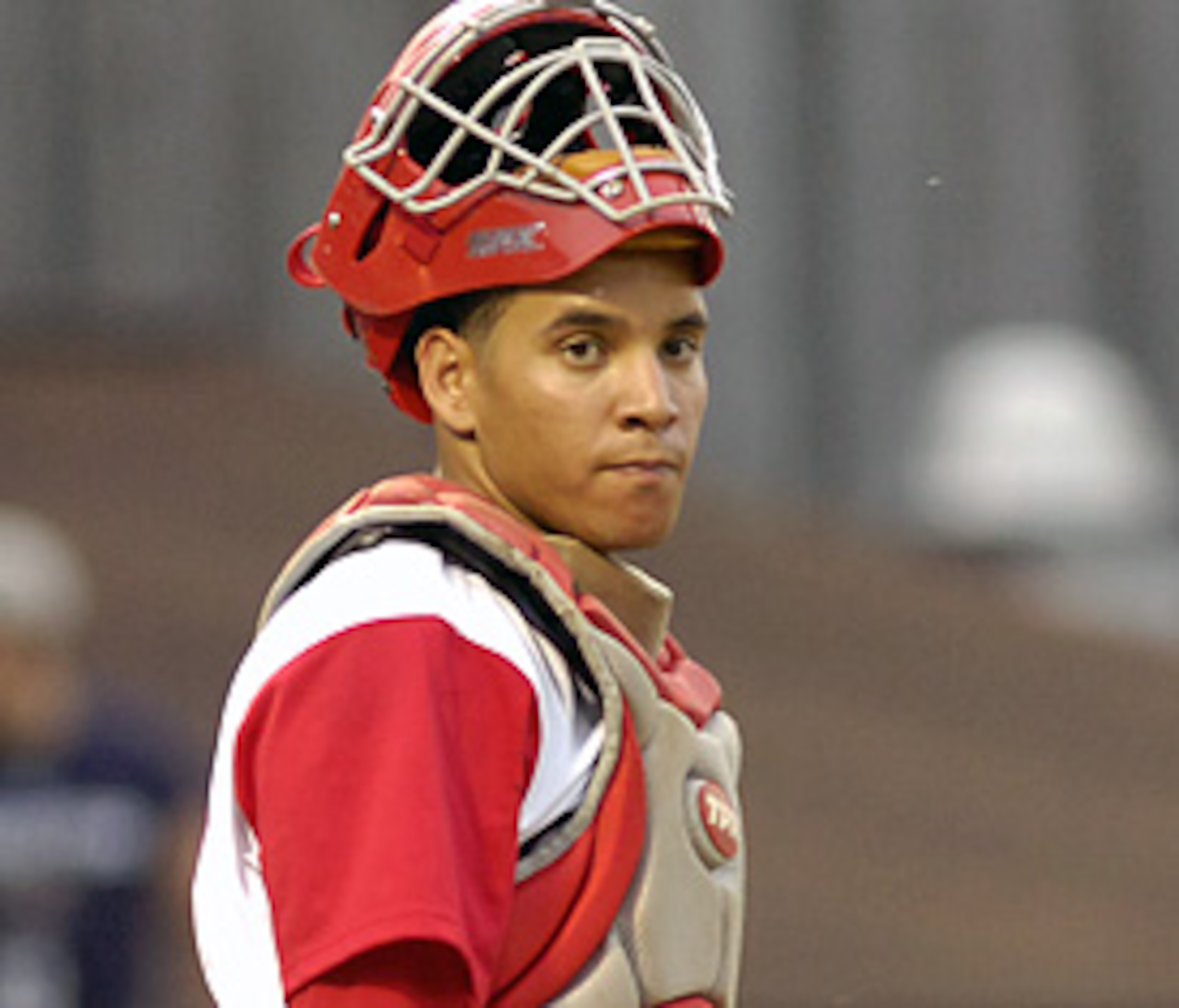
2014 age: 23
Contract Status: Unknown; Current Phillies Prospect
One thing that the Phillies have done well over the last decade is drafting catchers. Of those catchers, Lou Marson, Travis D'Arnaud, Tuffy Gosewisch and Sebastian Valle have helped the Phillies in different ways.
Blocked by Carlos Ruiz at the major league level, who, by the way, was signed as an amateur free agent and not drafted, the Phillies packaged Marson with Carlos Carrasco, Jason Donald and Jason Knapp and sent them to the Cleveland Indians to acquire Cliff Lee in 2009.
The following year, the Phillies traded D'Arnaud, Drabek and Michael Taylor to Toronto to acquire Roy Halladay from the Blue Jays. They were confident enough in Gosewisch and Valle to deal from the depth of their system, and only time will tell how that pays off.
Valle, who will turn 21 this year, is not known for his offensive skills, at all. In 2010, He posted an unimpressive slash line of .253 / .296 / .427, but did show decent power, hitting 16 HRs.
It isn't his offensive skill that makes him an interesting prospect, though. His ability to call a game, and knowledge of the game of baseball in general, makes him one of the better catching prospects. Even though Baseball America projects Gosewisch as the better defensive catcher, he is not nearly as adept in handling a pitching staff as Valle.
Valle is going to be an interesting name to watch going forward. If Gosewisch can improve his offensive numbers, which have been borderline terrible over the past few seasons, then his defensive prowess may push him into the spot of top catcher. Until then, Sebastian Valle projects as the team's catcher in 2014.
First Baseman: Ryan Howard
8 of 15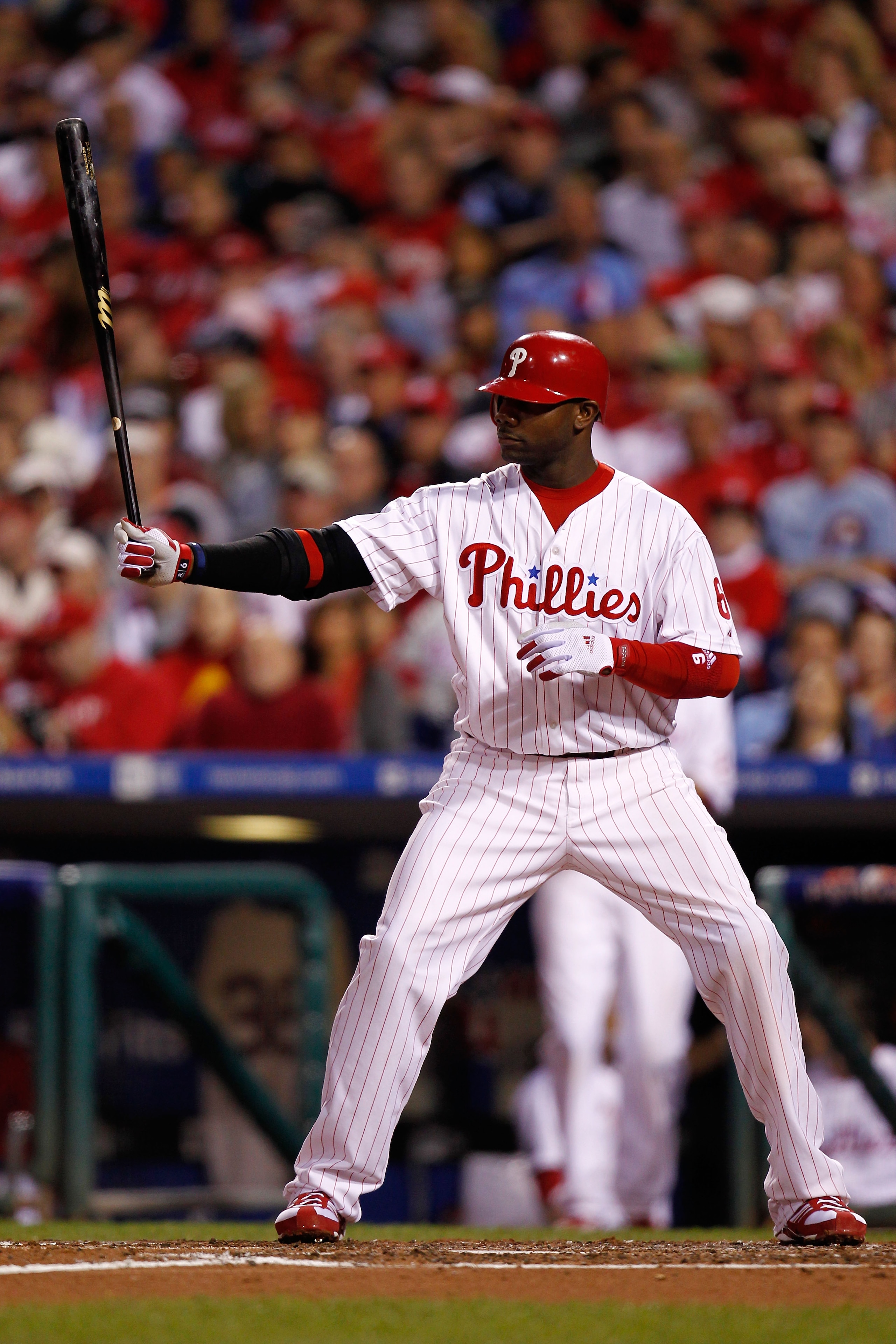
2014 age: 34
Contract Status: Third year of five-year extension; will earn $25 million.
When Ryan Howard signed his five-year, $125 million extension with the Phillies during the 2010 season, Philadelphians were ready to burn General Manager Ruben Amaro at the stake. (Of course, his Cliff Lee signing has saved his life, for now.)
Howard, who sustained an ugly ankle injury in a game against the Washington Nationals, had a down season in 2010. Thanks to the injury, he played the fewest games of his career since he became the everyday first baseman in 2007, and hit just 31 HRs, which by his standard, is a low total. He continued to improve other areas of his game though, including his overall offensive output, assembling a slash line of .276 / .353 / .505, driving in 108 runs, and despite an incredibly negative UZR, improving the range of his defense.
Is he going to be worth the $25 million the Phillies are going to be on the hook for in 2014?
Probably not. That doesn't mean it will be wasted money, however. Howard will continue to be a power threat well into his career. In my mind, he is a lot like Jim Thome, whose average and on-base percentage are not all that great in the latter half of his 30s, but he is a threat to hit a home run every time he steps to the plate.
Howard, while playing in Citizen's Bank Park, will continue to be the same type of threat. The trick for the Phillies will be to continue having him improve his defense. If he can do that, he can combat the many critics who will say that his bat belongs in the American League as a DH. If he can continue to reduce his rate of strikeouts and increase his plate discipline, he should be a productive first baseman, like Thome, well into his career.
So what can we realistically expect out of Howard going forward? I think a slash line of .260 / .355 / .510, with 37-40 HRs, and more than 100 RBI is a fair estimate for Howard in 2014. In a healthy season, he won't show nearly as much regression as his .859 OPS suggests from 2010.
Second Baseman: Chase Utley
9 of 15
2014 age: 35
Contract Status: Unknown; Becomes free agent after 2013 season.
Chase Utley is one of those players that people find it hard to imagine wearing a different uniform. He may not be the same to the Phillies as Derek Jeter is to the Yankees, but he is certainly a player that belongs in Philadelphia for the rest of his career.
By those standards, Baseball America expects Chase Utley to be wearing a Phillies uniform in 2014, and it's hard to disagree. With no immediate middle infield prospect at any level, Utley remains a cog in the machine.
Like many other players on the Phillies roster in 2010, Utley spent an extended period of time on the disabled list with a torn ligament in his thumb. In the Chase Utley way, he returned to the diamond several weeks before the doctors expected, but his performance was clearly suffering.
In 115 games last season, Utley posted a slash line of .275 / .387 / .445, hit 16 HRs, and drove in 65 runs. His UZR of 10.3 was well above average, and the Fielding Bible awarded him as the best defensive second baseman in baseball. Though his OPS of 832 is still above average for a second baseman, it was nowhere near the normal OPS of above .900 that Utley is used to posting.
A full, healthy season should do wonders for Utley in 2011, as he, like most of the Phillies offense, expects to rebound from injury. However, what does the 2014 season hold for Utley?
Though he had a down year, Utley's batting average has been in regression for a while. While I believe it will climb from 2010, it may not stay there for long. Utley is at his best when he can fully utilize his hands and wrists in that short, compact swing, and drive the ball out of the park to right field. Now that his hands are healthy, his power should return.
One thing that he has always been good at is reaching base. In 2010, he averaged a walk per every strikeout, so his on-base percentage should return as well. A slash line of .280 / .390 / .470, with 23-28 HRs and somewhere between 90-100 RBI seems like a fair estimate for Utley's 2014 season at this point.
Shortstop: Jimmy Rollins
10 of 15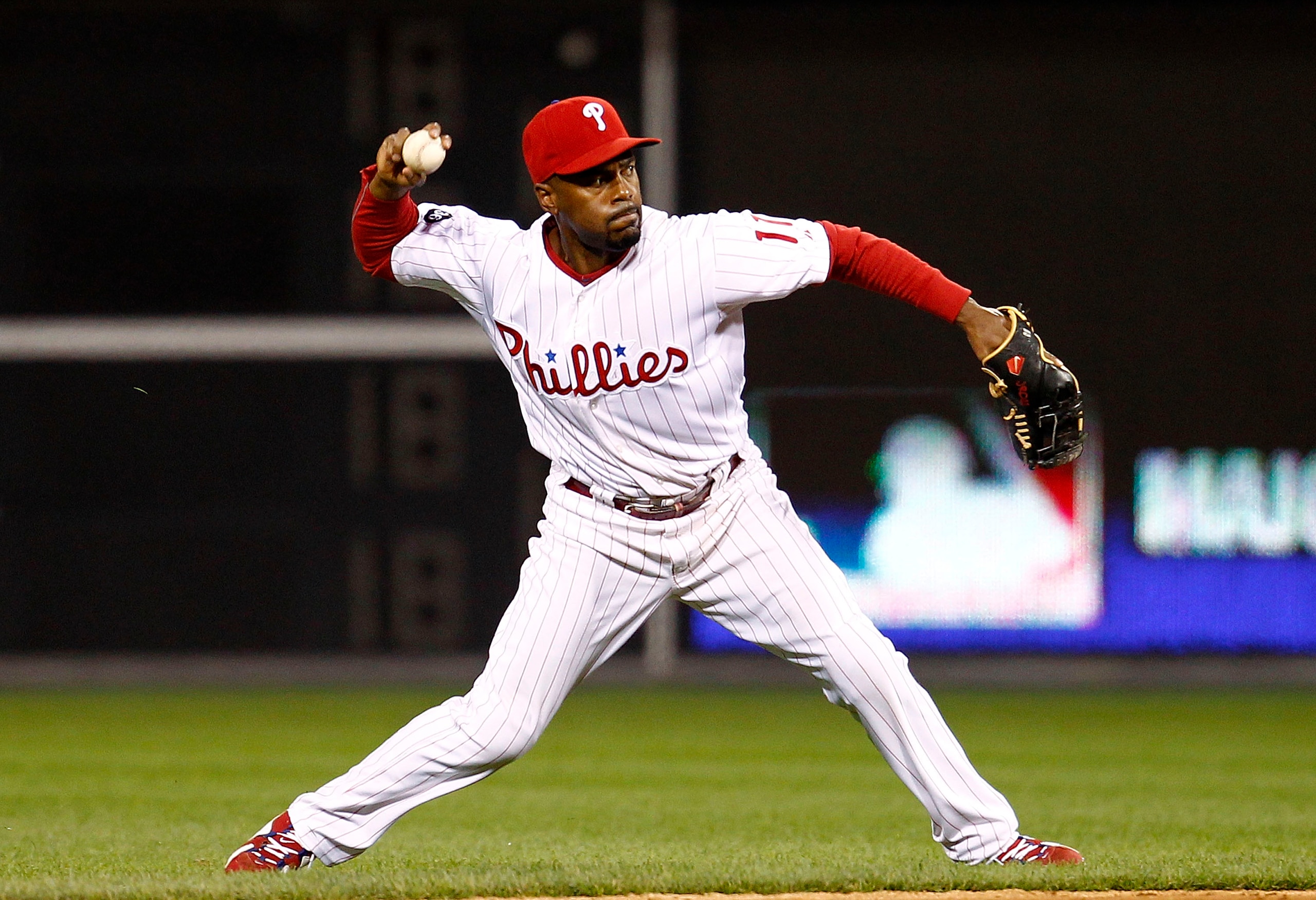
2014 age: 35
Contract Status: Unknown; Becomes free agent after 2011 season.
I found this to be one of Baseball America's more interesting projections. Rollins, who will be 35 in 2014, will be a free agent after the 2011 season, and with his health and lack of productivity being called into focus over parts of the last three seasons, it is surprising to see them project him with the Phillies into 2014.
Perhaps the lack of major league-talent, middle-infield prospects limits their outlook, much like in Utley's case.
Rollins was banged up for most of the 2010 season, and considering the fact that most of his injuries over the past three seasons have been to his legs, the Phillies will be concerned with offering him a contract that extends into the 2014 season. He played in just 88 games in 2010, hitting .243 / .320 / .374, with 8 HRs and just 17 stolen bases, a far cry from the numbers that earned him the MVP trophy in 2007. One thing that Rollins continued to do well was play defense, posting a UZR or 6.9.
The 2011 season is going to determine Rollins' fate with the Phillies. Though I doubt they'll look to the free-agent market and see a better option than Jimmy Rollins, they won't pay him the big bucks to be an offensive shortstop, when his defense far exceeds his offensive output nowadays.
He won't like being compared to a guy like Orlando Cabrera, but that seems to be who he has become, in a glorified sense. He'll have to accept a team-friendly deal to remain in Philadelphia, and I won't even project his numbers. More than likely, he'll move to the middle of the lineup in 2011 to replace Jayson Werth, where he has excelled in the past, and that makes his offensive expectations a lot different.
He could, of course, remain at the top of the order as well. As long as he stays healthy and continues to play good defense, he should be a Phillie in 2014, and all years in between.
Third Baseman: Placido Polanco
11 of 15
2014 age: 38
Contract Status: Unknown; Becomes free agent after 2012 / 2013 if option is declined.
When you think to the future and realize that Placido Polanco will be 38 heading into the 2014 season, you may also be led to believe that his best years are behind him, and that may very well be the case.
If his option is declined after the 2012 season, the Phillies may be able to find a better, younger third baseman on the free-agent market, with no immediate replacement in the minor league system. However, if the best they can do is to re-sign Polanco to a one-year deal for his age-38 season, they may make out okay.
Though he was injured in 2010, he was the recipient of a bit of bad luck. He was hit on the elbow by a Tim Hudson fastball during the regular season, and played through the injury. Though he'll need to have surgery to remove those bone chips this offseason, the Phillies expect that he'll be ready to go well before Spring Training begins.
Polanco exceed expectations in 2010, posting a slash line of .298 / .339 / .386, with 6 HRs and 52 RBI. He continued to do what he has been known to do over the course of his career: use all fields when hitting and move the leadoff runner along batting second in the order.
Aside from his offensive production, Polanco played a well-above-average third base in his first full season there in Philadelphia. His UZR of 10.0 was among the lead leaders for third basemen.
What can we expect out of Polanco, who is playing above-average baseball at age 35?
It's tough to say. One thing that Polanco will continue to do well is hit for average. He is one of the best contact hitters in the league, and uses the whole field to get base hits. If he continues that into 2014, it's fair to expect an average of around .285, while his power remains near non-existent. Five to 10 HRs is the max you can expect.
As he continues to play third base, he should remain above average there as well.
Left Fielder: Jonathan Singleton
12 of 15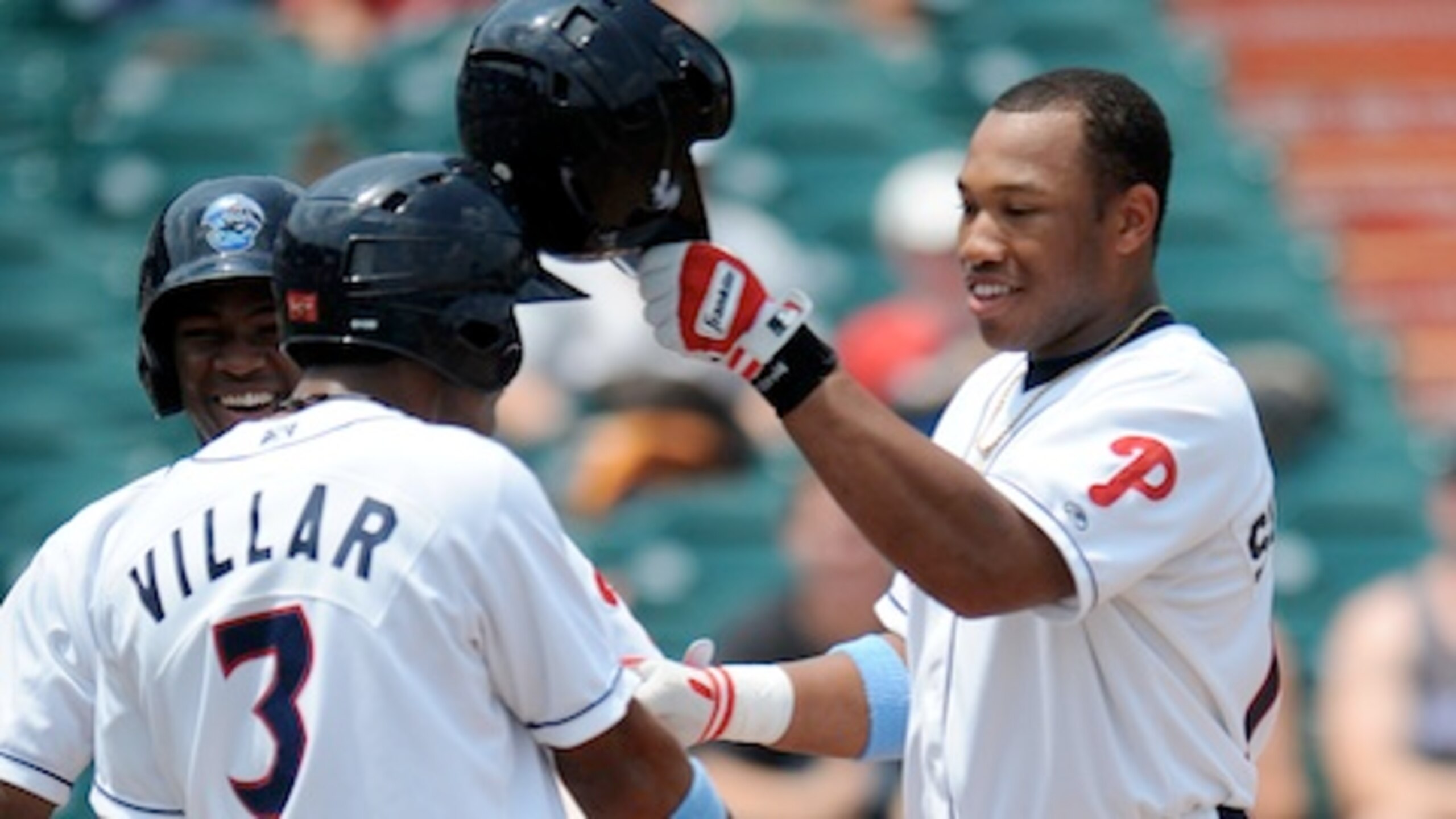
2014 age: 23
Contract Status: Unknown; Current Phillies Prospect
Jonathan Singleton was one of the most talked-about Phillies prospects of the 2010 season. After just 31 games with the Phillies' rookie league team in 2009, expectations for Singleton to perform weren't all that high entering 2010, but the left-handed first baseman certainly turned a few heads in the organization.
In fact, the Phillies' brass decided to move the athletic first baseman to the outfield, acquainting him with left field since they believe his arrival in the major leagues isn't all that far away, and he is blocked at the major league level by Ryan Howard, and by conventional thinking, Domonic Brown.
Singleton put on an impressive offensive show in 2010, playing in 104 games with the Phillies Single-A club and posting a slash line of .288 / .392 / .477, hitting 14 HRs while stealing nine bases. A good average and the ability to draw walks (13.8 BB%) were a couple of Singleton's strong points. Many experts, including prospect guru, ESPN's Keith Law, believe that the athletic Singleton will have no problem transitioning to the outfield, especially the less intensive left field.
According to some scouts, Singleton is still coming into his 6'2", 215-lb frame. Baseball America ranks him as the best power-hitter and strike-zone disciplinarian in the Phillies' farm system. Rather impressive for a system that still houses top prospect Domonic Brown.
His swing helps him to generate all of that power. With a thin waist, he has a very "armsy" swing and two-handed finish. His upper-cut swing helps him put the ball in the seats with ease, and according to some scouts, he will be a regular outfielder with 25-plus HR power.
It will take a few years for him to master left field, but when he does, the Phillies will have found a very nice outfielder, who can only build on his .869 OPS from 2010.
Center Fielder: Shane Victorino
13 of 15
2014 age: 34
Contract Status: Unknown; Becomes free agent after 2012 season.
Shane Victorino has been one of the most pleasant surprises in baseball, especially for the Phillies. Selected in the 2005 Rule V Draft from the Los Angeles Dodgers, Victorino has blossomed into one of baseball's premiere center fielders.
The recipient of a National League Gold Glove Award for his defensive prowess in center field for three years in a row, (2008-10) Victorino has become a well rounded player in his tenure with the Phillies, gaining the favor of those harsh Phillies fans, who've given him the moniker of "The Flyin' Hawaiian."
Victorino, like many other Phillies, had a rough year in 2010. He spent time on the disabled list with an oblique strain, and never got into a groove offensively, despite hitting a career high 18 HRs. His slash line of .259 / .327 / .429 was not the norm for the speedy center fielder, whose OBP dipped .031 points from 2009.
Charlie Manuel hinted that his lack in production was from being bounced around the lineup as the Phillies tried to cope with injuries. For instance, Victorino was much better when he was hitting in the leadoff spot: .276 / .345 /.466. He should find a steadier role there in 2011, as the Phillies figure to move Jimmy Rollins down to the fifth spot in the lineup, and Victorino will take his 34 stolen bases to the leadoff position.
What can the Phillies expect out of Victorino in 2014?
With prospects Jiwan James and Domingo Santana both in the Phillies system, it would be a bit of a surprise to see Victorino in center field at all in 2014, but if he was, he would still be a quality outfielder. A line of .280 / .335 / .410, with 8-15 HRs and 25-30 steals seem like realistic expectations from the Hawaiian.
Right Fielder: Domonic Brown
14 of 15
2014 age: 26
Contract Status: Fifth year of service time; Becomes free agent after 2015 season.
The Phillies 2014 projected lineup features names like Ryan Howard, Chase Utley, Jimmy Rollins and Shane Victorino, but by that time, the Phillies best offensive player could be the top prospect in all of baseball, right fielder Domonic Brown.
Brown, who was just 23 years old when he made his major league debut in 2010, will be entering the prime of his career by the 2014 season. The 6'5", 200-lb outfielder ranked as the top prospect in all of baseball as the 2010 season concluded, and though his position with the Phillies' major league club is up in the air for the 2011 season, he figures to have been an everyday regular for a few seasons by the time the 2014 season rolls around.
Though his brief stint with the major league club was unimpressive in 2010, Brown completely destroyed the minor leagues, posting a combined slash line of .332 / .391 / .582, hitting 20 HRs, driving in 68 runs, and stealing 17 bases. He has become one of the most promising "five-tool" outfielders in the game.
It would be ridiculous to predict Brown's numbers based off of 62 ABs at the major league level, but as one professional scout said, "The sky is the limit for that kid."
Notes and Predictions
15 of 15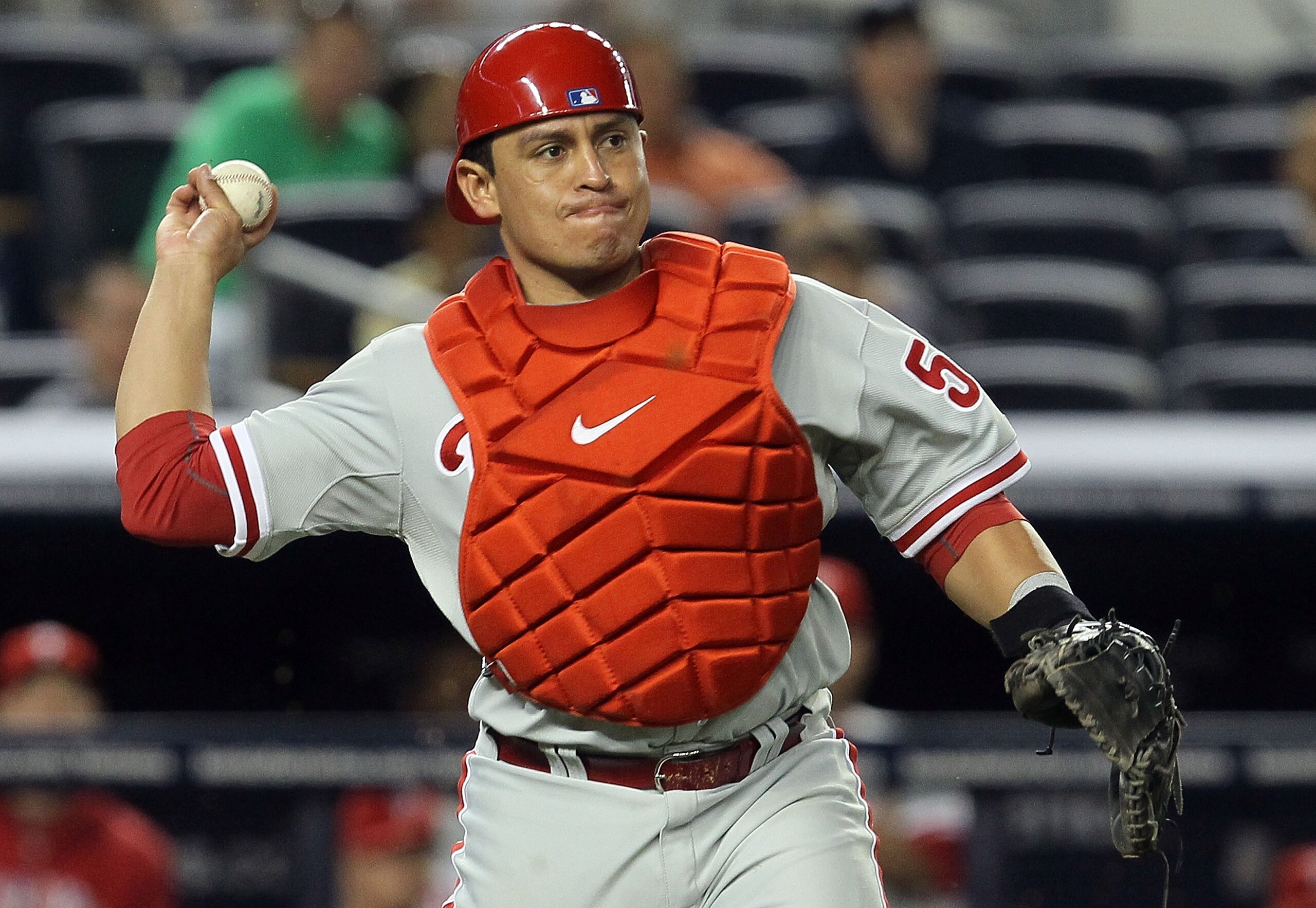
Baseball America publishes one of the most reliable roster projections for each major league club every season. They take into a number of different variables, such as team preferences, minor league systems, contract status and payroll, and assemble a likely roster for the season four years ahead of the current year.
With that being said, it's not guaranteed that any of these players are retained after their contracts expire, or that any of these prospects make the major league club. Baseball America carries a very, very good track record in projecting rosters, however.
With all due respect to Baseball America, I think they made one of the biggest mistakes of their projection this year in not including Carlos Ruiz on their roster. Ruiz, a fan favorite in Philadelphia, had a breakout season in 2010, but it is his defensive skill and ability to call a game and handle a staff—which could rival that found in the All-Star Game—that makes him such a great catcher.
Even though Sebastian Valle is known for many of the same things, I find it ridiculous for Baseball America to project Ryan Madson, whose contract expires after the 2011 season, and faces competition for the closer's role should it be vacated by Lidge in dominant minor league righty Justin DeFratus, and not Carlos Ruiz, whose contract does not expire until after the 2013 season, if the Phillies exercise his option, over the inexperienced, less talented, Sebastian Valle.
Other than that, however, I think Baseball America hit the nail on the head. The Phillies' top two positional prospects, Domonic Brown and Jonathan Singleton, should be regular players in the lineup by 2014, and Brody Colvin, Vance Worley and Jarred Cosart will all compete for the fifth starter's spot.
The Phillies could also move some of their top pitching prospects to the bullpen for help, with Roy Halladay, Cliff Lee, Roy Oswalt and Cole Hamels each projected to be a part of Philadelphia's roster in 2014, and top prospects Brody Colvin and Jarred Cosart expected to fill out the rotation.
That would open up bullpen spots for prospects like Antonio Bastardo, Scott Mathieson, Justin DeFratus, Josh Zeid, Michael Schwimmer, Trevor May, Jesse Biddle, Austin Hyatt and Phillipe Aumont. The Phillies could also have a few valuable trade chips, if they need to make a trade, in Jiwan James, Domingo Santana and Aaron Altherr.
*All projections belong to Baseball America, and the player descriptions, stat compilation, and opinions are those of Gregory Pinto.