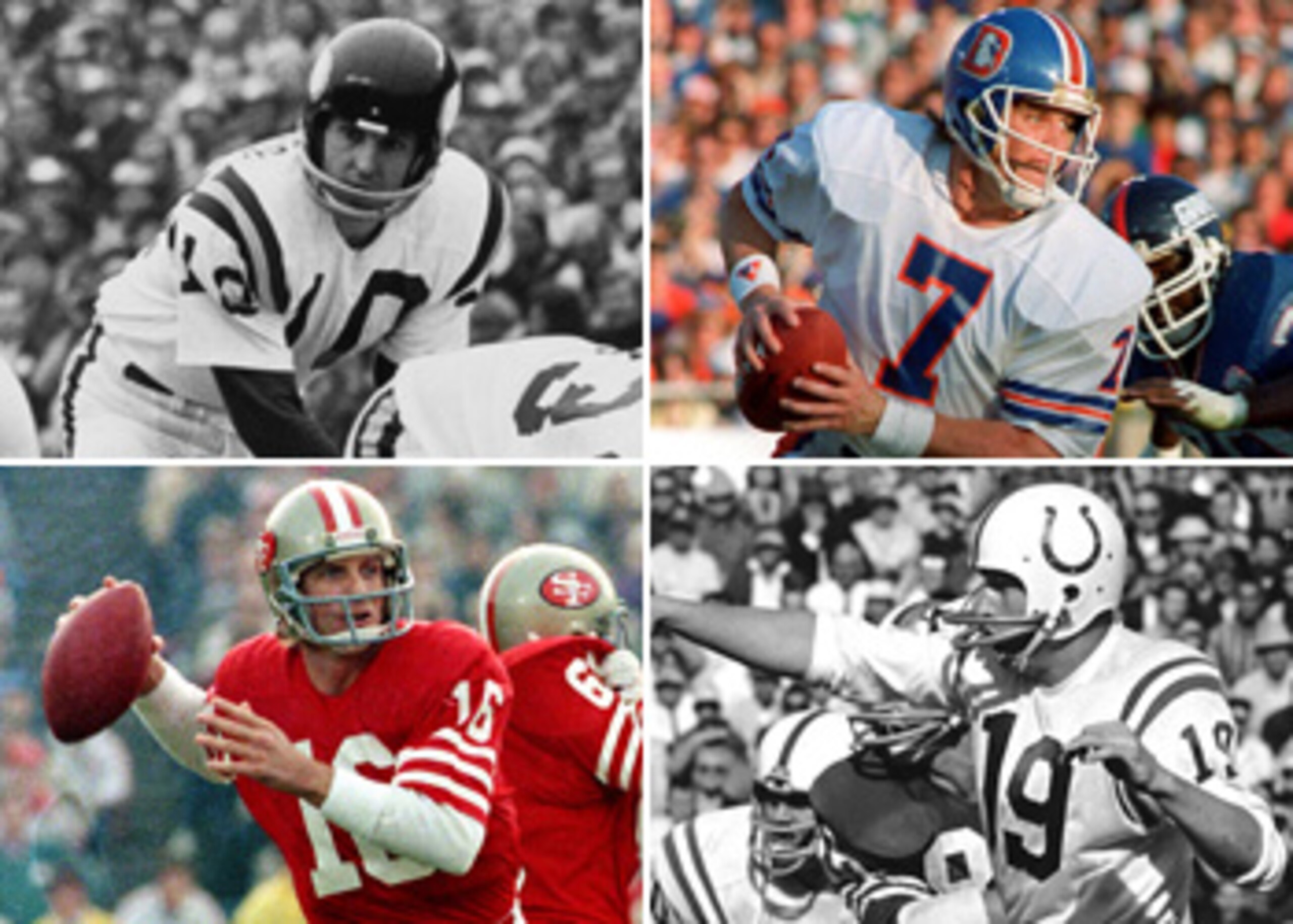
A 32 Team All-Time QB Only Mock Draft
By (Correspondent) on May 16, 2010
7,465 reads
The way I came up with the order of this mock draft was from the 2010 draft order and I messed with it a bit. Teams like Carolina and Chicago did not have first round picks so I had to reorder the draft order a bit.
These 32 all time quarterbacks are the ones I think are the best. This is just an idea, if all of these players went into a mock draft and see what that player did in his career and what he could or could have done for your franchise.
For example, teams like Detroit and Atlanta could have their record books rewritten if they drafted players like Peyton Manning and Steve McNair.
Maybe you like the quarterback of your favorite franchise, but maybe you will like the new quarterback being selected by your favorite franchise in this “32 All-Time QB Only Mock Draft”.
http://en.wikipedia.org/wiki/Main_Page
http://www.profootballhof.com/default.aspx
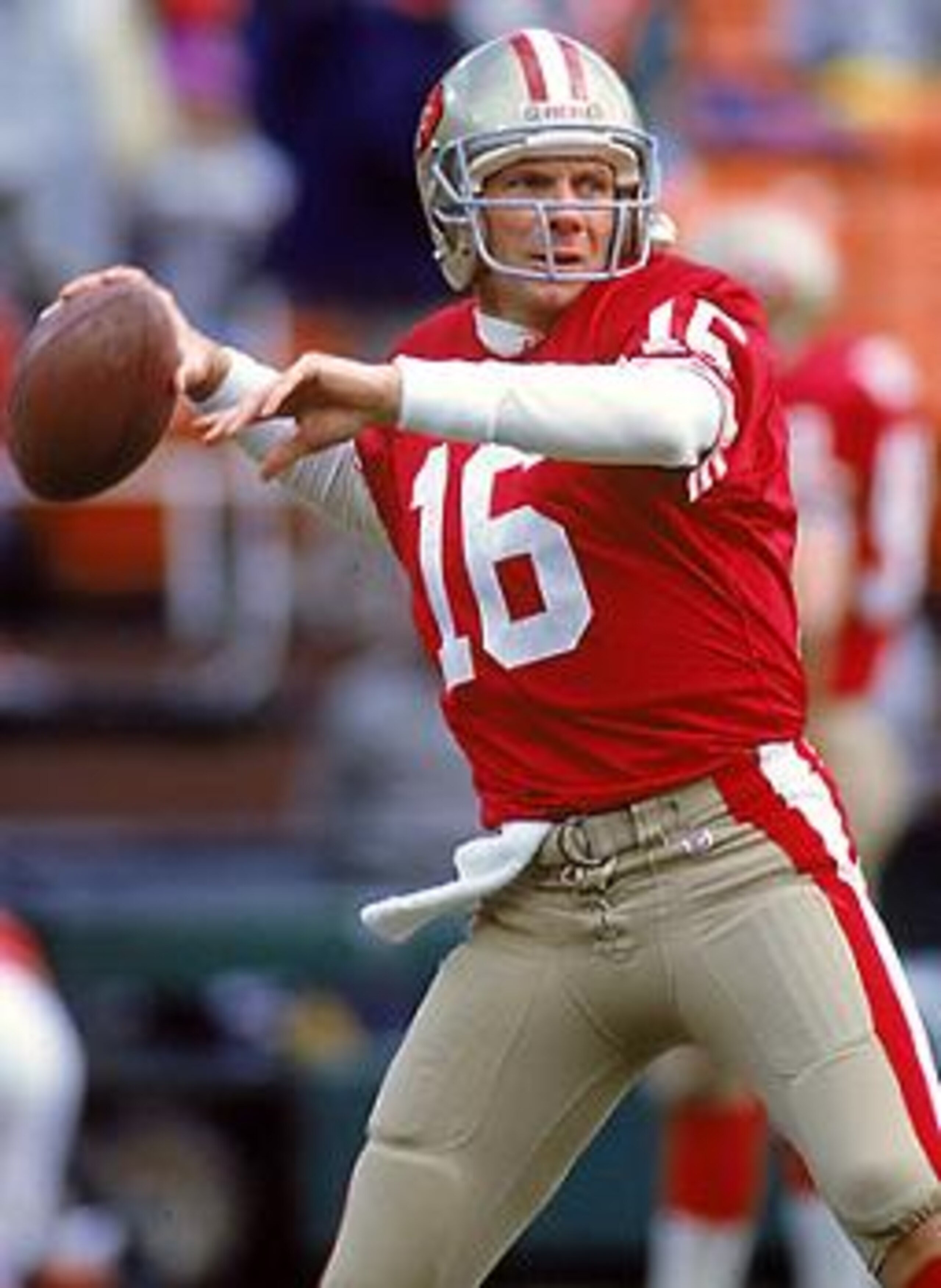
St. Louis Selects Joe Montana 1st Overall
Joe Montana had a stellar career with the 49ers and Kansas City Chiefs. A master of late-game comebacks, Montana directed his teams to 31 fourth quarter come-from-behind wins during his illustrious career, including a 92-yard drive in the closing seconds of Super Bowl XXIII.
Montana won the NFL’s passing title in both 1987 and 1989. He topped the NFC in passing five times (1981, 1984, 1985, 1987, and 1989).
Thirty-nine times he passed for more than 300 yards in a game, including seven times in which he surpassed 400 yards. His six 300-yard passing performances in the post-season are an NFL record.
He also owns the career playoff record for attempts, completions, touchdowns, and yards gained passing.
Montana led his team to the playoffs eleven times. Along the way, he captured nine divisional championships and victories in Super Bowls XVI, XIX, XXIII, and XXIV. His outstanding play in Super Bowls XVI, XIX, and XXIV earned him Most Valuable Player honors in each game.
Named All-NFL three times and All-NFC on five occasions, Montana was voted to the Pro Bowl eight times, which was a league record for a quarterback at the time.
In 1992, after missing 31 consecutive games due to an injury to his throwing arm, Montana made a dramatic comeback. In the second half of the regular season finale, a Monday Night Football offering vs. the Detroit Lions, Montana performed his magic of old, completing 15 of 21 passes for 126 yards and two touchdowns as the 49ers defeated the Lions 24-6.
In 1994, Montana became just the fifth quarterback to pass for more than 40,000 yards in a career.
At the time of his retirement, he ranked fourth in career passing yardage (40,551 yards), attempts (5,391), and passing touchdowns (273). His 3,409 completions ranked third all-time, and his career passer rating of 92.3 was second all-time.
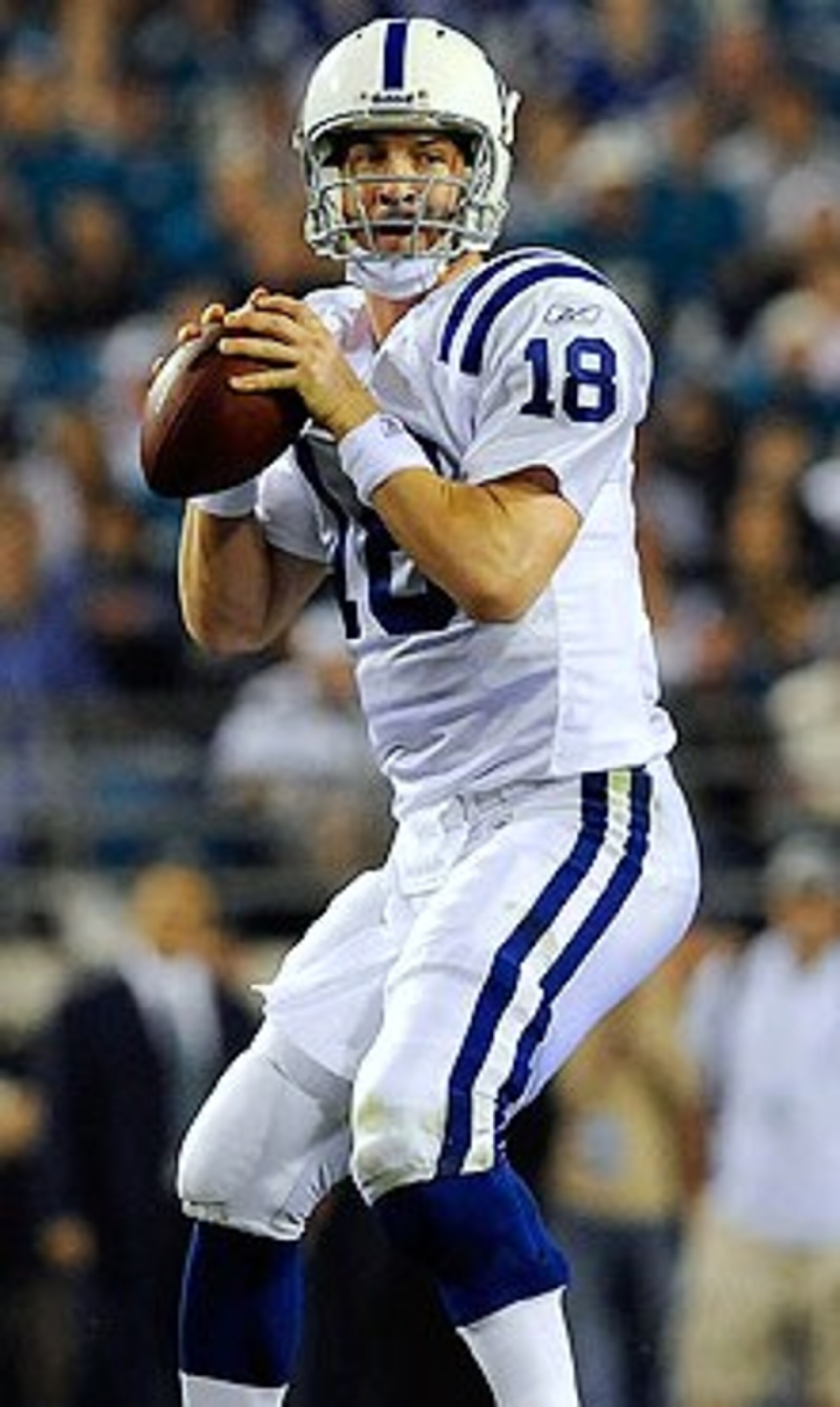
Detroit Selects Peyton Manning 2nd Overall
Peyton Manning is considered one of the best quarterbacks of all-time. He has the record for most NFL MVP awards with four. The Colts drafted him as the first overall pick in 1998.
In his rookie season, he passed for 3,739 yards with 26 touchdowns, set five different NFL rookie records, including most touchdown passes in a season, and was named to the NFL All-Rookie First Team.
Manning holds NFL records for consecutive seasons with over 4,000 yards passing and the most total seasons with 4,000 or more yards passing in a career. Manning holds the fourth-highest career passer rating (95.2) behind only Steve Young (96.8), Phillip Rivers (95.8), and Tony Romo (95.6).
He is the all-time Colts franchise leader in career wins, career passing yards, pass attempts, pass completions, and passing touchdowns.
In 2009, The Sporting News listed him as the No. 1 player in the NFL today. Also in 2009, Fox Sports named him player of the decade.
Since the Colts drafted Manning in 1998, the team has the highest conversion rate on 3rd down (44.6%) and 4th down (61.1%) plays in the NFL.
While leading the Colts to their Super Bowl XLI victory in 2007 (Super Bowl MVP), Manning helped the team to an NFL record by converting 56.1% of its 3rd downs.
Manning has been named to 10 Pro Bowls (1999, 2000, 2002, 2003, 2004, 2005 (Pro Bowl MVP), 2006, 2007, 2008, 2009). He is a four time AP NFL MVP (2003, 2004, 2008, 2009) and was also named to the NFL’s 2000's All-Decade Team.
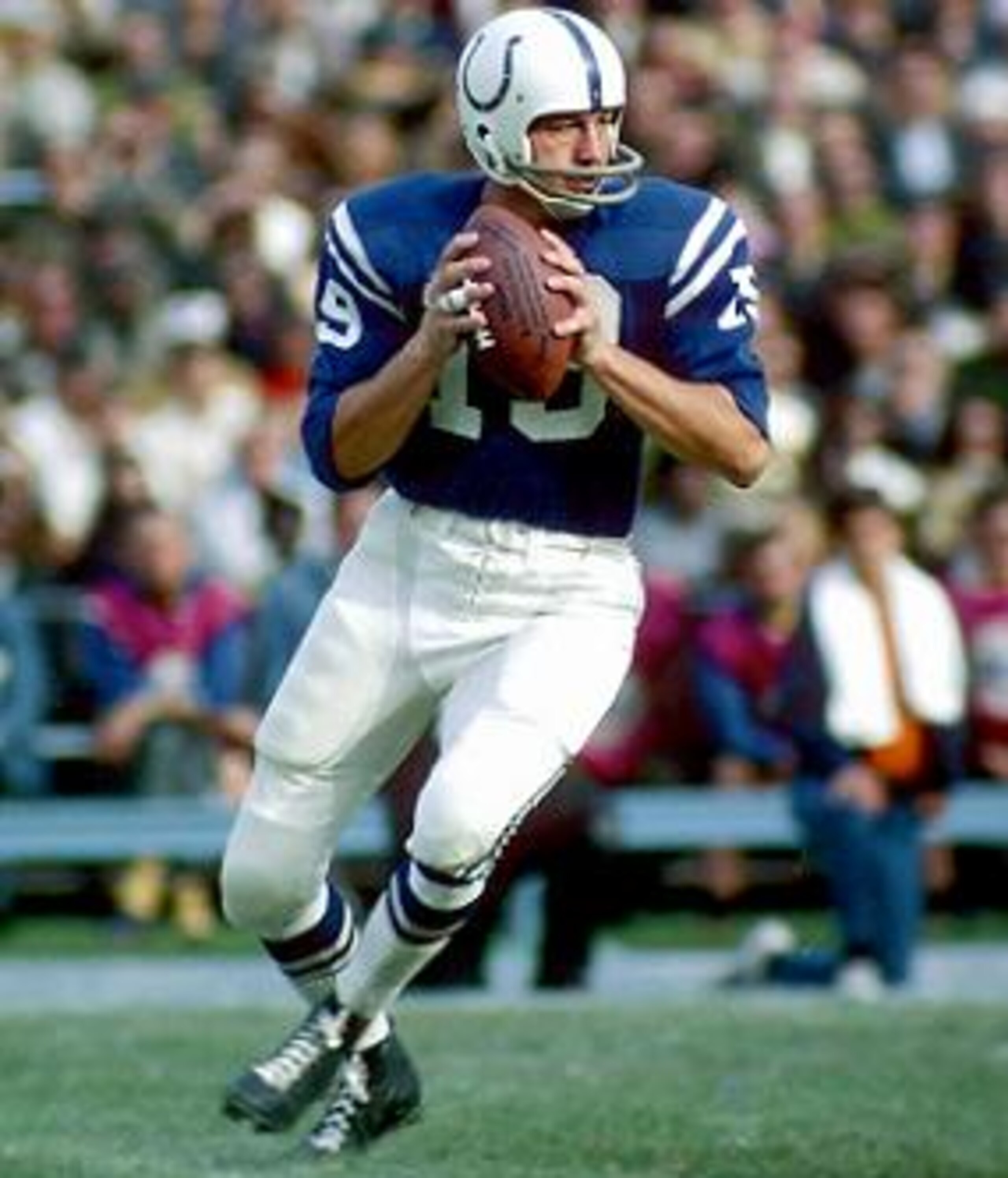
Tampa Bay Selects Johnny Unitas 3rd Overall
Unitas’ first pass was intercepted for a touchdown but from that moment on, he never looked back. For the next 18 seasons, "Johnny U'' ran up a ledger of game winning exploits seldom matched in NFL history.
Without a doubt, it was his last-second heroics in the 1958 NFL title game, often called "the greatest game ever played," that turned Unitas into a household name.
The New York Giants, with two minutes to play, were leading, 17-14, when the Colts started a last-gasp drive at their own 14. “Mr. Clutch” went coolly to work with seven straight passes that set up a game-tying field goal with seven seconds left. Unitas then engineered a textbook perfect 80-yard march to win the game in overtime.
The game, played before a national television audience, gave Unitas his chance to demonstrate all of his marvelous attributes – confidence, courage, and leadership, play calling genius, and passing skill.
Unitas’ career statistics include 40,239 yards and 290 touchdowns passing.
His record of at least one touchdown pass in 47 consecutive games may stand forever. A genuine team player, Unitas was selected the NFL Player of the Year three times (1959, 1964, 1967), and named to 10 Pro Bowls (1957, 1958, 1959 (MVP), 1960 (MVP), 1961, 1962, 1963 (MVP), 1964, 1966, 1967).
The Colts won the NFL championship under Unitas' leadership in 1958 and in 1959 (called the rematch), by defeating the New York Giants 23–17 in sudden death overtime and in 1959 31-16 over the Giants.
In 1970, Unitas led the Colts to Super Bowl V. He was knocked out of the game in the second quarter, after throwing a 75-yard touchdown pass (setting a then-Super Bowl record) that helped lift the team to victory.
Unitas was named to the NFL’s 75th Anniversary All-Time Team and to the NFL’s 1960’s All-Decade Team.
In 1999, he was ranked No. 5 on "The Sporting News'" list of the 100 Greatest Football Players, behind only Joe Montana among quarterbacks.
Johnny Unitas was voted into the Pro Football Hall of Fame in 1979.
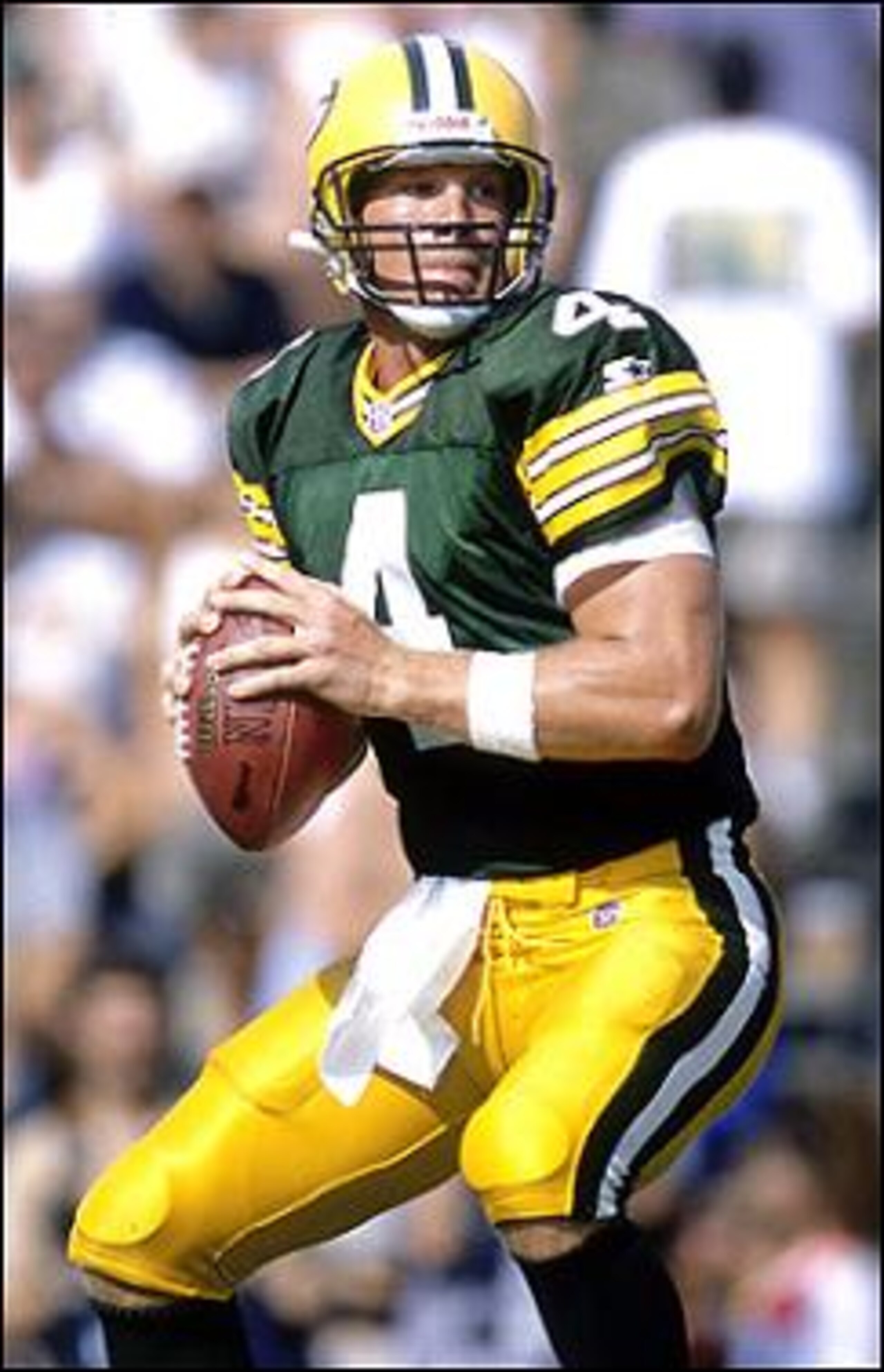
Washington Selects Brett Favre 4th Overall
Brett Favre is considered one of the best quarterbacks of all time.
Brett is the only player to become the MVP three consecutive years (1995-1997). He has been honored with 11 Pro Bowl (NFL Record) selections (1992, 1993, 1995, 1996, 1997, 2001, 2002, 2003, 2007, 2008, 2009), while becoming the NFC’s MVP five times (1995, 1996, 1997, 2002, and 2007).
He led the Packers to seven division championships (1995, 1996, 1997, 2002, 2003, 2004, and 2007), four NFC Championship Games (1995, 1996, 1997 and 2007), and won two (1996 and 1997).
Favre has also reached the Super Bowl twice (XXXI & XXXII) during his career, winning Super Bowl XXXI against the New England Patriots.
Favre was named to the NFL’s 1990’s All-Decade Team.
He holds many NFL records that include: Most career touchdown passes, most career passing yards, most career passing attempts, most career passing completions, most consecutive starts, most career victories, and his least favorite, most career interceptions.
Since first being named the starter of the Green Bay Packers before playing the Pittsburgh Steelers on September 27, 1992, Brett Favre has never missed a game. He is currently in first place for the most consecutive starts by a quarterback in the NFL and one of only five quarterbacks to have started over 100 consecutive games in NFL history.
In 2009, Favre surpassed Jim Marshall for starts at any position with his record-breaking 271st start as a quarterback as the Vikings played the Lions. Favre has started in 285 consecutive starts as a quarterback (309 including playoffs).
The consecutive starts streak is widely considered one of the most notable streaks in sports, so much so that the Pro Football Hall of Fame has as an exhibit displaying the jersey Favre wore during his record breaking 117th consecutive start as a quarterback, and a section of their website devoted to what the Hall of Fame calls an "Iron Man".
Favre is the only quarterback to have led a team to victory over all thirty-two teams in the league since the NFL first expanded to 32 franchises.
Brett Favre has accumulated 69,329 passing yards for 497 touchdowns in 19 seasons.
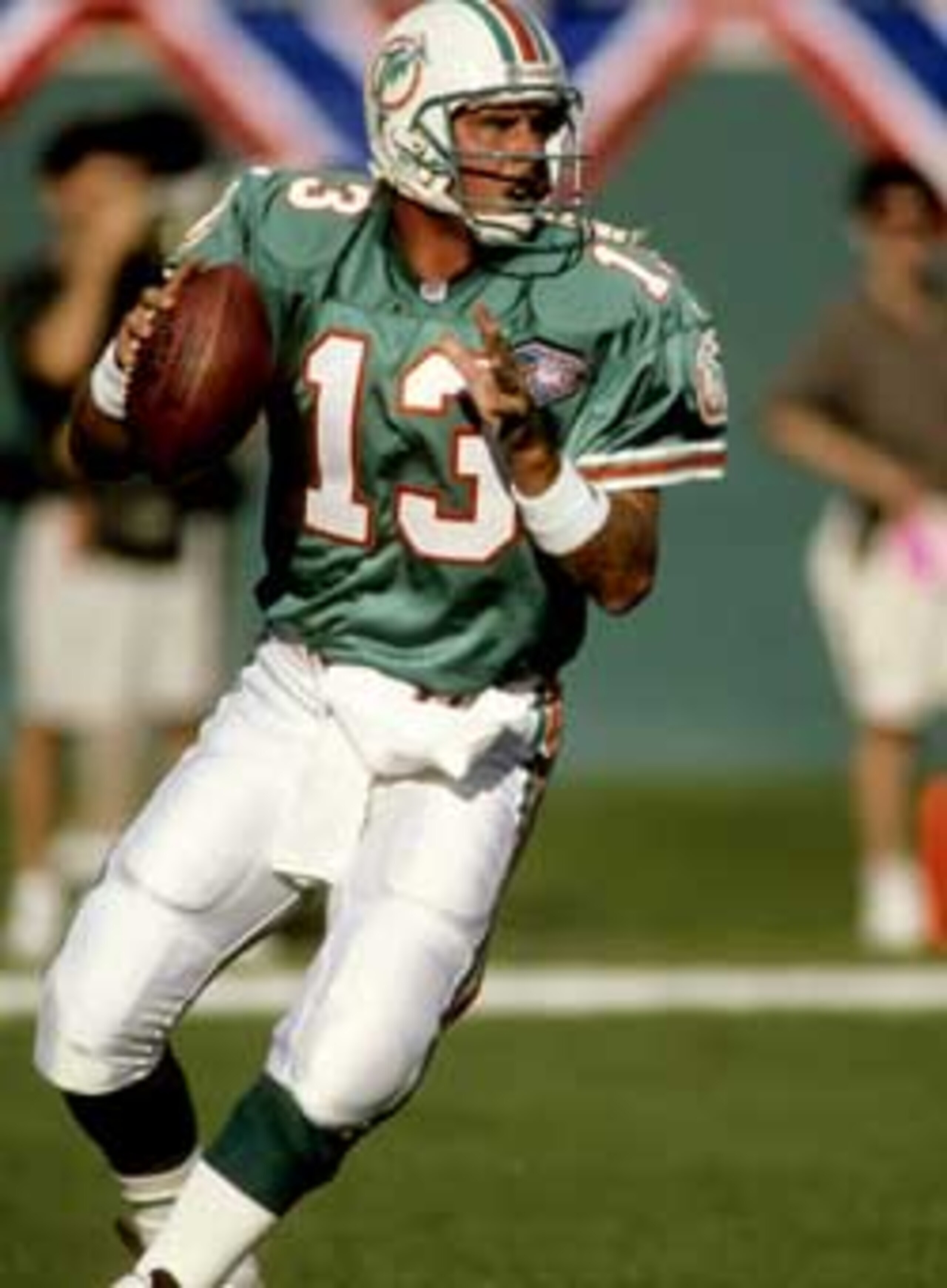
Kansas City Selects Dan Marino 5th Overall
The Miami Dolphins, much to their surprise at the time, found University of Pittsburgh quarterback Dan Marino still available when it came time to make their first pick in the 1983 NFL Draft.
Five other quarterbacks, including Hall of Famers Jim Kelly and John Elway, had been taken before the Dolphins grabbed Marino with the 27th pick overall.
Marino earned the starting role early in his rookie season. For the next 17 years the fortunes of the franchise rode on his shoulders. By the time he retired following the 1999 NFL season, Marino had literally rewritten the passing section of the NFL's record book.
He became the first player ever to pass for 5,000 yards in a single season finishing with a remarkable 5,084 yards. His 48 touchdown passes obliterated the previous record, 36 touchdowns passes held by Y.A. Tittle and George Blanda. By season's end, he had set six league records and was named the NFL's Most Valuable Player (1984).
In Super Bowl XIX, Marino completed 29 of 50 passes for 318 yards, passed for one touchdown and threw two interceptions as the Dolphins fell to Hall of Famer Joe Montana and the San Francisco 49ers 38-16.
Marino's passing prowess continued at a record pace and by the end of the 1995 season had supplanted Hall of Fame quarterback Fran Tarkenton as the career passing leader in attempts, completions, yards, and touchdowns.
Marino's career totals are staggering as he completed 4,967 of 8,358 passes for 61,361 yards, and threw 420 touchdowns during his 242-game NFL career.
Thirteen times in his career Marino passed for 3,000 yards or more in a season which includes the six seasons he reached the 4,000-yard plateau.
He passed for 300 yards in a game 63 times and threw for 400 or more yards in a game 13 times.
Marino led the Dolphins to 36 fourth-quarter comeback victories, most all-time. Had 116 wins under Don Shula (the most by a head coach/quarterback combination in NFL history).
Miami Dolphins retired his jersey No.13 and Dan Marino was inducted into the Pro Football Hall of Fame in 2006.
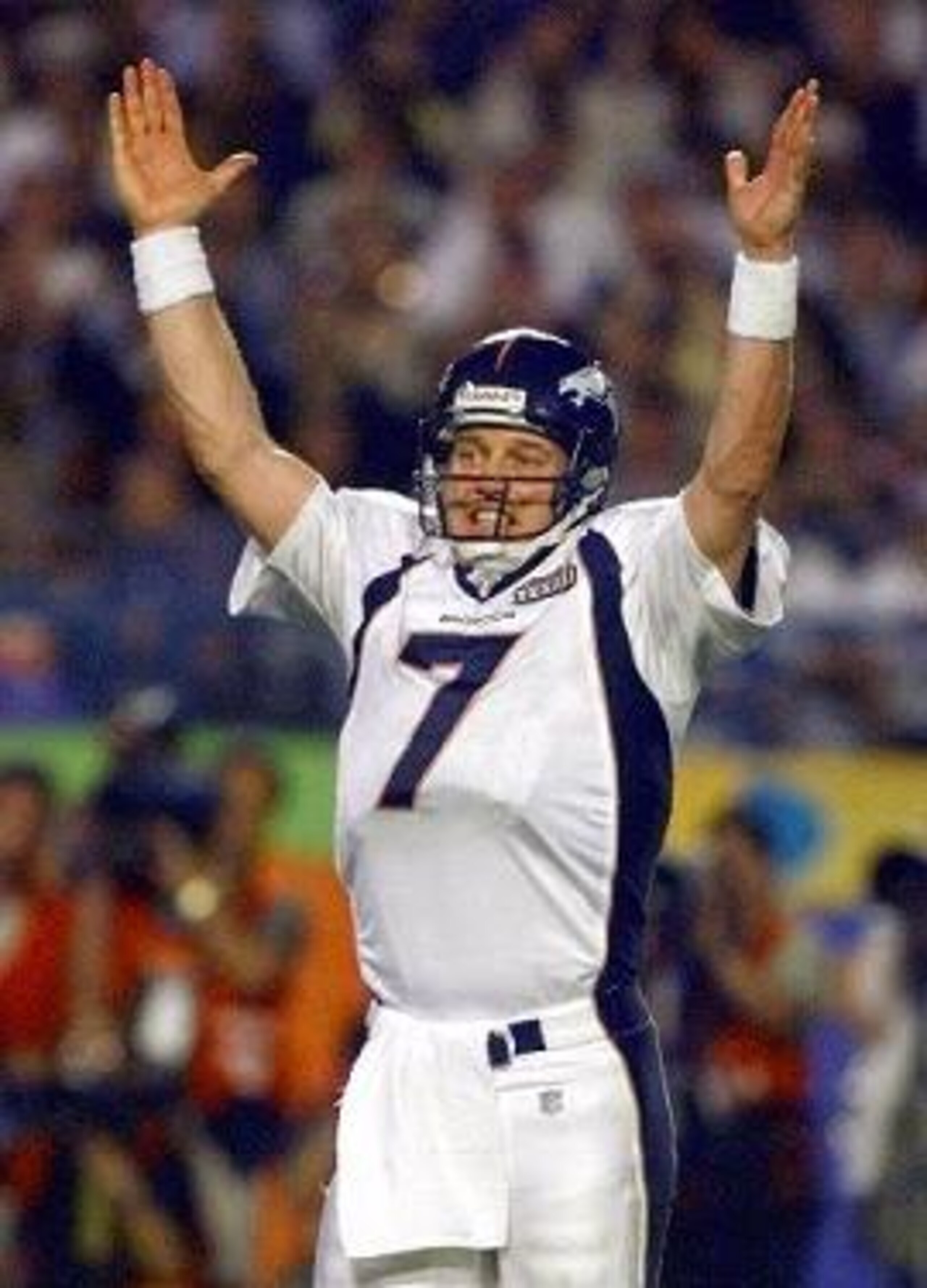
Oakland Selects John Elway 6th Overall
By his second year in the league, Elway set team records for passing attempts, completions and yards.
In 1987, he embarked on what is considered to be one of the most clutch performances in NFL history, when he helped guide the Broncos on a 98-yard, game-tying drive in the AFC Championship Game against the Cleveland Browns.
The moment is known in National Football League lore as The Drive. Following the AFC Championship Game, Elway and the Broncos lost in Super Bowl XXI to the New York Giants.
After two more Super Bowl losses, the Broncos entered a period of decline; however, that would end during the 1997 season, as Elway and Denver won their first Super Bowl title by defeating the Green Bay Packers, 31–24, in Super Bowl XXXII.
The Broncos repeated as champions the following season in Super Bowl XXXIII by defeating the Atlanta Falcons, 34–19. Elway was voted MVP of that Super Bowl, which would prove to be the last game of his career.
The versatile Elway is the only player in National Football League history to pass for more than 3,000 yards and rush for more than 200 yards in the same season seven consecutive times. He was only the second quarterback in NFL history to record more than 40,000 yards passing and 3,000 yards rushing during his career.
Elway was selected to play in nine Pro Bowl games (1986, 1987, 1989, 1991, 1993, 1994, 1996, 1997, 1998). Elway was a first- or second-team All-Pro choice three times and a first- or second-team All-AFC choice five times. In addition to his all-league honors, he was named the NFL’s Most Valuable Player in 1987, AFC Offensive Player of the Year in 1993.
The Denver Broncos retired his No.7 jersey, also in 1999; he was ranked number 16 on The Sporting News' list of the 100 Greatest Football Players.
At the time of his retirement, he ranked second all-time in three of the game’s most significant passing categories, passing yards (51,475), attempts (7,250), and completions (4,123).
Elway was inducted into the Pro Football Hall of Fame in 2004 in his first year of eligibility.
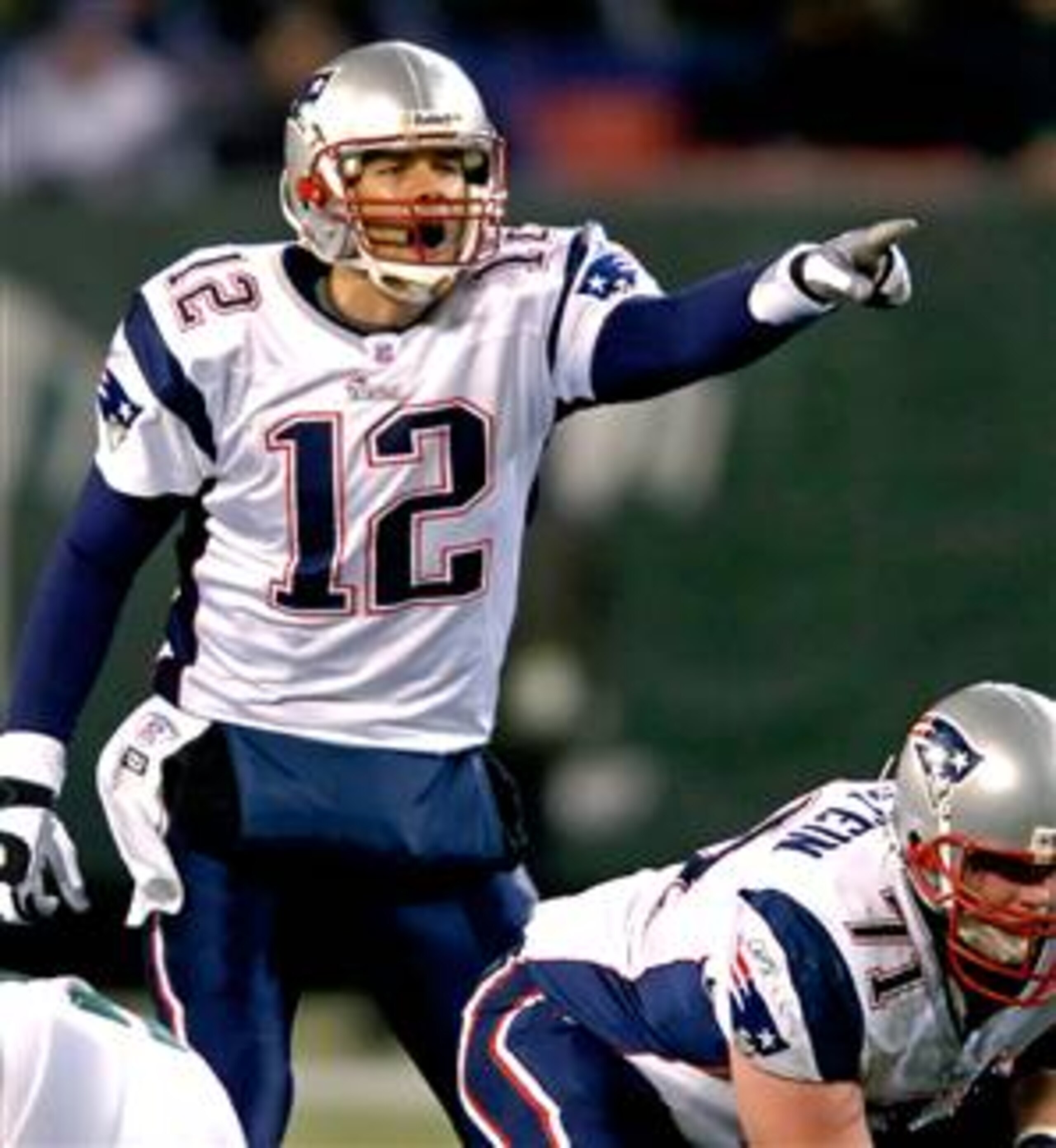
Cleveland Selects Tom Brady 7th Overall
The Patriots drafted Brady in the sixth round of the 200 NFL Draft. Brady has played in four Super Bowls, winning three of them (XXXVI, XXXVIII, XXXIX).
He has also won two Super Bowl MVP awards (XXXVI and XXXVIII), has been selected to five Pro Bowls (2001, 2004, 2005, 2007, and 2009) and was named NFL Comeback Player of the Year.
He holds the NFL record for most touchdown passes (50) in a single regular season. Brady has the sixth-highest career passer rating of all time (93.3) among quarterbacks with at least 1,500 career passing attempts.
He was named Sports Illustrated's Sportsman of the Year in 2005. He also helped set the record for the longest consecutive win streak in NFL history with 21 straight wins over two seasons (2003-04).
In 2004 and 2007, The Sporting News named Brady “Sportsman of the Year.” He was also named the 2007 NFL MVP, as well as 2007 Male Athlete of the Year by the Associated Press, the first time an NFL player has been honored since Joe Montana won in 1990.
Brady holds numerous regular season and postseason records, including the highest single-game completion percentage, regular season or postseason (26/28, 92.9%), tied most completions in one Super Bowl (32), most completions in Super Bowl history (100/career), the highest winning percentage of any quarterback ever during his first 100 starts (76 wins), and the longest streak of games with 3 or more touchdown passes (10 games).
Brady was named to the NFL’s 2000’s All-Decade Team and is New England’s All-time leader in passing touchdowns (225), passing yards (30,844), completions (2,672), and quarterback record (97-30).
Brady is the fourth-fastest player to reach 200 career passing touchdowns (116 games).
Brady led the Patriots to 29 game-winning drives and led the Patriots Brady to a 16–0 record in 2007.
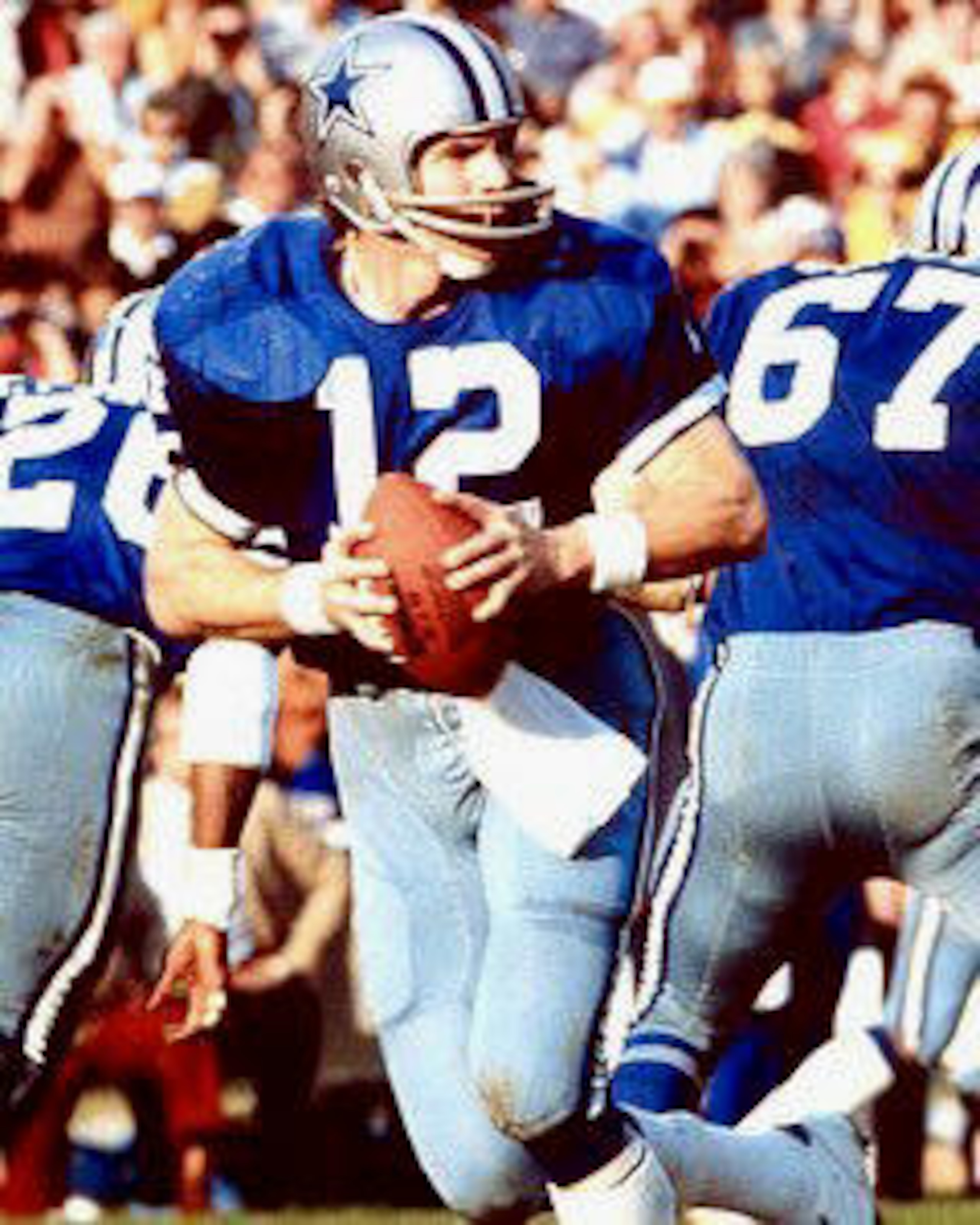
Seattle Selects Roger Staubach 8th Overall
Staubach was key part in developing the Cowboys to become America's Team and led the team to nine of the Cowboys record-setting twenty consecutive winning seasons. Staubach led the Cowboys to their first Super Bowl victory and as a result he was named MVP in Super Bowl VI.
Legendary coach Tom Landry described Staubach as "possibly the best combination of a passer, an athlete and a leader to ever play in the NFL."
He led the club to five Super Bowl appearances (V, VI, X, XII, and XIII), with victories in Super Bowl VI and Super Bowl XII. Staubach was named Most Valuable Player of Super Bowl VI becoming the first of four players to win the Heisman Trophy and Super Bowl MVP.
Perhaps his most famous moment was the controversial "Hail Mary Pass" in the 1975 playoff game against the Minnesota Vikings. With seconds on the clock and the Cowboys trailing 14–10, Staubach launched a 50-yard bomb to wide receiver Drew Pearson, who caught the pass and strode into the end zone for a 17–14 victory. After the game, Staubach quipped he prayed a "Hail Mary" before throwing the pass.
The moment has been emblazoned in football folklore ever since, and the "Hail Mary Pass" has entered the realm of football nomenclature.
Staubach was one of the most exciting NFL players of the 1970s. Known as "Roger the Dodger" for his scrambling abilities, and also as "Captain Comeback" for his fourth quarter heroics, Staubach had a penchant for leading scoring drives which would lead the Cowboys to improbable victories. He led his team to 23 game-winning drives (15 comebacks) in the fourth quarter, with 17 of these coming in the last two minutes.
He was named to the Pro Bowl (1971, 1975, 1976, 1977, 1978, and 1979) six times during his eleven-year (1969-1979) NFL career and named to the NFL’s 1970’s All-Decade Team. He also was granted to the Dallas Cowboys Ring of Honor.
In 1999, he was ranked number 29 on The Sporting News list of the 100 Greatest Football Players, the second-ranked Cowboy behind Bob Lilly.
Staubach retired from football in March 1980, as the then highest rated passer of all time at 83.4, and was voted into the Pro Football Hall of Fame in 1985.
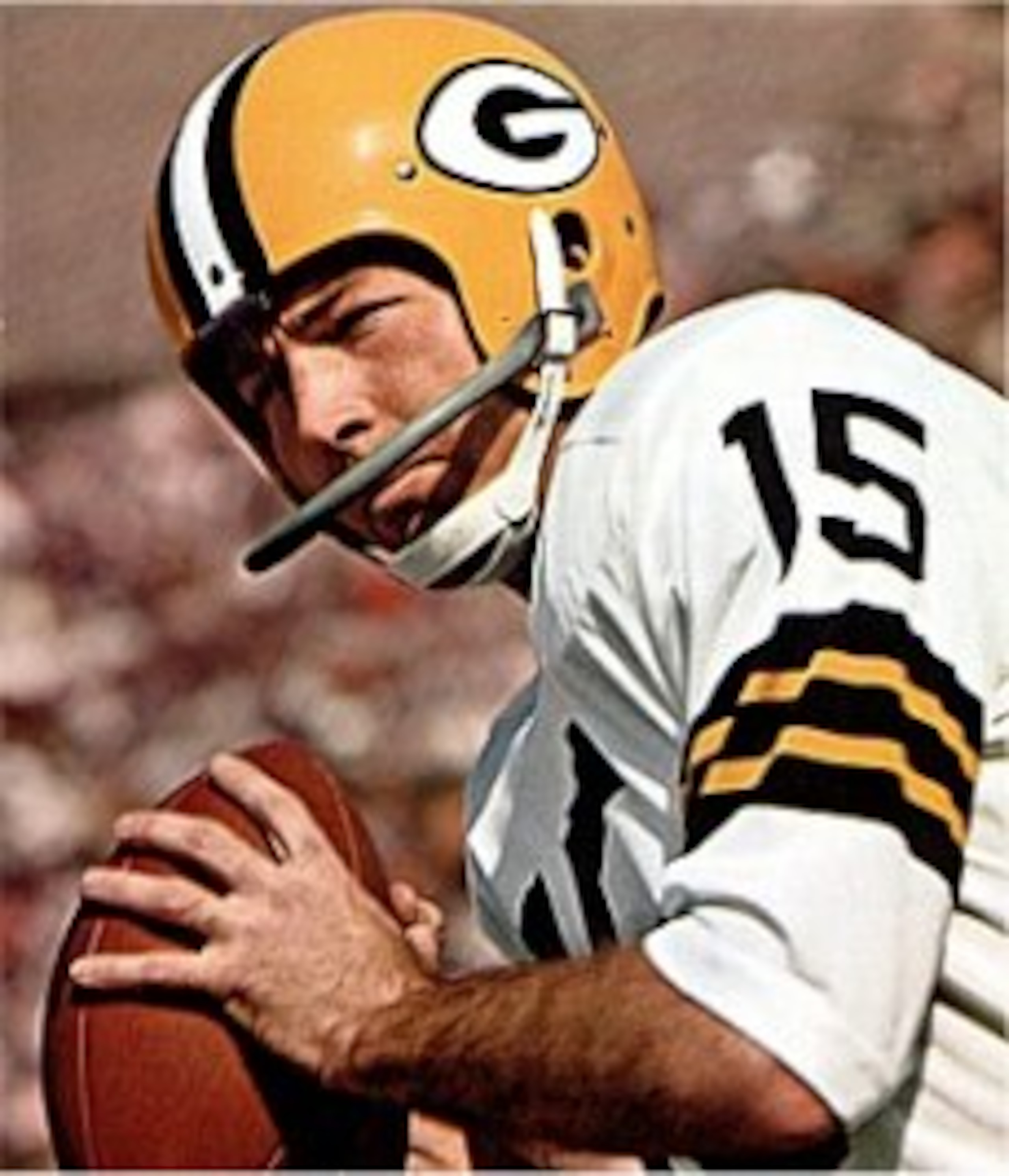
Buffalo Selects Bart Starr 9th Overall
Bart Starr was the quarterback for the Green Bay Packers from 1956 to 1971 and the Most Valuable Player of the first two Super Bowls. He earned four Pro Bowl selections and was inducted into the Pro Football Hall of Fame in 1977.
As Vince Lombardi's quarterback, Starr's Packers won NFL Championships in the 1961, 1962, 1965, 1966, and 1967 seasons. Following the NFL championships in 1966 and 1967, he led the Packers to convincing victories over the champions of the rival AFL in the first two Super Bowls and was named the Most Valuable Player of both games. He is the only player to quarterback a team to five NFL championships.
Starr was responsible for calling plays when he was quarterback, as was the norm at the time. One of his most famous play calls was in the Ice Bowl against the Dallas Cowboys in the NFL championship game on the final day of 1967. Instead of handing off (as the play was designed), Starr sneaked the ball himself for the winning touchdown.
Starr held several NFL passing records, including the lifetime record of completing 57.4 percent of his passes over a 16-year period. He led the league in passing three times. The Associated Press named Starr the NFL’s Most Valuable Player in 1966.
In 1999, Starr was ranked number 41 on The Sporting News list of the 100 Greatest Football Players.
Starr was named to the NFL’s 1960s All-Decade Team and the Green Bay Packers retired his jersey, No.15.
He is one of five Green Bay Packers to have his number (15) retired by the team. The others are Tony Canadeo (3), Don Hutson (14), Ray Nitschke (66), and Reggie White (92).
Starr has an NFL award named after him. A panel of judges gives the Bart Starr Award annually to an NFL player of outstanding character.
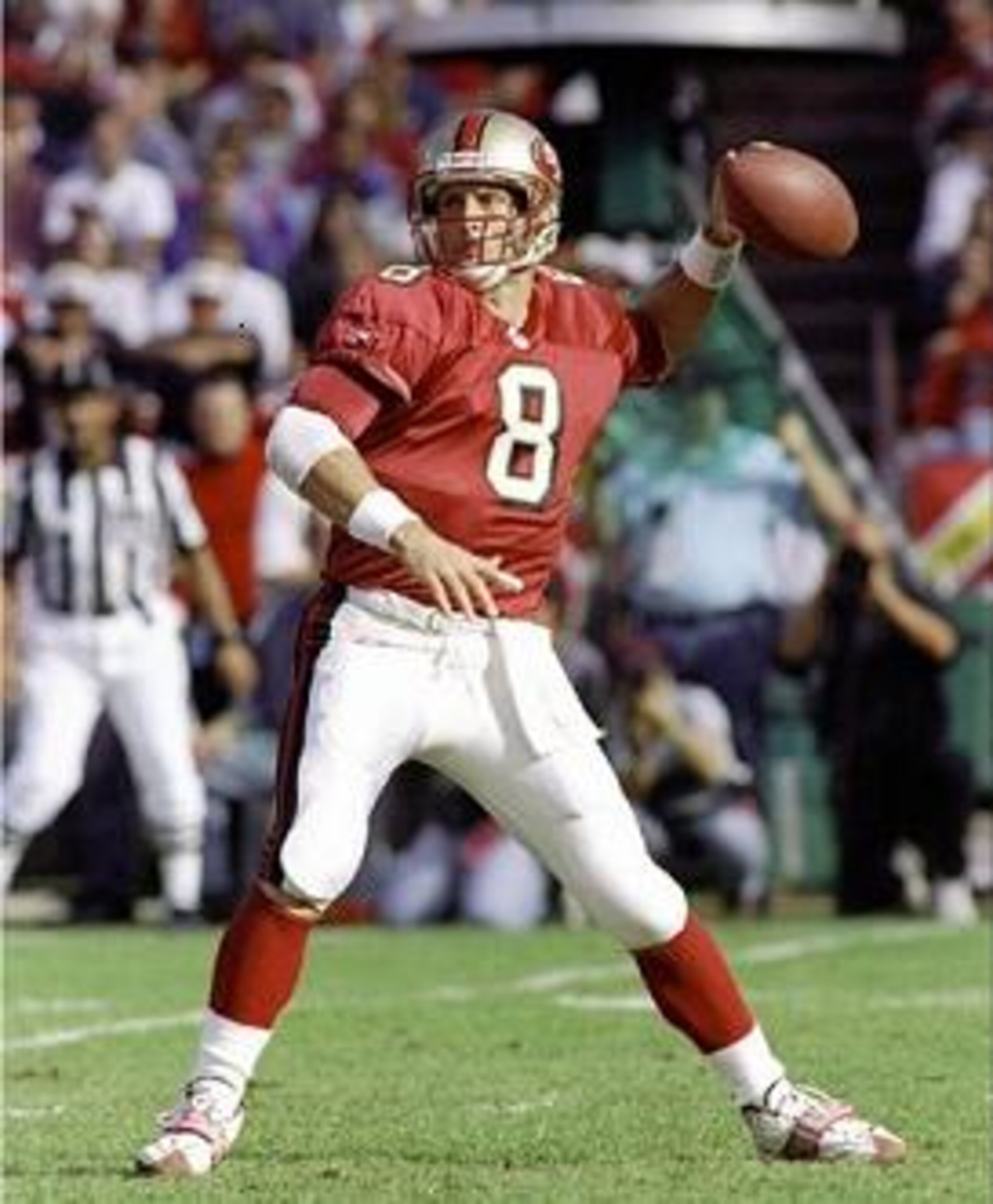
Jacksonville Selects Steve Young 10th Overall
Steve Young played with the Tampa Bay Buccaneers, but is best known for his time playing with the San Francisco 49ers.
Young was named the Most Valuable Player of the NFL in 1992 and 1994 and the MVP of Super Bowl XXIX. Young holds the NFL record for highest career passer rating and won six NFL passing titles.
Young finished the season with 3,456 passing yards and 537 rushing yards, along with an NFL best 25 touchdown passes and 107.0 passer rating, earning him the NFL Most Valuable Player Award and his first selection to the Pro Bowl of seven (1992, 1993, 1994, 1995, 1996, 1997, and 1998).
He was the first quarterback ever to record a triple digit rating in consecutive seasons.
On the strength of a six touchdown performance that surpassed the previous Super Bowl record of five, owned by the man Young replaced, Joe Montana, Steve Young was named the MVP of Super Bowl XXIX, as the 49ers defeated the San Diego Chargers, 49-26.
He threw for 3,969 yards, a then franchise record 35 touchdown passes with only 10 interceptions, completed an NFL record 70.28 percent of his passes, and broke Montana's single season mark with a then record 112.8 passer rating. He was named NFL MVP for the second time in his career in 1994.
Although he did not become the 49ers' starter until his 8th NFL season and he played a full season only three times during his 15-year career, Young compiled impressive career numbers. He threw for 33,124 passing yards and 232 touchdowns, with 107 interceptions, and 43 rushing touchdowns.
His 96.8 career passer rating is the highest in NFL history. His 4,239 rushing yards are the second most ever gained by a quarterback, behind Randall Cunningham.
He has the third-highest single-season passer rating at 112.8 (set in the 1994 season), next to Indianapolis Colts' Peyton Manning (121.1 QB rating in 2004), and New England Patriots' Tom Brady (117.2 QB rating in 2007).
In 1999, he was ranked No.63 on The Sporting News list of the 100 Greatest Football Players.
The San Francisco 49ers retired his No.8 jersey, and he became the 11th player in team history to receive this honor.
Steve Young was elected to the Pro Football Hall of Fame on February 5, 2005; he was the first left-handed Quarterback to be so honored.
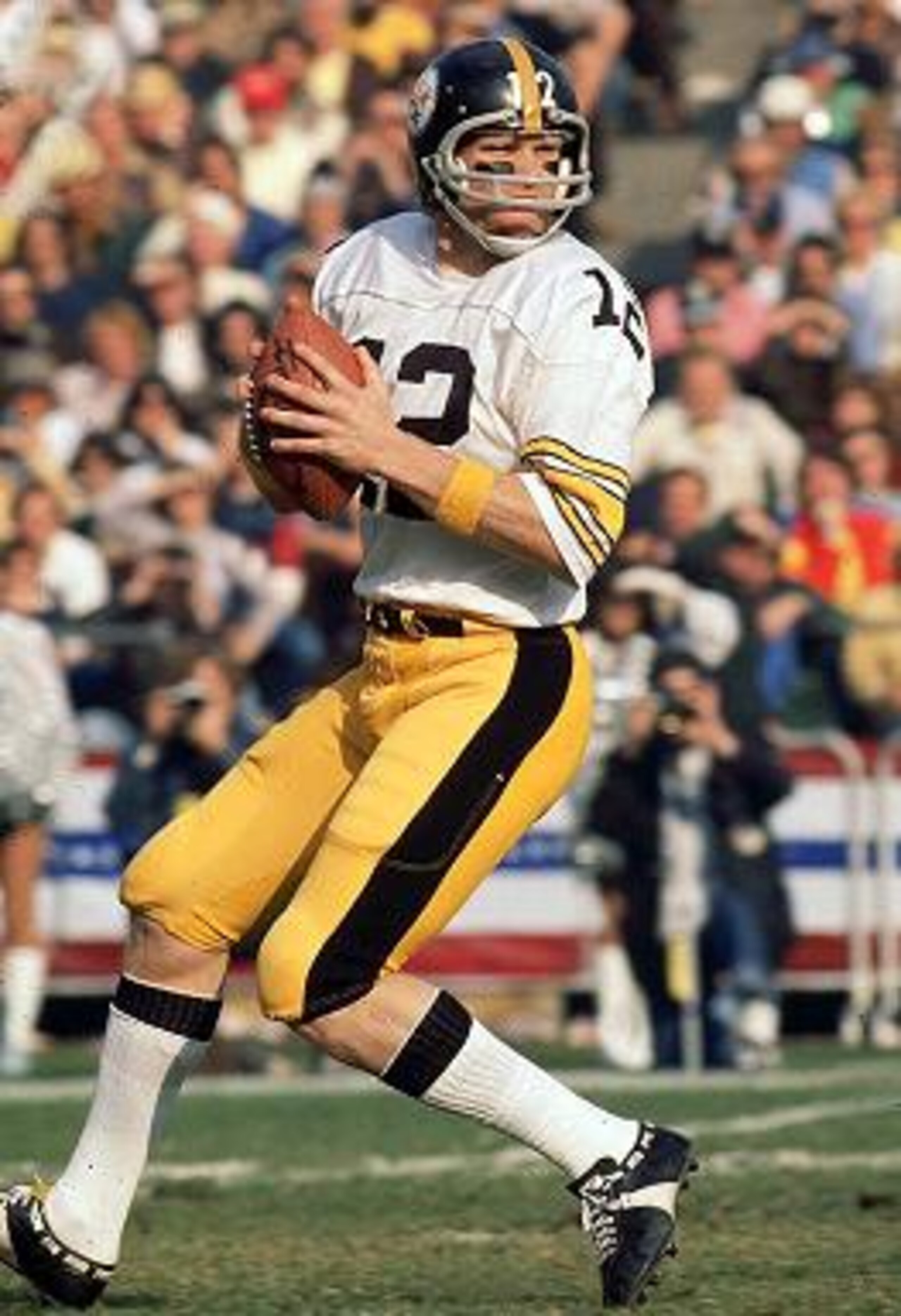
Chicago Selects Terry Bradshaw 11th Overall
In 1972, Bradshaw threw the pass leading to the "Immaculate Reception," which is among the most famous plays in NFL history.
“Last chance for the Steelers, Bradshaw trying to get away. And his pass is...broken up by Tatum. Picked off! Franco Harris has it! And he's over! Franco Harris grabbed the ball on the deflection! Five seconds to go! He grabbed it with five seconds to go and scored!” (Curt Gowdy)
Bradshaw led the Pittsburgh Steelers to eight AFC Central Championships and recorded four Super Bowl rings (IX, X, XIII, and XIV).
In four Super Bowls, he passed for an impressive 932 yards and 9 touchdowns. In 19 postseason games, he completed 261 passes for 3,833 yards.
Bradshaw won back-to-back Super Bowls between the 1974 (Minnesota) and 1975 (Dallas) seasons.
In 1978, Bradshaw won Super Bowl XIII against the Dallas Cowboys and was named Super Bowl MVP and 1978’s regular season MVP as well.
He would return to the Super Bowl in 1979 for his fourth Super Bowl win against the Los Angeles Rams (19-31) and be named to his second Super Bowl MVP award.
Bradshaw also went to three Pro Bowls in 1975, 1978, and 1979 and was named to the NFL’s 1970s All-Decade Team.
In his 14-season career, Bradshaw completed 2,025 of 3,901 passes for 27,989 yards and 212 touchdowns. He also rushed 444 times for 2,257 yards and 32 touchdowns.
While the Steelers no longer officially retire uniform numbers (with the exception of Ernie Stautner's No.70), they have not reissued Bradshaw's No.12 since he retired, and it is generally understood that no Steeler will wear that number again.
In 1999, Bradshaw was ranked number 44 on The Sporting News' list of the 100 Greatest Football Players.
Terry Bradshaw was inducted into the Pro Football Hall of Fame in 1989, his first year of eligibility.
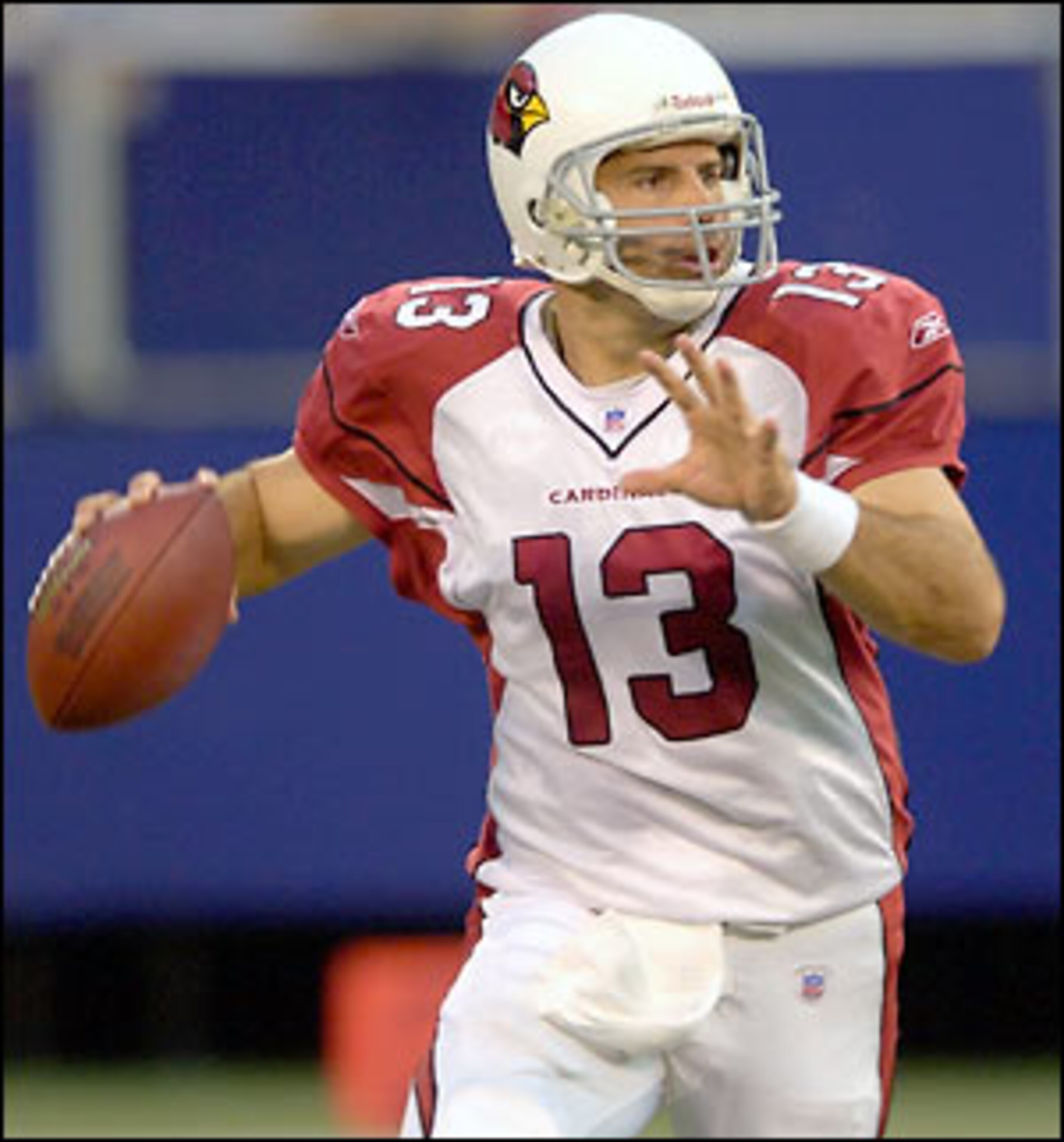
Miami Selects Kurt Warner 12th Overall
Warner put together one of the best seasons (1999) by a quarterback in NFL history, throwing for 4,353 yards with 41 touchdown passes.
The Rams' high-powered offense was nicknamed "The Greatest Show on Turf" and registered the first in a string of three consecutive 500-point seasons (1999-2001), an NFL record.
Warner will go on to be considered the best undrafted player of all time following a 12 year career regarded as one of the greatest stories in NFL history.
Warner first attained stardom during his highly successful stint with the St. Louis Rams from 1998–2003, where he won two NFL MVP awards in 1999 and 2001, as well as the Super Bowl MVP award in Super Bowl XXXIV, becoming the sixth player to win both the league MVP and Super Bowl MVP awards in the same year.
He also led the 2008 Arizona Cardinals to Super Bowl XLIII (the franchise's first-ever Super Bowl berth), and owns the three highest single-game passing yardage totals in Super Bowl history.
He also holds the highest completion percentage in a single game during the regular season, at 92.3 percent (24/26).
Kurt Warner was a five-time Pro Bowler (1999, 2000, 2001, and 2008), and a two-time AP MVP (1999 and 2001), with many passing records: Most yards passing in a playoff campaign (1,156 in 2008), three highest single-game passing yardage totals in Super Bowl history (XXXIV, XXXVI, and WLIII), only NFL quarterback to throw 40 touchdowns and win a Super Bowl in the same season (1999), tied Dan Marino as the fastest player to pass for 30,000 yards. He accomplished this in 114 games.
He also resurrected two franchises (St. Louis and Arizona), leading them to a combined three Super Bowls, winning one (XXXIV) in the process.
He has also threw at least 100 TD passes for two different teams (St. Louis Rams and the Arizona Cardinals).
Warner’s career totals are 32,344 passing yards, 208 touchdowns, and a 93.7 quarterback rating.
He will be eligible for induction into the Hall of Fame following the 2015 season.
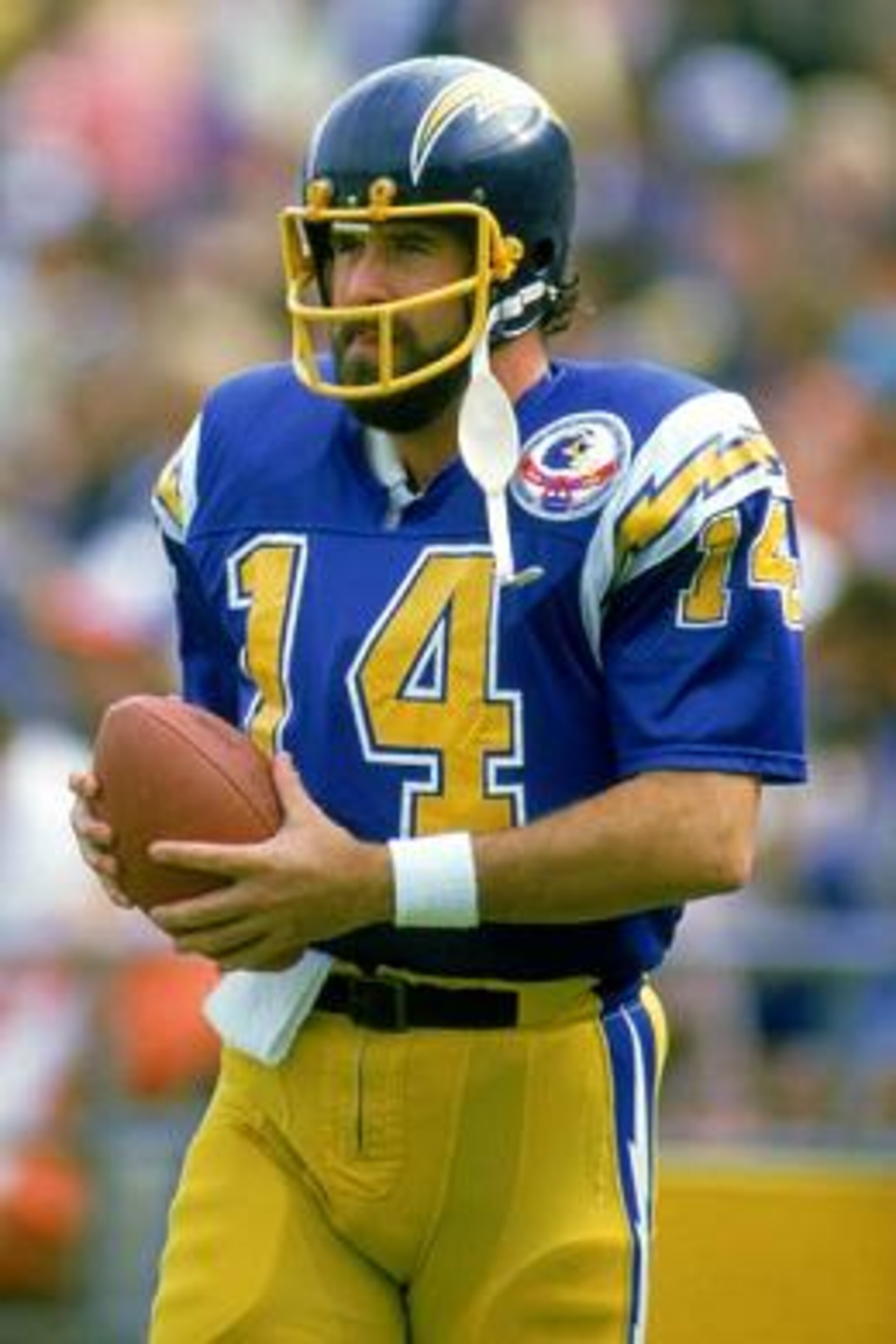
Carolina Selects Dan Fouts 13th Overall
Dan Fouts played his whole career with the San Diego Chargers from 1973 through 1987. He is one of the many famous, most prolific passing quarterbacks during the Golden Age Super Bowl era of the 70s and 80s.
Dan Fouts is one of only seven quarterbacks in NFL history who have achieved two consecutive (back-to-back) 30-touchdown passing seasons.
He was also the third quarterback in NFL history to pass for 40,000 yards, after fellow Hall of Famers Johnny Unitas and Fran Tarkenton, and the first quarterback ever to throw for over 4,000 yards in back-to-back seasons.
Fouts was a six-time Pro Bowl selection (1979, 1980, 1981, 1982, 1983 (Pro Bowl MVP), and 1985) and compiled passer ratings over 90.0 for a 3-year stretch (1981-83).
Fouts threw for over 4,000 yards for 3 consecutive seasons (1979-81), led the NFL in passing yards in 4 consecutive seasons (1979-1982). His career high of 4,802 passing yards during the 1981 season was an NFL record at the time.
The Chargers led the league in passing yards an NFL record 6 consecutive years from 1978-1983 and again in 1985 under Fouts.
Fouts was named to the NFL’s 1980’s All-Decade Team, and in 1999, he was ranked number 92 on The Sporting News' list of the 100 Greatest Football Players.
In 2009, the fans picked him as the "Greatest Charger of All Times" for the Chargers 50th anniversary year.
Fouts' jersey, No.14, is one of the only two numbers retired by the San Diego Chargers (the other being Lance Alworth's No.19).
Fouts finished his 15 NFL seasons with 3,297 of 5,604 completions for 43,040 yards and 254 touchdowns.
Dan Fouts was elected to the Pro Football Hall of Fame in 1993.
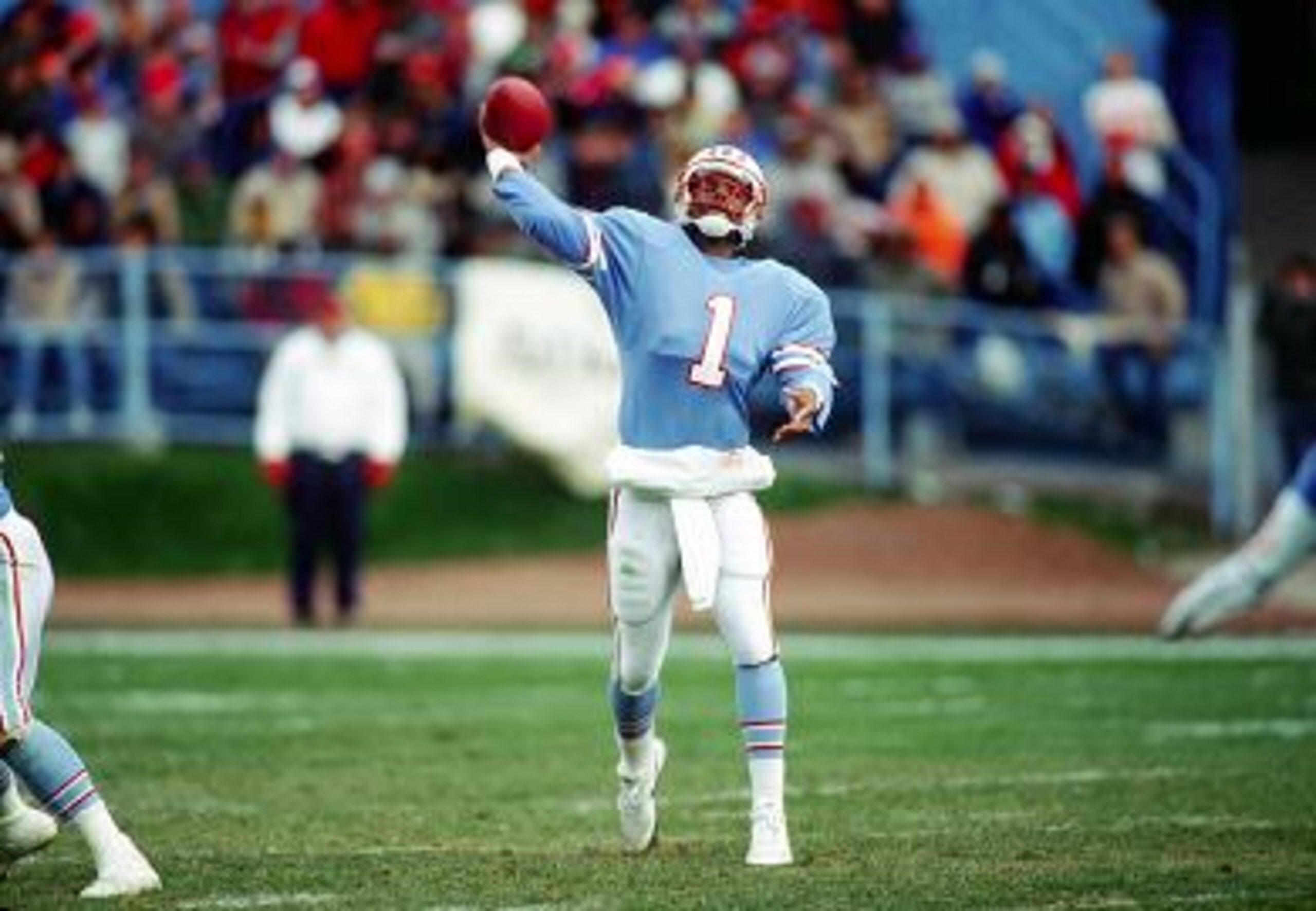
New York Giants Select Warren Moon 14th Overall
In 1990, Moon led the league with 4,689 passing yards. He also led the league in attempts (584), completions (362), and touchdowns (33), and tied Dan Marino's record with nine 300-yard games in a season. The following year, he again led the league in passing yards 4,690.
He joined Hall of Fame quarterbacks Dan Marino and Dan Fouts as the only quarterbacks to post back-to-back 4,000-yard seasons. Moon also established new NFL records that season with 655 attempts and 404 completions.
He is one of only two people to be enshrined in both the Pro Football Hall of Fame (2006) and Canadian Football Hall of Fame (2001).
Warren Moon was named to nine Pro Bowl games (1988, 1989, 1990, 1991, 1992, 1993, 1994, 1995, and 1997) and was named Pro Bowl MVP in 1998.
He also was named the 1990 NFL’s Offensive Player of the Year, throwing for 4,689 passing yards, 33 touchdowns and a quarterback rating of 96.8.
As a Houston Oiler, Moon set a franchise record for wins with 70, which stood until Steve McNair (74) broke it in 2004, long after the team had become the Tennessee Titans.
Warren Moon's career is still exceptional: 3,988 (1st) completions for 49,325 yards (1st), 291 touchdown passes (1st) all are franchise records.
Moon was in the top-five all-time for passing yards, passing touchdowns, pass attempts, and pass completions when he retired.
The Tennessee Titans retired his jersey, No.1.
Denver Selects Jim Kelly 15th Overall
Kelly led the Bills to four consecutive Super Bowls in 1990, 1991, 1992, and 1993, though the Bills lost all four of them.
He helped lead the Bills to 4 consecutive Super Bowl appearances (only to lose all 4) and 5 divisional championships from 1989 to 1995. Buffalo made the playoffs in 8 of Kelly's 11 seasons as their starting quarterback.
Kelly was perhaps best known for running the Bills' "K-Gun" no-huddle offense, which was a fast-paced offense that denied opposing defenses the opportunity to make timely substitutions.
In the 1990s, he established the Bills as one of the NFL's most successful and dangerous offenses, instrumental in leading Buffalo to four consecutive Super Bowl appearances.
Kelly holds the all-time NFL record for most yards gained per completion in a single game (44), established on September 10, 1995 in the Bills' game against the Carolina Panthers.
In his four Super Bowls, Kelly completed 81 of 145 passes for 829 yards and 2 touchdowns, with 7 interceptions. His 81 completions and 145 attempts are the second most in Super Bowl history behind Joe Montana.
In Super Bowl XXVI, he set a record with 58 pass attempts, and in Super Bowl XXVIII he set a record with 31 completions (this was later surpassed by Tom Brady's 32 completions in Super Bowl XXXVIII).
Kelly finished his 11 NFL seasons with 2,874 completions in 4,779 attempts for 35,467 yards and 237 touchdowns, with 175 interceptions, all of which are Buffalo records. Kelly made the Pro Bowl four times (1987, 1990, 1991, and 1992).
Jim Kelly could very well be the biggest disappointment to play in the Super Bowl. The Redskins, Giants, and the Dallas Cowboys stumped Kelly twice (1992 and 1993). He completed 81 of 145 passes for 829 yards and two touchdowns, with seven interceptions during those four Super Bowls.
In 2002, in his first year of eligibility, he was inducted into the Pro Football Hall of Fame.
Tennessee Selects Fran Tarkenton 16th Overall
At the time of his retirement he owned every major quarterback record, Tarkenton held NFL career records in pass attempts, completions, yardage, and touchdowns; rushing yards by a quarterback; and wins by a starting quarterback.
He is best known for his years with the Minnesota Vikings and New York Giants and then traded back to the Vikings.
He played for the Vikings from 1961 to 1966, during which time he frequently locked horns with head coach Norm Van Brocklin, who disdained the idea of a mobile quarterback, a concept that Tarkenton dramatically advanced in the NFL.
Tarkenton was given the nicknames "The Mad Scrambler," "Frantic Fran," and "Scramblin' Fran" because he frequently ran around in the backfield to avoid being sacked by the opposition.
He led the Vikings to three Super Bowls (1973, 1974, and 1976) in the 1970s, but lost all of them.
In Tarkenton's first Super Bowl appearance they lost to the Miami Dolphins 24–7, they lost the second to the Pittsburgh Steelers in a defensive struggle 16-6, and in the last Super Bowl Tarkenton would ever play, the Vikings were blown out by the Oakland Raiders 32-14.
Tarkenton won the NFL's MVP award after the 1975 season, capturing All-Pro honors in the process. Tarkenton was also second Team All-Pro in 1973 and earned All-NFC selection in 1972 and 1976. He was named second Team All-NFC in 1970 and 1974. Tarkenton was selected to play in nine Pro Bowls (1964, 1966, 1967, 1968, 1969, 1970, 1974, 1975, and 1976).
In his 18 NFL seasons, Tarkenton completed 3,686 of 6,467 passes for 47,003 yards (6th) and 342 touchdowns (4th), with 266 interceptions.
He also is fifth on the all-time list of wins by a starting quarterback with 124 regular season victories. He also used his impressive scrambling ability to rack up 3,674 rushing yards and 32 touchdowns on 675 carries.
In 1999, he was ranked number 59 on The Sporting News list of the 100 Greatest Football Players.
Fran Tarkenton was inducted into the Pro Football Hall of Fame in 1986.
San Francisco Selects Donovan McNabb 17th Overall
He was the Philadelphia Eagles' quarterback from 1999 to 2009 and traded to the Washington Redskins in 2010.
McNabb led the Eagles to four consecutive NFC East division championships (2001, 2002, 2003, and 2004), five NFC Championship Games (2001, 2002, 2003, 2004, and 2008), and one Super Bowl (Super Bowl XXXIX, in which the Eagles were defeated by the New England Patriots).
Perhaps his most memorable play has become known as "4th and 26", which took place against the Green Bay Packers in the final minutes of a 2003 NFC Divisional playoff game.
The Eagles, faced with a fourth down and 26 yards, needed to convert for a first down, with only 1:12 remaining and no timeouts available. Donovan McNabb threw a perfect strike to Freddie Mitchell deep into the Packers' secondary. The play set up David Akers' 37-yard field goal attempt after McNabb ran for another first down. The field goal was good and they went on to win the game in overtime.
McNabb has been named to the Pro Bowl (2000, 2001, 2002, 2003, 2004, and 2009) six times during his 11 year active career and honored to be a part of the Philadelphia Eagles 75th Anniversary Team.
He is the Eagles' all-time leader in career wins, pass attempts, pass completions, passing yards, passing touchdowns, and most NFC Championships appearances (5).
McNabb is the least-intercepted quarterback per pass attempt of all time, (4588 attempts-96 interceptions, and 2.09%).
He was the first NFL Quarterback ever to throw for more than 30 touchdowns and fewer than 10 interceptions (2004).
McNabb is one of six quarterbacks of all time to have over 25,000 passing yards and 3,000 rushing yards.
He is currently the third-highest winning percentage among active quarterbacks (83-45-1, .647) behind Peyton Manning (119-59-0, .669) and Tom Brady (88-25-0, .779).
Pittsburgh Selects Troy Aikman 18th Overall
Troy Aikman led the Dallas Cowboys to three Super Bowl wins in the 1990’s and being part of one of the best franchises in league history.
In 1992, Aikman set career highs in completions (302), passing yards (3,445) and touchdown passes (23), and led the Cowboys to a team record 13 regular season victories and the 2nd best record in the NFC.
During the playoffs Aikman broke Joe Montana's record of 83 passes without an interception by throwing 89.
Aikman led the Cowboys to consecutive Super Bowls in 1992 and 1993 and in Super Bowl XXVII against the Buffalo Bills; Aikman led the Cowboys to a blowout victory, 52–17. Aikman was named Super Bowl MVP after completing 22-of-30 passes for 273 yards and 4 TDs.
Dallas knocked the Green Bay Packers out of the playoffs to earn their 3rd Super Bowl appearance in the last four years. Dallas won Super Bowl XXX against the Pittsburgh Steelers 27–17, with Aikman throwing 1 TD pass.
Aikman was selected to the first of six consecutive Pro Bowls (1991, 1992, 1993, 1994, 1995, and 1996) in 1991.
In 1997, Aikman became the first quarterback in Cowboys' history to have three straight 3,000-yard seasons.
He ended his career as the Cowboys' all-time leading passer (32,942 yards). 90 of his 94 career wins were in the 1990s and were the most by any quarterback in any decade until Tom Brady and Peyton Manning surpassed him in the 2000s with 97 and 101 respectively. This makes Aikman 3rd on time on that list.
His career statistics include 32,942 yards and 165 touchdowns for a passer rating of 81.6.
Aikman was inducted into the Dallas Cowboys Ring of Honor with his longtime teammates Michael Irvin and Emmitt Smith.
In 1999, Aikman was ranked No. 95 on The Sporting News' list of the 100 Greatest Football Players.
Aikman was elected to the Pro Football Hall of Fame in 2006.
Atlanta Selects Steve McNair 19th Overall
Steve McNair spent the majority of his NFL career with the Tennessee Titans and was traded to the Baltimore Ravens, with whom he played for two seasons before retiring after thirteen NFL seasons.
McNair's 2,665 passing yards were the most for the Oilers since Warren Moon in 1993, and his 13 interceptions were the fewest for a single season in franchise history.
He also led the team in rushing touchdowns with eight and ranked second behind running back Eddie George with 674 yards on the ground, the third-highest total for a quarterback in NFL history.
McNair led the Titans to the playoffs four times, and the Ravens once, and played in Super Bowl XXXIV with the Titans.
McNair led the Titans to Super Bowl XXXIV in a re-match with the Rams. On the final play of the game, a McNair pass to Kevin Dyson was complete, but Dyson was unable to break the plane of the goal line, giving the Rams the win.
He is the Titans' all-time leading passer. McNair was selected to the Pro Bowl (2000, 2003, and 2005) three times, was All-Pro and Co-MVP in 2003, all as a Titan.
In 2000, McNair registered career passing highs in yards (3,350), completions (264), touchdowns (21) and quarterback rating (90.2). He was also the team's most effective rusher, tying George for the club lead with five scores.
McNair threw the longest touchdown pass in the Ravens' history, when he threw an 89-yard touchdown pass to receiver Mark Clayton; McNair helped Baltimore to a 13–3 record and an AFC North Championship.
Houston Selects Drew Bledsoe 20th Overall
Drew Bledsoe is best known as the starting quarterback for the New England Patriots from 1993-2001. During the 1990’s and early 2000’s, he was perceived to be the face of the Patriots franchise.
The Patriots earned their first postseason appearance in eight years with Drew Bledsoe at quarterback. Bledsoe started all 16 games that season and went on to set a NFL record in pass attempts (691), becoming the second NFL quarterback to complete 400 or more passes in a season (400), and led the league in passing yards (4,555).
Bledsoe led the Patriots to Super Bowl XXXI, where they lost to the Green Bay Packers by the score of 35-21. Bledsoe completed 25 of 48 passes for 253 yards, with two touchdowns and four interceptions in the loss.
He became the first NFL quarterback to complete game-winning touchdown passes in the final 30 seconds of two consecutive games.
He had one of his best seasons ever in 2002, passing for 4,359 yards and 24 touchdowns and making his fourth trip to the Pro Bowl (1994, 1996, 1997, and 2002).
In 2002, his first season in Buffalo, he set single season records for yards, attempts, completions on an offense that had 7 other franchise records.
During his tenure with the Cowboys, he threw for over 3,000 yards in a season for the ninth time in his career, tying Warren Moon for fourth in NFL history.
When Bledsoe retired in April 2007, he left fifth in NFL history in pass attempts (6,717) and completions (3,839), seventh in passing yards (44,611), and 13th in touchdown passes (251).
Cincinnati Selects Boomer Esiason 21st Overall
Boomer Esiason is amongst the most prolific left-handed quarterbacks in NFL history.
Esiason was the signal caller on one of the most potent offenses of the late 1980s, and he was surprisingly mobile, rushing for 1,598 yards on 447 attempts and scoring 7 touchdowns in his career.
Esiason led the Cincinnati Bengals to their second (and to date, their last) appearance in the Super Bowl, where they again lost another close game to the San Francisco 49ers 20-16.
In Super Bowl XXIII, the 49ers, led by Hall of Fame quarterback Joe Montana, marched 92 yards on their last drive and won the game on a touchdown pass to receiver John Taylor with 34 seconds remaining in the game that closed it out for a win.
Esiason won the NFL MVP award for the 1988 season, but was so depressed by the team's close Super Bowl loss that he declined to play in the Pro Bowl.
Esiason signed with the Arizona Cardinals as a free agent in 1996. It was during this season, on November 10, 1996, that Esiason threw for the 3rd best passing yardage day in NFL History, with 522 yards in a 37-34 overtime victory over the Washington Redskins.
Boomer Esiason was named to four Pro Bowl games (1986, 1988, 1989, 1993) and holds several NFL career records for left-handed quarterbacks, including most touchdown passes (247), passing yards (37,920), and completions (2,969). Esiason also led the AFC in passing in both 1988 and 1989.
Among the awards Boomer Esiason has earned during his career include the NFL Most Valuable Player Award in 1988 (leading the league with a quarterback rating of 97.4), and the Walter Payton Man of the Year Award in 1995 for his charitable work.
Esiason got the "Boomer" nickname before he was born. His mother, reacting to his constant kicking in the womb, called him "Boomer," and he has kept the name since.
New England Selects Randall Cunningham 22nd Overall
Randall Cunningham was said to have reached "elite" status during the 1988 season, when he threw for 407 yards during the "Fog Bowl" playoff game against the Chicago Bears.
In 1989, Cunningham, who had been an all-conference quarterback and punter while at UNLV, unleashed a 91-yard punt against the Giants on December 3, the longest in Eagles history (and the fourth-longest ever). He had 20 punts during his career, with an average of 44.7 yards per punt
In 1990, against the Buffalo Bills, when Cunningham, threw a pass 60 yards to wide-receiver Fred Barnett, resulting in a 95-yard touchdown. That same year, Cunningham finished with 942 rushing yards, 3rd most ever for a quarterback, 10th best in the league.
Feeling as if the fans and organization didn't fully appreciate his contributions to the team's success, as well as being unhappy with his role as a back-up,
Cunningham retired from football after the 1995 season.
Cunningham joined the Vikings in 1997 after being out of football in 1996. There he reunited with former Eagles wide receiver Cris Carter.
Cunningham enjoyed the greatest season of his career in Minnesota during the 1998 campaign when he guided the Vikings to a 15-1 regular season record with 34 touchdown passes and only 10 interceptions, and
Cunningham led the league with a 106.0 passer rating while the Vikings posted a then-NFL record 556 points during the 1998 season.
Cunningham would be named to four Pro Bowls (1988 (MVP), 1989, 1990, and 1998) throughout his career and was named the NFL’s 1992 Comeback Player of the Year.
In his final 10 NFL seasons, Cunningham played in only 80 games, but finished his 16-year career completing 2,429 of his 4,289 attempts for 29,997 yards and 207 touchdowns, with 134 interceptions. Cunningham also rushed for 4,928 yards on 775 carries and 35 touchdowns.
He retired after the 2001 season as the NFL's all-time leader in rushing yards and carries for the quarterback position and tied for fourth with Steve Grogan in rushing touchdowns by a QB.
Green Bay Selects Phil Simms 23rd Overall
In 1984, after many seasons plagued by injuries and up-and-down play, Simms finally emerged as a team offensive leader. He passed for 4,044 yards (second most in the National Football Conference (NFC)), 22 touchdown passes, and led the Giants to a playoff berth.
In a game against the Cincinnati Bengals during the 1985 season, Simms passed for 513 yards—the fifth most passing yards in a single game in NFL history.
The Giants met the Denver Broncos in Super Bowl XXI. In the biggest game of his life, Simms had one of the finest performances in Super Bowl history.
He completed 22 of 25 passes (with 2 of his 3 incompletions being drops by receivers) for 268 yards, setting Super Bowl records for consecutive completions (10), accuracy (88%), and passer rating (150.9).
Simms was named Most Valuable Player (MVP) of Super Bowl XXI, after he led the Giants to a 39–20 victory over the Denver Broncos and set the record for highest completion percentage in a super bowl (20 attempts), going 22 for 25.
Simms is also known for inaugurating the phrase "I'm going to Disneyland"
In 1990, Simms was having one of his finest seasons, leading the NFC with the highest quarterback rating (92.7) and the Giants to an 11–3 record. His season was cut short due to a broken foot suffered in the fourteenth game against the Giants' eventual Super Bowl XXV opponent, the Buffalo Bills. The Giants went on to defeat the Bills 20–19 in the Super Bowl (Hostetler was the starter in that Super Bowl).
He also was named to the Pro Bowl for his performances in the 1985 and 1993 seasons.
In his 14 seasons with the Giants, Simms completed 2,576 out of 4,647 passes for 33,462 yards and 199 touchdowns.
Sports Illustrated considered him to be the "Most Underrated Quarterback" in NFL History in their August 27, 2001 issue entitled, "The Most Overrated and Underrated."
Simms' jersey #11 was retired in a halftime ceremony of a game versus the Dallas Cowboys. During an emotional speech, Simms stated that he wanted to don his jersey one final time, and throw "one more pass" to teammate Lawrence Taylor.
Baltimore Selects Mark Brunell 24th Overall
During his years in Jacksonville, Brunell was selected to the Pro Bowl three times, in 1997, 1998, and 2000 and awarded the Pro Bowl MVP in the 1997 game.
With Brunell starting, the Jaguars won an AFC Central Division title and became the first NFL expansion team to make the playoffs three times in its first four seasons of play.
The furthest he led the team was to the 1996 AFC Championship Game, which they lost to the New England Patriots. They returned again in 1999, but would lose to the Tennessee Titans.
In 2005, Brunell played much better and led the team to a 10–6 record and a playoff victory over the Tampa Bay Buccaneers. He finished third in the 2005 NFL Comeback Player of the Year awards.
On September 24, 2006, Brunell broke the NFL record for most consecutive completions in single game when he completed his first 22 passes against the Houston Texans. Brunell also set the Redskins franchise record for highest completion percentage in a single game (88.9%). Hall of Fame quarterback Sammy Baugh held the previous record for 66 years (87.5%).
Mark Brunell won a Super Bowl ring with the New Orleans Saints when the Saints defeated the Indianapolis Colts in Super Bowl XLIV, 31-17.
Brunell currently has a total of 31,928 passing yards for 182 touchdowns on an 83.9 quarterback rating.
Philadelphia Selects Roman Gabriel 25th Overall
Roman Gabriel is considered by many to have been one of the best players at that position during the late 1960s and early 70s.
He was awarded the NFL Most Valuable Player Award in 1969 and earned Pro Bowl spots in 1967, 1968 (MVP), 1969, and 1973.
In 1973, he led the NFL with 3,219 yards and 23 touchdown passes, for which he was awarded the NFL Comeback Player of the Year Award.
As of the end of the 2009 NFL season, he still holds the Rams' career records for touchdown passes (154), passes attempted (3,313), and wins by a starting quarterback (74).
The 1967 Rams finished as the highest scoring team in the NFL (398), but were eliminated from the playoffs by the Packers 28-7.
In his career he had a winning record of 86-64-7 and passes for 29,444 yards and 201 touchdowns. He is the only quarterback from his era to still rank high in the "lowest interception percentage" category in NFL passing statistics.
Gabriel's last completion of his career was a 15-yard pass to Vince Papale, the walk-on WR and special-teams captain who is the inspiration for and subject of Disney's movie Invincible, starring Mark Wahlberg. In 1982 he was the last football coach at Cal Poly Pomona.
Arizona Selects Jim Hart 26th Overall
Jim Hart played for the St. Louis Cardinals from 1966 through 1983 and the Washington Redskins in 1984. From 1974-1976, he guided the Cardinals to three straight 10+ win seasons along with back-to-back division crowns in 1974 and 1975. He was also selected to the Pro Bowl four times 1974-1977.
UPI, All-NFC and second team All-Pro named Hart the NFC Player of the Year at the conclusion of the 1974 season.
Jim Hart currently holds the franchise records for: 87 quarterback wins, 2,590 quarterback completions, passing yards (34,639), and touchdowns (209).
Dallas Selects Ken Anderson 27th Overall
Ken Anderson spent his entire professional career playing for the Cincinnati Bengals.
He would become one of the most accurate short-range passers in the league, and was extremely effective at rushing the ball for a quarterback (2,220 yards for 20 touchdowns).
Ken is considered to be one of the first quarterbacks to run what would become known as the "West Coast Offense."
Anderson passed for a franchise record 447 yards while the Bengals racked up a franchise record 553 offensive yards on their way to a 33-21 win against the Bills. It was the team's first ever win in a Monday night game.
Anderson's best season was in 1981, he completed 62.6% of his passes for 3,754 yards and 29 touchdowns, with only 10 interceptions leading the NFL with a career-high 98.4 passer rating.
This performance earned him both the Associated Press and Professional Football Writers of America NFL Most Valuable Player Awards and the NFL Comeback Player of the Year Award.
The Bengals lost Super Bowl XVI 26-21 against the San Francisco 49ers, but Anderson had a fairly good performance in it. He completed 25 of 34 passes for 300 yards and 2 touchdowns, and a touchdown on 5 rushing attempts.
At the time, his 25 completions and 73.5% completion percentage were both Super Bowl records.
In 1982, Anderson set an NFL record by completing 70.6% of his passes.
In his 16 NFL seasons, Anderson completed 2,654 of 4,475 passes (59.3%) for 32,838 yards and 197 touchdowns and 160 interceptions. He also gained 2,220 rushing yards and 20 touchdowns on 397 carries.
His completions, passing yards, and touchdown passes are all Bengals records.
Anderson led the NFL in Quarterback Rating 4 times during his career (1974-'75 & 1981-'82) and led the league in passing yards twice (1974, 1975). He was selected to 4 Pro Bowls (1975-76 & 1981-82).
In 2008, NFL Network selected Anderson as No.10 on their list of top 10 players who have not yet made it into the Hall of Fame.
San Diego Selects Len Dawson 28th Overall
Len Dawson signed with the American Football League's Dallas Texans on June 30, 1962. The move reunited him with Hank Stram, who was beginning his third year as the Texans' head coach.
In that first season, 1962, Dawson led the league in touchdowns and yards per attempt, and was The Sporting News' selection as the AFL MVP, and was selected by his peers as a Sporting News 1966 AFL All-League player.
He also led them that year to the first of three league titles (1962, 1966, and 1969) in a thrilling double-overtime victory over the two-time defending champion Houston Oilers. Dawson ran a ball-control offense in the 20-17 win, and tossed a 28-yard touchdown pass to halfback Abner Haynes. Then the team moved to Kansas City and were renamed The Chiefs in 1963.
He would win four AFL passing titles (1962, 1964, 1966 and 1968), ending the 10-year run of the league as its highest-rated career passer. From 1962 to 1969, Dawson threw more touchdown passes (182) than any other professional football quarterback during that time.
Dawson led the Chiefs to Super Bowl I, the first championship game between the AFL and their NFL rivals. The NFL champion Green Bay Packers won easily, 35-10.
He then capped his year with MVP accolades in Super Bowl IV, the last game ever played by an American Football League team.
Dawson was selected to six AFL All-Star games (1962, 1964, 1966, 1967, 1968, 1969), one Pro Bowl selection (1971), and the Kansas City Chiefs retired his jersey, No.16.
Dawson ended his career in 1975, having completed 2,136 of 3,741 passes for 28,711 yards and 239 touchdowns, with 181 interceptions. He also gained 1,293 rushing yards and 9 touchdowns on the ground.
Len Dawson was inducted into the Pro Football Hall of Fame in 1987.
New York Jets Select Drew Brees 29th Overall
Drew Brees has been selected to the Pro Bowl four times in his career – with the Chargers in 2004 and the Saints in 2006, 2008, and 2009.
He was named the NFL's Comeback Player of the Year in 2004 (3,159 yards for 27 touchdowns).
Brees had a productive first year with the Saints. He threw a league-leading 4,418 passing yards, finished third in the league with 26 touchdown passes and 11 interceptions and a 96.2 passer rating. Brees was named starting quarterback for the NFC in the 2007 Pro Bowl.
In 2007, Brees was named first runner-up behind former teammate Tomlinson for league MVP by the Associated Press. Brees and Tomlinson were co-recipients of the Walter Payton Man of the Year Award.
Brees passed for 4428 yards and tied a then team record with 28 touchdowns. He also set the NFL record previously held by Rich Gannon for pass completions in a single season with 440.
In 2008, Brees finished 16 yards short of the NFL record for passing yards thrown in a single season set by Dan Marino in 1984. He finished the season with 5,069 yards and became the second quarterback in NFL history to throw for over 5,000 yards in a season.
He passed for 300 yards ten times during the season, tying Rich Gannon's 2002 record, and was named the AP 2008 Offensive Player of the Year.
In week 12, Brees led the Saints to an 11-0 record, defeating the New England Patriots 38-17 on Monday Night Football. Drew Brees totaled 371 yards passing, posting a perfect quarterback rating of 158.3.
He finished the season with a completion percentage of 70.62, which established a new NFL record.
The Saints defeated the Indianapolis Colts 31-17 in Super Bowl XLIV on February 7, 2010. Brees tied a Super Bowl record with 32 successful completions to win the Super Bowl Most Valuable Player Award. He threw for 288 yards and 2 touchdowns. It was the first world championship in franchise history.
Minnesota Selects Joe Theismann 30th Overall
Joe Theismann led the Redskins to a win in Super Bowl XVII and an appearance in Super Bowl XVIII.
He would go on to set several Redskins franchise records, including most career passing attempts (3,602), passing completions (2,044) and passing yards (25,206), while also throwing 160 touchdown passes, and on the ground, he rushed for 1,815 yards and 17 touchdowns.
He was the NFL's MVP in 1983, racking up 3,714 passing yards for 29 touchdowns, and a 97.0 quarterback rating.
He earned the Player of the Game Award (MVP) in the second of his two Pro Bowl (1982 and 1983) appearances.
Some may remember him most when he was hit by New York Giants linebackers Lawrence Taylor and Harry Carson during a Monday Night Football.
Viewers in an ESPN poll voted that his injury was the NFL’s “Most Shocking Moment in History,” and The Washington Post dubbed the tackle “The Hit That No One Who Saw It Can Ever Forget.”
Joe Theismann was honored to be selected to the Washington Redskins Ring of Fame and to the 70 Greatest Washington Redskins.
Indianapolis Selects Bob Griese 31st Overall
Bob Griese led the Dolphins to three consecutive Super Bowl appearances, including two Super Bowl victories (VII and VIII).
Griese went on to earn AFL All-Star (1967 and 1968) or AFC-NFC (1970, 1971, 1973, 1974, 1977, and 1978) Pro Bowl honors in eight years.
Griese led the team to their first Super Bowl in 1971, and Bob Griese was named the Most Valuable Player in the NFL with 2,089 passing yards for 19 touchdowns and a quarterback rating of 90.9.
Despite their unbeaten season 1972, the Dolphins were listed as two point underdogs to the Washington Redskins in Super Bowl VII. However, true to the form of the season, the Dolphins played an almost perfect game winning 14-7.
Griese and the Dolphins were able to hold onto victory and establish the only time an NFL team has remained unbeaten and untied through an entire season going 17-0.
Griese led the Dolphins to their third Super Bowl, and then totally dominated the Minnesota Vikings in Super Bowl VIII 24-7.
On Thanksgiving, 1977, Griese threw six touchdown passes in three quarters to demolish the (then) St. Louis Cardinals.
He had established his reputation as the “Thinking Man’s Quarterback,” as he brilliantly called his own plays throughout his career. Dolphin owner Joe Robbie called him “the cornerstone of the franchise,” around whom the Miami Dolphins were built.
The Miami Dolphins had the highest winning percentage in all professional sports in the 1970s, and Bob Griese was its starting quarterback throughout the decade, except when he was injured for several games in 1972, 1975, and 1978.
In Griese's 14 pro seasons, he threw for 25,092 yards and 192 touchdowns. Griese also rushed for 994 yards and seven scores.
Bob Griese would go on to have his jersey, No.12, retired and he was eventually elected to the Pro Football Hall of Fame in 1990.
New Orleans Select Rich Gannon 32nd Overall
Some people may not have known Rich Gannon early on in his career as he had most of his success towards the end.
During his first 11 years he only totaled 11,158 passing yards for 66 touchdowns and 53 interceptions, but he would turn it around when the Oakland Raiders picked him up in 1999.
He excelled in Jon Gruden's West Coast offense and was voted to the Pro Bowl in his first year as a Raider, the first of four straight selections (1999, 2000, 2001, and 2002).
In 2001 and 2002, he won the Pro Bowl MVP award consecutively, a feat achieved by no other NFL player.
Gannon won the NFL Most Valuable Player Award after a record-setting 2002 season, throwing for 4,689 yards and 26 touchdowns, which helped the Raiders advance to Super Bowl XXXVII.
Gannon holds franchise records for the Oakland Raiders in most completions (career/season 1,533/418), most attempts (season 618), most passing yards (season 4,689), highest completion percentage (career/season 62.6/67.6), highest passer rating (career 91.2), and the most 300 yards passing games in a career (20).
Gannon finished his career with 28,743 passing yards, 180 touchdowns, 104 interceptions, and an 84.7 quarterback rating. He has a quarterback record of 76-56.
What is the duplicate article?
Why is this article offensive?
Where is this article plagiarized from?
Why is this article poorly edited?
Flag This Article


181 Comments
Loading comments...
This comment and all replies have been deleted This comment has been deleted Undo delete