

NFL Draft 400: Top OTs for 2018 NFL Draft
Scouts and general managers have called the 2018 NFL draft class average, but we still have questions. Who is the best overall player? How about the best at each position?
The NFL Draft 400's goal is to figure that out.
We tracked, scouted, graded and ranked the top 400 prospects with help from scouting assistants Marshal Miller, Dan Bazal and Jerod Brown. Together, we viewed tape of a minimum of three games per player—the same standard NFL teams use. Oftentimes, we saw every play from a prospect over the last two years.
Strengths and weaknesses figured into the grades, with a pro-player comparison added to match the prospect's style or fit in the pros. The top 400 prospects will be broken down by position for easy viewing before the release of a top-400 big board prior to the April 26-28 draft.
In the case of a tie, players were ranked based on their overall grade in our top 400.
30. Jamar McGloster, Syracuse
1 of 30
POSITIVES
—Uses his length to create separation.
—Throws his hands early and often while initiating contact.
—Has the hands to redirect and stun defenders when he does make contact.
—Rhythm stepper who can get to points in all pass sets.
NEGATIVES
—Shuffle-stepper who crosses himself up in pass protection.
—Opens hips early in pass protection and gives up the edge easily.
—Lacks strength to latch on and drive average defenders.
—Is a pusher and doesn't look to finish blocks downfield.
—Throws his hands well but is easily chopped aside.
OVERALL
Syracuse's Jamar McGloster features underwhelming technique in pass protection that will cause concern in the NFL. He has the length to intrigue a team that's willing to build practice squad depth. However, his lack of power and intensity as a run-blocker only exacerbates a deficiency in requisite offensive line fundamentals.
GRADE: 4.99 (Camp Body)
PRO COMPARISON: Billy Turner, Miami Dolphins
29. Austin Golson, Auburn
2 of 30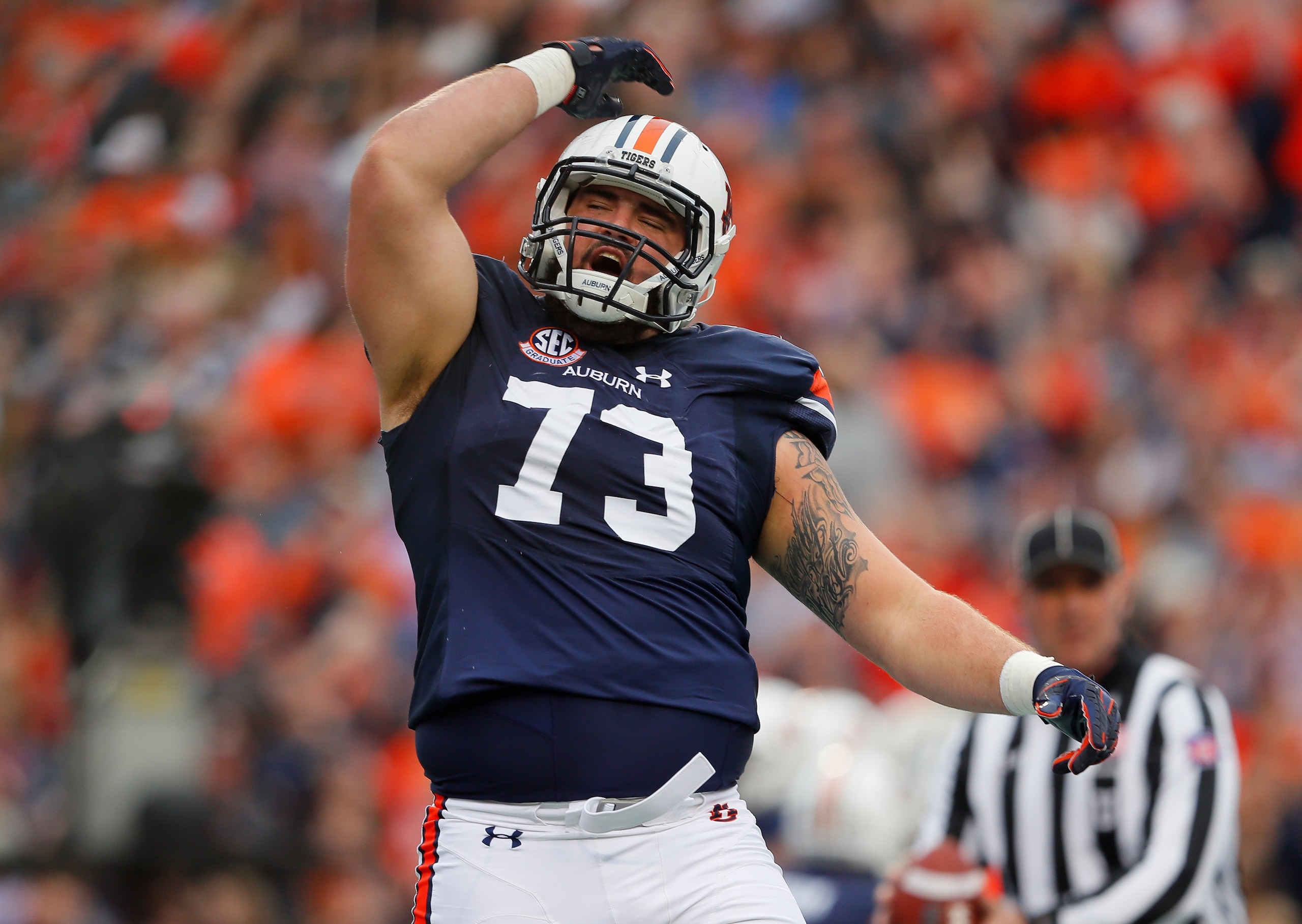
POSITIVES
—Played all over the line at Auburn and has the versatility to develop as an interior lineman.
—Above-average mental processing to be an effective starter at multiple positions.
—Understands angles, both at the line of scrimmage and in the second level, to be an effective run-blocker.
—Identifies assignments and plays through the whistle.
—Decent feet that help him translate to either side of the line.
NEGATIVES
—Looks like more of a "big guy" (6'5", 312 lbs) versus legitimate NFL-caliber athlete.
—Slow out of his stance and loses early in the rep.
—Plays with a high chest, causing balance and leverage issues.
—Lack of true defined position has led to a stunted development.
—Powerful opponents will expose a weak lower back that keeps him from bending and anchoring against high-caliber players.
OVERALL
Austin Golson's experience playing all over the line at Auburn will earn him a spot in a training camp. He's a limited athlete and fails to demonstrate the requisite skills to be an NFL starter, though. At best, he'll use his intelligence and ability to learn multiple positions to land a spot as a valuable practice squad member.
GRADE: 4.99 (Camp Body)
PRO COMPARISON: Bobby Hart, Cincinnati Bengals
28. Aaron Evans, UCF
3 of 30
POSITIVE
—Has experience at UCF helping to build the program, and he's grown as a player alongside of it.
—Built for the NFL (6'4", 325 lbs) with good thickness throughout his body.
—Strong enough to be effective at the point of attack in a gap run scheme.
—Has a wide base with the strength to pound the inside half of an opponent's foot and dig out defenders one-on-one.
NEGATIVES
—Doesn't have the change-of-direction skills to mirror on the edge as a tackle.
—Limited flexibility in his hips causes him to pass-set upright far too often.
—Locks on in pass protection and doesn't have natural feel for stunts.
—His initial punch is solid, but he's slow to reset his hands after counters from defenders.
—Limited overall athlete who's best suited for a move inside.
OVERALL
Aaron Evans has been a part of the UCF program through the winless 2015 season and the rapid turnaround to last year's success. He comes with the experience of a quality practice squad player. Teams will likely move him inside where they can utilize his thick frame and power while minimizing some of his obvious athletic limitations.
GRADE: 5.00 (Priority Free Agent)
PRO COMPARISON: Kent Perkins, Cincinnati Bengals
.jpg?w=2560 "Steelers Lions Football")
.png?w=2560 "Bills Camp Football")
27. Rod Taylor, Ole Miss
4 of 30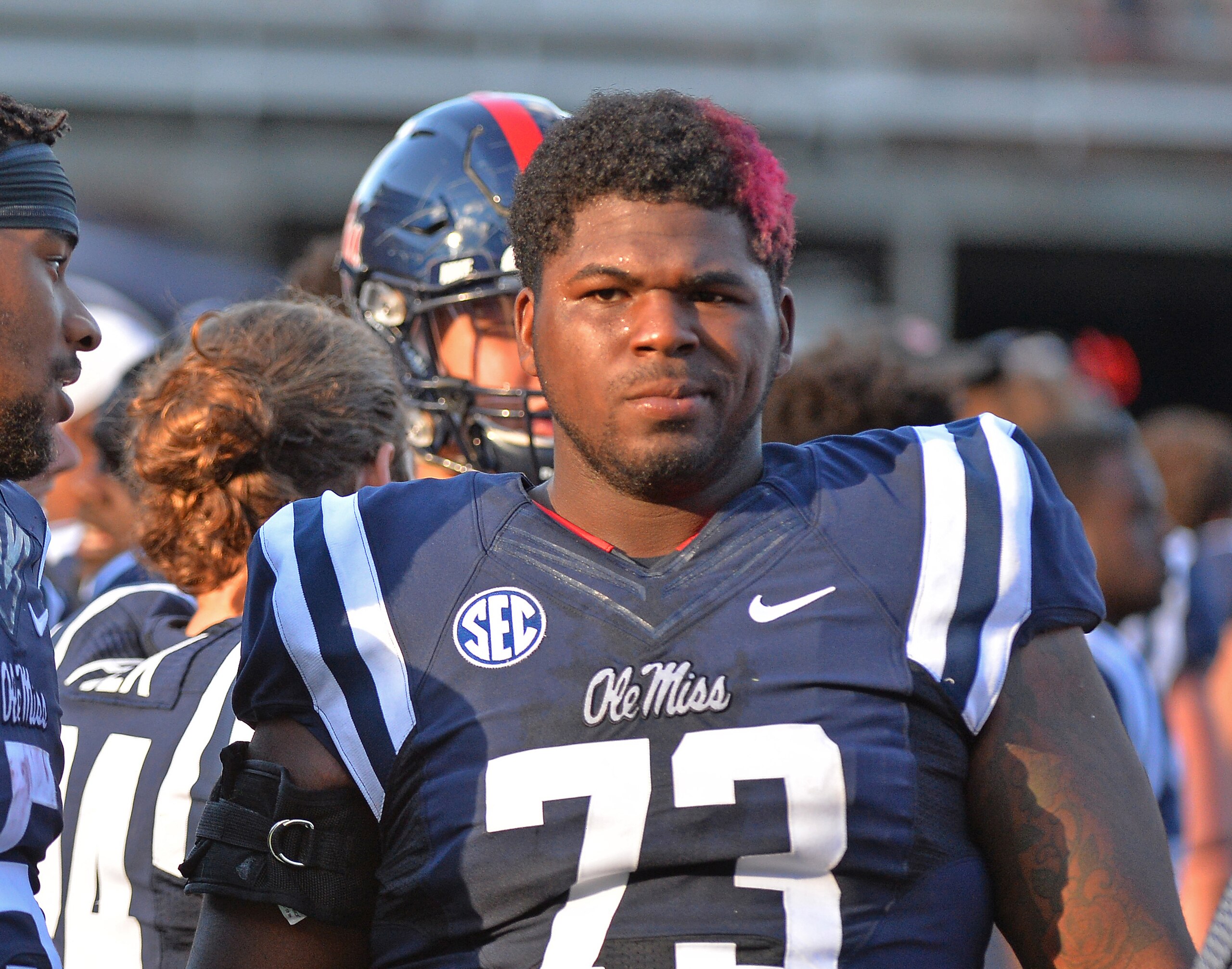
POSITIVES
—Has experience at guard and tackle in the ultra-competitive SEC.
—Top-heavy and can use hands to be an adequate as run-blocker.
—Has decent feet to mirror athletes on the interior defensive line.
—Has experience in space as a puller and can move with purpose.
NEGATIVES
—Lacks the length (34 ¼" arms) needed to be an effective NFL tackle.
—Only one season of complete health.
—Wide striker who rounds his arms and loads up, essentially telegraphing his punch.
—Lacks legit bubble in lower body and doesn't have the weight (320 lbs) to anchor against power.
—Length issues lead him to lean and reach too often.
OVERALL
Rod Taylor has the experience NFL teams want, but his lack of length is a major concern if he's going to play tackle. Taylor's best bet is to move inside and serve as the eighth offensive lineman who can play either guard or tackle in a pinch. His ability to anchor against power opponents has to improve regardless of where he lines up and will make him a liability early in camp.
GRADE: 5.20 (Priority Free Agent)
PRO COMPARISON: Nick Easton, Minnesota Vikings
26. Rick Leonard, Florida State
5 of 30
POSITIVES
—Played defensive end before moving to the offensive line in 2016 and is a raw prospect.
—Has a strong punch that can stun and neutralize the pass rush.
—Has enough athleticism to work out in space.
—Is a developmental prospect who's still learning and can be shaped by an NFL team to fit scheme and style.
NEGATIVES
—Lower-body strength to anchor against pressure is mediocre.
—Doesn't have the muscle memory built into his lower body yet and will struggle to consistently reach the same base in pass protection.
—Runs with big, swinging motions and struggles to maintain balance and coordination through contact.
—Is hurried in all movements, and his frenetic pace often causes problems.
—Change-of-direction skills are lacking and leave him hopeless against speed in the open field.
OVERALL
Rick Leonard has the size (6'7", 311 lbs) NFL teams want, but he's a raw prospect who will take a patient coaching staff to mold him into a contributor. He's a converted defensive lineman who has the speed and power to become an NFL offensive lineman, but his technique and fundamentals are still far behind many of his peers'.
GRADE: 5.25 (Priority Free Agent)
PRO COMPARISON: T.J. Clemmings, Minnesota Vikings
25. Nick Gates, Nebraska
6 of 30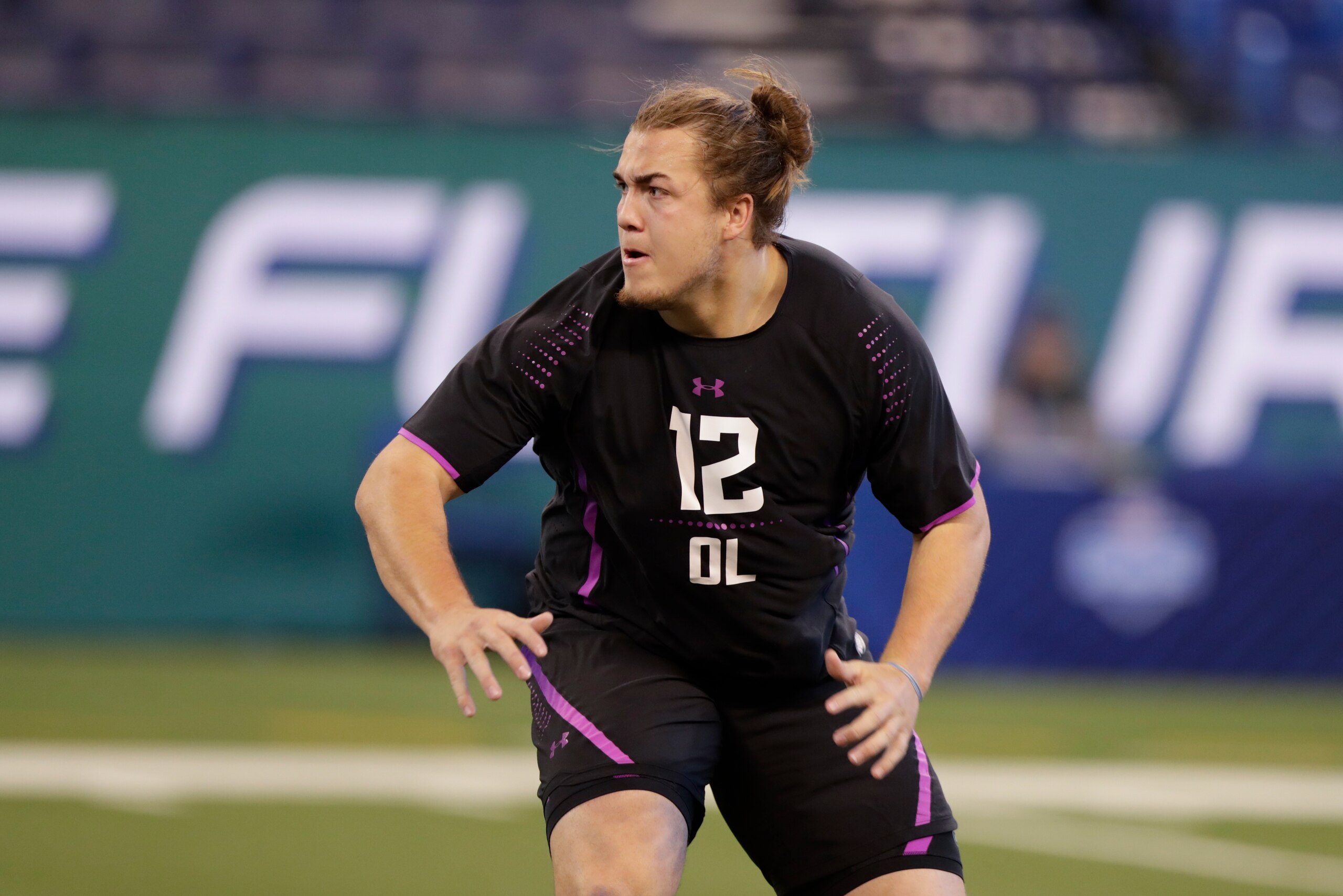
POSITIVES
—Early entry prospect with three years of starter's experience.
—Has quick feet that can mirror and redirect inside with pass-rushers.
—Displays good mental processing to counter pass-rush plans.
—Solid athlete who can get out in space and run.
NEGATIVES
—Plays high and is often bowed back by defenders who easily gain leverage.
—Doesn't have much of a backside and can't anchor versus power at any point in the rep.
—Opens hips early in the rep and struggles to stay square against speed.
—Locks on to targets and will drop eyes in pass protection, exposing the edge.
—Overwhelmed by power and can be beaten routinely.
—Scouts told us he's lazy and entitled.
OVERALL
Nick Gates has multiyear starting experience at a big program in Nebraska. NFL teams will bring him in to be a camp body based on that. If the 6'5", 307-pounder can build a sturdy lower body, he has a chance to challenge for a roster spot as a backup and potential swing tackle. His athleticism meets the requirements and can compensate for some of his deficiencies in the meantime.
GRADE: 5.25 (Priority Free Agent)
PRO COMPARISON: Antonio Garcia, New England Patriots
24. David Bright, Stanford
7 of 30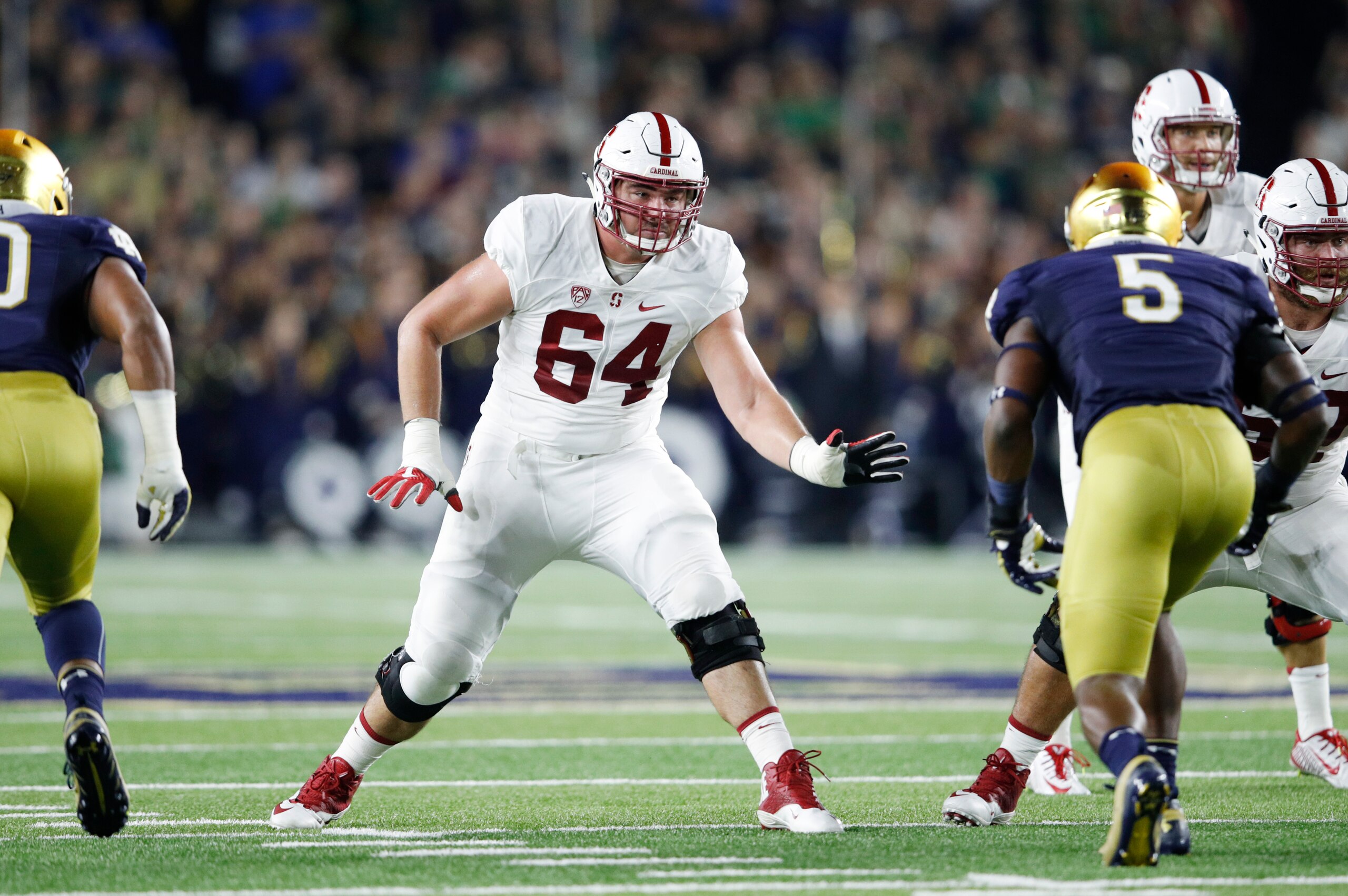
POSITIVES
—Lined up at tackle and guard for Stanford and has experience on both the left and right sides.
—Smart player who can identify angles toward second-level defenders.
—Combo blocks well with the hand placement to generate movement at the point of attack.
—Can disrupt the pass-rush plan early if he strikes with good timing.
—Doesn't quit in reps, even when he's lost. Will fight to try to regain control.
NEGATIVES
—Limited flexibility in ankles, knees and hips cause leverage balance concerns.
—Not a lot of weight in his lower half, and he'll struggle to routinely anchor against speed-to-power.
—Poor timing of strikes in pass protection allow speed to get on top of him in a hurry.
—Struggles to drive out of gaps because of a lack of weight in his lower body if his initial leverage is compromised.
—Doesn't latch on and ends up grasping for straws when beaten.
OVERALL
David Bright is an intelligent, versatile offensive lineman who can line up at almost any spot and give a team a handful of reps. He's the kind of player who makes a perfect eighth offensive lineman who can fill in at most spots in a pinch. He's a limited athlete without much weight in his lower body, which causes issues when digging out defenders at the point of attack. Bright is a training camp player and could make a practice squad with his ability to fill multiple roles.
GRADE: 5.30 (Priority Free Agent)
PRO COMPARISON: James Hurst, Baltimore Ravens
23. Greg Senat, Wagner
8 of 30
POSITIVES
—Basketball player with great length (84 ½" arms) and frame (6'6", 302 lbs).
—Upside prospect with athleticism to easily move at left tackle and reach defenders.
—Recovery agility is there to save a rep if he's beaten off the snap.
—Work ethic and drive looked good in all-star matchups.
NEGATIVES
—Limited experience; raw prospect.
—Has the lean, long frame of a basketball player and requires more bulk and strength.
—Defenders with strong hands can easily swat away his punch and get into his frame.
—Cannot anchor against pass-rushers with a bull rush. Plays too tall and doesn't have lower-body power.
—A waist-bender who will lose reps against any pass-rusher who can bend on the edge and get under his hands.
OVERALL
Greg Senat is a late-round "draft and stash" kind of player teams will look to develop into a starter. With so few prospects coming out of college ready to play in the pros immediately, Senat offers intriguing upside as an athlete at tackle.
GRADE: 5.30 (Priority Free Agent)
PRO COMPARISON: Laurent Duvernay-Tardif, Kansas City Chiefs
22. Brett Toth, Army
9 of 30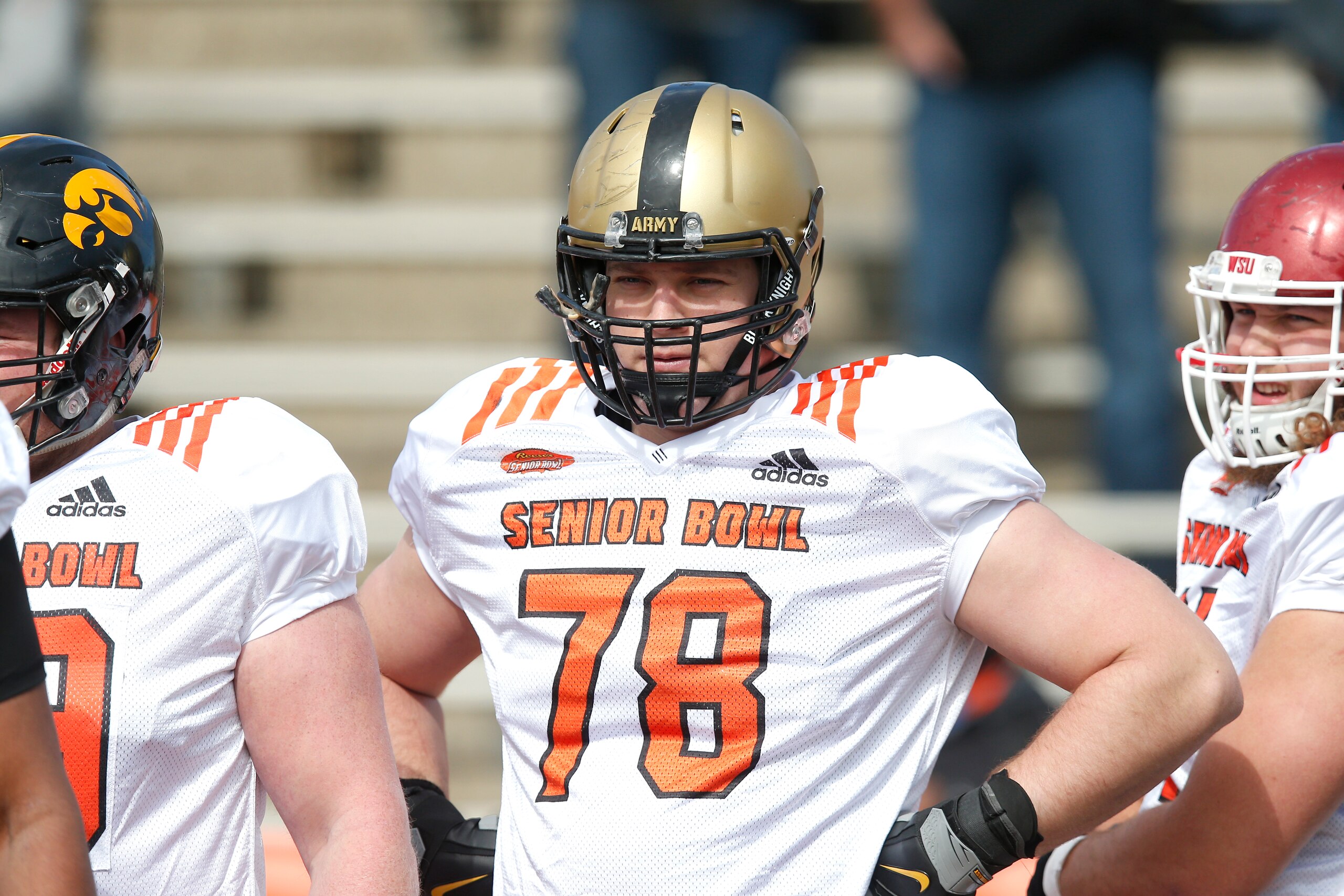
POSITIVES
—Long, lean frame (6'6", 291 lbs) that can pack on the necessary muscle to be an NFL starter.
—Developing pass protector who has the fundamental movement skills to match both power and speed.
—Army asks him to cut quite often, and he routinely is effective at neutralizing speed and defensive linemen's height.
—Good athlete who can open up and run in a zone scheme.
—Wins with tenacity.
NEGATIVES
—Undersized by pro standards and will need an NFL conditioning program to build his body.
—Army service requirements will delay his ability to join a team by two years.
—His kick-slide looks more like that of a player who's reaching his leg back to gain depth, not truly driving to half-man relationship.
—Struggles to keep his shoulders square in his slide and will give pass-rushers too many options early in rep.
—Limited number of true pass sets at Army.
OVERALL
Toth's NFL career may be put on pause thanks to Army service requirements, but the offensive tackle has the foundational frame and skills to make him worth waiting for. He's an above-average athlete and is a blank slate for an NFL team to shape into a quality starter. He'll have to put on weight and become a more consistent pass protector, but the fundamental traits are apparent.
GRADE: 5.55 (Round 6)
PRO COMPARISON: Kyle Murphy, Green Bay Packers
21. Zachary Crabtree, Oklahoma State
10 of 30
POSITIVES
—Three-year starter at right tackle for Oklahoma State.
—Tenacious as a down blocker with the thickness (6'7", 310 lbs) to wash defenders out.
—Thick body that looks suited for NFL physicality.
—Solid in combo blocks and understands when to disengage and work into second-level defenders.
—Patient in pass protection and willing to look for work.
NEGATIVES
—Unable to latch on to defenders and drive beyond the line of scrimmage; far too willing to stay in a stalemate.
—Slow, lethargic shuffle step in pass protection.
—Underwhelming athlete who will struggle to routinely handle reach blocks and blocks in space.
—Plodding mover who runs like it's a chore.
—Inconsistent base, beginning with his stance and progressing through both run and pass reps, causes balance issues that will be exploited in the NFL.
OVERALL
Zachary Crabtree has a beefy frame and should have no problem competing as a rookie. However, his lack of fluid athleticism is a concern and will limit teams' long-term expectations for him. With some of the NFL's best pass-rushers lining up over right tackles, Crabtree will have to become a more efficient mover if he expects to see legitimate playing time. Early on, he's nothing more than a depth piece.
GRADE: 5.60 (Round 6)
PRO COMPARISON: Matt Tobin, New England Patriots
20. Brandon Parker, North Carolina A&T
11 of 30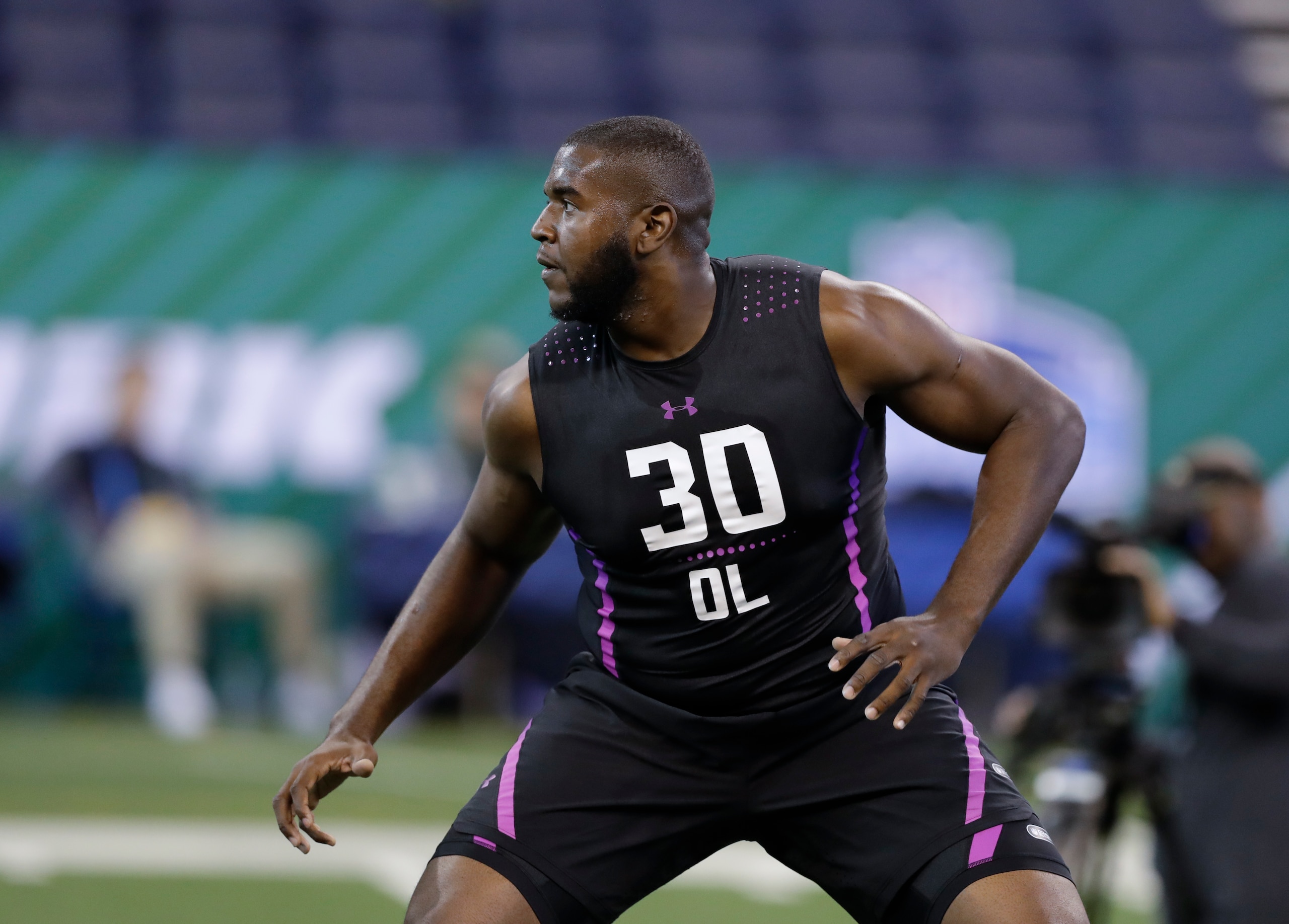
POSITIVES
—Long, lean athletic frame (6'7", 305 lbs) with 35-inch arms.
—Above-average athlete for a player of his height and size.
—Has the length to drive out of his stance in pass protection, which will transition to the pros.
—His hand positioning and usage maintain striking ability through the entire rep.
—Was a four-year starter and still hasn't maxed out ability.
NEGATIVES
—Mistimes punch in pass protection or won't let it go until it's too late.
—Lightweight trunk and will struggle to anchor against an NFL bull rush.
—Lack of flexibility in his hips and knees causes his height and leverage to become an issue when he can't rely on size.
—Is a high-cut prospect who plays with a thin base that leads to balance issues, particularly when countering defenders.
—Coordination looks underdeveloped, like he's still learning how to operate within his body.
OVERALL
NFL teams will look at Brandon Parker and see a long-armed, athletic tackle who, at worst, is the kind of blank slate to take a risk on. A four-year starter at North Carolina A&T, Parker has all of the fundamental skills to break into an NFL camp. He has some balance and coordination issues that can be coached out if a team is willing to work through his early struggles.
GRADE: 5.60 (Round 6)
PRO COMPARISON: Shon Coleman, Cleveland Browns
19. Colby Gossett, Appalachian State
12 of 30
POSITIVES
—Has the athleticism and physicality to compete in the NFL immediately.
—Starting experience at guard and tackle.
—Consistent starter who is an obvious leader.
—Fires off the ball well and looks for work inside in pass protection.
NEGATIVES
—Not a particularly coordinated player and will have balance issues.
—Adequate change-of-direction skills that show up as the pocket collapses.
—Odd punch timing that looks like it takes time for his brain to tell his hands to fire.
—Heavy-looking mover despite an athletic frame (6'5", 311 lbs).
—Once he engages, he leans instead of engaging his hips and driving through defenders.
OVERALL
Colby Gossett understands the offensive line well and has experience at both guard and tackle. He's shown all of the requisite skills to be a developmental player worth at least a practice squad role as a rookie. His transition will be largely dependent on his ability to become a more coordinated open-field mover.
GRADE: 5.70 (Round 5)
PRO COMPARISON: Jerald Hawkins, Pittsburgh Steelers
18. Toby Weathersby, LSU
13 of 30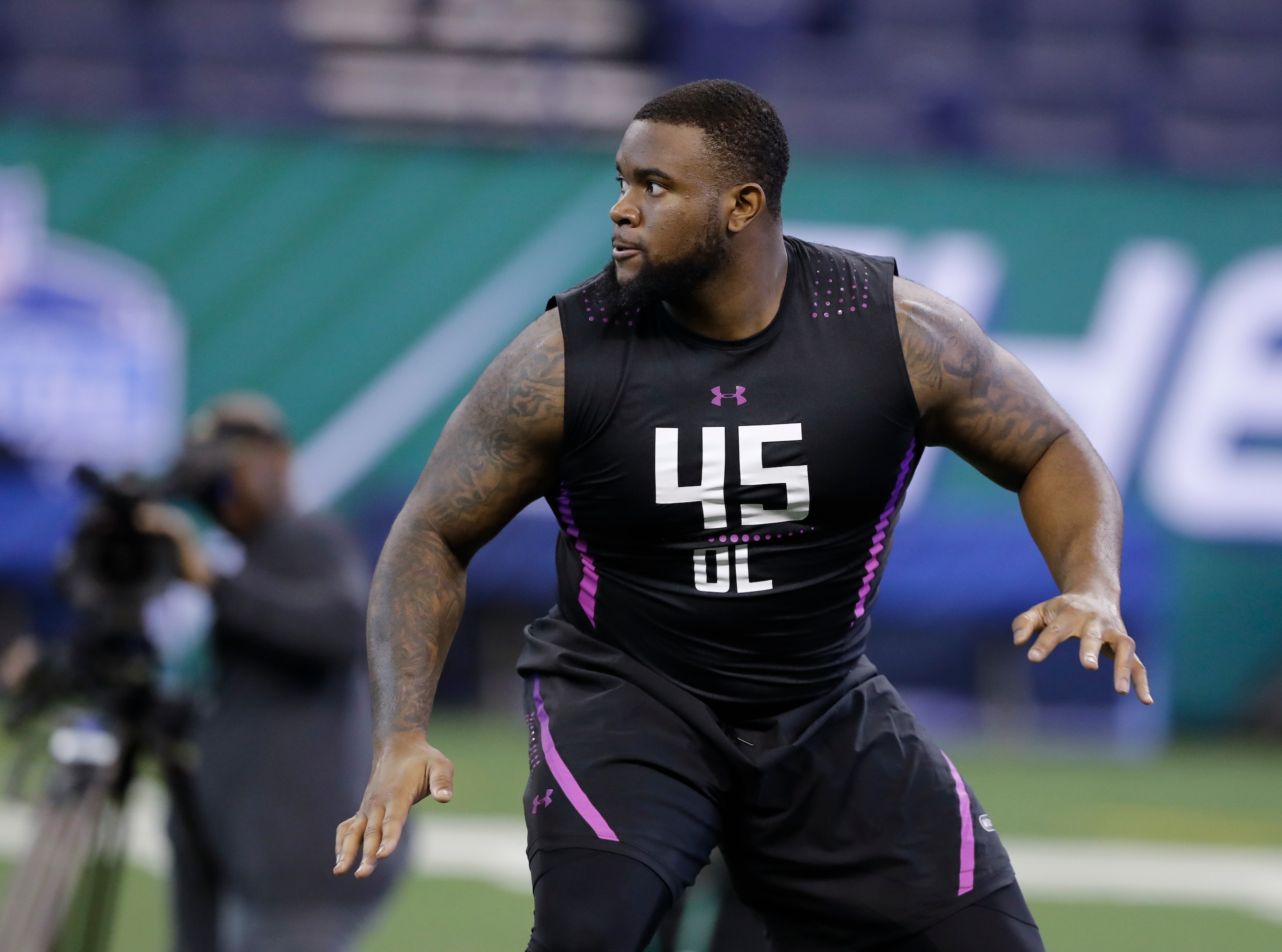
POSITIVES
—Keeps half-man relationship in pass protection consistently and is always in position to strike or counterpunch.
—Punch timing is solid, which helps disrupt pass-rush plans early in rep.
—Has feet like John Henry steel-drivers when he decides to play with power.
—Good lower-body mechanics in tight spaces that help gain leverage.
—Drives out of his stance with a purpose as a pass protector.
NEGATIVES
—Stops his feet upon contact and is willing to lean on players instead of driving them.
—Heavy-footed mover who struggles in space.
—Most of his weight is in his midsection; he lacks thickness in his lower body.
—His movements in pass protection look like someone who's counting his steps instead of playing with natural awareness.
—Doesn't have the eye-popping finishes you want to see from a player his size (6'5", 317 lbs).
OVERALL
Toby Weathersby looks the part of an NFL backup and has starter potential. He appears to be thinking too much on the field and treats every rep like a math problem. While his consistency is a benefit, the lack of fluidity to counter defensive linemen is an issue. Once Weathersby can play with a little less rigidity, he'll compete for playing time.
GRADE: 5.70 (Round 5)
PRO COMPARISON: Cam Fleming, Dallas Cowboys
17. Cole Madison, Washington State
14 of 30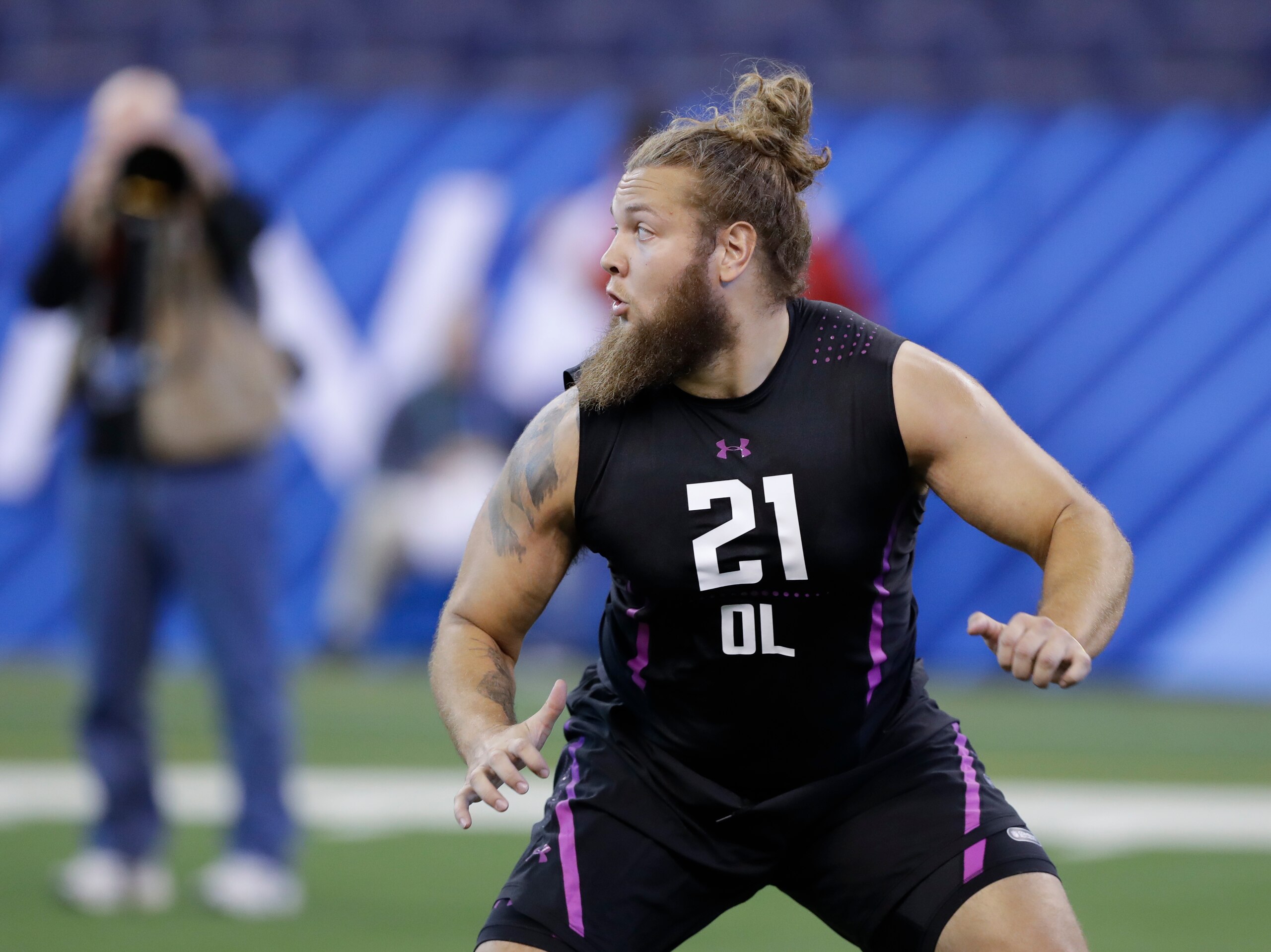
POSITIVES
—Drives out of his stance with efficiency to get into pass sets.
—Has an above-average quick set that can compensate for length issues (32 ¼" arms).
—Relentless worker who plays through the whistle.
—Athletic player who can move laterally on reach blocks with ease.
—Ability to match speed around the edge is impressive.
NEGATIVES
—Strength to anchor is a concern, and power opponents will exploit that.
—Tempo of Washington State's offense did him favors in minimizing his deficiencies.
—Arm length looks short and forces a late punch that won't hold up against NFL defenders.
—Doesn't have the strength to drop his weight and anchor but also plays with poor balance and leverage; he's making it harder on himself than it needs to be.
—Lunges as a last resort, which only accelerates his losing the rep.
OVERALL
Cole Madison will excel in an offense that utilizes an outside-zone scheme and lets his athleticism shine. A move to guard may best serve him, but a lack of lower-body strength and power will have to be addressed regardless. His quick set is incredibly efficient and can mask some of the concerns that come from a lack of arm length and ability to anchor against built-up power.
GRADE: 5.80 (Round 4)
PRO COMPARISON: Joe Thuney, New England Patriots
16. Ike Boettger, Iowa
15 of 30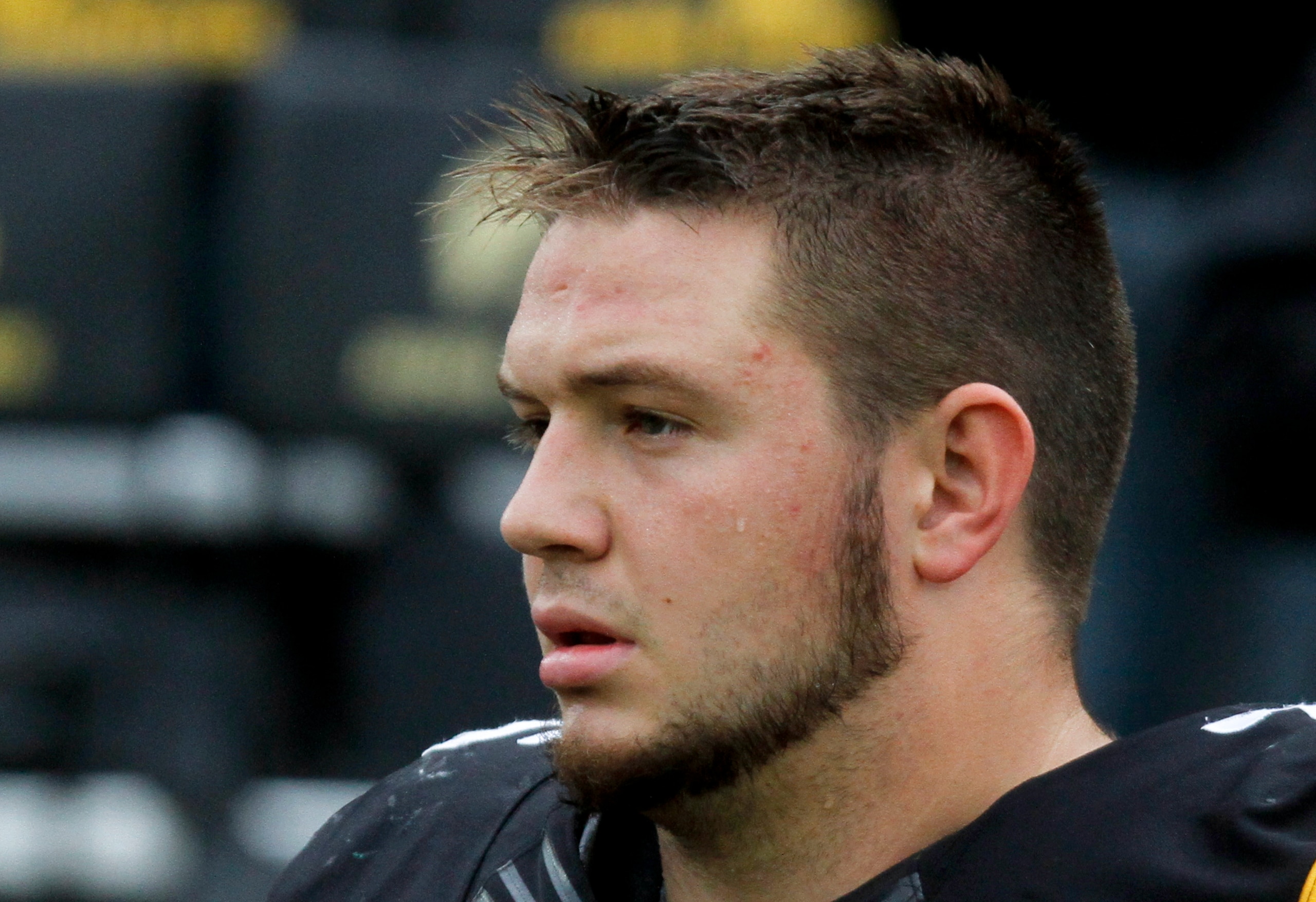
POSITIVES
—Versatility to play either tackle spot or to move inside to guard.
—Looks like an NFL tackle with a muscular frame (6'6", 310 lbs) and barrel chest.
—Good mental processing to help identify second-level defenders on combo blocks.
—Power and tenacity to be effective in a gap scheme.
—Long arms that help run speed around the pocket's edge.
NEGATIVES
—Achilles injury in 2017 and a high-ankle sprain in 2015 may cause concern over his long-term availability.
—Hand strength looks below-average as he rarely latches on and sustains blocks at the second level.
—Limited athleticism and fluidity that is apparent in vertical pass sets.
—He's a leaner in the run game and will have balance issues against NFL defensive linemen.
—Lumbering mover when primary target is second-level defender.
OVERALL
Ike Boettger benefits tremendously from the fact that Iowa churns out quality offensive linemen every year. With an athletic frame and long arms, he looks like a starting NFL lineman already. Athletic limitations may prompt teams to give him a shot at guard, where his experience and versatility can shine. If he can hold up for an entire NFL season, Boettger has the foundational traits to be a depth player early in his career while pushing for starting time.
GRADE: 5.80 (Round 4)
PRO COMPARISON: Mike Remmers, Minnesota Vikings
15. Jamil Demby, Maine
16 of 30
POSITIVES
—Four-year starter with plenty of experience.
—Quick feet given his size at 6'5", 335 pounds.
—Solid reach blocker who can latch on and bring his hips behind him to generate movement on the edge.
—Puncher's mentality and throws strikes early and often.
—Good awareness and recognition to identify targets at the second level.
NEGATIVES
—Is heavy and lacks the functional flexibility to drop his hips and win leverage battles consistently.
—Wants to strike first and will end up lunging at targets who can keep their distance.
—He's a pusher more than a latch-on-and-drive-type of run-blocker.
—Strikes wide and high far too often and will lose to technicians with good hand usage.
—Can't redirect weight with agile linebackers in space.
OVERALL
Jamil Demby played well at the Senior Bowl and handled most of his one-on-one reps with the consistency NFL teams want to see. He's a big tackle and has the weight to excel in a gap scheme. He'll have to become a more functional bender and pair flexibility and mobility with some of the heavy-handedness that he likes to insert into his playing style.
GRADE: 5.85 (Round 4)
PRO COMPARISON: Morgan Moses, Washington Redskins
14. Alex Cappa, Humboldt
17 of 30
POSITIVES
—Relentless finisher who looks to dominate every play.
—Size (6'6", 305 lbs), strength and length (32 ⅝" arms) all meet the NFL thresholds.
—Solid athlete who can utilize different pass-set techniques with ease.
—Has the change-of-direction skills and balance to mirror pass-rushers in space.
—Has a powerful punch and looks to abuse defensive linemen with it or latch on early in rep.
NEGATIVES
—There's competition concerns out of Humboldt State versus what he'll see in the NFL.
—Relies on pure talent, and his technique gets sloppy as a result.
—Has a tendency to fire his hands later than he should and can lose reps early.
—He'll struggle to set at the same rate as speed rushers on the edge and may be asked to move to guard to compensate.
—Heavy, chest-forward lean at times that veteran defenders who can manipulate balance will expose.
OVERALL
Alex Cappa will have to answer questions about the level of the competition he faced at Humboldt State. As such, the California native is training with offensive line guru LeCharles Bentley in Arizona to continue developing. Cappa meets all of the size requirements of an NFL offensive tackle and has the mindset of an aggressive finisher. A move to guard may be on the docket for him, but there's no doubt he's worth a middle-round selection.
GRADE: 5.90 (Round 4)
PRO COMPARISON: David Bakhtiari, Green Bay Packers
13. Desmond Harrison, West Georgia
18 of 30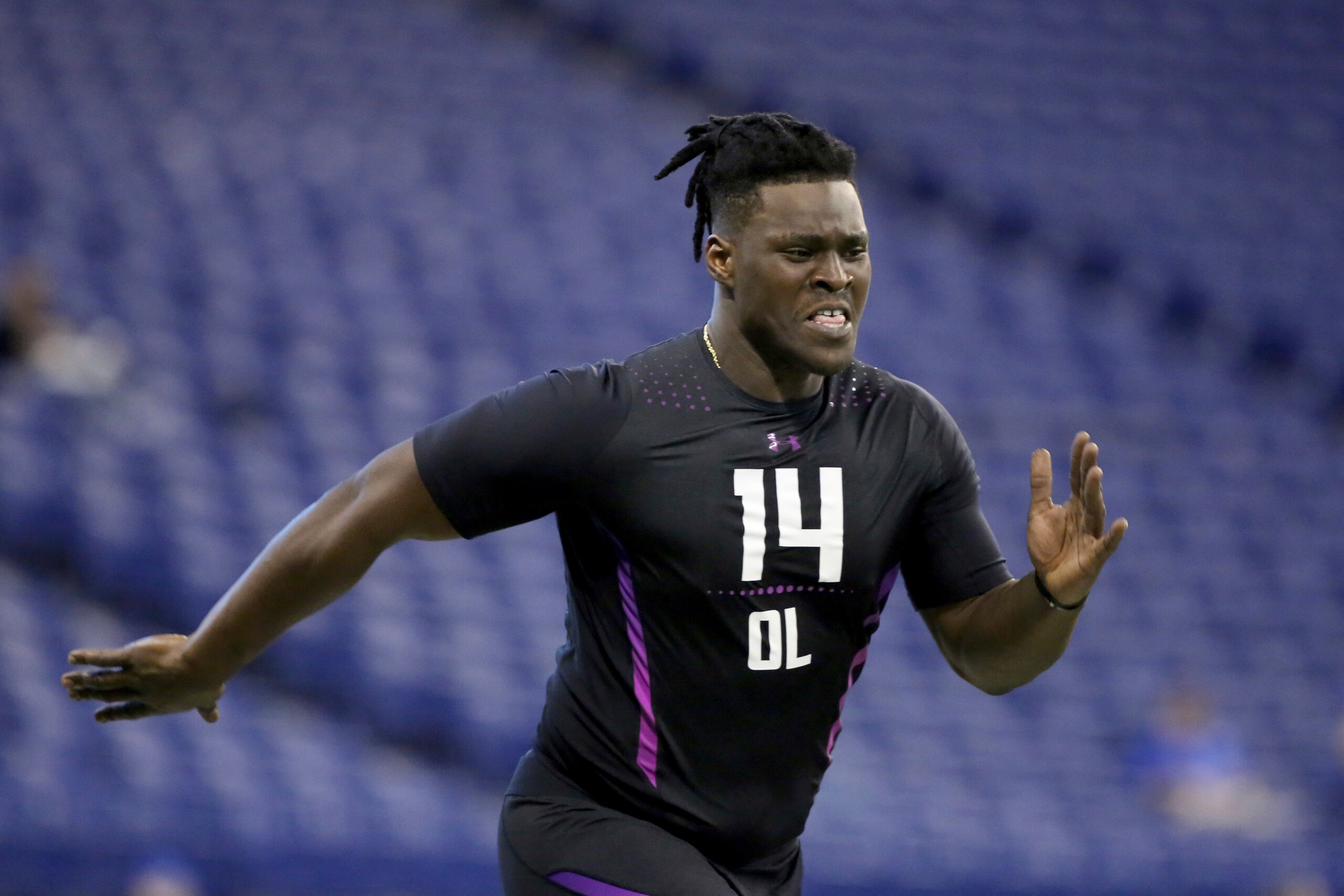
POSITIVES
—A natural athlete with excellent quickness to match elite length (34" arms, 10 ⅜" hands).
—Man-handled competition at West Georgia and showed the mean streak and finisher's mentality teams want in a prospect.
—Can make every block and shows excellent movement skills. Reach blocks look easy for him. Beautiful flexibility and burst.
—Prototypical recovery athlete. Can reset if beaten off the line and easily cuts off pass-rushing lanes.
—His ceiling is the highest of any tackle in the class. If a team can tap into his potential, he's a long-term answer on the left side.
NEGATIVES
—Weighed just 292 pounds at the combine and comes with legitimate concerns about his ability to hold weight.
—Bounced around between three high schools and three colleges. Was a JUCO player, signed at Texas, was dismissed after Charlie Strong suspended him twice for violating team rules, spent two years away from the game then signed at West Georgia.
—Will be a 25-year-old rookie.
—A redshirt-type of player who is at least one year away from seeing the field due to his lean frame and raw technique.
—Has excelled on athleticism and has never been tested by elite competition.
OVERALL
The 6'6" Desmond Harrison looks like a potential All-Pro tackle on tape, but then you factor in the off-field issues, his age, his lack of size and the time it'll take to get him up to speed with an NFL playbook and he becomes less of a sure thing. He's a risky prospect with a potentially huge payoff.
GRADE: 5.99 (Round 4)
PRO COMPARISON: Julien Davenport, Houston Texans
12. Will Richardson, NC State
19 of 30
POSITIVES
—Excellent right tackle measurements (6'6", 306 lbs, 35 ¼" arms) with a thick frame and mass throughout.
—Didn't allow a sack or quarterback pressure during the 2017 season.
—Dropped weight for the combine and made major improvements to his body after appearing soft on tape.
—Improved quickness showed up on film when compared to his 2016 tape. He gets to the second level well, and he better executed reach blocks.
—Easy, smooth footwork in both the run and pass game.
NEGATIVES
—Suspended two games during 2017 season for marijuana-related issues.
—Charged with DWI in 2015.
—Can be stiff-hipped and doesn't always get great leverage in the run game. Quick, flexible pass-rushers can also dip and get under his hands.
—Zone schemes might give him fits initially until he works on his steps. He's not a natural athlete and doesn't move well laterally.
—Scouts told us he'll be slow to develop.
OVERALL
Will Richardson has the tools to become a starting right tackle if he can steer clear of his past mistakes. Teams will have to vet his background, but if he's all-in, he could be a value pick early on Day 3.
GRADE: 5.99 (Round 4)
PRO COMPARISON: Eugene Monroe, retired
11. Chukwuma Okorafor, Western Michigan
20 of 30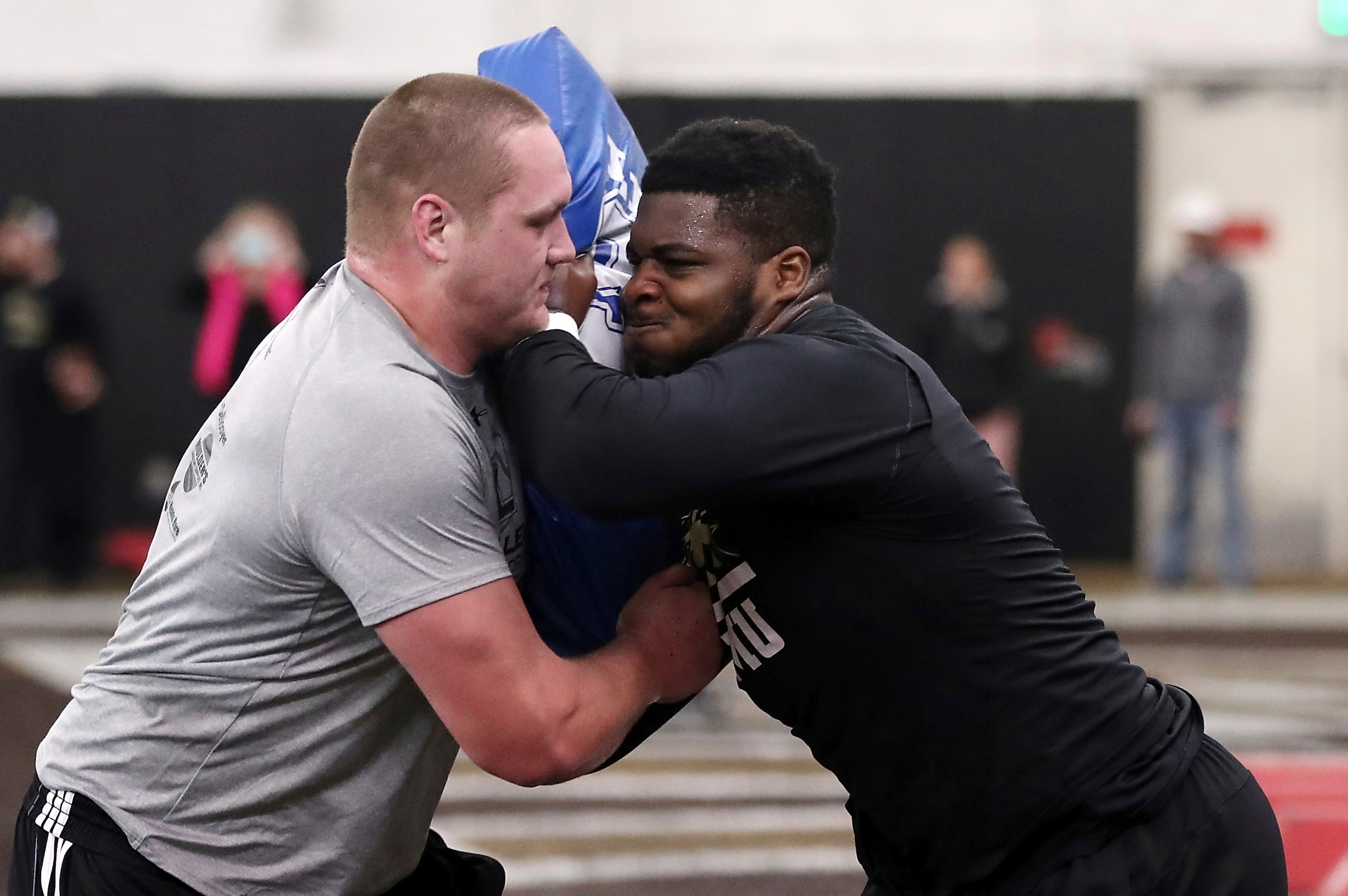
POSITIVES
—Massive frame (6'6", 320 lbs) with excellent power in his trunk and the size to road-grade defenders.
—In the run game, he can body defenders and shows strong grip strength to lock on and drive.
—Has impressive leverage out of his stance and doesn't play too tall for a 6'6" blocker.
—Anchors well and protects his inside shoulder by using his length (34 ½" arms) and size to shut down pass-rushing lanes.
—Has experience playing both left and right tackle and shows the power to play guard.
NEGATIVES
—Can get his feet crossed in space and will get worked when set up hard to the outside and forced back inside.
—Doesn't always play to his size and can be timid against better competition.
—Has excelled on size and doesn't show great poise or instincts. Double-moves will ruin his day. Hasn't faced many complete pass-rushers.
—Doesn't look coordinated or athletic in space. Might be best as a guard in a power scheme.
—Had a rough Senior Bowl week when facing pass-rushers who could set up and win with speed. His technique and high posture in pass sets got exposed.
OVERALL
Chukwuma Okorafor immigrated to the U.S. just eight years ago and is still developing. Teams will like his massive size, power and ability to dominate defenders when he locks up with them. He might be a right tackle in the pros but has starter traits.
GRADE: 6.00 (Late Round 3)
PRO COMPARISON: Marcus Cannon, New England Patriots
10. Orlando Brown, Oklahoma
21 of 30
POSITIVES
—His quick set is efficient and takes away pass-rushing lanes early in the rep.
—Is massive at 6'8" and 345 pounds with arms like fire hoses (35").
—When he's first to punch and locks his arms out, it's game over for defenders.
—Throws his weight around behind everything he does and can grind down defenders by the fourth quarter.
—His pass sets are effective and, at worst, create a deep pocket for quarterbacks to step into as Brown moves defenders around.
NEGATIVES
—Limited lateral agility shows up in reach technique.
—Technique in down blocks is poor, as he just leans his body on defenders rather than driving through them.
—Athletic testing caused major concern about his ability to compete consistently with NFL talent.
—Misjudges angles at the second level and often overruns targets or is beaten with agility in tight spaces.
—Quick defenders who can beat his arm length and get under his pads early can win reps consistently.
OVERALL
Orlando Brown's athleticism will always be a concern for a player of his size. He's a mountain, but the mobility and flexibility to handle NFL athletes is lacking and will have to be compensated for with sheer size and force. Brown's pass sets are surprisingly smooth and show flashes of a promising player who can develop into a quality starter. He's a project who, with good coaching, could become a starter soon.
GRADE: 6.00 (Late Round 3)
PRO COMPARISON: Trent Brown, San Francisco 49ers
9. Joseph Noteboom, TCU
22 of 30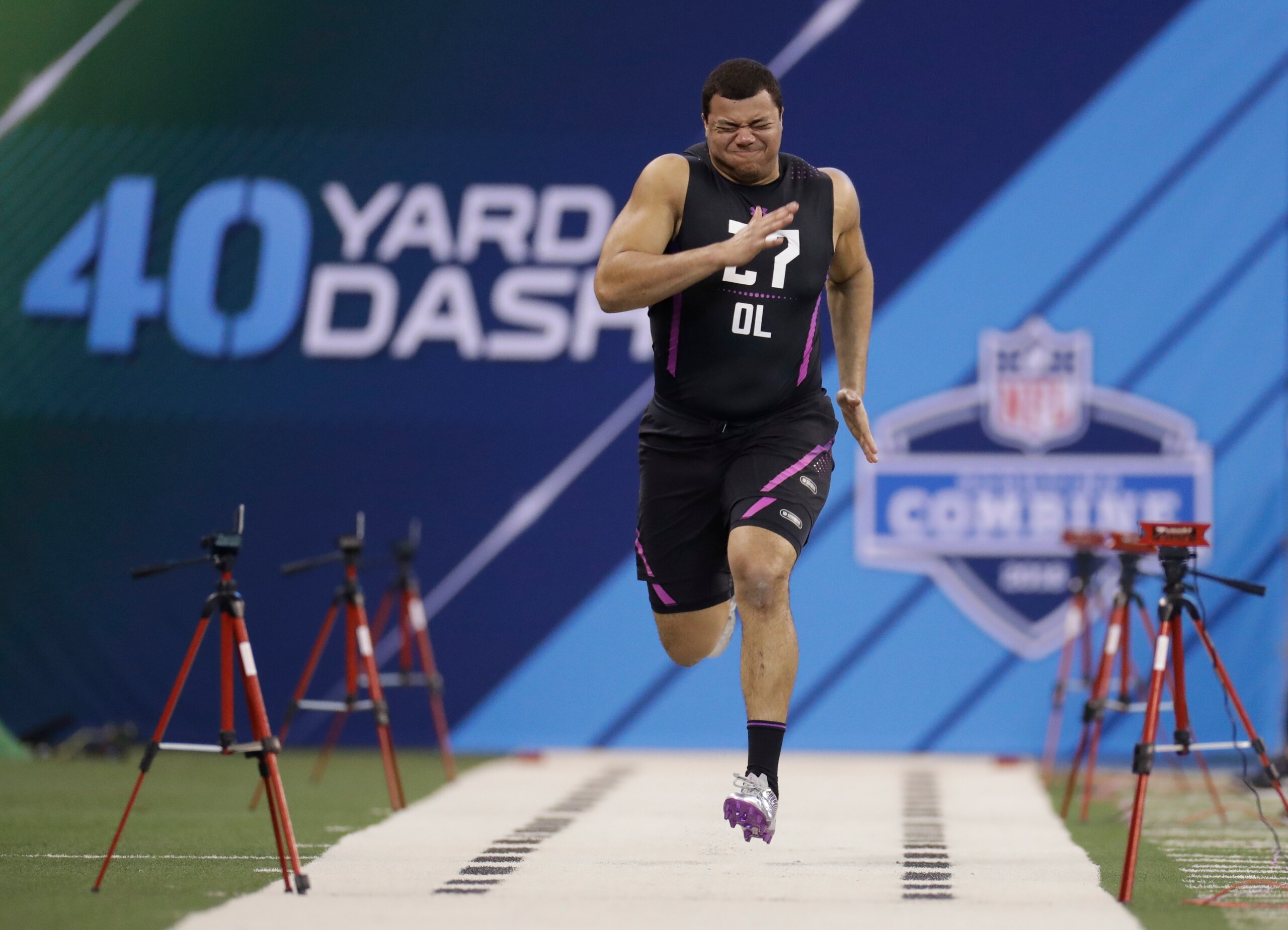
POSITIVES
—Has four years' worth of playing time—including one season at right tackle before he moved to the left for the 2016 and 2017 seasons.
—Good athlete who has experience pulling in space.
—Shows variability in his pass sets, which can counteract diverse pass-rushers.
—Drives out of combo blocks with intention and can locate second-level defenders well.
—Encouraging performance at Senior Bowl.
NEGATIVES
—Struggles to handle speed as a reach blocker and work laterally.
—Raw power from defenders overwhelms him and stuns him early in reps.
—Punch timing is inconsistent and creates spacing issues while he's handling stunts along the defensive line.
—Lazy to explode out of his stance when getting into vertical sets that force him to open early.
—Shows inconsistent effort working down the line of scrimmage, which ruins edge runs.
OVERALL
Joseph Noteboom has all of the size (6'5", 309 lbs) and athleticism NFL teams want to see. The foundational skills are enough to make him a middle-round selection with the possibility he'll develop into a high-quality starter. Noteboom doesn't have the strength or leveraging technique for a move to guard, but he could become a productive right tackle.
GRADE: 6.25 (Round 3)
PRO COMPARISON: Garry Gilliam, San Francisco 49ers
8. Martinas Rankin, Mississippi State
23 of 30
POSITIVES
—Above-average mental processing to identify run-blocking angles at the second level.
—Sudden, violent punch that can stun defenders of all sizes.
—Secondary plans as a pass protector are solid and show an ability to counter defenders.
—Gets out of his stance in a hurry and with a purpose.
—Patient upper body in pass protection to handle inside moves and keep the edge clean.
NEGATIVES
—Doesn't have the pass-set fluidity to be a legitimate tackle against edge speed.
—Leverage is an issue that bull-rushers who can get under his pads early will expose.
—Wide puncher who opens up his chest and disrupts balance throughout pass sets.
—Hand strength is a problem in both phases as he routinely struggles to latch on and drive or dominate.
—Doesn't have the type of routine nasty blocks that other tackles in this class do.
OVERALL
Martinas Rankins' effort in pass protection highlights a patient player who works with intent and can counter defenders throughout the rep. He'll struggle to compete against speed around the corner and may be asked to move inside to guard as a result. Rankins' violent punch and ability to stun defenders help to counteract some of the leverage issues and give him the ability to latch on to defenders for the nasty downfield finishes NFL teams love.
GRADE: 6.45 (Round 3)
PRO COMPARISON: Cedric Ogbuehi, Cincinnati Bengals
7. Brian O'Neill, Pitt
24 of 30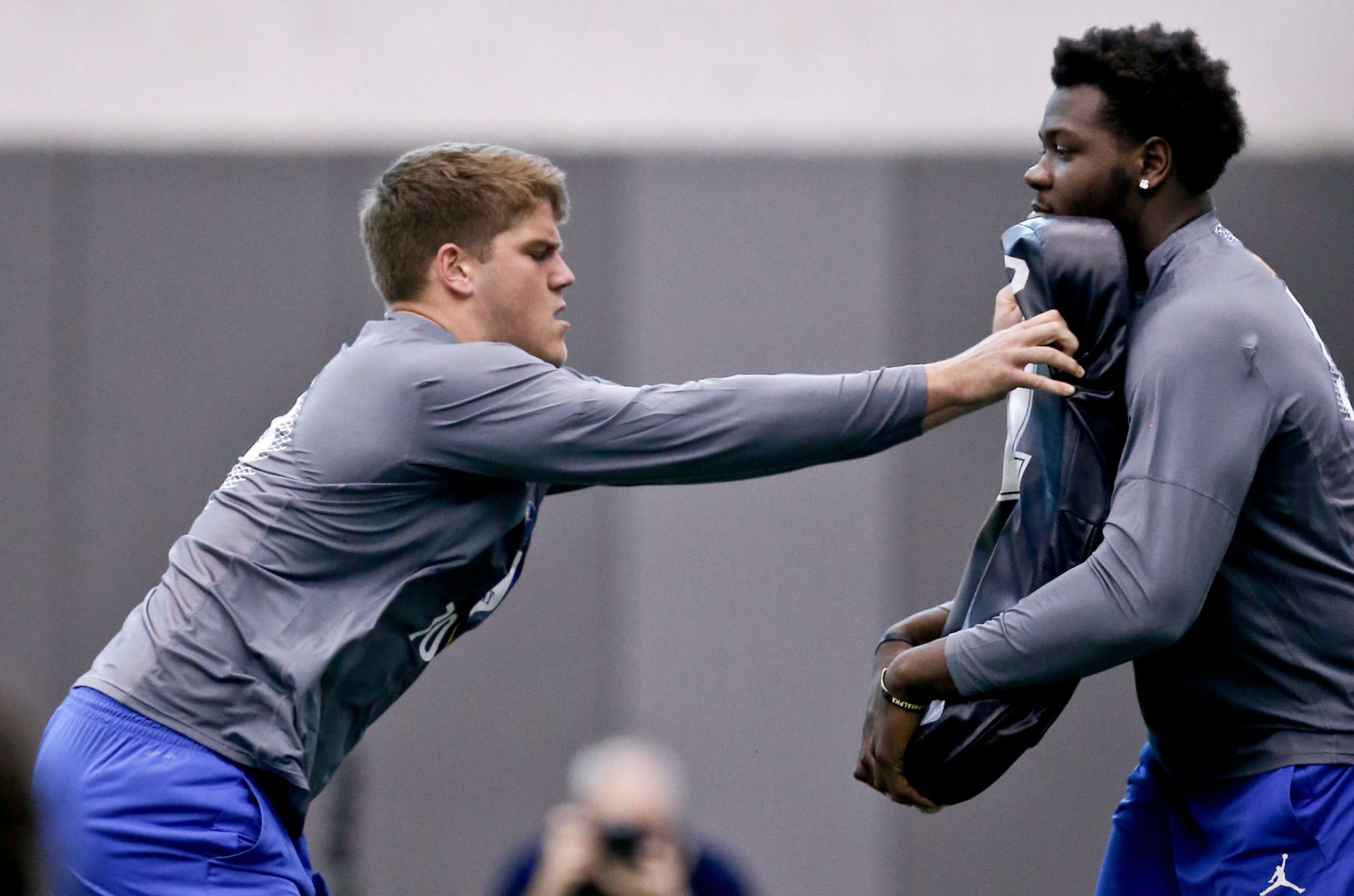
POSITIVES
—Ideal size (6'7", 297 lbs) with excellent athleticism and movement skills.
—Tailor-made for a zone scheme with his ability to pull and execute reach blocks.
—Measured with 34 ⅛-inch arms and uses those well to keep rushers off his frame and to create a wide arc in his pass sets.
—Shows the instincts to read and react to blitzes and stunts.
—Positionally versatile and could play either tackle spot or be kicked inside to guard.
NEGATIVES
—Struggled with technique and power throughout Senior Bowl practices.
—Lean frame needs to be filled out and strength concerns were highlighted in Mobile, Alabama.
—Bull-rushers will put him on skates and easily drive him back into the pocket.
—Opens up his hips in his pass set and creates a wide-open door for pass-rushers to double-move him.
—Isn't a poised or patient blocker. He shoots his hands too soon and looks panicked against speed.
OVERALL
Brian O'Neill has nice potential as an athletic zone tackle, but there are legitimate concerns regarding his tape and what we saw at the Senior Bowl. Heading into the week in Mobile, he was billed as a potential top-50 player, but struggles there will hurt his stock on draft weekend. A weak tackle class could still push O'Neill into the second round, though.
GRADE: 6.50 (Round 2-3)
PRO COMPARISON: Cedric Ogbuehi, Cincinnati Bengals
6. Geron Christian, Louisville
25 of 30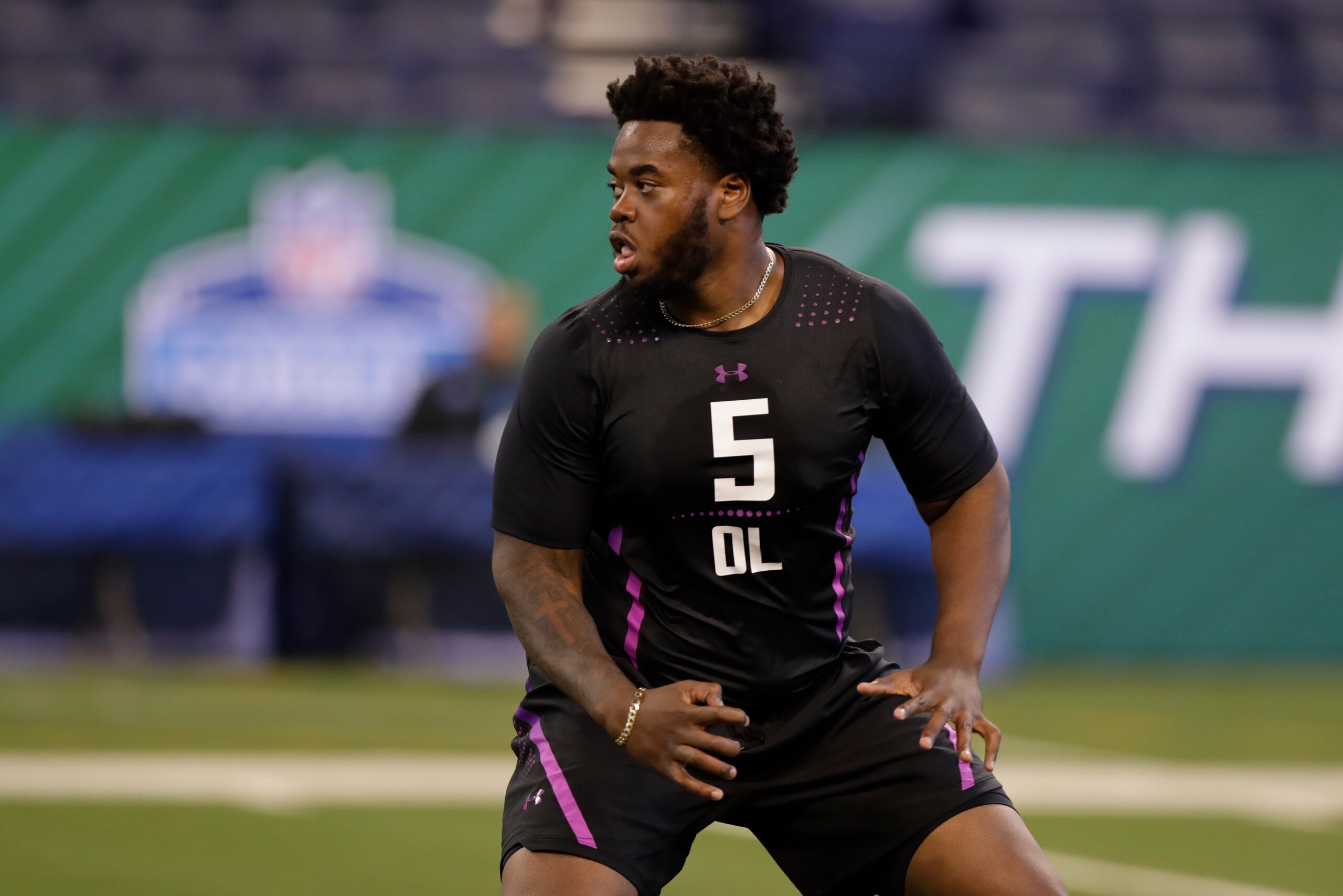
POSITIVES
—Three-year starter at Louisville with impressive length (35" arms) and athleticism who flipped sides during games.
—Agile as a pass-blocker and shows the patience and poise to handle versatile pass-rushers without lunging, shooting his hands too early or back-bending.
—Shows natural instincts and athleticism for the position and has day-one starter upside.
—Good size (6'6", 298 lbs) with the length and hand size (10 ¾") to impress on the hoof. He's a plug-and-play prospect from a size and athleticism standpoint.
—Smooth operator in his footwork. He slides and mirrors easily and can keep up with outside speed or kick inside to stop power.
NEGATIVES
—Average strength (19 reps on the bench press) shows up on film and in testing and might be his breaking point. Versatile pass-rushers can set him up and walk him back.
—Doesn't lock on and drive defenders out in the run game. He's more of a passive run-blocker.
—Can be late to open his toolbox and attack pass-rushers. He's almost too patient.
—Christian's punch is inconsistent in terms of timing and accuracy.
—More of a potential-based technician and will need to dedicate himself to working on his hands.
OVERALL
A team sold on Geron Christian's athleticism might be able to get him onto the field right away if his technique can be adjusted on the go. He has the length, quickness, footwork and agility that's hard to find at the position, but he has to add strength and remedy technical issues in his timing.
GRADE: 6.70 (Round 2)
PRO COMPARISON: D.J. Humphries, Arizona Cardinals
5. Tyrell Crosby, Oregon
26 of 30
POSITIVES
—A mean, massive tackle (6'5", 309 lbs) with the power to dominate players at the point of attack.
—Big, strong hands that he uses well to control defenders.
—Thick-framed tackle with the strength to push defenders around and anchor well against power rushers.
—Tough player in the run game and a finisher when he gets his hands on defenders.
—Unreal arm length (35 ¼") and hand size (10 ¾").
NEGATIVES
—Can be clunky coming out of his stance and struggles in space.
—Doesn't look the part coming off his first level and getting to linebackers.
—Burst is less than you'd like from a starting left tackle.
—Is scheme-limited. Doesn't have great movement skills and might be best in a power scheme only.
—Oregon offense does not translate to the NFL; will need a lot of work developing his technique.
OVERALL
Tyrell Crosby's tape is a blast to watch because of his power and how mean he is in the run game, but there are concerns about his flexibility in the passing attack. The right team could get a steal with him, though, if it's patient in developing his skills.
GRADE: 6.85 (Round 2)
PRO COMPARISON: Cordy Glenn, Cincinnati Bengals
4. Jamarco Jones, Ohio State
27 of 30
POSITIVES
—A two-year starter with experience in all four seasons at Ohio State.
—Incredible arm length (35 ⅛") that he uses well to keep pass-rushers off his body.
—Plug-and-play technique. He has excellent timing and awareness and is poised in pass protection with a well-timed punch.
—Excellent power to sit down and stop bull rushes.
—Slides well and can mirror against speed.
NEGATIVES
—Undersized for a tackle at 6'4" and 299 pounds.
—Did not test well at the combine and opted to not participate in the Senior Bowl.
—Hips look locked in the run game.
—Can be impatient and throws his hands too soon.
—Might be maxed out physically.
OVERALL
Jamarco Jones won't flash on tape as a great athlete, and he didn't dominate at the combine, but he's one of the draft's more solid blockers. Jones comes from a pro-ready blocking system, and he's spent the offseason working with Bentley to improve his technique even more. His length and technique will add up to make him a day one starter.
GRADE: 6.90 (Round 2)
PRO COMPARISON: Dion Dawkins, Buffalo Bills
3. Kolton Miller, UCLA
28 of 30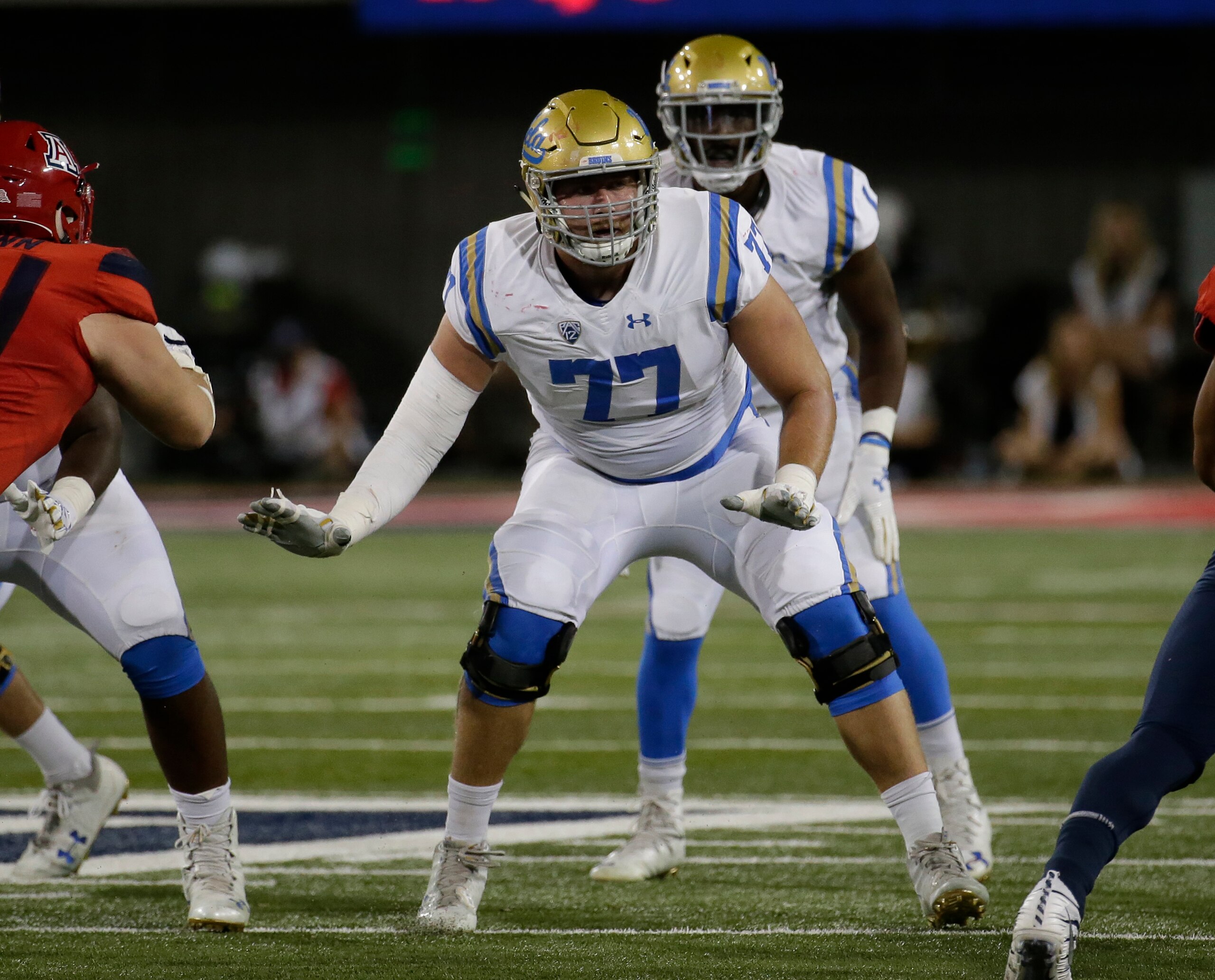
POSITIVES
—Impressive all-around athlete who won the combine with a 4.95-second 40-yard dash, 31 ½-inch vertical jump, 10-foot, 1-inch broad jump, 7.34-second three-cone drill and 4.49-second short shuttle.
—Started at right tackle as a freshman and sophomore before moving to left tackle in 2017.
—Strong puncher with excellent arm length (34 ⅛") and timing in his hands.
—Quick, smart processor who plays with patience and poise in the passing game.
—Has the power to drop his weight and shut down bull-rushers.
—Has the hands (10 ¾") to lock on and handle defenders.
NEGATIVES
—Might be too tall at 6'9" and struggles to drop to get under bending edge-rushers' pads.
—Lean frame that could hold more mass (309 lbs), and he needs to add to it.
—Speed rushers show the stiffness in his game.
—Is raw and needs to develop his run-game technique while adding strength.
—Despite long arms, he lets defenders into his frame.
OVERALL
Kolton Miller needs to be developed on the go. He isn't a plug-and-play left tackle and may end up at right tackle. He does bring technique, size and athleticism, and that's good enough to get a look late in the first round.
GRADE: 6.99 (Round 2)
PRO COMPARISON: Eric Fisher, Kansas City Chiefs
2. Mike McGlinchey, Notre Dame
29 of 30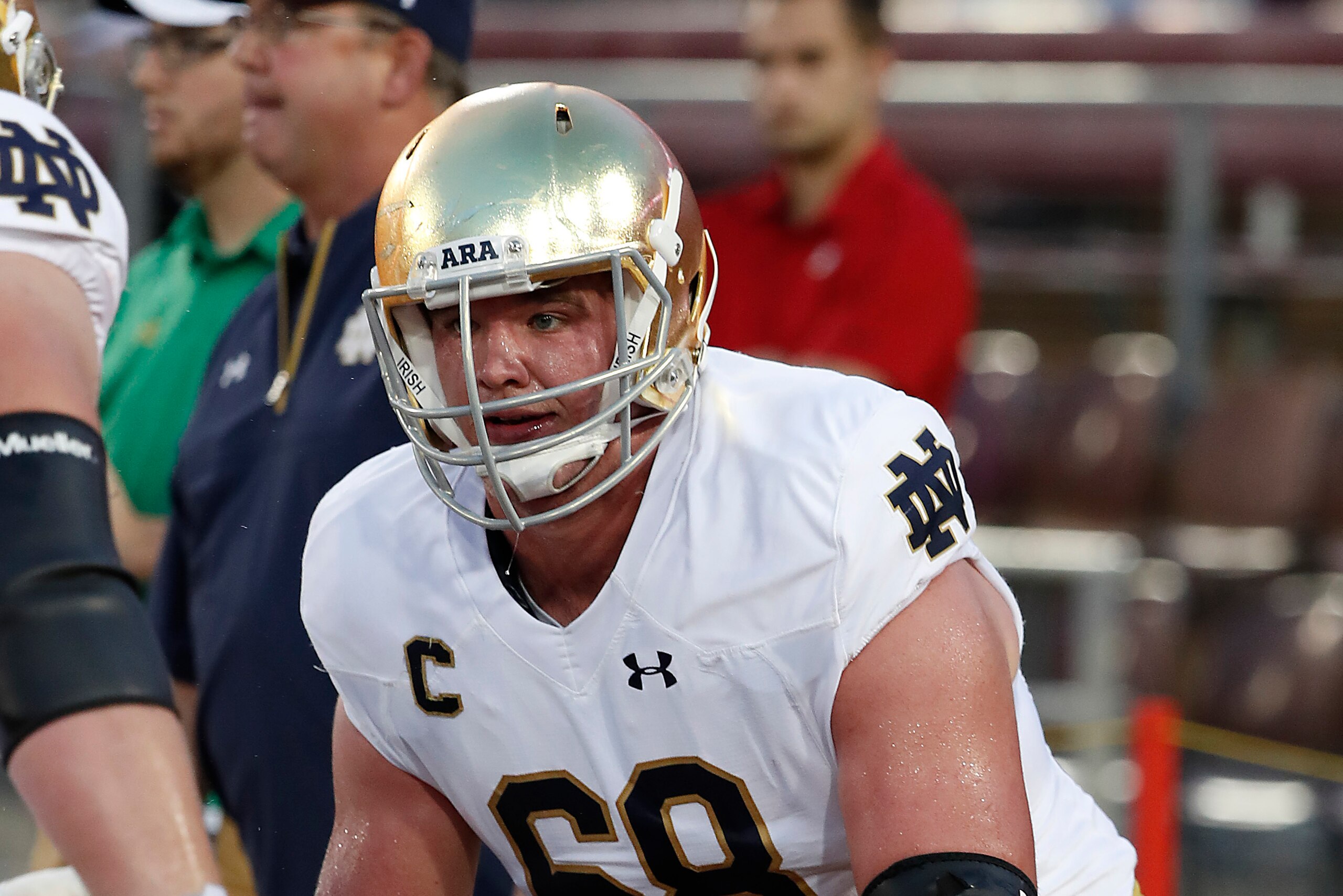
POSITIVES
—A four-year contributor who has two years' experience at each right and left tackle
—A smart technician who handles angles and timing well; knows when to shoot his hands.
—Naturally athletic hips and feet allow him to mirror and slide in the passing game.
—Plays with hip and knee bend and can squat and punch.
—Well-coached technician in the passing game; times his punches well; impressive awareness.
—Plug-and-play-type starter at right tackle.
NEGATIVES
—Struggled with speed rushers against Georgia and Miami.
—Doesn't bend well and has a hard time getting leverage in the run game at 6'8".
—Play strength can be average at times.
—Doesn't play with a mean streak.
OVERALL
Mike McGlinchey has issues (needs to add strength, needs to bend better in the run game) but is an excellent pass-blocker. He requires almost no projection because Notre Dame's scheme transitions so well to the NFL. That will add value to his name in an era where offensive line play is so bad.
GRADE: 7.00 (Round 1)
PRO COMPARISON: Jack Conklin, Tennessee Titans
1. Connor Williams, Texas
30 of 30
POSITIVES
—A naturally gifted, fluid athlete with explosive tape in pass protection and the run game.
—Bends well and has the flexibility to handle speed rushers off the edge.
—Day one impact in the passing game and has smooth movement to protect the corner.
—High-level instincts and awareness. His tape shows a high football IQ.
—Excellent in space, where his athleticism and agility show up.
—Showed post-knee injury in 2017 that he can play mean and bury pass-rushers.
—Will be 20 years old when drafted.
NEGATIVES
—Missed half the season in 2017 because of the knee injury (no surgery required).
—Arms measured at just 33 inches with a wingspan of 77 ⅞ inches. Both are low for tackles.
—Multiple scouts we spoke with suggested a move to guard, ala Zack Martin.
—Weighed in under 300 pounds at the combine (296 lbs).
—Play regressed in 2017 before injury.
OVERALL
Heading into the 2017 season, it looked like Connor Williams would be a top-10 pick. A rough game against Maryland and a September injury against USC changed that perception, but his technique is still the best of anyone in the class, and he's a top-tier athlete. His arms might be a little short for some teams, but he should be the first tackle drafted.
GRADE: 7.10 (Round 1)
PRO COMPARISON: Joe Staley, San Francisco 49ers
.jpg?w=2560 "Browns Camp Football")


.png?w=2560 "JB Threw Phone After Trade 😳")