

$210M Ace Max Scherzer Has Passed Clayton Kershaw as MLB's No. 1 Pitcher
The Washington Nationals signed Max Scherzer for $210 million in 2015. Two years and change later, that looks like money well spent on the best pitcher in Major League Baseball.
If you're reading this and your name is Clayton Kershaw: Sorry, but it's true.
Kershaw has been atop the pitching world for so long that such a stance ought to be outrageously controversial. Instead, it's becoming less so every fifth day.
TOP NEWS

Every Team's Biggest Offseason Decision 🧐
Judge Has Lower Leg Tightness

Mets player calls out own fans
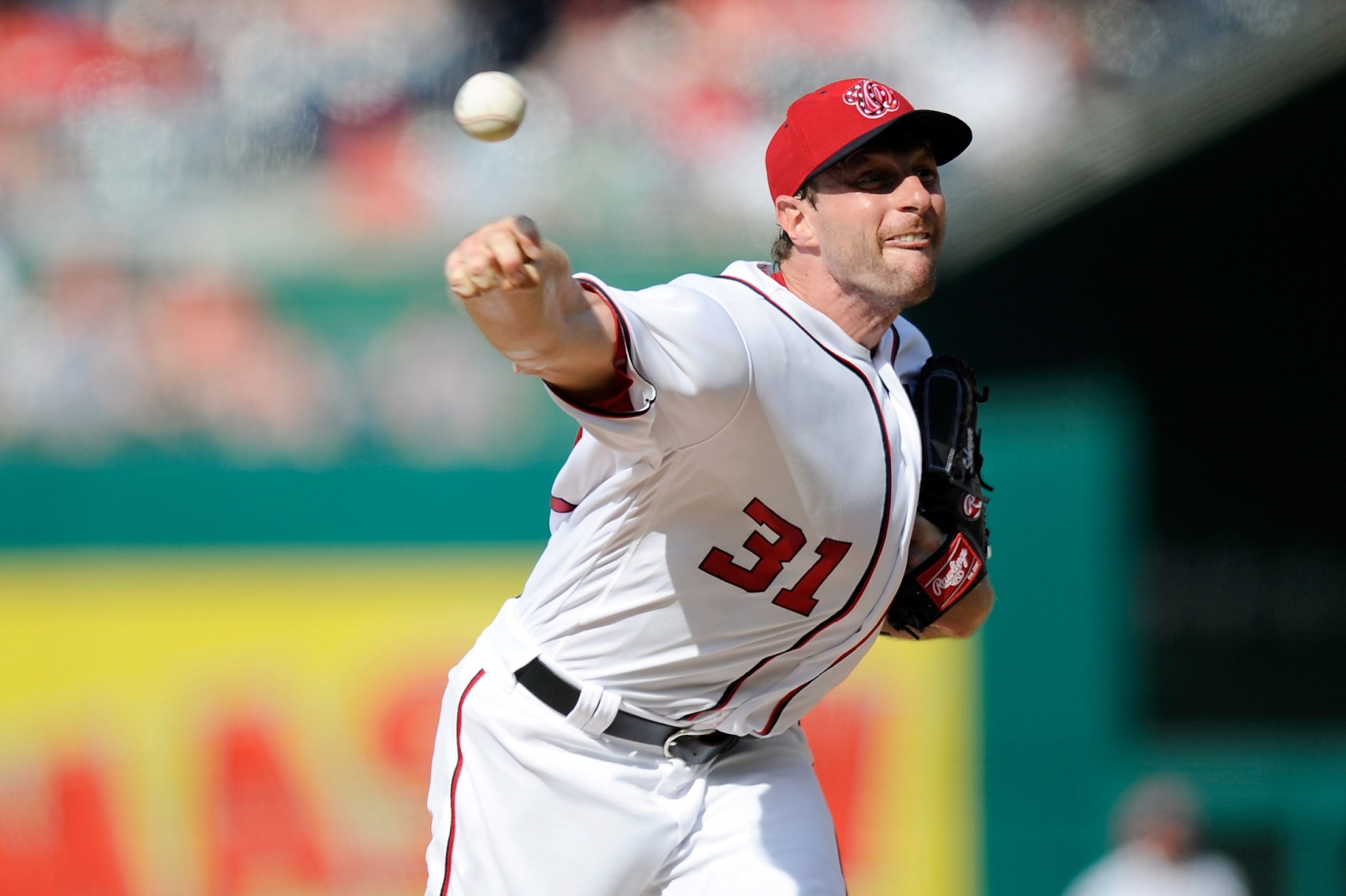
Scherzer, 32, exited his first start with the Nationals carrying a 0.00 ERA in 7.2 innings, and now holds a 2.73 ERA in 82 total starts with the club. Included within is one of only of only five 20-strikeout games in history, as well as two no-hitters.
He darn near made it three no-hitters when he took a no-no into the eighth inning against the Miami Marlins his last time out. But that's nothing new.
As Ryan M. Spaeder of Sporting News notes, Scherzer has made it a habit to flirt with no-hitters:
Maybe Scherzer will finally get his third when he takes on the Chicago Cubs on Tuesday.
But he doesn't need another no-hitter to loom large over other MLB aces. Per Baseball Reference WAR, there hasn't been a more productive pitcher since Scherzer arrived in Washington three seasons ago:
| 1 | Max Scherzer | 17.3 |
| 2 | Clayton Kershaw | 16.0 |
| 3 | Zack Greinke | 14.3 |
| 4 | Corey Kluber | 13.0 |
| 5 | Carlos Martinez | 12.1 |
To be fair, Scherzer's workload plays a hand in this. He's logged 564.2 innings since 2015, more than any other pitcher. And 73.2 more innings than Kershaw, who missed a good chunk of 2016 with a bad back.
Even if their workloads were equal, though, Kershaw would still be ceding ground to Scherzer in the "Best Pitcher in Baseball" debate.
After winning the American League Cy Young in 2013, Scherzer added a National League Cy Young to his collection last year. Now he has an MLB-best 2.09 ERA through 107.2 innings this year. That's good for 4.0 WAR, which is yet another MLB-best mark.
With a 2.47 ERA and only 2.9 WAR, Kershaw is all the way down at No. 11 on that leaderboard. This despite the fact his 109.1 innings give him a slight edge on Scherzer in workload.
Thus, the real difference between the two aces these days: performance.
Baseball is in an era ruled by the three true outcomes: strikeouts, walks and home runs. Pitchers aim to collect more of the former and fewer of the latter.
This is where the Scherzer/Kershaw relationship has taken some turns. A strikeouts-per-nine race that was Kershaw's for a time is now firmly in Scherzer's grasp. The walks-per-nine crown is still Kershaw's, but his ongoing control issues have tightened the gap.
The biggest difference of all, meanwhile, is happening in the home-runs-per-nine race:
Kershaw used to have a huge advantage in home run suppression, and even avoided being badly afflicted by the rise of homers in 2015 and 2016. That ability is gone now.
As Jeff Sullivan of FanGraphs sees it, this could be the price Kershaw is paying for aiming lower with his pitches at a time when hitters are no longer flummoxed by low pitches. Seems fair enough.
Regardless, the other side of this coin contains an interesting question: How is Scherzer now avoiding home runs?
A quick scan of the data reveals that it's not by luck that Scherzer has defeated his homeritis.
Simply by striking out a career-high 12.1 batters per nine innings, he's permitting fewer balls in play. And that's no joke. At 16 percent, his swinging-strike rate has never been higher.
What contact hitters do make against Scherzer is mostly for naught. According to the Statcast data, the percentage of his batted balls that register either as a "Barrel" or as "Solid Contact" is ticking down:
All this has a sense of inevitability to it. Because as anyone who's ever watched Scherzer pitch knows, just how the heck anybody ever hits him is one of this planet's great mysteries.
He's traditionally worked off of a three-pitch mix that's flat-out electric. His fastball averages 94.3 miles per hour and seems to hit another gear when it enters the hitting zone.
Meanwhile, his slider (via Pitcher List) can do this:
And this is his changeup:
And Scherzer doesn't make it easy to track the ball. There are a bunch of moving parts in his wind-up and he releases his offerings from a funky three-quarters arm slot. For hitters, there's a discombobulating effect.
"The ball looks like it’s coming on top of you," Edwin Encarnacion, then with the Toronto Blue Jays, told James Wagner for the Washington Post in 2015. "That makes it much harder."
Despite his funky arm slot and explosive stuff, Scherzer has no trouble throwing strikes. Since 2015, only four qualified starters have pounded the strike zone more frequently than him.
All this adds up to an impressive baseline level for excellence. But what we're seeing now is a pitcher who's clearly not satisfied.
When Scherzer began his career in 2008, his slider was his only breaking ball. He told Eno Sarris of FanGraphs that he now throws three breaking balls: the change-of-pace curveball that he added in 2012, and two different types of sliders. One's a traditional power slider for right-handed batters. The other is more of a cutter-ish slider for left-handed batters.
"I can throw it in to lefties and that way it’ll stay hot, keep it higher, in a little bit harder, so it’s not breaking out over the plate," Scherzer said.
The expansion of his pitching repertoire is fascinating in that is has allowed Scherzer to alter his pitching style.
You know that excellent fastball? Well, he's not using it much anymore. Per Brooks Baseball, his fastball percentage had already been trending down. Now in 2017, it barely accounts for half of all his pitches:
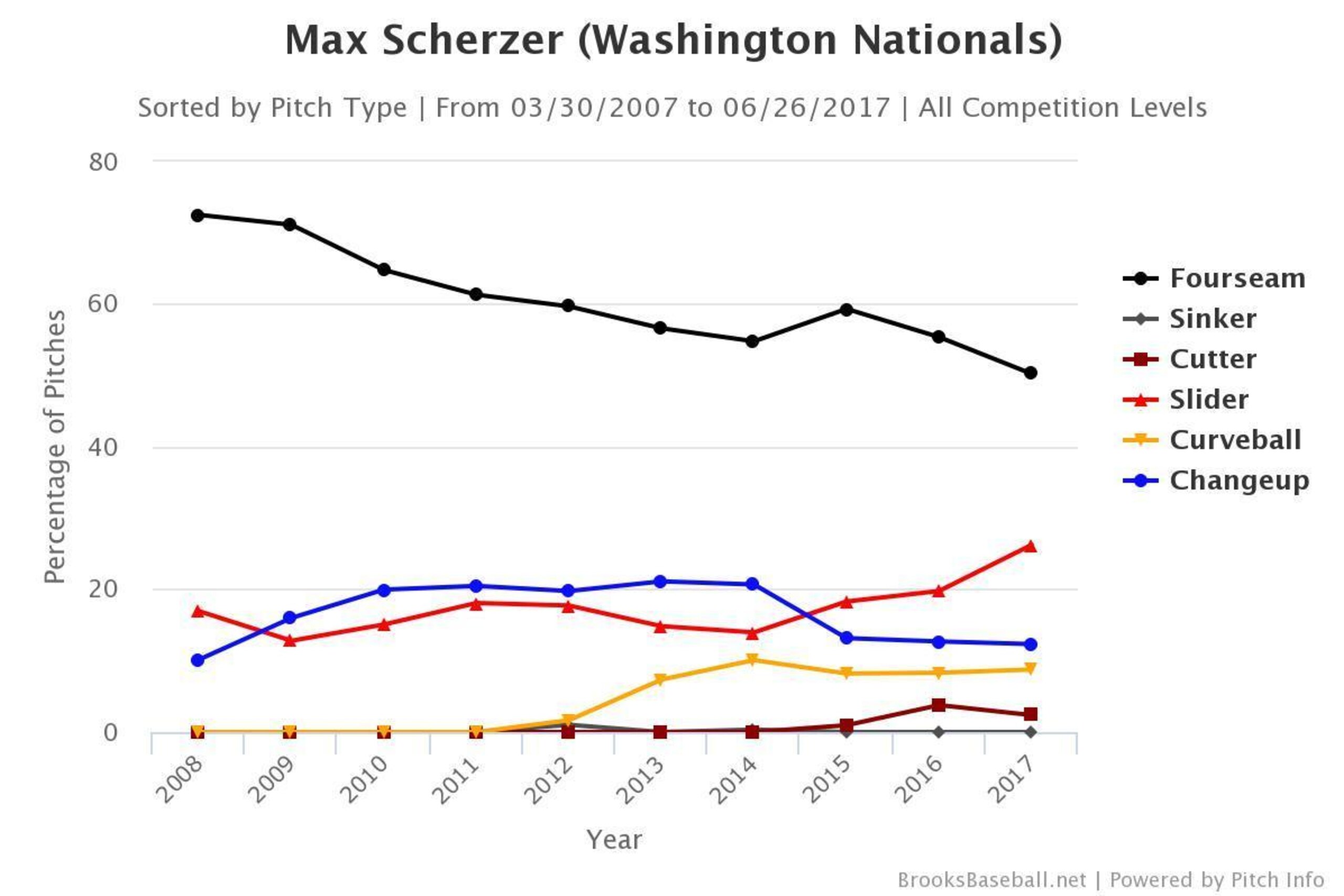
Although it's certainly a factor, this isn't just because Scherzer is getting into more counts that are conducive to finishing hitters off with secondary pitches. He's also pitching backward, using his fastball a career-low 55 percent of the time on the first pitch.
The anticipated danger of an approach like this is increased wildness. But Scherzer's command is still pinpoint. He ranks sixth in MLB with a strike zone percentage of 49.8. And those are overwhelmingly good strikes, as 45.15 percent have stayed out of the absolute middle of the zone.
The CliffsNotes version is this: Scherzer has long been a pitcher of great talent, and now he has more weapons and both a willingness and ability to use them. Lo and behold, he's gone from hard to hit to even harder to hit.
Meanwhile in Los Angeles, Kershaw remains a three-pitch thrower with a preference for first-pitch fastballs. It's safe to assume there's an adjustment he can make that can fix what ails him. But for now, he's hit a wall.
His loss has been Scherzer's gain. And the way he's going, Scherzer doesn't look too eager to return the favor.
Data courtesy of Baseball Reference, FanGraphs, Baseball Savant and Brooks Baseball.

.jpg?w=2560 "LSU Duo Banned from NFL in 2026")
.jpg?w=2560 "Mock NBA Expansion Draft 🤔")
.jpg?w=2560 "Stribling to Miss 'Close' to 10 Weeks")

.jpg?w=2560 "Best Fits for Top NFL FAs 🧩")
.jpg?w=2560 "Breaking News")