Four Plays That Will Shape the Outcome of the 2016 NFL Season
Each NFL season ultimately comes down to just a handful of plays—the blitz that doesn't get picked up, the tight end seam route that the safety cannot cover, the fake handoff that sets up the long bomb, the goal-line pass that should have been a run. (Sorry about that last one, Seahawks fans.)
This season will be no different. The top contenders have their core concepts, offensive and defensive tactics that most opponents just cannot stop. Most of the strategies are basic on the surface: keep the opponent guessing, create mismatches for playmakers, use your own talent to maximum advantage. But when Rob Gronkowski, Von Miller, Cam Newton or the Cardinals veterans enter the equation, a basic strategy can turn into an overwhelming edge.
Here are four core plays from four top contenders, ripped from 2015 game film, which will shape the outcome of the 2016 season. (Actually, there are six total plays, but they are built on four core concepts.) These plays will either propel the NFL's elite back to championship weekend, or challengers will find new ways to neutralize them and create a whole new power structure atop the standings.
Team: Carolina Panthers
Play Concept: Play-action deep passes built from the read-option threat
Defenses facing the Panthers last year had to worry about Cam Newton's arm, his legs and an option-laced playbook designed to make the best use of each. This season, they have one more thing to worry about: an upgraded receiving corps.
The figure below is taken from the third quarter of the NFC Championship Game. Newton is in shotgun formation with Jonathan Stewart (28) and a blocking back in the backfield. The defense must be wary of both Newton and Stewart as read-option rushing threats. So when Stewart follows his blocker past Newton (who briefly pauses to sell the option), the whole middle of the defense is frozen. Linebackers watch the backfield action before retreating into pass coverage. Even the free safety is temporarily immobilized.
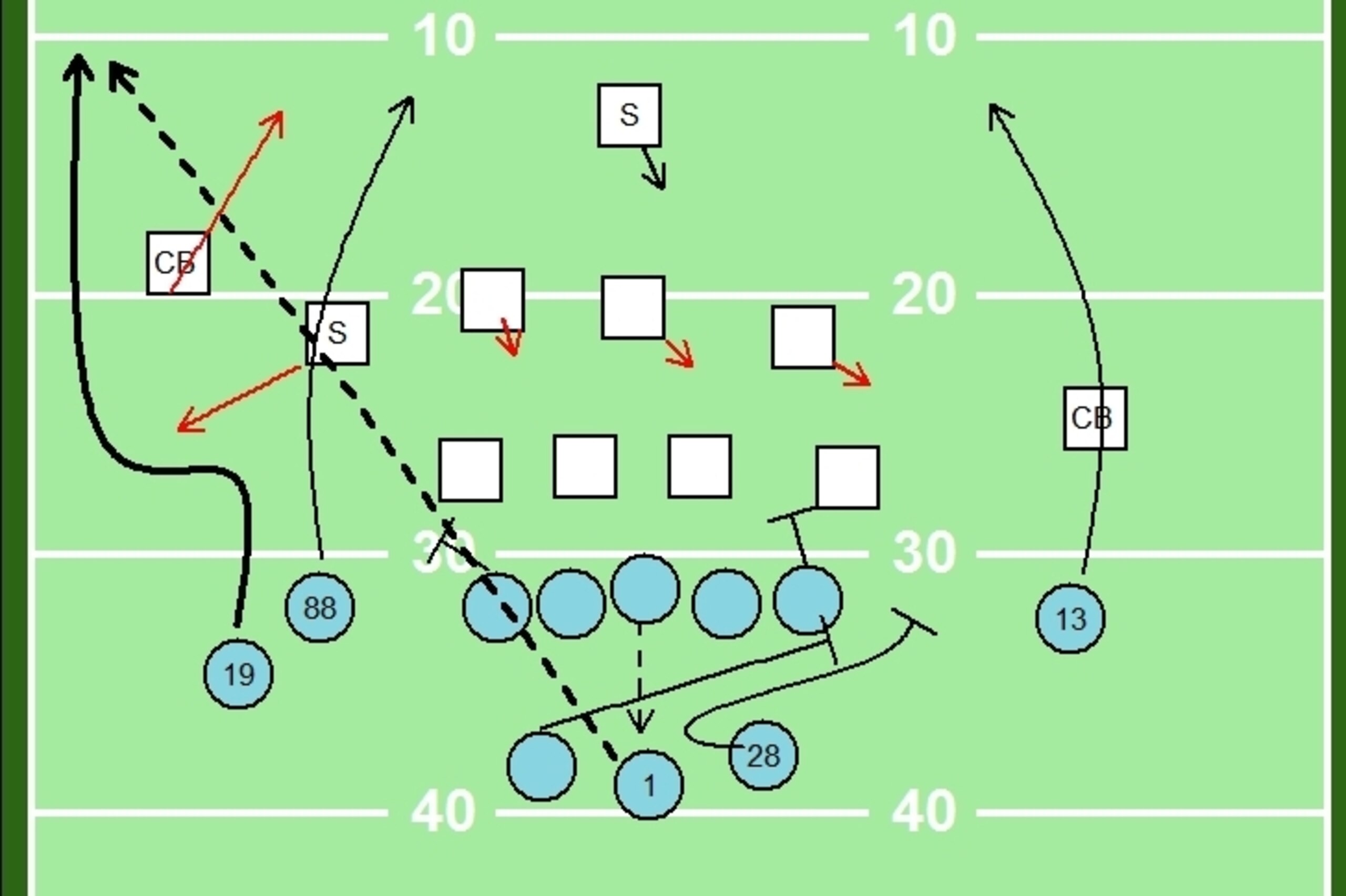
Stewart and the blocker are merely pass protectors on this play, however. The seven-man protection gives Newton time to scan the field while Ted Ginn (19) runs a wheel route and Greg Olsen (88) runs a post. The poor defensive back lined up against Olsen had to worry about Newton on an option and then scurried into flat coverage against Ginn, only to find himself covering one of the NFL's fastest receivers racing up the sideline. Newton found Ginn for 39 yards.
The Panthers used a similar concept against the Cardinals later in the fourth quarter, when they were pulling away with a victory. The diagram below shows Olsen beating a deep safety for a 54-yard catch and run with the defense in man coverage. The principles are the same: two backs, an option threat, max protection to slow the defense.
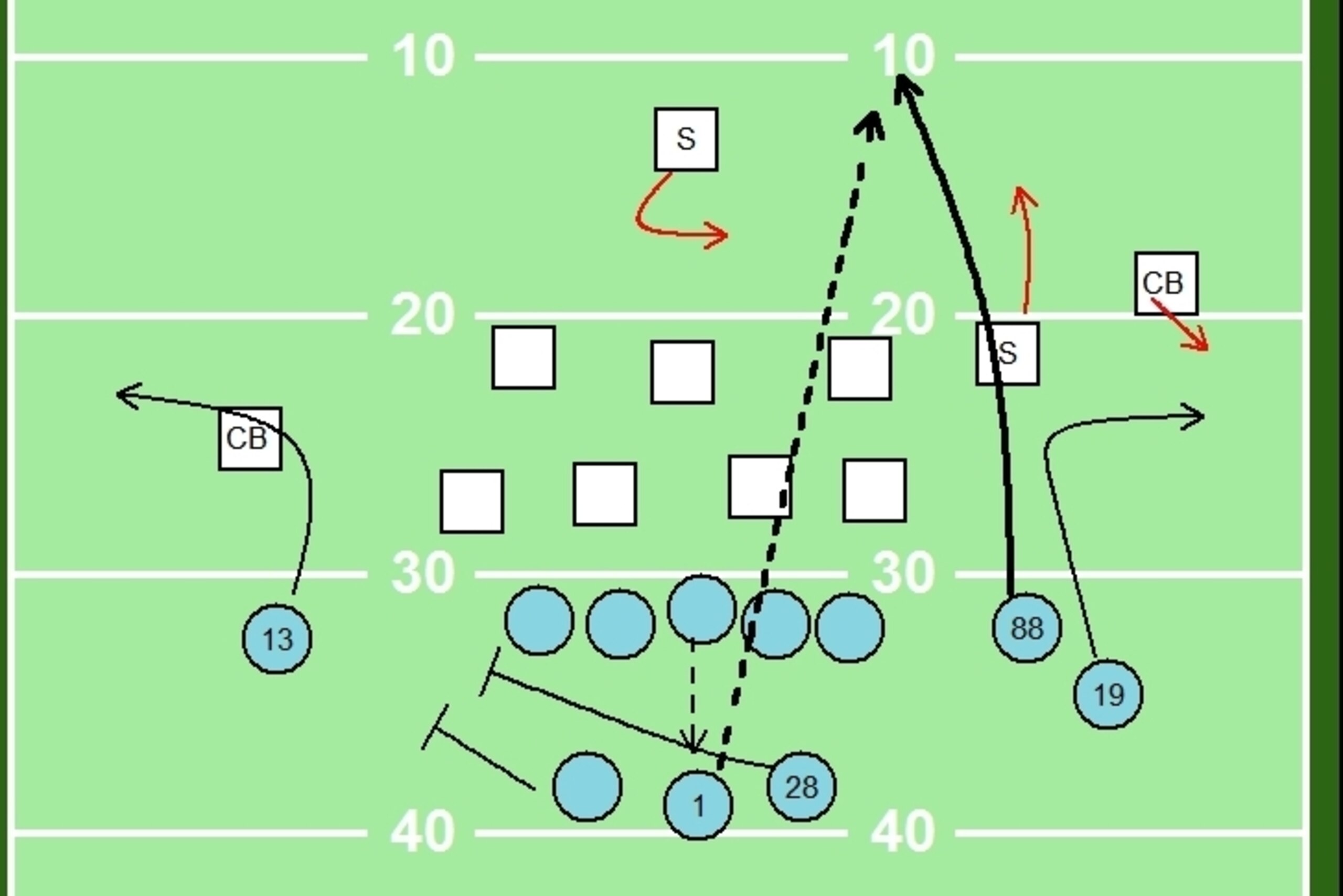
You will notice that Kelvin Benjamin (13) has been added to these diagrams. Last season, defenses had little to fear from receivers such as Corey Brown and Devin Funchess. With Benjamin back and Funchess more experienced, the Panthers can flood the field with dangerous receivers while still using the option threat to force defenders to react instead of act.
The best way to stop Panthers concepts like these is to build a lead, which will minimize the impact of the running game. The Broncos did that in the second half of the Super Bowl. We'll get to them later.
Team: New England Patriots
Play Concept: Red-zone tight end mismatches
The Patriots create mismatches by filling the field with versatile weapons and playing at a quick tempo. The plays themselves are usually simple. But with tight ends and running backs who can play wide receiver and shifty wide receivers who can cause havoc in the slot, defenses often find themselves in a no-win situation.
Play base, and Gronkowski will beat your safety up the seam, or Julian Edelman will slice inside a bigger defensive back for an easy catch. Add extra defensive backs, and the Patriots tight ends can easily switch from deep threats to in-line blockers. Try to mix and match, and Tom Brady will shift into no-huddle mode and do whatever he wants to do with the defenders you leave on the field.
This year, Martellus Bennett joins Gronkowski to give the Patriots two outstanding tight ends. Look for Gronk and Bennett to line up anywhere and everywhere, especially when the Patriots are in the red zone.
The diagram below comes from the Patriots' Week 12 loss to the Broncos. The personnel have been changed to reflect the current Patriots personnel. That's bad news with Jimmy Garoppolo (10) replacing Brady at shotgun. But it is good news with Bennett (88) split right and Edelman (11) and Chris Hogan (15) replacing the backups the Patriots were forced to rely on late last year due to injuries.

The Patriots huddled before this particular play, but they broke the huddle quickly, and Brady got rid of the ball while the Broncos were still lining up. The linebacker covering the tight end on the far offensive right was actually Von Miller! Chris Harris started on that side of the field, but then he raced over to cover the inside receivers on the offensive left. Another linebacker ended up covering Gronkowski (87) on his corner route. Brady never had to look in that direction. The tight end split wide right—the very ordinary Scott Chandler last year—was open from the snap.
Maybe a cornerback like Harris won't abandon coverage responsibilities to a pass-rusher like Miller now that Bennett is the second tight end. But then who covers Edelman weaving through traffic underneath? This formation, with this personnel, creates easy-to-read mismatch opportunities. It doesn't take a Brady to exploit them. A Garoppolo will do.
The Patriots have used tactics like these for years. The only way to stop them is to beat their offensive line with four down linemen in the trenches, rushing Brady (or the new kid) while leaving plenty of defenders in coverage. The Broncos were one of the few teams that could do that consistently last year. We're getting to them. Promise!
Team: Arizona Cardinals
Play Concept: 3-by-1 receiver bunches
The Cardinals generate so many big plays from their 3-by-1 receiver formations (three receivers on one side, one on the other) that it was hard to find one perfect play to illustrate what they do. The Cardinals use many different tactics based on the core concept of loading one side of the formation with receivers and attacking vertically. One of their most dangerous strategies is built around a formation and personnel grouping that works equally well as a downfield zone-flooding attack and as an overloaded rushing formation.
The next diagram shows three receivers bunched to the offensive left: speedy J.J. Nelson (14) on the outside, tight end Daniel Fells (85) on the inside and future Hall of Famer Larry Fitzgerald (11) in between. To keep the safeties honest, Michael Floyd (15) is split wide right.

The receivers run a simple "layers" concept. Play action and a shallow cross by Andre Ellington (38) hold the linebackers in place. Fitzgerald runs a deeper crossing route. The crosses clear out space for Nelson to beat a cornerback one-on-one. Fells stays in to block, giving Carson Palmer (3) extra protection while the longer routes develop.
It's not surprising that the Cardinals force defenses to pick and choose from their many receiving weapons. What's surprising is how often Arizona uses this formation for power sweeps to the edge.
The next diagram is taken from the Week 15 blowout of the Eagles. It's the same formation, though flipped; the Eagles respect Floyd so much that a safety is positioned 17 yards deep, shaded to his side of the field. But the Cardinals are running right, taking advantage of Fitzgerald's skills as a blocker. He cracks inside in search of a linebacker while Fells seals off a linebacker and John Brown (12) creates a cutback lane by blocking a cornerback.
Fitzgerald actually misses his block in the Eagles game, and a safety gets a free shot at David Johnson (31). But Johnson makes the defender miss, enjoys downfield blocks by Brown and others and breaks some tackles en route to a 47-yard touchdown.
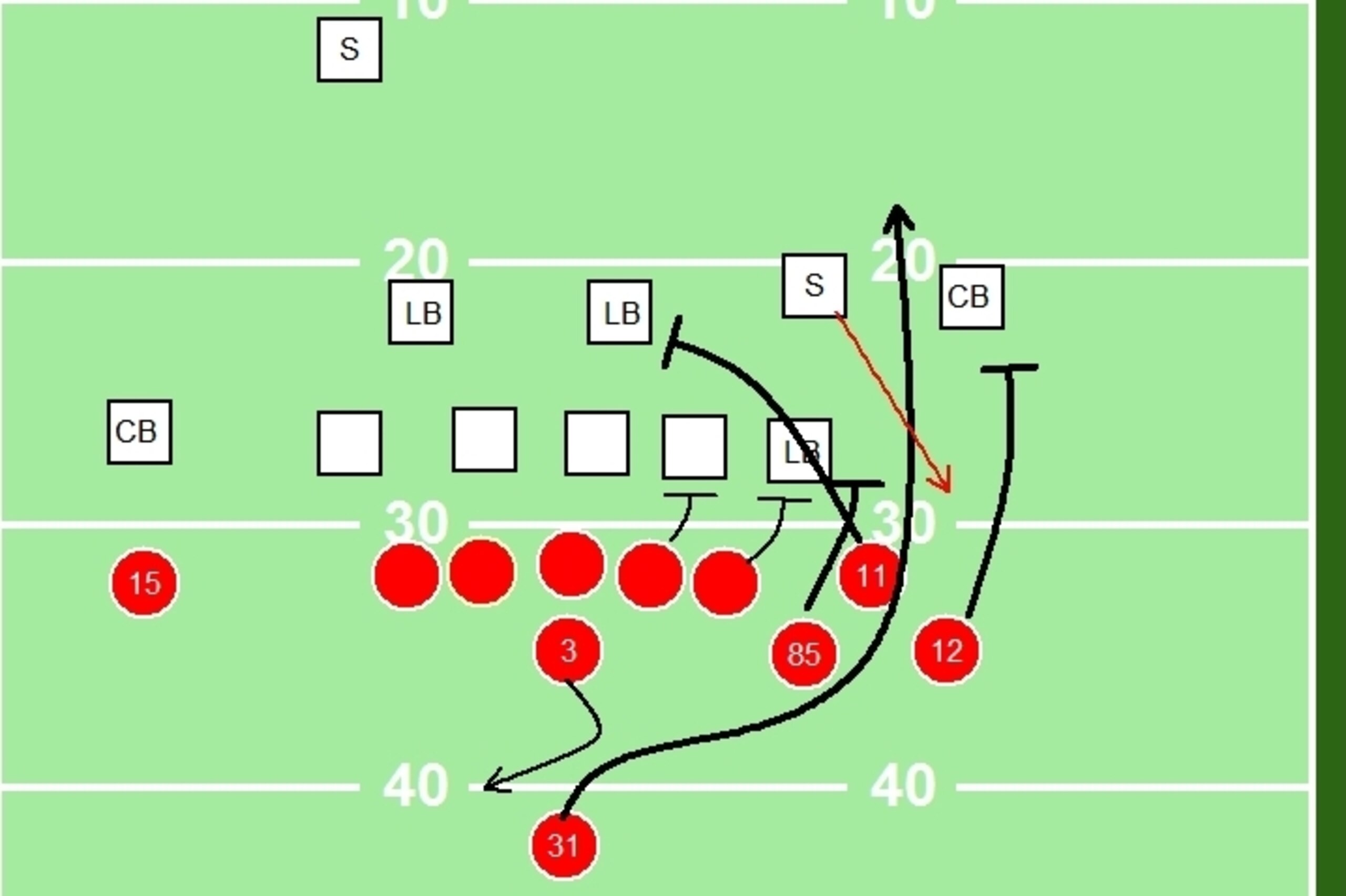
With their full complement of weapons back this season, the Cardinals will be able to dictate on offense. For them, that means putting a three-man combo of speed, savvy and blocking ability on one side of the formation, adding a dynamic running threat and waiting to see how opponents stop it. Most defenses won't have a chance.
Team: Denver Broncos
Play Concept: The "Anytime, Anywhere" Zone Blitz
The Broncos defense is like an offense. It can attack in a variety of ways. It's designed to generate big plays. And it's full of multidimensional players who give coordinator Wade Phillips the latitude to use just about any tactic he likes, no matter the game situation. The Broncos don't worry about what the offense will do to their defense. They make the offense worry about what their defense will do to it.
Our final diagram shows a Broncos zone blitz, taken from the Vikings game in Week 4 of 2015. Safety T.J. Ward (43) blitzes the edge to neutralize the running back. Miller (58) sacrifices himself with a hard inside rush that blows up the right side of the offensive line. Both defenders are clearing a path for linebacker Brandon Marshall (54), who loops between them.
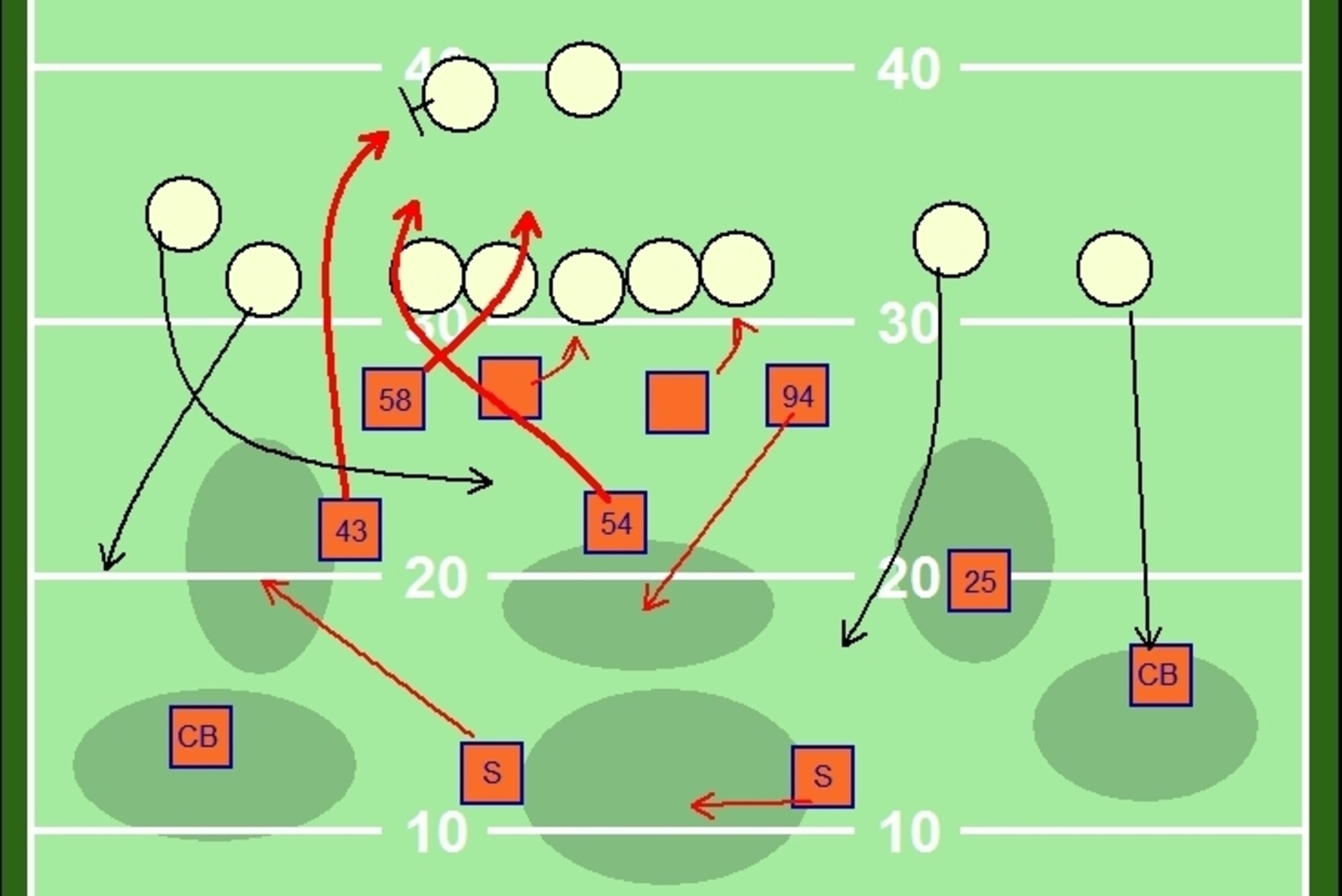
Meanwhile, DeMarcus Ware (94) drops into coverage in the short middle of the field. Harris (25), a Pro Bowl cornerback who is most effective in the slot, joins Ware in underneath coverage. The Broncos play an elegant three-deep, three-under zone—the zone defenders and blitzes roll to the offensive right while Miller and the D-line slant to the left. Teddy Bridgewater gets sacked for a five-yard loss and fumble.
This blitz works because of the talent and versatility of the defenders: The 34-year-old Ware can still drop into coverage without tripping over himself, the Broncos secondary is deep enough to allow Ward and Harris to play close to the line without risking a deep ball, and Miller is Miller.
But what's most remarkable about this blitz is when it was called: The Broncos led 23-20 with just 35 seconds left and the ball near midfield! Instead of dropping eight defenders into coverage, Phillips merrily dialed up a complex blitz, one that used his two best pass-rushers as a coverage defender and a sacrificial pawn. So much for "prevent" defense, and good luck anticipating a play design like this one.
The Broncos defense will have to be extra daring this season. But it proved last year that it is up to the challenge. And with a playbook full of concepts like this one, it is probably looking forward to it.
Mike Tanier covers the NFL for Bleacher Report. Follow him on Twitter @MikeTanier.
.jpg?w=2560 "Eagles Bears Football")


.jpg?w=2560 "SmackDown Before MITB Recap 📝")