
B/R MLB 300: Ranking the Top 80 Starting Pitchers of 2016
It's time for the B/R MLB 300 to take a break from bats and gloves and focus on the arms. First up: starting pitchers.
There are typically 150 starting pitchers in Major League Baseball at any given moment. And while 2016 hasn't been a banner year for great starting pitching the way the previous few years were, there are still many good starters out there. Our list covers 80 of them, who are scored like so:
- Control: 30 points
- Whiffability: 25 points
- Hittability: 25 points
- Workload: 20 points
Before we move on, here's a reminder that this year's B/R MLB 300 is different from past versions in a key way. Rather than use the events of 2016 to project for 2017, the focus is strictly on 2016. Think of these rankings as year-end report cards.
For more on how the scoring and ranking work, read ahead.
How They're Ranked
1 of 45
There's only one thing starting pitchers needed to do to qualify for this list: make at least 15 starts.
The scoring is based mostly on statistics and data—current through play on Tuesday, September 27—from Baseball-Reference.com, FanGraphs, Brooks Baseball, Baseball Prospectus and Baseball Savant. The numbers, plots and graphs at these sites leave few blind spots when looking at each player's performance, allowing for analytical scouting reports that cover the following:
Control: We know the average starter is walking 3.0 batters per nine innings and finding the strike zone with 44.6 percent of his pitches. However, we also know these are the bare-minimum guidelines for determining what kind of control a starter has. We're also interested in how well each starter executes his pitches, basically meaning we'll be considering command as well as control.
Whiffability: This is where we're interested in how well each starter misses bats. The league average of 7.7 strikeouts per nine innings is a guiding star, but we'll also look at swinging-strike percentages (SwStr%) in relation to the 9.5 MLB average for starters. This is a gateway into looking more into the quality of each pitcher's stuff and how he uses it.
Hittability: Missing barrels is arguably just as important as missing bats. This is where we look at how each pitcher manages contact. Ground balls (44.4 average GB%) and pop-ups (9.5 IFFB%) are preferred in addition to low exit velocities (89.1 mph average). Keeping the ball in the yard (1.3 HR/9) is also a plus.
Workload: Nothing fancy here. Overall games started and innings pitched are the guiding stars, and we'll also weigh how each pitcher gets it done. That means looking at how well they maintain their stuff within games, how efficient they are and how they avoid the dreaded third-time-through-the-order penalty.
The individual scores are meant to mimic the 20-80 scouting scale while also taking sample sizes into account. Perfect scores are reserved for players who have excelled throughout the entire season, with bonus points possible under extraordinary circumstances. Anything else is a judgment call.
Last but not least: If any two (or more) players end up with the same score, we'll make another judgment call on the player (or players) we'd rather have.
80-71: Snell-Hernandez
2 of 45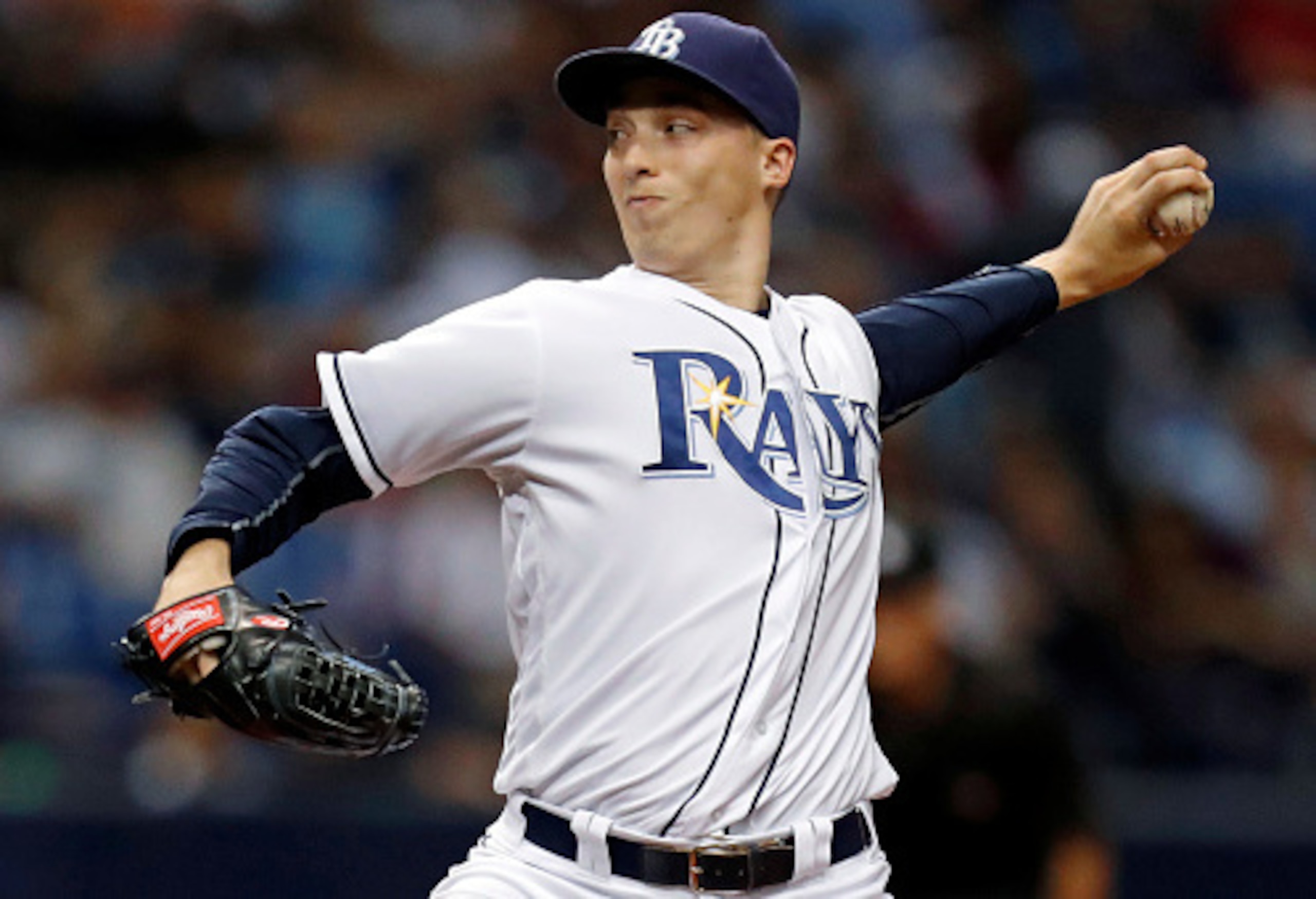
80. Blake Snell, Tampa Bay Rays
Control: 10/30; Whiffability: 16/25; Hittability: 14/25; Workload: 7/20
The negatives here are obvious: Blake Snell has gotten limited exposure (86.1 innings in 18 starts) and has battled control struggles with a 5.2 BB/9. An inconsistent arm slot, which he may not fix until he adds more weight to his 6'4", 180-pound frame, hasn't helped the latter. There's a lot to like about the action on his pitches, though, which has helped him secure a 9.8 K/9 and a solid exit velocity.
79. Adam Conley, Miami Marlins
Control: 11/30; Whiffability: 14/25; Hittability: 12/25; Workload: 12/20
There's a lot to like about Adam Conley's three-pitch mix. He has a four-seamer with a bit of rise and outstanding arm-side run, as well as a changeup and a slider that both have a good deal of deception. This is where his 8.4 K/9 comes from. Now he needs a consistent release point to help him improve his ugly 4.2 BB/9 and, just as importantly, be more efficient from inning to inning.
78. Jordan Zimmermann, Detroit Tigers
Control: 21/30; Whiffability: 7/25; Hittability: 13/25; Workload: 9/20
Even Jordan Zimmermann's 2.0 BB/9 doesn't do his control justice. Beyond simply being good at throwing strikes, the way in which he changes eye levels with high fastballs and low secondaries makes him tough to square up. However, his velocity decline isn't helping him there or, as evidenced by his 5.7 K/9, in the whiffability department. And this just when he's even been able to take the hill.
77. Martin Perez, Texas Rangers
Control: 14/30; Whiffability: 5/25; Hittability: 15/25; Workload: 17/20
Martin Perez's whole approach is to attack hitters with a variety of moving pitches at and below the knees. When it's working, he gets ground balls (52.9 GB%), and the Rangers go home happy. But it also means living with a few walks (3.5 BB/9) and virtually no strikeouts. Perez's 4.7 K/9 is the lowest among all qualified starters, and it means he needs a lot of help from his defense.
76. Yordano Ventura, Kansas City Royals
Control: 12/30; Whiffability: 9/25; Hittability: 14/25; Workload: 16/20
Yordano Ventura still has a live arm, averaging 96.0 mph on his heat. And with a 50.7 GB%, he's still benefiting from keeping the ball down. But there's bad news there too. He hasn't been keeping his off-speed pitches down enough, which is costing him in whiffs and loud contact. It's thus the same old story with Ventura: He has worlds of potential, but he still needs to fine-tune his craft.
75. Chris Tillman, Baltimore Orioles
Control: 14/30; Whiffability: 11/25; Hittability: 11/25; Workload: 15/20
Chris Tillman is still changing eye levels well, generally working up with his four-seamer and at and below the knees with everything else. And after losing velocity in 2014, he's gained it back and used it to boost his K/9 to 7.5. But that doesn't make him a strikeout pitcher, and Tillman's not much of a command artist or contact manager either. He gets ace billing, but he's just a reliable workhorse.
74. Doug Fister, Houston Astros
Control: 17/30; Whiffability: 5/25; Hittability: 15/25; Workload: 15/20
A return to health has restored Doug Fister's velocity and spin. His return to a location pattern of putting his hard stuff higher and his slow stuff lower has allowed him to do a good job of missing barrels with a 87.9 mph exit velocity. He's still a shell of his old self, though. Though improved, his 5.7 K/9 reflects how his stuff is far from vintage. His control also isn't as sharp as it once was.
73. Jason Hammel, Chicago Cubs
Control: 17/30; Whiffability: 13/25; Hittability: 8/25; Workload: 14/20
It's a nice change of pace that Jason Hammel has stayed fresh for a whole season. Thank you, potato chips. He's also maintained good control for a guy who pitches off his slider, posting a 2.9 BB/9 and keeping everything low. However, his 7.8 K/9 is a big downturn from 2015. And because he can't fool hitters in the zone, he can't avoid high exit velocity (90.8 mph).
72. Danny Salazar, Cleveland Indians
Control: 11/30; Whiffability: 19/25; Hittability: 10/25; Workload: 12/20
You can't doubt the quality of Danny Salazar's stuff. He works in the 94-95 mph range with his fastball and finishes hitters off with one of the top swing-and-miss changeups in the business. Thus, his studly 10.6 K/9. Now he just needs three things: better control, an ability to avoid loud contact and, last but not least, good health.
71. Felix Hernandez, Seattle Mariners
Control: 11/30; Whiffability: 10/25; Hittability: 16/25; Workload: 15/20
Felix Hernandez used to combine great stuff with great control. But now his stuff is losing velocity. His 3.9 BB/9 reflects how his control is going too. His arm slot is trending down, and his whole style now involves putting the ball below the knees and hoping hitters chase. The one area where this is still working is his hittability. He's maintaining a 50.7 GB% and a solid exit velocity at 88.9 mph.
70-61: Koehler-DeSclafani
3 of 45
70. Tom Koehler, Miami Marlins
Control: 12/30; Whiffability: 12/25; Hittability: 15/25; Workload: 14/20
Tom Koehler no longer pitches off his four-seam fastball. His slider, curveball and changeup account for the bulk of his pitches. That has allowed for more swinging strikes and softer contact. But as his 4.0 BB/9 serves to remind, it's hard for anyone not named Bronson Arroyo to control a secondaries-first approach. He also doesn't miss enough bats or barrels to excel away from Marlins Park.
69. Jameson Taillon, Pittsburgh Pirates
Control: 23/30; Whiffability: 8/25; Hittability: 14/25; Workload: 8/20
Jameson Taillon hasn't needed to pitch a ton of innings to make an impact in his rookie season. His 1.3 BB/9 reflects excellent control that comes from a consistent arm slot and ownage of the arm-side edge of the zone with his hard stuff. And apart from his four-seamer, everything he throws has proved effective at getting ground balls. In time, he should improve on his modest 7.4 K/9.
68. James Paxton, Seattle Mariners
Control: 20/30; Whiffability: 15/25; Hittability: 7/25; Workload: 11/20
A lower arm slot unleashed James Paxton's full velocity potential and gave him greater consistency within the strike zone. From this, he benefited with a rock-solid 4.7 K/BB ratio in 19 starts. Good health continues to come and go for him, however. And despite his uptick in stuff, he's continued to struggle with hard contact. Batters hit the ball at an average of 91.0 mph off him.
67. Joe Ross, Washington Nationals
Control: 19/30; Whiffability: 12/25; Hittability: 12/25; Workload: 10/20
Joe Ross was doing fine before he was waylaid by a bad right shoulder. Not great but fine. Like his older brother, Tyson, he works off a sinker-slider combination with enough location and movement to post a solid 7.8 K/9 and keep hard contact at bay. Now all Ross needs to do is work on getting his sinker lower in the zone, and better things may be in store.
66. Michael Wacha, St. Louis Cardinals
Control: 19/30; Whiffability: 10/25; Hittability: 13/25; Workload: 12/20
Michael Wacha remains reasonably good at keeping the ball down. He also still rocks a bread-and-butter changeup that gets him whiffs and ground balls. It's not enough for him to excel at either, however, as he managed just a 7.4 K/9 and 47.0 GB% before getting injured and moving to the bullpen. He mainly gets hurt on his fastball, which too often strays down the middle.
65. Trevor Bauer, Cleveland Indians
Control: 13/30; Whiffability: 12/25; Hittability: 13/25; Workload: 16/20
Trevor Bauer has embraced the sheer electricity of his arsenal, downplaying his four-seamer in favor of more movement. That's helped him become a ground-ball pitcher with a 48.3 GB%. But he otherwise remains a frustrating pitcher, still unable to avoid walks (3.3 BB/9) and now not missing as many bats (7.8 K/9). Maybe next year will finally be the year he puts it all together.
64. Gio Gonzalez, Washington Nationals
Control: 15/30; Whiffability: 14/25; Hittability: 10/25; Workload: 15/20
It's to Gio Gonzalez's credit that he hasn't paid a more dire price for such a substantial velocity decline. That speaks to how he still has two good secondaries in his curveball and changeup and to how he's showing solid control for the first time in his career. He nonetheless remains a diminished version of his vintage self: still not very efficient and more hittable in every way.
63. Vince Velasquez, Philadelphia Phillies
Control: 15/30; Whiffability: 19/25; Hittability: 9/25; Workload: 11/20
Vince Velasquez was having a rough second half before the Phillies shut him down. He certainly has things he can improve on. Chief among them would be his control, as his style consists of challenging hitters and not much else. You can say this, though: It's no small feat that each of his five pitches posted double-digit whiff rates. That's a live arm, and its 10.4 K/9 may be just the beginning.
62. Matt Moore, San Francisco Giants
Control: 13/30; Whiffability: 14/25; Hittability: 10/25; Workload: 17/20
Matt Moore is healthy for the first time since 2013, and he has better control (3.3 BB/9) now than he did then. Throw in good velocity with 92-93 mph heat and a sharp curveball, and you get a typical power left-hander. But the big disappointment of Moore's career continues to be his inability to miss as many bats (8.1 K/9) as he should. He's also nothing special at missing barrels.
61. Anthony DeSclafani, Cincinnati Reds
Control: 22/30; Whiffability: 13/25; Hittability: 9/25; Workload: 11/20
Anthony DeSclafani has been a quiet (albeit limited) success story with a 3.38 ERA in 19 starts. He's never struggled to control the ball, but he's trying a new trick this year by working lower with his secondaries. That's had a hand in him becoming a better strikeout pitcher with a 7.8 K/9. The catch is that his hittability has gone backward, with both his GB% and exit velocity taking hits.
60-51: Guerra-Odorizzi
4 of 45
60. Junior Guerra, Milwaukee Brewers
Control: 13/30; Whiffability: 14/25; Hittability: 15/25; Workload: 13/20
Don't read too much into Junior Guerra's 2.81 ERA. The aged rookie owes that to how well he's kept the ball in the yard (0.7 HR/9) with a little help from the BABIP gods (.250), and he hasn't earned either with what's actually pedestrian contact management. Nonetheless, he has shown solid control (3.2 BB/9) of a pretty good arsenal and has been good for six innings every time out.
59. Ivan Nova, Pittsburgh Pirates
Control: 23/30; Whiffability: 9/25; Hittability: 13/25; Workload: 12/20
Pittsburgh Pirates pitching coach Ray Searage has salvaged something from Ivan Nova's season. His sinker and curveball combination have always made him a good ground ball pitcher. So it goes with a 53.0 GB%, helping to make up for otherwise loud contact. As Jeff Sullivan covered at FanGraphs, all Searage has done is make Nova throw more strikes. That's a good way to improve a pitcher.
58. Carlos Rodon, Chicago White Sox
Control: 18/30; Whiffability: 15/25; Hittability: 10/25; Workload: 14/20
A wrist injury got in his way, but 2016 has otherwise been a step forward for Carlos Rodon. His 2.9 BB/9 is a massive improvement over last year's 4.6. That's a combination of him going over the top and downplaying his slider. He's had to sacrifice some whiffs to make it work, but his 8.9 K/9 proves his stuff is good no matter what. Keep an eye on this guy.
57. Yu Darvish, Texas Rangers
Control: 15/30; Whiffability: 19/25; Hittability: 16/25; Workload: 7/20
It's like Yu Darvish was never gone. His year off recovering from Tommy John surgery hasn't stopped his improving control (2.9 BB/9) or his extreme ability to strike hitters out (11.5 K/9). He's actually come back with better stuff, showing more velocity and earning double-digit whiff rates on his slider, curveball and cutter. To boot, all this stuff is tough to square up for exit velocity. Welcome back.
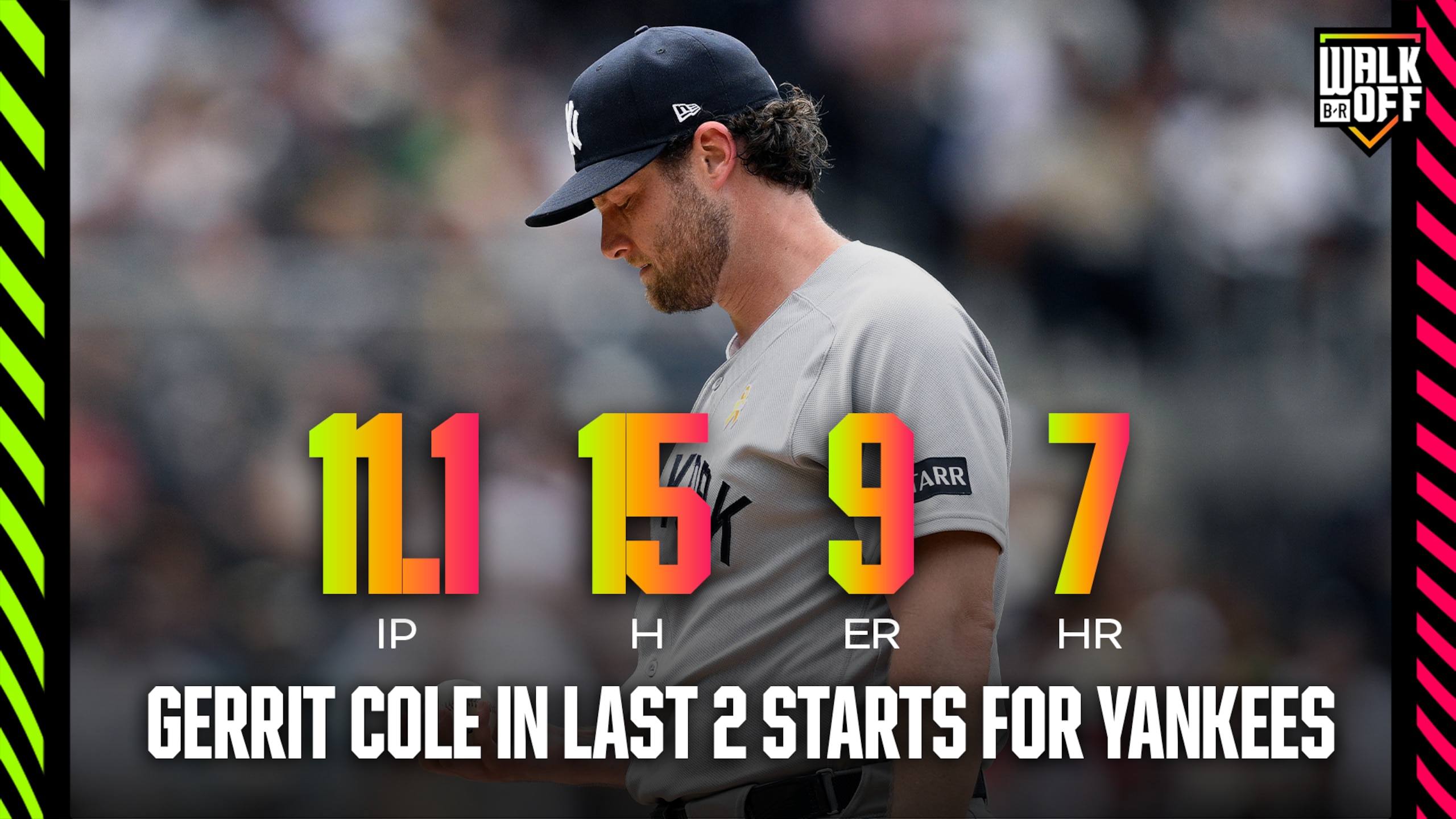
56. Gerrit Cole, Pittsburgh Pirates
Control: 18/30; Whiffability: 11/25; Hittability: 16/25; Workload: 12/20
Injuries have kept Gerrit Cole off the mound and have made it difficult for him to find a consistent release point. On the plus side, his stuff remained overpowering. He averaged 95.2 mph on his heat and maintained good action on his secondaries. This didn't buy him many whiffs. But with a 45.6 GB%, a 11.7 IFFB% and 88.5 mph in batted ball velocity, he remained tough to square up.
55. Jerad Eickhoff, Philadelphia Phillies
Control: 22/30; Whiffability: 10/25; Hittability: 9/25; Workload: 17/20
With just a 1.9 BB/9, Jerad Eickhoff has displayed impressive control for a guy who barely throws 50 percent fastballs. It's largely because of that he's been the rock in the Philadelphia Phillies' rotation, averaging six innings per start. But for a guy who throws so many breaking balls, he's surprisingly hittable. A 7.5 K/9 is nothing special, and a 1.4 HR/9 is painful.
54. Kendall Graveman, Oakland A's
Control: 22/30; Whiffability: 5/25; Hittability: 15/25; Workload: 16/20
Kendall Graveman is a sinkerballer who pitches exactly like you expect a sinkerballer to pitch. He does a heck of a job working hitters at the knees, limiting walks (2.3 BB/9) and racking up plenty of ground balls (52.2 GB%). But only Martin Perez has a lower K/9 than Graveman's 5.1, and all his ground balls don't prevent him from serving up iffy exit velocity at 89.8 mph.
53. Ian Kennedy, Kansas City Royals
Control: 18/30; Whiffability: 16/25; Hittability: 7/25; Workload: 17/20
Ian Kennedy loves to go right at hitters with his fastball, and it's very much a reason why he's once again missing bats with an 8.7 K/9. It's getting harder to hit every year. But he still doesn't limit walks (3.1 BB/9) or command the ball that well for a guy who loves his fastball so much. And when he doesn't miss bats, he gets hit very, very hard. Case in point: a 1.5 HR/9 and 89.9 mph exit velocity.
52. Robbie Ray, Arizona Diamondbacks
Control: 13/30; Whiffability: 23/25; Hittability: 8/25; Workload: 14/20
Robbie Ray has some under-the-radar stuff. His four-seamer and sinker have good velocity and good action, and his slider is quietly among the best at missing bats. That's where his sparkling 11.4 K/9 comes from. Ray just doesn't offer much else, as he's not efficient and is largely incapable of beating right-handed batters within the zone. Hence a platoon split that can't be ignored.
51. Jake Odorizzi, Tampa Bay Rays
Control: 21/30; Whiffability: 13/25; Hittability: 7/25; Workload: 17/20
Perhaps more than any other pitcher, Jake Odorizzi makes his way by changing eye levels. His 2.7 BB/9 and 7.8 K/9 are testament to how well he executes it, as he's consistent and frequently able to fool batters. But when they're not fooled, ball go far. He's served up 1.4 homers per nine innings and 90.4 mph in exit velocity. That's made him prone to short outings.
50-41: Estrada-Stroman
5 of 45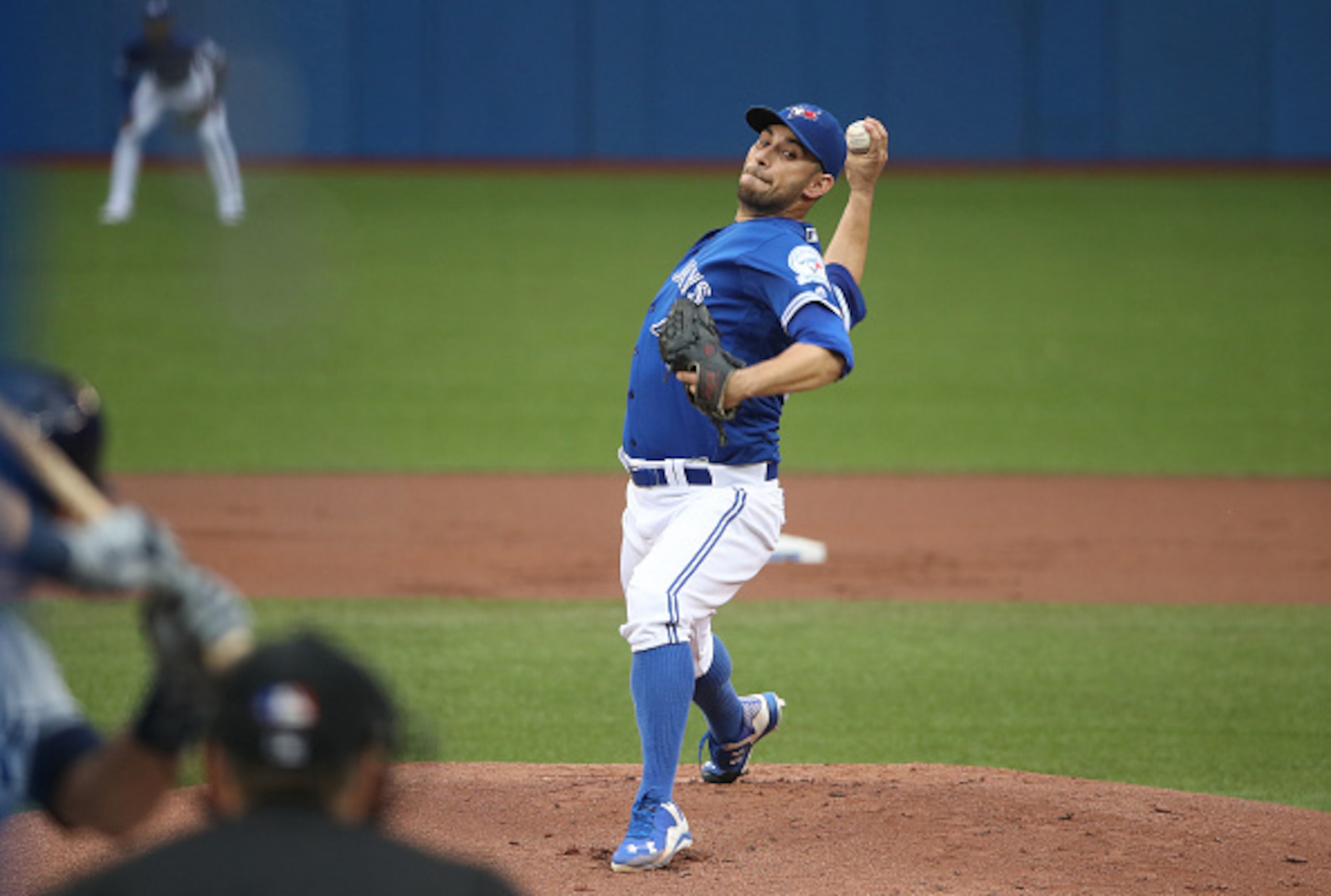
50. Marco Estrada, Toronto Blue Jays
Control: 15/30; Whiffability: 16/25; Hittability: 13/25; Workload: 15/20
Marco Estrada has a four-seamer that rises and a changeup that seems to stop in mid-air. He's been putting his changeup lower in 2016 and baiting hitters with fastballs at the belt. He gets a lot of easy outs from this style, collecting an 8.5 K/9 and a 16.4 IFFB%. Disciplined hitters can coax him for walks (3.3 BB/9), though, and any batted ball that's not a pop-up is usually trouble.
49. CC Sabathia, New York Yankees
Control: 14/30; Whiffability: 11/25; Hittability: 20/25; Workload: 15/20
CC Sabathia showed up to 2016 healthy and with a new pitch selection. He's ditched his four-seamer and added a cutter, ensuring everything he throws moves. This has made it easier for him to miss barrels, as his average of 85.4 mph puts him among baseball's exit-velocity leaders. But with more movement comes less control. And with his velocity still long gone, missing bats remains a struggle.
48. Zach Davies, Milwaukee Brewers
Control: 22/30; Whiffability: 10/25; Hittability: 14/25; Workload: 14/20
Zach Davies' lilliputian stature (6'0" and 155 lbs) doesn't make it easy for him to log high pitch counts or innings totals. And with velocity that sits in the 89-90 mph range, he's not overpowering anyone. But he sure does keep the ball low, limiting walks (2.1 BB/9) and racking up quiet contact. He's quietly been one of the more interesting success stories of 2016.
47. Jeff Samardzija, San Francisco Giants
Control: 19/30; Whiffability: 9/25; Hittability: 13/25; Workload: 19/20
With just a 7.1 K/9, Jeff Samardzija's strikeout rate still isn't what it used to be. Still, being able to throw seven different pitches for strikes at least allows him to give batters plenty of different looks. If nothing else, it's helping him maintain respectable exit velocity at 89.3 mph. And at the end of the day, the guy's a lock for six innings. Good or bad, that's worth something.
46. Adam Wainwright, St. Louis Cardinals
Control: 19/30; Whiffability: 9/25; Hittability: 15/25; Workload: 17/20
Don't read too much into Adam Wainwright's 4.67 ERA. He still does many things well, including control (2.6 BB/9) and missing barrels (87.3 mph exit velo). He's also still a workhorse. But with his arm slot dropping more and more, his command is becoming less precise. Meanwhile, his curveball isn't the swing-and-miss pitch it used to be.
45. Bartolo Colon, New York Mets
Control: 30/30; Whiffability: 4/25; Hittability: 9/25; Workload: 17/20
Bartolo Colon is still around and still doing his thing: throwing 90 percent fastballs and assaulting the strike zone with them. The idea is to limit walks and use different movements to avoid barrels. He's not great at the latter, but his 1.5 BB/9 is proof of how good he is at the former. His big weakness is what's inevitable when a pitcher pumps 80-something heaters into the zone over and over: no whiffs.
44. Hisashi Iwakuma, Seattle Mariners
Control: 27/30; Whiffability: 7/25; Hittability: 9/25; Workload: 18/20
The Seattle Mariners can still count on two things when Hisashi Iwakuma takes the ball: excellent command (2.1 BB/9) that keeps his pitch count low and provides at least six good innings as a result. But he was a more effective pitcher when his splitter was a larger part of his arsenal. Downplaying it has cost him ground balls (40.8 GB%) and strikeouts (6.5 K/9).
43. Dallas Keuchel, Houston Astros
Control: 19/30; Whiffability: 12/25; Hittability: 15/25; Workload: 16/20
How do you go from a Cy Young winner to a 4.55 ERA? Stuff and command struggles will do the trick. Dallas Keuchel lost velocity in 2016. He also didn't make hitters go get his pitches, throwing more sinkers inside the strike zone rather than just outside the zone. But with a strong 56.7 GB%, a decent 3.0 K/BB ratio and 168 innings, Keuchel also didn't crumble as much as his ERA suggests.
42. Steven Wright, Boston Red Sox
Control: 15/30; Whiffability: 14/25; Hittability: 17/25; Workload: 16/20
Steven Wright's knuckleball has given us some of the best GIFs of the season, and they also earned him a decent 7.3 K/9 and even better 87.4 mph exit velocity. He's missed fewer bats than anyone in the zone and earned more contact than anyone outside the zone. Too bad his big breakout had to be ruined by a bum shoulder and a generally lousy second half.
41. Marcus Stroman, Toronto Blue Jays
Control: 20/30; Whiffability: 10/25; Hittability: 14/25; Workload: 18/20
Marcus Stroman's 4.34 ERA exaggerates how bad he's been in 2016. He's delivered in his promise on some fronts, showing strong command of a deep arsenal that's allowed for a solid 3.1 K/BB ratio and MLB-best 60.5 GB%. But doing nothing but keeping the ball down has made him predictable. Despite his tendency for ground balls, the price he's paid for that has been 91.2 mph exit velocity.
40. Ervin Santana, Minnesota Twins
6 of 45
G: 29 IP: 176.1 K/9: 7.5 BB/9: 2.7 HR/9: 0.9 ERA: 3.37
Control
Walks have never been a big problem for Ervin Santana. That's life when you can maintain a release point as consistently as he does. He doesn't actually throw that many pitches in the zone, posting just a 41.0 Zone%. His approach involves throwing fastballs low and his secondaries lower, ideally getting hitters to chase the latter. It mostly works, but it might work better if he kept his fastballs even lower.
Whiffability
Santana's modest strikeout rate masks a solid 10.1 SwStr%. It's impressive that the 33-year-old's fastball is still sitting 92-93 mph with no decline in sight. His slider and changeup, meanwhile, are still doing the heavy lifting when it comes to missing bats. But neither has been a true standout swing-and-miss pitch. Part of the problem is hitters haven't been swinging at them as much.
Hittability
Santana doesn't specialize in ground balls (42.5 GB%) or pop-ups (8.0 IFFB%). That makes his hittability contingent on avoiding the barrel of the bat. He's only OK at that, posting average batted ball velocity of 88.8 mph that's right there with the MLB norm. He needs hitters to chase his pitches in order to induce soft contact. He doesn't have the stuff to get it in the zone.
Workload
Santana is one of those guys who's a lock for six innings every time he takes the ball. He's averaging 6.1 innings per start. Some of that is his efficiency. It also has to do with how well he maintains his stuff from inning to inning. He does run into trouble the third time through the order, however, which is typically when he's leaning too heavily on his slider.
Total
Santana has flown under the radar for a lousy Minnesota Twins team by being his usual self: throwing strikes, eating innings and getting just enough whiffs to make it all interesting.
39. Drew Pomeranz, Boston Red Sox
7 of 45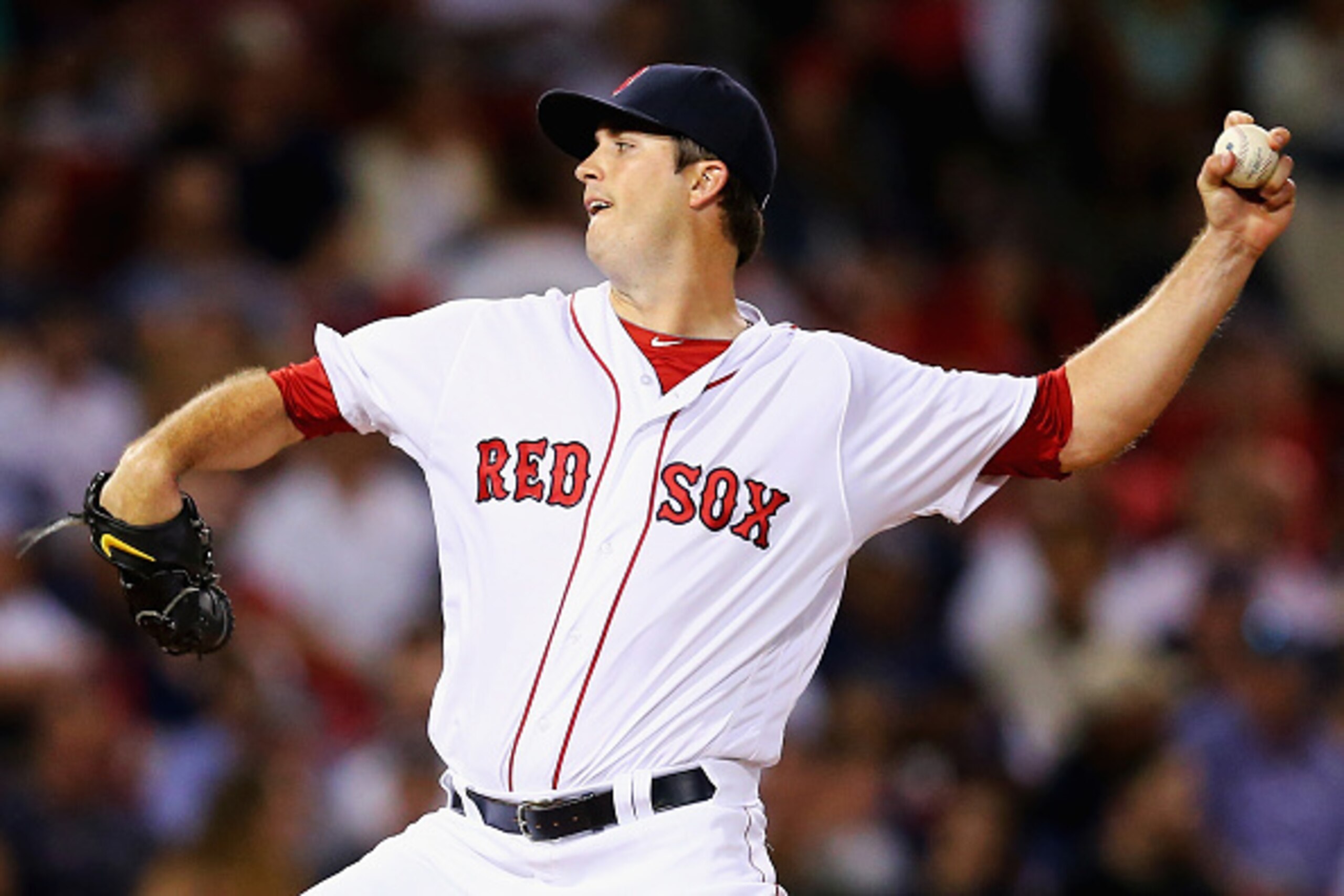
G: 30 IP: 169.1 K/9: 9.8 BB/9: 3.5 HR/9: 1.2 ERA: 3.35
Control
Drew Pomeranz finally has a consistent release point. One of the things it's earned him is improved fastball command, as he's now pretty good at working the glove-side edge with his hard stuff. But walks remain a problem in part because he's opted for more movement in his arsenal. He's added a cutter and now throws his curveball as often as his four-seamer. That can work if you spot your curve at the knees, a la Rich Hill. Pomeranz aims lower with his.
Whiffability
Pomeranz found some extra whiffability last year and has sustained it with his high strikeout rate and 11.1 SwStr% this season. This is not a velocity matter, as his average of 90-91 mph on his fastball is nothing special. This is all about his curveball. He throws it a lot, and its location and sheer vertical drop make it a tough pitch to hit. Fun to look at, too.
Hittability
As with most pitchers, the best idea is to wait Pomeranz out and hope for something down the middle. Any hitter who can get a pitch like that can crush it. Otherwise, said hitter is screwed. Pomeranz gets pop-ups from his heat and ground balls from his curveball, resulting in a 46.4 GB% and a 11.8 IFFB%. Thanks in part to these things, he has solid overall exit velocity at 88.6 mph.
Workload
Pomeranz is in uncharted territory with his workload, and it shows. His velocity has been up and down throughout the year and has peaked early in games. And thanks to his general inefficiency, he hasn't averaged six innings or 100 pitches per start. He's at least remained healthy, however, and things would look a lot worse without his strong performance the third time through the order.
Total
Pomeranz's control and workload issues prevent him from rating as a top pitcher. But he's established himself as a tough at-bat for opposing hitters, capable of missing bats and barrels with his curveball-heavy attack.
38. Tyler Anderson, Colorado Rockies
8 of 45
G: 19 IP: 114.1 K/9: 7.8 BB/9: 2.2 HR/9: 0.9 ERA: 3.54
Control
That weird little hitch in Tyler Anderson's delivery doesn't stop him from maintaining a consistent release point, which partially explains his 48.3 Zone%. Meanwhile, his pitches play well off each other thanks to his location patterns. He uses his four-seamer and cutter to toy with the glove-side corner, and he'll get his changeups to peel in the opposite direction down below the zone. Albeit in a small sample, he's shown himself to be a crafty pitcher.
Whiffability
Anderson has both a good strikeout rate and an even better 10.7 SwStr%. He's not overpowering, sitting 90-91 mph with his fastball and 86-87 mph with his cutter. But he throws a lot of changeups, and it gets the job done as his primary swing-and-miss pitch. It's not an elite swing-and-miss pitch, but its location, solid arm-side fade and velocity differential make it a good one.
Hittability
Not giving hitters anything good to hit while also feeding them varying degrees of movement has made Anderson the exit velocity king of all starters at an average of just 85.1 mph. It's legit soft contact, too, as he's up there among the league leaders in Soft%. And with a 50.9 GB%, much of that quiet contact is staying on the ground. With a larger sample size, he'd stand out even more.
Workload
Anderson has only needed an average of 94 pitches to handle 6.0 innings per start. His efficiency is a major factor, and it shouldn't be overlooked that he actually adds velocity as games go on. He's not immune to vulnerability with more exposure, however. That's one reason why he's topped out at seven innings or so.
Total
The easy knock against Anderson's position as a top-40 pitcher is that he's handled a small sample size. But in this small sample size, he's showed good control and stifled hard contact while putting up a 3.54 ERA for the Colorado Rockies. The latter, in particular, is no small feat.
37. John Lackey, Chicago Cubs
9 of 45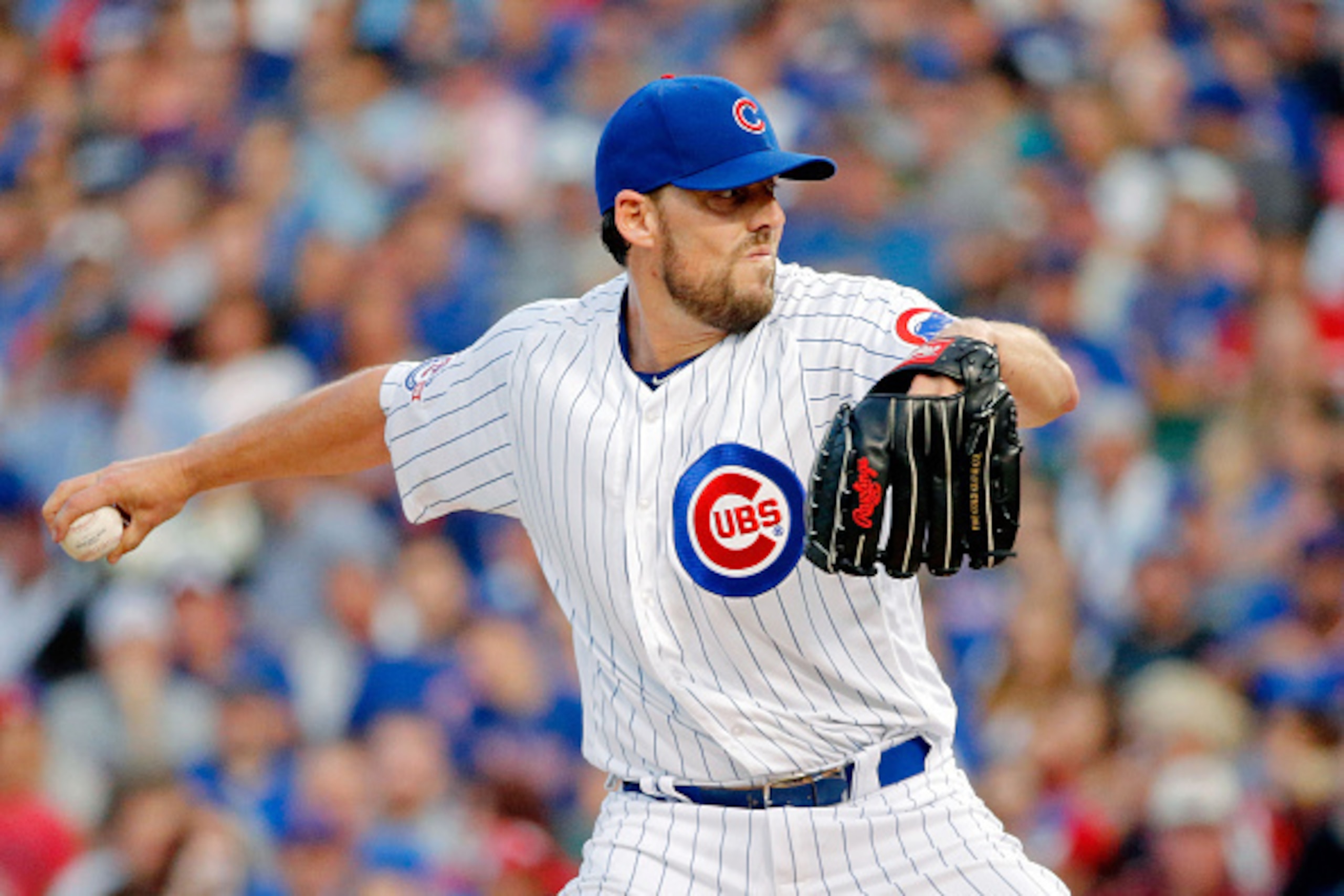
G: 29 IP: 188.1 K/9: 8.6 BB/9: 2.5 HR/9: 1.1 ERA: 3.35
Control
John Lackey's 2.5 BB/9 is the latest in a string of quality walk rates. He has an easily repeatable delivery that mostly allows for consistent release points, and he's the type who will work hitters in, out, up and down with his heat. And yet, his Zone% has gone from above 48 to just 45.0. He throws his sinkers from a lower arm slot, and has had issues throwing them in the zone as a result. He's also moved lower with his secondaries, costing him some more in-zone pitches.
Whiffability
Lackey has a solid strikeout rate and a better than solid 11.5 SwStr% to back it up. He still has good life on his pitches for a guy his age. His slider, in particular, is only getting better with age. Its whiff rate is the highest it's ever been, and it's indeed one of the better swing-and-miss sliders thrown by any starter. Two reasons: It's a good pitch, and he's putting it further out of reach.
Hittability
Lackey is typically good for a solid ground-ball rate and a solid pop-up rate, not to mention an acceptable rate of loud contact. Not in 2016. His GB% is down to 41.0, his IFFB% is down to 8.4 and his exit velocity is up to 90.4 mph. He's failed to claim ownership of the arm-side corner against both lefties and righties, who have done a lot of damage in that vicinity.
Workload
If nothing else, Lackey is always good for consuming innings. He's done that by averaging 6.5 innings on only 98 pitches per start. He's obviously big, strong and efficient with his pitches. He also avoids the third-time-through-the-order penalty. He has less velocity by then, but a more varied pitch mix.
Total
Lackey has been more prone to hard contact than he usually is, but he's otherwise featured more of the same: pretty good control, pretty good stuff and a lot of innings.
36. Kevin Gausman, Baltimore Orioles
10 of 45
G: 29 IP: 172.1 K/9: 8.9 BB/9: 2.4 HR/9: 1.4 ERA: 3.66
Control
Kevin Gausman already had good enough mechanics to be a control artist. Now he has the repertoire he needed. He's stopped messing around and become a three-pitch pitcher: four-seamer, splitter and curveball. He's putting his fastball in the zone more frequently than ever and doing a fine job of keeping it low and everything else lower, helping to boost his chase rate (34.7 O-Swing%).
Whiffability
Gausman is striking out basically a batter per inning and rocking a 10.9 SwStr% to boot. This has little to do with his 94-95 mph fastball and instead everything to do with his splitter. He's made it a bigger part of his arsenal as the season has moved along, which tells us he knows it's getting swings and misses better than any other splitter. Some of that is owed to how he's done a better job of keeping the pitch down. Apart from that, it's just a pretty pitch.
Hittability
On the surface, it could be worse. Gausman is surrendering a non-terrible average of 89.6 mph on batted balls. And with a 14.8 IFFB%, he's continuing a trend of getting better at collecting pop-ups. The catch is that his fastball has surrendered 18 home runs and 90.6 mph in average exit velo. This is a warning that it's not such a good idea to work exclusively around the knees with it.
Workload
There's good and bad here. On the one hand, Gausman has averaged 104 pitches per start and gotten tougher late in games. In a related note, he maintains his stuff well throughout games. He has lost zip throughout the season, however, and he's fallen short of six innings per start despite his many pitches. Efficiency is something he needs to work on.
Total
Gausman is still developing from a thrower into a pitcher. But with improving command to go with a nasty arsenal of pitches, he's not even all the way there yet, and he's already getting really good.
35. Jon Gray, Colorado Rockies
11 of 45
G: 28 IP: 162.2 K/9: 10.1 BB/9: 3.1 HR/9: 1.0 ERA: 4.54
Control
Jon Gray has never been bad at limiting walks, but it may be tough for him to get better as long as he has fastball command that comes and goes. He hasn't quite hammered out a consistent release point, which is partially to blame for his modest rate of fastballs in the strike zone. His overall Zone%, however, is up from 44.7 to 47.6. He's put more trust in secondary pitches this season. Those he can actually hit the zone with, giving him a unique command profile.
Whiffability
Gray has earned his strikeout rate by posting a 12.2 SwStr%. He's gained some velocity this year, sitting in the 95-96 mph range with his fastball. Having more pitches to go to also helps. But let's face it, it's really all about his slider. It's a pretty pitch, and he's benefiting from it both by using it more and by collecting more whiffs with it. It's an elite swing-and-miss slider.
Hittability
With Gray using his four-seamer and a variety of secondaries, you hope for ground balls and pop-ups. He specializes in neither, posting just a 43.5 GB% and 8.1 IFFB%. He's been collecting quieter contact despite that, as his exit velo has dropped from 89.5 mph to 88.6 mph. A more unpredictable pitch mix and a slight increase in swings outside the zone can do that for you.
Workload
Gray is a strikeout pitcher who's only thrown 97 pitches per start and whose velocity has peaked early in games. It's no wonder he gets hit hard the third time through the order, and also that he's averaged just 5.8 innings per start. He's getting there, but he's not a workhorse yet.
Total
Don't put too much stock into Gray's 4.54 ERA. That's actually pretty good for a Coors Field product, and it masks how he's developing into the power arm the Colorado Rockies hoped he would be.
34. Zack Greinke, Arizona Diamondbacks
12 of 45
G: 26 IP: 158.2 K/9: 7.6 BB/9: 2.3 HR/9: 1.3 ERA: 4.37
Control
Zack Greinke remains a great example of consistent mechanics. He basically never struggles with his release point, and that's just one thing that makes him such a great strike-thrower. Another is how crafty he is working the zone edges, earning strikes in the zone and on swings outside the zone. He hasn't been quite as sharp as usual in 2016, however, as his pitches have drifted toward the middle.
Whiffability
It's not just Greinke's strikeout rate that's down from 2015. His SwStr% is as well, going from 12.0 to 10.4. His strength is still getting hitters to expand the strike zone and whiff at his slider and changeup. But his slight command issues have lessened the whiff capabilities of those two pitches and that of his fastball even more. He doesn't have overpowering velocity, so he needs location.
Hittability
Greinke's ability to get hitters to expand the zone is still helping him here, too, as batters average only 82.6 mph in exit velocity when they make contact outside the zone against him. But his overall exit velocity is up to 88.6 mph because his command issues have made it easier for hitters to beat him in the zone, where they hit him at an average of 92.2 mph. This has had a hand in skyrocketing his HR/9 from 0.6 to 1.3.
Workload
Greinke hasn't been the same workhorse who averaged seven innings and 101 pitches per start in 2015. An oblique strain put him on the DL for a while, and he's averaged just 6.1 innings and 96 pitches when he's been healthy. Despite his best efforts to mix things up, getting killed the third time through the order hasn't helped.
Total
Greinke's 4.37 ERA overstates how bad he's been. If nothing else, he remains a terrific command artist and a good workhorse. But between his diminished whiffability and hittability, he's definitely not the same pitcher he was a year ago.
33. Chris Archer, Tampa Bay Rays
13 of 45
G: 32 IP: 194.2 K/9: 10.5 BB/9: 3.0 HR/9: 1.3 ERA: 4.02
Control
It's been a tale of two seasons for Chris Archer's control. He walked 3.9 batters per nine innings in the first half and is down to 1.8 in the second half. He's gotten his release point closer to where it was early in 2015 and also gone back to a straightforward fastball-slider pitch selection. There's also been better spacial difference between the two, which has forced hitters into chasing his pitches more often. He had a 28.2 O-Swing% in the first half. It's up to 33.6 in the second half.
Whiffability
Swings and misses haven't been a problem for Archer, as both his 10.5 K/9 and his 12.2 SwStr% are basically carryovers from 2015. He has lost some velocity off his fastball, going from 95-96 mph on average to "just" 94-95. But keeping it up in the zone allows him to keep hitters off his slider, which is still outstanding at missing bats. Considering how hard he throws it, it's unfair how much it moves.
Hittability
Archer is a case of a pitcher who's a lot better at missing bats than missing barrels. He's not great at getting ground balls (47.3 GB%) or pop-ups (7.9 IFFB%) and serves up 90.8 mph in exit velocity. The problem is his fastball, which hitters hit at an average of 93.1 mph. As much as he likes to challenge hitters with it, they can handle stuff that's hard and straight.
Workhorse
Archer can handle throwing a lot of pitches, as this is the second year in a row he's averaged over 100 per start. He also packs a little extra velocity for late in games, effectively minimalizing his third-time-through-the-order penalty. And yet he averages only six innings per start. Between all his strikeouts and (early on, anyway) his control issues, that's the price for poor efficiency.
Total
Even when Archer was struggling in the first half, he was still among the best in the game at missing bats. Ever since he found his control in the second half, he's turned back into one of baseball's best starters, period.
32. Julio Teheran, Atlanta Braves
14 of 45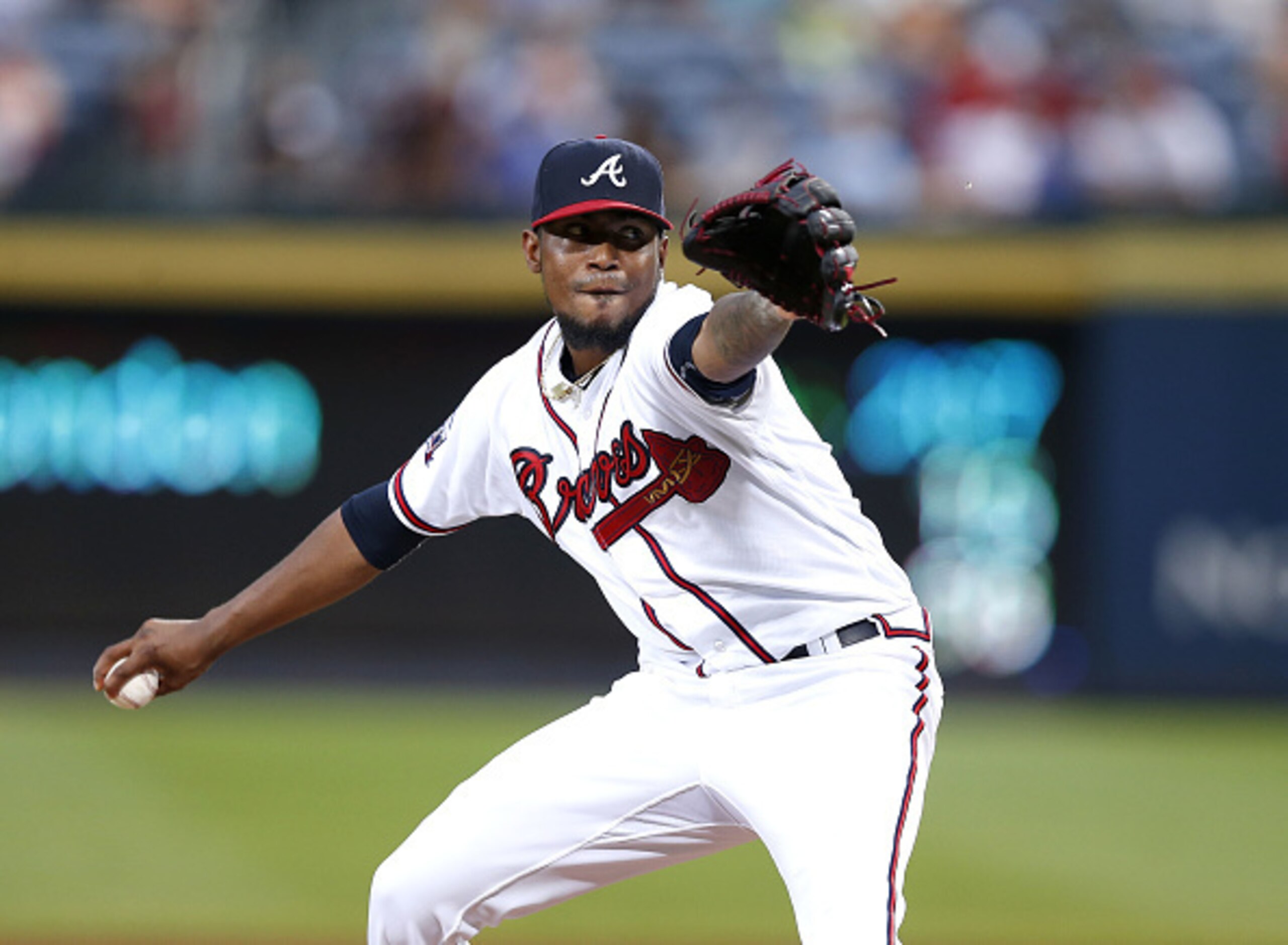
G: 29 IP: 181.0 K/9: 7.7 BB/9: 2.0 HR/9: 1.1 ERA: 3.33
Control
Julio Teheran's issue with walks (3.3 BB/9) from 2015 is no more. A big key has been him simplifying his arsenal. He's still a five-pitch guy, but it's mostly four-seamer and slider with his sinker, curveball and changeup as show-me pitches. He has a good location pattern, too, using his four-seamer to work the glove-side edge of the zone and his slider to expand beyond it. It's not by accident that he's getting hitters to expand the zone more frequently, with his O-Swing% up from 28.0 to 30.8.
Whiffability
Teheran's strikeout rate has also improved. His SwStr% of 9.9 is not his best, but pretty good. That's almost entirely owed to his slider. It's not only one of his primary pitches, but by far his best swing-and-miss offering and one of the better swing-and-miss sliders, period. It features some sharp glove-side run which, combined with its location, makes it tough to lay off and tough to hit.
Hittability
Teheran loves that glove-side edge, and batters have yet to produce enough loud contact in that area to convince him to switch things up. His stuff isn't overpowering enough to beat hitters when he makes mistakes, though. His overall exit velo is only 89.6 mph despite his ownership of the glove-side edge, and he specializes in neither ground balls (38.8 GB%) nor pop-ups (8.8 IFFB%).
Workload
Teheran has been a solid workhorse when he's pitched. He's averaged 6.2 innings per start on 99 pitches, maintaining his stuff and not getting too easy to hit with each plate appearance. It's a shame about his lat injury; otherwise he'd be looking a third straight 200-inning season.
Total
It's been wasted on a bad Braves team, but Teheran is back to looking like the promising starter who made a name for himself back in 2014. His stuff has always been good. He just needed to get his command back.
31. Rich Hill, Los Angeles Dodgers
15 of 45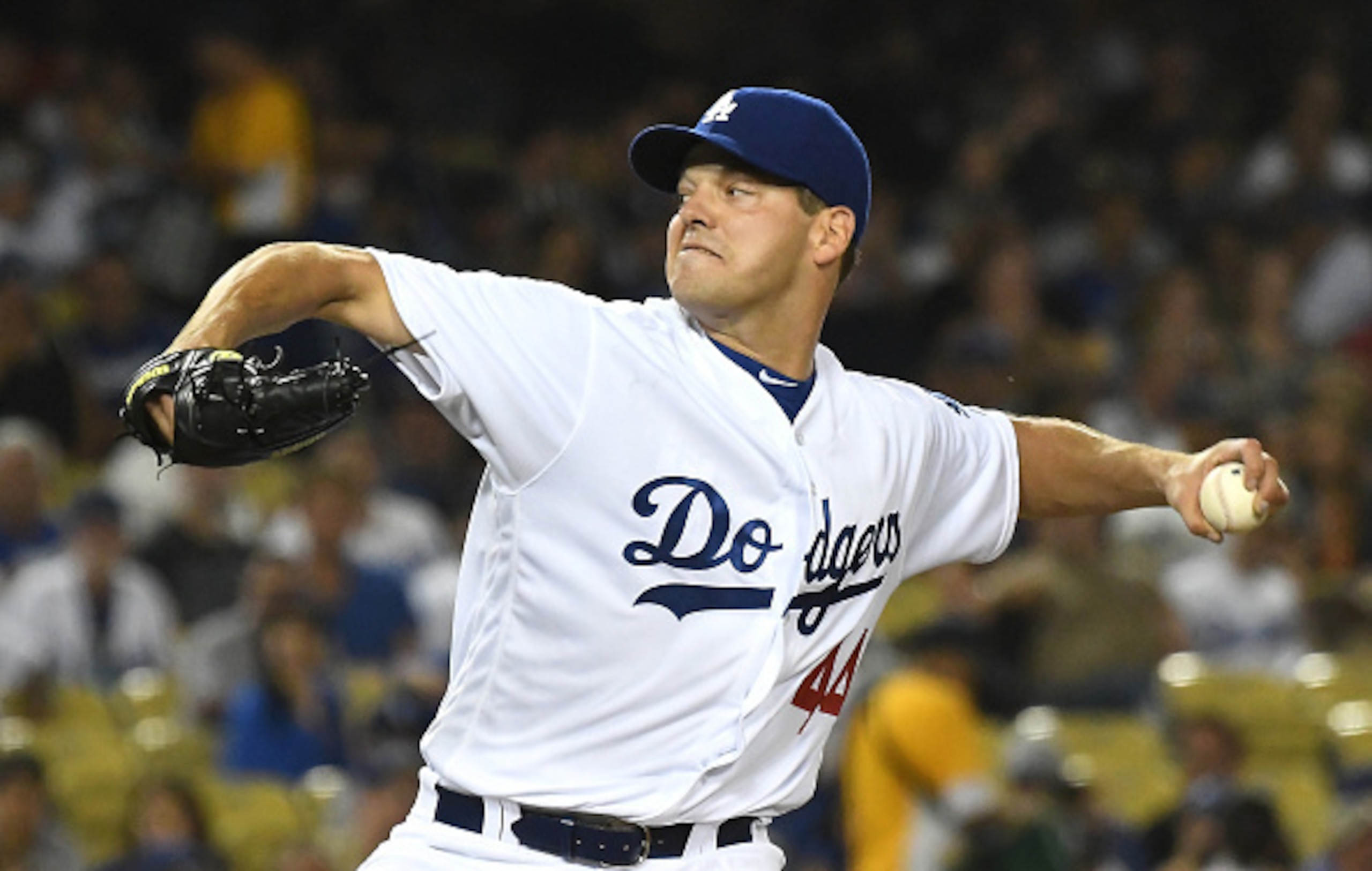
G: 19 IP: 105.1 K/9: 10.7 BB/9: 2.7 HR/9: 0.3 ERA: 2.05
Control
Some walks happen when Rich Hill is on the mound, but no other starter with at least 100 innings has hit the strike zone more frequently. He explained to me that a healthy shoulder has allowed him to be more consistent with his delivery. He also understands the value of tunneling. He's spoken about keeping his fastball and curveball "on the same axis," and he makes good on that by not having much vertical separation between the two in his location patterns. That works because...
Whiffability
No starter spins the ball quite like Hill. That results in a fastball that has good late life, and which draws whiffs better than any other. His curveball, meanwhile, has more glove-side run than any other left-handed starter's curve, and it can vary depending on the arm angle he throws from. Either way, his curves tend to be delightfully GIF-able. With these weapons, his 10.7 K/9 captures his nastiness more so than his 10.6 SwStr%.
Hittability
All that spin makes Hill just as tough to square up as it does to hit him in the first place. His fastball gets pop-ups and his curveball gets ground balls, leading to a 46.0 GB% and a 13.3 IFFB%. He's also averaging 87.6 mph in batted-ball velocity, with the only real danger area for him being across the middle of the strike zone. It's no wonder he's so tough to take deep.
Workload
Hill has been a fine workhorse when he's been healthy, averaging just about (5.9) six innings per start on just 96 pitches per start. And he's been tougher to face the second and third time through the order than the first. But in keeping with the story of his career, good health has been hard to come by. And because of that, he hasn't been allowed to go very long recently. Not even perfection could intervene.
Total
Hill's health woes have undermined his season and put a dent in his score here. Make no mistake, though. When Hill has been healthy, he's been among the game's most dominant starters.
30. Carlos Martinez, St. Louis Cardinals
16 of 45
G: 30 IP: 188.1 K/9: 7.9 BB/9: 3.3 HR/9 0.7 ERA: 3.15
Control
Not that Carlos Martinez had pinpoint control to begin with, but it's been worse and has gotten "worser" throughout 2016. He's rocking a 3.7 BB/9 in the second half, in which his release point has gotten notably lower. Relative to 2015, he's also been up with his pitches throughout 2016. On the bright side, that's meant a higher rate of pitches in the zone. On the not-so-bright side, it means he's basically been getting by on his stuff alone.
Whiffability
And yet, Martinez's stuff hasn't been as effective in 2016. His K/9 is down from 9.2, and his 9.1 SwStr% is down from 10.5. The stuff itself is fine. He hasn't lost any velocity, still sitting 95-96 with his heat. His slider and changeup are also going strong, with the latter having maintained the arm-side fade he added in 2015. But it hasn't been the elite swing-and-miss pitch that it was in 2015 despite that. That's one of the offshoots of his command issues.
Hittability
It may be easier to work Martinez for walks and to make contact against his pitches. But good contact? Still a challenge. He's carrying on as an outstanding ground ball artist with a 56.5 GB%, and he's still holding hitters to subpar exit velo at 87.6 mph. To boot, there's really no one area where it's easy to get him for loud contact. This is a legit case of a talented pitcher being effectively wild.
Workload
Martinez's undersized frame (6'0" and 185) doesn't do him any favors, but give him credit for staying mostly healthy after running into shoulder trouble late last year. And since his game revolves so heavily around his stuff, also give him credit for how well he maintains it in games. Without that, he likely wouldn't be able to average 6.3 innings per start.
Total
Martinez hasn't been as dominant as his 3.15 ERA suggests, as he's struggled with his command and ability to miss bats relative to his legitimately great 2015 showing. He still has electric stuff, though, and it continues to miss barrels.
29. Jeremy Hellickson, Philadelphia Phillies
17 of 45
G: 31 IP: 185.2 K/9: 7.3 BB/9: 2.2 HR/9: 1.2 ERA: 3.78
Control
Commanding the ball has never been Jeremy Hellickson's problem, so it's no wonder he's sticking to what's worked for him in the past in 2016. The objective of his attack is to throw low and lower, working both edges of the zone with his hard stuff and finishing hitters off with curves and changeups below the knees. He doesn't actually pound the zone, but he makes up for it by always posting O-Swing% rates over 30 percent.
Whiffability
Hellickson may only have a 7.3 K/9, but it's misleading. His 10.9 SwStr% is the his best since his Rookie of the Year season in 2010. His curveball and changeup do the heavy lifting, with the latter rating as the No. 1 swing-and-miss changeup on a whiffs-per-swing basis. He's put it further out of reach below the strike zone in 2016, which amplifies its deception.
Hittability
Hellickson will likely never fully cure his homer-itis. The reality is that he just can't beat hitters in the zone with his hard stuff. But one thing he's done this year is opt for fewer straight fastballs, downplaying his four-seamer in favor of more sinkers and cutters. The extra movement has had a positive effect. His average exit velocity is just 88.0 mph, and he's back to inducing pop-ups (14.4 IFFB%) and soft contact (20.5 Soft% and 25.7 Hard%). Long balls aside, he's been tough to hit.
Workload
As improved as Hellickson has been, his third time through the order has been his worst time through the order. He maintains his stuff and mixes it up, but hitters are simply on to his act. That's had a hand in limiting him to 6.0 innings per start, hindering what would otherwise be an impressive workload.
Total
Even I think this score overrates Hellickson's 2016 season a little. But it goes into the books as a return to form anyway, as he's back to missing bats and, more importantly, keeping loud contact to a minimum.
28. J.A. Happ, Toronto Blue Jays
18 of 45
G: 31 IP: 188.2 K/9: 7.7 BB/9: 2.6 HR/9: 1.1 ERA: 3.20
Control
J.A. Happ used to have major control problems, but he's reaped the rewards of a more consistent arm slot since adopting a three-quarters release in 2014. His new trick this year is using his two-seamer in more equal tandem with his four-seamer, using the former to work the arm-side corner and the latter to work the glove-side edge. Meanwhile, he's put his secondaries out of reach below the zone. Facing him is an uncomfortable guessing game.
Whiffability
Happ's strikeout rate isn't great, but he's also rocking a career-best 9.9 SwStr%. Pretty good for a guy who throws 70 percent fastballs that only sit in the 91-92 mph range. One of those happens to be one of the best swing-and-miss four-seamers in the league. That's owed to the solid vertical action that allows its velocity to play up and to how good he is at sneak-attacking hitters up in the zone with it.
Hittability
On that last note, up in the zone is the same place where Happ is best at avoiding hard contact. But he doesn't work there exclusively, and that invites some trouble. His overall batted-ball velocity is a not-so-good 90.1 mph. Neither his 42.5 GB% nor his 9.6 IFFB% is enough to make up for that, leaving just one thing that can: with just a 35.4 Pull%, Happ is one of the hardest starters to pull.
Workload
Eating innings used to be the only thing Happ was good for. Now it's just another thing he's good for. It's a testament to his efficiency that he's needed only 95 pitches to average 6.1 innings per start. He's also maintained his stuff well within games and, apart from a blip in July, throughout the year for a guy who's pushing 34.
Total
Happ's 3.20 ERA (not to mention his 20 wins) overstates how good he's been in 2016, but there's no question he's been one of the top pitchers in the league. The last couple of years have seen him establish good command and turn into a generally crafty pitcher.
27. Aaron Sanchez, Toronto Blue Jays
19 of 45
G: 29 IP: 185.0 K/9: 7.5 BB/9: 3.0 HR/9: 0.7 ERA: 3.06
Control
Suddenly, Aaron Sanchez can throw strikes. A related story is how he showed up to camp with more weight on him. The extra strength has made his delivery smoother and easier to repeat. He's had an easier time finding the strike zone with a 46.7 Zone%, which is really all he needs to do with his stuff. More precision with his fastball command would be nice, but for now he can let the action on his pitches overwhelm the opposition.
Whiffability
Sanchez's approach mostly involves daring hitters to try to square up his sinker, which accounts for over half his pitches. His 7.5 K/9 and 8.1 SwStr% are not disappointing in that regard. But when he does smell a strikeout, he can go to either his straight four-seamer or his hammer curveball to collect. The latter is easily his best swing-and-miss pitch. And just from the look of it, we probably haven't seen it at its best yet.
Hittability
It's not impossible to make good contact against Sanchez. Hitters are averaging 90.6 mph on their batted balls against him, doing the bulk of their damage at the bottom of the strike zone. But with a 55.1 GB% and a 20.7 Soft%, Sanchez is a case of exit velocity not telling an accurate story. To boot, he forces hitters to wait on the ball and go the other way, where balls in play don't do as much damage.
Workload
The Blue Jays are right to be watching Sanchez's innings closely. Beyond him being in uncharted territory, this is a guy whose velocity has been up and down throughout the year and within games, and who's also gotten easier to hit with more exposure within games. Despite all this, he's also averaged 6.4 innings on 97 pitches per start. He's not an elite workhorse yet, but he's getting there in a hurry.
Total
Sanchez's breakout season has hit something of a wall in its final two months. If nothing else, that's a reminder he's not yet a complete pitcher. But if this is what he can do with some control of his electric stuff, watch out.
26. Steven Matz, New York Mets
20 of 45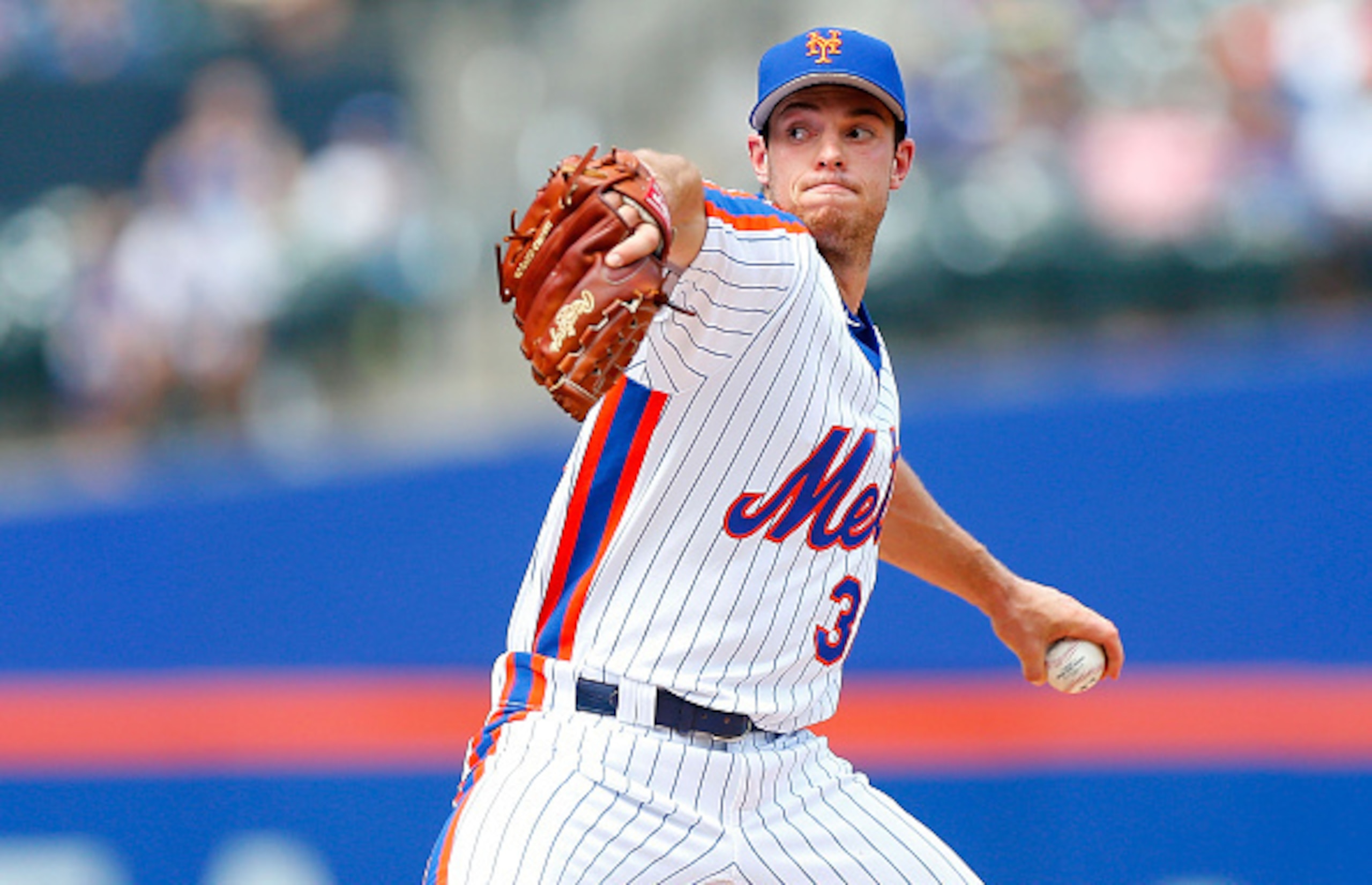
G: 22 IP: 132.1 K/9: 8.8 BB/9: 2.1 HR/9: 1.0 ERA: 3.40
Control
Steven Matz's season is over, but it was fun while it lasted. He throws strikes because he has an easy-to-repeat delivery with little wasted movement. And because, well, he just plain throws strikes. He hit the strike zone at basically the same rate as Clayton Kershaw, which is as good as it gets. He can throw strikes with all of his pitches, too, as none stray far from the center of the zone either vertically or horizontally.
Whiffability
Matz could probably get more whiffs if he baited hitters into chasing bad pitches. As it is, an 8.8 K/9 and a 9.8 SwStr% are pretty good for a guy who spent so much time in the zone. That speaks to the quality of his stuff. He threw five pitches regularly in 2016, and four of them have double-digit whiff rates. The best is his changeup, which has elite arm-side fade.
Hittability
Matz worked off a two-seamer rather than a four-seamer, making it easier for him to collect ground balls to the tune of a 51.1 GB%. He also made it incredibly difficult to pull the ball, which is when hitters are most dangerous. And thanks to all his movement, he could also limit exit velocity in the strike zone en route to an overall average of 89.2 mph.
Workload
Matz was solid when healthy, averaging 6.0 innings on just 98 pitches per start. Trouble is, he wasn't healthy for as much of the season as the Mets would have liked. And while he was a good bet for six innings, anything more was usually asking too much. He maintained his stuff well, but hitters were on to him the third time through the order.
Total
Injuries have once again conspired against Matz in 2016. Nonetheless, it shouldn't be overlooked how well he's pitched when he's been healthy, throwing strikes and overwhelming batters with an array of quality pitches.
25. Cole Hamels, Texas Rangers
21 of 45
G: 31 IP: 193.2 K/9: 9.0 BB/9: 3.6 HR/9: 1.1 ERA: 3.30
Control
It's not by accident that Cole Hamels has an inflated walk rate. His 40.2 Zone% is one of the lowest out there. This is largely a pitch selection matter. He doesn't work off his four-seamer anymore. He throws it in equal tandem with his cutter, and also throws quite a few sinkers, changeups and curveballs. That much movement ups the difficulty of controlling the ball, and he further restricts his margin for error by mainly working low and lower. It's a good pitching style, but walks are the price to pay.
Whiffability
The bright side of Hamels' pitching style is that it's still getting many swings and many swings and misses outside the zone. His changeup and curveball do the heavy lifting. Everyone knows all about the former, but the latter has quietly become an elite swing-and-miss pitch in its own right. Likewise, it's at a point that it may be just as GIFable as Hamels' changeup. This is how Hamels is continuing to strike out a batter per inning with a SwStr% in the 12-13 range.
Hittability
With so much movement and so many low pitches, it's no wonder Hamels is rocking his best GB% in years at 50.0. And courtesy of his ability to get hitters to chase his pitches, he also has averaged exit velocity of 87.9 mph. The downside: he owns the highest pull rate of any qualified starter. That's when hitters are most dangerous.
Workload
It's going to take a late push to get Hamels back over the 200-inning plateau again. He's needed over 100 pitches to average 6.2 innings per start. He's struggled badly the third time through the order, when he arguably gets too cute with his pitch selection. Rather than attack hitters, he tries to befuddle them. Apparently not a great idea.
Total
Hamels has come down to earth in the final weeks of 2016. That's not a fluke, as he was overachieving for much of the year. But let's be real: The guy still has good stuff and an idea of how to use it.
24. Michael Fulmer, Detroit Tigers
22 of 45
G: 25 IP: 155.2 K/9: 7.5 BB/9: 2.3 HR/9: 0.9 ERA: 2.95
Control
Michael Fulmer's 2.3 BB/9 is good, but even better is his 1.5 BB/9 since July. This is a case where a drop in arm slot has proved to be a good thing. Everything was up early in the year. He's since been working up only with his four-seamer and doing a better job of keeping everything down. That's a good way to keep hitters on edge, which explains his 36.1 O-Swing% since July. We've witnessed a good thrower turn into a good pitcher.
Whiffability
There's nothing special about Fulmer's strikeout rate, but his 10.5 SwStr% is above average. He has good velocity at 94-95 mph, and he can indeed use that to throw the ball by hitters. But the real stars are his slider and changeup. They're both good at getting whiffs. His changeup wasn't perceived as a weapon when he entered the majors. He's turned it into one simply by getting comfortable with it. In all, he's working with an impressive arsenal.
Hittability
Because Fulmer uses a varied pitch mix that involves him working up with his four-seamer and down with everything else, it's no surprise to see him inducing both ground balls (49.2 GB%) and pop-ups (10.9 IFFB%). His exit velocity is only average at 89.0 mph, but there haven't been really any troubling spikes since he switched things up in July. More swings outside the zone will do that for you.
Workload
Fulmer has lost velocity as the year has progressed, but he's still averaged 6.2 innings on only 96 pitches per start. His efficiency is a big key, and he also does himself the favor of bearing down when things get tough. He's not much easier to hit the third time through the order than he is the first time through the order. That's in part because he's throwing harder late in games.
Total
Fulmer's Rookie of the Year charge has slowed down in the last month or so, allowing all the talk about Gary Sanchez to heat up. Fulmer is a legit candidate, however, as he's overwhelmed hitters with his stuff and his command of it.
23. Danny Duffy, Kansas City Royals
23 of 45
G: 41 (25 GS) IP: 173.1 K/9: 9.6 BB/9: 2.1 HR/9: 1.4 ERA: 3.43
Control
This season marks the most consistent Danny Duffy has ever been with his release point, and he's taken advantage of that by pounding the strike zone. Among qualified starters, only Bartolo Colon has visited the zone more often. He mostly works at the belt with his four-seamer and sinker. Risky, but two things make it work: the excellent velocity and movement on his hard stuff, and the fact that he's keeping hitters honest by keeping his secondaries low for a change.
Whiffability
Duffy has acquired his 9.6 K/9 the old fashioned way: by getting hitters to swing and miss with a 13.1 SwStr%. His four-seamer gets its share of whiffs because of its mid-90s velocity and rising action, but his changeup and slider are the two best swing-and-miss offerings he has. Keeping them lower has helped, but both have pretty good action as well. Especially his changeup, which is gaining arm-side fade.
Hittability
Duffy normally specializes in attracting pop-ups but not this season. His IFFB% is down to 8.4. He's asked for that by challenging hitters more frequently, making it easier for them to get under the ball. Hence his 36.1 Hard% and 89.9 mph exit velocity. He's saved by how tough he makes it to pull the ball, posting the second-lowest Pull% among qualified starters.
Workload
Duffy has been a good workhorse since moving into the rotation, averaging 6.2 innings on only 94 pitches per start. Despite switching from a bullpen role, he's maintained his velo well. His act is generally wearing thin late in games, however. He might be better off sticking with his heat rather than trying to get cute with extra sliders.
Total
Simply remaining healthy in 2016 has been an accomplishment for Duffy. Meanwhile, he's also shown what he can do when given a chance to air out his high-octane stuff. He's not impossible to square up, but the hard part is hitting him, period.
22. Carlos Carrasco, Cleveland Indians
24 of 45
G: 25 IP: 146.1 K/9: 9.2 BB/9: 2.1 HR/9: 1.3 ERA: 3.32
Control
Before his season came to an early end, Carlos Carrasco continued to repeat his motion as well as anyone could possibly ask. That's one part of why his control is so good, with the other big one being how he doesn't waste his four-seam fastballs. They only account for roughly 40 percent of his pitches, but roughly 60 percent of them find the zone. That works to set up his array of secondaries. One gripe: Too many of his in-zone heaters are down the middle.
Whiffability
Between his high strikeout rate and even more impressive 12.0 SwStr%, missing bats continued to be Carrasco's specialty. For reasons discussed above, he doesn't throw many of his 93-94 mph heaters by hitters. But he has little trouble getting hitters to chase the sliders, curves and changeups he puts below the knees, and they usually come up empty. His two breaking balls are outstanding swing-and-miss pitches, and his changeup is none too shabby in its own right.
Hittability
Hitting Carrasco is tough. But for those who can, hitting him hard is easy. Going as heavy as he does on the secondary stuff allowed him to rack up a 48.5 GB%, but that doesn't make up for the fact that batted balls off him averaged 90.2 mph. It's even worse (93.1 mph) against his four-seamer. He needs it to set up his secondaries, but it's not a pitch he can beat hitters in the zone with.
Workload
Carrasco just can't avoid run-ins with the injury bug but was dependable when he was able to pitch in 2016. Although his stuff sagged as he got deeper into games, the dreaded third time through the order was when he was at his toughest. Between that and his efficiency, he was able to average over six innings per start on fewer than 100 pitches before getting hurt two pitches into his final start.
Total
Carrasco's hard contact problem and injury proneness hold him back from being truly elite. But anyone who can throw strikes with his kind of stuff is always going to be a tough guy to face.
21. Matt Shoemaker, Los Angeles Angels
25 of 45
G: 27 IP: 160.0 K/9: 8.0 BB/9: 1.7 HR/9: 1.0 ERA: 3.88
Control
Matt Shoemaker has never had any trouble limiting walks, but he's typically gone about it by attacking hitters. Essentially, he pitched to contact. He changed that in 2016. He went to his splitter more than ever before and kept hitters off it by moving everything else a little higher. The result was this: He kept a par-for-the-course 45.8 Zone% and also boosted his O-Swing% to 35.0. That's a lot of strikes.
Whiffability
It doesn't show as much in his strikeout rate, but all those swings outside the zone did help boost Shoemaker's SwStr%. It went from 9.1 in 2015 to 13.1 this year. His splitter collected the bulk of those, with both its increased use and his adjusted location pattern playing a role in that. Oh yeah, it's also a nasty pitch with diving action and some arm-side fade.
Hittability
The extra splitters and swings outside the strike zone did help Shoemaker cut down on his home run rate, which plummeted from 1.6 per nine innings in 2015. Boosting his IFFB% to a career-high 13.2 and limiting loud contact at and below the knees were a factor in that. But his overall exit velocity rose from 87.6 mph to 88.5 mph, a reflection of how hitters were liable to punish Shoemaker when he went high.
Workload
Shoemaker averaged only 5.9 innings and 92 pitches per start, but that's misleading. Although his season was bookended by a couple of short starts and one (very scary) short start, he otherwise lasted at least six innings in 19 of 27 outings. He got easier to hit as games went on, but his efficiency helped him overcome that more often than not.
Total
Shoemaker's season came to an abrupt and frightening end, but there's no ignoring how good he was when he was on the mound. He took the good command he always had and found ways to parlay it into more whiffs and some soft contact to boot.
20. Jake Arrieta, Chicago Cubs
26 of 45
G: 30 IP: 192.1 K/9: 8.7 BB/9: 3.5 HR/9: 0.7 ERA: 2.85
Control
Jake Arrieta's walk rate is substantially worse than last year's 1.9 BB/9. He's departed from the mechanical groove he got himself into over the prior three years, now working with a different arm slot. He hasn't been as sharp in general, but where he's really hurting himself is with his fastball command. He's throwing fewer of his bread-and-butter sinkers for strikes. That's made it easier for hitters to wait him out, and they've done so by dropping their swing rate against him.
Whiffability
Arrieta has gone backward here, too, and not just with his K/9. His SwStr% has gone from 11.1 to 10.5. His control issues have played a part in this, as he hasn't had as easy a time getting hitters to go fishing at his pitches. His chase rate is down from 34.2 percent to 29.4 percent. A velocity drop hasn't helped either. Still, this is not to be mistaken for a bad performance. Arrieta still has great stuff across the board, with his slider and curveball serving as two reliable swing-and-miss pitches.
Hittability
Arrieta's struggles getting hitters to chase have hurt him here too. Like any other pitcher, it's outside the zone where he collects the bulk of his soft contact. Still, going from an average of 85.2 mph on batted balls to 87.2 mph is only going from "amazing" to "great." Arrieta's array of movements also earn him a 52.8 GB% and elite soft-hit and hard-hit marks. Contact management is still his best feature.
Workload
This season hasn't been the same sort of dominant romp as 2015, when Arrieta averaged darn near seven innings per start. He's been less efficient and has had his stuff peak early in games, making him less effective with each plate appearance. Nonetheless, he's still averaged 6.4 innings and 101 pitches per start. As with everything else here, it's not all bad.
Total
There's no question Arrieta is a diminished version of the ace he became in 2015. There's also no question even a diminished version of him is still really good, particularly because it's still very difficult to hit him hard.
19. Jose Quintana, Chicago White Sox
27 of 45
G: 31 IP: 202.0 K/9: 7.8 BB/9: 2.1 HR/9: 0.9 ERA: 3.21
Control
This is the first among many things Jose Quintana doesn't get enough credit for. He has nice, simple, low-effort mechanics that make it very easy to sustain a release point. And how he throws strikes is a sight to behold. He keeps everything low but also uses his four-seamer and sinker to work in and out. He also makes good use of his many curveballs, spotting them at and below the knees. Dude's like a Colombian Tom Glavine.
Whiffability
With a pitching style like his, it's no wonder Quintana's 7.8 K/9 largely comes courtesy of his ability to catch hitters looking at strike three. His 7.5 SwStr% isn't as impressive. Such is life for a guy who, despite solid 92-93 mph velocity, is not a power pitcher. As expected, his curveball is the only good swing-and-miss pitch he has. But while it's a good-looking pitch, his refusal to use it exclusively as a chase pitch limits its whiffability.
Hittability
Quintana's sinker hasn't gotten as many ground balls in 2016, and his overall GB% has suffered. It's dropped from 47.1 to 40.3. Nonetheless, his four-seamer has had a big hand in earning him a 13.6 IFFB%, and his overall exit velocity is a solid 88.8 mph. His mistakes are easily punishable, but he's safe when he hits his spots. And he hits his spots a lot.
Workload
Another year, another 200-inning season for Quintana. Like in the previous three seasons, he got it done by averaging easily over six innings on over 100 pitches per start. Although he loses velocity as games go on, he ups his deception by downplaying his four-seamer in favor of more movement. Without that, his third-time-through-the-order penalty might be worse.
Total
Any list of the most underrated pitchers in baseball needs to have this guy on it. Arguably at the top. Quintana isn't overpowering, but he's an excellent command artist who can get outs in a number of ways.
18. Tanner Roark, Washington Nationals
28 of 45
G: 33 (32 GS) IP: 204.1 K/9: 7.4 BB/9: 3.0 HR/9: 0.8 ERA: 2.86
Control
Tanner Roark's season has been bookended by control issues. In a related story, his arm slot has been out of whack at both ends of the year. All the same, he is a better command artist than his 3.0 BB/9 lets on. He may not be one to fill up the strike zone, but he works all levels of it with his four-seamer, two-seamer and off-speed pitches, also moving the ball in and out. He's not as precise as somebody like Kyle Hendricks, but he gets the job done.
Whiffability
Roark has solid velocity in the 92-93 mph range, but he's not the type to blow anyone away. His 7.4 K/9 and 8.9 SwStr% are probably as good as it's going to get for him. He does get by OK with the sheer variety of his secondary offerings, however. He gets equal mileage out of his slider, curveball and changeup, and each is as good a swing-and-miss pitch as the last.
Hittability
Roark isn't a great ground-ball pitcher despite his many movements and smoke-and-mirrors approach, posting only a solid 48.8 GB%. But even his average of 87.9 mph on batted balls understates how good he is at quieting contact. Roark owns one of the league's highest soft-hit rates and the lowest hard-hit rate. This is the benefit of working the edges as well as he does.
Workload
After being wasted in relief last season, Roark hasn't skipped a beat in his return to the rotation in 2016. He's averaged 6.3 innings and 101 pitches per start. Not only is he efficient, but his relative success the third time through the order reflects his craftiness and how well he maintains his stuff.
Total
This is the second year out of three that Tanner Roark has quietly put up a sub-3.00 ERA in a heavy workload. He was arguably better the first time around, but there's no arguing this: He's a flat-out terrific contact manager.
17. Jacob deGrom, New York Mets
29 of 45
G: 24 IP: 148.0 K/9: 8.7 BB/9: 2.2 HR/9: 0.9 ERA: 3.04
Control
Jacob deGrom's season is over, but let's recognize that it was another good one. His arm slot has gotten lower, but that hasn't compromised his ability to find the zone. His 47.0 Zone% was actually a career high. That's good by any standards, but it's especially impressive for a legit five-pitch pitcher. He's also continuing to change eye levels, putting plenty of four-seamers up high and keeping everything else down low. So apart from the arm slot, business as usual.
Whiffability
Some velocity has fallen off deGrom's fastball. He went from sitting at 95.0 mph to the 93-94 range. His whiffability suffered accordingly but was still good. His solid strikeout rate was backed up by an equally solid 10.7 SwStr%. It's not any one pitch that did the deed but rather four of the five. Only his two-seamer didn't have a whiff rate in the double digits. Basically, what you already knew: He has great stuff.
Hittability
It sure was tough to pull the ball against deGrom, as his 32.2 Pull% was the lowest among starters with at least 140 innings. That helped mitigate the reality that his contact management was otherwise just OK. He didn't make real improvements to his ground ball (45.6 GB%) or pop-up (7.7 IFFB%) rates, and his 88.7 mph in batted ball velo was just a tick south of average.
Workhorse
After being limited by the Mets' best intentions last year, deGrom's workload was limited by the injury bug in 2016. That interrupted a season in which he averaged 6.2 innings per start on fewer than 100 pitches, a testament to his efficiency. To boot, it's a testament to his craftiness that he doesn't get considerably tougher to hit with each plate appearance despite losing stuff throughout games.
Total
Health troubles cut deGrom's season short and could limit him come 2017. But when he was healthy in 2016, he continued to establish himself as an ace with an ideal mix of stuff and command.
16. Kenta Maeda, Los Angeles Dodgers
30 of 45
G: 31 IP: 173.0 K/9: 9.2 BB/9: 2.5 HR/9: 1.0 ERA: 3.28
Control
Kenta Maeda is a low-rent Zack Greinke. He doesn't limit walks by pounding the strike zone, posting just a 42.1 Zone%. His approach is more about pounding the edge of the zone away from both lefties and righties. A consistent release point allows him to be precise in doing so, and that precision results in two things: a healthy number of strike calls and swings (31.6 O-Swing%) outside the zone.
Whiffability
Maeda's strikeout rate is the real deal, as it's backed up by an easily above-average 11.5 SwStr%. He doesn't have overpowering stuff, averaging just 90.0 mph in fastball velocity with no really explosive movement on any of his pitches. But the fact that his fastball, slider and changeup all have double-digit whiff rates is a testament to how well he locates and sequences his pitches.
Hittability
With so much movement on the outside edges of the zone, it's disappointing that Maeda has only managed a 43.9 GB%. His style of pitching away also works better against righties than lefties, who have made some loud contact on that outside corner. But overall, the reality that he's allowed just 85.9 mph in average exit velo speaks to how tough he is to square up. His 11.4 IFFB% also helps.
Workload
Maeda faced a tough transition in his first year in the States, but he's stayed healthy and maintained his stuff throughout the year. However, he's not a workhorse. Pitch count limitations have played a part in his averaging 5.6 innings per start. So has the competition, which has struggled early but ultimately knocked Maeda around to the tune of an .879 OPS the third time through the order.
Total
Workload issues aside, Maeda has been everything the Dodgers could have hoped for in 2016. Through the use of command and sequencing, he's avoided both barrels and, surprisingly, bats entirely.
15. Stephen Strasburg, Washington Nationals
31 of 45
G: 24 IP: 147.2 K/9: 11.2 BB/9: 2.7 HR/9: 0.9 ERA: 3.60
Control
Stephen Strasburg's regular season is finished because of his latest injury. If so, he won't get to lower a 2.7 BB/9 that's not his finest. But otherwise, his 49.4 Zone% is plenty high. He's always thrown strikes, but the last two years have seen him really start challenging hitters. Not just by throwing more heaters in the zone but by also throwing them higher in the zone. That works to set up his slider, curveball and changeup around the knees.
Whiffability
Strasburg is backing up his 11.1 K/9 with a 11.0 SwStr% that, strong though it is, understates his arsenal. With his newfound slider joining the fray, Strasburg has expanded from three swing-and-miss pitches to four primary offerings with double-digit whiff rates. His changeup remains the nastiest of the bunch, as well as the most GIFable. But really, they're all just...good.
Hittability
Contact management traditionally hasn't been one of Strasburg's strengths. He's changed that. His average of 88.2 mph is a case of his exit velo going further south, and that's backed up by improvements in his soft-hit and hard-hit rates. He's not doing this by getting ground balls (39.5 GB%) or pop-ups (7.7 IFFB%). He's simply missing barrels, with his migration up in the zone with his hard stuff being a big factor.
Workload
It's a shame about Strasburg's ongoing durability issues. Otherwise, 2016 would have been a nice step forward. His last injury-shortened start aside, this is the first season in his career in which he's been good for over six innings and 100 pitches per start. He's maintained his stuff within starts and actually gotten harder to hit each time through the order.
Total
Strasburg's iffy durability is more of the same. Apart from that, 2016 has probably been his most well-rounded season yet. He could always command the ball and miss bats. This year, he mixed in some contact management too, making him one of the game's most dominant starters.
14. Masahiro Tanaka, New York Yankees
32 of 45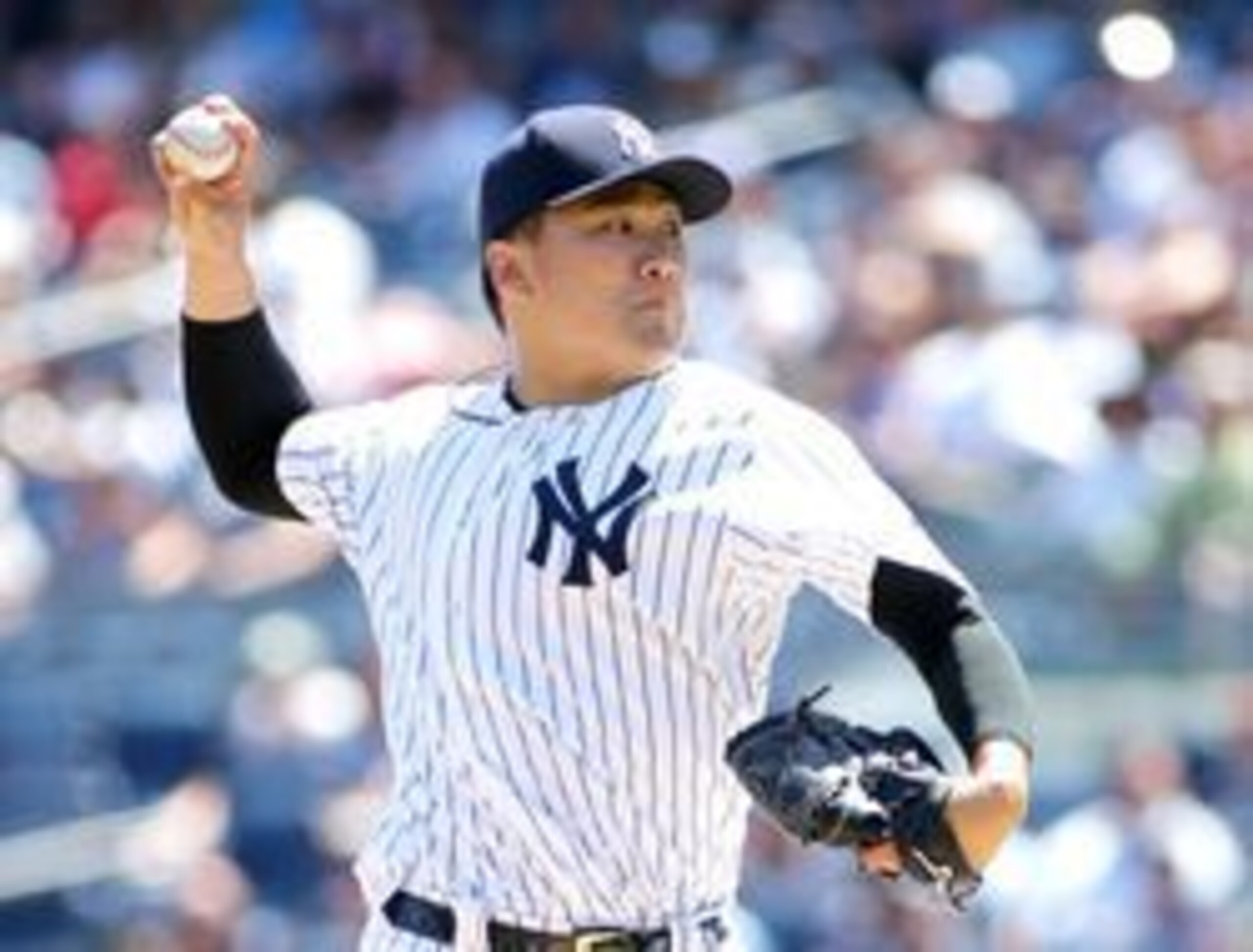
G: 31 IP: 199.2 K/9: 7.4 BB/9: 1.6 HR/9: 1.0 ERA: 3.07
Control
Masahiro Tanaka has never not been a strike-thrower, but finding a consistent arm slot after searching for one in 2015 has certainly helped. Otherwise, he's still a guy who doesn't necessarily have to pound the zone to get strikes. He moves in and out with his four-seamer, sinker and cutter, and keeps everything low to set up his slider and splitter. It takes a high chase rate to make this work. He has that covered and then some with a league-high-tying 36.5 O-Swing%.
Whiffability
This aspect of Tanaka's game has become less of a factor. It's not just his K/9 that's down. His 10.9 SwStr% is way down as well. Hitters have gotten better at recognizing and hitting his splitter, rendering it somewhat less of a world-beating force. It's still solid, however, and his slider is equally as solid. Having two good swing-and-miss pitches is a nice substitute for one elite one.
Hittability
It's a good thing Tanaka is so good at getting hitters to reach, because he's prone to getting crushed whenever he goes in the zone. That's where his not-so-good average of 89.7 mph in batted ball velocity comes from. But since he is indeed good at getting hitters to expand, he can downplay that problem. And with a 48.2 GB% and 12.0 IFFB%, much of the contact off him doesn't go far.
Workload
Remember when everyone assumed Tanaka's elbow was a ticking time bomb? So much for that. He's stayed on the mound and been a reliable workhorse the whole way. His efficiency has allowed him to average 6.4 innings per start on an average of 95 pitches. He also has a little extra zip late in games, making him a challenge to face the third time around.
Total
Tanaka began his career amid overwhelming hype. There's been less of that in 2016, and it's rendered his best season yet largely invisible. Although he's not the strikeout pitcher he used to be, he's craftier and just as effective.
13. David Price, Boston Red Sox
33 of 45
G: 34 IP: 225.0 K/9: 9.0 BB/9: 1.9 HR/9: 1.2 ERA: 4.04
Control
There's not much left to say about David Price's control. Everything stems from perfect mechanics, and throwing fewer fastballs hasn't robbed him of his ability to throw strikes. He doesn't wander far from the center of the zone vertically or horizontally. What he does instead is move the ball around, working all edges of the zone and keeping hitters guessing. He's been sharper at some times than others in 2016, but on the whole, neither his 1.9 BB/9 nor his 47.3 Zone% really does him justice.
Whiffability
Price's velocity loss is too great to be ignored, as he's gone from sitting 94-95 mph to sitting 92-93 mph. But he's still striking out a batter per inning with a 12.0 SwStr% anyway. He mostly owes this to his changeup, which continues to get better as a swing-and-miss offering. It has more arm-side fade than it used to, and Price is typically flawless in locating it.
Hittability
This is where Price's velocity loss has actually hurt him. It's been years since he was a good ground-ball artist, so limiting damage is entirely up to him missing barrels. He hasn't done that. His 88.2 mph average in batted ball velo isn't terrible, but hiding behind it is (by far) a career-high 34.9 Hard%. Not surprisingly, that stems from an exit velo increase against his hard stuff.
Workload
Nothing wrong here. Price hasn't missed a start and has once again gone well over 200 innings. He's averaged 6.6 innings and 103 pitches per start. His stuff is remarkably consistent within each start. And despite his overall decrease, he's actually managed to add velocity over time.
Total
Price's 4.04 ERA doesn't befit an ace, but he's been steady with a 3.43 ERA since mid-May. Along the way, he's done what he usually does: throw a lot of strikes, miss a lot of bats and eat a ton of innings.
12. Rick Porcello, Boston Red Sox
34 of 45
G: 32 IP: 217.0 K/9: 7.6 BB/9: 1.2 HR/9: 0.9 ERA: 3.11
Control
Simply hitting the strike zone is no problem for Rick Porcello, in no small part because he has efficient mechanics that he's consistent with. But how he throws strikes is also commendable. He's fallen in love with the high fastball, which by itself is a useful tool for changing eye levels. But usually that means setting up pitches below the knees. Porcello may be the only guy in the sport who so consistently works at the knees with his other pitches. Impressive stuff.
Whiffability
Neither Porcello's 7.6 K/9 nor his 8.1 SwStr% highlights him as a strikeout artist. That's a sacrifice he has to make with all his pitches in the strike zone. But there's still no ignoring how his four-seamer has taken over as his most reliable swing-and-miss offering and one of the better swing-and-miss fastballs anywhere. With velocity that sits in the low 90s, this is proof that location can indeed be as valuable as any radar gun reading.
Hittability
With a 43.8 GB% that's on track to be a career low, Porcello is no longer the extreme ground ball pitcher he used to be. But he hasn't become a poor contact manager despite that. He's cashed in some ground balls for pop-ups with a 13.2 IFFB%, and his batted balls average just 88.9 mph. He can still get caught making the occasional flat pitch and pay for it with a rocket off the bat, but those are really the only times he gets hurt.
Workload
With velocity that peaks in the first inning and goes swiftly downhill from there, Porcello should be having trouble eating innings. Instead, he gets tougher to hit with each time through the order and has averaged 6.8 innings per start on 103 pitches. That's what craftiness can do.
Total
Has Porcello been as good as his 22 wins and 3.11 ERA? Probably not. He's benefiting from a career-low BABIP that overstates his contact management. Nonetheless, he's certainly one of the elite command artists and workhorses in the game.
11. Johnny Cueto, San Francisco Giants
35 of 45
G: 31 IP: 212.2 K/9: 7.9 BB/9: 1.9 HR/9: 0.6 ERA: 2.79
Control
Explaining Johnny Cueto is a bit like explaining Mulholland Drive, but here goes... First off, it shouldn't work. He not only uses a variety of motions that spread his release point around, but he also has an arsenal that favors pitches with movement. But he actually can find the zone, posting a 44.6 Zone%. And by going in, out, up and down, he also forces hitters to expand the zone (32.4 O-Swing%). It's weird...but effective.
Whiffability
With his different looks and movements, Cueto is more about freezing hitters than racking up whiffs. His SwStr% is only 9.2 this year. One issue is that he just doesn't throw that hard anymore, as his fastball now averages just 91-92 mph. But if nothing else, he'll always have his changeup to get whiffs for him. It's a good change of pace from his other stuff. And also, totally nasty.
Hittability
With so many different types of movements, the only pitch Cueto throws that doesn't get ground balls is his four-seamer. Instead, it gets pop-ups. Hence his combination of a 50.6 GB% and a 10.9 IFFB%. He also rocks below average exit velo at 88.3 mph, with most of that coming courtesy of his talent for getting hitters to reach for his pitches.
Workload
This is Cueto's fourth year out of five with over 200 innings, and he's averaged darn near seven innings on over 100 pitches per start to get there. His velocity may be down overall, but he adds velocity as games go along. That and his general ability to befuddle hitters explains why he's so tough the third time around.
Total
As good as he is, young pitchers should take note: Don't be like Johnny Cueto. Only Johnny Cueto can use different quirks, movements and sequences to baffle the opposition.
10. Jon Lester, Chicago Cubs
36 of 45
G: 31 IP: 197.2 K/9: 8.7 BB/9: 2.2 HR/9: 0.9 ERA: 2.28
Control
In appreciation of Jon Lester's mechanics, we'll now acknowledge that his release point has barely budged in the last few years. That's one reason why he's one of the best command artists working today. The other is how consistently he works both sides of the zone with his four-seamer and owns the glove-side edge with his cutter. This leaves only one reasons why his walk rate is just 2.2 per nine innings: David Ross hasn't stolen as many strikes for him.
Whiffability
Lester has experienced a nice velocity spike in 2015 and 2016, averaging a little over 92 mph on his heat. But that's not really the reason he has a solid strikeout rate, not to mention a 10.4 SwStr%. What's really helping is how he's using his curveball. He's been moving it lower and lower and has watched its whiff rate rise accordingly. It now draws more whiffs per swing than any other curveball.
Hittability
Lester's cutter and curve induce ground balls, and his four-seamer gets pop-ups. It's a nice dynamic that has led to a 46.6 GB% and an 10.8 IFFB%. And by virtue of his ownership of the glove-side edge of the strike zone, he also has good average batted-ball velocity at 88.0 mph. His mistakes get hit hard, but this is what happens when you don't make many of those.
Workload
Lester may be pushing 33, but he's still ticking as a reliable workhorse. He's once again averaging over six innings per start, this time on less than 100 pitches. There hasn't been a drop-off in his stuff throughout the year. Ditto for within games.
Total
It feels like Lester has gotten lost in the shuffle after a moderately disappointing season in 2015. But make no mistake: He's back to doing everything well thanks to pinpoint command and stuff that's aging well.
9. Jose Fernandez, Miami Marlins
37 of 45
G: 29 IP: 182.1 K/9: 12.5 BB/9: 2.7 HR/9: 0.6 ERA: 2.86
Control
As petty a gesture as it may be, the final season of Jose Fernandez's all-too-brief career is certainly worth saluting. He continued to avoid the lower arm slot that may have ruined his elbow in 2014. He also assaulted the strike zone with more fastballs. Just as important was his curveball command. He kept moving it further from the center of the zone, making it more tempting for hitters to chase as it swept across the plate. We were watching a great thrower turn into a truly great pitcher.
Whiffability
Of course, the stuff that made us all fall in love with Fernandez in the first place was still there as well. He finished with a 12.5 K/9 and a 14.2 SwStr%. His curveball only got tougher to hit and was an elite swing-and-miss offering no matter which way you slice it. GIFable, too. His changeup and fastball, which sat in the 95-96 mph range, weren't too shabby either. Together, these things were pushing Fernandez toward one of the highest strikeout rates ever. A couple bonus points are only fair.
Hittability
Hitters are most dangerous when they pull the ball. That's something they weren't able to do against Fernandez, who had the lowest pull rate in MLB. That was a good way for him to limit the effect of the hard contact that found him anyway. His batted balls averaged 89.9 mph, which he didn't absorb with ground balls (40.2 GB%) or pop-ups (7.7 IFFB%).
Workload
The Marlins watched Fernandez's workload closely, but that didn't stop him from making strides as a workhorse. This was the first year he averaged over 100 pitches in addition to six innings per start. And whereas he used to leak velocity as games went along, he held his throughout games this season.
Total
Fernandez was absolutely one of the best pitchers in baseball in what tragically turned out to be his final season. And as always, boy did he make it look fun. I'm at once amazed that he left us with so many fond memories in just four years as a big leaguer, and heartbroken that there will be no more.
I like to think he's on a mound in the middle of an Iowa cornfield, smiling as he blows heat past Shoeless Joe Jackson and other legends who have passed us by.
8. Madison Bumgarner, San Francisco Giants
38 of 45
G: 33 IP: 219.1 K/9: 10.1 BB/9: 2.2 HR/9: 1.1 ERA: 2.71
Control
Doug Thorburn of Baseball Prospectus rated Madison Bumgarner's mechanics as the best in the NL West in 2014. This season is the best he's been at repeating them. Meanwhile, he's keeping it simple with his three-pitch mix; four-seamers go high, cutters/sliders go low, and curveballs go lower. Any pitcher could do this in theory, but his execution of it sets him apart. One gripe: Working a little lower with his fastball and a little higher with his cutter has cost him swings outside the zone.
Whiffability
Bumgarner's career-best 10.1 K/9 is slightly misleading, as it comes with an 11.5 SwStr% that's not a career best. But whatever. His ability to throw his fastball and cutter by hitters is going strong, and his curveball continues to gain steam as one of the best swing-and-miss hooks out there. That reflects its increasing nastiness, as it keeps dropping more and more every year. This calls for a GIF.
Hittability
Bumgarner started out as a ground-ball pitcher, but he's become more of a pop-up guy as he's fallen in love with the high fastball. So it goes with a 11.2 IFFB%. He's also rocking average exit velocity of 89.1 mph, which is respectable. But this is the area where drawing fewer swings outside the zone is hurting him. He collects as much soft contact outside the zone as anyone, but that ability hasn't been exploited as much in 2016. There's been louder contact off him as a result.
Workload
By now, I'd say Bumgarner's picture belongs next to the term "workhorse" in the dictionary. He continues to be good for more than 100 pitches per start, as well as nearly seven innings. This isn't so much because he gets tougher to hit as games go on. The opposite is actually true. It has more to do with him being a literal Paul Bunyan clone who never tires and can't be broken.
Total
Bumgarner is about to make it four years in a row with over 200 innings and an ERA under 3.00. That shows what you can do with strong mechanics and great stuff.
7. Chris Sale, Chicago White Sox
39 of 45
G: 31 IP: 221.2 K/9: 9.2 BB/9: 1.8 HR/9: 1.0 ERA: 3.21
Control
With a delivery seemingly comprised entirely of knees and elbows and stuff that moves all over the place, Chris Sale shouldn't be able to throw strikes. And yet, he does. He's among the best at finding the zone and among the best at working it. He can go in, out, up and down with his heat and work off the corners with his slider and changeup. He thus enjoys the best of both worlds: strikes in the zone and strikes from hitters who are chasing his pitches (33.4 O-Swing%).
Whiffability
It was clear early on that Sale would be pitching to contact more in 2016. He's held himself to that, working with less velocity and lowering his strikeout rate and SwStr% (11.3) well below his 2015 numbers. But this is still Sale we're talking about. He still throws hard, and his four-seamer, sinker, changeup and slider all have insane movement. The only one without a double-digit whiff rate is his sinker, giving him three reliable swing-and-miss pitches.
Hittability
Pitching to contact with less velocity has allowed more hard contact to find Sale. His exit velo is up from 86.2 mph to 89.1 mph, and his hard-hit rate is up from 25.1 to 31.7. But he's still mostly safe when he works on the edges and when he gets hitters to chase—two things he continues to do well.
Workload
Here's one benefit of not chasing as many strikeouts: Despite averaging about the same number of pitches per start as he always does, Sale is also averaging 7.2 innings per start for the first time. And he's been tougher the second and third time through the order than the first. He starts hitters off with a lot of four-seamers and then likes to hit them with more sliders later. That's no fun for them.
Total
This hasn't been Sale's most overpowering season, but even a less overpowering Sale is still one of the best pitchers in the sport. Maybe he doesn't miss bats, but he still has outstanding command of lethal stuff.
6. Corey Kluber, Cleveland Indians
40 of 45
G: 32 IP: 215.0 K/9: 9.5 BB/9: 2.4 HR/9: 0.9 ERA: 3.14
Control
Doug Thorburn of Baseball Prospectus rated Corey Kluber's mechanics as the best in the AL Central back in 2014. His arm slot has dropped since then, but at least it's remained consistent throughout 2016. And while he doesn't make things easy by throwing more sinkers, cutters and sliders than four-seamers, he makes it work. He can work both sides of the plate with his hard stuff and has done a better job of keeping his slider and changeup down.
Whiffability
Kluber's K/9 is down a notch from his high of 10.3 in 2014, but his 12.6 SwStr% is par for the course. He doesn't throw as hard, sitting at 92-93 mph with his fastball. But he can still throw the ball by hitters and has a downright filthy weapon in his slider. It gets more glove-side run than any slider thrown by any other starter. That leads to some awesome GIFs, as well as an elite swing-and-miss rate.
Hittability
Despite his array of movements and strong command, Kluber remains a modest ground-ball artist with a 44.5 GB%. His real talent is limiting hard contact. He's averaging just 87.0 mph on his batted balls, with one of the league's lower hard-hit rates to boot. Both lefties and righties can hurt him around the arm-side edge of the zone, but it's tough to square him up anywhere else.
Workload
Kluber should make it three years in a row with over 220 innings. He's helped himself by gaining velocity as the year has moved along. He's also maintained his stuff well within games, making it that much easier to sustain his dominance each time through the order. These things plus his efficiency and his sheer size explain how he's able to average 6.7 innings on 100 pitches per start.
Total
Kluber may never again match his 2014 peak, but this season has put to rest the notion that it was a one-year wonder. He still has filthy stuff and an idea how to use it.
5. Justin Verlander, Detroit Tigers
41 of 45
G: 33 IP: 220.2 K/9: 10.0 BB/9: 2.3 HR/9: 1.2 ERA: 3.10
Control
Justin Verlander wasn't right for a while. Especially not in 2014, when he was all messed up following offseason surgery. But good health has allowed him to be free and easy with his delivery the last two seasons, and his command has been particularly on point this year. He's back to loving the high fastball, and he can work on both sides of the plate with it. That keeps hitters off all the other pitches he has, which he keeps low enough to boost his chase rate from 31.3 to 33.8.
Whiffability
Verlander has regained some of his lost velocity, going from 92-93 mph to 93-94 mph with his fastball. Beyond that, he's getting more spin on his pitches than all but a couple of other starters. These things would indeed equal a high strikeout rate, not to mention his best SwStr% in years at 12.0. None of his pitches is truly elite at racking up whiffs, but his four-seamer, slider and changeup all have double-digit whiff rates. That mix of quality and quantity is a taste of Verlander's good ol' days.
Hittability
Verlander has always been more of a fly-ball pitcher, so it's imperative that he collect as many pop-ups as he can. His 11.2 IFFB% is right in line with his career norm in that regard. He's also doing a good job of stifling loud contact in general, limiting batted balls to 88.3 mph in exit velo. That's mostly thanks to his preference for high hard ones and his renewed ability to get hitters to chase.
Workload
Let's not be surprised that a healthy Verlander is averaging darn near seven innings and 110 pitches per start. It's not smooth sailing the whole way, as he hasn't been exempt to the third-time-through-the-order penalty. But for all we know, it would be worse without his time-honored habit of throwing harder as games move on.
Total
Verlander is back. He may not have his vintage stuff, but being able-bodied for the first time in years has allowed him to reclaim good stuff and even better command.
4. Kyle Hendricks, Chicago Cubs
42 of 45
G: 30 (29 GS) IP: 185.0 K/9: 8.1 BB/9: 2.1 HR/9: 0.7 ERA: 1.99
Control
You know you're living well when people are comparing you to Greg Maddux. It's high praise that Kyle Hendricks is deserving of. He has a fluid delivery that he's worked into a consistent arm slot this year. Beyond that, watching him pitch typically means taking in a master class on how to locate. Hendricks will work both sides of the zone, and this year he's doing a better job of changing eye levels with more high four-seamers and lower off-speed pitches. I try to avoid perfect scores, but...
Whiffability
Hendricks isn't really a strikeout pitcher, but his 8.1 K/9 and his 10.2 SwStr% are above-average. He doesn't throw hard, averaging just 87-88 mph with his fastball. But he quietly has an elite swing-and-miss changeup. His new habit of changing eye levels helps it, but nothing beats old-fashioned sharp movement. The pitch dives like a splitter, except with more arm-side run.
Hittability
Moving the ball around with different types of movement? That's a good way to avoid barrels. He's the type who can induce ground balls (48.6 GB%) and pop-ups (9.7 IFFB%). He also boasts an average of 87.3 mph on his batted balls that actually understates things. His 25.0 Soft% is the best in baseball, and his 25.6 Hard% is one of the best.
Workload
Hendricks doesn't have as many starts as other top pitchers, but he's otherwise handled as much as the Cubs could have asked. He's needed only 95 pitches to average 6.3 innings per start, and he's maintained his stuff well and refused to wilt under the weight of more exposure.
Total
Hendricks may be the best pitcher in a starting rotation that also features Jake Arrieta, Jon Lester and John Lackey. All he's needed to achieve that is pinpoint command of an arsenal full of movement.
3. Noah Syndergaard, New York Mets
43 of 45
G: 31 (30 GS) IP: 183.2 K/9: 10.7 BB/9: 2.1 HR/9: 0.5 ERA: 2.60
Control
We'll get to Noah Syndergaard's habit of throwing thunder in a second. For now, his control is worth appreciating too. His delivery has no wasted movement, making it easy for him to maintain a consistent release point. And while he could just try to blow hitters away in the strike zone, he's a bit more methodical. He'll work both sides of the plate, especially against righties. He earns himself a solid 45.3 Zone% and sets hitters up for an elite 36.5 O-Swing%. Now then, thunder...
Whiffability
It would be disappointing if Syndergaard didn't have one of the highest strikeout and swinging strike (14.2 SwStr%) rates in the league. His average fastball of 98.0 mph is the best there is by plenty, and he also has a slider and changeup that can both eclipse 90 mph. The latter two do the heavy lifting, as both rate as elite swing-and-miss offerings. You know, just in case you couldn't tell from looking at them.
Hittability
Syndergaard doesn't just try to blow hitters away with his four-seamer. It's only accounting for about 30 percent of his pitches, with the rest being sinkers and off-speed offerings. That's where his 51.2 GB% comes from. As for his upper-crust 21.0 Soft% and his 87.9 mph in average batted-ball velocity, well, that's what happens when you have stuff so good that you can only be hurt right down the middle.
Workhorse
Syndergaard's first full season has gotten to him a little bit lately, as his velocity hasn't been as consistent in the last three months as it was in the first three. Besides which, the Mets have been cautious with his pitch counts. All the same, he's averaged 6.1 innings on 97 pitches per start. He's been notably tough the third time through the order. In a related story, he has a little Justin Verlander in him, upping his heat when games get late.
Total
Syndergaard's first full season in the majors has been as advertised. If anything, he's surpassed expectations with his stuff and has certainly surpassed them with his command.
2. Clayton Kershaw, Los Angeles Dodgers
44 of 45
G: 20 IP: 142.0 K/9: 10.7 BB/9: 0.6 HR/9: 0.4 ERA: 1.65
Control
It's unfair to give a guy who's missed half the season a perfect score. Otherwise, there's nothing to complain about. Clayton Kershaw probably has baseball's most consistent delivery, and he continued to use it to assault the strike zone in 2016. And he can pretty much do what he wants with his stuff. In or out with his fastball. At or below the knees with his slider. Ditto with his curveball. And with hitters constantly on edge, he's able to get them to expand the zone with a 34.5 O-Swing% too.
Whiffability
Apart from the sample size, there's nothing to gripe about here either. Kershaw backs up his strikeout rate with a 15.6 SwStr%. His fastball, which has elite vertical action in addition to solid 93 mph velocity, has become a good swing-and-miss pitch. His slider is one of the best there is at missing bats. His curveball actually isn't, but, well, come on.
Hittability
This is something Kershaw still doesn't get enough credit for. He's become a good ground-ball artist as he's continued to downplay his fastball, posting a 49.5 GB%. But since that fastball can still induce pop-ups, he's also rocking a 15.5 IFFB%. He's also limited batted balls to just 87.4 mph. He can be beaten when he makes mistakes, but, yeah. This is Kershaw we're talking about.
Workload
Had it not been for his bad back, this would be yet another year of Kershaw eating innings like, as the kids used to say, they're going out of style. He was averaging darn near eight innings per start before his back acted up, and his average has regressed to only 7.1 innings per start since he returned.
Total
It says a lot that Kershaw can sit for half the year and still come out looking like arguably the best pitcher in baseball. He's the most perfect pitcher in the sport, combining pinpoint command with some of the best stuff around.
1. Max Scherzer, Washington Nationals
45 of 45
G: 33 IP: 223.1 K/9: 11.2 BB/9: 2.2 HR/9: 1.2 ERA: 2.82
Control
Max Scherzer's 2.2 BB/9 isn't as impressive as last year's 1.4 mark. That's life when you opt for more movement and hitters are more disciplined against you. But throwing strikes has hardly become a problem. The consistent arm slot Scherzer found in 2013 is still going strong, and he's hitting the zone with over 60 percent of his fastballs. The only gripe is that he hasn't been changing eye levels as well, as he's down with his heat and up with his secondaries. Otherwise, nothing to complain about here.
Whiffability
This is the second year in a row Scherzer has rocked a K/9 in the 11 neighborhood and a SwStr% in the 15 neighborhood. You shouldn't need me to tell you his stuff is straight-up nasty. He sits 94-95 mph with a fastball that also has lethal late life, making it one of the best in the business at missing bats. His slider is also an elite swing-and-miss pitch. His curveball and changeup are two good ones. With stuff like this, it doesn't matter where he locates it. He can get whiffs both inside and outside the zone.
Hittability
The home runs are an obvious blemish. That's related to how Scherzer is very much a fly-ball pitcher. In addition, even he's risking being hurt whenever he makes mistakes in the zone. Nonetheless, his batted-ball velocity is just 87.6 mph, and he has strong soft-hit (22.1) and hard-hit (29.5) rates, not to mention a 13.3 IFFB%. He may be home run-prone, but most of what he serves up is soft contact.
Workhorse
Make it three 220-inning seasons in three years for Scherzer. He's big, strong and efficient, and he maintains his stuff well. Plus, he's not terrible the third time through the order. These are good ways to average 6.8 innings on 105 pitches per start.
Total
In a year that's gotten only half a season out of Clayton Kershaw, Scherzer stands out as the National League's most well-rounded pitcher. He might have the most electric stuff of any pitcher, and his command of it has only gotten better with age.


.jpg?w=2560 "Lions Clear $35.6M Cap Space")

.jpg?w=2560 "Report: Tucker Kraft Earns $75M Deal")
.jpg?w=2560 "Most Important 2027 NFL Free Agents")


.jpg?w=2560 "Cooper Rush Injury Update")