Teddy Bridgewater's Injury Ends a Fairy-Tale Vikings Season Before It Begins
Teddy Bridgewater hit Charles Johnson for 19 yards, then connected with Stefon Diggs on a deep corner route for 22 yards, then found Kyle Rudolph over the middle for a 27-yard catch-and-run touchdown. Three crisp, deep passes to three different receivers, 68 yards and six points in about 40 seconds of a two-minute drill, rat-a-tat-tat.
It was Sunday afternoon, the new U.S. Bank Stadium looked like a futuristic palace from a science fiction movie, and after some early sluggishness, Bridgewater and the Vikings offense was sharp and dynamic. It was preseason hope in distilled form: the young quarterback, his multifaceted arsenal, his newfound confidence and big-play capacity. For a few minutes, a breakout season from Bridgewater and the Vikings loomed on the immediate horizon.
TOP NEWS

New NFL contenders starting to emerge after Week 4
.jpg?w=2560 "Cardinals Giants Football")
NFL investigating 2 referees for separate viral exchanges
.jpg?w=2560 "Hill Injury Update Football")
Report: Chiefs Contact Hill's Agent
Then Bridgewater crumpled to the turf Tuesday afternoon, and so much of that hope crumpled with him.
Brian Murphy of the St. Paul Pioneer Press described the scene in a graphic series of tweets that read like Herbert Morrison's radio account of the Hindenburg disaster:
But a zeppelin didn't crash at Vikings practice. A young quarterback crashed, painfully and frighteningly, taking the fortunes of a franchise with him at least for 2016, but possibly beyond.
The Vikings announced Tuesday evening that Bridgewater suffered a dislocated knee and a torn ACL. Prior to the official diagnosis, Vikings head coach Mike Zimmer confirmed during an afternoon press conference that it was a "significant knee injury" and a "possible" season-ender. He even noted that Bridgewater needed sedation, a discouraging sign.
Bridgewater is going to be gone for a while, long enough to turn Sunday's impressive effort from the first page of storybook into a forgettable footnote.
When a budding franchise quarterback such as Bridgewater goes down, the whole football world holds its breath. There's a risk that he could take an entire coaching regime, organizational philosophy and era of football down with him.
The Cowboys suffered a major loss of their own last Thursday when Tony Romo suffered his second significant back injury in two years. But the situations are very different. Bridgewater is not 36 years old with a decade of ups and downs behind him and a successor waiting in the wings. Romo's injury was unfortunate, but the rise and fall of the Romo era was squarely behind us the moment he got hurt early in 2015.
Bridgewater is part of a nucleus of talent that was just starting to demonstrate what it might be capable of. He's the centerpiece of a large haul of recent high draft selections: Matt Kalil, Harrison Smith, Sharrif Floyd, Anthony Barr, Trae Waynes, Eric Kendricks. Some of the selections worked out better than others, but there were lots of them, and along with late-round finds such as Diggs, they were all growing up together, with Adrian Peterson as the drill sergeant.
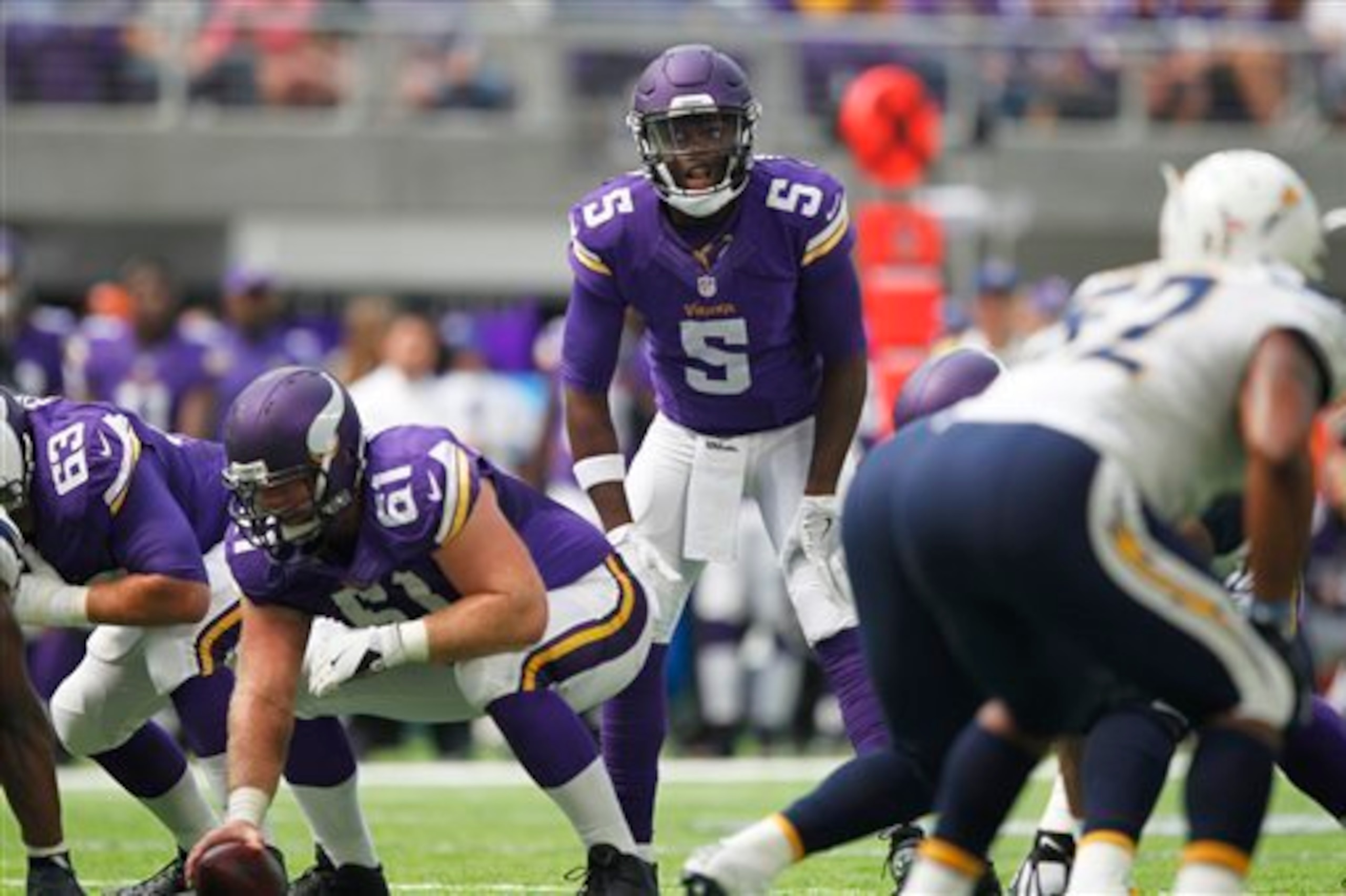
There's something beautiful about a football team building through good draft decisions and careful cap management. You can keep your worst-to-first stories; many teams that "come from nowhere" go back there after a year or so. It's more fun to watch the skittering pebbles become an avalanche. First some rookies develop, then a weakness becomes a strength, then the young quarterback finds his go-to receiver, then he learns to find his checkdown receiver, and before long, the opponent can't find a single weakness to exploit on the road in mid-January.
The Vikings have made so many good decisions since hiring Mike Zimmer as head coach. They traded up to select Bridgewater, whose combine and pro-day workouts were the stuff of negative draft-spin legend, when new offensive coordinator Norv Turner found an easy-to-correct hitch in his delivery.
The team found a way to keep Peterson even after contract negotiations appeared to be beyond the point of no return. When the Mike Wallace trade proved to be a mistake, the Vikings first pushed Diggs ahead of him in weekly game plans, then cut bait. Smith developed into one of the NFL's best safeties, and the Vikings made sure they paid him like one. Stem to stern, Zimmer and general manager Rick Spielman assembled and developed a remarkable mix of young talent and still-productive veterans.
The Vikings went 7-9 as Bridgewater worked his way into the lineup in 2014, then won the NFC North and came within a missed field goal on an Arctic afternoon of beating the Seahawks in the playoffs. All that was missing was some big-play passing ability. Bridgewater proved he had the leadership, competitiveness, athleticism, decision-making skills and short-range accuracy to be an outstanding quarterback, but the long ball, or even the semi-long ball, remained a weakness.
Then Sunday came, Bridgewater displayed his newfound medium-to-deep capability, and this looked like the year when the Vikings would join the short-list contenders and stay there for a while.
Then Tuesday came, and everything is in doubt.
Zimmer said what coaches always say in the wake of major injuries: "Everyone can count us out if they want. I think that would be a mistake."
It's not a mistake. Count the Vikings out for 2016.
Bridgewater's backup is 36-year-old Shaun Hill. If you started with Ryan Fitzpatrick and shaved off the beard, the Harvard storyline and about 35 percent of the (not-exceptional-to-begin-with) quarterbacking ability, you would be left with Shaun Hill.
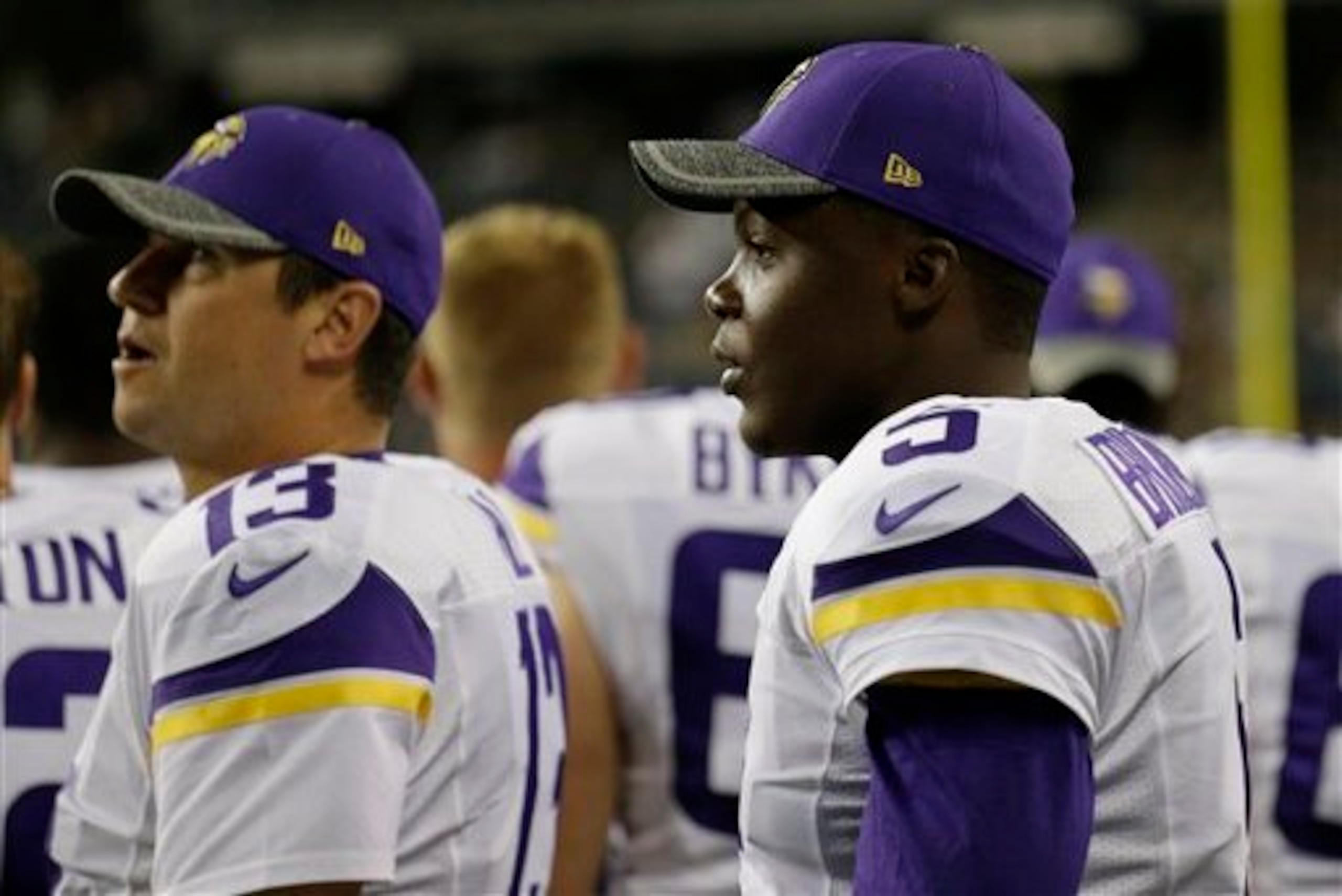
Hill can win some games by handing off to Peterson and letting Zimmer's defense do most of the dirty work. But the career backup who couldn't win a full-time job with the woeful 49ers of the pre-Jim Harbaugh era isn't going to have a magical season. The Vikings will fall back into the NFC pack this season.
The Vikings lose much more if Bridgewater is out for the season, which, given the diagnosis, seems all but certain. They also lose their upward trajectory, the momentum that comes from a young team and a coaching regime growing up together.
If Hill is mediocre—and he has never been much more than mediocre—it can create a domino effect. The young receivers start pressing and take a step backward in development. The defense remains on the field too long, creating a vicious circle. The losses lead to doubts in the locker room, then within the organization.
Maybe 2016 is only a minor step back: 7-9 again, no great worries. Maybe it is written off as a lost injury year. But a lost year can stunt the development of promising youngsters. It can make free agents eager to test the market. It could push Peterson—whose workload just expanded yet again—closer to retirement. A whole organization can lose its traction. And if Bridgewater returns and isn't an immediate savior…well, you know how these things go.
Yes, we just did everything short of bury U.S. Bank under 50 feet of snow in those last three paragraphs, so let's walk this back a little bit. Zimmer's a fine coach, and Turner and Hill are professionals. The receivers are promising. Many of the defenders are great. Peterson is still Peterson. Not too long ago, he helped the Vikings reach the playoffs with Christian Ponder and Joe Webb at quarterback, so anything is theoretically possible.
And Bridgewater will be back, though we don't know when.
Vikings football itself did not cease to exist Tuesday afternoon.
What the team really lost was that magic moment when it looked like its plan had come perfectly together. Those Sunday afternoon passes in the dazzling, improbable indoor Minneapolis sunshine were like a piece falling into a puzzle. Bridgewater's injury is a swift kick to the bottom of the table. The pieces are still there. Some are still together. But the picture is no longer clear at all.
It will take time for the Vikings to put everything back into place. Sometimes it takes a franchise a full season. Sometimes longer. Sometimes the puzzle never gets completed.
Bridgewater's injury was gruesome. Let's hope it wasn't devastating. After two years of planning and 40 seconds of brilliance, NFL fans should all want to someday see what the grown-up Vikings and Bridgewater can really do together.
.jpg?w=2560 "Titans Giants Football")
.jpg?w=2560 "Dolphins Bills Football")