

Inside a Beanball War: How One Play Turned into Three Days of Royals, A's Rage
There they were, Royals shortstop Alcides Escobar rolling around in pain on the Missouri earth, Athletics baserunner Brett Lawrie picking himself up at second base, a hand on Escobar's back, seemingly checking with concern to make sure Escobar was OK.
What happened over the next 72 hours on that April weekend in Kansas City was alternately stunning and frightening. Like strong winds swirling themselves into a tornado, the slow-moving initial few seconds after the play were overcome by the forces of human nature. No one man or manager was a match for the momentum that followed.
Always, brawls have been as much a part of baseball as hot dogs, down in front and Babe Ruth.

But how does one single play escalate into a full-blown, three-day war?
The best answer is that it happens for the same reason fans cannot look away from a bench-clearing rhubarb on the field any more than they can turn away from the drama inside of their own families. Brawls, and the sparks that ignite them, are fueled by so many of the same emotional components that stir our own passions: Rage. Confusion. Fright. Vengeance. Love.
Hey, nobody ever said these things make sense, did they?
Out of the Three-Day War staged by the Royals and Athletics, through the haze of anger and shouting, four-letter words and peacemaking, Royals outfielder Lorenzo Cain chuckles as he thinks back to one moment on the infield grass between the mound and second base. There, in the scrum, Oakland designated hitter Billy Butler, who spent the first eight years of his career with the Royals, encountered Kansas City outfielder Jarrod Dyson.
"I remember Billy telling Dyson, 'I love you, man,'" Cain says. "I thought that was pretty hilarious.'"
Says Dyson: "We were trying to keep peace. And he said, 'I love you, man.' And I said, 'I love you, too.'"

When the two teams meet this weekend in Oakland for the first time since their Battle Royale, there is no telling if love will prevail. Emotions still raw two months later, Lawrie last week declined to address the situation. So did Butler.
"You know what?" Butler said. "I've got feelings for guys on both sides. It's unprofessional for me to answer. I don't want to talk about it."
"We just want to play baseball," Royals reliever Kelvin Herrera says. "Play hard."
"It's over," says Royals manager Ned Yost, whose spirited club engaged the White Sox in another bench-clearing melee in Chicago less than a week after the Oakland fight. "Absolutely. It should be over.
"Let's play baseball."
Over the past several weeks, Bleacher Report spoke with some two dozen participants in the A's-Royals fight and various other brawls. We discussed anger, understanding, the always mysterious baseball code, ignition points and various other angles.
When tempers flare, does the rage permeate the entire clubhouse? Is the anger real for everyone? Do some players simply put up a front while adhering to the code? Come clear your bench with us.
Friday: Anger and Confusion
It started with a deflected ground ball and a hard slide from a player known for being hyper-aggressive. Situation: Lawrie, on first base, nobody out, top of the seventh inning, 4-4 game, Josh Reddick at the plate.
Reddick drilled a ground ball up the middle that deflected off of reliever Kelvin Herrera's foot. The ball redirected toward Kansas City third baseman Mike Moustakas. Escobar, shaded toward the middle of the infield, came from behind second base to receive the throw for the force out.
His positioning is important, because as he took the throw from Moustakas, Escobar was facing third base, almost like a first baseman awaiting a throw. Lawrie came barreling into him with a hard, late slide, crashing into Escobar's left leg just a split second after the shortstop had caught the ball for the force out.
"It was scary when he hit me," says Escobar, who initially thought his leg was broken. "[Our trainers] did a lot of exercises with it and tested it."
He received the ball so late there was no chance to attempt a double play.
"Sometimes in the game, this happens," Escobar says of Lawrie's takeout slide. "In that situation, I know every guy will try and break up a double play. But that's not a double play situation. You don't need to slide like that. I got the ball like a first baseman.
"But you know what? I don't think about it. I forget everything."
From the A's perspective and that of a couple of scouts who were there that night, the deflected ball was the culprit, not Lawrie.
"You look at the slide, there was some uncertainty on that play," Athletics manager Bob Melvin says. "And you couple that with a guy who is a very aggressive baserunner, a very aggressive player.
"Hopefully, we've put it behind us and can just play baseball the next time we see them."
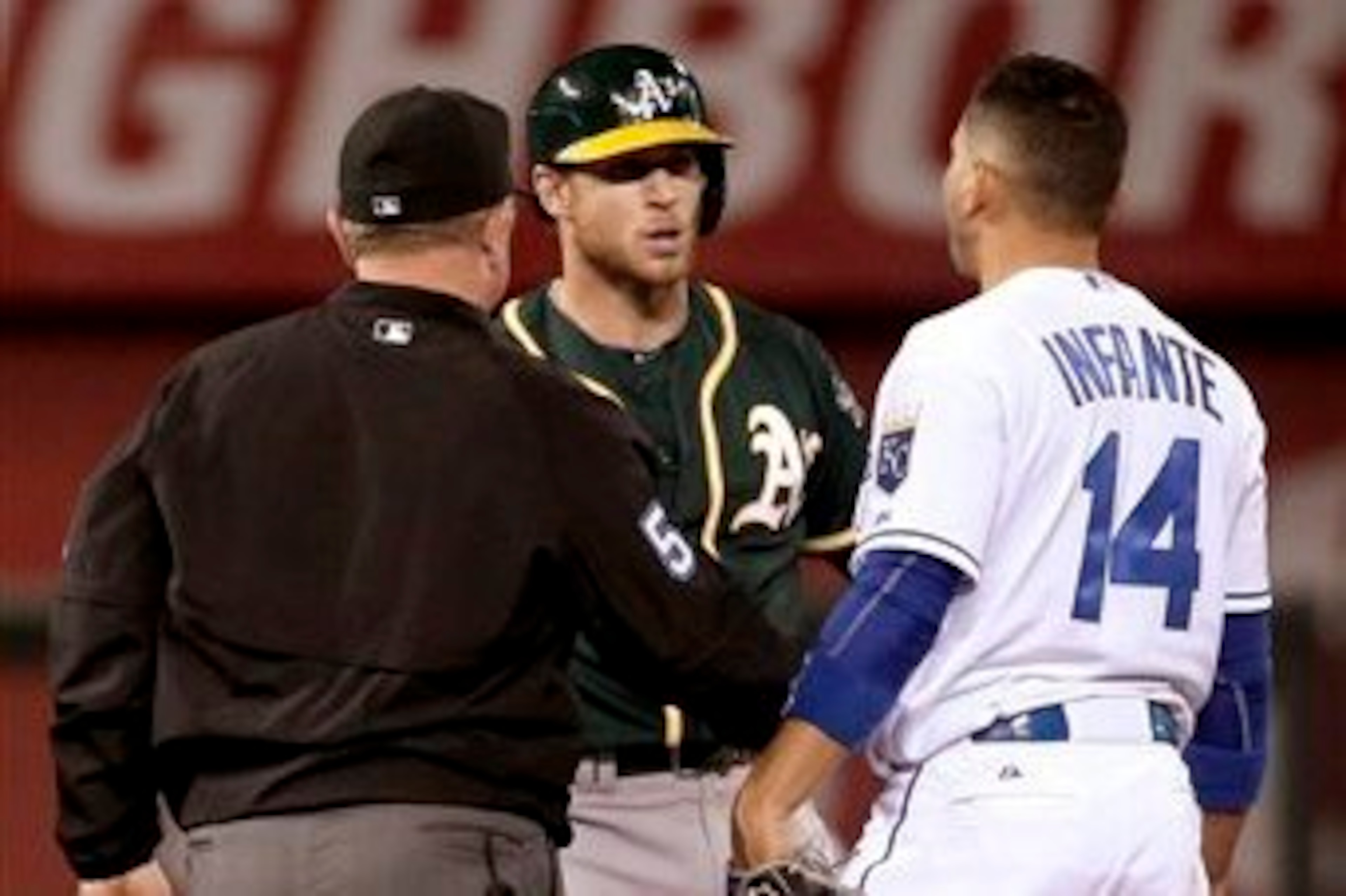
As Kansas City second baseman Omar Infante and Lawrie jawed while Royals trainers tended to Escobar, players rushed in and tempers began to flare. Escobar left the game and was forced to sit the rest of the weekend. Fortunately, he avoided serious injury. Diagnosed with a sprained knee, he returned to the Kansas City lineup that Monday against Minnesota.
"A hard slide's a hard slide, but if he would have slid right into the bag he would have been safe," Yost says. "Then you have to determine, OK, the kid plays ultra-hard and was he trying to hurt Escobar? No. But is it a slide that could result in an injury for Escobar? Absolutely."
Says Melvin: "For me, when you talk about dirty slides, it's the intent. There was no intent on that."
As for the rest of that Friday night, things between Escobar and Lawrie got even weirder. Lawrie said he texted a message of apology to Escobar. The Royals shortstop said he never got one, even producing his cellphone to reporters to prove it.
Lawrie, who produced his phone, as well, to show that Escobar had received the message and responded gruffly, took to Twitter to explain himself:
Two weeks ago, in a conversation with Bleacher Report, Escobar reiterated that he still personally has not spoken with Lawrie: "I don't talk to him. I let him forget about it."
Brawls: A Starter Kit
They start with a beanball. The most notorious near-riot of our time took place in Atlanta, in August 1984, when the Padres and Braves staged an epic after Atlanta starter Pascual Perez drilled leadoff man Alan Wiggins with a pitch in a game that included this box-score line: three bench-clearing incidents, 13 ejections of uniformed personnel, five fan arrests and San Diego manager Dick Williams being tagged with a $10,000 fine.
Mike Borzello, who would go on to become a bullpen coach for the Yankees, Dodgers and, currently, for the Cubs, was a 12-year-old Braves bat boy that day.
"I don't know how many times the benches cleared that day, but it seemed like 100," Borzello says. "I was sitting with another bat boy on folding chairs outside of the Braves dugout and we were just trying to stay out of the way, and you couldn't. I remember climbing into the first row of the stands and trying to stay out of it because guys were mixing it up pretty good."

The Yankees' Tino Martinez and the Orioles' Armando Benitez in 1998. The Padres' Carlos Quentin and the Dodgers' Zack Greinke in 2013.
They start with a slide. Lawrie. Pete Rose into Bud Harrelson in the 1972 NL Championship Series.
They start with a bat. This summer is the 50th anniversary (so soon?) of Giants pitcher Juan Marichal conking Dodgers catcher Johnny Roseboro over the head in San Francisco in 1965.
They start with a catcher's mitt to the face. Alex Rodriguez lived to get his 3,000th hit long after Bronson Arroyo drilled him with a pitch in 2004 and, while A-Rod chirped at Arroyo, Red Sox catcher Jason Varitek gave him a mitt sandwich.
They start with a book. Shortstop Omar Vizquel wrote a biography in 2002 in which he noted that his old Indians teammate, closer Jose Mesa, choked when blowing a save in Game 7 of the 1997 World Series ("The eyes of the world were focused on every move we made. Unfortunately, Jose's own eyes were vacant."). You might say Mesa vowed revenge ("I want to kill him"), and he worked on exacting it: Mesa drilled Vizquel with a pitch the next three times they played.

They start with a weak roller down the first-base line, when the pitcher fields it and tags the runner out; words are exchanged and the benches clear.
This is what happened just four days after Oakland left town, when the Royals opened a series against the White Sox in Chicago and engaged in a brawl that in some ways was nastier than the preceding weekend. On Opening Day, White Sox starter Jeff Samardzija had drilled Cain with a fastball. More batters were hit. It carried over.
"That all started Opening Day," Yost says. "It was like, OK, that was over. And then there's a lot of chirping over there on [the White Sox's] side, and we weren't saying anything, and it pissed everybody off. Adam Eaton yelled at Yordano Ventura and Ventura yelled back and here we go.
"You could just kind of feel it from the inning before. There were certain guys on their side who were chirping, chirping, chirping, and our guys had enough of it."
In the end, five players were ejected: two Royals and three White Sox.
"Things like that happen because teammates try to protect teammates," Herrera, the Royals reliever, says. "The other reason is maybe when you hit a home run and you pimp. Me personally, I don't care if someone pimps a home run. I may strike him out the next time.
"It evens out. It's never the last time or the first time."
Flash points vary. The yelling and screaming, pushing and shoving, doesn't.
Saturday: Vengeance and Codes
With Escobar injured and out of the lineup and less than 24 hours after Friday night's incident, Ventura aimed a 99 mph fastball at Lawrie and hit him in the ribs. Nobody was surprised, least of all Lawrie, who simply put his head down and moved along to first base.
The A's dugout went ballistic. Ventura immediately was ejected by umpire Jim Joyce. The benches cleared. Ventura walked toward Lawrie on the first-base line and catcher Salvador Perez pulled him away.
"I told Brett, 'I have a lot of respect for you for the way you handled that,'" Oakland's Ben Zobrist says. "He was not trying to hurt anybody the night before. There was no malice on his part when he slid into second base.

"Knowing he was going to get hit, taking it and going down to first base, even the way it happened. The guy throwing a slider down and away the first pitch, and then going up and in at him. Almost to get him to lean in.
"I thought that was bush-league, too."
Baseball's ancient eye-for-an-eye code dictated that with Escobar on the bench, injured, Lawrie would be a target on Saturday. Everybody knew it, even as the code hung in the air, thick as humidity, unspoken.
"I think if you're a professional and you're going to stick up for your teammates, you're not going to walk around talking about it," Royals closer Greg Holland says.
Ventura didn't talk about it.
On the bench, Escobar appreciated it.
"In that situation, everyone knows baseball," he says. "Everyone knows when you do something dirty what's coming."
Says Reddick, the Athletics outfielder: "I thought Brett handled it better than anyone could have done it in this league by not giving them anything to build on. And it just seemed like they just wanted to keep digging."
Brawls: A Beanball Primer
The textbook example of a club that kept digging…and digging…and digging was the '84 Padres, who responded to Perez hitting Wiggins to start the game by taking target practice at Perez every single time he came to the plate until they hit him.
Ed Whitson tried and missed in the second inning.
Whitson tried and missed in the fourth inning.
Reliever Greg Booker tried and missed in the sixth inning.
Reliever Craig Lefferts finally hit Perez in the eighth inning.
"We were nine games up with six weeks to go and we felt like that was their way to try to intimidate us and their last shot to make us fold, which usually happened in the past," former Padres infielder and recently retired Giants coach Tim Flannery says of Perez taking aim at Wiggins to start the game. "In our mind, that's what we were rallying around."
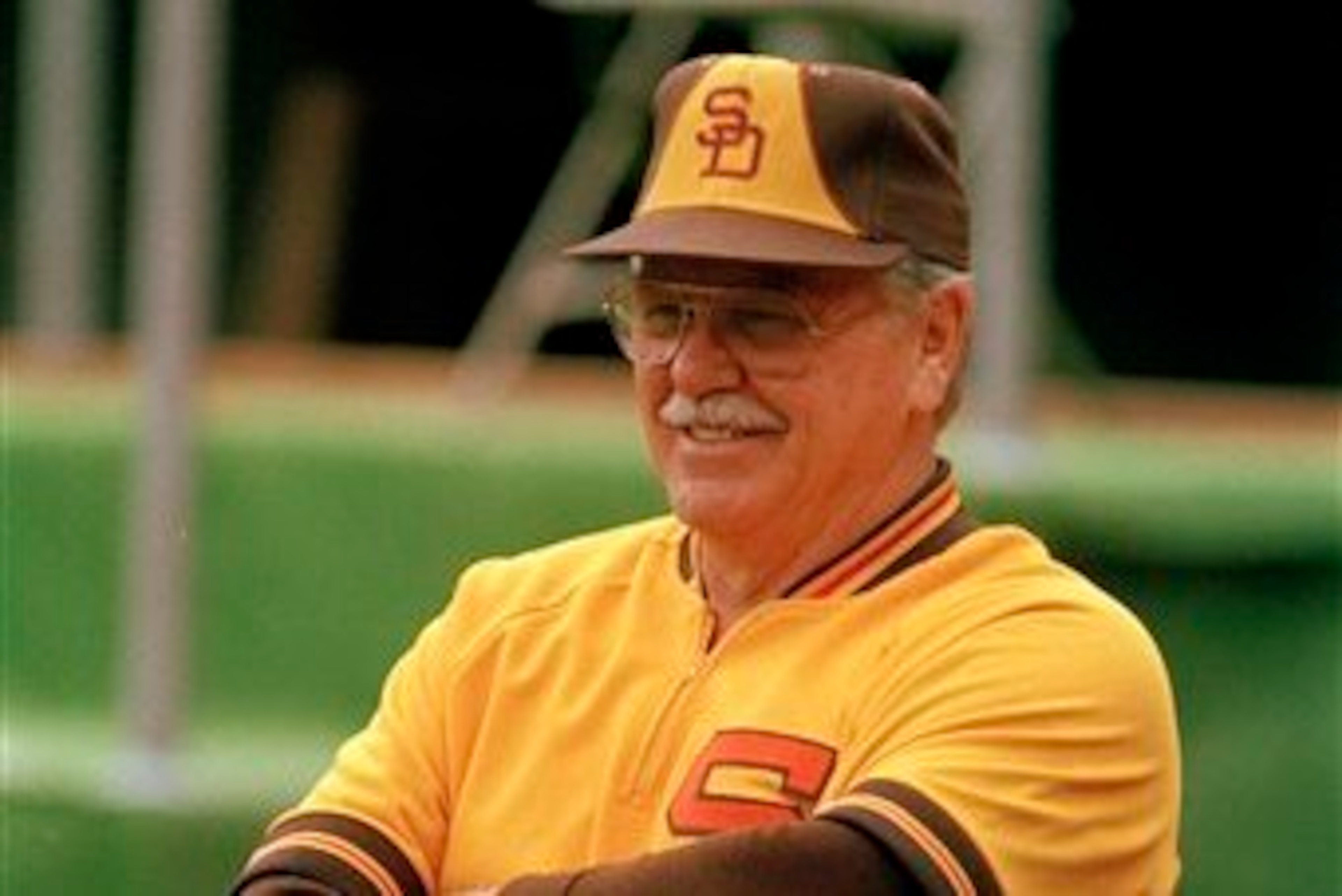
That's why, even when the Padres couldn't hit Perez, they kept trying. It was so full-blown, bat-crap crazy that in the dugout, knowing ejections were coming, Williams made a list. When he and Whitson were tossed, coach Ozzie Virgil would manage and Booker would pitch next. If they still couldn't get Perez, when those two were ejected, coach Harry Dunlop would manage and Greg Harris would pitch next.
There were three different bench-clearing episodes. By the end, Braves third baseman Bob Horner, on the disabled list with a broken wrist, came downstairs from the press box and, along with two fans, tackled San Diego veteran Champ Summers to keep him out of the Braves dugout, where Atlanta was essentially keeping Perez under protective custody.
"I remember eventually that John McSherry (the umpire crew chief) was talking about forcing the teams to stay in the clubhouse," Borzello says. "If you were hitting, they were saying they were going to make you stay in the clubhouse and only the hitter and on-deck hitter would be allowed out. That was the thought on how to contain this thing."
By day's end, Borzello had stories to which few other 12-year-olds are privy.
"They were all telling their own story of where they were in the fight," Borzello says of that postgame Braves clubhouse. "I remember Claudell Washington saying he was choking out Kevin McReynolds, and I remember Rick Mahler saying that he grabbed hold of Tim Flannery and bodyslammed him. They all have their own separate story of their part in the brawl. It was nuts.
"Obviously, the Royals and A's stuff has gone on, but I don't know how many times we cleared the benches. Five or six times, and they were all crazy brawls. It wasn't just pushing and shoving. It was knock-down, drag-out."
Sunday: Grievances and Rage
According to baseball code, retribution had been paid. Lawrie had been hit with a pitch on Saturday. He had taken his medicine and quietly trotted to first base.
"Lawrie did a great job of going to first base, and it's over in everybody's mind," Yost says.
Fans filling Kauffman Stadium for the weekend still smelled blood. Fans will be fans. Like players protecting a teammate's back, fans have their team covered. Tension in the air or not, the code said case closed.
"You completely think it's over," Yost says. "And then all of a sudden you get two outs, and..."
Up steps Cain. Oakland starter Scott Kazmir hits him in the foot with the first pitch.
"If he didn't do it on purpose, it sure looked like he did," Yost says.
"I stood up and looked at him, and he asked me if I was OK," Cain says. "He definitely made it seem like it wasn't on purpose.
"Once he said that, I said, 'OK, it wasn't on purpose. I'll leave it at that.'"
From his view at second base, Zobrist didn't sense anything amiss.
"It was obvious to us that he pulled a fastball in too much and hit him in the foot," Zobrist says. "If you're trying to hit somebody, you don't hit them in the foot. I think a lot of stuff gets caused by oversensitivity."
By Sunday, everyone in the ballpark was on high alert and, yes, overly sensitive. So whether a pitch had meaning or not, intent or not, with nerves already frayed, reaction was going to trump rational thought every time. Which has been another ingredient in diamond dustups as long as the game has been played.
"We don't know if it was on purpose or not," one Royals player says. "But 100 percent, that instigated it."
Still, there was hope that maybe an already boiling series would not bubble over on the final day. Even when Kazmir hit Cain, there was hope—at least, on the Athletics' side.
"I didn't feel it at that point," said Zobrist, who was involved in ugly brawls with the Red Sox and Yankees when he was with Tampa Bay. "I was like, 'I hope they realize that wasn't on purpose.'
"But they were overly sensitive, and they were going to feel like if anybody got hit on their side, it was going to be on purpose."
Enter Herrera. In the eighth inning, the Kansas City reliever fired a 100 mph fastball behind Lawrie, and the benches cleared for a third consecutive day. Lawrie, who had no reaction when hit with Ventura's pitch a day earlier, went nuts.
Herrera, who was ejected immediately, further incited things by wildly pointing to his head, as if to tell Lawrie he would hit him in the head the next time.
If Kazmir had not hit Cain earlier in the game, would anything have happened?

"Maybe no," Herrera says. "But every time I see a teammate with marks here and here and here (pointing to his thigh, knee and shin), and I see that often this year, I don't like it.
"I don't think it's fair."
The Royals were hit with a rash of pitches early this season: At the end of April, the month when they sparred with the A's and White Sox, they were tied with the Rangers for the most in the majors at 20.
Now, they've dropped to fifth at 35.
As for pointing at his head, Herrera says the Royals were angry that Lawrie had used his foot to block third base and impede a Kansas City runner's slide on a play at the bag.
"We need to find a cleaner way to play baseball," Herrera says. "We are professionals. I wasn't saying I was going to hit someone in the head. If I hit someone in the head, maybe they die.
"I can say it 1,000 times, and they're not going to believe it."
Brawls: A Bullpen Primer
Maybe you've wondered as you've watched benches clear in the past: Those guys running in from the bullpen, are they all angry, too, from 400 feet away? Or are they simply obeying baseball etiquette by showing up?
Royals and Athletics relievers got their running in during the series. But what, exactly, were they attempting to accomplish?
"Me, personally, I'm just looking to make sure nobody's getting beat up by someone on the ground," Royals reliever Ryan Madson says. "I'm just looking to pull people off of other people.
"That's the thing in this game: Our hands are valuable."

Says A's reliever Evan Scribner: "I'd say 98 percent of the time, by the time we get close to it, it's over. Depending on what's going on, we're either mad or we're trying to protect the guy who was starting it.
"We also go off of the other bullpen. If they run out, we run out."
In his role as bullpen coach over the past two decades, the Cubs' Borzello estimates he's probably charged in from the bullpen 50 times for fights. When Bernie Williams smashed a homer against the Orioles in a game in '98 and Benitez hit Martinez in the middle of the back with a 98 mph fastball later that inning, Borzello was a Yankees coach and recalls relievers Graeme Lloyd and Jeff Nelson immediately bolting.
"That happened in a split second," Borzello says. "There was no buildup. This was a two-run homer to take the lead in a big game and the next pitch hits Tino.
"Both of them started screaming, then our dugout starts jawing with Benitez on the field. You could see it escalating, and then our guys in the bullpen were like, 'F--k this,' and then, boom, it's on."
From the bullpen, that is the exception, not the rule.
"It's hard to get mad," Scribner quips, "when you know it's going to be over by the time you get there."
On the Field
Nobody has more experience fighting this season than the Royals. Ventura alone got into it with the Angels' Mike Trout, Lawrie and Eaton all within a matter of 10 days.
While things with the A's were coyote ugly for three days, less than a week later the Royals were at it with the White Sox in Chicago in a brawl in which Samardzija and Cain were attempting to hurdle bodies to get at each other.
"I'm very laid back," Cain says. "I focus on being a peacemaker. To get me upset that much, that's really hard to do."
The stereotypical baseball brawl is that of more posturing than slugging, but given that we're talking about young men mostly in their 20s with testosterone spiking, not everyone is prone to thinking clearly as they come charging out of the dugout.
In one infamous moment during a Tigers-Twins brawl in 1982, sparked when Minnesota reliever Ron Davis buzzed the tower of Enos Cabell, provoking the second bench-clearing incident of the night, Detroit pitcher Dave Rozema charged out and aimed a karate kick at Twins infielder John Castino. Rozema missed, and tore up his knee in the process.
It helped wreck Rozema's career, and two years ago, he had knee replacement surgery. Still, he is having problems with the knee.

"Lifelong, it's something where I'm sure every day, he wakes up and probably thinks about that," says Tigers executive Alan Trammell, who was on the field as the team's shortstop that day.
In the Padres-Braves brawl, Flannery was popped in the mouth by outfielder Gerald Perry.
"Funny thing is, we became pretty good friends throughout both of our coaching careers after that because we both saw a side of each other where we both were out of our minds," Flannery says.
"It was the last day of a real long road trip and I remember flying home, coming back to the stadium and Donna (Flannery's wife) picks me up in the car, reaches over to kiss me and I have a big bloody lip."
"What happened to you?" Donna asked.
"You didn't watch the game?" Tim replied. "It was a long day at the office."
Every player has heard stories, which is why when you see them come tumbling out of the dugout, more than you think are looking to keep the peace.
"You're really looking to see where the crowd is," Royals first baseman Eric Hosmer says. "You don't want anything to escalate. Some guys are too valuable to go down with injuries.
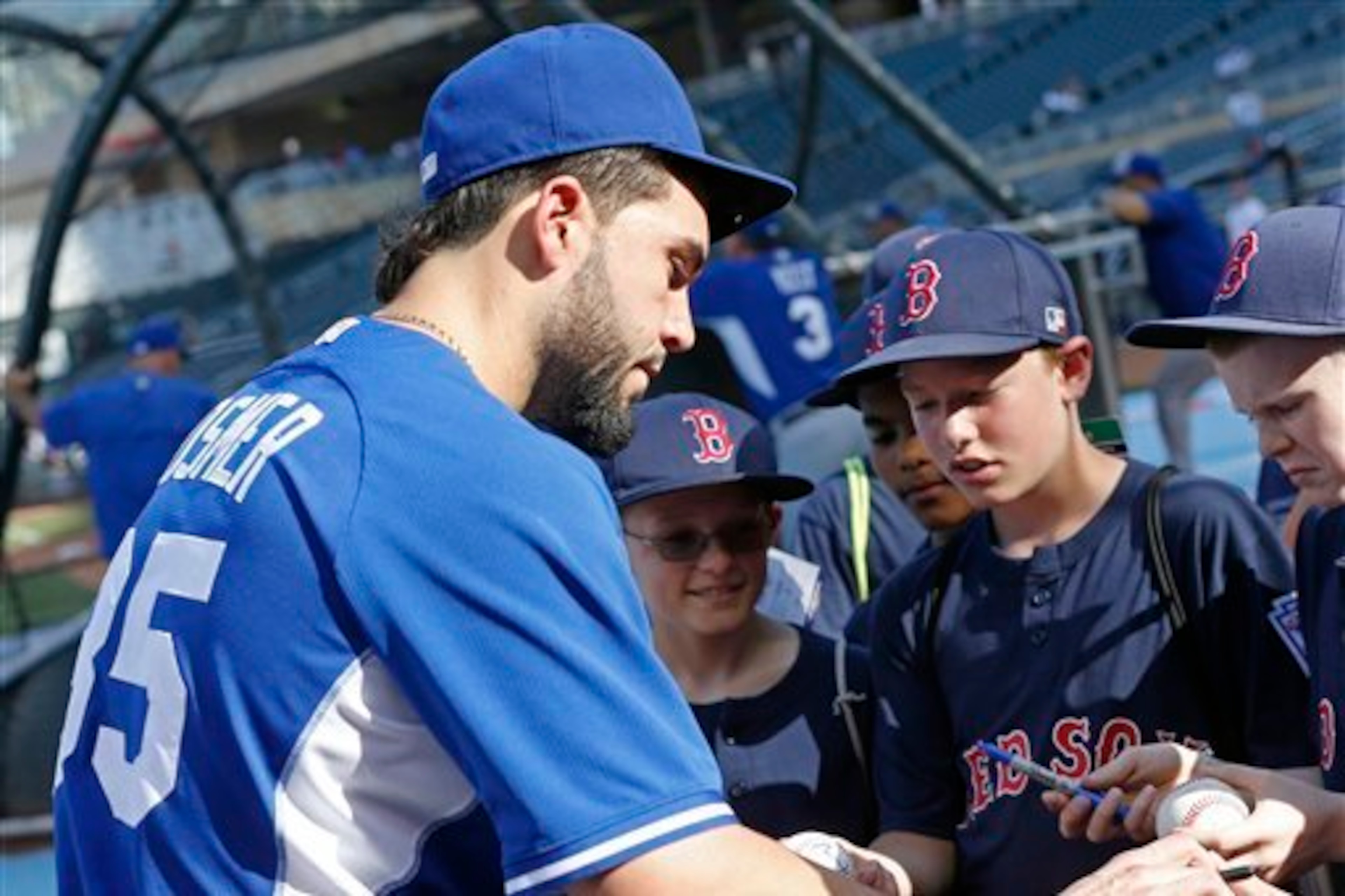
"Against the White Sox, Chris Sale and Jose Abreu were in the middle of it and me, personally, I was trying to get those guys out of there because they're too valuable to the game to lose them. Sometimes crazy stuff happens, sometimes as dumb as tripping over someone and tearing an Achilles."
In Chicago that night, Holland, the Royals' closer, was on the disabled list and in the clubhouse. He rushed into the dugout just as Ventura, whose words with Eaton had ignited things, escaped the middle of the melee and drifted toward the Royals dugout.
"If you're on the DL and you go onto the field, it can be really bad for a player as far as being suspended," Holland says. "I took two steps on the field and (former teammate and current White Sox player Emilio) Bonifacio told me, 'Hey, get this guy off the field.'"
So Holland and teammate Alex Rios, who formerly played for the White Sox, moved Ventura inside.
In the On-Deck Circle
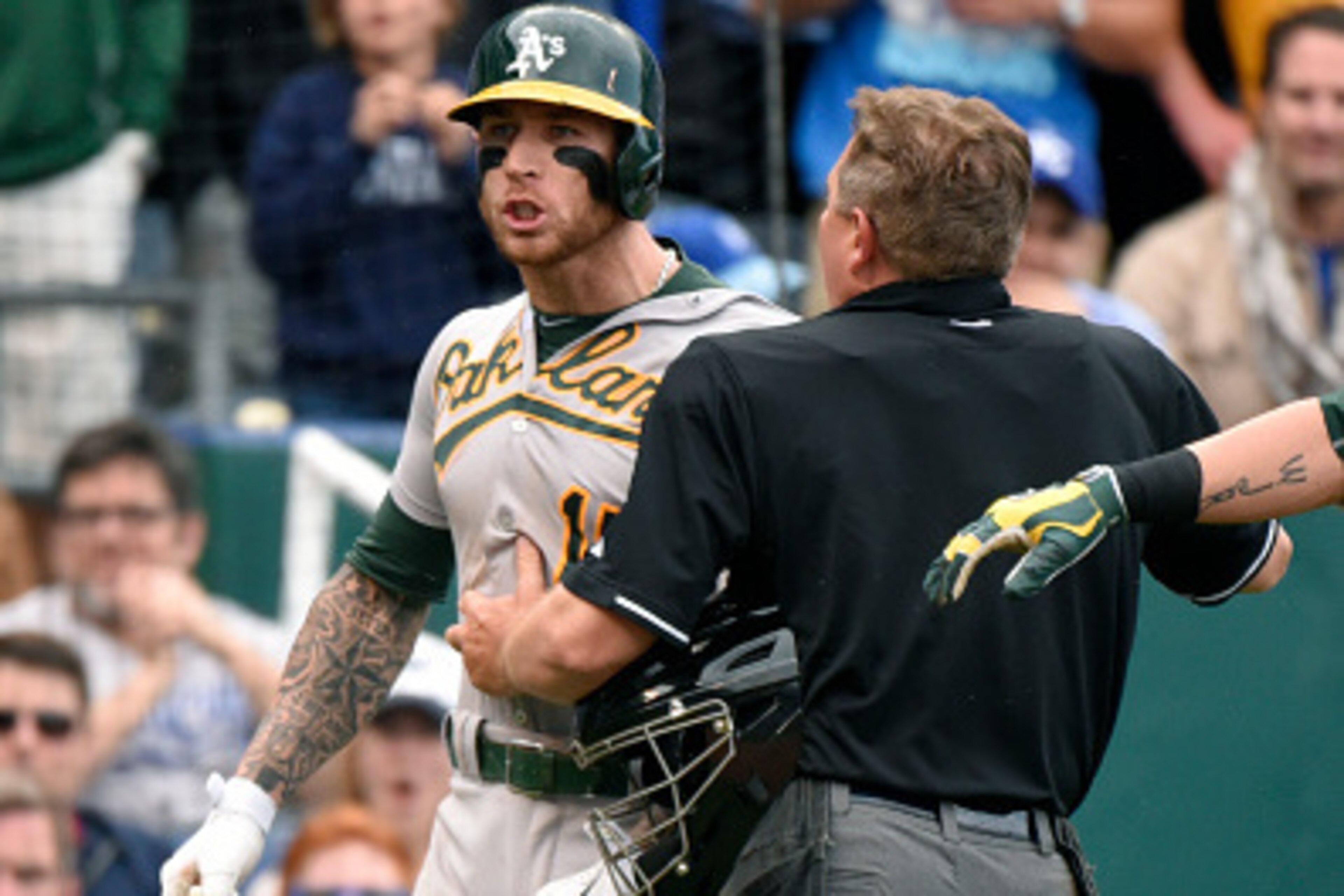
When Herrera's sizzling fastball sailed behind Lawrie on Sunday, Oakland's safety valve was the man closest to the action: Reddick, who was up next.
One day after Lawrie simply put his head down and went to first when Ventura hit him, he wasn't in nearly as charitable of a mood. And Reddick and plate umpire Greg Gibson moved quickly.
"I remember doing everything I could to calm Brett down, telling him, 'Look, you're handling this better than anyone in the league would handle it and you need to understand that,'" Reddick says. "The umpire was telling him the same thing, so that was pretty amazing to see the umpire telling him he was handling it the best he could and that he was the smarter and the better person in this whole fight.
"That's all I remember. Sunday, as soon as I saw the ball thrown behind him, I sprinted up to pull him away and prevent anything else from happening. We don't need him to get suspended for five or six games for something stupid."
Brawls: Feeding Frenzy in the Stands
Tough thing about being the road team during a brawl, of course, is that you immediately become Public Enemy No. 1 until you leave town.
Fortunately, after years of bench-clearing episodes and experimenting with crazy promotions like 10-cent beer night in Cleveland, baseball has stepped up security in ballparks, and the Wild West days are (mostly) in the past.
Like when fans involved themselves in the '84 Atlanta-San Diego brawl. That five of them were arrested seems almost unfathomable today. How could they have gotten that close to the action?
Well, for one thing, San Diego utility man Kurt Bevacqua maybe didn't make the smartest decision when he was hit with a beer.

"You know the big ones, like a quart of milk?" Bevacqua says. "They had these beer canisters at Fulton County Stadium, and we're talking eighth inning, people were worked up by then. You've got your Jeff Foxworthy rednecks in the stands and one of them threw what felt like a full one of these things that hit me right in the head. I didn't have a helmet on or anything.
"The mistake I made was going into the stands. I could have gotten beat up pretty badly if not for one security guard out there. My spikes slipped out from under me and I fell down. I got shellacked pretty good."
In Kansas City, while the atmosphere in the ballpark was hostile, the A's never feared for their safety. But they took their share of abuse, especially in the usual hot spots: verbally, in the bullpen, and digitally, on Twitter.
"The fans were very upset," Scribner says. "I don't think they understand the game the way the players do. They were just mad. They thought it was all our fault. 'You guys are animals!' stuff like that."
Says Reddick: "I don't know what those fans were thinking. It was sad to see fans cheering as a ball is thrown at a guy's head. If you're going to get rowdy on the night [Escobar] gets hit, I understand.
"Sunday, when you're cheering when a 99 mph fastball comes at [Lawrie's] head, I just don't know where we are as a society these days to have that kind of thing be acceptable.
"I've lost all respect for those people who said those things and cheered. It wasn't all of the fans, but it was probably a majority of them. For those who were there and civilized about it, that comment was not made for them."
As for Twitter…
"I blocked a few people," Reddick says. "I don't respond to people who say that stuff. They're all tough behind the computer. They would never say it to my face outside of the baseball field.
"Let them be tough for their 140 characters, and I'll go on about my day."
"@blawrie13 you're getting beaned tomorrow bitch
— Jon Eaton (@sketchy1poker) April 18, 2015"
The Lingering Effect
Ten weeks have passed since the A's were in Kansas City, enough time to calm things down and, maybe, even cause the slightest bit of amnesia.

For one thing, and Lawrie surely would be the first to agree with this, at least Escobar wasn't hurt badly. Nothing was broken or torn. There was no DL stint.
No question, Escobar says, he would be angrier today if the slide would have sent him to, say, the surgeon's table.
"Maybe, yeah," Escobar says. "Maybe I'd think differently. I feel really good that nothing happened."
Clearly, everyone from the umpires to the O.co Coliseum security guards will be on high alert this weekend, and because of that, maybe the chances of re-engagement are low.
Players, though, can have long memories.
When Quentin charged Greinke and broke the pitcher's collarbone in 2013 after being drilled, there was a personal history that few in the National League realized. Quentin's rising tide of anger dated back to '08, when he was with the White Sox and Greinke was with the Royals (another layer to the longstanding rivalry between the Royals and White Sox).
Most people in the ballpark had no idea, but it was the third time Greinke had hit Quentin (and he had hit only one other batter more than once in his entire career).
"And if you want to look further into the numbers, I don't think Zack had ever hit anybody on a 3-and-2 count," says Padres hitting coach Mark Kotsay, who was a teammate of Quentin's in Chicago and San Diego.
And yes, the Padres ran the numbers the next day, searching for a sort of baseball DNA that would excuse Quentin.
Similarly, Tigers outfielder Al Cowens stunned everyone in Comiskey Park by charging White Sox pitcher Ed Farmer in a game in 1980. The score was 3-3 in the 11th inning, Cowens grounded to shortstop…and went straight for the mound instead of first base.
"Todd Cruz was playing shortstop," Farmer, now a White Sox broadcaster, recalls. "He double-clutched the throw. I yelled, 'Throw that thing, he can run!' And Todd says, 'Look out!' Cowens came up from behind."
A year earlier, when Farmer was pitching for Texas, he broke Frank White's wrist and Cowens' jaw with different pitches in the same game.
"My fastball was running so much that day, it just ran in and hit him in the jaw," Farmer says. "I went to the hospital the next day and told him, 'I didn't mean to hit you, I hope you understand that.' And he said, 'I'm going to tee you up.'
"I don't blame him. His jaw looked like a football. It was asinine of me to go to the hospital."
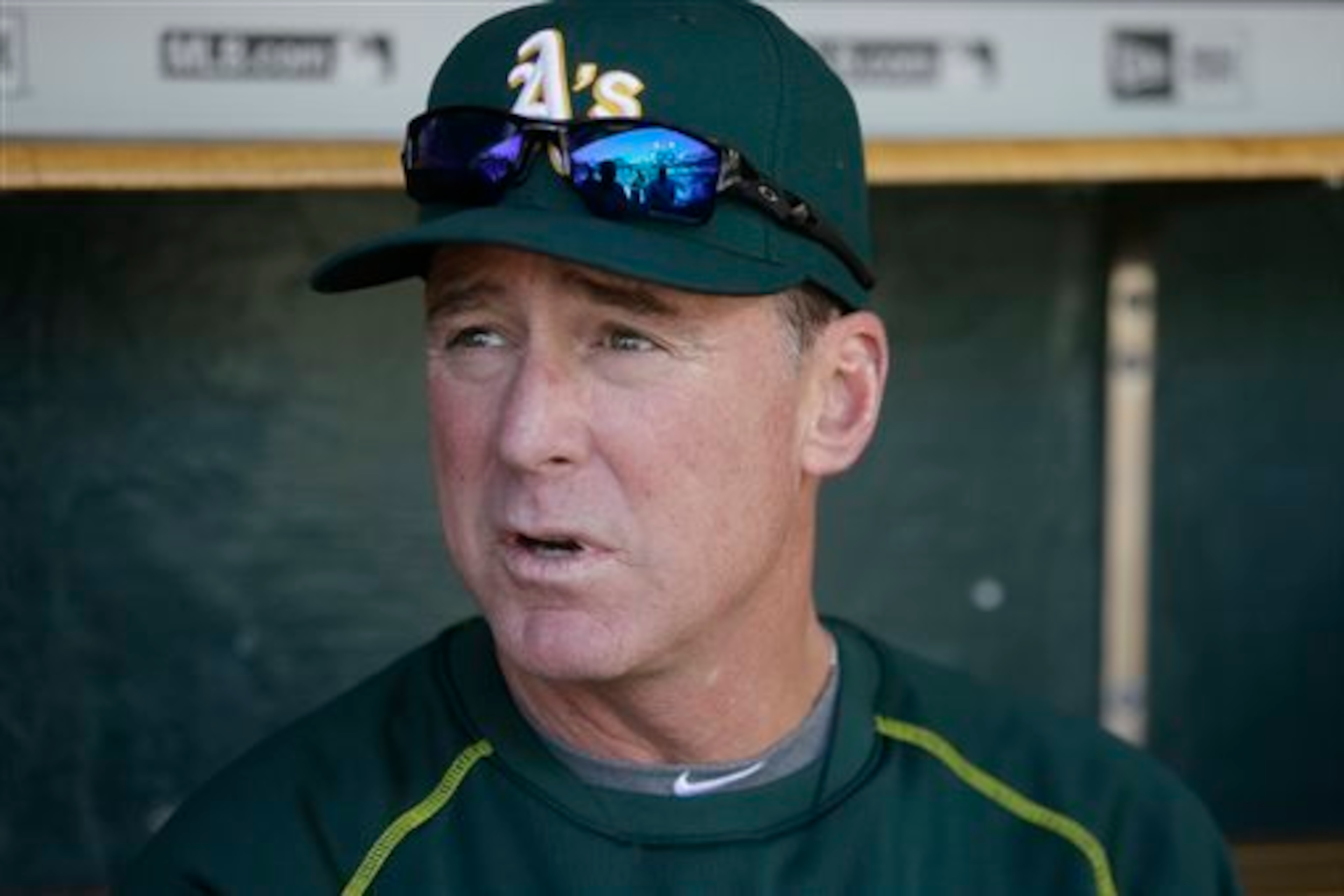
"Sometimes things linger a little bit," Melvin, Oakland's manager, says. "To an extent, you want to get in the last jab or whatever, so to speak. Sometimes boys will be boys. You liken it to two kids hitting each other and you want to have the last lick."
Where the Royals are concerned, they are a young team still finding its way. Following his jawing with Trout/Lawrie/Eaton in succession, Ventura, 24, was pulled aside and talked to by veteran pitchers Jeremy Guthrie and Edinson Volquez. Yost also spoke with his team.
"You have to take care of your business, as long as it's in the right way," Yost says. "There's a right way to do it and a wrong way to do it. We've never been through it as a club to know the right way and the wrong way because they're so young.
"They really care for each other and they want to protect each other and be there for each other."
To this day, members of the '84 Padres team, the first NL pennant winner in San Diego history, maintain that that hot August day in Atlanta was what bonded them for good.
To that extent, the first-place Royals think they've made their point around the league.
"It's good now," Herrera says. "We don't get hit by so many pitches."
So now the schedule sends them to Oakland, and maybe this time there will be no need for weigh-ins and boxing gloves.
"I don't want another controversy," Escobar says. "I want to continue playing baseball like we are now and forget about everything. I don't want to go there and talk too much and fight."
Or, as Madson, the Royals' reliever, says: "We're all on the same level here. There is no higher league. Everyone should be treated with respect. The game will even things out over time. Most of the time, people learn from situations and move on, or they grow from them, because it gets old. What we want to do is play baseball.
"It's about the game, not about who's the toughest. We're not tough. We're baseball players. Those MMA guys, they're tough."
Scott Miller covers Major League Baseball as a national columnist for Bleacher Report.
Follow Scott on Twitter and talk baseball.
_0.png?w=3840 "Summer League Takeaways ✍️")
.jpg?w=3840 "Watch: Jerry Rice Chases After Heckler")
.png?w=3840 "Offseason Moves Sure To Backfire 💥")

.png?w=3840 "Spida's Pitch to LeBron 🗣️")