

How Does the Project Begin with Project Quarterbacks?
"He's got a lot to learn. We're not looking for him to be a starter right now."
New York Jets head coach Todd Bowles acknowledged a reality when he spoke with Brian Costello of the New York Post after his team selected quarterback Bryce Petty in the 2015 NFL draft.
Petty might be a starter one day. He might become a reliable, efficient passer who can be trusted to lead an offense with minimal mistakes. Heck, let's dream big: He might be a Pro Bowler and a golden franchise arm found at the low price of 103rd overall. In NFL quarterback terms, studs found that late are so deep in the bargain bin they're surrounded by dusty DVD copies of Snakes on a Plane.
TOP NEWS

New NFL Power Rankings 📊
The Robinsons POUND the Rock 🪨
Takeaways from Falcons' dominant MNF win
But right now he'll watch, learn and wait. Which means he falls under a common label, one that comes with both hope and, almost inevitably, either despair or indifference: developmental quarterback.
"He will need spoon fed pro-style concepts and requires a year or two of development," CBSSports.com analyst Dane Brugler wrote in his predraft evaluation of Petty.
Developmental quarterback is a category primarily for Day 3 picks. It's a box that declares them as projects for a variety of reasons. They range from a significant adjustment to be made after thriving in a spread offense (Petty is guilty as charged), to having impressive athletic ability but needing to improve in the pocket (take a bow, Green Bay Packers rookie quarterback Brett Hundley).
Some are projects, while others are experiments. Either way, the NFL's cold numbers game too often ends in an incomplete mission.
Which led me to a question: Where exactly does development begin for the developmental quarterback?
I wanted to peek behind the curtain, and several quarterback coaches offered a glimpse inside their lab.
What is the process behind taking the quarterback canvas provided and attempting to create a workable passer by minimizing weaknesses? It all starts with a language.
Speaking Football Fluently
Rookie contracts are four years long, and in the period between 2011 and 2014 there were 26 quarterbacks selected on Day 3 (Rounds 4-7). The current combined start total of those project QBs, including playoffs? Only 30 from five sparsely used arms.
| Kirk Cousins | 9 |
| Ryan Lindley | 7 |
| T.J. Yates | 7 |
| Zach Mettenberger | 6 |
| Greg McElroy | 1 |
That shows the challenge ahead for mid-round picks, and the depth-chart burial they often face. In 2014, there were 28 quarterbacks who took at least 50 percent of their team's regular-season snaps, per Pro Football Focus. Of them, 16 were first-round picks, and only five either went undrafted or were selected on Day 3.
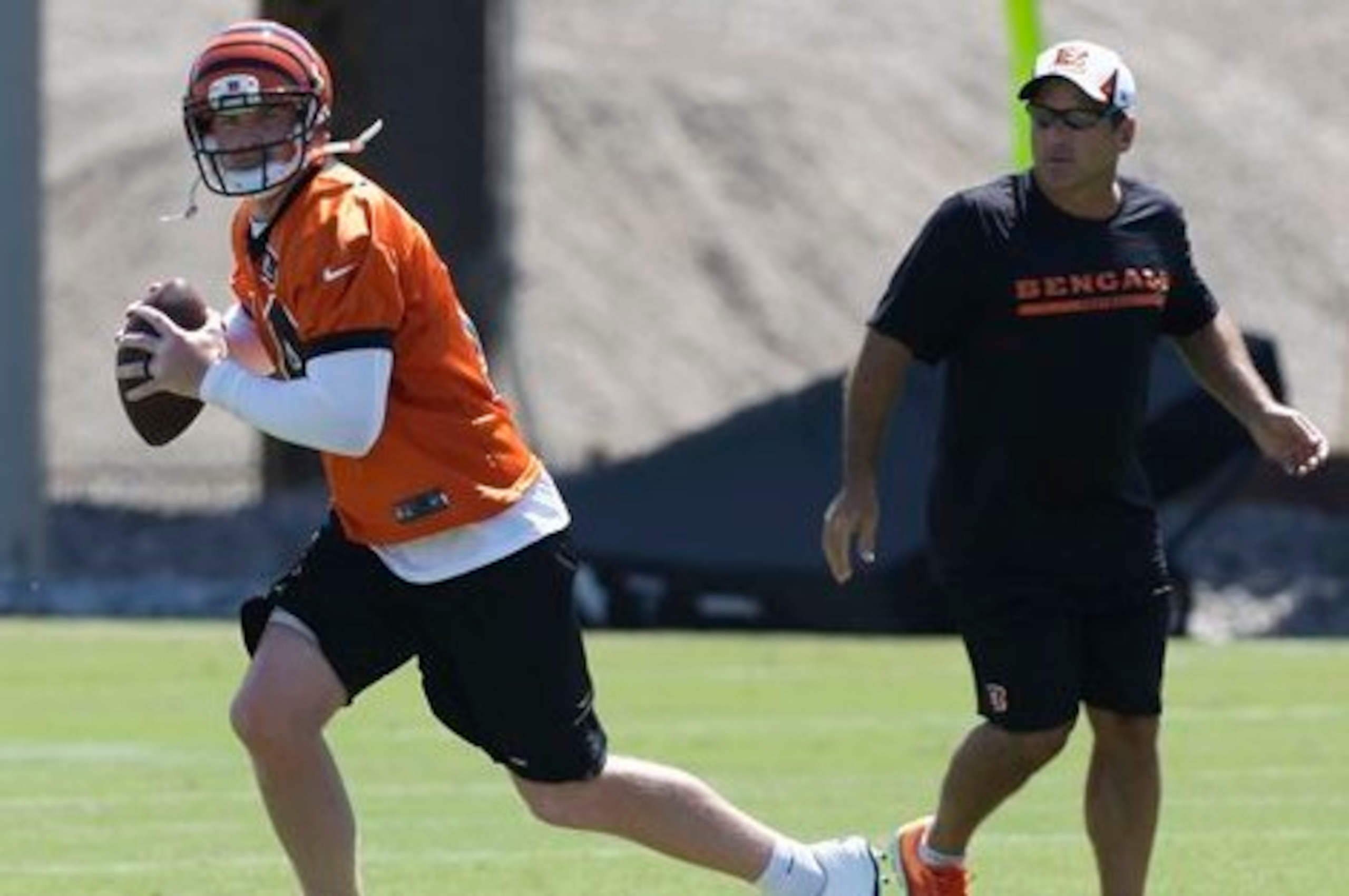
Bengals quarterback coach Ken Zampese is working with a Day 3 pick: AJ McCarron. The two-time national champion and Heisman Trophy runner-up (2013) with Alabama was Cincinnati's fifth-round pick in 2014.
Immediately for Zampese, the task ahead with his student starts with learning how to speak a different football language, and doing it by first looking at what the enemy is thinking
"When you have a quarterback you think is in that range of 'OK, he's not ready right now, but we think we can get him ready to be a backup or starter down the road,' the first day they come in, you start with defense," he told Bleacher Report during a phone conversation.
"You teach defense, and the huddle, cadence, formations and offensive terminology so you can establish a language that's yours."
That link between coach and quarterback is how the bridge from college to the pros is conquered, or at least how the first steps are taken. Often when we think of the challenges associated with that transition for a rookie quarterback, speed comes to mind. The physical kind, whether it's a cornerback who can close on an out route quicker, or a linebacker capable of pouncing on a short slant.
But mental speed is equally critical on the field, and initially in practice. The amount of information the developmental quarterback needs to absorb is immense, which makes finding a language—your language—a vital early teaching tool.
"The quest is to teach the language as fast as you can so that you can speak football fluently," Zampese said. "Then the transfer of information back and forth as you go can be as fast as possible."
When that information begins to flow, a question has to be answered.
Who Are You When Something Bad Happens?
There will be mistakes early, and they'll come in many forms: bad throws, poor reads and sacks after holding onto the ball too long.
For Zampese, true growth lies in more than merely correcting mistakes.
"The negative play itself is less important, and what's important is the response to that play," he said. "Because that always determines the next success the quarterback is going to have, or failure."
We can see physical ability, and quantify it. We can measure how far an especially athletic quarterback ran after breaking the pocket, or how long his sailing deep ball flew for that game-changing touchdown.
But excelling at the mental side of football doesn't appear in any box score, even if it eventually leads to production and progression once a switch is flipped.
"If a guy can't throw it, he can't throw it, and he can't play," Zampese said. "But if he's good enough to throw it, then what separates those guys from the great ones playing right now? It's all mental."
A young quarterback who hasn't found that head space will soon be experiencing a spinning sensation when the game demands quicker decision-making.
Being groomed as a potential future starter means there's a veteran present, which makes staying levelheaded easier.
"When you have a veteran ahead of you, a quarterback can learn from watching and listening," said Danny Langsdorf, the former New York Giants quarterback coach who worked with Ryan Nassib, a fourth-round pick in 2013 who's doing his learning behind Eli Manning.
"Some of these rookies just get thrown in there, and that makes it hard. To me, it doesn't matter if you're a first-rounder or a seventh-rounder: There's a real advantage to playing behind a veteran for a little while."
Mike Neu certainly knows the value of a veteran. The New Orleans Saints quarterback coach is beginning his work with Garrett Grayson, who was just selected in the third round and could eventually be Drew Brees' successor.
"We're fortunate to have a lot of great teaching tape from Drew Brees to be able to use, and help Garrett develop," said Neu.
"In the long run, it's the little things that will make the difference as to whether or not you're successful."
Everything All At Once
Confidence isn't a problem for McCarron. We know this because Zampese called him "football smart" while praising his work ethic. Often the coach's phone buzzes, and it's McCarron on the other end ready to ask questions.
We also know it because he's not shy about his sky-high ambitions after recovering from a shoulder injury. He wants to be a starter one day, and get starter money.
Confidence is a fine asset for any young quarterback, because in practice, everything happens all at once.
"We're doing everything from the jump as far as the footwork is concerned and the foundation things, like where we drop to and where our eyes are," Zampese said.
Both mentally and physically, the focus remains on playing fast.
"There are levels of understanding with a particular route and the starting points," Zampese said. We want to nail the starting point of each route so that we can play fast.
"Then there will be other levels of understanding for that route you can get to as you gain experience. But if you don't have a starting point, you'll be indecisive. And when you're indecisive, you play slow. And if you play slow, you turn the ball over."
Knowing How to Read, and Where to Start
There's a specific kind of speed that needs to become second nature: reading the defense. A young quarterback has to assess what an NFL defense is offering, and how that potentially changes his next move.
Knowing where to begin while scanning the field should eventually become a reflex. Oftentimes, a particular defensive look doesn't agree with the route combination on one side of the field. So the quarterback should instinctively shift his eyes to the opposite side and begin progressing through his reads there.
"Certain plays you can start to the left side, and others you start to the right side depending on the look of the defense," said Zampese. "We're trying to get [the quarterback] to understand what the good looks are for the left side and for the right side, and come to those conclusions while sometimes eliminating one side or the other before the snap of the ball. Then he can play fast to one side."
There it is again: playing fast.
"You want them so comfortable that the game slows down," said Langsdorf. "If they're prepared and know what they're doing, that happens."
"There's a lot that goes into each play on the quarterback's shoulders. Whether they're going to change the play, or get out of a bad play. The mental part of the game is big, and they have to react quickly, take a look at the defense they're getting and make a decision."
It's About Asking Questions
A quarterback's development is fed by a need for answers. There has to be a constant curiosity fueled by a mind that craves challenges.
Zampese has been the Bengals quarterbacks coach since 2003, and beyond that, he's been on an NFL sideline in some capacity since 1998. He can easily identify an eager learner through what he sees, and more importantly, what he hears.
"The more you wrap your mind around a particular route or a particular technique, the more questions you'll have," he said. "I can tell with young guys how far their minds can go by what they ask, and if they ask questions at all. Are they thinking about their position outside of our prescribed meeting and practice times?"
"It can't be just, 'Hey, I'm going to do what I'm asked to do and that's all.' Instead, it has to be, 'I'm going to do what I'm asked to do, and then I'm going to ask about the next step, and what I'm missing.'"
Generously, there are about a dozen people on this planet who can play the quarterback position at a high level. Then there are maybe a half-dozen more who can meet the standard required to be adequate.
Raw talent separates those two tiers, of course, and inherently the developmental quarterback faces an immediate weakness of some kind to overcome. His ability to rise is anchored by a hunger to work, to learn and to always process what lies ahead.

.jpg?w=2560 "Rams Eagles Football")
.jpg?w=2560 "Grading WWE Raw 🔠")


.jpg?w=2560 "Injury-stricken Seahawks signing veteran RB")
