
Added Flexibility: Versatile Offensive Line Prospects Offer Better Draft Value

The more a prospect can do at the NFL level, the more valuable he becomes. This is particularly true along the offensive line.
In the NFL, teams are mandated to maintain a 53-man roster. On game days, the number is reduced to 45. Teams generally keep eight offensive linemen on their final roster and only seven active on game days.
Teams are sometimes placed in drastic circumstances due to unforeseen injuries. A lineman with the ability to play multiple positions as a starter or backup is absolutely vital to a team's ability to withstand injuries.
TOP NEWS
Eagles OL Puts FO on Spot 😳
.jpg?w=2560)
Tomlin's Take After Cowboys' Players-Only Meeting 💀

Saints Mock Draft Pick 🔮
At one point last season, the Atlanta Falcons were forced to play starting tight end Levine Toilolo at right tackle for half a game due to multiple offensive line injuries. While this is an extreme case of what can happen on game day, the overall value of a lineman increases by being able to shift seamlessly to other positions along the offensive front.
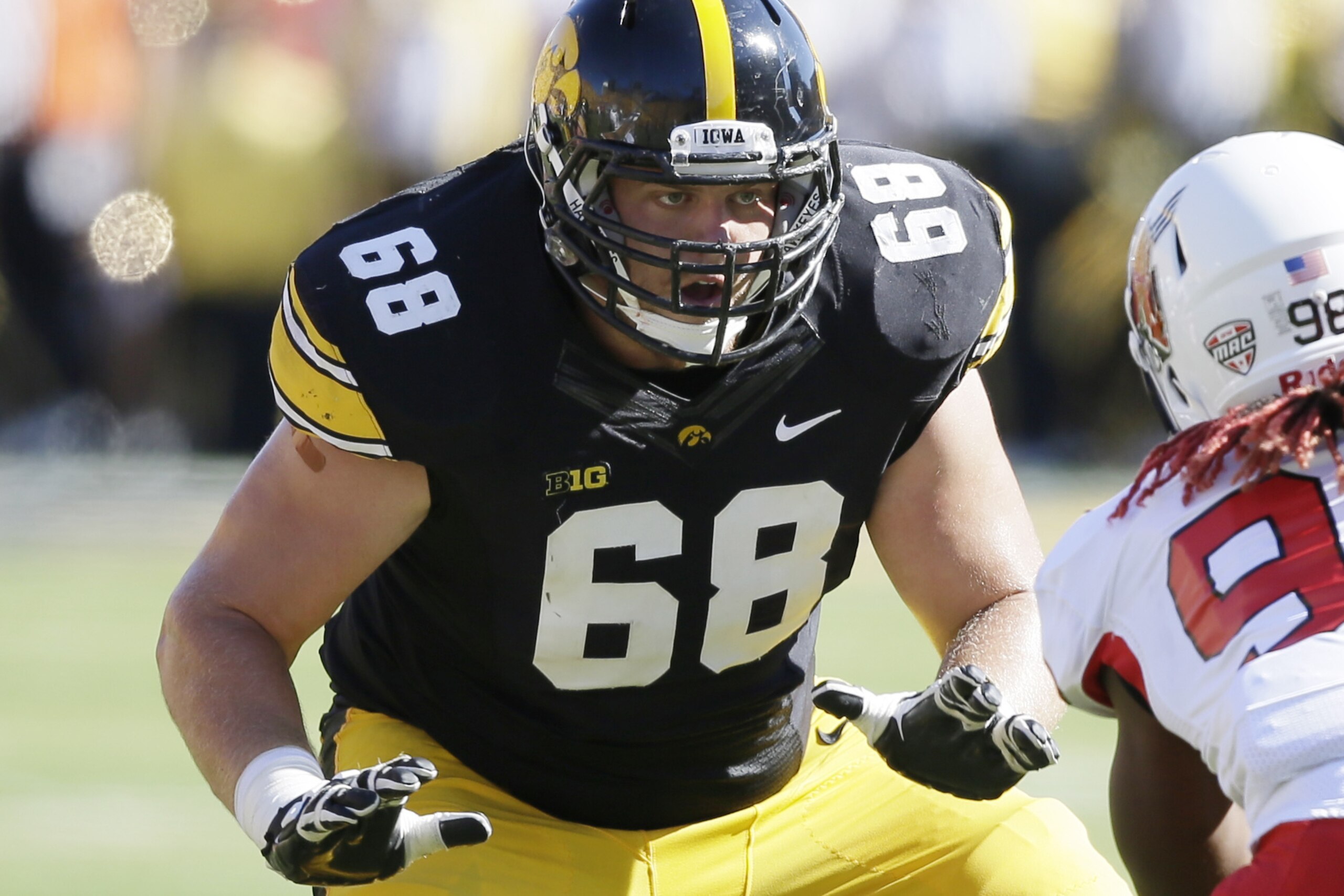
The 2015 offensive line class is truly unique. The top two prospects, Iowa's Brandon Scherff and LSU's La'el Collins, are generally considered guard prospects even though they played left tackle for the bulk of their careers.
Scherff in particular is strongly viewed as a guard prospect, according to NFL Network's Daniel Jeremiah (via NJ.com's Jordan Raanan):
The reason Scherff projects well to guard is his build at 6'5" and 319 pounds with less-than-ideal 33.375" arms. The reigning Outland Trophy winner also displays an explosive lower body to uproot bigger defensive linemen, as evidenced by a 443-pound hang clean, and absolutely nasty disposition as a run-blocker.
Projecting Scherff to guard, where he played 11 games as a redshirt freshman, doesn't completely rule out the possibility of his eventually playing offensive tackle, though.
His lateral movement and ability to change directions are actually better than that of two former Iowa products, the Green Bay Packers' Bryan Bulaga and the Detroit Lions' Riley Reiff, who developed into legitimate starters at offensive tackle in the NFL.
| Player | Year | 40-yard dash | 10-yard split | 3-cone | Short shuttle |
| Scherff | 2015 | 5.05 | 1.80 | 7.18 | 4.57 |
| Reiff | 2012 | 5.23 | 1.82 | 7.87 | 4.75 |
| Bulaga | 2010 | 5.22 | 1.80 | 7.70 | 4.75 |
Pro Football Focus graded Reiff as an above-average blind-side protector in 2014, and Bulaga signed a five-year, $33.75 million contract in free agency to remain the Packers' starting right tackle.
Scherff's tape during his senior season didn't always reflect his overall agility, because the offensive tackle suffered an MCL injury during the season that required surgery. The Iowa native returned to practice later in the week and never missed a game.
Also, Scherff's arms are actually longer than both Bulaga's and Reiff's.
A team selecting the latest product from Iowa's assembly line of offensive line talent may decide to let him play left tackle until he proves he can't. Or they could groom him at guard to eventually take over at left tackle. Both options are open, since Bulaga displayed enough physical ability to possibly start at four of the five offensive line positions.
And he isn't the only first-round prospect with similar potential.
La'el Collins

The LSU product's plight is very similar to Scherff's.
After becoming a starter at guard, Collins spent his last two seasons on campus at left tackle. Yet he's often projected as a guard prospect despite a first-round grade.
Teams have asked Collins numerous questions about where he will actually play.
"They’ve asked me if I could slide to the right side, and then in two years go to the left," Collins said at the NFL combine, via Sports Illustrated's Doug Farrar. "I feel very confident in what I do, so it wouldn’t be a problem. They’ve asked me about playing guard and I could play either spot, right or left side. I love the one-on-one matchups. Being out there, one-on-one with a guy and having my way with him.”
The transition from offensive tackle to guard is all about speed and quickness.
Does an offensive tackle display nimble enough footwork to handle some of the world's greatest athletes, who will be using their speed and natural athleticism to get after the quarterback?
Or is that prospect better suited to play inside, where he has less room to operate, but the defenders gets into the block much quicker, and they're stronger at the point of attack?
Collins didn't adequately address either question during the evaluation process.
At the Reese's Senior Bowl and NFL combine, the Baton Rouge, Louisiana, native showed up at 305 pounds. Collins, who was listed at 321 pounds on LSU's official site, impressed at both events with his movement skills. It was enough to warrant consideration as a legitimate left tackle prospect.
Collins then showed up at LSU's pro day and weighed 320 pounds a month after his combine workout, according to the team's official release.
His weight fluctuation automatically brings the earlier performances into question and raises doubt as to whether or not Collins can legitimately play left tackle at the next level.
There is, however, no question about Collins' dominance as a run-blocker, courtesy of OL Watchdog:
As a tackle or a guard, Collins should be able to step in immediately and contribute as a physical presence along the offensive front. He might be better suited for man-gap schemes instead of zone-heavy systems, but the LSU product has previously shown an ability to do both, whether he maintains a certain weight or not.
Being able to play four out of the five offensive line positions is only one type of versatile lineman. There are also those prospects capable of playing all three interior positions as a swing player at guard or center.
A.J. Cann
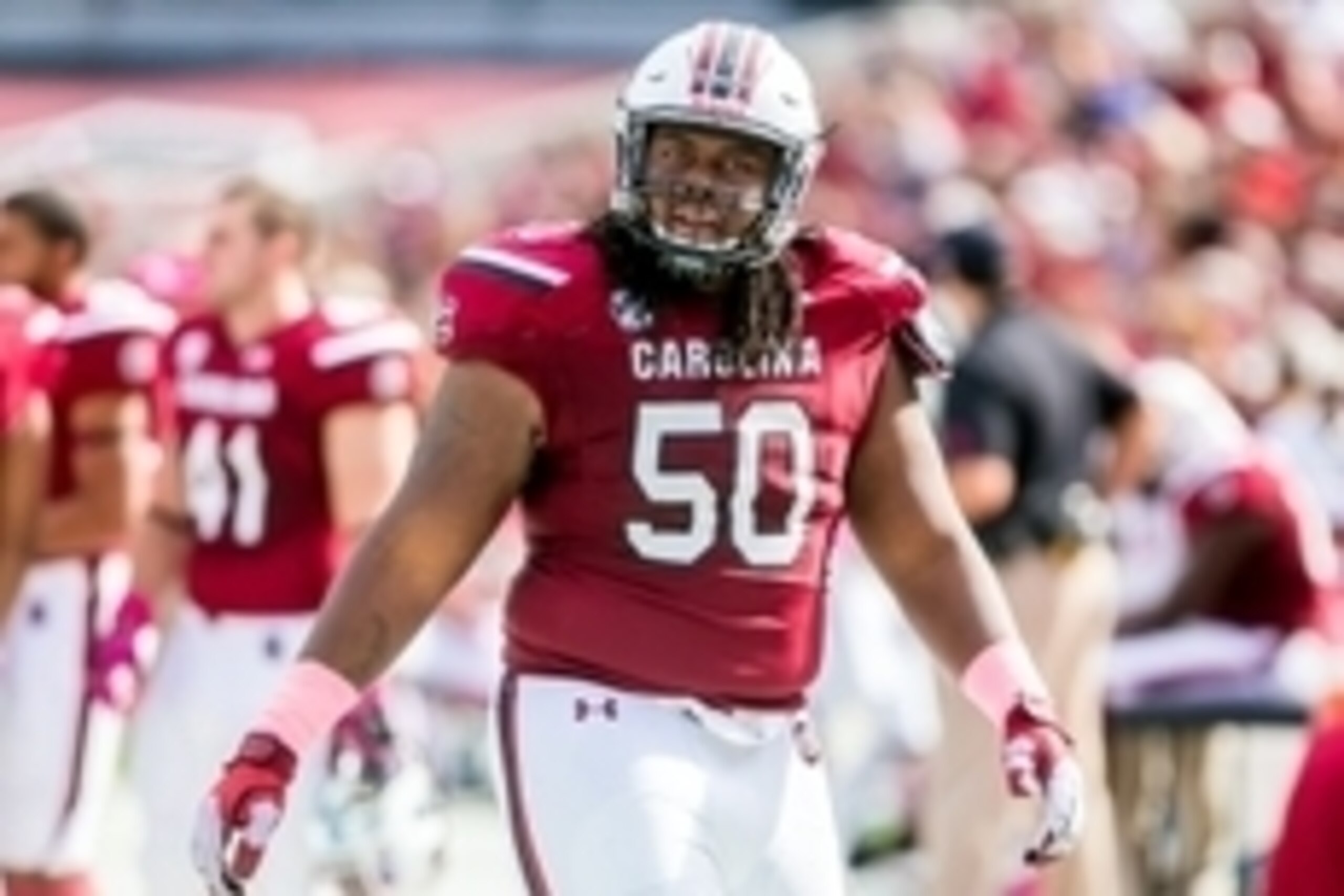
After 51 starts—the second-most for an offensive lineman in South Carolina history—at left guard, Cann already projects well to a certain position.
"I see him as a left guard-only prospect who overcomes lack of height with athleticism," an anonymous SEC coach told NFL.com's Lance Zierlein.
However, the Bamberg, South Carolina, native didn't let his four years of tape simply speak for him. Cann tried to prove he could do more for NFL teams to consider.
At the South Carolina pro day, the guard provided NFL scouts with something a little extra, according to DraftInsider.net's Tony Pauline:
Cann hinted at the possibility a month earlier at the NFL combine.
"I can play either LG or RG, maybe even center," the South Carolina product said, via CBSS ports' Dane Brugler. "I don't think that would be a problem."
The second-team Walter Camp All-American already established himself as one of the top guard prospects through four years of play. Yet teams interested in Cann have now seen him in some center drills.
Even as a projected second-round pick at guard, center holds more overall value. The ability to play all three interior spots along with his stellar player at South Carolina makes Cann one of the best offensive line prospects in this year's class.
While it's impressive to be able to play three or four offensive line positions, very few can play all five.
Cameron Erving
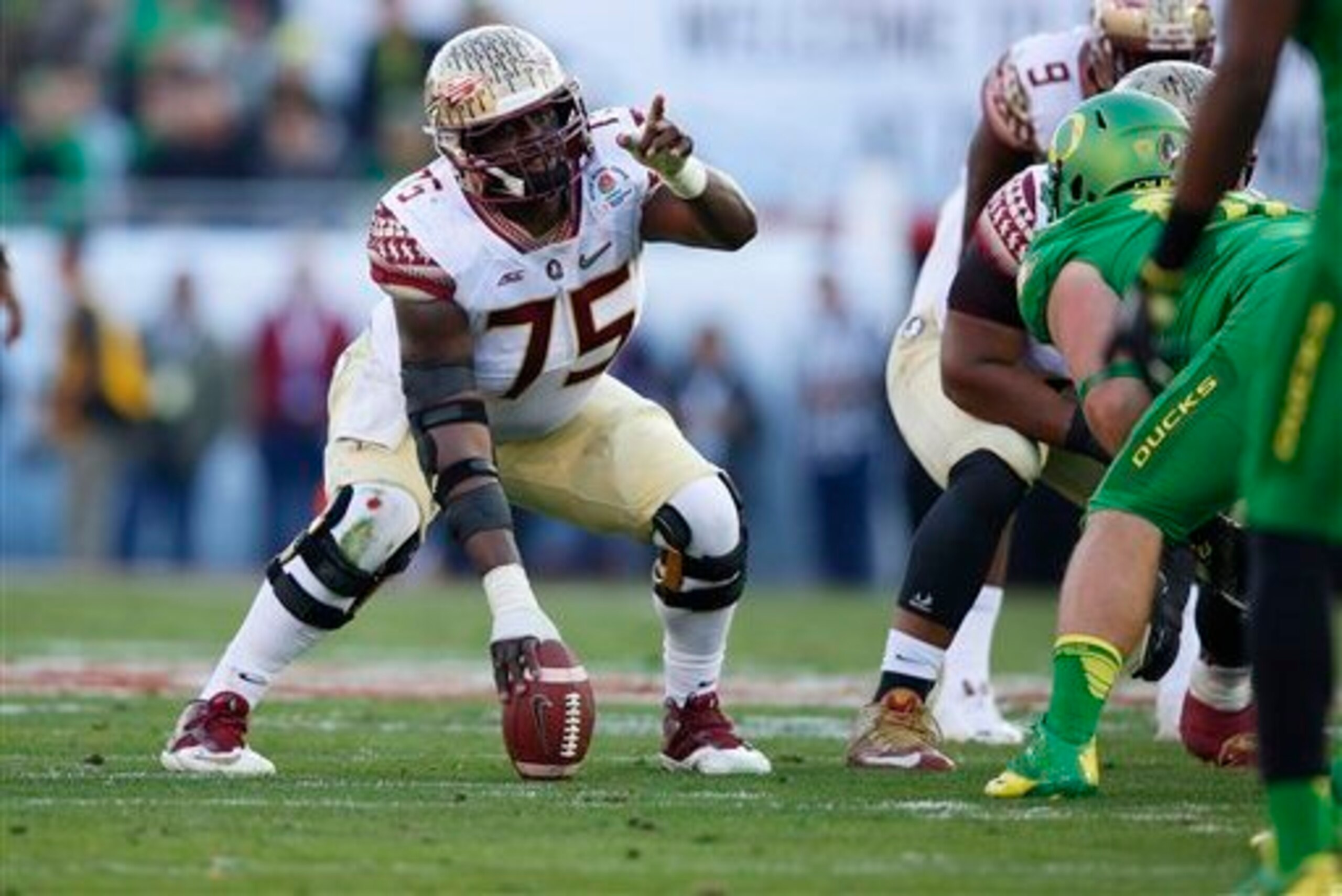
Maybe the most impressive achievement of any college football player last season belongs to Erving.
The Seminoles product was named to the 2014 All-ACC First Team at left tackle and the Second Team at center.
Erving is only three years removed from playing defensive line after making the transition from defense to offensive line in the spring of 2012.
For two-and-a-half years, Erving served as the Seminoles' left tackle and played at a high level on the blind side. In 2013, the native of Moultrie, Georgia, was awarded the Jacobs Blocking Trophy as the best offensive lineman in the ACC. He won the award in 2014 as well.
But Erving's 2014 campaign took a slight detour on his way to the NFL. The blind-side protector was pressed into action at center due to injuries along the offensive line.
It was from this point that Erving's draft status absolutely soared. The former offensive tackle seamlessly transitioned inside and dominated over the second half of the season. The move seemed absolutely natural for him.
As tackle, Erving was viewed as as second-tier prospect. But his move inside should make him a first-round selection and the highest center prospect off the board.
Teams, though, aren't overly particular regarding the position he eventually plays.
"The teams I've talked to have just talked about me playing offensive line," Erving told Bleacher Report in a phone interview. "They want to see how well you comprehend offenses and know defenses. They've seen the film. They eye in the sky doesn't lie, and that's always (something) I've been a big believer in. Whatever team picks me, I'll just have to find how I fit into their system."
Based on Erving's answer, some teams may still view him as an offensive tackle prospect, while others lean toward center. Also, the possibility of guard can't be ruled out of the equation. At 6'5" and 313 pounds with arms just over 34 inches in length, Erving owns the requisite physical tools and athleticism to play all five offensive line positions.
ESPN's Louis Riddick even believes Erving's potential supersedes that of some of the previously discussed offensive line prospects:
The Florida State product is not the only prospect in this year's class with the ability to potentially play all five offensive line positions.
Ali Marpet
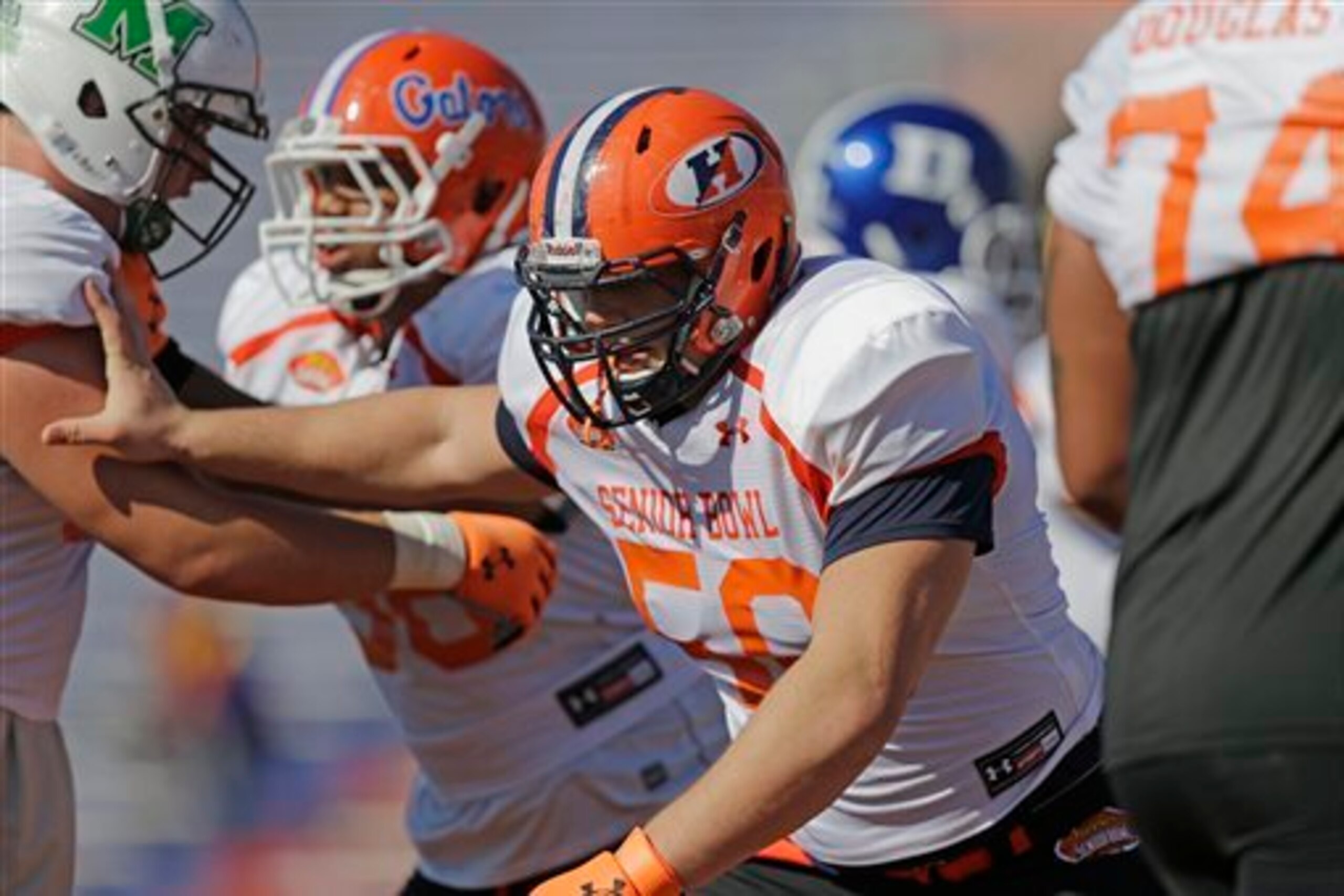
The Division III product from Hobart College remains one of the media darlings in the upcoming draft.
Everyone roots for the underdog, even though Marpet proved to be a bully during his collegiate career while playing against inferior competition.
At the Reese's Senior Bowl, Marpet didn't falter against vastly superior competition. Instead, he thrived. The South Florida Sun-Sentinel's Omar Kelly was blown away by Marpet in Mobile, Alabama:
Marpet, who played left tackle in college, worked primarily at guard and even saw some time at center, according to FirstRoundGrade.com's Bryan Perez.
Even NFL.com projects Marpet as a center.
"Marpet has also been impressive in meetings with line coaches," NFL Network's Albert Breer reported. "With his combination of intelligence and ability, he might be a center long-term."
Before the move is made official, though, Hobart might be able to hold up at tackle in certain situations.
At 6'4" and 307 pounds with 33.375" arms, his measurements are less than ideal. But not all tackle prospects fit the mold. The Hobart product is certainly a top-notch athlete with top-five finishes at the combine in the 40-yard dash, three-cone drill and 20-yard shuttle.
Marpet will likely be drafted sooner rather than later based on his raw athleticism and potential to play all five positions in a pinch.
Versatility equals value
What do each of the aforementioned prospects have in common?
They'll be selected by at least the end of the second day of the draft. Scherff, Collins and Erving will, in some order, likely be the first three offensive linemen off the board.
Cann and Marpet are second-day options, but their ability to play multiple positions only enhances their natural value. Teams wouldn't be quite as high on Cann as a pure guard prospect. If Marpet didn't show well at the Senior Bowl or offer position flexibility, the Division III product wouldn't even be considered in the first three rounds.
The ability to competently play multiple positions on a limited NFL roster is simply too tempting for teams when comparing these prospects to position-specific options.
Usually, the ability to play more than one position can even be what differentiates one prospect from another. Beyond those mentioned, Oregon's Jake Fisher, Missouri's Mitch Morse and Utah's Jeremiah Poutasi also provide similar flexibility and value.
Talented big men are hard to find. Big men athletic enough to do multiple things are highly sought-after commodities.
In this year's draft class, it's not a coincidence that some of the best overall talents among the offensive linemen present the best value due to their position flexibility.
Brent Sobleski covers the NFL draft for Bleacher Report. Follow him on Twitter @brentsobleski.
.jpg?w=2560)
.jpg?w=2560)