

Jalen Collins Has Tools to Be Next Standout Press Cornerback
Between the 2015 NFL combine, school pro-day events and a chance to catch up on underclassmen film, players like LSU cornerback Jalen Collins will shoot up draft boards. The focus after the season ended has been on underclassmen that entered the NFL draft pool early, and as exposure increases, the buzz follows.
Collins is entering the NFL at the most opportune time; of the top 15 cornerbacks graded by Pro Football Focus, 10 measured at least 5’11”. His official measurement of 6’1” and 203 pounds at the combine is impressive, but his 32" arm length is even more exciting. Coaches go crazy for his blend of size and speed because those measurements can help overcome other limitations.
TOP NEWS

New NFL contenders starting to emerge after Week 4
.jpg?w=2560 "Cardinals Giants Football")
NFL investigating 2 referees for separate viral exchanges
.jpg?w=2560 "Hill Injury Update Football")
Report: Chiefs Contact Hill's Agent
On the field, Collins’ lack of experience shows in his technique. But he also stands out because he can impact the game as a cornerback. Shutdown cornerbacks are as rare as franchise quarterbacks, so teams will take chances on players that flash the elite traits required to ascend into All-Pro-caliber players.
Boasting some of the most impressive physical traits of the secondary class, Jalen Collins has the perceived upside of an elite cornerback. Can he reach that potential? Let’s take a look at Collins’ strengths and where he has room to improve.
Collins’ Strengths
As mentioned before, Collins measures extremely well when compared to other cornerbacks. According to Mockdraftable.com, the 488 cornerbacks that attended the combine from 2005 through 2014 had an average height of 5’11”, with a standard deviation of 1.65".
To find where Collins lands on the bell curve, we just have to do some simple math. Standing two inches over the average, Collins is more than one sigma (standard deviation) away from the average. This is significant in difference, as he’s taller than about 95 percent of all cornerbacks measured at the combine. That’s an elite trait.
His length isn’t quite as elite, but he still has more reach than about 68 percent of other cornerbacks. The average arm length for 184 cornerbacks measured was 31.51”, and Collins sits at 32.125”. The resulting z-score is .615, which is solid and comfortably between average and the first sigma.
On the field, Collins played a lot better as the season progressed. With only 10 career starts, it’s not surprising that his performance was a little bit like a roller coaster. But his natural movement skills and explosiveness often took over stretches of games, and opposing offenses weren’t willing to test him in coverage.

In addition to having great size, Collins is a tremendous athlete. On quick slants and comebacks, he boasts quick feet that allow him to backpedal with efficiency and the hips to open up and attack the incoming pass. It’s normal for big cornerbacks to struggle greatly with turning their hips and accelerating quickly on these routes, but Collins showed improvement at controlling his body as he saw more snaps.
The example above shows a few things. Collins, at the top of the screen, does allow the completion, but he forced a very difficult play by the quarterback and receiver. He shows the excellent ability to transfer his weight and stick like glue to the receiver, which is something that wasn’t happening with regularity earlier in the year.
Still on the same play, Collins has the patience to force Amari Cooper to show his route. Cooper tries to get Collins off-balance at the line of scrimmage, but Collins was fully prepared for whichever direction Cooper would go. Don’t forget, Cooper is one of the best route-runners in college football and is projected to be an early first-round pick because of his own talent.
One of the highest-valued talents as a cornerback is the ability to get into position to play the ball and then have the awareness to finish at the catch point. Whether grabbing the interception, pass deflection or by forcing an incompletion by bothering the receiver, the cornerback’s goal is best accomplished through positioning.
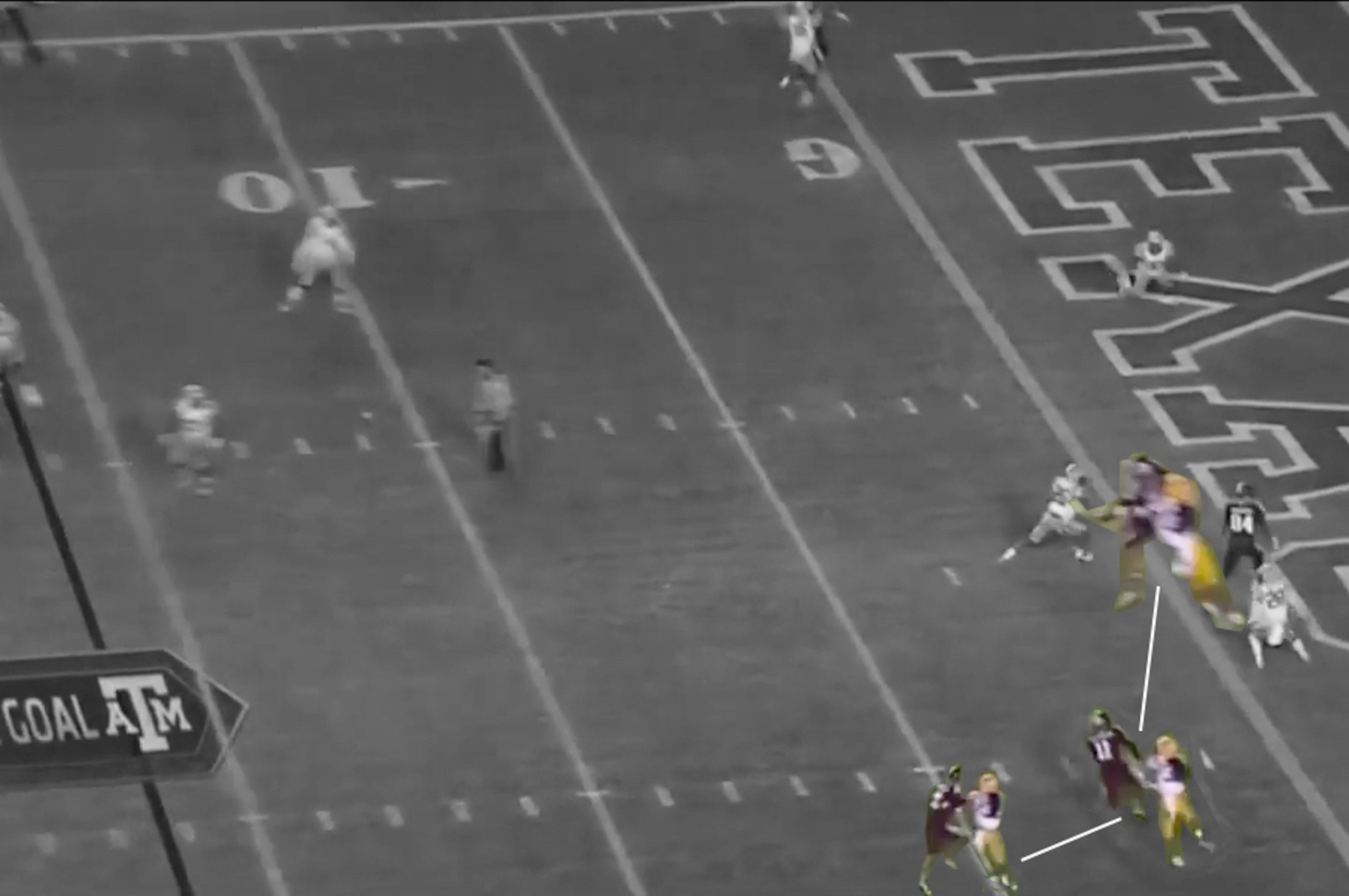
This play above helps illustrate Collins’ ability to force a tight pass on a post route. Without any safety help immediately to the inside, Collins has a tough task on his plate. His ability to explode and catch up to the receiver on the route was tested, and although he didn’t end up in front of the receiver’s face, the quarterback failed to hit the small target window that Collins forced.
The coverage wasn’t perfect, but with the combination of size, speed and length, Collins can afford to make small mistakes and still be in solid position. Of course, to become elite and realize his potential, his ball skills will be the key.
Finding the ball early in turn-and-run situations is a rare skill that many quarterbacks seem to lack. Playing the ball buys the defender the benefit of the doubt when there’s contact, and it opens up turnover possibilities. But it requires twitch reactions, confidence and familiarity with receiver tendencies.

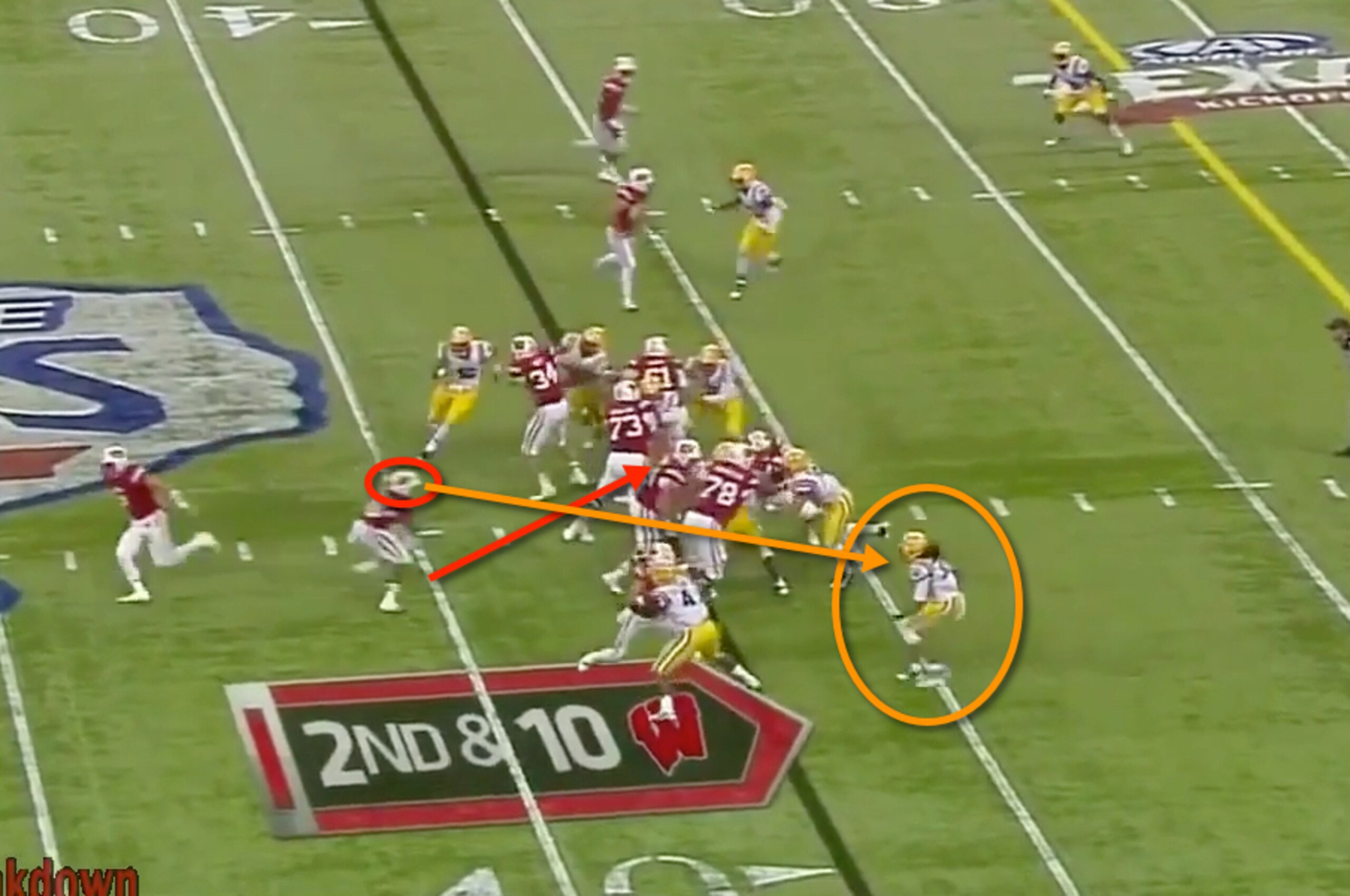
Collins had only three interceptions in three seasons, so it’s safe to say that his ball awareness is underdeveloped. But he flashed the ability to break up passes and logged 19 career passes defensed. A good example was in the 2014 season opener against Wisconsin, when he pinned a receiver to the sideline and used his length to knock the ball away from a trail position.
A bonus positive for Collins is his willingness to play the run. His physical profile is tantalizing because he can act as an extra safety on the field, but his mindset is key. Throughout his career, Collins showed that is a very capable tackler, finishing with 90 total tackles and three for loss.
Even when he isn’t finishing the play, Collins is a great run-lane filler. Some cornerbacks will dog it and allow themselves to just be a weak deterrent for the ball-carrier to attack their run gap.
But that isn’t Collins’ attitude. He’s a team player that is willing to show himself in the running lane, and on the picture below, Wisconsin running back Melvin Gordon decides to cut inside because he sees Collins waiting for him.
Collins’ Weaknesses
Starting just 10 games, there’s little surprise that many of Collins’ issues come back to technique. When critiquing technique, every prospect and many NFL players are inconsistent with how they play, so the key is to find what can reasonably be corrected and what cannot.

For Collins, his biggest area of trouble is his footwork. At 6’1”, he struggles at times cutting inside because his hips are limited with flexibility and it’s hard or maybe impossible for him to drop his hips as well as a smaller cornerback. To compensate, he needs to have great feet that allow him to change directions easily.
This example above is from LSU’s matchup with Notre Dame. Collins, on the bottom of the screen, loses this route and allows a modest gain. His backpedal is solid and he stays balanced until the receiver fakes outside, then cuts back to the numbers. That’s where Collins loses.
Take a close look at the screenshot below to see what happened.
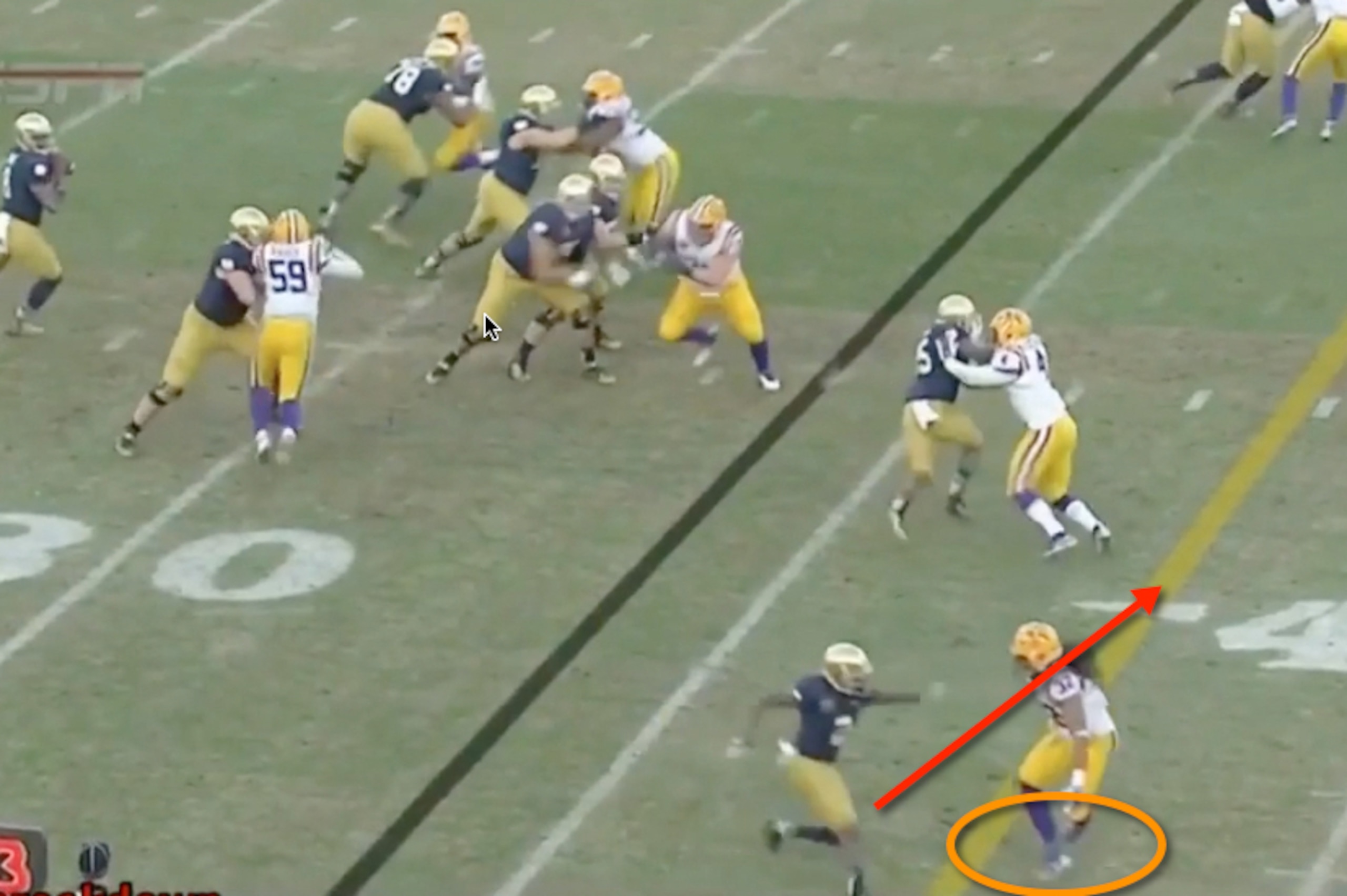
Collins crosses his feet because he’s sold that the receiver is going up the sideline. His discipline will have to be on point in these situations, or else this can happen more often. He did show improvement as the season progressed, but his footwork has to become rock solid for him to fit man schemes that ask him to follow receivers horizontally.
His ball skills, although flashing to be a positive, are largely a concern. He lacks consistency in looking up, finding the ball and taking it. Some interceptions just happen, but leaving too many on the field is an issue that separates average talents from the greats.

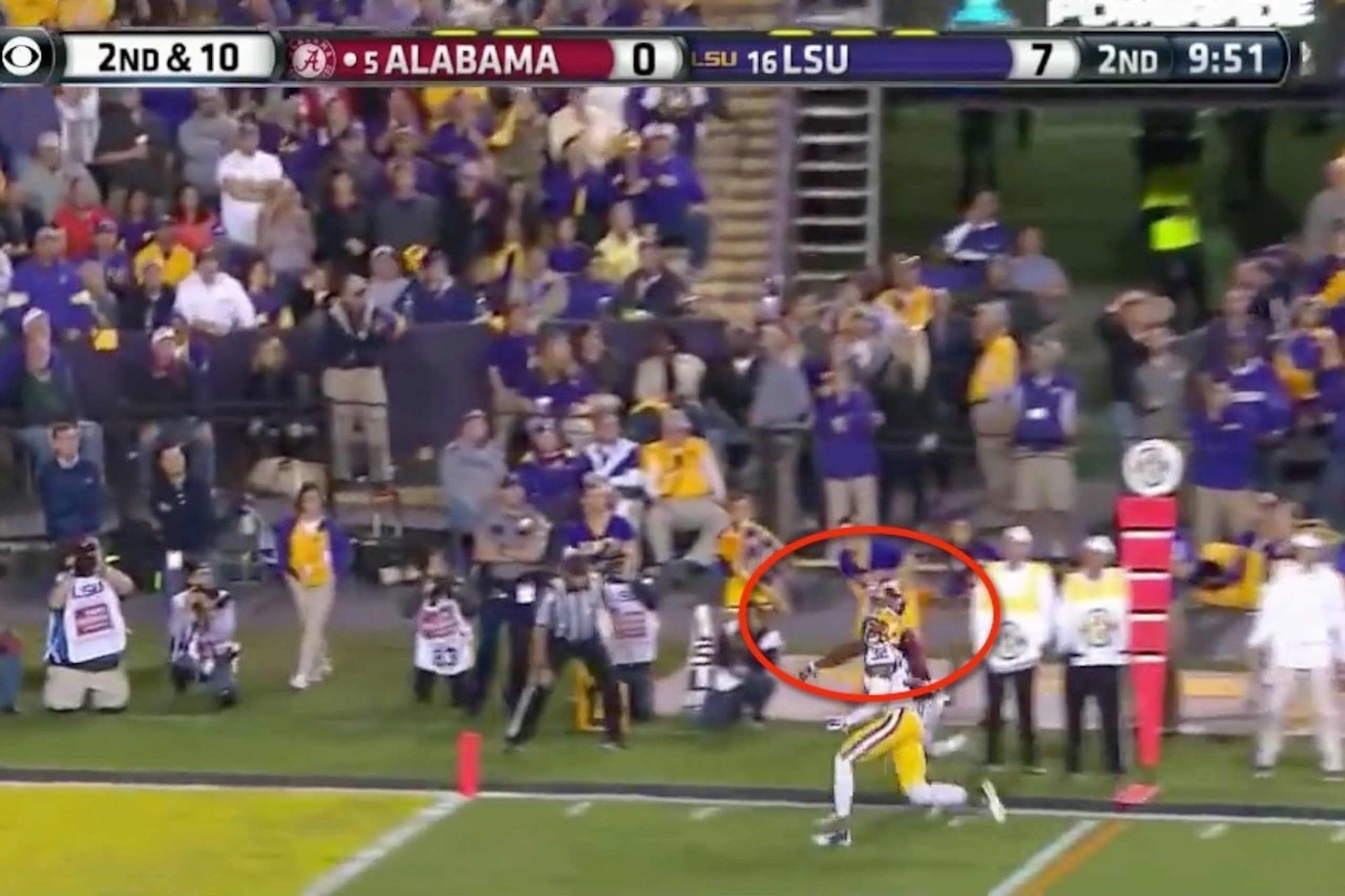
On a pair of back-to-back plays against Cooper in 2014, Collins exhibited his inconsistencies finding the ball. The first play is above, and we can see that Collins’ eyes are nowhere near the ball. He was late to look back and it gave Cooper the chance to haul in a touchdown pass. Luckily for Collins, he couldn’t reel it in and finish the play.
The very next play went right back toward Collins and Cooper on a fade route. As the ball arrives, Collins is attentive and plays the ball much more effectively, and Cooper’s chances on playing the ball are much lower. Although not a pass defensed or an interception, Collins forced a nearly impossible play because of his ball awareness. Now he has to become more reliable in coverage with that skill.
Projection
Seeing how Jalen Collins progressed through the 2014 season, his natural movement skills and combination of size and speed are worth investing in. His floor is relatively average, too, since he has the ability to play safety if he has to. A decent floor and very high ceiling are worth a late first-round pick in the 2015 class.
Stylistically, Collins is reminiscent of Jimmy Smith of the Baltimore Ravens. Smith was a solid athlete with great length, but he also needed time to refine his technique. If Collins is willing to put in the work, he is very similar in length and how he moves. In a press scheme, that bodes well for both the team and player.
All stats used are from sports-reference.com.
Ian Wharton is a NFL Draft Featured Columnist for Bleacher Report, contributor for Optimum Scouting, and analyst for eDraft.
.jpg?w=2560 "Titans Giants Football")
.jpg?w=2560 "Dolphins Bills Football")




