

Senior Bowl: What It Really Is, What It Really Means and Why You Should Care
MOBILE, Ala. — There's a pirate ship behind the end zone.
Kansas State receiver Tyler Lockett lays out and catches a deep sideline pass from Colorado State quarterback Garrett Grayson. The crowd cheers. Gus Bradley's Jacksonville Jaguars coaching staff offers finer points to quarterback, receiver and defender (Auburn's Nick Marshall, himself a quarterback until a few hours ago) after the catch. NFL scouts scribble in their notebooks. Alabama coach Nick Saban looks on, thronged by reporters and admirers.
Dozens of writers and bloggers make note of Lockett's catch. Many will write, "Tyler Lockett looked great at the Senior Bowl" many times over the next three months. None of them will mention the pirate ship.
TOP NEWS
Week 2 NFL Power Rankings 📊
.jpg?w=2560 "Patriots Seahawks Football")
Report: Darnold Could Miss 3-6 Weeks
Top Week 2 Fantasy Football Pickups 🏈
It's not a real pirate ship, of course. It's not a Tampa Bay Buccaneers stadium architectural marvel, either. You know the pirate ship your brother-in-law built for your 7-year-old nephew a few years back, the one no one would insure? Well, it's more shipshape than that, but it's still a hunk of two-by-fours and paint, the symbol of Fairhope High School, whose football field occasionally plays host to the top prospects for the most popular professional sport in America.
Welcome to the Senior Bowl. Those dozens of practice reports, tweets and roundups you will read for the rest of this week and through the draft season make it sound like the Senior Bowl takes place in some hermetically sealed, dustless football vacuum: the RCA Dome or some state-of-the-art facility where college all-stars run drills in a sensory-deprivation chamber.
The Senior Bowl really takes place in and around the unique little city of Mobile: at a small college stadium, a hotel, a convention center, some downtown bars and restaurants, and a suburban recreational complex with a pirate ship behind the end zone.
The Senior Bowl is the NFL's human-scale, grassroots scouting event. It may be the NFL's only remaining human-scale, grassroots event. But standing between Saban and some scouts, watching Lockett dive for the ball with the Jolly Roger flying in the background, I cannot help but ask myself: What the heck are any of us doing here?
Football's Living Fossil
The Senior Bowl consists of three days of intense, important practices for a game no one cares much about. It's a tail wagging a brontosaurus.
The least important thing about the Senior Bowl is the Senior Bowl. I will be at home for the Senior Bowl, as will about 90 percent of the people who came to Mobile explicitly because of the Senior Bowl. The Senior Bowl is all about preparing for the Senior Bowl: It's three days of college prospects proving to the NFL that they can prepare and practice like pros.
Established in 1950, the Senior Bowl is a relic from the era in which postseason college games were a popular midsized-city chamber-of-commerce ploy to fill hotels, restaurants and bars for a few winter days while putting the city on television and on the map. We host the Turnip Bowl, so consider our spacious convention center and gorgeous waterfront for your next sheetrock supplier's expo.
Other bowls have evolved over the decades to become intensively sponsored ESPN placeholder programming. The Senior Bowl is more of a living fossil. It's sponsored (I am fighting a nonstop urge for peanut butter cups), and NFL Network broadcasts the game in a slow period between Pro Bowl fantasy drafts and deflated football controversies. But this college all-star game, the last to carry any real cache among fans and all but the bush-beater-level scouts, exists to keep Mobile from plunging out of national consciousness and tumbling into its own bay.
The "NFL draft event" status is critical to the Senior Bowl's importance. The Senior Bowl has much more in common with the NFL Scouting Combine than, say, the GoDaddy.com Bowl, which Mobile also hosts. NFL Network broadcasts practices as well as games, with Mike Mayock providing interpretive commentary of why one receiver's dig route made him midround-pick worthy while an identical-to-the-untrained-eye dig route will lead to a life of wearing a real estate blazer.
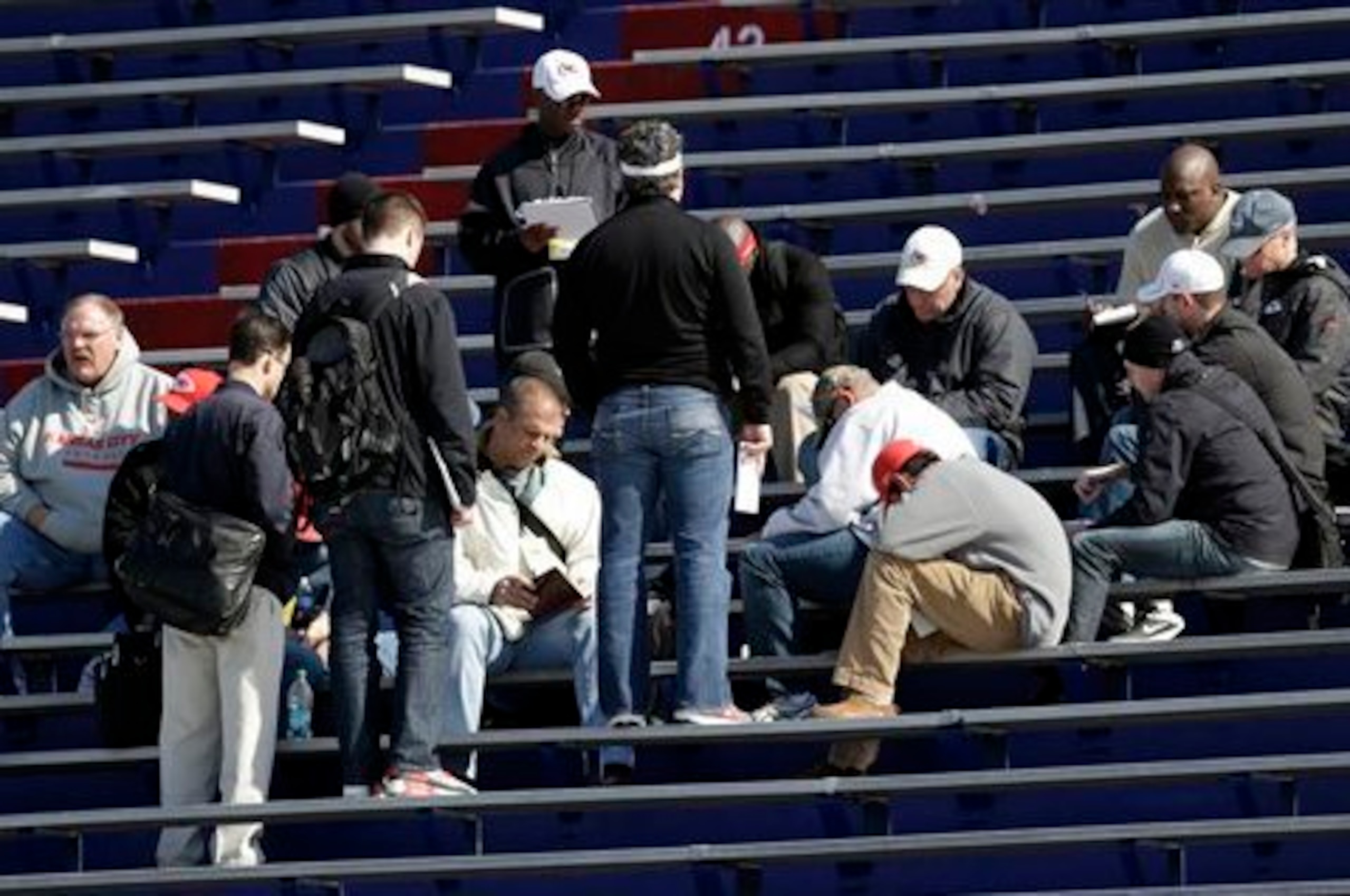
Media types—there are probably at least 10 times more media members than you will ever find at any non-championship-relevant bowl—hustle in at the start of the week for weigh-ins and practices, instead of strolling up to the stadium two hours before kickoff.
Team scouting contingents are huge; as I type this sentence at an otherwise sleepy downtown coffee shop, a crazy quilt of black, red, teal, purple and burgundy NFL sportswear waits in line while a high-profile coach leaves with a muffin.
Whole scouting departments are here because Danny Shelton and Ameer Abdullah are here. I am here because the scouts and coaches are here, and because Shelton and Abdullah are here. Bleacher Report is happy to pay me to be here because you care about Shelton and Abdullah, Bryce Petty and Devin Smith.
The coffee shop can remain here, in part, because it is crowded with coaches, scouts and reporters for one week a year, keeping the poverty missions and job-for-day providers a few blocks away from encroaching on the middle of downtown.
So by reading this, you are helping to keep a historic district of one of America's oldest cities financially solvent. Click three or four more times to help even more! But you do not need to know that or care about it.
All you need to know is that some of the most outstanding NFL prospects in the nation are here. And for them—as well as the players who chose not to come—the stakes are very high.
Dig a Little Deeper
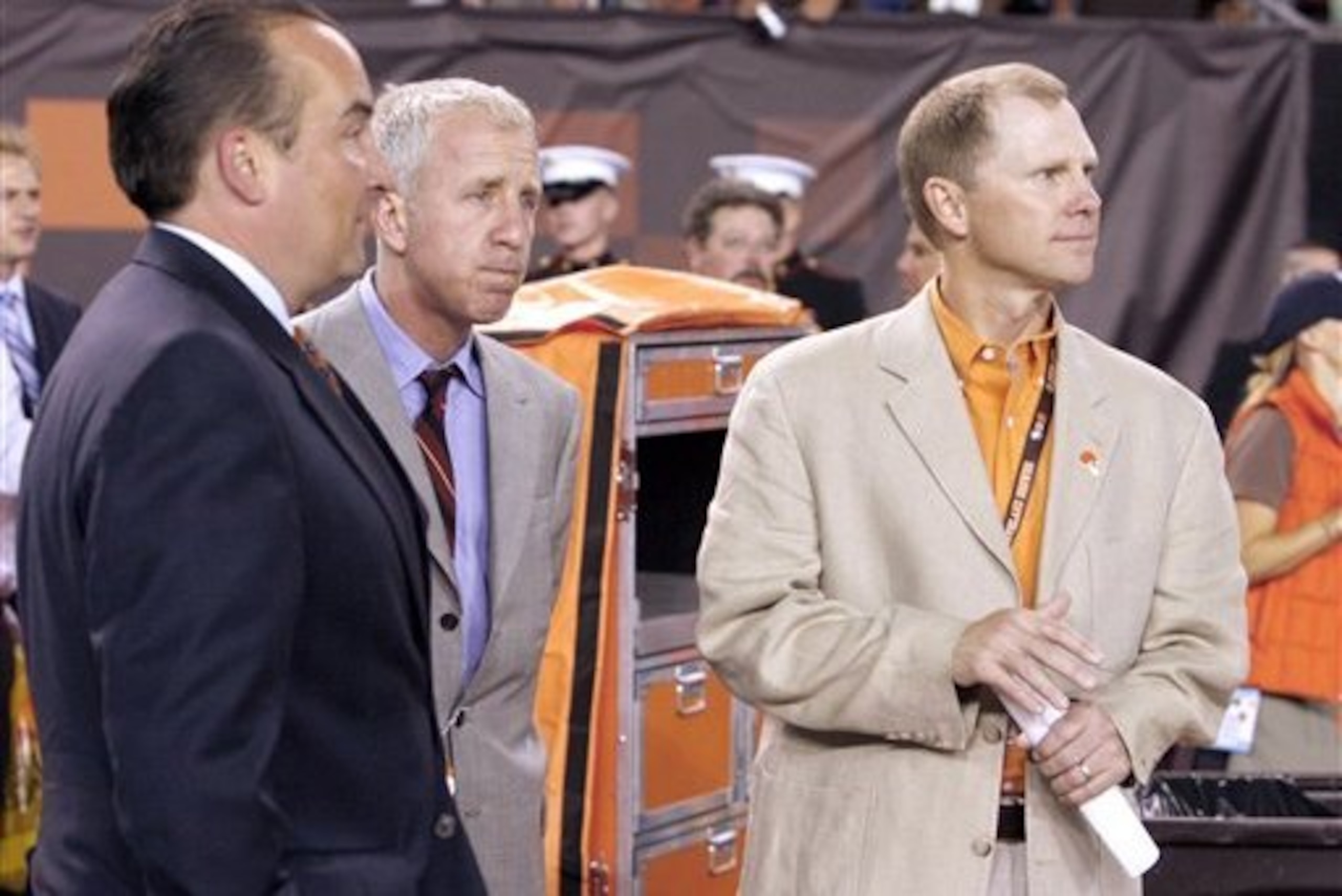
Phil Savage speaks directly to the NFL scouts and coaches at Tuesday morning's weigh-in, politely ignoring the presence of dozens of reporters, photographers and videographers among the standing-room-only crowd at the Mobile Convention Center. He thanks the NFL folks for their participation and urges them to acknowledge the courage and commitment the 108 prospects made by volunteering to participate in the Senior Bowl.
Savage then runs down an itemized list of the players who are not here. First, those who had injuries. Then, those who declined early in the recruiting process, taking the time to write a letter or make a phone call to decline the invitation like budding professionals.
Then the hammer drops. Savage names nine players who "to me, you should dig a little deeper on." A no-show, no-call to the Senior Bowl can put a top prospect on the naughty list.
You may remember Savage as the cantankerous general manager of the Browns from 2005 to 2008. The Mobile native was a poor fit behind a desk but is a natural as executive director of the Senior Bowl, where he acts as a kind of political party whip.
Times are tough for college football all-star games.
Elite prospects, like the prettiest girls at the dance, leave as much as possible to the imagination, letting their game film and reputations do their talking for them during an offseason full of combine workouts, Pro Days and private visits.
Savage pushes hard against that trend by working both his college and NFL connections to make the Senior Bowl a vital step toward the NFL for any prospect who has completed his college eligibility (hence the "senior," though juniors are now eligible under special circumstances) and falls outside the clear top five in the upcoming draft.
In addition to praising arrivals while shaming no-shows each year, Savage helped lure both the candy sponsorship and the NFL Network. He keeps tweaking schedules and game rules to make the game and practice week as enticing as possible to prospects, teams, reporters and agents.
Still, with top draft choices so often culled from the junior class and cream-of-the-crop college superstars sensing little to gain from playing with near-strangers in an all-star game, big names like Jameis Winston and Marcus Mariota (little to gain) are not at Senior Bowl Week.
Savage, ever the event promoter, spun the absence of two superstar quarterbacks into a compelling storyline. "The race is on to be No. 3," he said at Monday's opening press conference. "Everyone's anxious to find out who that is."
Quarterbacks vying for that No. 3 spot include Grayson (who threw the pirate pass mentioned earlier) and Bryce Petty of Baylor. Neither quarterback looked great Tuesday, but quarterbacks rarely look great throwing to unfamiliar receivers for the first time.
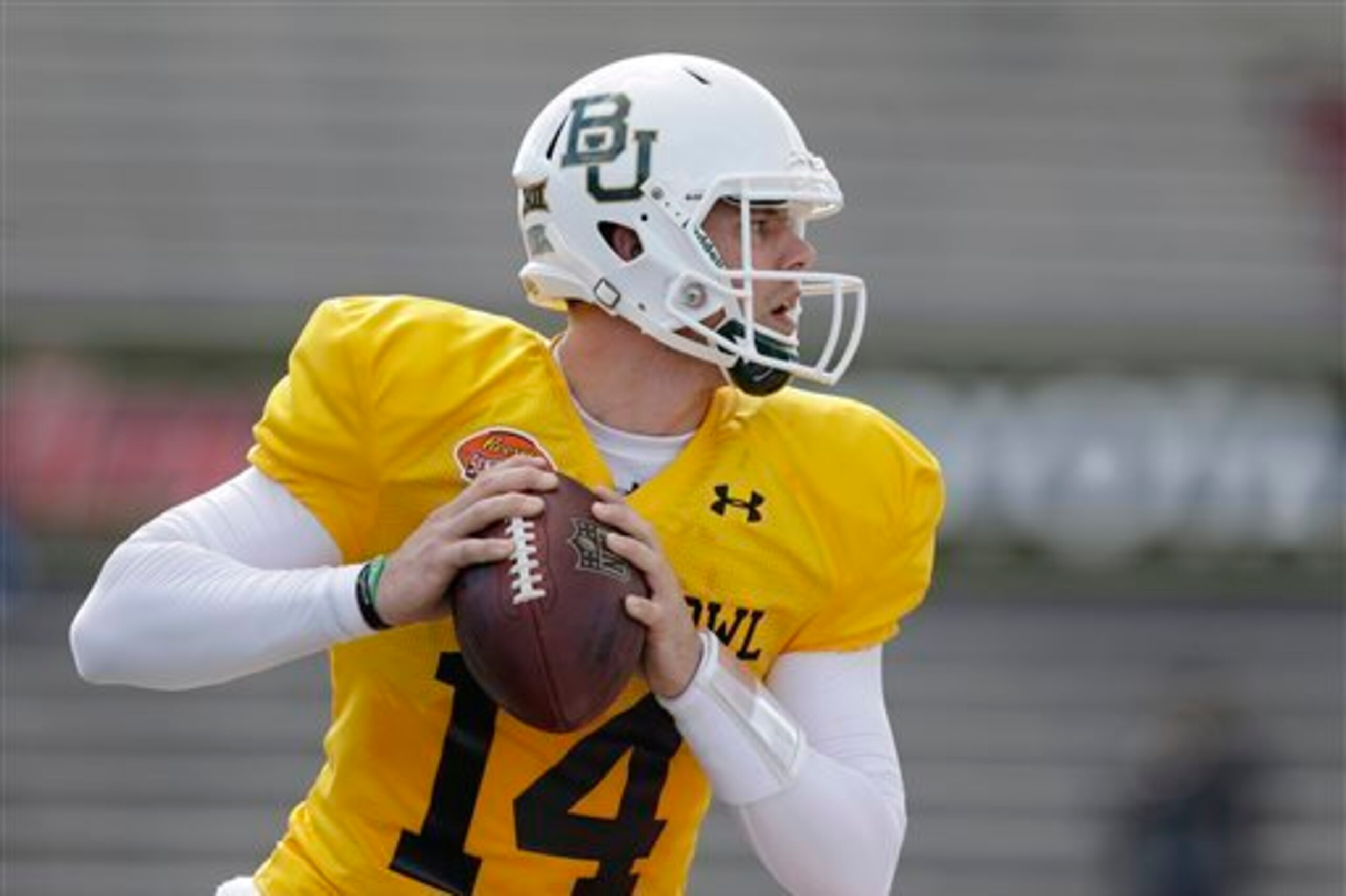
Petty, Grayson and others can still follow in the footsteps of quarterbacks like Derek Carr and Jimmy Garoppolo, who solidified their standings at last year's Senior Bowl. Garoppolo even gamely climbed the ladder from the East-West Shrine Game (last week's all-star exhibition, which has lost much of its luster) to the Senior Bowl, hustling through two weeks of grueling practices with two different coaching staffs. He is now preparing to back up Tom Brady in the Super Bowl.
Players at other positions can use the Senior Bowl to answer questions. Eric Fisher arrived as a small-school (Central Michigan) offensive lineman two years ago and left on his way to becoming the first player taken in the 2013 draft, having proved his ability to block major-program competition. Aaron Donald's height (6'0") was seen as a potential liability before he spent Senior Bowl week blowing up every blocker on the practice field; he became the 13th player selected in last year's draft and was one of the league's best defensive rookies.
And then there was Russell Wilson.
He arrived in Mobile three years ago as a too-short (5'11") low-round prospect. A week of torrential downpours and tornado warnings gave him few opportunities to prove he was something more. One mini-monsoon forced him to practice on a concrete floor inside the convention hall, throwing to receivers who were wide-open between the water fountain and the door to the men's room. He spent another practice throwing into a stiff, steady wind.
In the interview rooms, however, Wilson was No. 1 with a bullet. Fellow players raved about him. The coach-and-scout mutter about his preparation and dedication grew loud. Wilson only worked his way up to the third round—another day of decent weather would have helped him further—but he landed on the radar of an organization that knew precisely who he was and what they wanted him to become.
Scouts and coaches are not necessarily looking for the next Wilson; they are looking for everything. But players know the Wilson opportunity is here, and that it is not just seized on the practice fields, but in interviews, meetings and even on the team bus. At the Senior Bowl, everything is evaluated.
Players start the week parading across a stage in compression shorts in front of hundreds of onlookers; every roll of flab and knot of muscle is recorded. Coaches and scouts note how they talk, what they eat, how they interact with their new teammates. It's an intense, public week-long job interview disguised as an entertaining event to pour some money into the local economy.
Oh, about that No. 3 quarterback: Many would list UCLA's Brett Hundley as the most likely candidate. Hundley is Senior Bowl-eligible, and Savage made it clear that he was actively recruited. But Hundley was on the Savage shame list: no show, no call, no reason given.
It's a minor thing, but...maybe we should dig a little deeper.
Draftnik Paradise
If you love the NFL draft and all the attendant hoopla, the draft itself is not the place you want to be. February's scouting combine is not the place you want to be. The Senior Bowl is the place you want to be.
Downtown Mobile looks like New Orleans after a zombie apocalypse: crumbling with genteel grace, crowded with antebellum beauty, crammed with great eateries and good bars, but nearly deserted.
The January weather is comfortable, give or take the occasional tornado warning. You can sit outside at one of the causeway seafood shacks, munching softshell po'boys and enjoying bay breezes between practice sessions.
The town is always decorated in January for its own mini Mardi Gras a few weeks after the NFL clears out. You walk, dine and drink in a sleepy downtown sparsely populated by some homeless, a few hipsters and hordes of draftnik zombies: scouts, coaches, writers, agents, owners, hangers-on and players all thrown together in a city too tiny to offer many VIP velvet-rope options for bigwigs.
The guys at the table next to you work for the Titans. The group that just walked out write for ESPN, Sports Illustrated and Bleacher Report. Yes, that famous football personality was more than a little tipsy.
On a Senior Bowl Tuesday, you start at Ladd-Peebles Stadium, home of South Alabama University, nestled in a working-class neighborhood on the outskirts of downtown. You drive through moss-covered trees into a garden district of columned porches and historic markers, through the tiny downtown of French cathedrals, wrought-iron railings, government buildings and boarded-up shops, through a tunnel and onto a long causeway of high reeds and bay views.
On the east side of the bay, you reconnect with the 21st century, driving through a few miles of suburbs to reach Fairhope, home of the pirate ship. Then, back downtown for food, drinks and people-watching. It's like a brief tour of all the ecosystems of human habitation: maritime, bayou, Southern, suburban, privileged, impoverished, historic.
There are autograph tents after each practice, and they are rarely crowded. Players are never that far away, either at tiny Ladd-Peebles or the playground. There are fan events, like a Friday afternoon Meet the Players session (free) and a Wednesday Fellowship of Christian Athletes rally (also free). But the whole week is really a fan event: four hours per day of watching college All-Stars practice, usually in fine weather, as coaches mill about and impromptu sideline press conferences break out within earshot.
The draft itself is a cattle call with loud music and louder formal wear—a pep rally for a season four months away. The combine is a droning series of press conferences, with workouts off-limits to everyone but team brass and NFL Network cameras.
The Senior Bowl is a trough of college and pro glitterati that you can wallow in. It's great for writers. For fans, it's a best-kept secret, though folks in SEC territory are in on it: By midweek, campers will begin to pull into the Ladd-Peebles parking lot, turning draft auditions into an end-of-week cocktail barbecue.
The Senior Bowl is one last chance to interact with a famous football player before he disappears behind a veil of agents and team public relations directors and reappears as an unapproachable mass-market gladiator. It's a rare chance to catch the NFL with its tie loosened, to see coaches and owners acting like people. The NFL needs more Senior Bowls, more opportunities to walk among us mortals. Both sides could use more reminders that the other is also comprised of real human beings.
You'll see Grayson, Lockett and the others in NFL uniforms soon enough. For now, enjoy the scouting reports and hyper analysis, here at Bleacher Report and everywhere football is discussed for fun or profit. I'll be studying these guys for their NFL worthiness as much as Matt Miller, Mayock or any other draftnik does. But I will never lose sight of the pirate ship.
Mike Tanier covers the NFL for Bleacher Report.
.jpg?w=2560 "Packers Jacobs Plea Football")

.jpg?w=2560 "Grading WWE NXT 🔠")