Facing the Weight of Expectations, Sixers Gambling That a Risky Change Pays Off
He spent more than a week watching the Kyrie Irving- and Gordon Hayward-less Boston Celtics bully his Philadelphia 76ers in the second round of the Eastern Conference playoffs. Two days after his team was sent home for the summer, Sixers head coach Brett Brown was candid in his assessment of the roster. "I think that another high-level free agent is required. … I think we need help to win a championship," he said afterwards.
There were stars available. The Sixers tried luring LeBron James. They danced with the Spurs around Kawhi Leonard. They pined for Paul George. Certainly, they figured, one would jump at the chance to play alongside Philadelphia's young, dynamic duo of Ben Simmons and Joel Embiid.

Brown—who took the full reins of the team after a bizarre Twitter scandal engulfed, and led to the firing of, team president Bryan Colangelo—and the Sixers struck out all on all three. Instead, they were forced to settle for re-signing sharpshooter JJ Redick and acquiring Wilson Chandler and Mike Muscala, two reserves, all three for just one year.
That left the franchise with about a month to devise a way to plug all the holes the Celtics exposed.
Sure, the previous season had been thrilling: 52 regular-season wins after winning 75 games total over the previous four years. Sixteen straight victories to punctuate the regular season. A postseason berth for the first time since 2012. A playoff series victory for just the second time since 2003.
Embiid, the team's transcendent seven-foot star, played 63 games, more than double his career total entering the season. He also established himself as a perennial MVP candidate. Simmons returned from the series of foot and leg injuries that kept him out for the entire 2016-17 campaign and won the NBA's Rookie of the Year award.
Within a single season, the Sixers had transformed into one of the most skilled and starry groups in the NBA.
But the playoffs had made clear that there were questions Brown would need to answer. What do you do when your best player's strength (posting up) is the least efficient way to attack a defense? When your second-best player can't, and largely won't, attempt a shot outside the paint? When your only knockdown shooter and, in many ways, the fulcrum of that dizzying offense you run doesn't possess the physical tools to match up with the type of rangy, bouncy wings that the Celtics—and now also the Raptors—reloaded with? And when your own All-Defense three-and-D wing is exposed as lacking in both those the "3" and "D" areas?
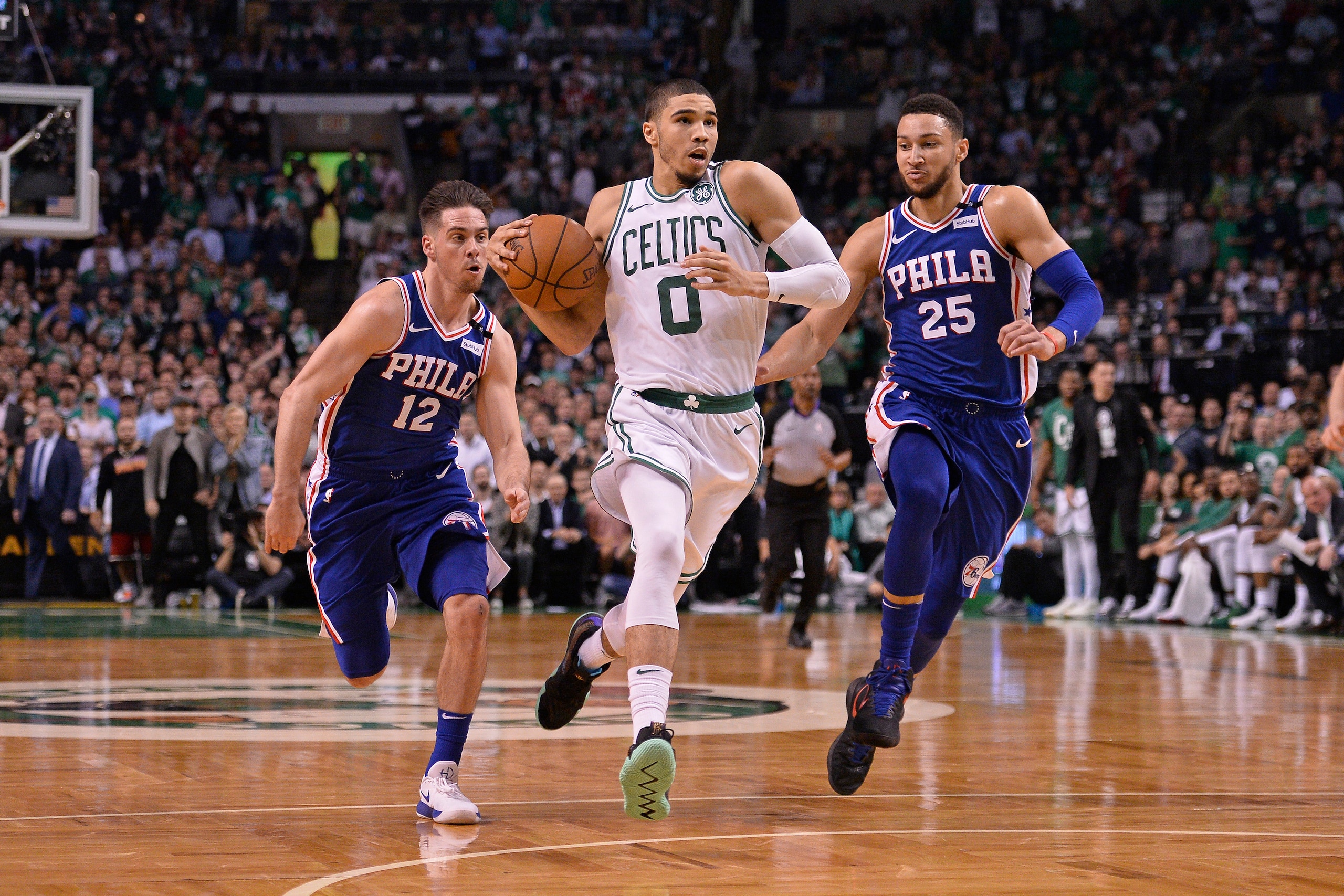
Brown spent the summer thinking about the different ways he could maximize his team's talent. He could sit back, tinker along the margins and hope for the best. Or he could roll the dice.
Which leads us to a recent phone call. Two calls, actually—both placed by Brown. One was to his longtime former boss, Spurs head coach Gregg Popovich. The other was to one of his former Spurs players, the recently retired Manu Ginobili. Brown told them he was thinking about making a change. A small one on paper, but a big one in import.
His team's starting lineup—the one that had wrecked opponents last season and propelled the Sixers into the playoffs—might have to be broken up.
The Sixers really want to win a championship. "It is our goal to go play in an NBA final" this year, Brown said recently. This, of course, is true in theory about every NBA team. But it's their path toward contention that separates the Sixers from their NBA brethren and has Brown feeling itchy about making the leap before his young and cheap players cease being so young and cheap.
You no doubt know the history by now. The seasons of 19, 18 and then 10 wins, the Process, the trusting, Sam Hinkie, Sam Hinkie's "death"—a crucifixion that, his apostles affirm, occurred on behalf of the Sixers' sins. It's a history that smothers every Sixers move, like a thick fog.
Yet here we are, not even three years removed from that infamous 10-win season, and the Sixers have grown into one of a handful of teams that can realistically dream about capturing a title.
"I feel that we got all the talent to make it happen," Embiid said during the team's media day. Six opposing coaches/scouts/executives polled for this story all had the Sixers pegged as winning between 50 and 55 games. As one said, "They're easily one of the four best teams in the Eastern Conference, and probably ahead of everyone except Boston and Toronto."
Embiid is perhaps the most dominating post presence the league has seen since Shaquille O'Neal. He's a brilliant rim defender. Also, as he pointed out at the beginning of training camp, "This is the first time I'm healthy, especially during the summertime and coming into the season." Simmons could average a triple-double. Redick is still one of the league's premier snipers. 6'10" forward Dario Saric drilled 39 percent of his triples last season but can also put the ball on the floor and bully smaller opponents in the paint. He is a favorite of scouts and might be one of the NBA's most underrated players.

The defense is stout, both in talent and scheme. The offense, which is always looking to run and eschews pick-and-rolls (no team ran fewer than the Sixers last year) in favor of ball movement, is tailor-made for pouncing on dreary regular-season opponents.
Embiid, Simmons and Co. are going to spend October through April racking up wins and filling our Twitter timelines with dazzling highlights. Chances are they'll coast through the first round of the playoffs too.
But a second straight 50-win season, coupled with the growing fame of their rising stars, will introduce new obstacles to the picture, namely fame and the sort of magnifying lens this group has yet to live under. Making the leap from lottery regular to playoff contender is the easy part. It's the next step—one that involves dealing with expectations, something Brown has yet to experience since taking the Sixers gig in 2013—that often confounds teams.
"Ultimately, our team will have to figure out what our internal expectations are and lock out all of the noise that comes with external expectations and really focus on that internal goal," said Redick, who witnessed how expectations and dueling goals could derail a team during his time with the Lob City Clippers. "We live in a 24/7 news cycle where you hit a two-game losing streak, you get off to a slow start, you lose to the Celtics twice in a row, you know, people chatter, and we have to be able to block that out and sort of focus on what that end goal is, which is winning an NBA championship."
But what happens when your roster doesn't appear to have the necessary talent to meet your own lofty expectations?
That 16-game win streak to close the season, for example? Twelve of those victories came over teams with losing records. That humming offense that fattened up during the regular season on transition points and weak defenses that snap under the pressure of a couple of ball reversals? Once the games moved into the boxing ring that is playoff basketball, the offense's output cratered. Suddenly all those passes pinging around the perimeter—no team threw more passes than the Sixers last year—and that symphony of guards dashing around the floor looked more like window dressing for a limited group than the foundation of a beautiful attack.
Anointing the pass as "king," as Brown is fond of saying, is great. But even the most perfect of schemes—and let's not forget the Sixers led the league in turnover rate last season—can only cover up so many holes.

"That's the thing people often don't realize about the playoffs," one Western Conference assistant coach said. "You play a team four, five, six straight games, they just figure stuff out. There doesn't have to be some magic scheme or anything. They just get a feel for you, and that's where you need the talent and to cover your weaknesses."
Of course, you can nitpick almost every roster. Few are perfect. The problem is the Sixers have reached a point where they're trying to take down the rosters that are.
As the summer was ending, Brown was still thinking about how to solve this riddle. Striking out in free agency meant all growth would have to come from within. That left Brown with one option: squeezing every ounce of talent out of every player on the roster.
Over time an idea began to grow: What if he tinkered with his starting lineup? This would be a big deal for any team and head coach, but even more so for the Sixers. Their starting lineup—consisting of Simmons, Redick, Robert Covington, Saric and Embiid—ran circles around opponents last year, outscoring them by a robust 21 points per 100 possessions, the top margin in the league among lineups that shared the floor for more than 300 minutes.
In the postseason, however, against an experienced and deep Celtics team in the Eastern Conference semifinals, that starting five was outscored by 12 points per 100 possessions over 47 minutes. That didn't bode well considering Boston only grew better and deeper in the offseason.
Brown remembered that in the 2006-07 season, Popovich had shifted Ginobili to the Spurs bench. Perhaps, he thought, he could do the same with Redick. This would bolster his second unit, and more importantly, it would provide 2017 No. 1 draft pick Markelle Fultz an opportunity to shine after he missed nearly all of his rookie season due to a series of vague injuries that had left his jump shot broken.
"I went back to Pop and Manu," Brown said, "and asked them to remind me, 'Manu, how did you feel,' and, 'Pop, remind me why we did it.' I've been thinking about this all summer. The things that Pop and Manu shared with me are so similar to what we have here right now."
The Spurs wound up winning a title that year, which no doubt left Brown feeling inspired. In September, about 10 minutes before the opening of Sixers training camp, Brown pulled Redick aside and informed the 34-year-old veteran that he was considering making a move. A few weeks later, in the Sixers' preseason opener, Brown made the decision official.
No one knows what to expect from Fultz, both this season and going forward. The Sixers have thus far put up an optimistic front. "When I see him now come back into our gym, you look at his swagger, his cocky side, his mojo, he's seeking shots," Brown said in September. "He really is not bashful." Elton Brand, the recently promoted general manager, went on Zach Lowe's ESPN podcast and said Fultz is now launching three-pointers during five-on-five scrimmages. Perhaps that's true, though it's worth pointing out that sources had told B/R otherwise.

Either way, there's preseason footage out there that tells us all we need. Has Fultz's shot improved from last year? Without a doubt. But let's not forget how low the bar was, and let's not overreact to his managing to make one of his five preseason attempts from deep, or to the evolution of his shooting mechanics from broken to eh, I guess it's not the worst thing I've ever seen.
The shot is still stiff and inconsistent. It's more of a push than a flick. And perhaps most worrisome: Fultz is still in denial about the root of his shooting woes—even though Drew Hanlen, the trainer Fultz spent the summer working under, attributed Fultz's struggles to "the yips."
"I think it was a 'mis-term' in words, but me and Drew have talked," Fultz said. "What happened last year was an injury. Let me get that straight. It was an injury that happened that didn't allow me to go through the certain paths that I needed to, to shoot the ball. Just like any normal person, when you're used to doing something the same way each and every day and something happens, of course, you're going to start thinking about it. It's just normal."
Fultz could well rediscover the smooth stroke that propelled him to the top of draft boards last year. But reinserting him into the picture could make things a bit more complex for the Sixers this year. Off the court, managing will need to be done. On the court, his presence, especially alongside a fellow non-shooter in Simmons, will present the Sixers with another hole in need of plugging come playoff time.
Still, Brown believes he can devise tactics that allow Simmons and Fultz to share the floor even though neither is a threat from the outside. Maybe by running more pick-and-rolls than in previous years. Maybe sticking Simmons down behind the backboard, "and because Joel Embiid can shoot, I can put him wherever I want, probably even in a corner," Brown said. He's also talked about having Fultz focus on corner three-point shooting—a shorter and generally easier shot—to help with spacing.
That Brown felt it necessary to insert Fultz into his wrecking ball of a starting lineup, though, tells us everything we need to know about the limits of this Sixers team.
It tells us that even at their best, they were not equipped to knock out the league's heavyweights. It tells us the Sixers recognize that a level of coddling is needed to help Fultz revive his game and fulfill his potential. And it tells us there is no guarantee this is going to work, as Brown tacitly acknowledged in the Sixers' final preseason game when he started the second half with Redick on the floor and Fultz on the bench, while explaining in some hazy way that the move was about growth.
Take all this, throw it in a bowl alongside all those expectations and then sprinkle some of the growing fame of Embiid and Simmons on top, and you get a combustible mix. Maybe it turns into something beautiful. Or maybe it all blows up.
Yaron Weitzman covers the NBA for Bleacher Report. Follow Yaron on Twitter @YaronWeitzman and sign up for his newsletter here.
.jpg?w=2560 "NBA Gambling Charges")

.jpg?w=2560 "Jonathan Taylor Landing Spots")
.jpg?w=2560 "NFL House in Paris Closes for Protests (AP)")