


Superteams defined the NBA offseason, and their influence will be felt on the 2017-18 All-NBA rosters.
Some of last season's selections had their clubs add one or more stars to the mix. Others watched as their clubs failed to find the difference-makers they need. Some will rely on their new teammates to provide a bolt of energy, while others will count on continuity to move them forward.
We have yet to see how any of these moves will change things in games that matter or how those relationships will evolve over the ensuing marathon. We don't know which teams will be attacked by the injury bug or which will be refashioned by trades.
But with the summer winds done blowing and rosters mostly set, now is a good time to predict this campaign's All-NBA first and second teams.
First-Team Guard: Russell Westbrook, Oklahoma City Thunder
1 of 10
2016-17 Absurd Achievement: Set NBA record with 42 triple-doubles and joined Oscar Robertson as the only players to ever average a triple-double.
Russell Westbrook's 2016-17 campaign was the league's greatest magic show. He made the impossible a reality, leaving a trail of dropped jaws and defeated defenders behind him. His assistants helped enhance the spectacle, but the spotlight was his alone—his 41.7 usage percentage cleared the previous high mark by three full percentage points.
The hyper-explosive guard has been reaping his well-deserved rewards ever since. First came the MVP, only the second collected in Oklahoma City Thunder franchise history. A five-year max extension that created the biggest total contract in league history—six years, $233 million—came later.
In between, OKC massively upgraded its roster—congrats on this season's Executive of the Year, Sam Presti—by flipping non-stars for All-Stars Paul George and Carmelo Anthony. That closed the curtain on Westbrook's solo act, but it should skyrocket his efficiency. He didn't have a teammate average 16 points pr game last season; now he has two who cleared 22 per game.
"Night in and night out, we're dealing with double-teams, we're dealing with triple-teams, we're dealing with traps. You can't do that now," George told NBA TV's Dennis Scott. "You can't double off of Russ. You can't double off Carmelo. And those guys are shooters; you can't double off me."
This could (maybe should) be the best version of Westbrook we've ever seen, which is incredible considering he's been an All-NBA first-teamer each of the last two seasons.
First-Team Guard: Stephen Curry, Golden State Warriors
2 of 10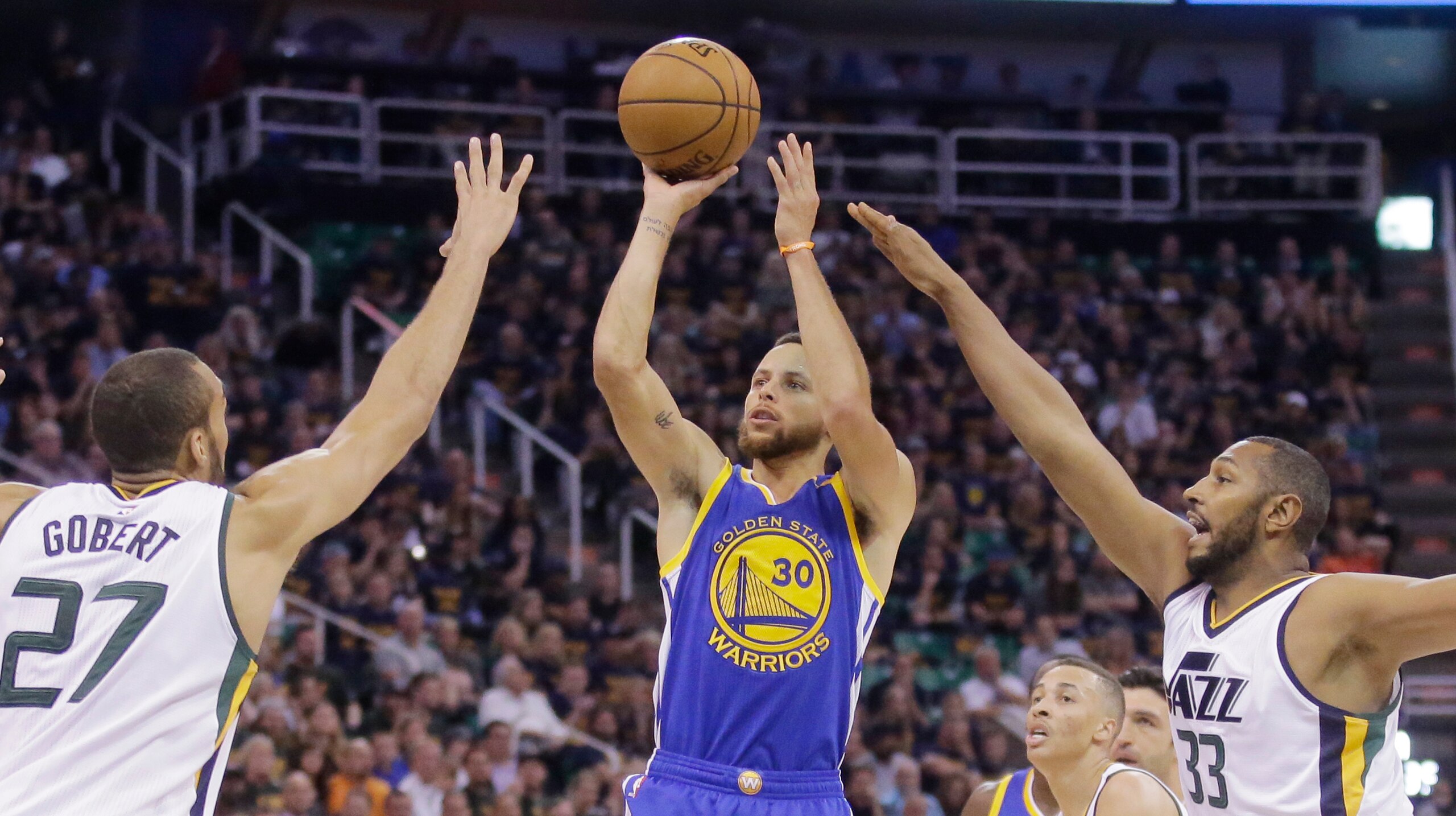
2016-17 Absurd Achievement: Recorded Association's second-ever season with 300-plus triples (324), trailing only his own 2015-16 unanimous MVP effort (402).
Over the last few seasons, an asterisk has been added to every defensive game plan outside Oakland. His name is Stephen Curry.
The two-time MVP has transformed the Golden State Warriors into juggernauts and evolved the art of three-point shooting. It's not just his unprecedented volume, it's the manner in which he shreds nets. He boasts the lethal combination of dizzying handles and pull-up marksmanship. Tack on a willingness to share the ball, creative playmaking and slick scoring around the basket, and there's no right way to defend him.
"He basically has rendered entire swaths of the league completely obsolete," Rob Mahoney of Sports Illustrated wrote. "Like if you are a certain type of center, you just can't play against the Warriors anymore. If you are a wing player who kind of falls asleep at the wheel when you are off ball, the Warriors are just going to run your guy through off-ball screens all day, and you are going to have to guard Steph."
Curry challenges conventional defensive thinking. You wouldn't think a player requires attention as soon as he crosses half court, but that's in his range. You wouldn't think historic efficiency could come from so many off-the-dribble shots, but here's the third-most accurate three-point shooter ever having less than 61 percent of his triples created by assists.
He is the NBA's cheat code, and he should be harder to handle than ever with the Warriors' roster improvements and his chemistry with Kevin Durant being at an all-time high. After receiving a second-team spot last season, Curry will return to the first team for the third team in four years.
First-Team Forward: LeBron James, Cleveland Cavaliers
3 of 10
2016-17 Absurd Achievement: In his age-32 season, paced all players in minutes per game (37.8) and real plus-minus (8.42).
Logic has never applied to LeBron James. It's one of the perks of being a cyborg, apparently.
Whether his 14th NBA season was his best doesn't matter. The fact it can even be discussed is mind-boggling.
He entered the year with 987 games under his belt—1,186 counting the playoffs—and a resume featuring four MVP Awards and nine consecutive All-NBA first-team selections. He proceeded to set new personal bests in assists (8.7), rebounds (8.6) and triple-doubles (13). And just in case anyone still mistook him for human, he also set a career high in dunks.
James raising the bar again this season shouldn't be possible, but it's more likely than you'd think. With Isaiah Thomas shelved indefinitely, James will have more scoring and distributing responsibilities than he's had in a while. He's also overloaded with motivations—sending a message to Kyrie Irving, winning with banana-boat buddy Dwyane Wade, chasing a fifth MVP to match Michael Jordan and Bill Russell—and reportedly opening eyes already with his effort.
"From being around him for at least three years pretty much every day, I can see the difference. He's just driven," JR Smith said, per ESPN.com's Brian Windhorst. "For whatever reason, he's not in those conversations, whether it's MVP or 'He might not be the best player in the world.' It's not so much to prove to [voters], it's to prove himself."
James should have more room to operate on offense with Kevin Love starting at center and easier defensive assignments with Jae Crowder on the roster. All arrows point to James becoming the first 12-time All-NBA first-teamer.



First-Team Forward: Kevin Durant, Golden State Warriors
4 of 10
2016-17 Absurd Achievement: Despite joining a new team and missing 20 games, set new bests in rebounds per game (8.3), blocks per game (1.6) and true shooting percentage (65.1).
Kevin Durant completed his first go-round with Golden State playing like a man in search of redemption. His scorched-earth showing in the championship round included 35.2 points per game on 55.6 percent shooting, a dagger for the ages and the Finals MVP Award.
But if Durant ever needed validation for ditching the Thunder and joining the Dubs, he should have found it long before. Going to Golden State was supposed to bring the best out of him, and that happened well in advance of his Finals heroics.
"Last year, Kevin Durant recorded the eighth season in league history with a true shooting percentage of at least 65.0 while attempting over 1,000 shots," Bleacher Report's Grant Hughes wrote. "It was one of the greatest displays of volume and efficiency the NBA has ever seen, marred only by 20 games missed because of injury."
And to think, that might have only been the appetizer. Durant, who scored more efficiently and defended more consistently than ever before, was transitioning to new teammates, new coaches and new schemes. He didn't even have a full season to facilitate the process, and it wasn't until the postseason that he and Curry found the right rhythm.
Peak Durant is a two-way terror, the single biggest threat to LeBron's basketball throne. If this isn't the season in which Durant surpasses his old training partner, it could mark the smallest gap between them yet.
First-Team Center: Karl-Anthony Towns, Minnesota Timberwolves
5 of 10
2016-17 Absurd Achievement: Became the first player ever to tally 2,000 points, 1,000 rebounds and 100 triples in an NBA season.
There are leaps of faith, and then there's reserving an All-NBA first-team spot for a 21-year-old who's never been an All-Star or All-NBA selection.
But Karl-Anthony Towns has already compiled superstar statistics during his first two NBA seasons. Any previous knocks for lack of team success should be out the window after the Minnesota Timberwolves' wildly productive summer. And the 7-footer isn't afraid of sharing his ambitions to became basketball's best player.
"That is definitely something that I see in my sight [being the best]. I'm getting better every year," Towns told The Undefeated's Marc J. Spears. "I'm getting smarter. I'm getting faster, quicker, so I feel like I can easily be that. It's just a matter of time for me."
For now, Towns must settle for 2017-18's best center.
Towns' offensive repertoire is built around the most coveted contemporary quality: versatility. He can overpower opponents in the post or finesse his way past them. He can stretch defenses with his shooting, take his man off the dribble and find open teammates from all angles. And teams can no longer pay as much attention to him with scorers like Jimmy Butler and Jamal Crawford added to the equation.
Still, to grant Towns this honor, we're making several assumptions. For starters, that voters will consider Anthony Davis as a power forward. Also, that Towns will make a big enough defensive leap to build a better two-way case than Rudy Gobert, DeAndre Jordan or Marc Gasol. And finally, that the Timberwolves make their expected jump and give KAT the better-team argument over DeMarcus Cousins.
Second-Team Guard: James Harden, Houston Rockets
6 of 10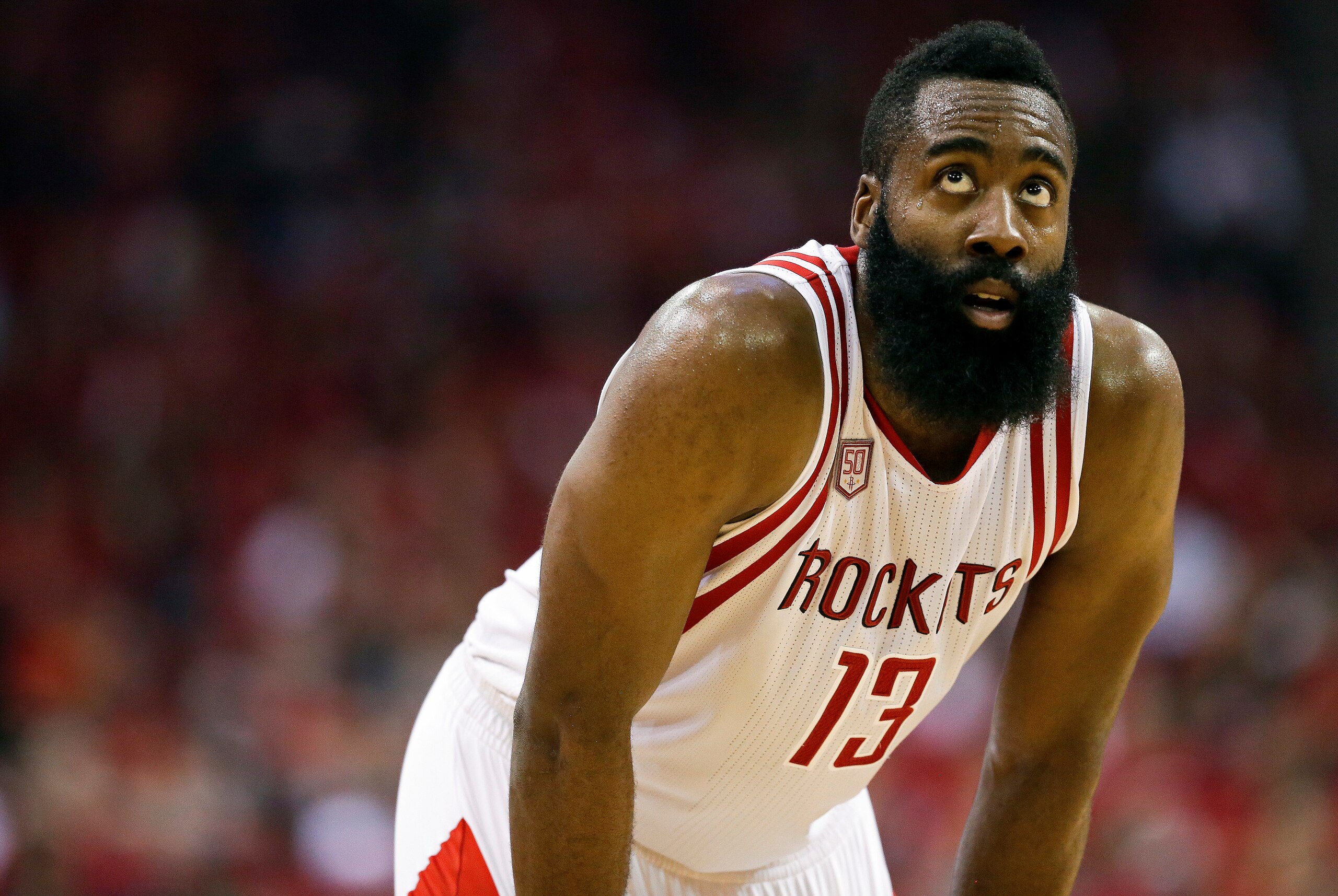
2016-17 Absurd Achievement: Led the NBA in assists (11.2) and still finished second in scoring (29.1) in his first season at point guard.
Last season, Mike D'Antoni decided All-Star shooting guard James Harden should become the league's most intriguing floor general. That experiment resulted in the bearded baller being the campaign's only unanimous All-NBA first-team selection.
So, the Houston Rockets have earned the benefit of the doubt when it comes to trying new things. Like shifting Harden to his old backcourt post to accommodate point god Chris Paul, for instance.
Sure, there's the potential for junior high dance-level awkwardness as the stars learn how to share control of the offense. But there's also a wealth of talent, a genius offensive mind overseeing it and a realization that each can help the other.
"I've had more catch-and-shoot opportunities, he has as well, in these four days of training camp than we've had in a few years," Harden said, per Jonathan Feigen of the Houston Chronicle. "It hasn't been tough because we're willing to share the ball … and make plays for our teammates and ourselves. I'm going to have that same mentality to score and create, but I don't have to do it as much because we have another guy that can do it on a high level."
Harden did all of Houston's heavy lifting last season. He averaged nearly twice as many points (29.1 to 16.2) and three times as many assists (11.2 to 4.2) as his closest teammate. That won't happen with Paul in town, although Harden's loss in volume production will bump him to the All-NBA second team.
Second-Team Guard: John Wall, Washington Wizards
7 of 10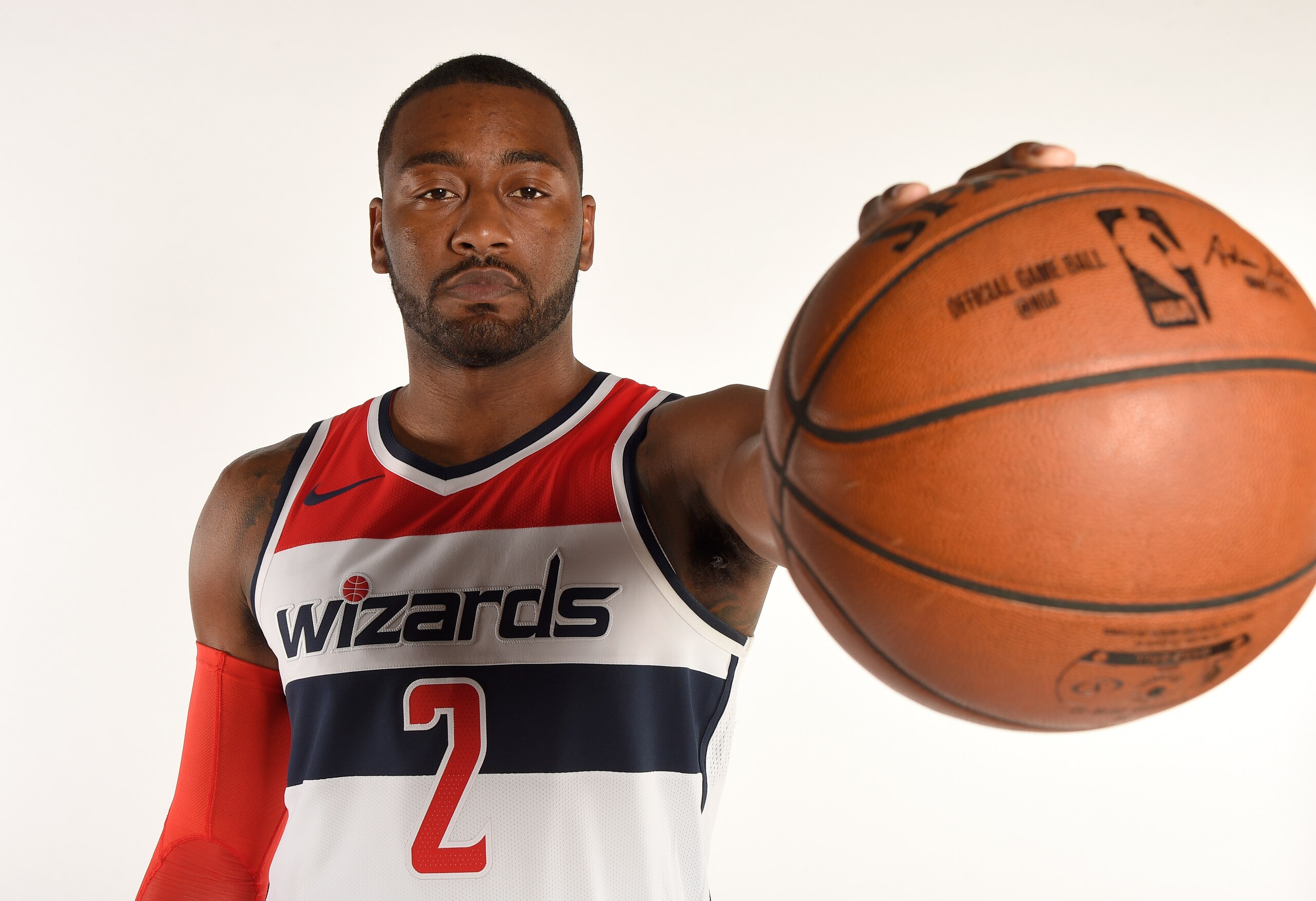
2016-17 Absurd Achievement: Became just the third player ever to average at least 23 points, 10 assists and two steals.
It seemed like it happened in a blur. Most things John Wall-related do.
He'd been a good floor general before, making his first All-Star appearance in his fourth season and never relinquishing his spot. But last year was different. He not only set career marks in points (23.1), assists (10.7), steals (2.0) and field-goal percentage (45.1), he was better on a per-minute basis and more efficient (23.2 PER) than ever before.
And he says he's just getting going.
"I feel like I am the best point guard in the Eastern Conference," Wall said, per Windhorst. "... I want to be in the MVP conversation. My expectations are very high."
The Washington Wizards need Wall to reach another level. Save for some second-team tweaks, they spent their summer further investing in their own core. That should give them a familiarity few teams can match, as their returning starting group was by far the league's most utilized lineup last season.
Chris Paul could have a loud argument for this spot, but Wall's age, athleticism and more prominent offensive role gets him the nod.
Second-Team Forward: Kawhi Leonard, San Antonio Spurs
8 of 10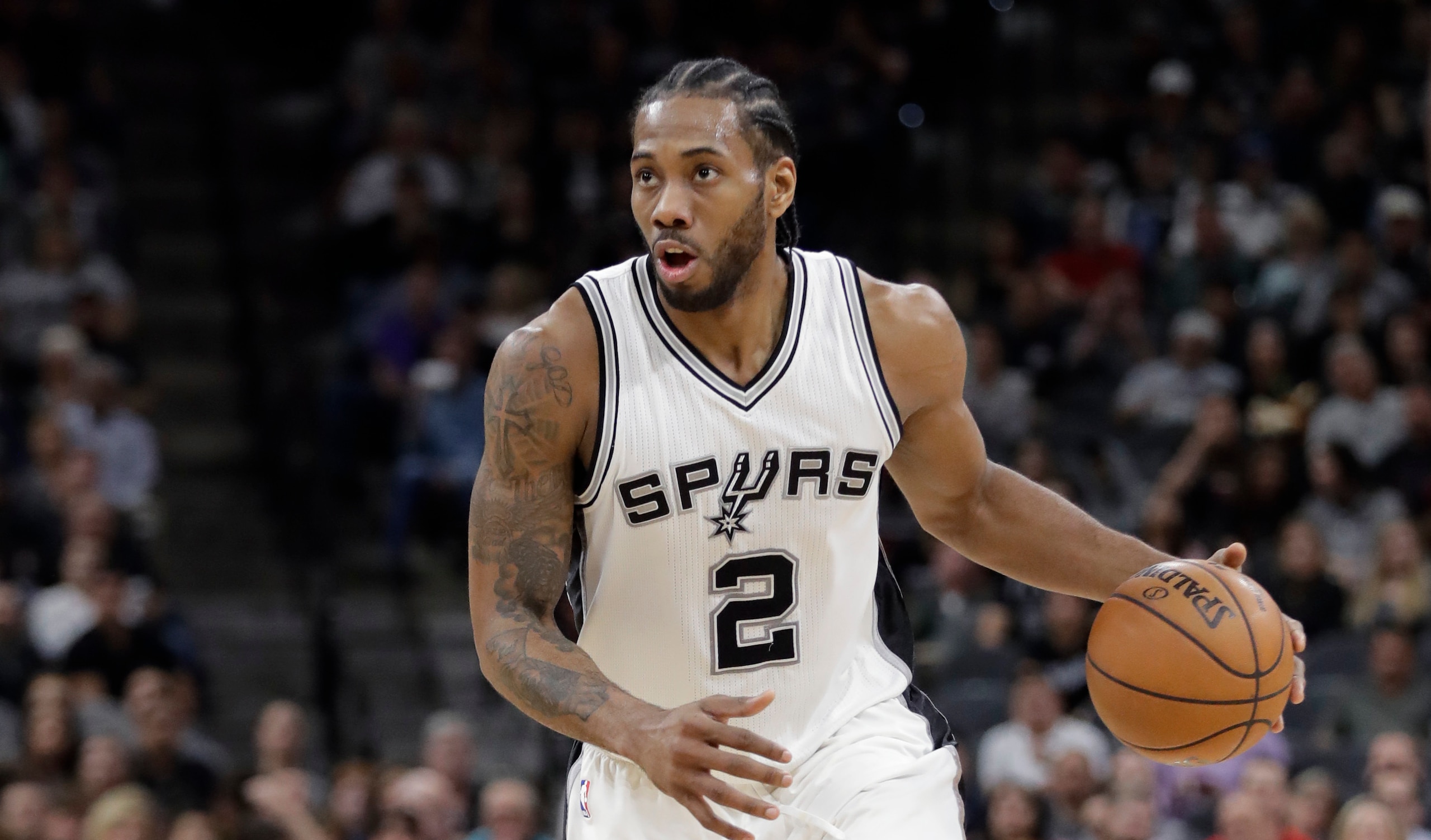
2016-17 Absurd Achievement: Was the NBA's only player to finish among the top eight in both offensive (8.9, sixth) and defensive (4.7, sixth) win shares.
If one stop wins you the game, there's no one you'd rather have defending than Kawhi Leonard. If one shot wins you the game, there are a few guys you'd take over Kawhi—but not many.
No one grades higher at both ends than the soft-spoken 26-year-old. That's why San Antonio Spurs coach Gregg Popovich has dubbed Leonard "the best player in the league right now," per the Vertical's Michael Lee.
Granted, Popovich might be a little biased toward his franchise face. But Michael Jordan isn't, and he called Leonard, "the best two-way player in the game right now." Penny Hardaway, another impartial observer, echoed that thought. Ditto for CBS Sports' Matt Moore.
So, why would Leonard lose the All-NBA first-team spot he's held for two years running? Because having the best floor balance doesn't necessarily mean making the biggest impact. And with Durant rapidly improving on defense and James gearing up to do everything for Cleveland, those two will leave slightly bigger imprints on this season than the Alamo City's finest.
Besides, the Spurs don't seem like their typical indestructible selves. Leonard is nursing a thigh injury, Tony Parker is coming off a ruptured quad and LaMarcus Aldridge has yet to look completely comfortable in silver and black.
Second-Team Forward: Giannis Antetokounmpo, Milwaukee Bucks
9 of 10
2016-17 Absurd Achievement: Had NBA's first season with top-20 finishes in total points, rebounds, assists, blocks and steals—and led Milwaukee Bucks in all five categories.
This didn't come down to a coin flip between Giannis Antetokounmpo and Anthony Davis, but it could have.
Davis, the first-team All-NBA center last season, joined four Hall of Famers as the only players to average at least 27 points, 11 rebounds, two blocks and two assists. Maybe more incredible was the fact the Brow did that without topping his career-high in PER (27.5, personal best is 30.8).
But while Davis is quickly becoming the league's next great big man, Antetokounmpo might be the first of his kind. Even Durant—who's basically a scoring guard with a center's length—views Giannis as "a specimen that we've never seen before."
Antetokounmpo takes the five-tool player thing even farther—he's a five-position performer. He's spent more than 10 percent of his career minutes at each of the 1 through 4 spots, and he can steal spot minutes as a small-ball 5. And he doesn't just play everywhere on the court, he does everything while he's out there.
"You could justifiably claim Antetokounmpo scored like [C.J.] McCollum, grabbed boards like [Tristan] Thompson, dished out dimes like [Kemba] Walker, stole the rock away like [Ricky] Rubio and swatted shots like [Hassan] Whiteside," Adam Fromal wrote for NBA Math.
While Davis is a modern star, Antetokounmpo feels more futuristic. His team is also more likely to post a better record, which could be the deciding factor between them.
Second-Team Center: Rudy Gobert, Utah Jazz
10 of 10
2016-17 Absurd Achievement: Led NBA in defensive real plus-minus (6.02), defensive win shares (6.0) and blocks (2.6).
Rudy Gobert is the ideal defensive anchor for today's game.
He's almost impossibly long, with the 7'9" wingspan jutting out of his 7'1" frame giving him a ridiculous 9'7" standing reach. But he looks equally impressive on the move, possessing the quickness and athleticism needed to counter small-ball lineups. And his instincts are advanced, so he's not someone opposing coaches can simply scheme around.
Last season, the Utah Jazz had the third-rated defense, and that number tied directly to Gobert.
They funneled everything to him, then watched as he blocked a bunch of shots, changed even more and stopped many from even being attempted. He faced the most shots at the rim (10.2 per game) and defended them better than anyone (43.8 percent allowed). Utah defended at the No. 1 rate with him (100.6) and fell to 21st without him.
"He impacts the game because he has a presence," Jazz coach Quin Snyder said, per ESPN.com's Tim MacMahon. "He creates thought at the rim: Whatever type of shot you're going to shoot, whether you're going to pass or shoot, whether you should not shoot."
Gobert needs more than defense to retain his second-team spot, though, especially if Joel Embiid's body finally cooperates. But Gobert surged at the offensive end after the All-Star break (16.7 points on 70.1 percent shooting), and he'll have to make another major jump with Gordon Hayward gone.
Unless otherwise indicated, all stats from Basketball Reference, NBA.com or ESPN.com.
Zach Buckley covers the NBA for Bleacher Report. Follow him on Twitter: @ZachBuckleyNBA.

.jpg?w=2560 "Raiders Could Start Mendoza")

.jpg?w=2560 "Rodgers Iced Out on Plane 💎")

.jpg?w=2560 "🚨 Week 8 AP Top 25 Poll")

.jpg?w=2560 "Packers Safety Slams Refs 🤬")