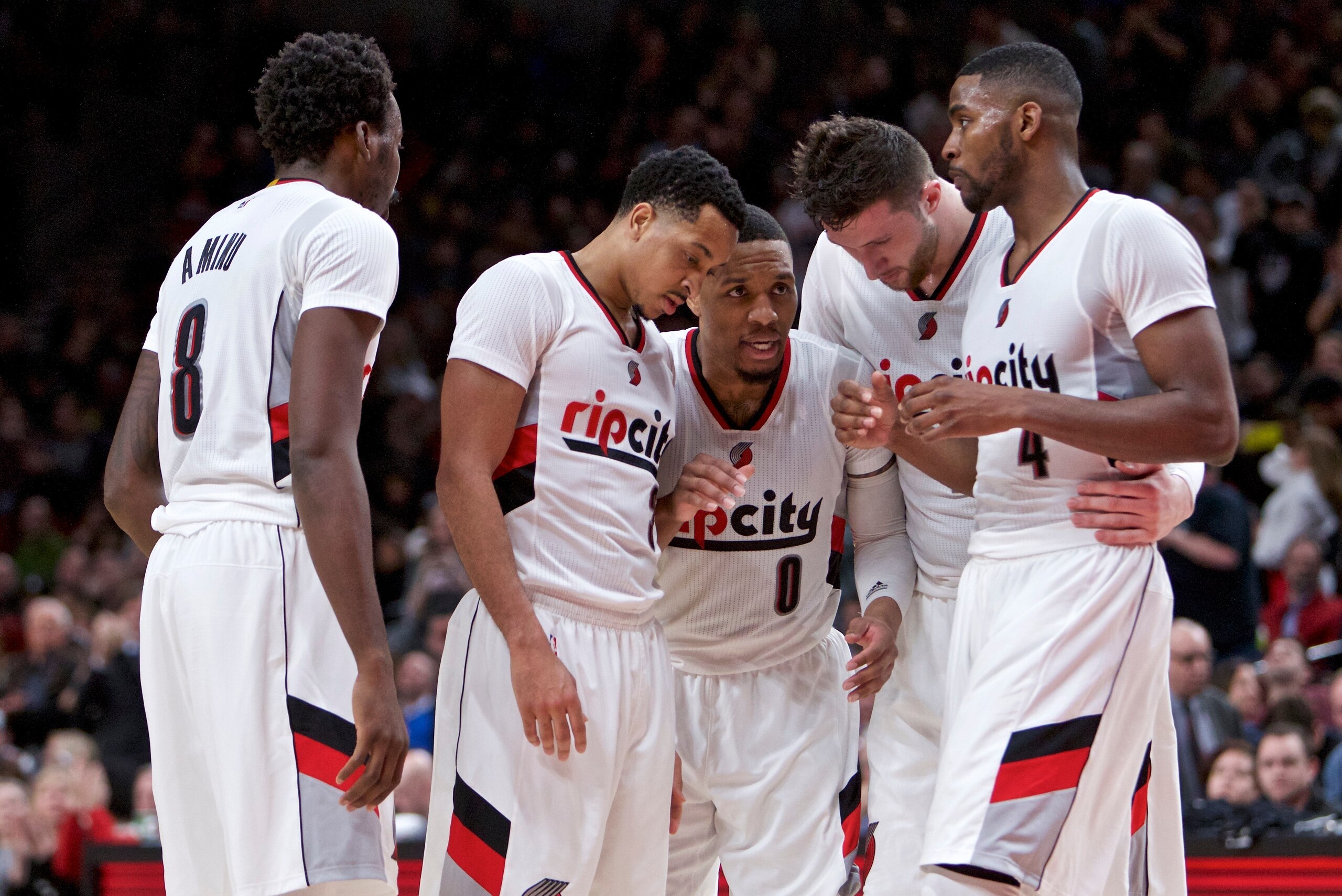


It was merely a matter of when, not if, the Portland Trail Blazers would meet their maker in Round 1 of the 2017 NBA playoffs.
Damian Lillard and CJ McCollum couldn't postpone the inevitable in their Western Conference matchup against the Golden State Warriors. Even Jusuf Nurkic, with all his 7'0" size and skill, wouldn't have extended his team's series with the championship favorites far beyond the four-game sweep it became.
As far as victories are concerned, Portland took steps back. The team won three fewer games during the 2016-17 regular season and five fewer in the playoff contests compared to how it fared in 2015-16.
Now, the Blazers face what could be either a quiet summer or one full of shakeups in Rip City. With one of the league's most bloated payrolls, Portland would be hard-pressed to be a player in free agency, but it has some assets it can use to lighten that load if the higher-ups so choose.
In the aggregate, though, the Blazers' outlook is hardly grim. They have two All-Star-caliber guards (Lillard and McCollum), a young big who looks like a solid building block (Nurkic) and a roster replete with experienced role players.
Put those pieces together properly, and Portland could be ready to climb the Western Conference standings next season.
Get Jusuf Nurkic Up to Speed
1 of 5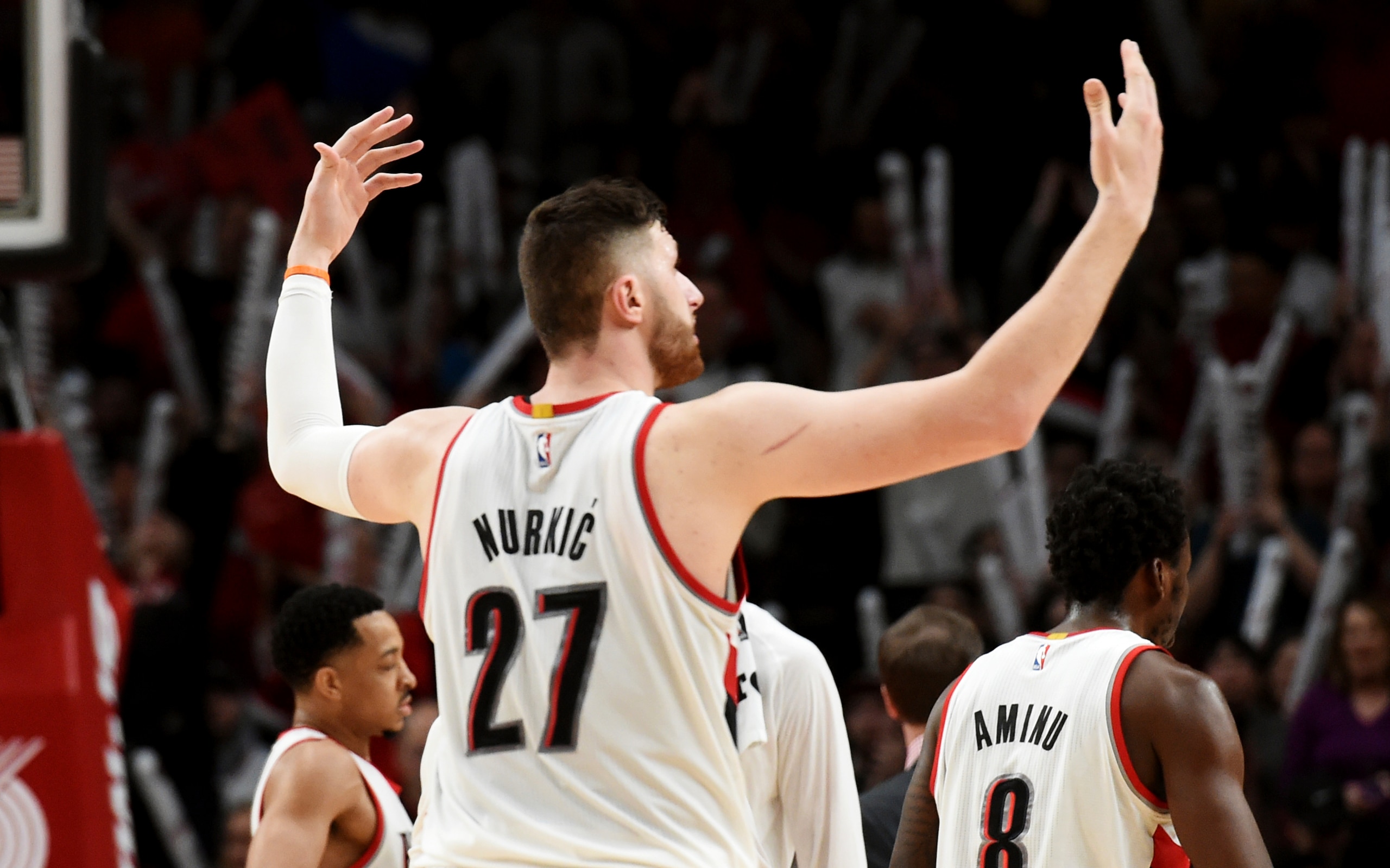
So much for Jusuf Nurkic saving the day in Rip City. Three weeks after fracturing his right fibula, the Bosnian returned briefly in Game 3 against Golden State, only to be ruled out of Game 4 shortly thereafter.
"He didn't do any further damage," Trail Blazers head coach Terry Stotts said, per the Oregonian's Mike Richman. "There was soreness, tenderness, and it just wouldn't be wise to have him play through that."
Nurkic didn't play much during his lone postseason appearance, but his impact was profound. In 17 minutes, he racked up 11 rebounds, four assists, two points, a block and a team-best plus-minus rating of plus-eight. Had he been healthy from the start, Portland might've had the munitions to do much more than test the presumptive champs in four games.
That promise makes Nurkic's fitness all the more critical for the Blazers going forward. During his 20 regular-season appearances for Portland, the 22-year-old bowled his way to 15.2 points, 10.4 rebounds, 3.2 assists, 1.3 steals and 1.9 blocks per game while helping to lift his team to a 14-6 record.
And that was without anything close to a complete grasp of the playbook after coming over from Denver before the February 23 trade deadline.
"I'm really happy I come in a right place," Nurkic told NBA.com's David Aldridge at the beginning of the month. "I think I'm a perfect fit here, and how it show right now, how it looks."
The last thing the Blazers want, though, is for their newest big man to fall into their long, painful lineage of injury-riddled bigs. If Nurkic can avoid that, Portland might have itself the frontcourt cog it's long sought to line up next to Lillard and McCollum.
Keep Tightening the Screws Defensively
2 of 5
As valuable as Nurkic was in a release-valve role offensively, his biggest impact in Portland might have come on the defensive end.
Before the Bosnian wound up in Oregon, the Blazers—who finished the 2015-16 season ranked 20th in defensive efficiency (105.6 points allowed per 100 possessions)—had dropped to 26th on that end, surrendering a ghastly 108.9 points per 100 possessions. That decline raised questions about Portland's ability to get stops with the sieve-like backcourt of Lillard and McCollum.
Then Nurkic arrived, and the Blazers turned things around defensively. During the big's 20 games in the rotation, Portland sliced its defensive rating to 105.7—the 12th-best mark over that span and one that would've landed them a hair under the 12th-ranked Boston Celtics over the course of the 2016-17 season.
Sustaining that improvement may be all the Blazers need to make the leap from lower-tier playoff participant to bona fide Western Conference contender.
So long as Lillard and McCollum are at the controls, Portland shouldn't have any trouble scoring points. A top-half defense could be the perfect complement to put the Blazers among the NBA's best.
And if they can climb well inside the league's top 10 on that end, even better.
Shed Some Salary
3 of 5
Salary-wise, the Blazers are already in the same stratosphere as the NBA's elite.
In fact, according to Basketball Reference, Portland—not the Cleveland Cavaliers, not the Warriors and not the San Antonio Spurs—will sport the heftiest payroll in basketball next season. That could change as free agency and trades unfold this summer, though the Blazers' projected bill of around $142 million figures to remain among the largest in the league.
Portland piled up most of its obligations last summer, when it spent big to retain homegrown players such as Allen Crabbe (four years, $74.8 million) and Meyers Leonard (four years, $41 million) as well as Maurice Harkless (four years, $40 million). It also brought in Evan Turner (four years, $70 million).
In truth, the Blazers aren't obligated to offload any of these players and their salaries. Their roster will soar well past the projected luxury-tax line of $121 million, but team owner Paul Allen (net worth: $20.1 billion, per Forbes) can afford the bill if he chooses.
No matter how deep Allen is willing to dig into his pockets, Portland's front office will be hard-pressed to add talent without carving out some long-term flexibility. Nixing Festus Ezeli's non-guaranteed $7.73 million for 2017-18 would only begin to scratch the surface.
Fortunately for the Blazers, they have some chips they can deploy should shedding salary become a priority. They have their own first-rounder to spare along with the Cavaliers' selection and the Memphis Grizzlies' pick (via Cleveland to Denver), which they netted in the Nurkic trade. They also have several future second-rounders due from other teams.

Sort Through the Frontcourt
4 of 5
If Nurkic is a sure thing up front, Portland will have to determine which of its remaining forwards and pivots fit best next to him, Lillard and McCollum in the rotation. That question could dovetail with the Blazers' potential payroll-slimming effort.
At a glance, Meyers Leonard looks to be the most vulnerable. His combination of size (7'1", 245 lbs), youth (25) and shooting ability (37.1 percent from three for his career) could make him an intriguing chip for other teams in search of a stretch 5.
His base salary ($9.9 million in 2017-18, $10.6 million in 2018-19, $11.3 million in 2019-20) makes him a relatively modest gamble in the NBA's economic climate. And since the Blazers already have Noah Vonleh and Ed Davis on the roster, they can afford to part ways with one of their pivots.
Whatever Portland decides to do at center behind Nurkic, it will have to find the right mix of forwards with whom to flank him.
Al-Farouq Aminu, once a staple of Coach Stotts' starting five, came off the bench during Nurkic's healthy stint and during all four games of the Blazers' first-round series. Evan Turner took over as the starting small forward until he injured his hand in February, and he reclaimed that role in time for the postseason. Maurice Harkless had a strong season and, at 23, could just be getting started.
Portland, then, will have plenty of options up front. The challenge for the organization will be figuring out which make the most sense as complements to the team's central trio.
Think About the Backcourt
5 of 5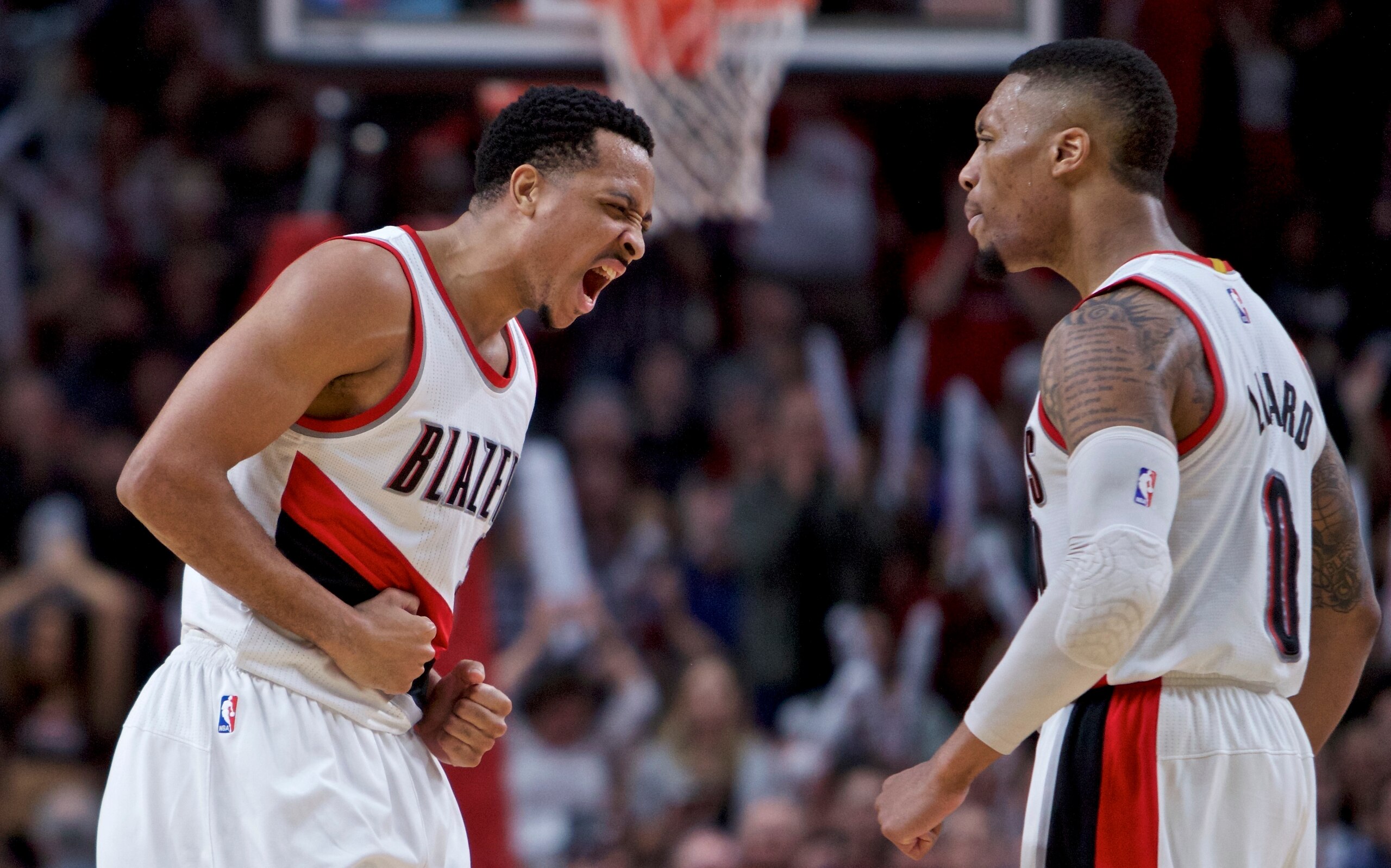
There's a lot to like about the pairing of Lillard and McCollum—certainly enough to keep them together without batting an eye.
That duo combined to average 50.0 points per game in 2016-17, pushing Portland's backcourt past those in Golden State, Toronto and Washington for the title of "NBA's Most Prolific." Their combined 9.5 assists per contest aren't too shabby either.
Still, there is some cause for concern with this duo over the long haul. As mentioned previously, Lillard and McCollum aren't top-notch stoppers, to say the least. The former ranked 55th (minus-1.20) among point guards in ESPN's defensive real plus-minus; the latter was 80th at shooting guard (minus-1.88).
As important as it is in today's outside-in NBA to have perimeter players who can put the ball in the hole from all over the floor, it may be even more critical to have guards who can, you know, guard.
Portland's cap crunch only adds to any consideration of a split between Lillard and McCollum. Can the Blazers afford to allocate such a huge share of their resources to two players with such similar skill sets?
Maybe they can, and maybe they will. If nothing else, it would behoove them to see what Lillard and McCollum can accomplish over a full campaign with Nurkic in the middle. But now might be the time to at least consider the possibility of a future with just one of the two Rain Brothers.
All stats via NBA.com and Basketball Reference unless otherwise noted.
Josh Martin covers the NBA for Bleacher Report. Follow him on Twitter, Instagram and Facebook, and listen to his Hollywood Hoops podcast with B/R Lakers lead writer Eric Pincus.

.jpg?w=2560 "Mahomes Told Teammate to Leave Meeting")
.jpg?w=2560 "5 Teams Eyeing Jonathan Taylor")

.jpg?w=2560 "NFL investigating Eagles")


.jpg?w=2560 "Jonathan Taylor Landing Spots 📍")