Even after upsetting the Golden State Warriors and unexpectedly winning an NBA title, the Cleveland Cavaliers are not yet free of their Kevin Love dilemma.
Yup, it's still there.
Love didn't look nearly as vulnerable during the regular season or throughout the rest of the playoffs as he did in the NBA Finals (our perhaps unfairly enduring memory). But the fit in Cleveland moving forward is far from perfect, if only because he may prevent the Cavaliers from unlocking the best version of themselves.
TOP NEWS

Brown with an all-time summary of relationship with Tatum

Heat, Giannis were down by 20+ in each of their 3 losses

Power Ranking Every NBA Team's Starting Lineup 🔢
Run It Back, For Now

Hoisting championship hardware buys the Cavaliers certain luxuries, one of which is the right to stand pat over the offseason. With the exception of possible retirements, wholesale changes are considered taboo. It's no accident Golden State had the highest roster continuity rate between 2014-15 and 2015-16. Trying to fix what ain't broken is a fool's errand.
Cleveland's general manager, David Griffin, shares this belief, per ESPN.com's Marc Stein:
Head coach Tyronn Lue is right behind him. And he made an even more important point during an appearance on ESPN's Mike and Mike (h/t Fear The Sword's Justin Rowan):
"Oh he's going to be here. I mean, without Kevin Love, we wouldn't have gotten to the Finals. You know, he had a great series against Detroit, a great series against Atlanta, a great series against Toronto. You know, with the way Golden State plays, and the positions they put you in, it was just a tough series. It's the same with Channing Frye. He did a great job of getting us to that point, but it's a tough series for him to play in because they play small, and it was tough for us matchup-wise.
"
Lue is right about the Warriors posing a uniquely problematic matchup for Love. There are not 28 other Draymond Greens running around the NBA—6'7" centers who chuck threes, thrive off the bounce and ultimately render the traditional stretch 4, once a billboard for innovation, utterly helpless.
Using NBA.com's lineup data for the regular season and playoffs, we can calculate how the team performed when LeBron James lined up at the 4. Though the Finals often seemed to tell a different story, Cleveland didn't gain a huge edge in those situations overall:
| James not at PF | 8.3 | +9.9 |
| James at PF | 6.7 | +8.1 |
| James at PF with Love on bench | -1.9 | +6.7 |
Some of the disparity in these scenarios can be attributed to the sample sizes. James spent less than 400 minutes on the court as a power forward without Love, hence the below-board plus-minus. Once those types of lineups became more commonplace during the playoffs, Cleveland had no issue outpacing opponents.
Except the Cavaliers, as the numbers show, still played better overall when James wasn't at power forward. Those instances can be directly associated with Love, since he is the primary reason James spends only a fraction of his minutes at the 4.
It's Not (Really) Your Scoring, Kevin

Still, there is an unsustainable element to Cleveland's current blueprint: James' best position is power forward, and even he seems to know it. Where he has bristled at the idea in the past, he now embraces the benefits that come with playing the 4.
James explained to Cleveland.com's Joe Vardon in March:
"I mean, our offense is a lot faster, a little bit more precise with me at the four. I'm going to be setting a lot more transition and halfcourt pick and rolls, which is OK. I know I can either get my guy open or if they put two on the ball I'm able to make a play, able to be a quarterback in that situation.
"
"I don't see a downfall to it," he would add.
That's because there isn't one. Cleveland isn't Miami. Assuming power forward responsibilities isn't a frill. It's a necessity.
James' outside stroke has abandoned him since returning to the Cavaliers. He shot just 35.4 percent outside the restricted area during the regular season, and his success rate between three and 16 feet reached its lowest point since 2004-05, his sophomore campaign.
This issue didn't resolve itself for most of the postseason, either. James converted just 35.9 percent of his looks outside the restricted area, and his accuracy between three and 16 feet noticeably dipped.

Stashing a perimeter liability at small forward, even when it's James, can become a problem. The Warriors were at their best in the NBA Finals when sealing off paths to the basket and coaxing LBJ into jumpers he wasn't hitting. Only when he went off in Games 5 and 6, shooting 7-of-14 from downtown, did the Cavaliers gain any control over the series.
Using James as a full-time 4 just makes more long-term sense. He often defends up a position anyway, and it will be easier to get him more post-ups when he doesn't share the floor with two bigs.
Love's three-point touch is supposed to mitigate this wrinkle. He can orbit the arc whenever James resorts to bully ball, and the Cavaliers have already taken to using him as a glorified spot-up shooter. But the logistics, while sound in theory, don't compute.
Love needs touches inside the elbows to be effective and eliminate the possibility of his morale torpedoing in the wake of bystander duty.
Besides, almost half of his regular-season looks came as catch-and-shoot opportunities. There isn't much more room for reasonable role manipulation. And yet, he still used up 113 more post-up possessions than James.
It's Your Defense
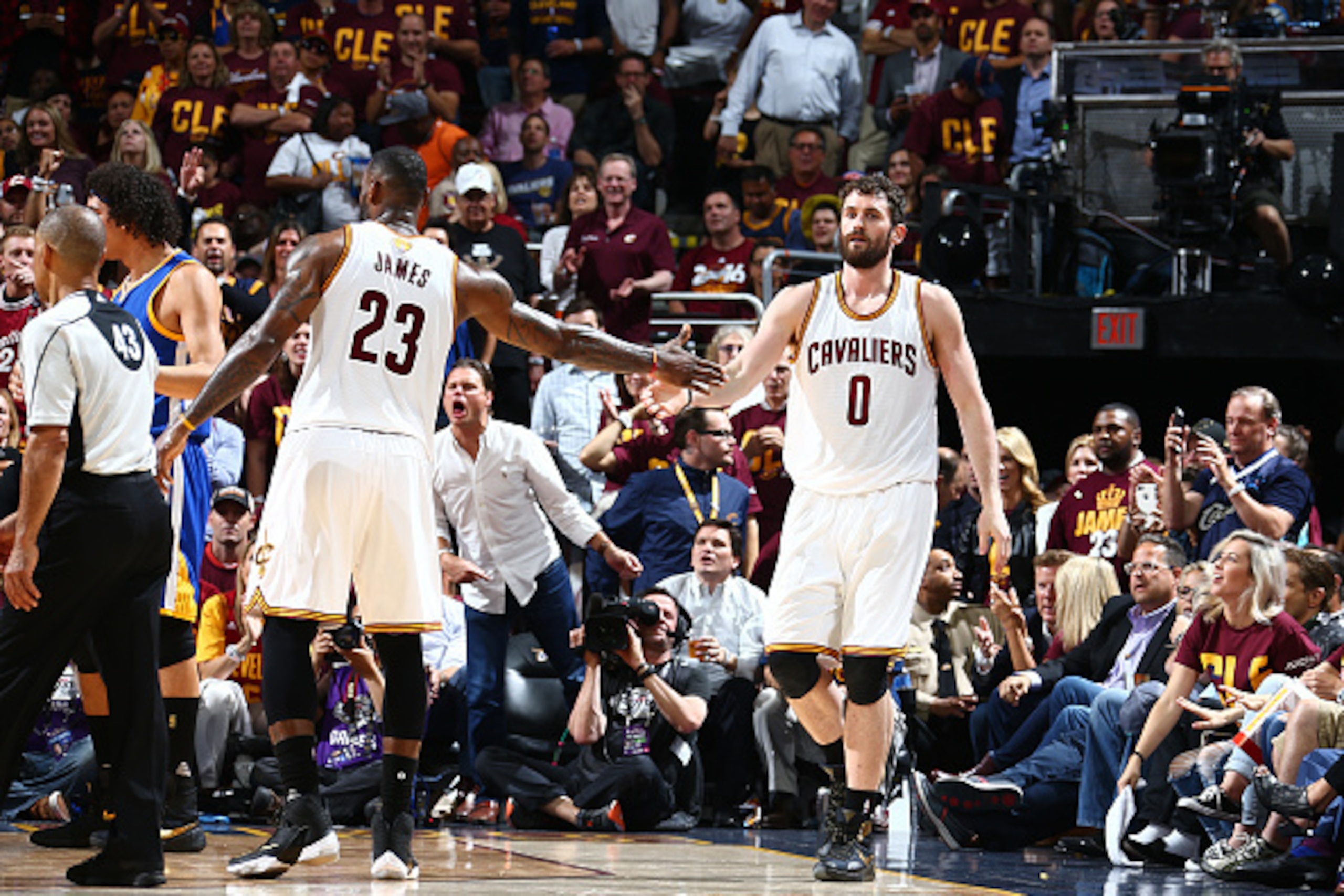
Now, slotting Love at center and staggering his minutes with Tristan Thompson's playing time does let the Cavaliers stick James at power forward. It's also defensive suicide.
In the 290 minutes Love played without Channing Frye, Sasha Kaun, Timofey Mozgov, Tristan Thompson and Anderson Varejao this year—time during which he would be considered a center—the Cavaliers allowed 112.4 points per 100 possessions, according to NBAWowy.com. That would have ranked as the worst defensive rating in the Association, with plenty of room to spare.
Most of Love's minutes at the 5, mind you, were spent alongside James (259). Cleveland still bled buckets, allowing 111.7 points per 100 possessions during that specific time, so there is no feasible scenario in which this power forward-center duo can survive on defense—especially against Golden State.
That's the other part of all this: The Cavaliers may be NBA champions, but that doesn't automatically make them the better team. Their Finals win is an upset for a reason. The Warriors, one can easily argue, remain the team to beat. At the very least, they are still the biggest obstacle standing between the Cavaliers and another title. There are no roadblocks in the Eastern Conference, and the West is the Warriors' to lose, regardless of whether they sign Kevin Durant.
It seems silly to plan a defending champion's core around one team, even when it's Golden State. But these warts aren't Warriors-specific. Love won't suddenly excel when switching onto smaller players. That championship-clinching set against Stephen Curry in Game 7 was the exception, not the rule:
Leaving Love Behind(?)
"Teams will call about Love, and the Cavaliers will listen, because that's what teams do," ESPN.com's Zach Lowe wrote. "But in the afterglow of an unprecedented Finals comeback, they justifiably exuded hope that this sometimes awkward nucleus could get even better—and more importantly, that LeBron might share in that hope."
Maybe Cleveland doesn't see Love's future as a problem right now. He will almost assuredly be around to start next season. A title guarantees that much. But Griffin admitted to Lowe this team isn't built "particularly well for playing" Golden State.
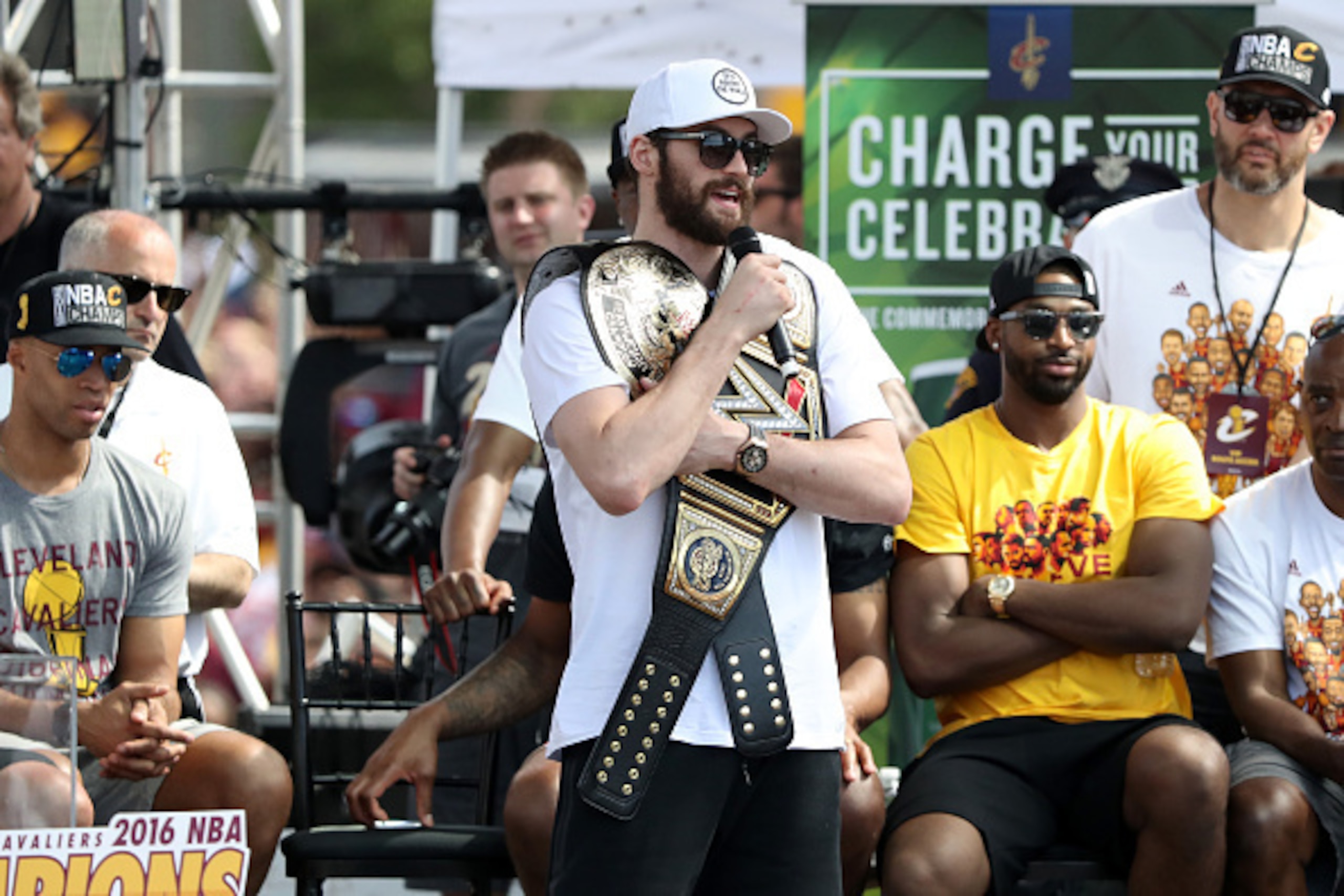
Might the Cavaliers, then, be better off flipping Love for a few spare parts, if only to deepen their roster and safeguard them against overpaying for incumbent free agents Matthew Dellavedova (restricted) and J.R. Smith? Should they be shopping him in favor of a couple of wings who'll let James play power forward without having to cover up for his should-be rim protector?
Cleveland was a plus-21 in the NBA Finals when using James as a power forward. They were a plus-35 when James ran the 4 without Love on the court. That doesn't go away—not even in victory.
Sure, this championship validates many things about these Cavaliers. Love's long-term fit in Cleveland, given everything else that's involved, just isn't one of them.
Stats courtesy of Basketball-Reference.com and NBA.com unless otherwise cited. Salary information via Basketball Insiders.
Dan Favale covers the NBA for Bleacher Report. Follow him on Twitter, @danfavale.
_0.png?w=2560 "Unranked Teams Cause Chaos in Rankings 📊")
.png?w=2560 "Week 8 Winners & Losers 📊")
.jpg?w=2560 "Jonathan Taylor Landing Spots 📍")