San Francisco 49ers: What Can We Expect from Anquan Boldin in 2015?
One of the best ways to predict future production for veteran players is through the use of Football Outsiders' similarity scores. The theory seems sound: If two players had similar stats and production over the past few seasons at the same age and with the same basic body type, then the odds are that they will continue to have similar stats and production in the future.
We’ve used this method of projecting players twice this offseason for the San Francisco 49ers. We came up with a fairly optimistic projection for Colin Kaepernick, with top comparable players including Ben Roethlisberger, Steve McNair and Jim Zorn. We found that players similar to Vernon Davis often have a minor bounce-back season if they return for another year, comparing him to players such as Miles Austin, Sonny Randle and Leslie Shepherd.
.jpg?w=2560 "49ers Giants Football")
.jpg?w=2560 "Commanders Vikings Football")
Today, let’s look at the most veteran of all veteran players on the 49ers’ offense: Anquan Boldin. Entering his 13th season in the NFL, Boldin has been seemingly immune to the effects of time. While his 2014 season wasn’t as effective on a per-play basis as his 2013 season was, he was still an above-average starter at an age when most receivers are headed for retirement.
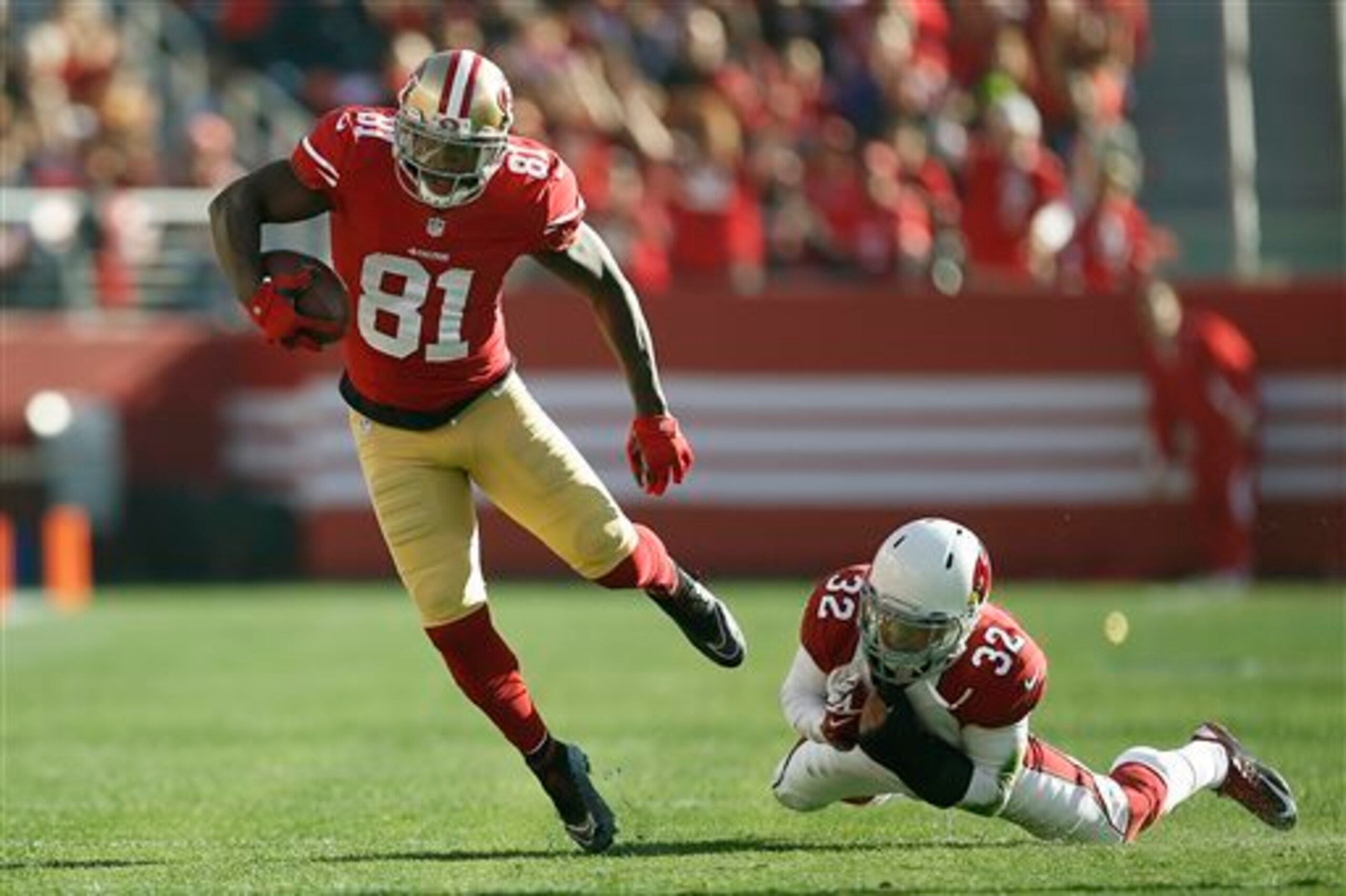
In San Francisco, Boldin has put up back-to-back 1,000-yard seasons. That’s the first time he’s done that since his days in Arizona in 2007 and 2008 and only the third time he’s ever put up back-to-back 1,000 yard campaigns. His 2013 season, in fact, might have been the best of his career—he had more yards and receptions as a young player in Arizona, but he made a ton of clutch catches on third down and in the red zone.
Was the slight step down in 2014 a sign that aging has begun to catch up to him? Or was it just a regular fluctuation based on the team as a whole stepping back? By looking at players who had similar runs to Boldin’s 2012-14 stretch, we can try to answer that question.
Simply because it’s hard to succeed at all in your mid-30s in the NFL, Boldin’s comparisons are an impressive list, including Hall of Famers Michael Irvin, Tim Brown, Charlie Joiner and Art Monk. It also includes Boldin's performances from 2011 to 2013, meaning he's been consistent over the last half-decade. I’ve included the entire top 300 in a Google document, but here are the top 25 comparable players.
| Rod Smith | 2003-2005 | 35 | DEN | 85 | 1105 | 6 |
| Tony Martin | 1997-1999 | 34 | MIA | 67 | 1037 | 5 |
| Derrick Mason | 2006-2008 | 34 | BAL | 80 | 1037 | 5 |
| Donald Driver | 2007-2009 | 34 | GNB | 70 | 1061 | 6 |
| J.T. Smith | 1986-1988 | 33 | PHO | 83 | 986 | 5 |
| Drew Hill | 1989-1991 | 35 | HOU | 90 | 1109 | 4 |
| Michael Irvin | 1996-1998 | 32 | DAL | 74 | 1057 | 1 |
| Tim Brown | 1998-2000 | 34 | OAK | 76 | 1128 | 11 |
| Jimmy Smith | 2003-2005 | 36 | JAX | 70 | 1023 | 6 |
| Charlie Joiner | 1979-1981 | 34 | SDG | 70 | 1188 | 7 |
| Anquan Boldin | 2011-2013 | 33 | SFO | 85 | 1179 | 7 |
| Irving Fryar | 1995-1997 | 35 | PHI | 86 | 1316 | 6 |
| Hines Ward | 2007-2009 | 33 | PIT | 95 | 1167 | 6 |
| Drew Hill | 1988-1990 | 34 | HOU | 74 | 1019 | 5 |
| Tony Gonzalez | 2006-2008 | 32 | KAN | 96 | 1058 | 10 |
| Rod Smith | 2002-2004 | 34 | DEN | 79 | 1144 | 7 |
| Terance Mathis | 1997-1999 | 32 | ATL | 81 | 1016 | 6 |
| Hines Ward | 2008-2010 | 34 | PIT | 59 | 755 | 5 |
| Art Monk | 1988-1990 | 33 | WAS | 68 | 770 | 5 |
| Henry Ellard | 1993-1995 | 34 | WAS | 56 | 1005 | 5 |
| Donald Driver | 2005-2007 | 32 | GNB | 82 | 1048 | 2 |
| Derrick Mason | 2007-2009 | 35 | BAL | 73 | 1028 | 7 |
| Jimmy Smith | 2000-2002 | 33 | JAX | 80 | 1027 | 7 |
| Keenan McCardell | 1999-2001 | 31 | JAX | 93 | 1110 | 6 |
| Irving Fryar | 1993-1995 | 33 | MIA | 62 | 910 | 8 |
| Anquan Boldin | 2012-2014 | 34 | SFO | 83 | 1062 | 5 |
| Average | NA | 33.6 | NFL | 77.4 | 1051.3 | 5.9 |
What you have there is almost a complete list of any receiver who could be considered a “savvy veteran” in the past 30 years. You don’t have any speedsters in particular—these are players who, like Boldin, aged gracefully because of their focus on solid hands and good positioning, rather than raw physical attributes. In other words, speed fades but positional savvy doesn’t.
It’s also a positive sign that several players show up twice on the list of top comparables. Besides Boldin, Derrick Mason, Donald Driver, Drew Hill, Hines Ward, Irving Fryar, Jimmy Smith and Rod Smith all show up twice in the top 25. That means these players put up good numbers as aging veterans and then continued to put up good numbers the year after. They, like Boldin, were consistent for a stretch in their 30s, providing value even as other similarly-aged players dropped out of the league.
Of course, it’s not all sunshine and roses. Most of the players on the list did begin to see their numbers drop in their following season. Of the 25 most similar players, 21 had 1,000-yard seasons in the final year of their comparison windows. In the year after—which would be 2015 for Boldin—only nine did.
Production dropped across the board: The average reception total dropped from 77.4 to 60.5; the average yardage total dropped from 1,051.3 to 753.5; and the average touchdown total dropped from 5.9 to 3.
That shouldn’t be all that surprising. Age ends everyone’s career. You can picture Jerry Rice failing to make the Denver Broncos in the 2005 preseason, or Johnny Unitas’ dead arm as a member of the San Diego Chargers or Emmitt Smith floundering at the line for the Arizona Cardinals. Eventually, your younger competition becomes too fast and too strong for all the knowledge and experience in the world to make up for.
Still, most of these players did end up aging gracefully. They had, on average, three seasons left in the tank, and almost all of them gradually drifted from top players to solid contributors before leaving on a moderate note. That 60-reception, 750-yard receiving line in the year N+1 season isn’t a bad statline at all—it’s the sort of numbers Greg Jennings or Dwayne Bowe put up in 2014. While neither of those are players you really want leading your offense at this point in their careers, those are starting-caliber numbers.
| Rod Smith | 2006 | 36 | DEN | 52 | 512 | 3 |
| Tony Martin | 2000 | 35 | MIA | 26 | 393 | 0 |
| Derrick Mason | 2009 | 35 | BAL | 73 | 1028 | 7 |
| Donald Driver | 2010 | 35 | GNB | 51 | 565 | 4 |
| J.T. Smith | 1989 | 34 | PHO | 62 | 778 | 5 |
In addition, that average statline is being drawn down by a couple of players. Jimmy Smith retired in 2006 after putting up 1,023 yards the season before; there’s every reason to believe he could have continued to play solidly had he returned. Irvin suffered a career-ending injury early in the 1999 season, prematurely truncating his performance. Boldin isn’t retiring, and it isn’t fair to project a massive injury, either.
So, 750 receiving yards might be a bit low. In fact, looking at those top 25 players, a plurality of them actually topped 1,000 yards in their next seasons, including Boldin. It’s far from a fait accompli that Boldin will decline significantly in 2015.
| 1,000+ yards | 9 | Boldin, Brown, Driver, Ellard, Fryar, Hill, Mason, Monk, R. Smith |
| 800-1,000 yards | 3 | Gonzalez, Mason, Ji. Smith |
| 600-800 | 5 | Hill, Mathis, McCardell, J.T.Smith, H.Ward |
| 400-600 | 4 | Driver, Fryar, Joiner, R. Smith |
| 200-400 | 2 | Martin, Ward |
| 0-200 | 2 | Irvin, J.Smith |
So, where does this leave us?
Age, for Boldin, is not a ticking time bomb. He’s not going to go from a 1,000-yard receiver to an on-field liability overnight. What we’re likely to see over the next two to three seasons—or until Boldin retires, whichever comes first—is a slow, gradual reduction in his effectiveness. In theory, this should be accompanied by larger and larger roles for the young receivers on the team, such as Bruce Ellington, Quinton Patton and DeAndre Smelter.
| Irving Fryar | 1996 | 34 | PHI | 88 | 1195 | 11 |
| Tim Brown | 2001 | 35 | OAK | 91 | 1165 | 9 |
| Drew Hill | 1991 | 35 | HOU | 90 | 1109 | 4 |
| Rod Smith | 2005 | 35 | DEN | 85 | 1105 | 6 |
| Anquan Boldin | 2014 | 34 | SF | 83 | 1062 | 5 |
I think a projection of somewhere between 800 and 1,000 yards seems fair for a 35-year-old Boldin. The decrease in yards per reception is probably a real effect of aging rather than a one-year blip. It’s unlikely, though not impossible, that Boldin will crack 1,000 yards in a season again.
However, he should still be an effective starter in 2015, making clutch receptions on third down. The addition of Torrey Smith to take the top off of defenses should give Boldin both additional room to work underneath and better matchups against opposing cornerbacks. That should help stem the effects of simply being another year older.
Boldin shows every sign of aging gracefully, but aging is still aging. Expect him to be effective, but not a star, going forward.
Bryan Knowles is a featured columnist for Bleacher Report, covering the Carolina Panthers. Follow him @BryKno on twitter.
.jpg?w=2560 "Commanders Cowboys Football")
.jpg?w=2560 "WWE Raw Live Grades 🔠")