The Biggest X-Factors for Cavs and Warriors in 2015 NBA Finals
With so many quality players featured, the 2015 NBA Finals won't just be about Stephen Curry and LeBron James. We will have unexpected players step up in unexpected moments, which is what makes this stage one of the most memorable in all of sports.
Despite Curry's MVP season, Golden State's willingness to share the basketball and commit as a unit on the defensive end have carried them all year. Although LeBron is shouldering most of the load in Cleveland now that Kevin Love is sidelined and Kyrie Irving isn't at 100 percent, his supporting cast has made timely baskets and played excellent defense.
TOP NEWS

J-Dub Suffers Gruesome Injury
Melo's Quote on Confidence 😎
Mazzulla Weighs In on Brown-Tatum Drama
That's what it takes in the playoffs. The NBA might be a league of superstars, but a seven-game series is prone to mistakes, lulls and gaps of intensity. It's nearly impossible to bring it on every possession of every game, and shots don't always fall.
Better teams don't just have a star surrounded by marginal role players. They have depth in the secondary scorer role, which relieves pressure on the offensive end of the floor. Stephen Curry isn't a dangerous player just because he can shoot at an otherworldly level. His teammates can punish opponents for over-committing resources to him, and that's what takes the Warriors to another class.
The same goes for LeBron: Pack the paint to protect against his drives, and the three-point line is left wide-open for the Cavaliers' legion of bombers. Take away those open catch-and-shoot opportunities, and James has his way at the rim.
This give-and-take is at the heart of game-planning for any NBA coaching staff. Every choice has a consequence. Good coaches play this pick-your-poison game and live with certain on-court results. Great coaches pick the right poison and watch that translate to decreased opponent inefficiency.
These strategies—and how each team reacts to them—will be the X-factors in this series.
Cleveland's Spot-Up Shooting
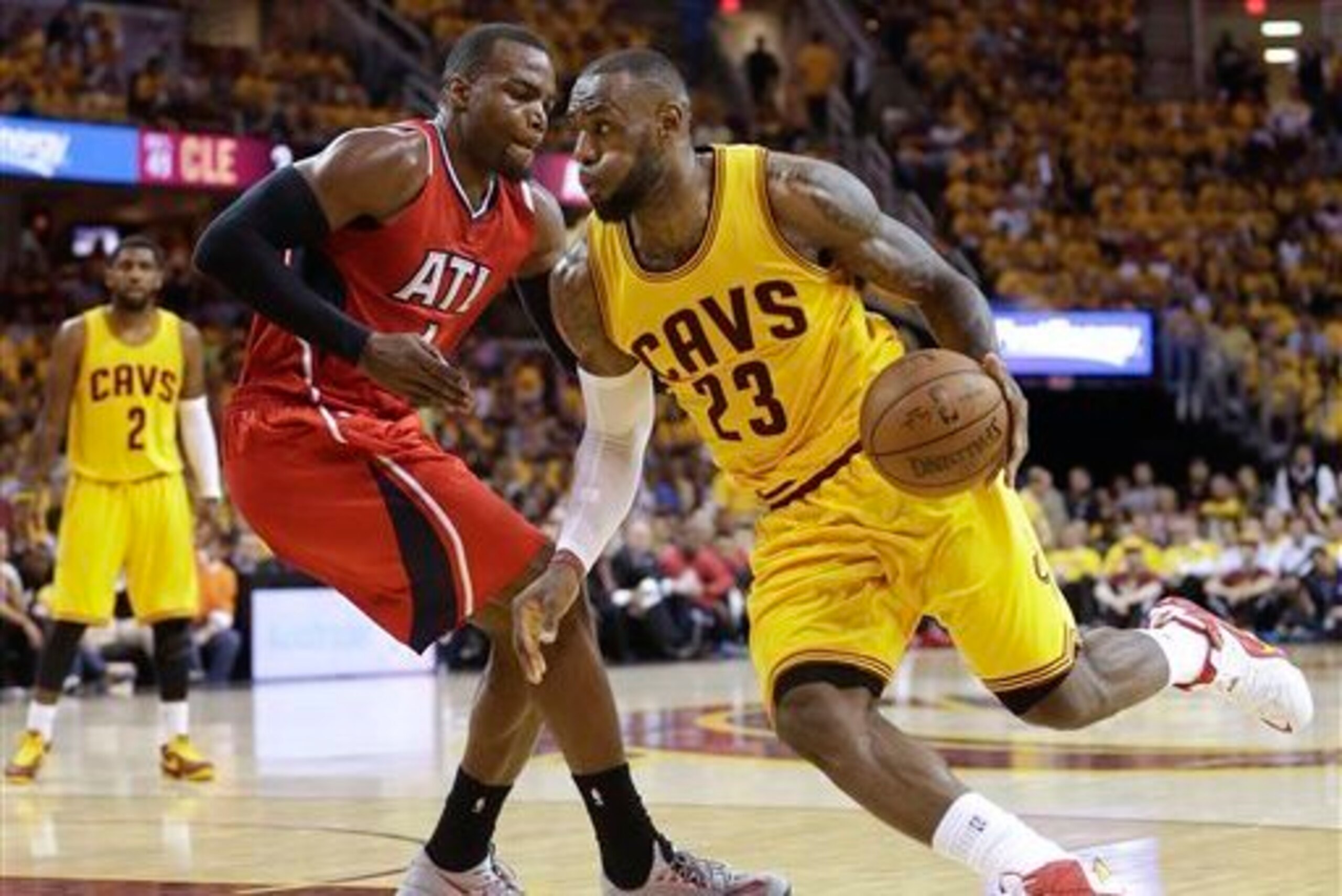
Strip away the dressed-up play designs of Cleveland's offense, and you're left with a fairly simple formula: Give the ball to LeBron and let him work.
In most cases, Cavs head coach David Blatt draws up sets to give LeBron the ball in favorable spots. From there, it's a matter of allowing the world's best player to make and execute the best possible decision.
Most NBA offenses function this way, but it's slightly less complex in Cleveland's case. With Irving and James, Blatt doesn't have to get cute to generate points. Although oversimplification can stifle ball movement, complexity for its own sake can limit individual creativity, which is far and away the easiest way to score.
Blatt has recognized this important point and has mostly gotten out of his own way.
Former Oklahoma City head coach Scott Brooks was constantly criticized for what Blatt is currently doing, but there's one key difference: Blatt has the most unselfish superstar in the game. Not to knock Durant or Westbrook's passing, but both are score-first players whose passing ability, though exceptional, isn't always utilized.
During these playoffs, Blatt has stationed LeBron in the post more frequently. He dominated DeMarre Carroll from this position in the Eastern Conference Finals, and we can expect much of the same strategy in the Finals.
James will not be able to dominate from a scoring standpoint as much as he did last round simply because of who Golden State can throw at him. Draymond Green is one of the sturdiest post defenders in the league, Andre Iguodala has been a defensive ace for most of his career, and Harrison Barnes has the length to bother James' vision.
In a recent Sports Illustrated piece, Chris Ballard delved into Barnes' development on the defensive end:
"In Barnes’ case, the team chose him for a reason. Warriors assistant coach Luke Walton, who is 6’8” and maybe 250 or so these days, often works with players in the post during and after practices, banging and bumping away. All the while, he’s gauging who possesses Skinny Guy Strength and who doesn’t. “There are only so many wings that can guard the post,” says Walton. “You have to be very strong.”
"
Still, most teams cannot single-cover LeBron without consequence. If they do send help, it will be up to Cleveland's spot-up shooters (J.R. Smith, Iman Shumpert, James Jones and Matthew Dellavedova) to make Golden State pay. Every shot they make will keep perimeter defenders a step closer to the three-point line and therefore a step further away from a help position.
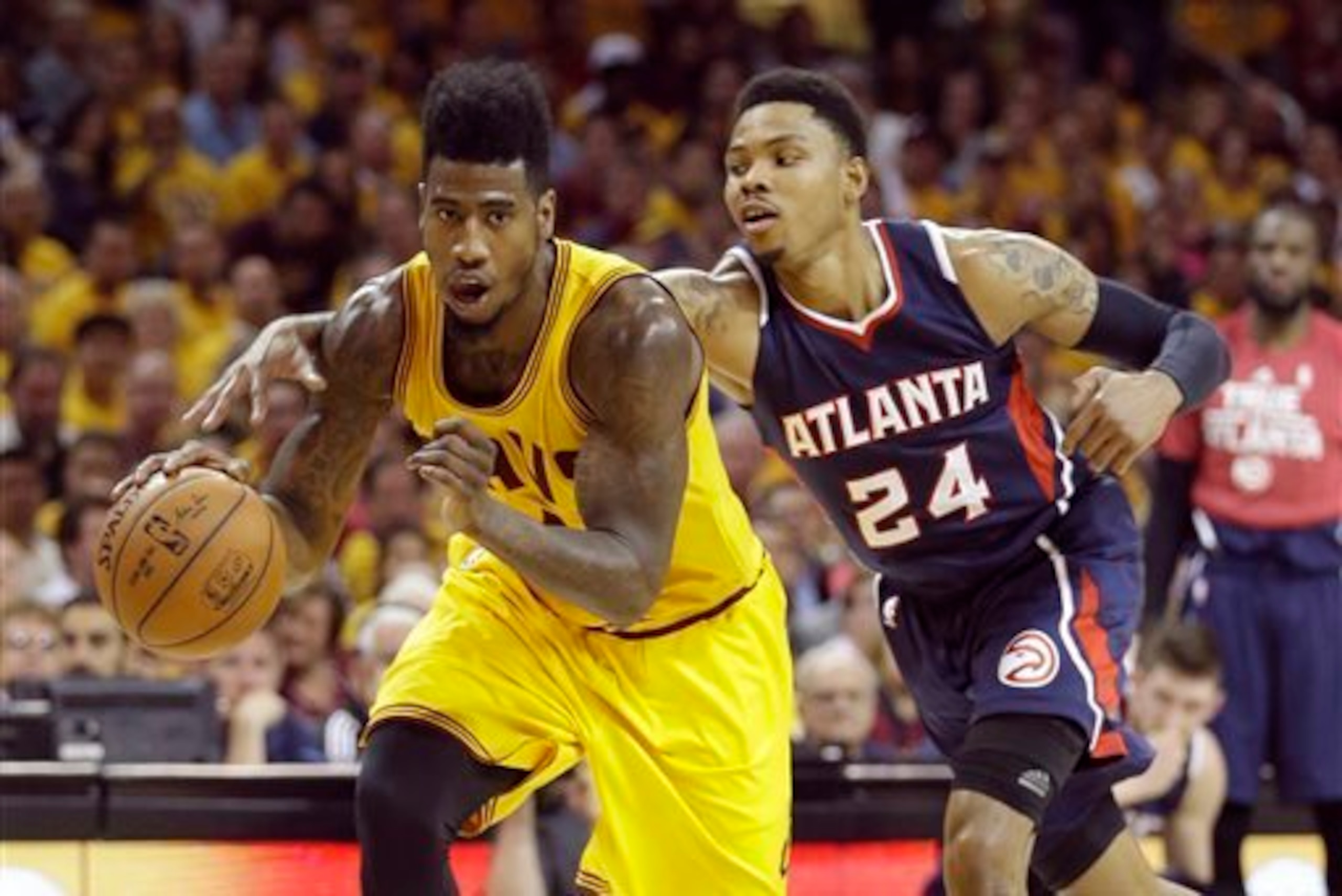
If they miss shots, Golden State can dig—a defensive maneuver in which a player guarding an off-ball shooter leaves his man briefly to stab at the ball without fully double-teaming—more freely. And if they can muck up LeBron's space without setting off a chain reaction of defensive rotations and an eventual breakdown, their defense will have a much easier time.
Thus far, LeBron's unselfishness has paid off. According to Synergy Sports, LeBron's post-ups have produced 0.969 points per possession for the Cleveland offense (a number slightly higher than the Cavs' 0.922 points per possession on all half-court offensive plays), mostly due to his teammates' ability to knock down shots and make plays off secondary penetration.
Here's an example of the former, with Kent Bazemore of the Atlanta Hawks digging on James as he backs down Carroll. LeBron's greatness doesn't just stem from his ability to see the floor and complete any type of pass. He has the ability to time up his passes so that they take advantage of the defense at the most opportune times.
Here, Bazemore hovers at the elbow area, clearly keeping an eye on James and slowly sagging away from Shumpert. The moment Bazemore goes to stunt at the ball, James whips a one-handed pass back out to Shumpert.

All of Bazemore's momentum is carrying him the wrong way, and he has no chance to get back out to contest Shumpert's shot.
That Shumpert makes the shot is a significant factor here. Besides the obvious, it's planted in Bazemore's head that maybe he can't cheat quite as far on the next possession. This gives James more time and space to operate for his own points, a dangerous proposition. The threat of giving up a three-pointer can be paralyzing.
Even if a jumper isn't there, it's always easier to attack the rim when a defender is closing out on a potential shot. A quick ball fake or a quick rip to the basket, and most defensive players are left standing and watching. From a purely physical standpoint, it's nearly impossible to sprint in one direction, stop and slide 180 degrees the other way.
On this play from the Eastern Conference Semifinals against the Chicago Bulls, LeBron spins baseline against Jimmy Butler after posting up in the middle of the paint. When he picks up his dribble and is unable to shoot the ball, notice how the entire Chicago defense has its eyes peeled on James and has completely collapsed into the paint:
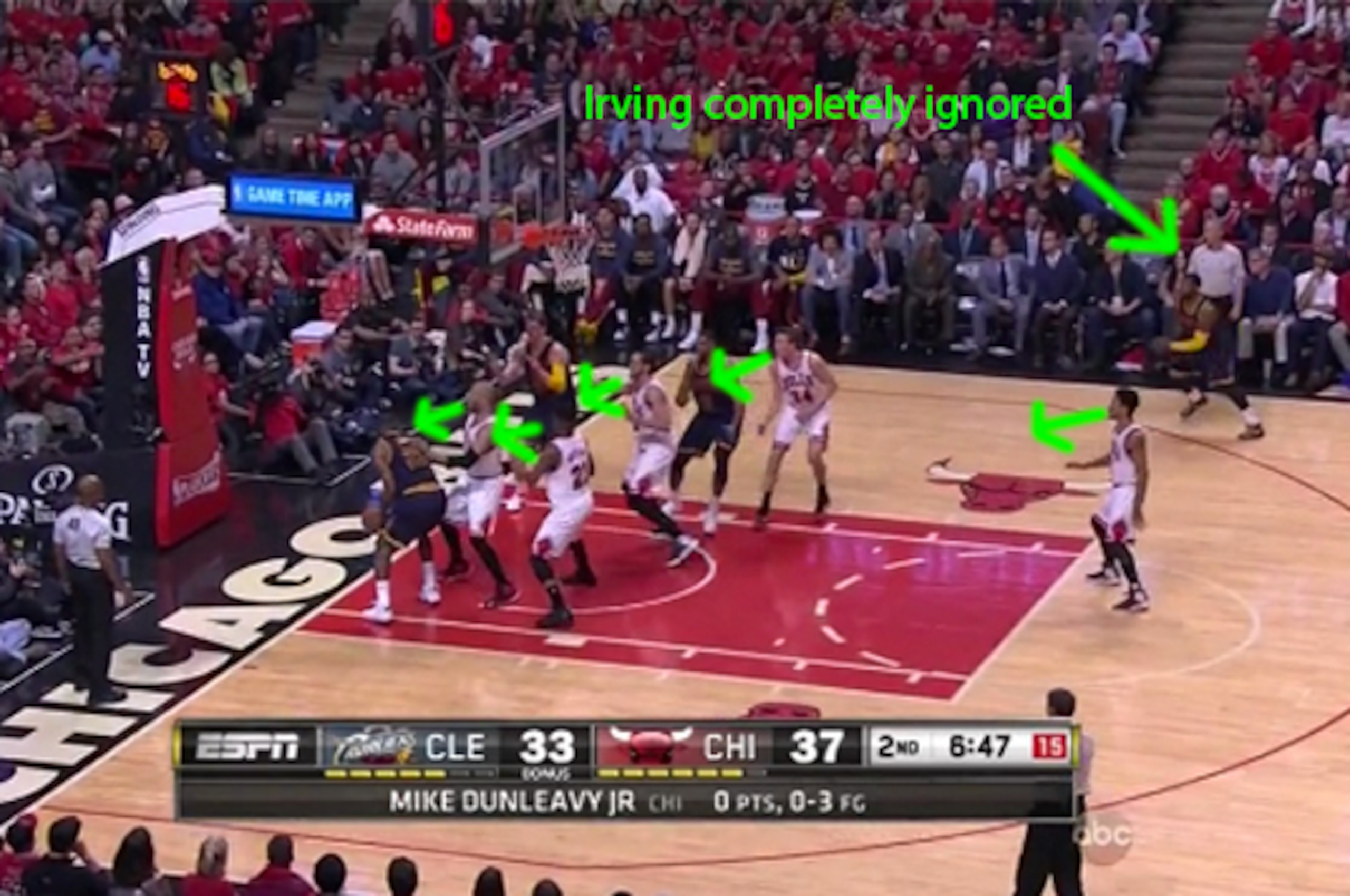
Irving has been completely ignored on the weak side because Mike Dunleavy is overly concerned with the ball side. LeBron gathers his balance, waits a count for Irving to enter a viable passing lane and fires a long bounce pass. Dunleavy chases the ball, but Irving swoops in and blows right by for the basket.
This is the type of movement and execution LeBron's teammates need to exhibit throughout this series. Without it, the Cleveland offense is in trouble. Although James is a great player, he can't do it all himself.
Golden State's Weak-Side Rebounding
For all the heroic performances James has logged during these playoffs, none of it would be possible without Cleveland's dominant offensive rebounding. Tristan Thompson has been at the forefront of this success, with his four offensive rebounds per game ranking best among NBA Finals participants and third for the playoffs overall, according to NBA.com.
Cleveland as a team hasn't been too shabby, either: Its 13 offensive rebounds per 100 possessions rank second in the playoffs. Although offensive rebounding isn't the biggest factor in deciding games, it has been especially crucial for a Cavs team that is shooting 43.6 percent from the field in the postseason.
Although jacking 29.1 three-pointers per game (and knocking down 35 percent of them) has helped to prop up their efficiency levels, it's the offensive rebounds to generate easy putbacks that have propelled the offense during dry spells.
Most offensive rebounds aren't a function of extreme effort or great feats of athleticism. When a defense rotates to stop the ball, it's up to the players not directly involved in the action to help the helper.
In Golden State's case, Andrew Bogut routinely slides over to protect the rim, leaving his man to lurk on the weak side and clean up the glass. The Warriors, however, are particularly disciplined at having a weak-side defender slide into the paint and plant himself between the basket and the offensive rebounder, thereby cutting off an easy drop-off pass and limiting offensive rebounding opportunities.
This pick-and-roll below from the Western Conference Finals against the Houston Rockets exemplifies the Warriors' seasoned understanding of this concept.
As James Harden looks to penetrate off a pick from teammate Dwight Howard, Bogut is forced to contain the ball on his own because Barnes gets caught up in the screen. This gives Howard a lane to dive to the rim unencumbered. Barnes and Bogut do a nice job swallowing up the ball, and Harden throws up a layup high off the glass.
But notice how, in the freeze frame below, Green has shifted into the paint to tie up Howard. Even though he's not able to completely box him out, he ties up Howard's hands and prevents him from getting what could be an easy offensive rebound.

A lot of NBA players are late in this recognition or do not trust their abilities to rotate and recover on time. In order not to get burned, they'll simply stay put and hope their teammates can take care of the board themselves.
Here, Green gives himself up to do the dirty work. He doesn't get the rebound, but it's his extra effort on the help that allows Bogut to corral the ball. Without it, Howard can continue to creep forward and simply leap over the off-balance Bogut to grab the ball.
Instead, Howard barely jumps and is resigned to getting back on defense.
Cleveland's Role Players
Shooting comes and goes. Even the best shooters experience dry spells, which is why the phrase "live by the three, die by the three" rings true time and again.
The Cavs' reliance on the three-pointer leaves them susceptible to this possibility. If they shoot the lights out, they'll be tough to beat. If they're bricking shots from the outside, LeBron's space will shrink, and everything else offensively will suffer.
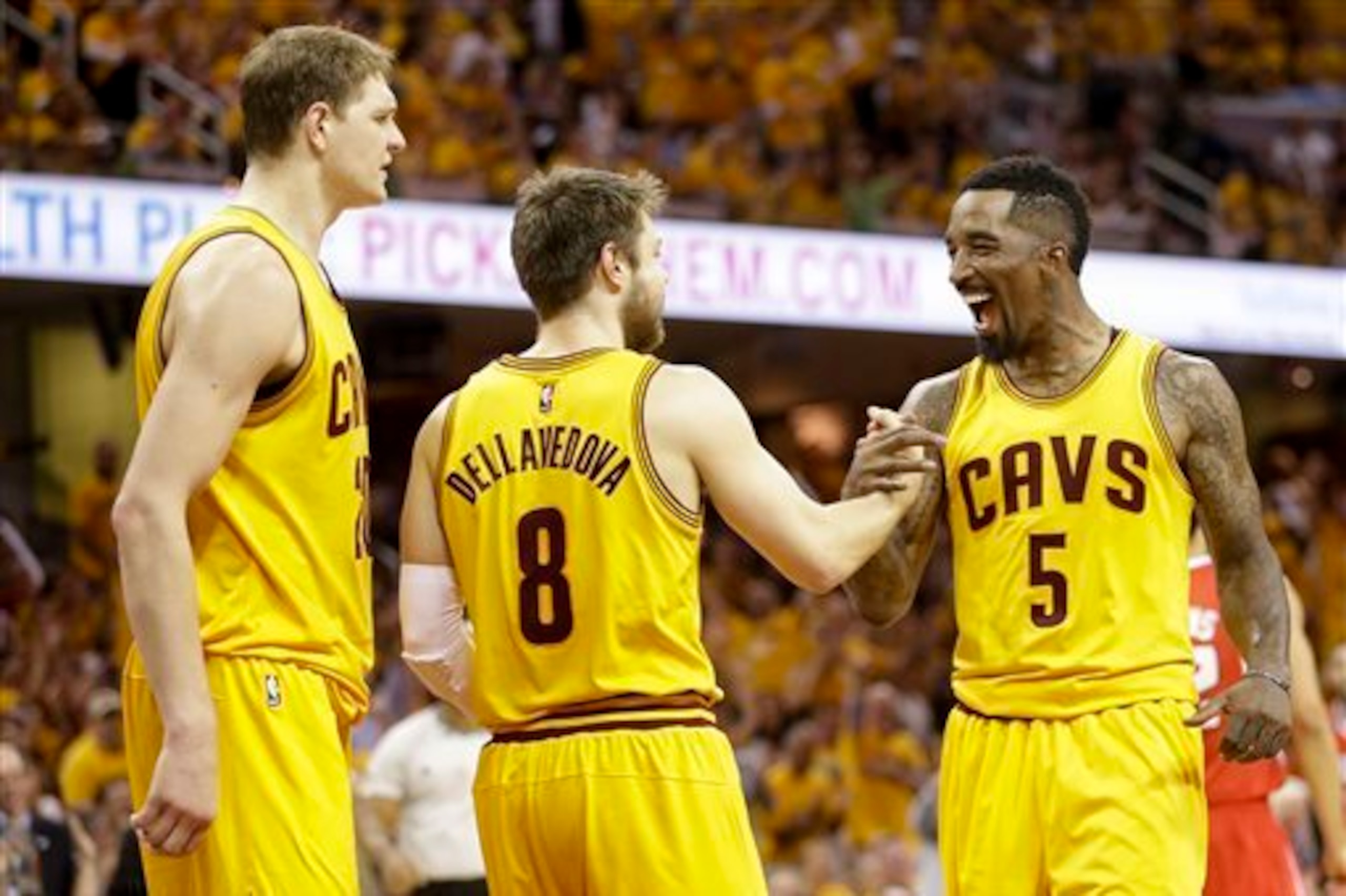
And LeBron needs more space to operate because he's more post-oriented now. Although Blatt is still running plenty of James-initiated pick-and-rolls, it takes less of a toll to back down someone in the post than to sprint, pivot and explode on every possession.
This is particularly crucial without Love on the floor and Irving struggling to stay healthy. The Cavs need LeBron for 48 minutes, but they can't risk running him into the ground, either. Blatt has been constantly toeing this line throughout the playoffs.
This is why Cleveland's role players, specifically Smith and Shumpert, are the biggest X-factors in this series. The Cavs need scoring and playmaking from their secondary options to preserve James.
A gutsier approach the Warriors could take is to simply help on LeBron as little as possible and trust their defenders in one-on-one situations. If they can keep shooters out of rhythm by locking down the three-point line, the Cavs' perimeter players might be less successful when those scarce opportunities do arrive.
Either way, Cleveland's role players will have to show up in a big way. They're the key to unlocking better ball movement and more operating space. Without them, LeBron's one-man show will not be enough.
Golden State is too deep and talented, and it would be a surprise if it does not win this series.






.jpg?w=2560 "Latest Peyton-Colts Rumors")