

Who the Atlanta Hawks Should Target in the 2015 NBA Draft
The 2015 NBA draft is the next order of business after the Atlanta Hawks' magical season came to a crushing end on Tuesday night. Behind a dominant four-game stretch from LeBron James, the Cleveland Cavaliers got out their brooms and swept the Eastern Conference's No. 1 seed out of the playoffs during the penultimate round of the postseason.
Now, the Hawks are no longer asked to focus on the present. They can look back and reflect on a truly unforgettable season, remembering the franchise-record 60 wins, the first 17-0 month in NBA history, four All-Stars, the dramatic Feb. 6 win over the Golden State Warriors, transition dunks from Kyle Korver and more.



But they can also begin to look forward.
Though most No. 1 seeds don't have a pick in the first round of the ensuing NBA draft, Atlanta is continuing to prove itself an exception. Thanks to the trade that sent Joe Johnson to the Brooklyn Nets, it has the right to swap picks in 2015, and it'll be taking advantage of that luxury on June 25, sending the No. 29 pick to Brooklyn for the No. 15 selection.
As good as the Hawks were in 2014-15, they can get better in 2015-16—assuming they manage to re-sign Paul Millsap and DeMarre Carroll, which is a topic for another time.
Internal improvement will help.
During the playoffs, Mike Budenholzer clearly realized Mike Muscala deserved more minutes. Dennis Schroder will continue to grow, and he'll turn just 22 years old before the start of his third campaign in the Association. And the team might get a boost from international waters. Walter Tavares, the Hawks' No. 43 pick in 2014, could join the squad after an impressive year with Gran Canaria in the Spanish ACB.
But the easiest way to get better is to nail that No. 15 pick, adding an impact player to a roster that, despite getting swept out of the playoffs, figures to be quite good again next year.
Target No. 1: A Lottery-Level Small Forward
It would be shocking if Justise Winslow, Mario Hezonja or Stanley Johnson ended up slipping outside the top 10 on June 25, as all three are elite wing prospects who will surely tantalize many of the first teams up on the board.
The Orlando Magic, Sacramento Kings, Denver Nuggets, Detroit Pistons and Charlotte Hornets could all justify taking those players, and it seems rather unlikely that at least three of those organizations would go in another direction.
Even if they do, the rest of the lottery squads would just snatch them off the board.
If, by some miracle, one member of that wing triumvirate manages to slip down to No. 15, the Hawks would surely gobble him up without a moment's hesitation. NBA commissioner Adam Silver would basically be able to announce Atlanta's selection before a representative of the team even made it official.
But we're not worrying about pipe dreams here, and that's why the Hawks should really focus their energy on the two remaining lottery-level small forwards in this draft class: Sam Dekker and Kelly Oubre.
Even if Carroll is eventually re-signed to an eight-figure-per-year deal, the 3 remains a position of need, as this year's backups—Kent Bazemore and Thabo Sefolosha—don't bring quite enough offense to the table.
Plus, the 34-year-old Kyle Korver isn't going to be around forever, and his eventual departure is going to leave one yawning chasm on the wing. We saw that front and center during the playoffs, both when he was struggling and when he was absent with an ankle injury that required surgery.
Dekker is the safer option at No. 15, especially if he's able to shoot like he did during the NCAA tournament. Though he was a willing second fiddle for much of the year, he found his attack mentality and thrived for Wisconsin throughout March Madness, averaging 19.2 points while shooting 57.1 percent from the field and 41.7 percent from beyond the arc.
The beauty of Dekker is that he can fit into virtually every system, as he's a well-rounded player capable of making an across-the-board impact. Is he a standout in any one area? Not at all, but he's not a negative contributor anywhere, either.
He's a great athlete with NBA-caliber size. He's a strong defender who moves his feet well and can switch to guard multiple positions. His jumper might not be consistent yet, but we saw the upside flashed during a lengthy run through the NCAA postseason. He can put the ball on the floor and serve as a primary distributor, even if he occasionally struggles to create his own shot.
And if there's a team capable of marginalizing that weakness, which may well be the biggest knock on his resume, it's the Hawks, a squad that prides itself on moving the ball and relying on assists to generate offense.
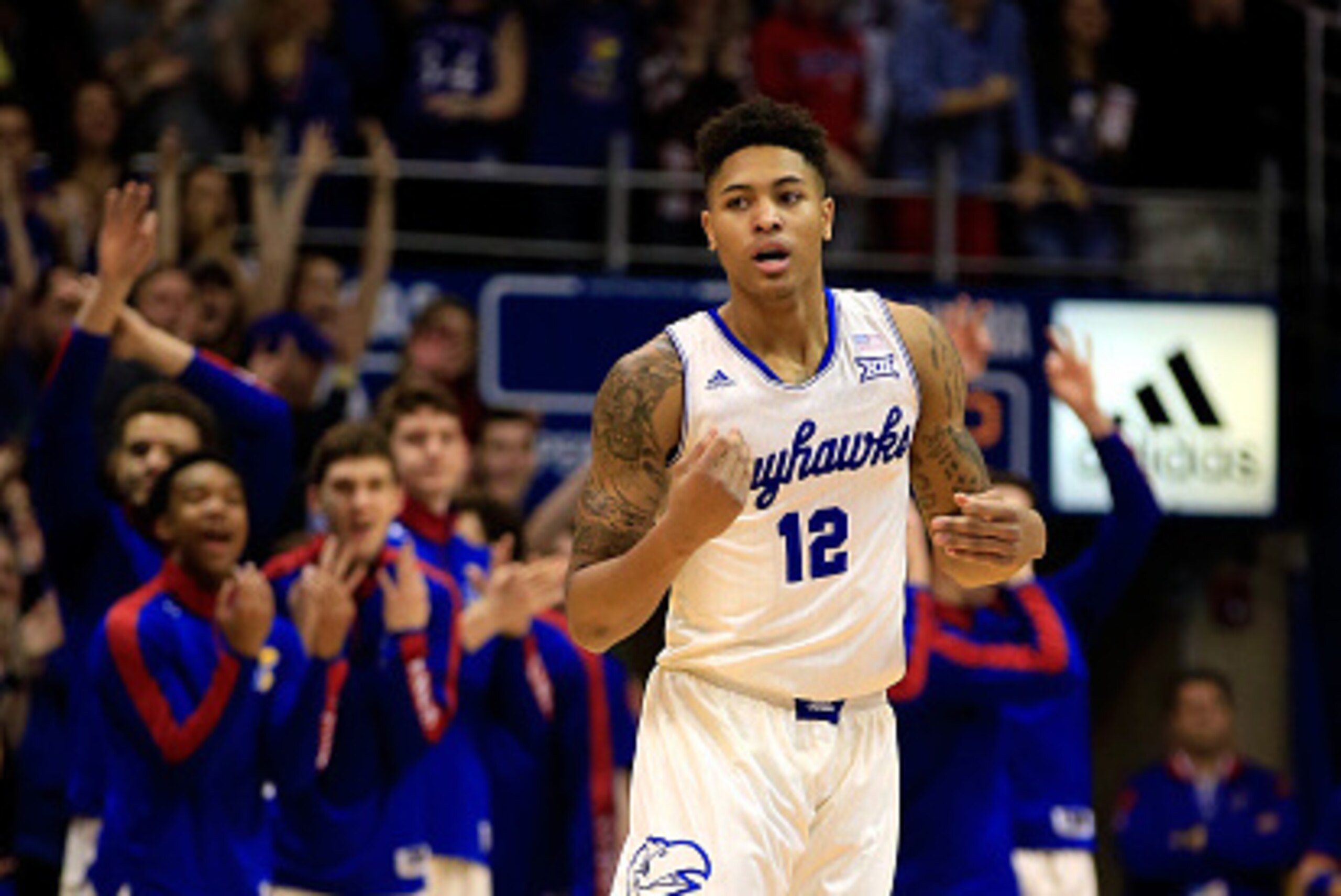
Oubre, meanwhile, isn't as perfect a fit. He's just even more talented, thanks to the tantalizing level of play he shows whenever he's mentally engaged. The Kansas freshman checked out of far too many plays during his one and only go-round under Bill Self, but he can look like Paul George 2.0 when the above-the-neck game is on point.
Drafting him isn't as long-term a play as picking a draft-and-stash prospect, but patience is going to be required. As Jonathan Givony wrote for DraftExpress.com, he's by no means a go-to player at this stage of his career:
"Oubre wasn't ready to be a go-to guy for Kansas as a freshman, and shouldn't be expected to be anything close to that as a NBA rookie. While he is extremely gifted physically and is blessed with a great deal of natural talent, he'll need to get much more consistent with his approach to the game, and improve his overall awareness and polish on both ends of the floor to reach his very high potential down the road.
"
The imaginary competition between Oubre and Dekker is an intriguing one, simply because one would bring immediate production and relative stability during a time of the year that's typically fraught with risk, while the other is more of a boom-or-bust prospect.
But given their current situation, the Hawks should have those two forwards atop the list of realistic potential selections while praying that one of member of the elite wing trio inexplicably falls to No. 15.
Target No. 2: Frank Kaminsky
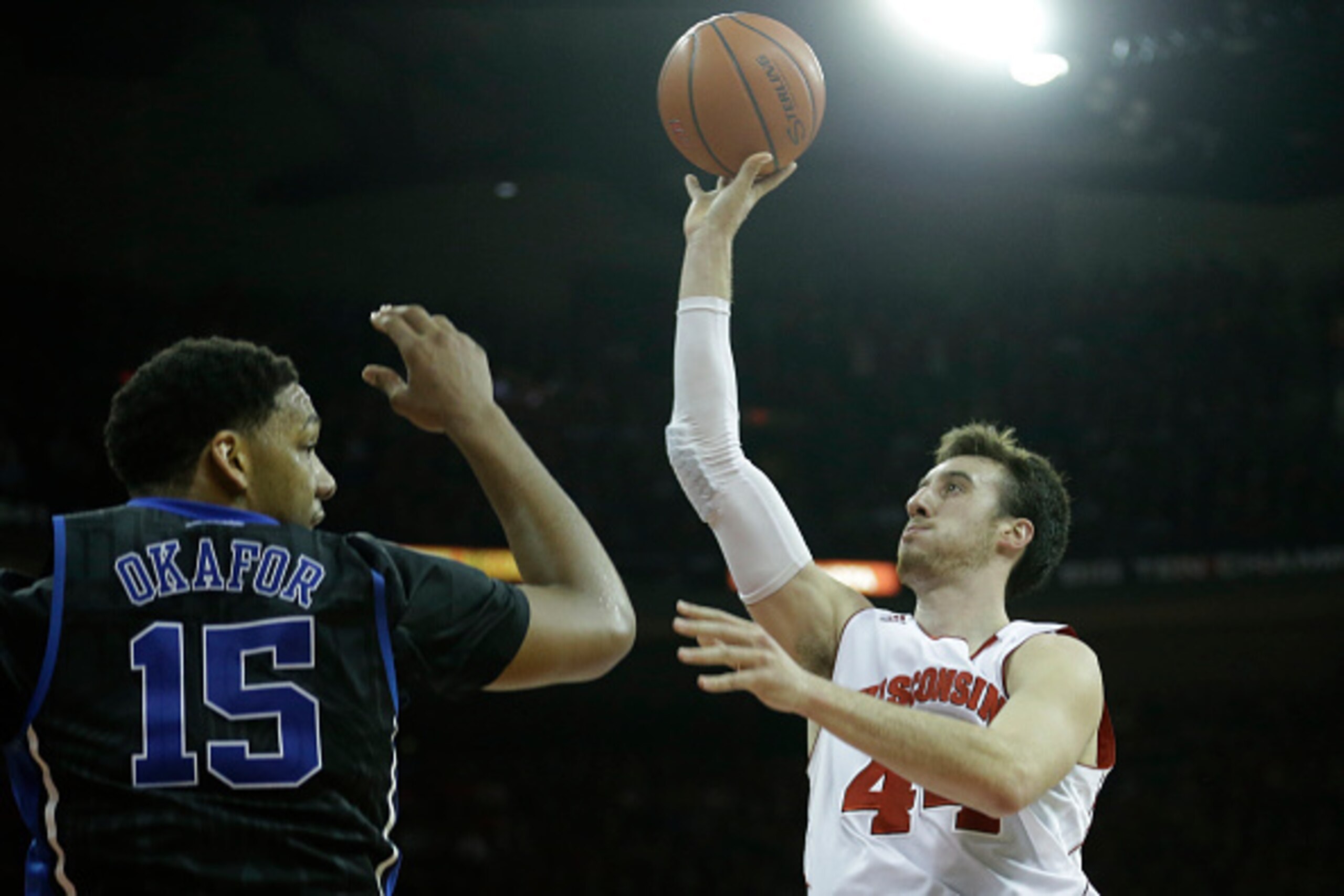
If the small forwards are gone, the Hawks can look to the frontcourt and add a piece who would fit in quite nicely with the Budenholzer offense.
Frank Kaminsky may have spent most of his collegiate career at Wisconsin playing the 5, but he's likely to shift down a spot in the lineup and work on stretching out the court once he joins the NBA.
"[I'm] turning myself into a 4," Kaminsky, working out for NBA executives in Santa Barbara, explained to the assembled masses, per Eric Pincus of Basketball Insiders. "In college, I played the 5 for so long. I know I can play the 4. I just have to pick up the nuances. The NBA values big guys that can stretch the floor."
If he can thrive at both of the biggest positions, he'd certainly have a place in the Atlanta rotation. Even with Al Horford and Millsap (assuming he's re-signed) entrenched as the starters and Muscala beginning to prove he deserves significant run, there's room for another big.
And yes, that remains true if Tavares comes over. The 7'3" center is quite raw and will have to develop significantly before he's a rotation member on a competitive team.
The situation would be a lot different if Pero Antic had remembered how to shoot the ball during the 2014-15 season. But that's not exactly what happened. Instead, the Macedonian center hit only 30.1 percent of his three-point attempts and was so unplayable during the postseason that he completely fell out of Budenholzer's rotation.

A replacement is needed, since the Hawks offense is at its best when a frontcourt player is capable of stretching out the floor. And that could easily be Kaminsky's role, especially given how skilled he is on the offensive end. He's talented enough that Bleacher Report's Jonathan Wasserman views him as a safe pick, ranking him No. 13 on his latest Big Board:
"Frank Kaminsky projects as a safe pick just based on his 7'0" size and convincing 41.6 percent three-point stroke. It gives him the potential to consistently stretch the floor and bring opposing anchors away from the rim, something that holds NBA value in itself.
But his face-up game has also become very sharp, thanks to much-improved footwork and excellent touch. Kaminsky can put the ball on the floor and attack closeouts off the dribble, as well as spin off line drives and score on the move.
"
Kaminsky is the ideal big man for the Hawks offense, even if he's not a prototypical NBA frontcourt player. A rim protector wouldn't be a bad get for an undersized group of players—Muscala, and potentially Tavares, notwithstanding—but this former Badger still has to be the top choice if the small forwards are somehow all off the board.
Target No. 3: R.J. Hunter

It's highly unlikely that the Hawks would have to dig this deep on their draft board. We've already highlighted six players who they should favor, and there are only 14 teams drafting in front of them. It's a virtual guarantee that not all of them will be gone by the time they're on the clock.
But if some strange circumstances unfold, Georgia State's R.J. Hunter isn't a bad backup plan.
To be fair, the mid-major wing player would be a bit of a reach at No. 15. Right now, DraftExpress.com has him going to the Cavaliers at No. 24. NBADraft.net's latest mock draft projects the exact same outcome. Wasserman's has him coming off the board at No. 17 and joining the Milwaukee Bucks.
But it would be totally justifiable for the Hawks to make him the first non-lottery player selected, as he's another ideal fit for the offense. Hunter, despite what his numbers this year might indicate, is a fantastic shooter who should thrive as he adjusts to the NBA game.
As Givony explains in detail, his three-point percentage in 2014-15 (30.5 percent) is quite misleading:
"Hunter's biggest appeal as a NBA prospect revolves around his outside shot, even if that's far from his only strength at the moment. He has deep range extending well beyond the 3-point line, and can make shots in a variety of ways, be it off spot-ups, coming off screens, or pulling up off the dribble. Hunter's release point is somewhat low, which would be more of an issue if he didn't get his shot off as quickly as he did. His mechanics are smooth and compact, complete with terrific footwork and a pretty follow-through, and he sets his feet and shoots it all in one quick, effortless and aesthetically pleasing motion.
"
Hunter's percentages as a jump-shooter were nothing to write home about over the course of his college career—he made just 35% of his 3-point attempts at Georgia State and 30% as a junior. He shows great confidence and aggressiveness as a shooter, though, hitting some deep and incredibly difficult looks that only real snipers do. That, combined with his mechanics, the huge volume of 3s he attempts (over 7-attempts per game), and his sparkling percentages from the free throw line (89% as a junior) lead you to believe that he'll find a way to develop into a very dangerous shooter in the NBA, particularly when he's drawing less attention from defenses than he did as a marked man every night for Georgia State.
If players were guaranteed to be just as effective shooting the ball as they were in college, the NBA would look quite different. Even with the lengthened arc, plenty of prospects with the right tools improve once they get to the professional level, and Hunter seems like a prime candidate to be the latest.
And it's not like he's a pure sharpshooter.
Hunter thrived on the defensive end, recording plenty of blocks and steals with his impressive length and lateral quickness. He'll be in for a bit of an awakening when he's no longer allowed to function on the top level of a zone scheme, but he certainly has the athletic ability and intelligence necessary to hold his own in the Association.
Plus, he's a strong distributor, which is a key piece in the Hawks' offensive puzzle.
Atlanta likely won't have to reach for Hunter during the 2015 NBA draft, as it should have plenty of feasible targets to pick from when on the clock. But if the Hawks do need to take a risk, Hunter is more than worth gambling on.
Adam Fromal covers the NBA for Bleacher Report. Follow him on Twitter: @fromal09.

.jpg?w=2560 "Raiders Could Start Mendoza")

.jpg?w=2560 "Rodgers Iced Out on Plane 💎")
.jpg?w=2560 "🚨 Week 8 AP Top 25 Poll")
.jpg?w=2560 "Packers Safety Slams Refs 🤬")
