

Indiana Pacers' New Identity Will Leave Roy Hibbert on Outside Looking In
The season is over for the Indiana Pacers, a little earlier than they hoped. The biggest reveal from this past campaign is that the team's primary identity—defense and physicality—may need to change.
A new and almost certainly smaller role is coming for Roy Hibbert.
Indiana's focus on force and suffocating defense dates back to when Jim O'Brien was fired and Frank Vogel was installed as head coach during the 2010-11 season. Vogel looked at a roster that was overmatched in the talent department and decided to double-down on the strengths of players such as Jeff Foster, Tyler Hansbrough and Hibbert.
TOP NEWS

Brown with an all-time summary of relationship with Tatum
Jokic says booing fans not welcome in Denver
Worst NBA Predictions 🫣
From then to now, that identity has been reinforced by roster moves such as the addition of David West, Ian Mahinmi and Luis Scola.
While Indiana's defense has consistently been among the league's best since Vogel took over, its offense has gotten continually worse. The table below shows how the Pacers have finished in offensive and defensive efficiency in each full season of Vogel's tenure, per Basketball-Reference.
| Season | Offensive Rank | Defensive Rank |
| 2011-12 | 7th | 9th |
| 2012-13 | 20th | 1st |
| 2013-14 | 23rd | 1st |
| 2014-15 | 23rd | 7th |
As the rest of the league moves toward pace and space, the pound-it-down-low approach of the Pacers has seemed more and more out of step.
In their end-of-season comments, both Larry Bird, vice president of basketball operations, and Vogel talked about wanting to change the team's identity to juice its offense. They also made a point of singling out Hibbert, who had another disappointing season.
Here are Bird's comments first (h/t Candace Bucker of The Indianapolis Star):
"We assume he's going to be back and if he comes back, we're probably going to play another style, and I can't guarantee him anything. He's going to have to earn it.
I was talking to coach earlier; we'd like to play a little faster tempo, and that means we've got to run a little faster, maybe at times play a little smaller. We just got into it, so I don't know what style, but we'd like to change it a little bit. … But I would like to score more points, and to do that, you've got to run.
"
And here is Vogel, pounding the same drum (from the same Buckner piece):
"We'll have to see how it all plays out and what the roster ultimately looks like, but there's a possibility that Roy's role will be diminished, if we're trying to play faster and trying to play smaller, but a lot of stuff is going to happen this summer. We'll see how the roster shapes out coming into next season.
"
Paul George is Indiana's best player. West is its vocal and emotional leader. But Hibbert is the player who really shapes the team's identity, the one who best represents its commitment to size and defense. To hear Bird and Vogel criticize him so loudly and specifically is a good indication of how dissatisfied they are with the status quo.
These offensive style charts I created can help illustrate exactly what Bird and Vogel are pushing back against.
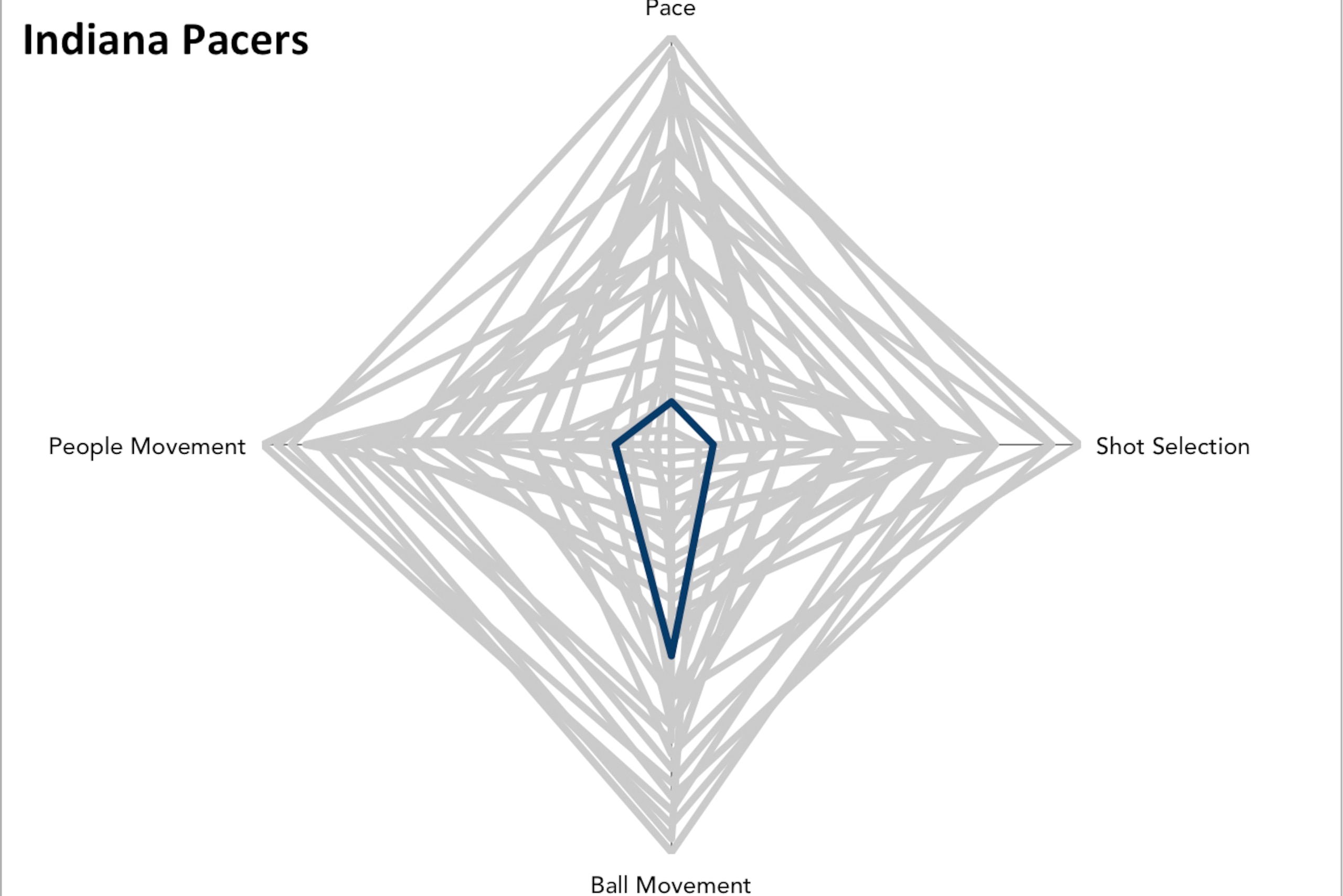
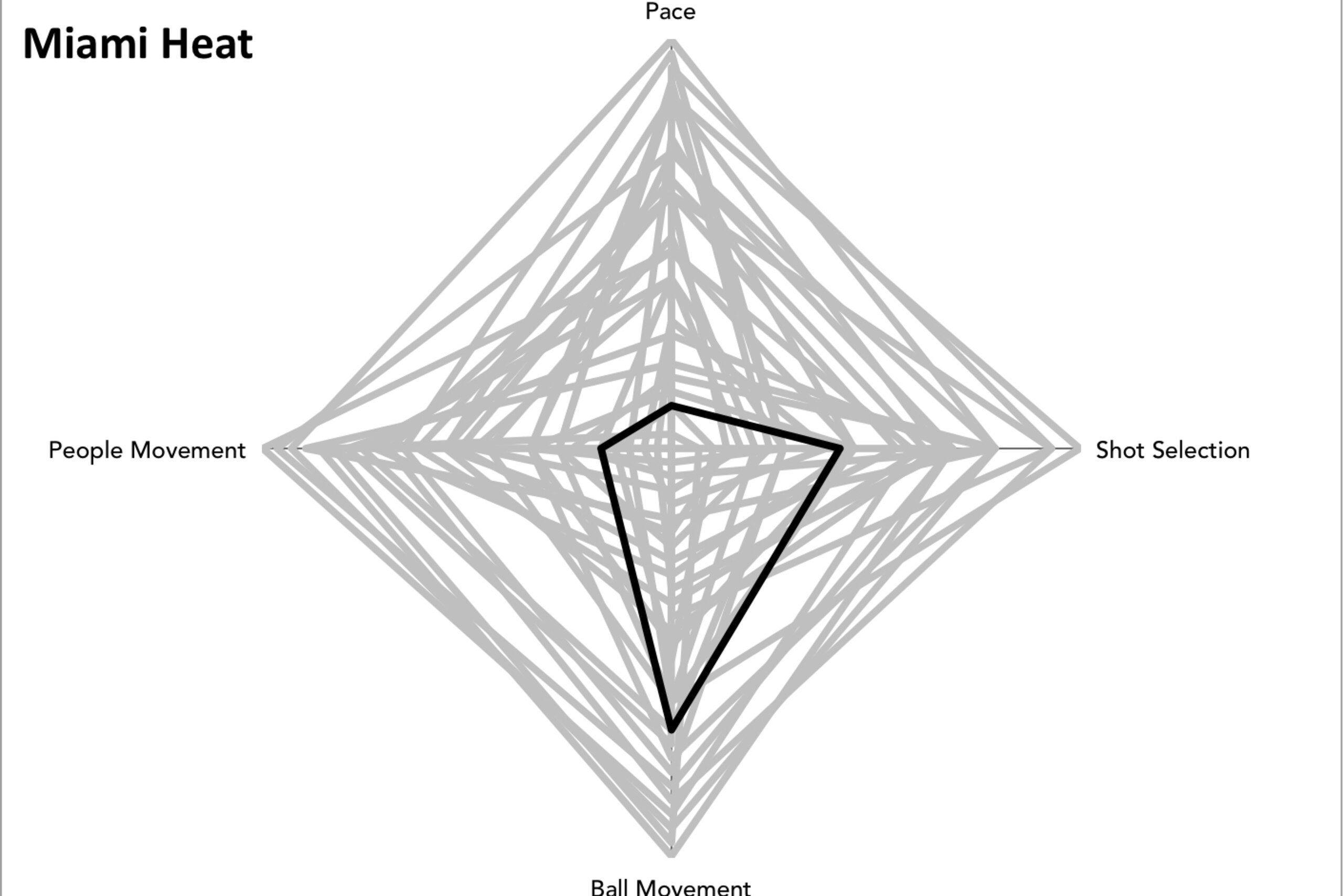
This chart highlights the stylistic traits of Indiana's offense (with all the other teams grayed out in the background). On each of the four axes—pace, ball movement, player movement and shot selection—distance from the center represents increasing quantity (or efficiency, in the case of shot selection). The entire methodology and metrics involved are explained here.
You can see that the Pacers were roughly average in their use of ball movement. They played very slowly, had very little player movement and relied on a very inefficient shot selection (a lot of long two pointers). Although I only have these charts for this season, my observation says this is a pretty fair representation of what Indiana has done on offense the past few years.
Compare its offense with the Golden State Warriors and the Los Angeles Clippers, the two most efficient offenses in the league last season.
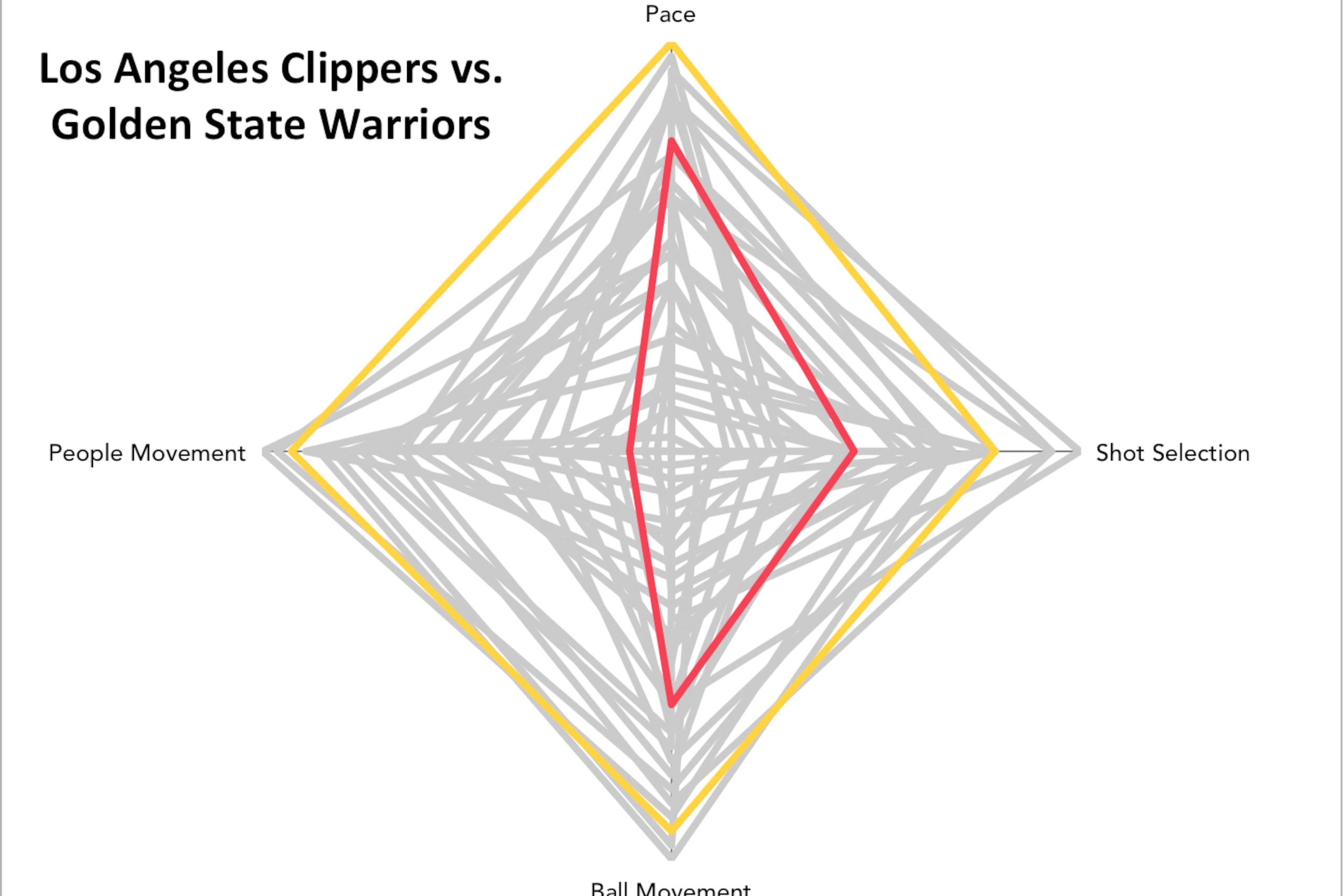
There is almost no overlap with the Pacers, but there are some significant differences between the two teams we see here.
That last point should be underscored because it's really important—there is no ideal template for offensive efficiency. A system has to complement the players and vice versa. The Warriors and Clippers are both successful because they have good offensive players and make good use of them in synergistic ways.
Going back to the Pacers, the two most similar offenses by style this season were the Miami Heat:
And the Memphis Grizzlies:
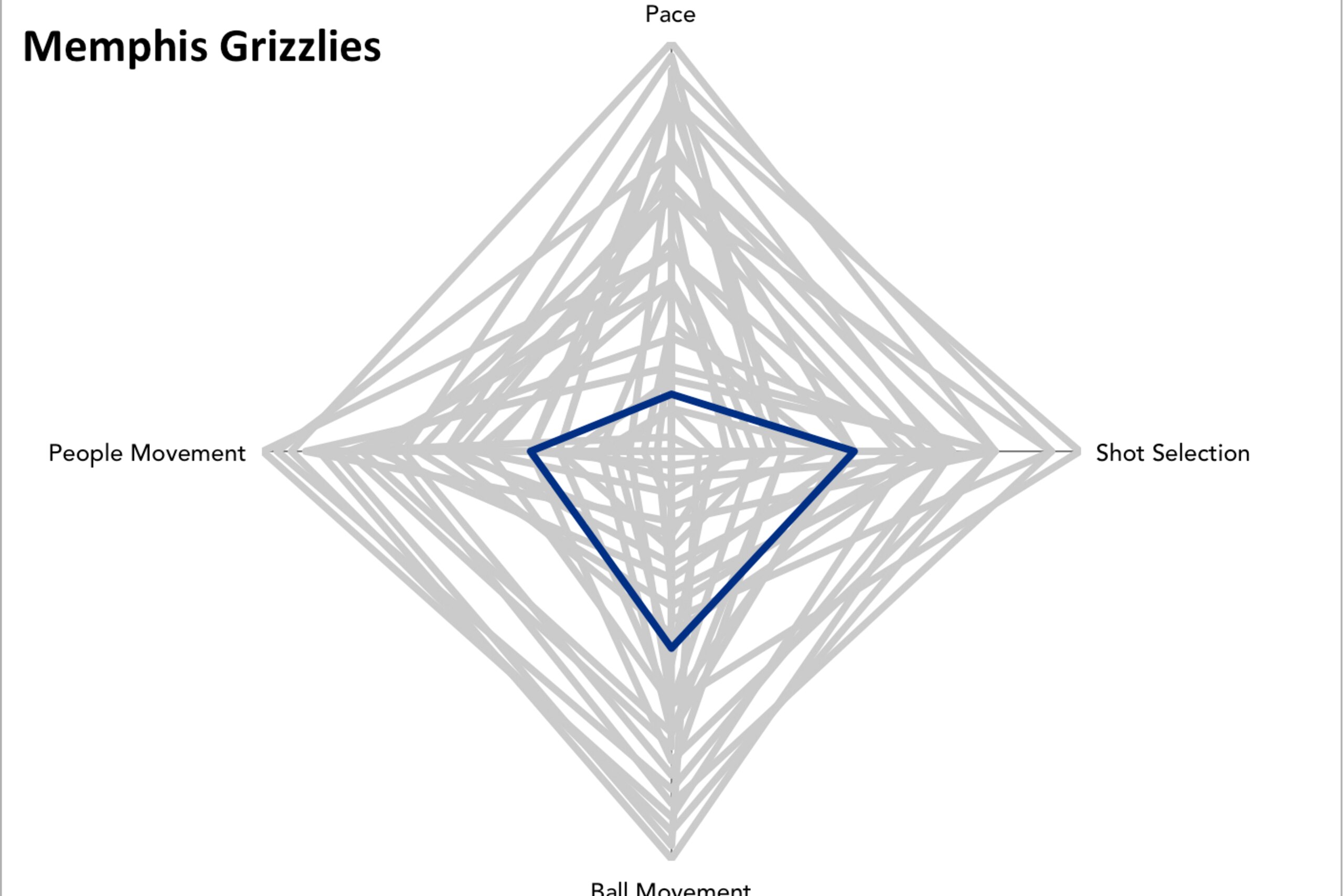
None of those offenses were particularly successful—the Grizzlies ranked 13th in offensive efficiency, the Heat were 21st, and the Pacers ranked 23rd, according to Basketball-Reference.
However, it seems obvious that the Heat and Grizzlies are running systems that are much better matches for their personnel. This style—low player movement and pace, with a lot of mid-range shots—is reflecting sets that feature a lot of post-ups and isolations with stationary shooters on the perimeter.
Memphis has two of the best post players in the league in Zach Randolph and Marc Gasol. The Heat have a set of very strong isolation scorers—Goran Dragic, Chris Bosh, Dwyane Wade—who also happen to be very good mid-range shooters. The Pacers don't really have the players to create efficiency in this style.
Which brings us back to Hibbert.
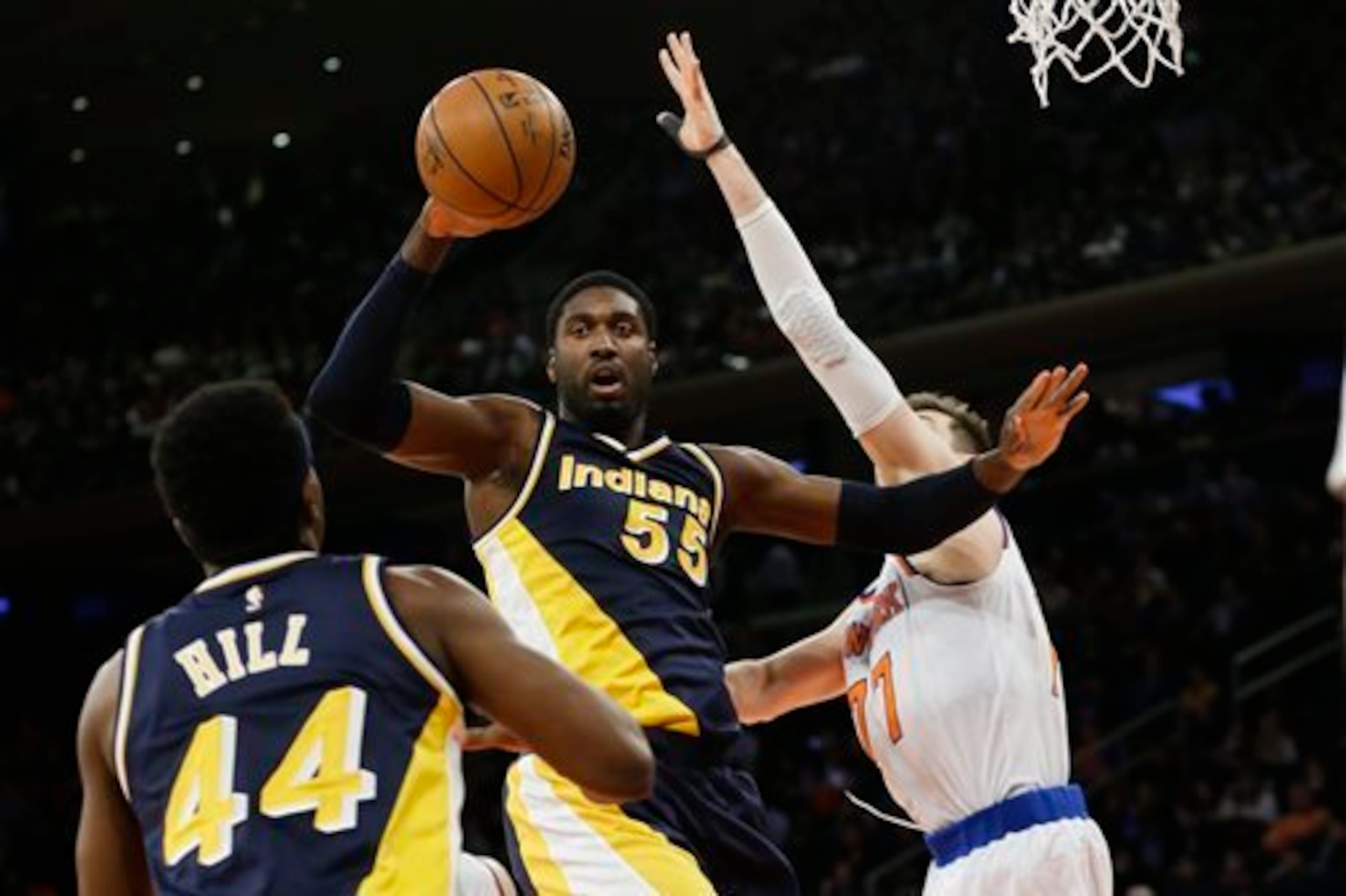
Ben Gibson of 8points9seconds did a great job of detailing exactly where and how Hibbert likes to work on offense:
"Hibbert continued to work from the right block on many of his post-ups, but we saw him expand more towards 10 feet and beyond this season than ever before. He saw a slight decrease in his shooting percentage near the basket but he improved his distance shooting to help make up for that. Without as many offensive weapons early in the season and whenever the injury bug bit Indiana, Hibbert was forced out of his comfort zone but still managed to keep around his career scoring averages.
"
The problem is that Hibbert's career averages are just not enough. He was not a reliable post scorer this season, and excepting a handful of strong playoff performances against the Miami Heat over the past few years, he never really has been. He's simply not able to be a foundational pillar in this style of offense.
The problem is that changing the team's offensive style doesn't exactly play to Hibbert's strengths, either. If the Pacers were to adopt a flexible, motion-heavy system like what the Warriors run, he's still incongruous. Hibbert isn't mobile enough in the pick-and-roll, nor does he have the shooting range to really be a useful cog in that sort of system.
If Paul George and George Hill were to blossom into the kind of hyperefficient individual scorers who could carry a system like the Clippers use, Hibbert is still in the way. There is really no place for him to be useful except along the baseline, where he'd be clogging up the lane drawing extra defenders to the penetration of Hill and George.
The bottom line is that Hibbert creates what appears to be an impossible conundrum on offense—he's not quite good enough to justify using offensive possessions on his post-ups, but he's not versatile enough to provide value in any other way.

Finding a new offensive identity, which seems imperative to the team's future, necessitates a much smaller role for Hibbert if one even exists at all. The challenge is that he is so effective defensively and so central to Indiana's scheme on that end of the floor that improving the offense will inevitably mean damaging the defense.
What the team is looking at then is a large and fundamental change of focus. We will probably see this reflected in how the Pacers rebuild their roster this summer. Scola, Donald Sloan, Rodney Stuckey, C.J. Watson and Lavoy Allen are all free agents.
Given Bird's and Vogel's comments about Hibbert, it seems plausible that the team might explore a trade.
It's also possible that those comments were meant to nudge Hibbert toward declining his $15.5 million player option for next season, becoming a free agent and solving the problem for Indiana. The Pacers will also be back in the lottery with the chance to select a player who could contribute next season and help them reshape their identity.
In Indiana's playoff losses to the Heat, we've seen it run into the ceiling of its current personnel and system. As the Pacers struggled through injuries this season, the Cleveland Cavaliers, Atlanta Hawks, Chicago Bulls and several others may have leapfrogged them in the Eastern Conference.
Raising their ceiling means remaking themselves. For the Pacers to get there, it means changing the nature of their relationship with the big man in the middle.

.jpg?w=2560 "Mahomes Told Teammate to Leave Meeting")
.jpg?w=2560 "5 Teams Eyeing Jonathan Taylor")

.jpg?w=2560 "NFL investigating Eagles")
.jpg?w=2560 "Jonathan Taylor Landing Spots 📍")

