

Will Houston Rockets' Total Dependence on James Harden Be Postseason Undoing?

James Harden's 2014-15 regular season has been an individual masterpiece, but his expansive offensive palette may not be enough to sustain the Houston Rockets' title hopes through May and into June.
The Beard resides atop the MVP ladder with Stephen Curry for good reason—he's kept Houston thriving despite encountering choppy waters littered with injuries, barreling his way to the bucket and bruising opponents with brute strength.
"I think I’ve done enough [to win] but that’s not my main focus,” Harden said of MVP honors, according to the Houston Chronicle's Jenny Dial Creech.
TOP NEWS

Brown with an all-time summary of relationship with Tatum
Jokic says booing fans not welcome in Denver
Worst NBA Predictions 🫣
However, Houston's singular approach, revolving around Harden's do-it-all mastery, isn't conducive to gains in the form of a Larry O'Brien Trophy.
Without question, Harden has been brilliant all season long. He ranks tied with Russell Westbrook for the league lead in scoring (27.5 points per game) and has maintained a three-point percentage of 38.1 despite shooting nearly seven treys per game.
To gauge Harden's importance to the Rockets, look no further than the team's offensive rating with him on and off the floor. With three games remaining, Houston's offensive rating hovers around a borderline-elite threshold. It cranks out 107.3 points per 100 possessions with Harden in the game, which would be good for No. 5 overall on the season.
| Harden On Court | 107.3 | 101.9 | 5.4 |
| Harden Off Court | 93.5 | 96.9 | -3.4 |
But when Harden sits, Houston's offense reverts to levels of helpless incompetency. During the 938 minutes he's been off the floor, the Rockets have produced 93.5 points per 100 possessions. That's worse than the New York Knicks and better than only the historically inept Philadelphia 76ers.
That discrepancy points to some insane dependence on the 25-year-old, who also leads all regular contributors in isolation frequency.
According to Synergy Sports' play-type data provided to NBA.com, Harden operates in isolations on 26.8 percent of his total possessions—notching 566 points in 557 such opportunities. For comparison's sake, LeBron James ranks No. 2 overall with 146 fewer points on 104 fewer opportunities.
Harden thrives in those situations, to be sure. He ranks in the 88th percentile as an isolation scorer, making him a whirling dervish of aggressive execution anytime he gets defenders out on an island.
A la Allen Iverson with the Eastern Conference-champion 2000-01 Sixers, Harden has assumed the role of scoring savior—shouldering the load in an attempt to mask his teammates' offensive deficiencies out of necessity. Those Sixers ultimately fell to the Los Angeles Lakers, 4-1, in the 2001 NBA Finals.
But for all of the praise Harden has earned, there's been a distinct lack of kudos for his supporting cast—and for good reason.
Bleacher Report's Kelly Scaletta explains:
Remember, this isn't an offense that's been blowing opponents away with regularity. Among projected Western Conference playoff teams, Houston owns the second-worst offensive rating (103.9). Only the Memphis Grizzlies (103.1) have been worse, and they're hot on the Rockets' tail.
Balance doesn't rule the day in H-Town, and that should be a major cause for concern entering the playoffs.
"His supporting cast isn't great," Bleacher Report's Dan Favale wrote. "It's a lot better with Howard back in the lineup, but the Rockets are bogged down by too many co-dependent players and not enough shot creation."
Harden's usage rate (percentage of a team's plays used by the player) of 31.3 checks in seven points higher than the next closest regular Rocket contributor, and that's Josh Smith at 24.4 percent. At last check, Smith wasn't the sort of consistent safety valve capable of relieving pressure in times of strife.
The same can be said of Trevor Ariza, Corey Brewer, Jason Terry and Terrence Jones.
Dwight Howard can offer some relief, but he's not going to carry the scoring load like he once did for the Orlando Magic. He can torment defenses for stretches with wicked finishes in the pick-and-roll, but Houston can't dump the ball to him in the post and let him go to work with his back to the basket.
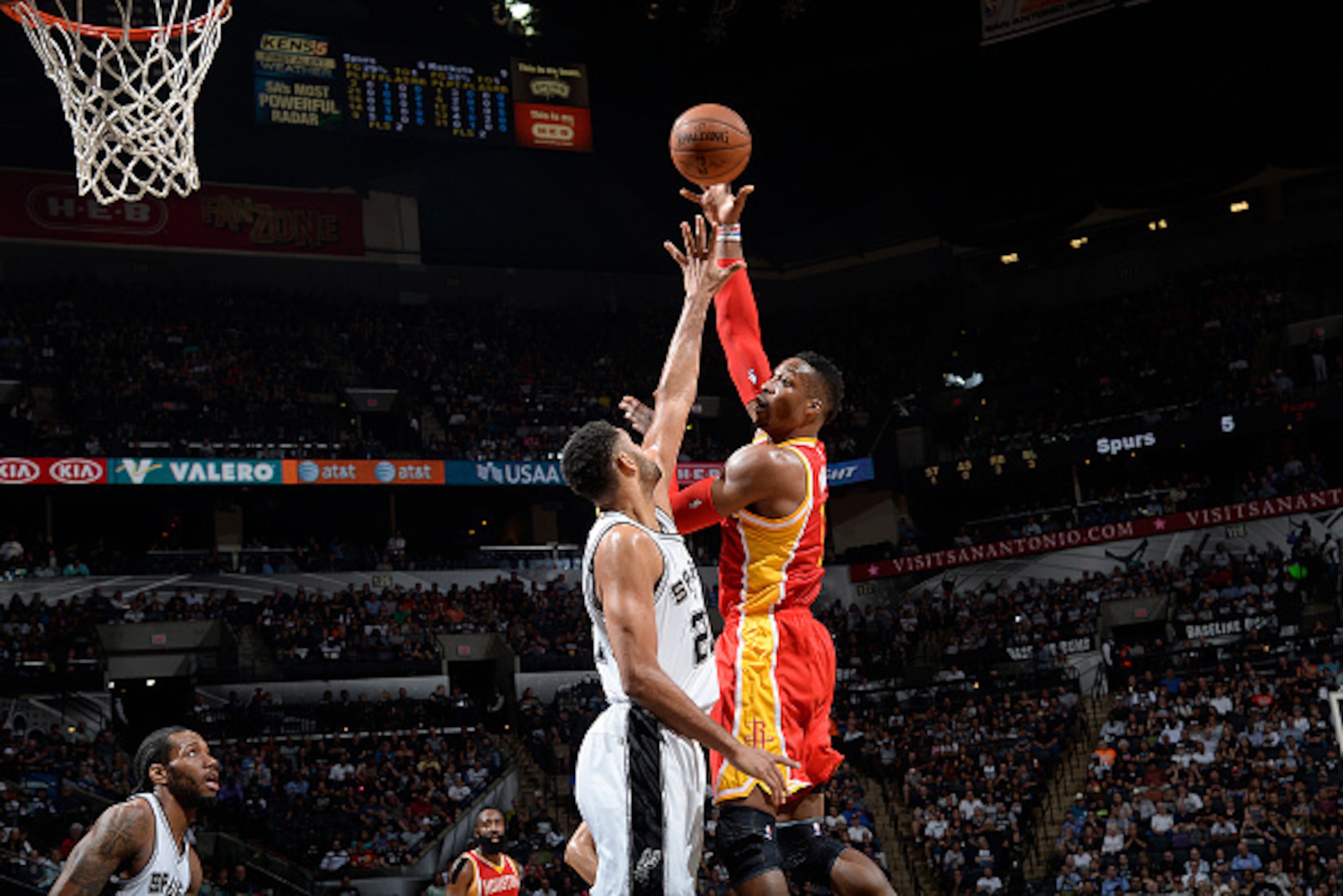
That's not how Howard makes his bread, and quite frankly, repeated post-ups only stand to make the Rockets offense even more stagnant than it already is. According to Synergy, Howard ranks in the 30th percentile as a post-up scorer, but in the 94th percentile as a roll man.
Unlike the Golden State Warriors—who have floor-spacers and shot-creators galore—the Rockets don't possess many reliable outlets if teams decide to double Harden and get aggressive with hedging schemes in the pick-and-roll.
Should Houston's combo-guard extraordinaire have easy entry paths to the bucket denied, the Rockets are going to be in serious trouble.
While the Warriors can take advantage of double-teams by finding Draymond Green for an open three at the top of the arc, Houston's ancillary options aren't as reliable. The Rockets don't have an Andre Iguodala situated in the corner, nor do they have a David Lee available for easy baseline or post-up opportunities.
The Rockets rank 20th in field-goal percentage (44.2) and 14th in three-point percentage (34.8), not to mention 27th in free-throw percentage (71.5). Those are marks indicative of a volume-centric and relatively inefficient approach compounded by a lack of supporting firepower.
That said, Harden has displayed the ability to have his cake and eat it too.
In a 115-112 win over the Oklahoma City Thunder on April 5, Harden dropped a game-high 41 points and six assists in the face of an aggressive defensive scheme.
"They were putting two on the ball and he did a nice job hitting Josh [Smith] a couple times, hit Joey [Dorsey] a couple times," Rockets coach Kevin McHale said, per the Houston Chronicle's Jonathan Feigen. "He went downhill and made the pass out. We missed a couple threes off that, but that’s the right play to make."
Harden is plenty capable of making the right play time and again, as he displayed against Oklahoma City.
However, what happens when he's forced to defer to his teammates will dictate how far Houston can progress in the grand postseason picture.
All statistics are current as of April 11 and courtesy of Basketball-Reference.com and NBA.com, unless noted otherwise.

.jpg?w=2560 "Mahomes Told Teammate to Leave Meeting")
.jpg?w=2560 "5 Teams Eyeing Jonathan Taylor")

.jpg?w=2560 "NFL investigating Eagles")
.jpg?w=2560 "Jonathan Taylor Landing Spots 📍")

