


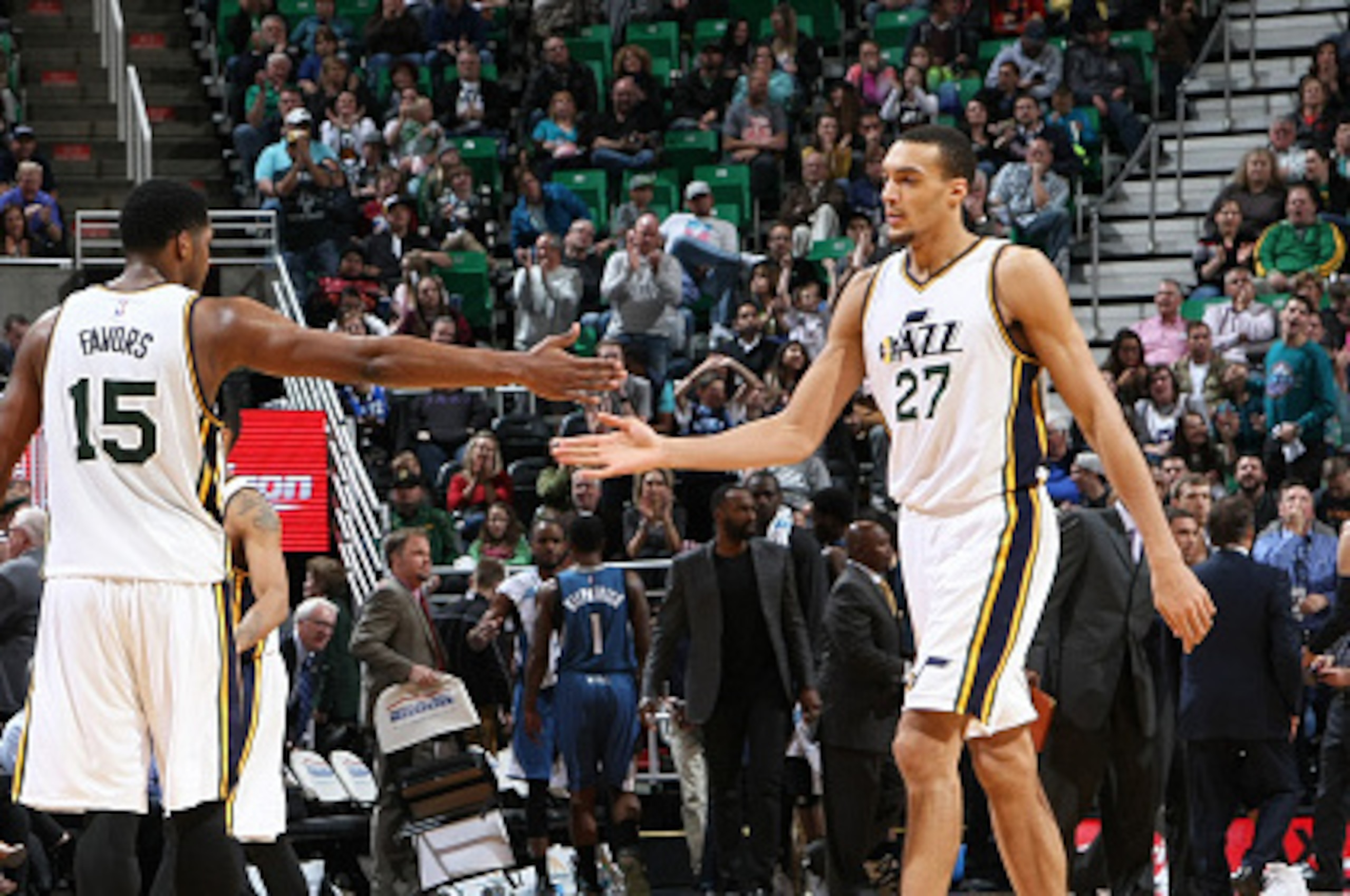
Rudy Gobert and Derrick Favors aren't your typically touted brand of defensive dynamos.
You won't find them on the covers of magazines, or playing on national television every other night, or in the NBA All-Star Game, or leading the Utah Jazz into the 2015 playoffs. They're young and, like the entire Jazz team, still developing into who they're meant to become.
And, collectively speaking, they're meant to become the league's best defensive frontcourt.
TOP NEWS

Brown with an all-time summary of relationship with Tatum

Heat, Giannis were down by 20+ in each of their 3 losses
Worst NBA Predictions 🫣
This isn't a ledge we're stepping out on or an impulsive whim we're indulging. This is a foregone fact. Gobert and Favors aren't just well on their way to becoming the most formidable frontcourt fortress alive—they're already there, trouncing their offensive limitations with impromptu greatness on the less glamorous end.
Before mincing more words on their wonder, here's a quick look at how their defensive-win-share totals stack up against those of the frontcourt pairings from the Association's other top-15 points-preventing units. The forthcoming marks were determined by combining every team's defensive-win-share leaders at power forward and center:
Fourth place is pretty darn good considering the company ahead of Utah: Golden State Warriors, Memphis Grizzlies and Atlanta Hawks—all championship contenders.
That Favors and Gobert are able to keep pace with tandems such as Andrew Bogut and Draymond Green, Marc Gasol and Zach Randolph, and Al Horford and Paul Millsap while headlining a sub-.500 Jazz squad is incredible. And their case doesn't end there.
Using those 15 dyads for reference, below are the 10 best defensive ratings from that group. Remember, in this instance, the lower number is the better score:
Certain circumstances can admittedly skew these results.
If Tiago Splitter weren't injured so much, he would likely be Tim Duncan's frontcourt partner, not Boris Diaw. That, in turn, would carry the San Antonio Spurs into the top 10 here, because the Splitter-Duncan coupling fares much better on the defensive end than a Diaw-Duncan combo.
Same goes for the Houston Rockets. If Dwight Howard and Terrence Jones didn't spend a majority of their campaigns on the sidelines, they would each have more defensive win shares, likely meaning we'd be looking at their performance together instead of Donatas Motiejunas and Howard's.
But this does not invalidate the immediate findings. It's more of an F.Y.I. These metrics are not the be-all and end-all. They are, however, a useful means to a relevant end.
With that in mind, notice which two frontcourt unions appear in the top five of both charts: Golden State's and Utah's.
There are no coincidences here. Gobert and Favors are the real deal. They manage to distinguish themselves in a way only Bogut and Green do, and those two hail from the league's best defensive team.
It's easy to dismiss such a distinction knowing the Jazz rank 12th in points allowed per 100 possessions overall. Though that's a strong standing, it hardly implies they're housing a first-rate twosome in the frontcourt.
That, of course, presupposes the Jazz are actually the league's third-best defensive unit.
Which they're not.
They're better.
Since Gobert joined the startling lineup on Feb. 20, the Jazz rank first in defensive efficiency, and it's not even close. They're allowing just 93.5 points per 100 possessions, while the next closest outfit (San Antonio) is at 98.4.
Once more, this is not an accident. Utah's defensive rise coincides with Enes Kanter's departure and Gobert's emergence because the latter is a defensive fireball.
"Gobert is the most influential interior defender right now," writes CBS Sports' Matt Moore. "He swats away everything inside. Straight-up, weakside, fadeaways, hook shots, everything."
This is not hyperbolic. Gobert is impregnable. He's sending back 7 percent of all shots he faces, the second-best mark in the league. It's also just the second time in Association history that a player, age 22 or younger, met that benchmark while logging at least 1,800 total minutes.
Opponents are shooting nearly 5 percentage points below their season averages when being guarded by Gobert. He's even more dangerous around the rim, where offenses are shooting just 39.1 percent against him—the absolute best mark among 116 players who contest at least four attempts at the iron per game.
While impressive, this isn't the most valuable thing about Gobert. More noteworthy is the profound impact he has on the entire defense. His ability to pick up dribble penetrators outside the paint, close out on shooters and rotate in to salvage blown coverage anywhere on the floor makes every player's job so much easier.
As David Locke, radio voice of the Jazz, points out, when you have a player like that, this happens:
Most would be quick to start riffing on Gordon Hayward next. He's often the Jazz's second-best defender and heralded for his ability to guard four positions.
Yet, even outside the context of power forward-center doublets, Favors doesn't receive enough credit for all he does on both ends of the floor.
Rookie Jazz shooting guard Rodney Hood puts it best, per The Salt Lake Tribune's Tony Jones:
"I think a lot of people take him for granted, but we know what he brings to the table. When he does something like block a shot, or demand the ball down low, we get on his back. All of his teammates love him. He's a great player, and he's one of the most underrated players in the league, in my opinion.
"
Favors is by no means a product of playing beside Gobert. He is tying a career high with 1.7 blocks per game, ranks second in defensive win shares for one of the NBA's premier points-deterrers and is a defensive plus overall.
Rival scorers are also shooting markedly worse when he's on their case:
Best of all, neither Favors nor Gobert is older than 23. Both have far from peaked. They're still growing, still improving, still getting scarier.
Still learning to work off one another.
These two complement each other because of the way they defend. Favors is blocking shots, but he's not necessarily a shot-blocker. He works within the Jazz's scheme, which, at this point, consists of them funneling ball-handlers into the paint.
Take this particular block by Gobert:
Trey Burke and Joe Ingles essentially guide Zach LaVine to Gobert. They don't bother cutting off his dribble penetration at the risk of leaving one of the Minnesota Timberwolves' shooters unattended.
Most importantly, you'll see Favors slide behind Gobert, ready to defend the last-second, under-the-rim pass. This allows Gobert to gamble, to prioritize blocks at the rim, without fear of giving up easy point-blank opportunities in the process.
On other occasions, Favors will journey outside to provide help defense, freeing up Gobert to police the rim.
Here's an example of this in action:
And another one:
Every power forward isn't capable of functioning under these circumstances. Favors has quick hands and quicker feet, and he, like Gobert, can step outside his comfort zone.
Having a power forward like him is a luxury. He and Gobert work together because they're able to play off one another. Neither one of them is haphazardly chasing blocks. There's a set of actions in place, one that depends on Favors reading and reacting to dribble drives so Gobert can freelance around the basket.
The only other frontcourt tandem of note that can match their reflexive versatility is the Warriors' combination of Green and Bogut. And with Bogut on the wrong side of 30 and forever sheathed in preventive bubble wrap, it's easy to see why this partnership poses no long-term threat to Gobert and Favors.
In large part because of this dynamic, defense is officially the foundation upon which the Jazz will build. It has bolstered their midseason rise, thus giving them hope there's a playoff berth in the not-too-distant future.
Even if they wanted to, the Jazz couldn't change course now. The defense is too good to discard, too perfect to tinker with.
Not that they would want to change course. That, after all, would entail them marginalizing the importance of Gobert and Favors—one of the NBA's best frontcourt duos of today, and the absolute best of tomorrow.
*Stats courtesy of Basketball-Reference and NBA.com and are accurate leading into games on April 10 unless otherwise cited.


.jpg?w=2560 "5 Teams Eyeing Jonathan Taylor")
.jpg?w=2560 "Mahomes Told Teammate to Leave Meeting")



.jpg?w=2560 "NFL investigating Eagles")
.jpg?w=2560 "Jonathan Taylor Landing Spots 📍")