

Isaiah Canaan Writing Blueprint for Philadelphia 76ers' Point Guard Role
When you prioritize the long-term over present results, you end up encouraging concepts instead of outcomes.
Such is the Philadelphia 76ers' philosophy, one which netted them their new point guard, Isaiah Canaan.
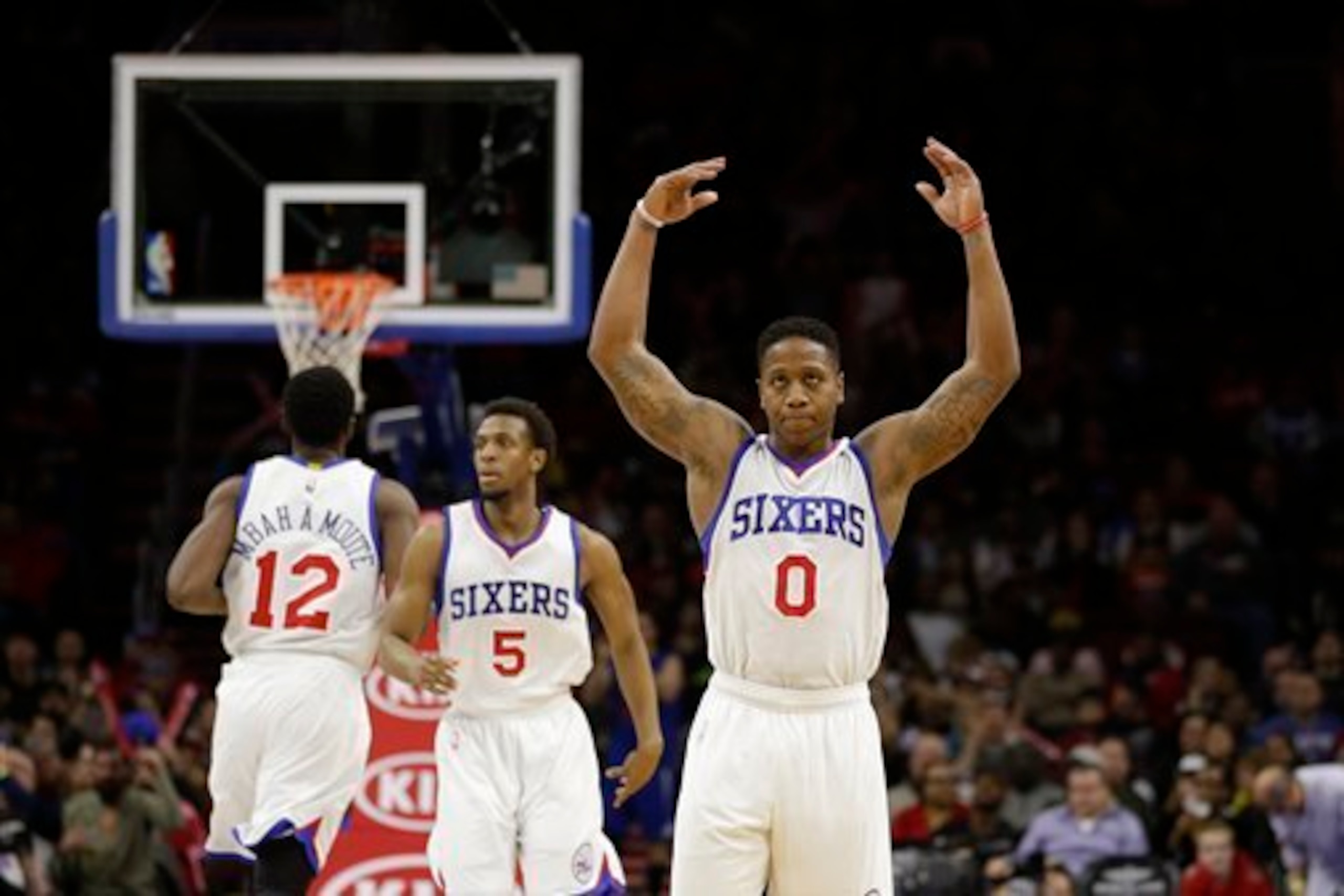
When the 76ers shipped off one of the NBA's most exciting and promising rookies, K.J. McDaniels, to the Houston Rockets for a second-round pick and Isaiah Canaan right before mid-February's trade deadline, basketball fans looked the tanking Sixers' way and raised their collective eyebrow.
TOP NEWS
Jokic says booing fans not welcome in Denver
Worst NBA Predictions 🫣

Power Ranking Every NBA Team's Starting Lineup 🔢
You have a promising, young player, and you still ditch him? When do all these second-round picks actually turn into value in the present? You can't sell the future forever.
Philly wasn't done dealing either. It swung reigning Rookie of the Year Michael Carter-Williams in a trade that would bring it the Los Angeles Lakers' protected 2015 first-round pick too, turning Canaan into the starting 1-guard.
There were those who were high on Canaan—people who were swayed by his impressive 2014 Las Vegas Summer League performance, or who loved him as a gunner coming out of Murray State or who saw his epic performance against Austin Peay as a junior (35 points on 15 shots) and were completely sold. Even many of them didn't even love the deal.
The criticisms were legitimate too. But what we're learning now is that when 76ers general manager Sam Hinkie made a swap with his former Houston boss, Daryl Morey, he was bringing in a concept more than a player.
The Sixers run an offense that mirrors the Rockets' attack. Who could've ever guessed the 76ers, an organization that fancies itself as one of the most analytics-driven teams, also run by a former Houston exec, would scheme a similar scoring onslaught?
"Onslaught" may be the wrong word choice actually. The Sixers offense is far tamer than the implication of that noun. Philly averages just 92.2 points per 100 possessions, redefining what inefficient offense looks like in the NBA.
That offensive rating is 5.5 points per 100 worse than that of the New York Knicks, who rank 29th, a difference larger than the one between the No. 1-ranked Golden State Warriors and the No. 12-ranked Oklahoma City Thunder.
It's the worst efficiency an offense has seen since the 2002-03 Denver Nuggets. But the Sixers are failing to score because of a lack of shooting and offensive talent, not necessarily because of scheme.
In Philadelphia, it's not about the amount of scoring; it's about the way shots are happening. Because Philly is so analytics-inclined, it still ends up taking loads of threes and shots at the rim.

Where do the Sixers rank in three-point rate? Sixth.
How about in restricted-area shots per game? Third.
And do they attempt mid-range jumpers, the least efficient shots in basketball? Almost never, ranking 28th in attempts from that area. The only teams that trail them: the Detroit Pistons and, of course, Morey's Rockets.
It's somewhat of a testament to Brett Brown's coaching abilities that Philadelphia can continue to lose games with players who are clearly trying to find a home in the league for the long term—most current 76ers won't be on this team two years from now; others may not even be in the NBA anymore—and yet, the Philly coach can continue to get guys to play within a system.
It would be simple for any fringe player to say, "I'm a talented playmaker. I'm going to start chucking up from wherever I want. Maybe I'll annoy some people around here, but whatever. I'll throw up big counting numbers and get a bigger-than-deserved contract next season."
Guys haven't done that, though.
"I don't care much if they're happy," Brown said about his young players. "I care a lot if we're developing them and we're moving the program forward. They have a privilege to play in the NBA, and they have an opportunity that you just don't make up. They have the best job interview they'll ever have in their life: NBA minutes."
So, what does all this have to do with Canaan? He's actually impressing during his interview.
He hasn't been just another cog in the 76ers' revolving roster. He's been the perfect one.
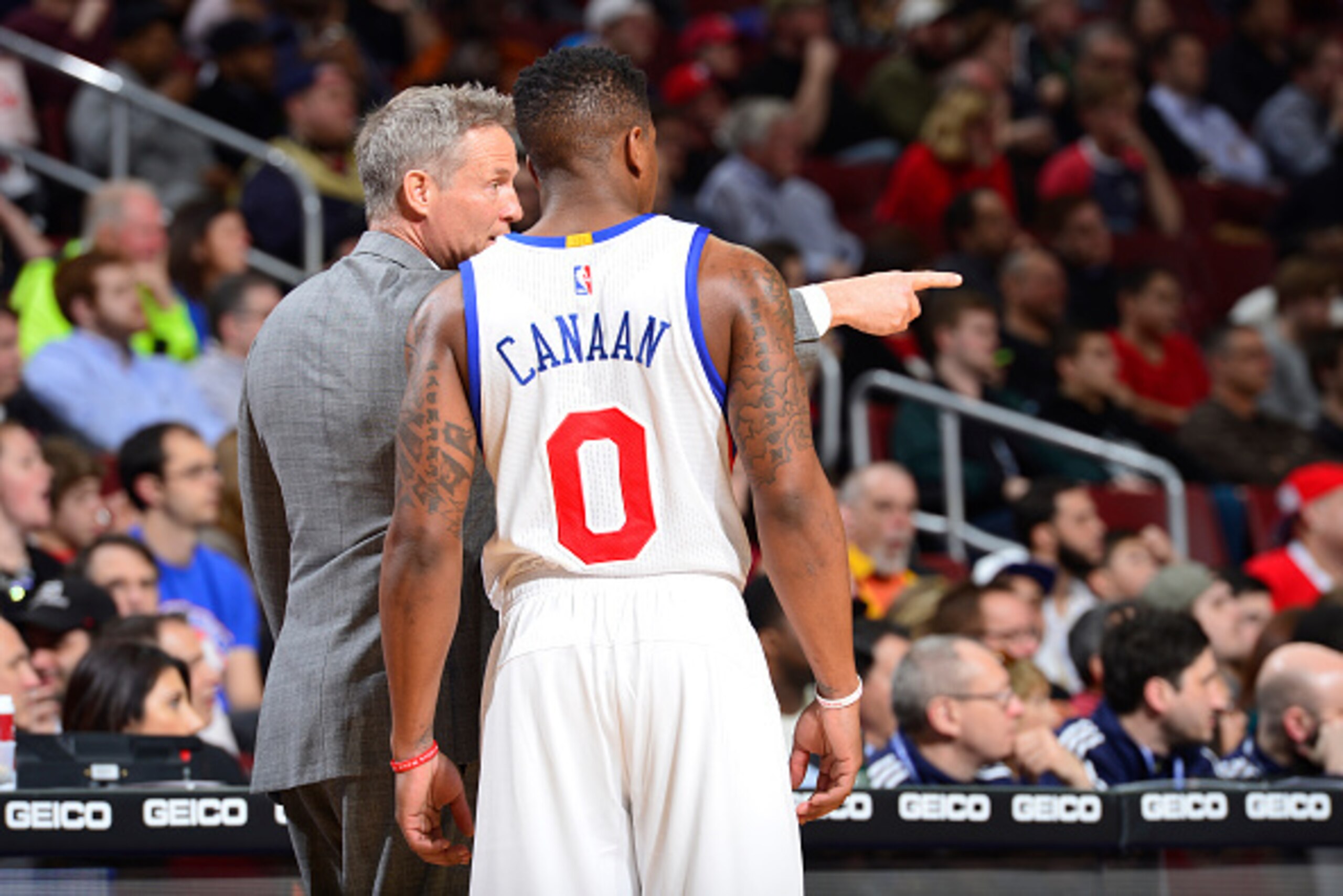
Philadelphia's new point guard won't stop shooting threes since coming over to the City of Brotherly Love. In 15 games with the 76ers, he's shooting 7.7 times a night from beyond the arc, actually hitting on 37 percent of those attempts. Nearly two-third of his shots are coming from three, and Philly has got to be loving it.
Everything he's doing screams Moreyball. A ridiculous 84 percent of his shots with Philly have come either from the restricted area or three-point range.
It's far different from what we saw with Carter-Williams, a talented player in some ways but not one who fits with the 76ers' organizational mentality.
Carter-Williams is capable of making plays Canaan can't. His 6'5" height will allow him to fling cross-court passes other point guards aren't physically capable of making. He's a stronger rebounder with a higher defensive ceiling, part of the reason the Milwaukee Bucks likely valued him. (Milwaukee's roster of long, athletic defenders allows Jason Kidd's squad to switch everything late in games without as much risk of running into mismatches.)
The problem, though, is MCW can't shoot. In today's game, a ball-dominant point guard who doesn't make shots away from the rim puts a cap on an offense. That was a major part of what was happening in Philly.
Carter-Williams was touching the ball more times per game than any other player in the NBA while with the 76ers. He paired that with 26 percent three-point shooting. Those are dangerous and offense-hindering complementary traits.
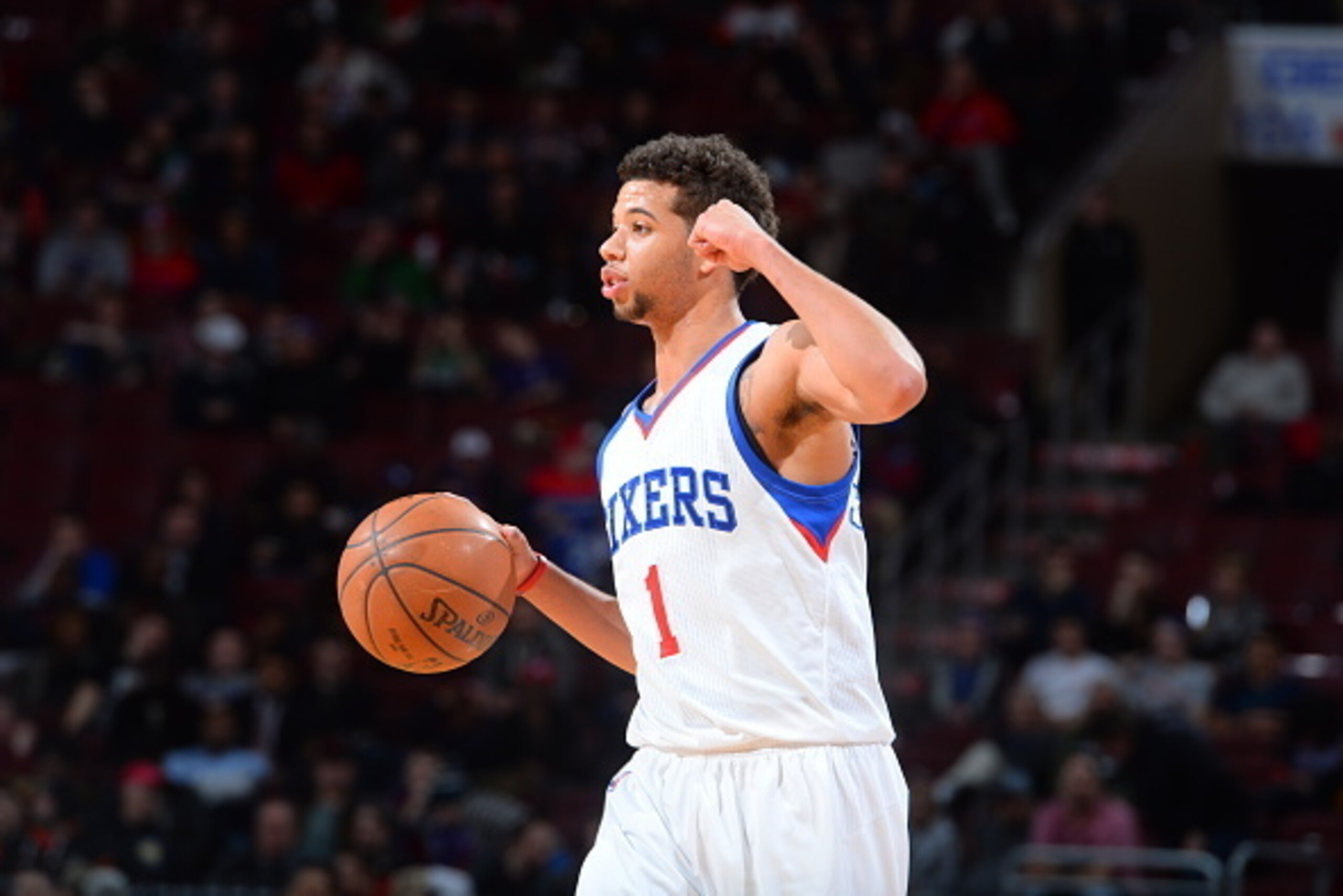
Since Canaan played his first game in Philadelphia on Feb. 22, the 76ers attack has hardly hit dominant levels, but it is averaging a notable three more points per 100 possessions.
Canaan, like MCW, can be a ball-dominant guy, someone who's perfectly willing and able to vomit occasional ill-advised shots with a hand in his face too. He'll heat check before he even gets warm. At times, he can be basketball gazpacho. He looks and feels like he should be hot, but he's perfectly tepid.
Right now, though, that doesn't matter.
The Sixers may not be trying to win games. Heck, they may not even be attempting to develop a full-on identity at the moment, though the tremendous recent play of Nerlens Noel, driving them to the top half of the league in defense, has helped. What they are trying to do, though, is find players who fit a mold.
Canaan might not be the point guard of the future in Philadelphia, but Hinkie is a suitor with a type. Even if Philly ends up capitalizing on Canaan's high value next season, trades him for a second-round pick along with The Next Isaiah Canaan, only continuing its perpetual game of "Musical Chairs: Roster Edition," it'll have some sort of consistency moving forward.
We always hear about roster continuity in the NBA. It's why the San Antonio Spurs and Memphis Grizzlies and Atlanta Hawks have such beautiful chemistry. The core players have been together long enough that they know each other's tendencies. But there can also be stylistic continuity.
Finding guys who fit into a system similarly can make transitions more seamless. The Sixers don't need Isaiah Canaan. They just need the idea of him.
Follow Fred Katz on Twitter at @FredKatz.
All quotes obtained firsthand. Unless otherwise noted, all statistics are current as of March 22 and are courtesy of Basketball-Reference.com and NBA.com.

.jpg?w=2560 "Mahomes Told Teammate to Leave Meeting")
.jpg?w=2560 "🚨 Week 8 AP Top 25 Poll")

.jpg?w=2560 "Baker Gets Glove From Rays 🧤")
.jpg?w=2560 "Steelers Roll Saints in Paris")
.jpg?w=2560 "NFL investigating Eagles")
.jpg?w=2560 "5 Teams Eyeing Jonathan Taylor")
.jpg?w=2560 "Updates from EVERY Game")