Predicting Houston Texans' Starting Lineup After the 1st Wave of Free Agency
Now that the flood of free-agent signings has slowed to a trickle, an educated guess can be made on who will be in the starting lineup for your favorite NFL team.
If that team is the Houston Texans, there is still a fair amount of guesswork going on. Uncertainty on both sides of the ball involves multiple positions, quarterback being the most vexing one.
Head coach Bill O’Brien started banging the drum for Ryan Mallett back in February. As quoted at the combine by Tania Ganguli of ESPN.com, O’Brien made it clear that re-signing Mallett would be key to more offensive production.
"I think if you look at our offense, I think it's important for us to bolster the quarterback position. To me, one of the ways to do that is to get Ryan Mallett back here."
This organization parted ways with Chris Myers and Andre Johnson, and their replacements are untested in their new roles. The New England Patriots and Pittsburgh Steelers have made accommodating this kind of turnover look easy.
When the armchair general manager asked why his team could not pull it off, the standard response was, “If it was that easy, everybody would be able to do it.”
The Denver Broncos were forced to switch Manny Ramirez from center to right guard in the ninth game of last season. Peyton Manning was not sacked any more than usual, and the running game actually improved after the move. It is, therefore, possible for Ben Jones to shift from left guard to center without the Texans offensive line falling apart. Or so it is hoped.
There are no expectations for DeAndre Hopkins or Cecil Shorts to be the perfect facsimile of Andre Johnson. The Texans' game plan must undergo some alterations to account for the loss of the most productive possession receiver in the NFL over the last decade. The crossing patterns and curls in the flat are not going away, they will just be spread around to more receivers.
The defense has some glaring holes at linebacker. Who will fill them is as much a mystery as why Brian Hoyer was deemed a more capable backup than Ryan Fitzpatrick. These and other questions will be covered in the coming slideshow.
Quarterback
1 of 9
Ryan Mallett
General manager Rick Smith engineered the trade which brought Matt Schaub to the Houston Texans in 2007. It cost two second-round choices (2007, 2008) and a swap of their first-round pick in the eighth position for the 10th pick in the same round of the draft.
The acquisition of Mallett was a much simpler and less costly transaction. He is the only other quarterback Smith has procured via trade, all for the price of a conditional seventh-round pick.
Mallett started a scant two games before going on injured reserve with a torn pectoral muscle. He was lost for the rest of the season, but there was little doubt the Texans wanted the soon-to-be free agent back.
Rivers McCown, NFL analyst for Bleacher Report who covers the AFC South, recommended re-signing Mallett. He subsequently saw no reason to keep Ryan Fitzpatrick.
"True, the Texans would lose some form of security blanket by dealing Fitzpatrick. But that's the whole point of my plan: To realize some untapped value at the quarterback position, you have to get rid of the known quantities. And despite Fitzpatrick's—I'll go with "functional"—play at quarterback last season, he is very much a known mediocrity at this point in his career.
"
It is understandable to saddle Fitzpatrick with that label based on his career. Comparatively speaking, doesn’t the same term describe Brian Hoyer at this stage of his development? He has as many touchdown passes as interceptions (19), a 56.5 percent completion rate and 76.8 passer rating.
Deciding between Mallett and Hoyer is something of a Hobson’s choice, defined as “an apparently free choice when there is no real alternative.”
The team-wide ineptitude of the Cleveland Browns is the reason they lost six of their last seven in 2014. How much of the collapse was Hoyer’s doing is open to debate. The quarterback will receive the lion’s share of the criticism no matter what level of mismanagement was the responsibility of ownership and the coaching staff.
What is known about Hoyer is far more discouraging than what is unknown about Mallett. McCown was describing the same situation when he advised trading Fitzpatrick. No one would have expected Hoyer to be the man to replace the starter in the 2014 opener.
Bill O’Brien wants to convince the fanbase that both quarterbacks are on equal footing when it comes to earning the starter’s spot.
"We have a strong belief that we have two quarterbacks that really understand our system, have great leadership ability, can throw the ball, that are tough and coachable, and are good teammates. And they're going to compete. That's going to help our team.
"
Before Hoyer appeared on the scene, the public expectation was that Mallett could lose the job only if he fell flat on his face in the preseason. How much the presence of Hoyer changes that expectation is uncertain at this early stage.
Mallett could fail to deliver on the promise which led to his re-signing. If so, the distance between where the Texans are and where they want to be grows that much longer.
Running Backs
2 of 9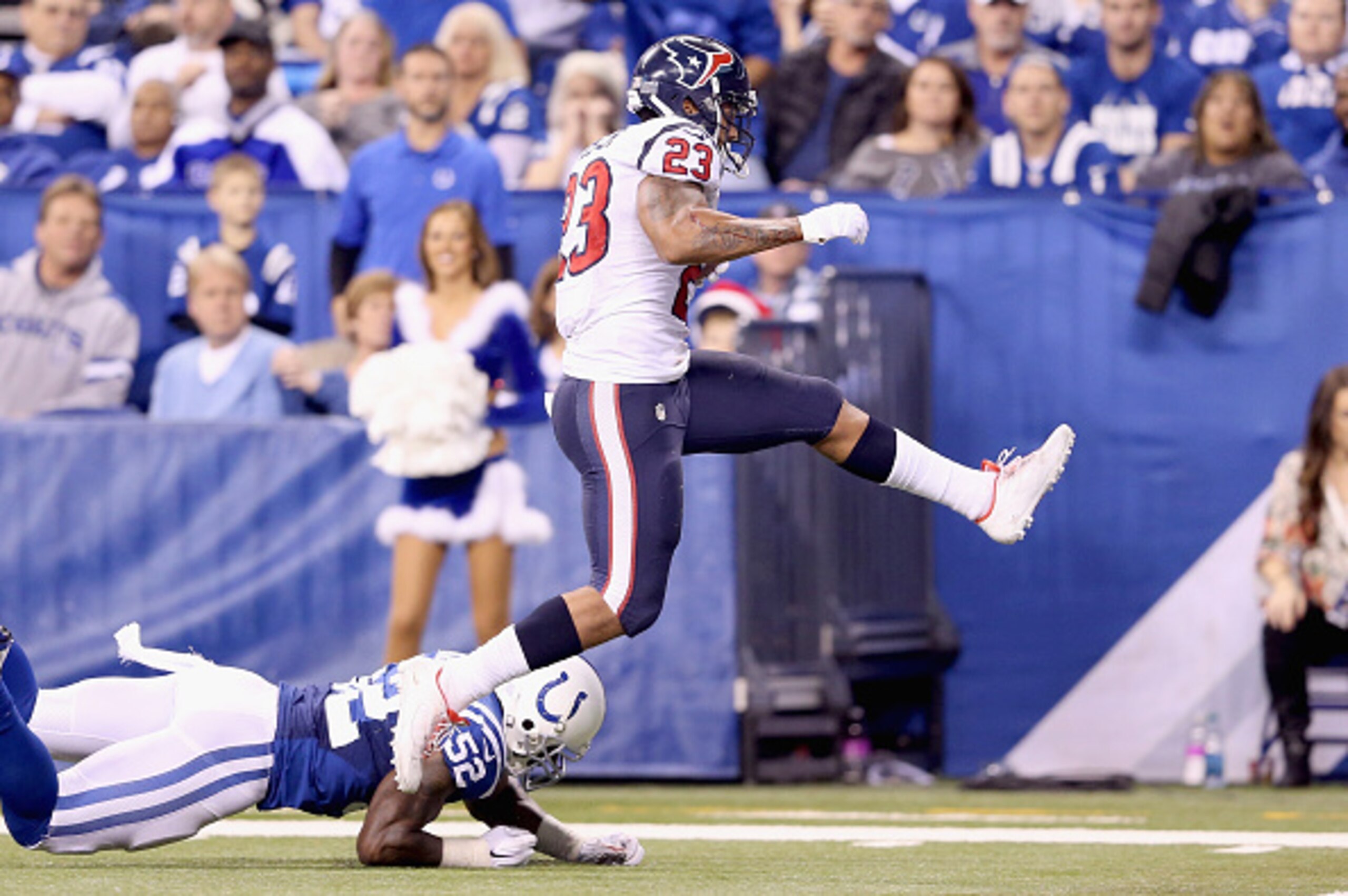
Halfback – Arian Foster
The relative strength of an NFL offense is usually based on the capabilities of its starting quarterback. When his capabilities are difficult to evaluate, as in the case of Ryan Mallett, another position becomes the basis of the calculation.
Foster is a running back who sets the tone for the rest of the Texans offense. He gained 1,042 yards on first and second down with 226 of his 260 carries. The 1,573 yards he gained from scrimmage ranked him fifth among the league’s running backs, even though three games were lost to injury.
This was after missing half the 2013 schedule with a back problem. The microscopic lumbar discectomy to fix his back “wasn't as major as it sounded." Foster compiled 298 touches in 2014, a more reasonable count than the 391 recorded in 2012.
Alfred Blue took the bulk of the remaining carries, although he averaged just 3.1 yards on his 169 attempts. Blue has comparable size to Foster, but his 228 pounds are not nearly as elusive as those of the four-time Pro Bowler.
With six NFL seasons to his credit, Foster has almost twice the shelf-life of 3.11 years for the average NFL halfback. His expiration sticker cannot have much time remaining. Melvin Gordon, Jay Ajayi or David Johnson are strong draft prospects who could end up in a Texans uniform.
Fullback – Jay Prosch
Every NFL roster has a fullback on it. They can be as little-used as David Johnson of the San Diego Chargers, whose 32 snaps last season ranked him 32nd in usage according to Pro football Focus (PFF).
Prosch had a mere 172 snaps in 2014, except his presence on the field seemed to have some meaning. He was in for only 46 snaps in the seven Texans losses. This could have occurred due to down-and-distance circumstances as opposed to some brilliant design.
So many offensive formations use their tight ends as H-backs, the position has become an afterthought. It is probably heading for extinction because the 43 fullbacks listed by PFF collectively gained 495 yards.
Throwing the occasional wham block and working on special teams counts for something. It may not be enough to keep the position that sent Marion Motley, Jim Brown and Larry Csonka to the Hall of Fame relevant in the future.
Receivers
3 of 9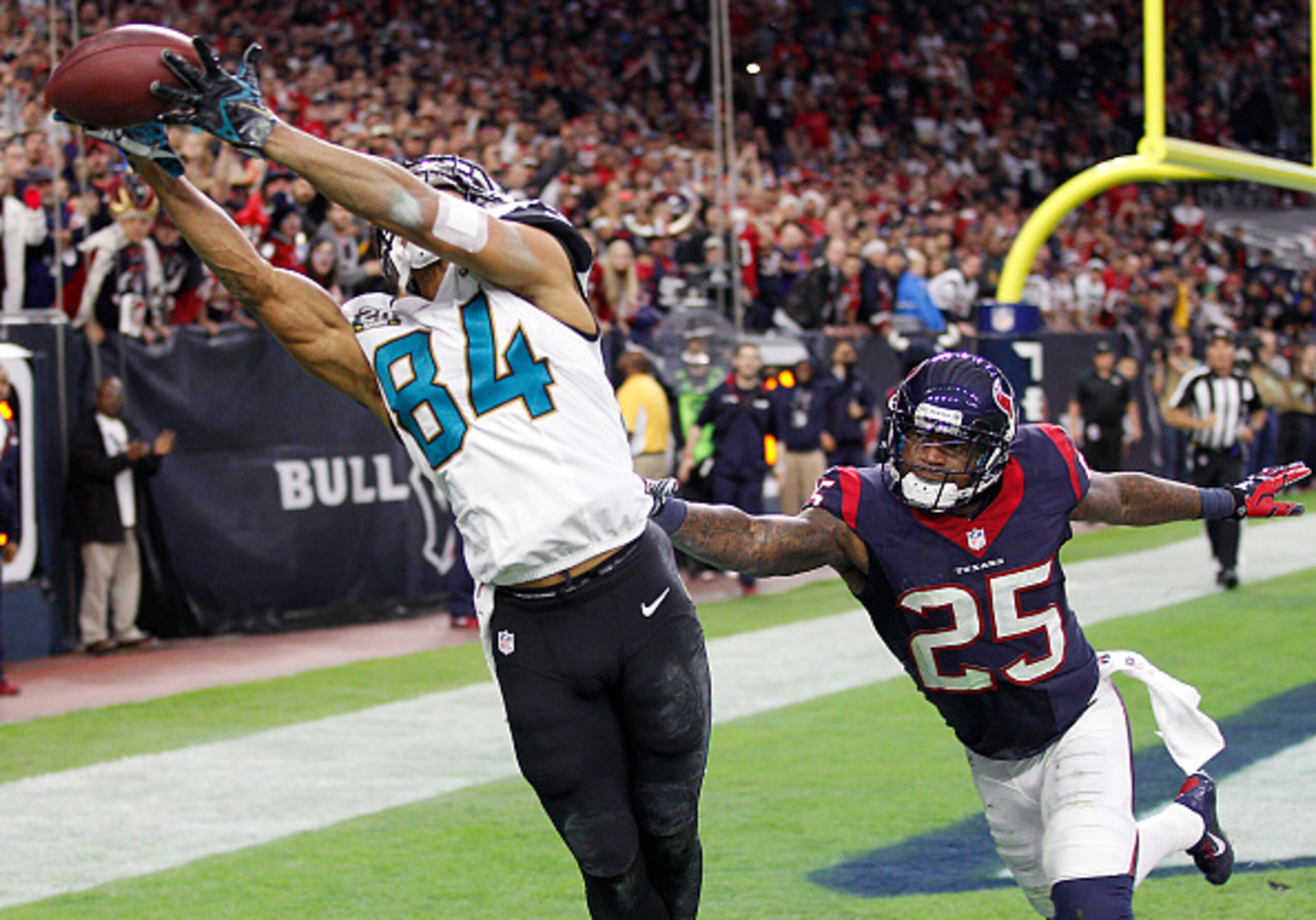
“X” Receiver – DeAndre Hopkins
It wasn’t supposed to happen this way.
The passing of the torch from Andre Johnson to Hopkins would occur upon Johnson’s retirement. The “gold watch” ceremony would take place after the final home game of the 2017 regular season. It would be highlighted by the man of few words promising great things in the playoffs from the top seed in the AFC.
Johnson’s departure from the Texans instead followed the same script most great players are forced to endure. Like Jerry Rice and his exit from the San Francisco 49ers, it came down to cap restraints.
The shift from Johnson to Hopkins was not evident on the field in 2014. The old pro had 146 targets to 127 for the youngster. It was the first season since 2005 Johnson averaged fewer than 10 targets per game in which he played 13 or more games.
As the offense enters a new phase in 2015, it might be better served by not devoting so much attention to a single receiver. An augmentation of Hopkins’ 2014 statistics to 80-plus receptions and double-digit touchdowns should not require it. Those numbers would be ample evidence of his ascension to the No. 1 receiver.
Slot Receiver – Damaris Johnson
This Johnson receiver was re-signed for $1 million, a sum commensurate with his 31 receptions and single touchdown. He is considered the slot receiver largely because of his size (5’8”, 175 pounds).
Hopkins had more receptions (26) in the slot in 2014 than D. Johnson (23) as measured by Pro Football Focus’ (PFF) slot performance. Comparing one Texan to another does not tell us much about the importance of the slot position.
Seven of the top 10 scoring offenses in 2014 had at least 70 receptions come from receivers who set up in the slot. The Philadelphia Eagles led the pack with 105, and 64 went to Jordan Matthews. Aaron Rodgers hit Randall Cobb 75 times out of the total of 97 targets from the slot for the Green Bay Packers.
It is more important to note all seven of those offenses spread out their targets among six to eight receivers. One or two players typically received most of the attention, but plenty of them got in on the action.
The point is the slot position may be a dedicated to one or two players in a handful of playbooks, but in most cases, a half-dozen or more are involved. The New England Patriots had seven, led by Julian Edelman with 38 receptions. The Seattle Seahawks spread their 89 catches around to eight players, and Doug Baldwin topped the pack with 41.
Damaris Johnson may have a slightly more productive year in 2015, maybe topping 40 catches and scoring two or three times. In the end, the offense would be better served if the targets are spread around to every wide receiver on the roster.
"Z” Receiver – Cecil Shorts
Shorts could be one of the beneficiaries of this share-the-wealth philosophy. He demonstrated his capabilities in his sophomore NFL campaign, catching 55 passes for 979 yards and seven scores. Even with Chad Henne and Blaine Gabbert at quarterback, his 17.8 yards per reception tied for second in the league.
Being unable to stay on the field has plagued him throughout his four years in the league. The injury history of his first three seasons as recounted by Tania Ganguli of ESPN.com reads like a cautionary tale.
"He has missed 14 games in his career because of a concussion and groin and hamstring injuries. He ended the 2012 and 2013 seasons on injured reserve and he missed three of the Jaguars’ first five games this season because of a hamstring injury. That capped a stretch in which he missed eight of a possible 24 games because of injuries. He missed six games as a rookie with hamstring injuries.
"
Shorts continued this brittle pattern in 2014, missing three games early in the year due to hamstring issues.
The top free-agent receivers were signed by the time Shorts decided to join the Texans on March 16. He was among the best remaining, though Stevie Johnson was still available and eventually went with the San Diego Chargers. Short's hamstrings seem to be the main obstacle keeping him from being a more consistent contributor.
Tight End – C.J. Fiedorowicz
This unit was nearly invisible in 2014, providing neither effective blocking nor timely red-zone receiving. How does one select which player to start when none did the job last year? J.J. Watt with his three touchdowns makes for a tempting choice, but he is too busy busting up offenses for full-time consideration.
When the offense trots out for its first series of the new season, Fiedorowicz is the best guess for who will be manning the strong side of the formation. Bill O’Brien will be out to prove the second-year player out of Iowa is not another in a long line of squandered third-round picks for this organization.
Arian Foster looks to be the centerpiece of the offensive game plan once again, and the former Hawkeye was drafted based on his credentials at dominating the point of attack. If PFF’s grading system is to be believed, Fiedorowicz was rated an even worse run-blocker (-11.2) than Garrett Graham (-6.2).
You can choose not to place your faith in the subjective judgments of those metrics. Anyone who noticed the rookie was only targeted seven times in 15 games knows he has much to prove in 2015.
.jpg?w=2560 "Chiefs Giants Football")
.jpg?w=2560 "Steelers Buccaneers Football")
.jpg?w=2560 "Titans Colts Football")
Offensive Line
4 of 9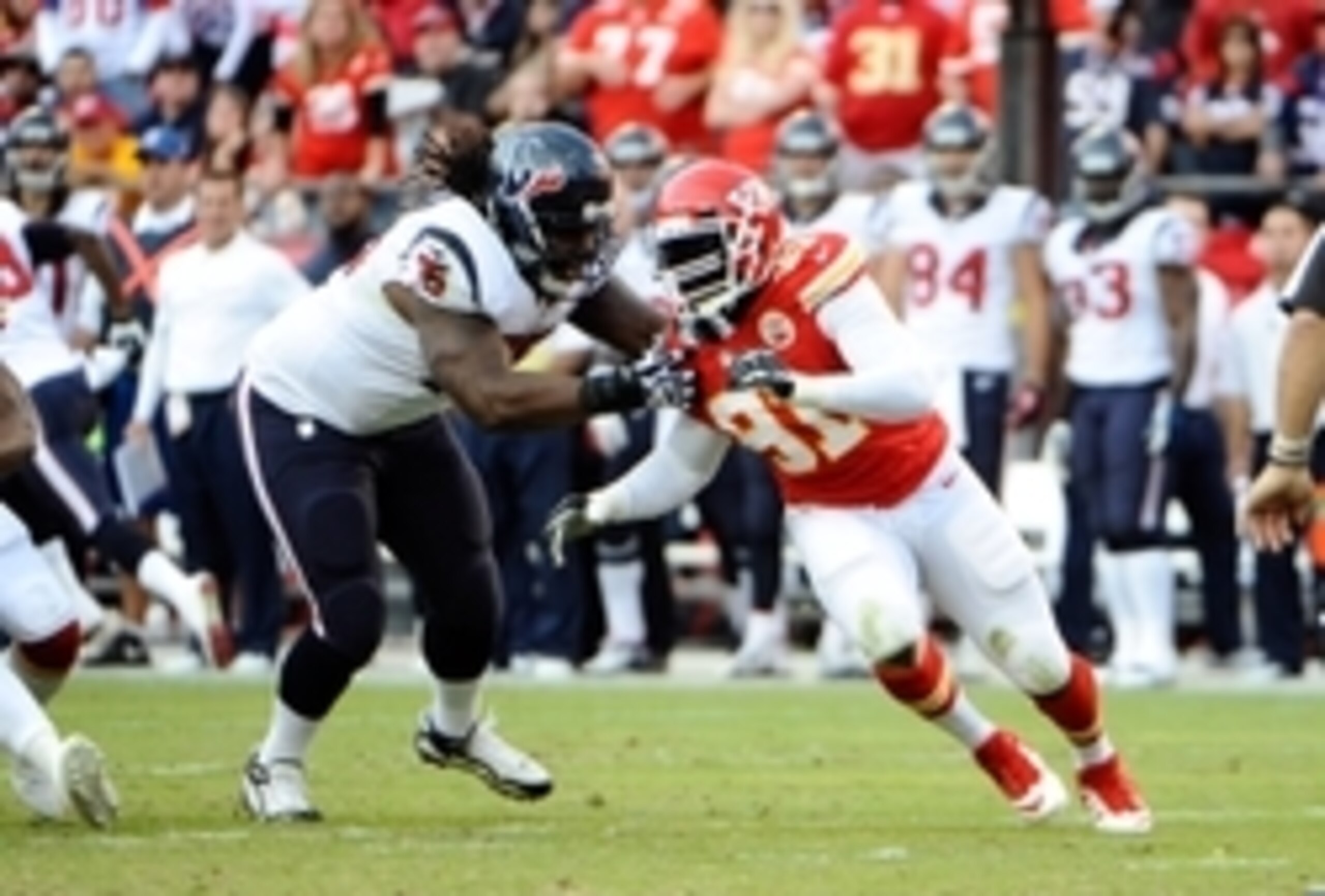
Left Tackle – Duane Brown
Another Pro Bowl appearance in 2014 certainly enhanced the resume of the Texans' best offensive lineman. It was not an indication he had reached same level of proficiency he enjoyed in his All-Pro season of 2012.
Brown is still one of the top-10 left tackles in the NFL, allowing two sacks in 16 games. His run-blocking has slipped in the last two seasons, taking him from a killer on the edge to simply an above-average sealer of the running lane.
Someday he will not be clearing a path for a dead-leg artist like Arian Foster, who makes cuts like a runner weighing 200 pounds rather than 230. Then Brown will need to be knocking defenders down instead of getting in their way. Guess he’ll have to get old before he gets mean again.
Left Guard – Xavier Su’a-Filo
Some fuss was made over Su’a-Filo missing OTAs due to UCLA being on a quarter system. The timing decreased his practice time and was the explanation for why he failed to impress early on.
He started to catch up near the end of the season, and he caught the notice of The State of the Texans website after the Tennessee Titans game in Week 13. Check out some of P.D. Starr’s Vines for the game footage.
Selecting an offensive guard just one pick outside of the first round does not come off as the best use of such a valuable asset. In hindsight, Jordan Matthews, Jeremy Hill or even Jimmy Garoppolo would have been bigger crowd-pleasers.
Now it can all be appreciated as one move in service of a larger plan. Su’a-Filo would replace Ben Jones at left guard, who would then take over for Chris Myers at center.
To recap, a relative newcomer to the NFL will become the starter at left guard. A total newcomer to center at the professional level will start at a position he has not played since 2011.
Center – Ben Jones
That brings us to Mr. Jones, a daring soul who will dine on insects for a laugh and a minimum of $20.
He may find swallowing insects an easier prospect than replacing the reigning expert at playing center in a zone-blocking scheme. Myers made it to two Pro Bowls while weighing in at 286 pounds, getting it done with stellar footwork and technique.
Jones was a serviceable guard, playing both sides of the line as needed. He was an All-SEC center in 2011, though it was on the second team as chosen by The Associated Press. The trick now is to meld the tricks he learned at one position at a different spot on the O-line.
Every lineman has to be ready to move in unison with his teammates on running plays. The center has to do it a split-second after hiking the ball. This is true in any scheme, but in the zone you have to step left, right, forward or back, depending on the call.
That bucket-step backward is rarely called for when power blocking, but is a staple when playing zone. To get the ball safely in the quarterback’s hands, go vertical and then move your body in reverse is trickier than it sounds.
Let us assume Jones has been playing some center on the scout team, in case Myers went down. Let us hope it was enough exposure to prepare him for succeeding the master with little disruption in efficiency.
Right Guard – Brandon Brooks
The rising star of this group is one of the biggest guards in the business. Whether the Houston Texans website (335 pounds) or Pro Football Reference (349 pounds) is correct, Brooks is definitely the most massive Texan on his side of the ball.
The best part is his play speaks as loudly as he is large. His pass-blocking has improved, not allowing a single sack in 1,005 snaps over 15 games in 2014. When leading a running back, he is as unstoppable as a 4 a.m. Black Friday shopper.
More rushing yards were gained through his inside gap than any other spot on the line. According to the Cumulative Rushing Report from Pro Football Focus (PFF), 505 yards for a 5.2 average were accumulated over his left flank.
There is no doubt Brooks will be a fixture on this line for years to come. He is the lone third-round choice to break the string of heartbreakers drafted by Rick Smith since 2012.
Right Tackle – Derek Newton
Kareem Jackson and Newton were the two major free agents retained by the Texans this offseason. Jackson had gradually earned the respect of the fans after the rockiest of starts.
Newton had a rougher go of it, and for good reason. His lackluster showing in 2012 was the result of a torn patellar tendon. The effects of surgery after the season’s end lingered into 2013, when his performance was as big a disaster as the 2-14 team itself. He was ranked by PFF as the second-worst right tackle who played the entire season.
His knee was better in 2014, and it showed throughout the turnaround year. He can block down on edge defenders but still has a tendency to fold on pass plays.
The image above illustrates the difficulty he has keeping his shoulders and hips lined up with his feet when locked on to a pass-rusher. Once that aspect of his technique catches up with the rest of his development, his $26.5 million contract will be in line with his pay.
Defensive Line
5 of 9
Left Defensive End – J.J. Watt
How popular is Watt here in Houston?
If Beyonce would agree to be his queen, they could create their own little monarchy here in the Bayou City.
How talented is the two-time Defensive Player of the Year?
He is ready to surpass Lawrence Taylor as the most dominant defensive player in league history.
That should be enough for one man. Then Bill O’Brien had to add part-time tight end to his job description. It was fun while it lasted, but keep him on the other side of the line of scrimmage in the future.
More touchdowns are not going to win him the MVP. A third 20-sack tally would contribute more to that goal. It would also cement his standing as the most disruptive force professional football has ever seen.
Forget Beyonce! That alone should be enough to make him king of all he surveys.
Nose Tackle – Vince Wilfork
Rick Smith should be glad “It’s not what you know but who you know” works as well as it does. He can thank Wilfork’s familiarity with ex-Patriots O’Brien and Romeo Crennel for helping land this whale.
What other explanation can there be for the 33-year-old winner of two Super Bowl rings signing with Houston? He has a year or two left before football is in his rearview mirror. To spend it with a team that has no established quarterback, and uncertain postseason possibilities, is bizarre.
Is Crennel expecting the ex-nose tackle to return to his former position? Wilfork dropped weight to take some stress off the Achilles tendon that was torn in 2013. He played defensive end almost exclusively last season, presumably to cut down on the double-teams and subsequent battering which comes with playing in the middle of the D-line.
John Breech of CBSSports.com is certain Wilfork will be starting while Louis Nix works his way back from knee surgery. Nix will also “attempt to learn everything Wilfork knows.” Texans defensive end Geoffrey Pagan may also have a thing or two to learn from a 3-technique player with two Super Bowl rings.
The entire Texans Nation was worried last season that Crennel would force J.J. Watt to play in a two-gap scheme that would cut down on his sack potential. Watt then turned in the best year of his brief yet spectacular career. If any coach can seamlessly work Wilfork into his system, it is the coach known to his players as “Rac.”
Right Defensive End – Jared Crick
Crick filled his role with as much grit as he could muster. His job was to anchor the right side of the defensive line, concentrate on stopping the run and at least keep the left offensive tackle busy when the opposition went airborne.
The specs of his position were generally fulfilled, even if the left tackle was not seriously challenged on many occasions. Crick did manage four sacks among his 27 quarterback pressures, leaving most of the fun for Watt.
Pagan has a shot at taking Crick’s place, where his 6’3”, 310-pound frame is better suited to what Crennel is seeking: a two-gap run-stuffer who can get more push into the pocket.
Linebackers
6 of 9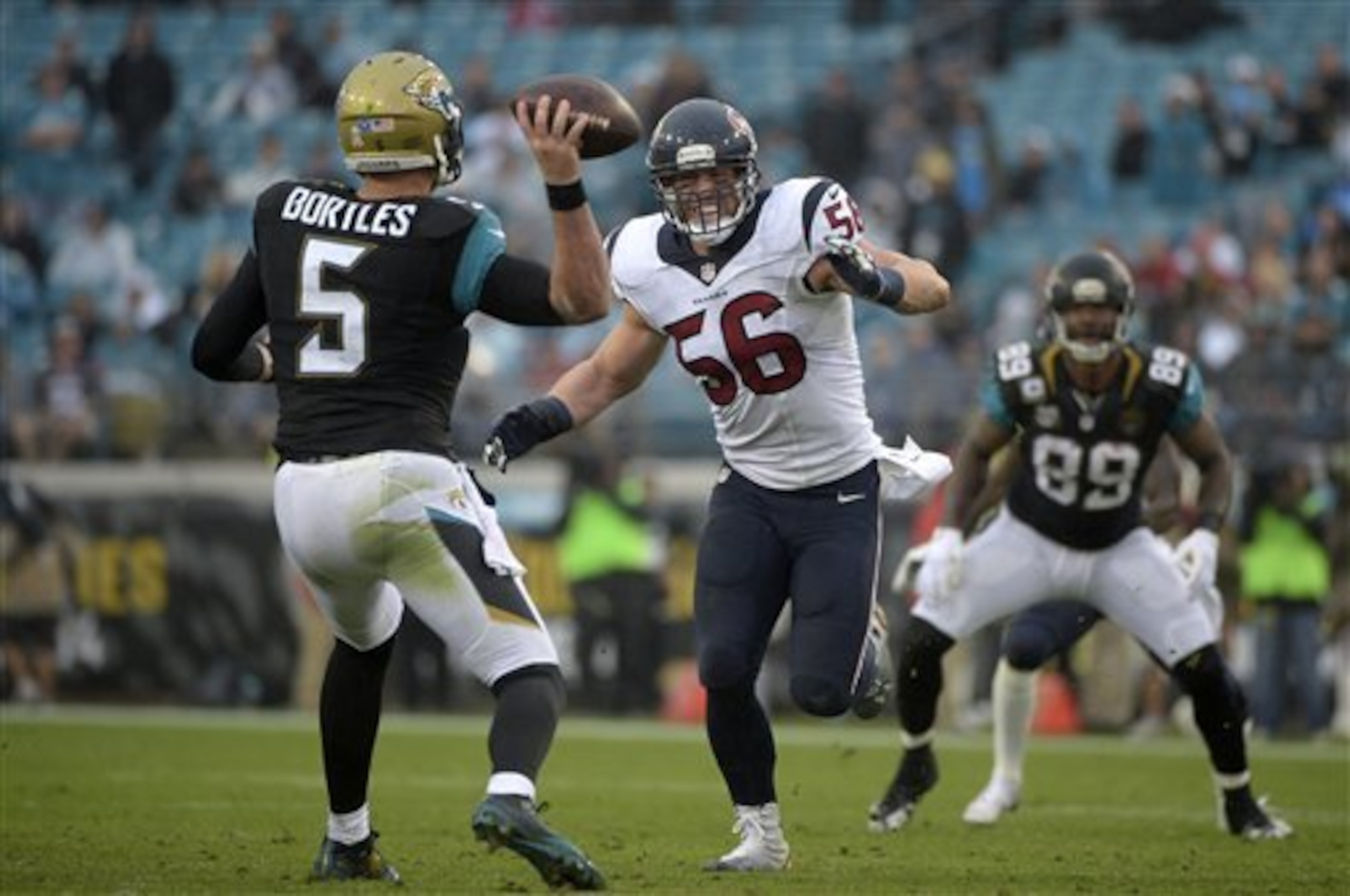
Sam Linebacker – John Simon
With Brooks Reed now a member of the Atlanta Falcons, Simon is the de facto strong-side linebacker. His production in limited action was, on the surface, spectacular. In 238 snaps, he created 15 QB pressures, a rate of 16.0 snaps per pressure.
This impromptu statistic would have made him the best outside linebacker in the unit if correlation meant causality. The small sample size renders the numbers almost meaningless.
The lack of information turns this into to a TBD position: To Be Determined. A player-personnel move will be made to pick up a cap casualty or veteran cut in training camp. A draft choice is not out of the question, with a bevy of outside linebackers scattered throughout the rankings at NFL.com.
Left Inside Linebacker – Mike Mohamed
This spot also comes off as a TBD position until you dig a little deeper into the numbers. Mohamed is the best coverage linebacker in this unit, topping the group with six passes defensed and a 79.7 quarterback rating for receivers he shadowed.
Brian Cushing led the Texans linebackers with 112 pass rushes and 301 coverage attempts in 733 snaps. Mohamed had almost as many pass rushes (103) and coverage attempts (265) in 524 snaps. If there was any lingering doubt offenses are throwing the ball regardless of down and distance, here is some convincing evidence.
However, is anyone out there convinced Mohamed is the long-term solution at starter? He has the makings of a fine rotational player, and let’s leave it at that. The linebackers truly need an upgrade as much or maybe more than the receivers do.
Right Inside Linebacker – Brian Cushing
Two injuries to the same knee in successive seasons have taken their toll on Cushing’s athletic prowess. He still has moments when the agility and hostility that made him Defensive Rookie of the Year in 2009 come to the fore. They happen to be fewer and farther between than in the past.
While still capable of anchoring the interior of the second defensive level, will there be highlights like the leaping interception to end the San Diego Chargers game in 2013?
The Texans defense made a huge jump in their first year under the tutelage of Romeo Crennel. The new defensive coordinator pulled it off with the first overall draft pick missing in action, a patchwork collection of linebackers and a defensive line with only one exceptional member.
Add one injury-free season from Cushing, and who knows how much further they could rise in the standings?
Will Linebacker – Whitney Mercilus
What a factor he could be if his demeanor on the field was a phonetic match for his surname. ”Merciless” could be endorsing everything from insecticide to personal-injury attorneys.
Rather than playing up to his conceivable nickname, his above-average foot speed has not been complemented by the overall talent to put it to use.
Mercilus has learned to maintain lane discipline and keep running backs from cutting in their chosen direction. His improvement in handling the run has not translated into what his team needs most.
Matt Weston of SB Nation went to great lengths to describe how the 2013 version of Mercilus places an over-reliance on going wide to get to the quarterback. This approach rarely works because it takes too long and gives everyone of the other team extra time to react.
When Mercilus was at Illinois, his speed advantage was so extreme he could fly right by your garden-variety collegiate tackle. The gentleman who do this for a living are more than prepared to take the outside linebacker upfield until his angle to the passer is too obtuse to interfere with the play.
The 2014 season brought in a new cadre of coaches including linebacker specialist Mike Vrabel. The change was expected to bring better results.
"New linebackers coach Mike Vrabel is pushing Mercilus. Three talented defenders surround him. Year 3 in the NFL should be the season when Mercilus' name sounds out. He just has to ring the bell for 16 games.
"
There were a couple of two-sack games against the Philadelphia Eagles and Pittsburgh Steelers and but only five for the entire season. They were part of 40 quarterback pressures in 822 snaps. These are not the kind of statistics that will convince management to pick up his fifth-year option.
Clowney may come to the rescue at some point in 2015. The National Institutes of Health advise “Many people can go back to sports or other intense activities in about 4 to 6 months.” Mike Wilkening of Pro Football Talk warned “He’s expected to need nine months to recover,” which would put him back with the team around August.
This gives Mercilus the better part of one more season to “ring the bell” before the bell tolls for him.
Defensive Backs
7 of 9
Left Cornerback – Johnathan Joseph
One of the most surprising developments of the offseason is that Joseph remains a Houston Texan. The three obvious bogies on the cap-casualty radar were Andre Johnson, Chris Myers and the 10th-year cornerback. The fact that Joseph was not pressured into an extension proposal to soften the blow of the team’s $12.25 million commitment is still stunning.
His contract is the fourth-highest for his position and the only one among the top seven for a player over 30. Was he good enough in 2014 to warrant such compensation?
Pro Football Focus did not place him among their top 20 cornerbacks, ranking 23rd overall. He allowed 814 receiving yards, the 10th-highest total, and his 58.1 completion percentage put him in 34th place. Alternatively, Joseph was targeted 117 times, the third-highest figure, while giving up only four scores.
Altogether, it’s a better deal than Patrick Peterson and his $14,791,200 stipend. J-Jo is signed for one more season, then the market will decide what he is worth.
He turns 31 next month, and opposing quarterbacks will test him to the limit. Whether he perseveres will go a long ways toward determining what kind of season Houston will have.
Right Cornerback – Kareem Jackson
Jackson got paid and is staying home. His four-year, $34 million deal is good for him and the organization. The guarantee is $20 million, but after two seasons, the dead money is a manageable $4.5 million. Re-signing Jackson is the best free-agent decision by this franchise since Johnathan Joseph came on board in 2011.
Enough about the finances, the football is what matters. One of the best cornerback duos stays intact as part of a secondary which held opponents to the fifth-leading passer rating in 2014. A secondary that might even improve even more in their second season under position coach John Butler.
Vince Wilfork will fortify the defensive line, Rahim Moore gives the secondary an excellent “over-the-top” safety and the depth in young defensive backs means the nickel and dime sub-packages will be well manned.
Free Safety – Rahim Moore
Rahim Moore or Kendrick Lewis? Moore picks off more passes, but Lewis forces more fumbles. Moore gives up more touchdowns, but Lewis permits more yards after the catch. Lewis signed for less (three years, $5.4 million vs. three years, $12 million), but Moore is younger (25 vs. 28).
The biggest advantage Lewis had was his two seasons working with Crennel when both were with the Kansas City Chiefs. The Texans decided to pay more for another safety who is not demonstrably better, outside of being eligible for the “higher upside” tag.
Moore was the top performer at the 2011 combine in the safety group for the 40-yard dash (4.62), vertical jump, three-cone drill and 60-yard shuttle. His overview from NFL.com was highly complimentary.
"Moore is a true difference maker at the safety position, and he projects to be an immediate starter at the next level. He is extremely rangy with the deep speed to hold up in cover-3, and he has a great closing burst when the ball is in the air. He also has great instincts and always seems to be in the right position in coverage.
"
All these skills did not translate into any Pro Bowl invites during his days with the Denver Broncos. It is early in his career, and being coached by someone other than Jack Del Rio should yield some tangible benefits.
Strong Safety – D.J. Swearinger
Does D. J. Swag dream of being the next Troy Polamalu? Every safety would like to be adept at making plays all over the field. The Texans would be satisfied with Swearinger becoming the next Glover Quin.
Quin was miscast as an “in the box” safety in Wade Phillip’s Cover 1 system. He took a deal with the Detroit Lions in 2013 and proved to be better at playing Cover 2. Swearinger tried to make the same transition last season and came up short.
Specifically, Swearinger has not learned how to roll into double coverage during the course of a play. A good example was a 52-yard completion from Mark Sanchez to Jeremy Maclin in the Week 9 Philadelphia Eagles game.
Eagles head coach Chip Kelly had his quarterbacks regularly attacking rookie cornerback Andre Hal, who was subbing for the injured Darryl Morris. Hal had already been burned by Maclin for a 59-yard touchdown in the first quarter.
When Maclin’s “8” route got him open, Swearinger was three steps behind the play, while Hal was trying to recover from Maclin’s inside break. Four plays later, Sanchez went after Hal again for a touchdown to Jordan Matthews.
The score was not the fault of Swearinger. The pass that put the Eagles deep in Houston territory was. He should have had Hal’s back when it was obvious the rookie was stuck in single coverage with the Eagles’ most dangerous receiver.
What is being asked of Swearinger is not easy. Most of the league’s strong safeties cannot perfect the timing of when to break off covering their man to help out another defensive back. This skill is a special one that separates the best from the rest.
Swearinger does not have the makeup speed and the flexibility of body or mind to manage this demanding task. The Texans’ list of draft priorities should include a strong safety with that kind of potential.
Kick Returners
8 of 9
Punt/Kickoff Returner – TBD
These responsibilities have been placed in the TBD category based on two assumptions.
The first is Keshawn Martin, the punt/kickoff returner of the last three seasons, will be given his walking papers. The second is the personnel department can do better than Damaris Johnson (above), the most likely option currently under contract.
Danieal Manning could have been penciled in as the kickoff returner. Manning is an unrestricted 32-year-old free agent who does not seem to be attracting interest from the Texans or any other team.
Perhaps there is a defensive back or wide receiver hiding on the roster who is ready and willing to take on either of these jobs. In that case, his identity will not be revealed until OTAs start in April.
Kickers
9 of 9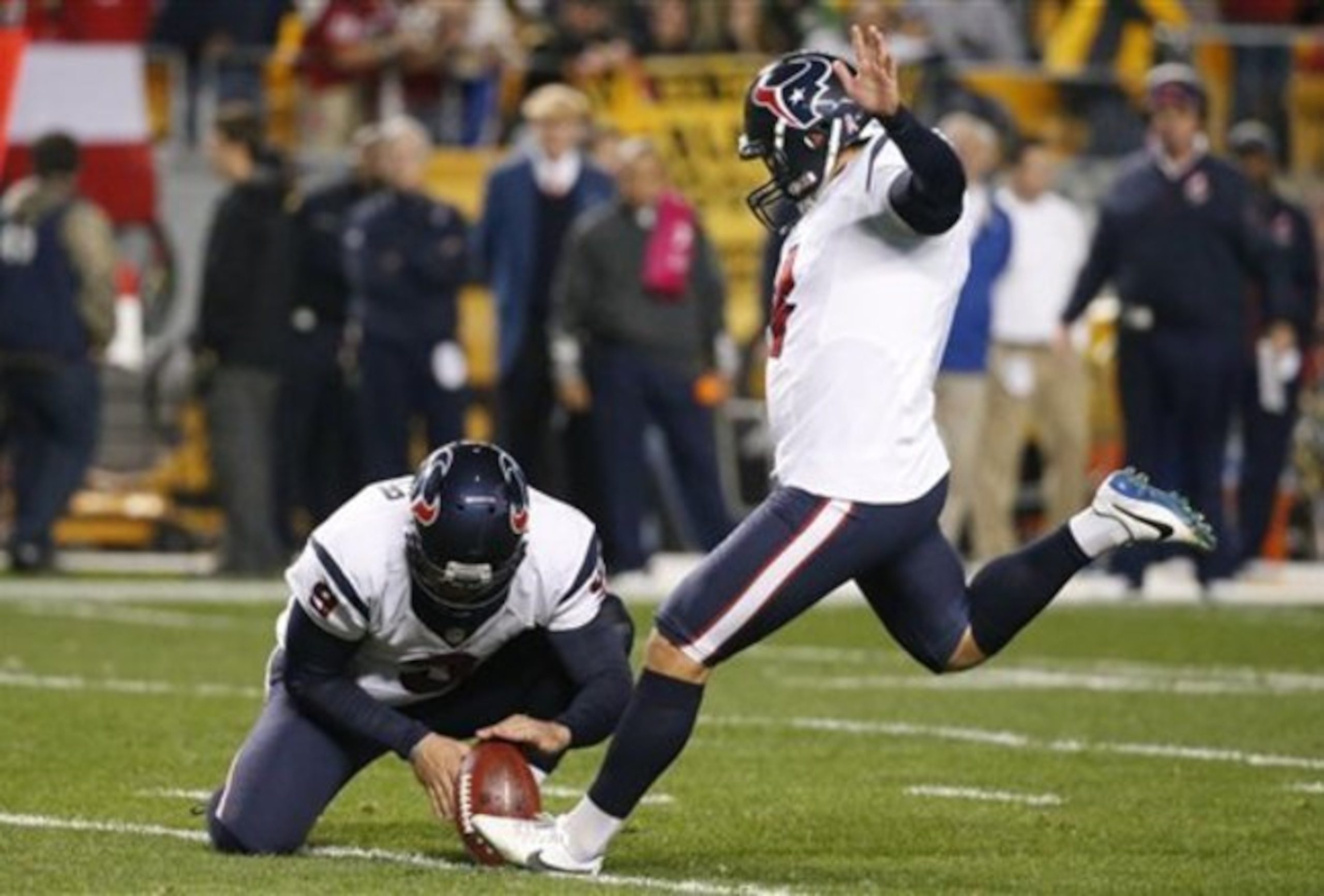
Punter – Shane Lechler
The most decorated punter in the annals of the NFL has been named to seven Pro Bowls and six All-Pro teams. It has been three years since Lechler has been so honored, yet he has averaged over 47 yards per kick over that time.
Lechler hails from East Bernard, a small Texas town that is less than a 50-mile drive from NRG Stadium. If he is so inclined, Lechler could stay close to home and keep punting until he starts receiving invitations to join AARP.
Placekicker – Randy Bullock
When a kicker goes from making 20 percent of his field goals over 50 yards in one season to making 80 percent in the next, most would say he had a comeback year.
Bullock was certainly better in 2014, improving his field-goal percentage from 74.3 to 85.7. It placed him in top half of the league, if only at No. 15.
Over his two seasons on the job, he has made 63.6 percent of his field goals against AFC South opponents. His worst percentage against any other division is 75 percent.
Case in point: His miss on a makeable 37-yard field goal in the fourth quarter of the 2014 home game versus the Indianapolis Colts put the brakes on the Texans’ comeback. Bullock has played his worst against his team's most critical opponents.
Until this trend is reversed, the former fifth-round pick will be further proof acquiring kickers through the draft is just a waste of the pick.
.jpg?w=2560 "Steelers Saints Football")
.jpg?w=2560 "Eagles Jaguars Football")
.jpg?w=2560 "🚨 Week 8 AP Top 25 Poll")