Reggie Jackson Is Not the Answer to the Detroit Pistons' Point Guard Problems
Reggie Jackson wanted a chance to prove his worth as a starting NBA point guard, and the Detroit Pistons needed someone to replace the injured Brandon Jennings.
On paper, the trade deadline marriage between Jackson and Detroit seemed like the perfect fit. But in practice, it could be headed to a divorce faster than a celebrity fling.
The speedy point guard has only had a nine-game run with his new club, but it's already produced enough evidence suggesting he isn't the solution to their problems at this position.
TOP NEWS

LeBron's Special Helicopter Deal

MJ Makes Record-Setting Donation 🙌
Report: Embiid Down to Rookie Weight
His individual numbers have been dreadful.
His 43.7 true shooting percentage is worse than the 47.7 mark Kobe Bryant posted with a bum shooting shoulder. Jackson's 16.2 turnover percentage with the Pistons is as high as it's been since his rookie year. He's averaging more field-goal attempts (16.2) than points (15.1) in Motown.
And somehow the team's statistics have been worse than his own.
Since Jackson's Feb. 22 debut, the Pistons are tied for the league's worst record at 1-8. They've been outscored by an average of 6.4 points per 100 possessions over that stretch. Only three teams have a lower net efficiency rating during this time.
The Pistons have played some good teams during their eight-game losing streak—notably, the Cleveland Cavaliers, Houston Rockets and Golden State Warriors—but it's impossible to chalk these struggles up to a bad break in the schedule.
Doing so would foolishly overlook the fact that Detroit has dropped games to both the New York Knicks and Los Angeles Lakers. Those clubs have just 30 wins against 98 losses between them.
No, this speaks to a much larger issue. There is no winning formula for the Pistons that involves Jackson manning the starting lead guard spot. Even if Pistons president-coach Stan Van Gundy would lead one to believe that Jackson's problems running point start and stop inside his own head.
"I just think, overall, he's off his game. He's pressing too hard, trying to do too much, sort of thinking too much," Pistons coach Stan Van Gundy said, per Vince Ellis of the Detroit Free Press. "He's got to relax and play according to what the defense does."

Surely, Jackson is putting pressure on himself to perform.
He never masked his desire to lead his own team. He needs to show he's capable of filling that spot, then, to justify wanting to get away from an Oklahoma City Thunder team that, when at full strength, looks an awful lot like a championship contender.
And he needs to do all of this in a contract year where he's looking to score a salary "near the max," per ESPN.com's Royce Young.
There are copious amounts of pressure in those endeavors.
But good luck finding the NBA player who doesn't feel some heat on a nightly basis. Fringe contributors have roster spots to secure. Superstars have accolades to obtain. There are mounds of money to be earned, playoff positions to be strengthened.
Besides, it's hard to feel for a guy who claimed he wanted to feel this type of stress. Jackson craved the keys to whatever car a team was willing to let him drive, he pleaded for a prominent role and the spotlight's unrelenting glare that comes along with it.
"It’s something I’ve always envisioned," Jackson told reporters of running his own show. "If it doesn’t work it doesn’t work, if it does it does, but I’ve always wanted the chance to try and make something special."
That's not happening in Detroit.
The Pistons presumably have their franchise cornerstone in Andre Drummond. If they opt against bringing back Greg Monroe this summer, they'd be moving away from one of only nine players averaging at least 15 points and 10 rebounds this season.
Whether Detroit's future rests in Drummond's hands or on the strength of the Drummond-Monroe frontcourt, it's going to be built around an inside-out attack. How can Jackson, a career 28.5 percent three-point shooter, help relieve any congestion in the paint?
He can't. Look at how little respect the Golden State Warriors gave him on the perimeter.
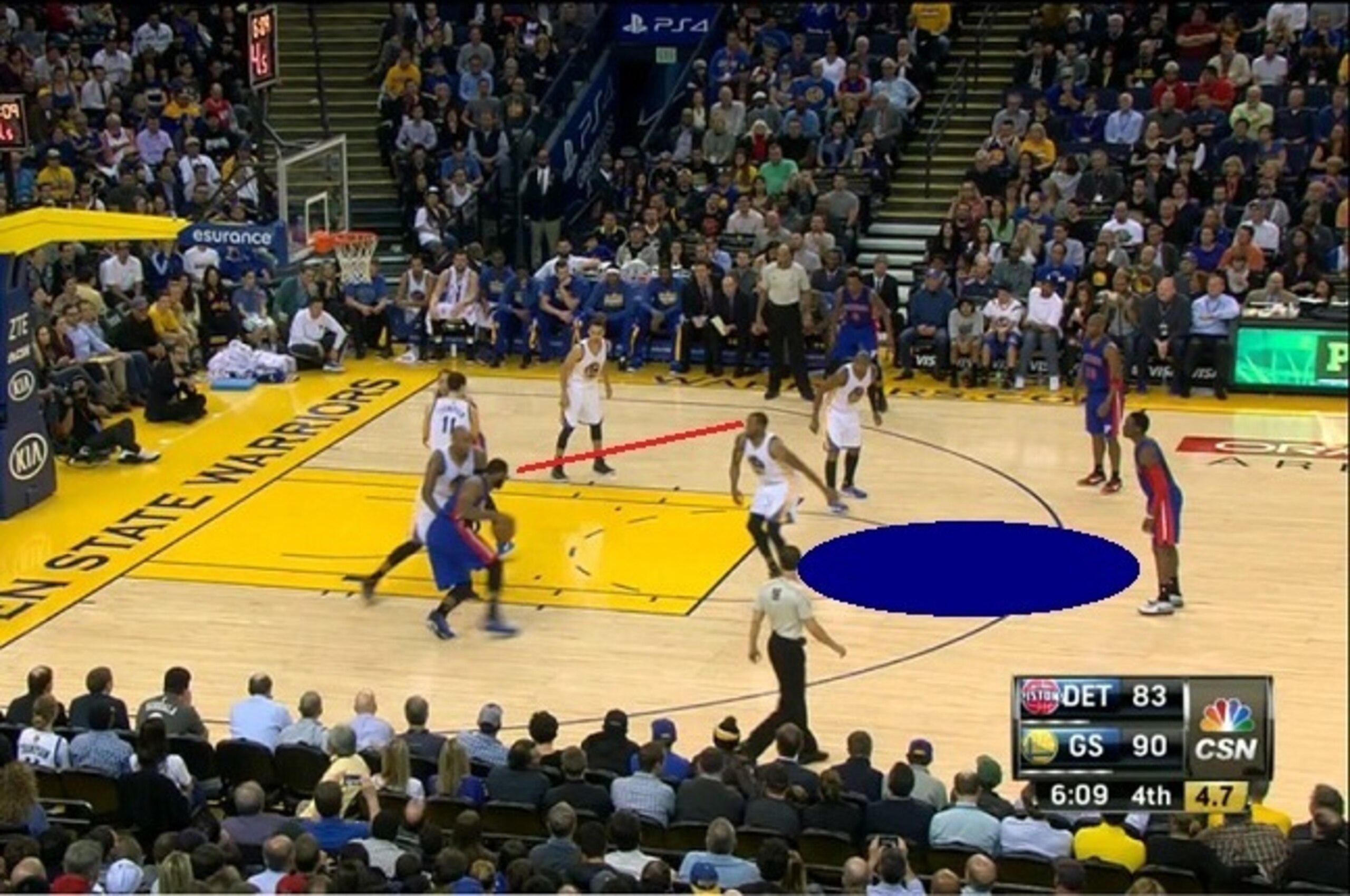
It's not just the space Andre Iguodala left between himself and Jackson, and it's also the fact that Iguodala completely turned his back on the Pistons point guard. Clearly, the Warriors weren't worried about getting burned from distance.
And that was just the beginning. As Drummond made his move to the middle, Iguodala continued hugging tighter on the interior. The Dubs doubled Detroit's big and didn't even bother to shift a help defender Jackson's way.

Do I even need to tell you what happened next? Drummond predictably ran out of real estate and turned the ball over.
Does this sound familiar, Pistons fans? Aren't these the same spacing issues Detroit faced when it tried playing Josh Smith, a career 28.1 percent three-point shooter, on the wing? Remember how that experiment ended?
Players can improve their perimeter shooting, but it's hard to imagine Jackson suddenly turning things around. He converted only 29.2 percent of his long-range looks over the last three seasons in OKC. And that was when he had Kevin Durant, Russell Westbrook and Serge Ibaka drawing defenders away from him.
Jackson has taken 166 threes without a defender closer than four feet this season. He's cashed in 45 of those looks (27.1 percent).
The Pistons need a floor-spacer to make this offense work. That's why they found some success with Jennings (career 35.1 three-point percentage) and, later, D.J. Augustin (37.3) at the helm. They won five of the eight games that preceded Jackson's arrival, with Augustin as the starter in seven and rookie Spencer Dinwiddie filling in for the eighth.
Talent isn't their problem.
They just need someone other than Jackson in charge, but Van Gundy isn't giving up on the restricted-free-agent-to-be.
"We're committed to him," Van Gundy said, per Vince Ellis of the Detroit Free Press. "It's a long-term thing. This isn't a tryout."
As convincing as those words sound, the organization's actions paint an even clearer picture of its plans.
"The fact the Pistons gave up Kyle Singler...and D.J. Augustin—and did so with the knowledge that Jackson had rejected Oklahoma City’s reported offer of four years, $48 million—is ample evidence that the Pistons fully intend to re-sign him," wrote Pistons.com's Keith Langlois.

Perhaps that puts a silver lining on Jackson's shooting woes.
As Grantland's Zach Lowe observed, Jackson's price tag is presumably plummeting with each errant shot:
But is that really a good thing? If interest in Jackson is waning, why should the Pistons feel compelled to keep theirs high?
The move to go get him doesn't have to play a part in this decision. If he isn't the right fit, Detroit would be much better off simply cutting its losses at season's end.
"They don't need to back themselves into a corner just because they traded for him," Dan Feldman wrote for the Detroit Free Press. "At this point, the trade is done. All decisions on Jackson should be based on projecting his future, not on how he was acquired."
Given how this presently looks, how much brighter can the future appear?
Moving forward without Jackson won't be easy. Jennings is less than two months into what's sure to be a lengthy recovery from his torn Achilles. Dinwiddie needs plenty of seasoning. The Pistons could grab a point guard with their upcoming lottery pick, but the selection might be better spent on a small forward—or a replacement for Monroe.
But overpaying a player who can't scratch their biggest itch isn't the right move.
Jackson cannot share the floor with two low-post players. He doesn't give them any breathing room, and they don't create driving lanes for him to attack.
Something needs to change. Either Jackson has to find a new team with a stretch 4 on the roster, or the Pistons need to revamp their roster to make it better suited to his skills. That means no more Monroe, better shooting on the wings and a commitment to pushing the pace.
Maybe Jackson shows something over the final 18 games that makes the Pistons consider significant changes around him. Maybe his value falls far enough that they can keep the 24-year-old on a low-risk, short-term deal. Those possibilities are both still in play.
But if the Pistons want both Jackson and their current roster around, then they're clinging to false hopes. This nine-game reality check has proved he isn't the answer to this problem.
Unless otherwise noted, statistics used courtesy of Basketball-Reference.com and NBA.com.
.jpg?w=2560 "2 NFL Officials Suspended")


.jpg?w=2560 "Mahomes' Wife Trolls Kubiak 💀")
.jpg?w=2560 "Injury-stricken Seahawks signing veteran RB")
.jpg?w=2560 "Love's Body Already 'Tired'")