

Previewing What New York Knicks Fans Should Expect Without Carmelo Anthony
After weeks of delaying the inevitable, the New York Knicks are about to find out how drastically different life without Carmelo Anthony will be.
Sitting Anthony has snowballed into an unavoidable fact. Left knee soreness has been dogging him all season, reaching fever pitch in January, when he missed the Knicks' first six games and admitted surgery would be his "only option" at some point, per the New York Daily News' Frank Isola.
Rest days have been sprinkled in over the last few weeks as the Knicks try to preserve Anthony's body. The goal, while seldom acknowledged, has become clear: Survive until the All-Star break, and then go from there.
TOP NEWS

LeBron's Special Helicopter Deal

MJ Makes Record-Setting Donation 🙌
Shams: KAT, Hart Could Be Trade Names
If at any point the Knicks or Anthony were thinking, hoping or banking on the superstar remaining available beyond then, they were delivered another dose of truth in Monday's loss to the Miami Heat. Anthony left the game during the fourth quarter and never returned.
Familiar pessimism then polluted the locker room afterward, per Bleacher Report's Ethan Skolnick:
As for when Anthony will actually shut it down, well, that remains a mystery.
With only one contest remaining before the break, Anthony may have already played his last game this season. We don't yet know for sure. But we do know an indefinite exit is nigh—if it's not here already.
Either way, the Knicks will eventually adjust and then struggle accordingly.
The Importance of Being Melo

On the most fundamental level, timing is irrelevant. The Knicks are going nowhere this season, with or without Anthony. They're on pace to win a franchise-worst 16 tilts and just one game behind the Minnesota Timberwolves for the NBA's worst record.
Still, the Knicks' fate isn't as firmly fixed with Anthony in the fold. He is their bridge, however rickety and inconsequential, to watchability.
Anthony is the only Knicks player averaging north of 13 points per contest. The team is also 0-12 in games he's missed. Quite simply, when he's off the floor, a terrible squad manages to get even worse.
Especially on offense.
| Overall | 99.2 | 27 | 43.8 | 35.9 | 48.3 | 23 | -8.7 | 28 |
| With Anthony | 105.1 | 10 | 45.6 | 37.4 | 50.1 | 14 | -4.2 | 24 |
| Without Anthony | 91.3 | 30 | 41.4 | 34.1 | 45.8 | 28 | -14.6 | 30 |
When Anthony sits, the Knicks run the league's worst point-piling machine. End of story. He's the difference between them scoring at rates comparable to top-10 attacks and utter implosion. That's both the perk and peril of having a featured scorer.
Having a lifeline is good, but dependency is fickle. The Knicks have no one else fit to carry their offense—not Amar'e Stoudemire, not Jose Calderon, not Langston Galloway. They're a band of misfit placeholders, many of them ill-suited for the triangle offense, even more of them playing for their next contract with a different team.
But Anthony is not a lifeline in the sense he ties everything together. He's a standout talent playing beside forgettable cohorts. That he impacts the Knicks offense so powerfully attests to his acumen more than it does the triangle's tenets.
The Knicks still run their butchered version of the triangle when he sits after all. Their shot selection with him is basically a carbon copy of their shot distribution without him.
Here's a looksy (note that totals do not amount to 100 percent since we're excluding backcourt attempts):
If anything, the Knicks' shot selection is a tad better sans Anthony. They're combining for more shots in the paint and restricted area, hoisting more threes and attempting fewer—though still too many—mid-range jumpers.
Offensive sets continue to start from the high post as well. The Knicks are often left to swing the ball around the perimeter more before reaching their preferred point of initiation, but whether it's Quincy Acy, Lou Amundson, Jason Smith or Anthony headlining the high post, the offensive structure doesn't change.
It's the skill level, the efficiency, that suffers most when Anthony steps off:
Notice how radically the Knicks' three-point success rate—specifically from the corners—falls in Anthony's absence. These slumping percentages are twofold.
First, the Knicks are not especially three-point prone. Though they rank eighth in deep-ball conversion rate, they're 20th in attempts. And while they're averaging more three-point looks per 100 possessions without Anthony, their efficiency drops in the wake of available personnel.
Iman Shumpert and J.R. Smith, two of the Knicks' six most frequent three-point shooters, are gone. Pablo Prigioni has fallen out of the rotation entirely.
Many of the Knicks' remaining shooters are, in turn, not proven outside commodities. Galloway is less than 20 games into his NBA tenure, and Smith is suddenly being asked to step beyond the three-point line. It doesn't matter that their percentages are sound (Smith is connecting on 41.7 percent of his long balls); they are not respected floor spacers by reputation.
Which is the other, more important part of all this: Losing Anthony kills the Knicks' already iffy spacing.
Buh-Bye, Spacing
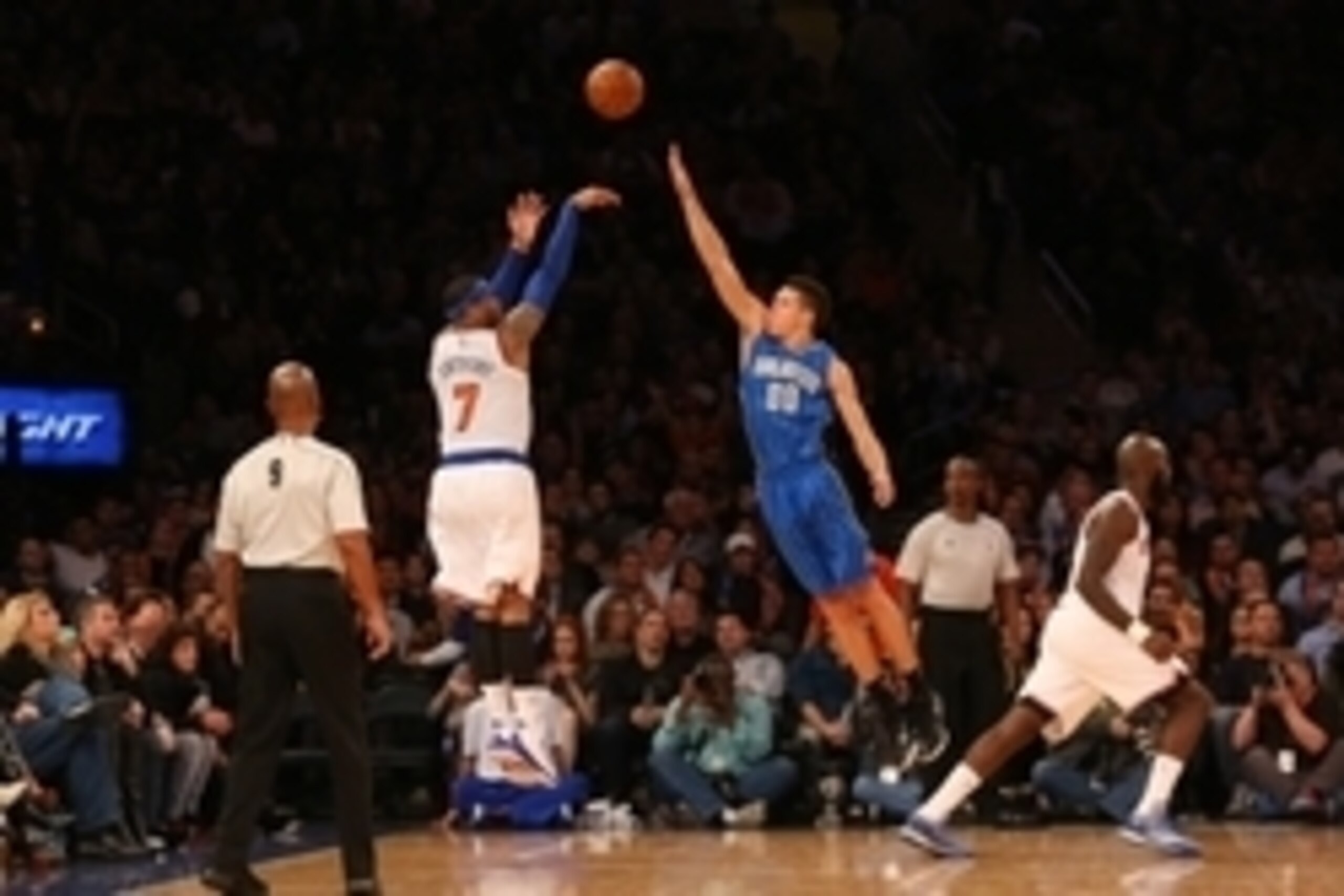
More than 75 percent of Anthony's minutes are coming at small forward, so the Knicks, with their dual-big lineups, are already testing the limits of timeworn tactics in a contemporary NBA.
Yet despite their lane-congesting combinations and questionable, mid-range-strained shot selection, they're able to prosper at times by exploiting the space Anthony creates, regardless of where he catches the ball.
Some teams (read: the Los Angeles Lakers) aren't going to double him. Most of the time, though, at least two sets of eyes are devoted to Anthony.
To wit:
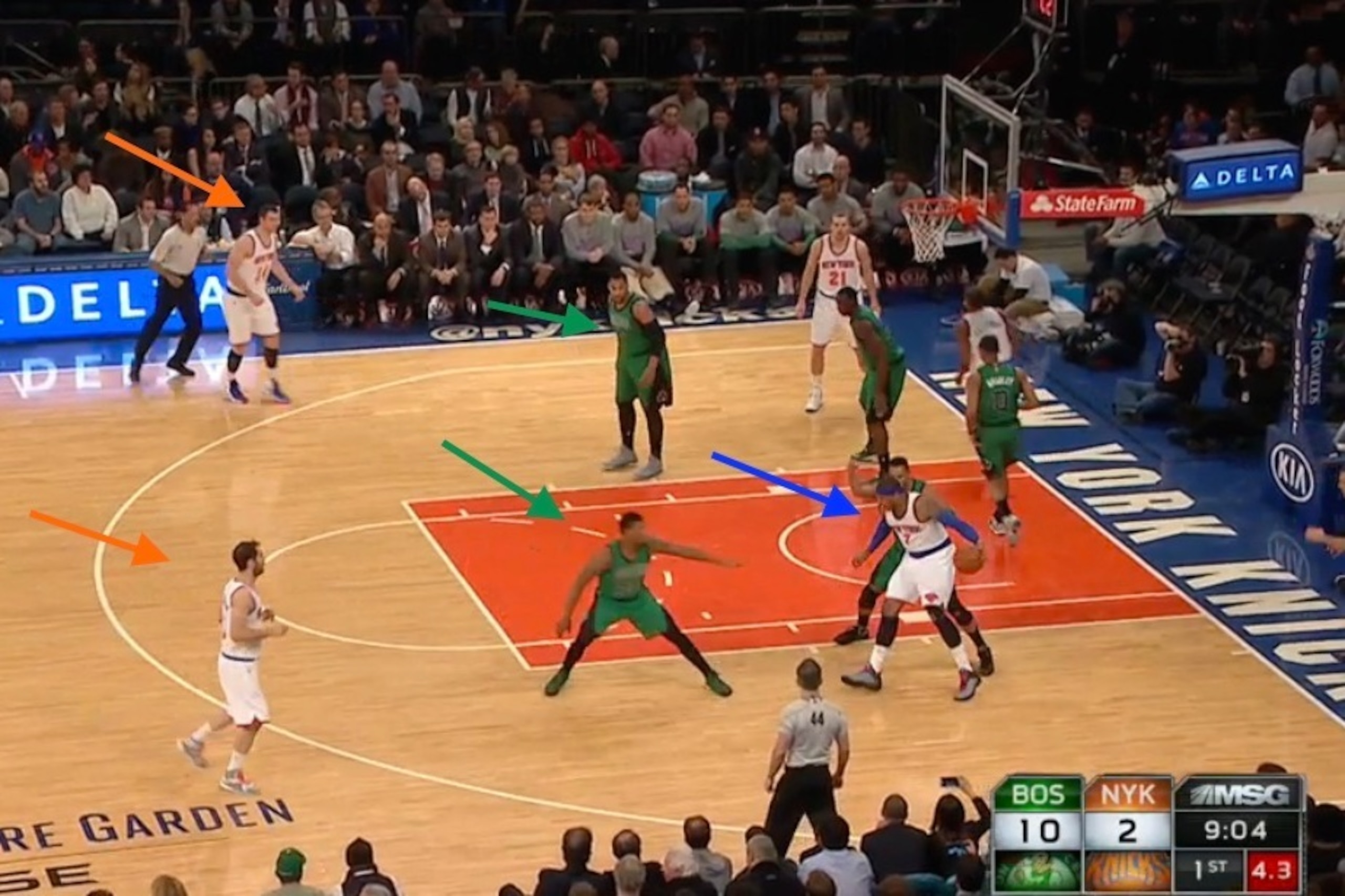
The impact on this particular play is mitigated by stashing Smith behind the rainbow, but the benefits of having Anthony are in full swing. The Boston Celtics defense is fixated on his every move even though he's outside. Shots become easier in the event he passes, providing wide-open looks to lurking teammates.
These effects don't change when Anthony is farther away from the basket. Look at the attention he commands against the Brooklyn Nets from slightly inside the arc just because he puts the ball on the floor:
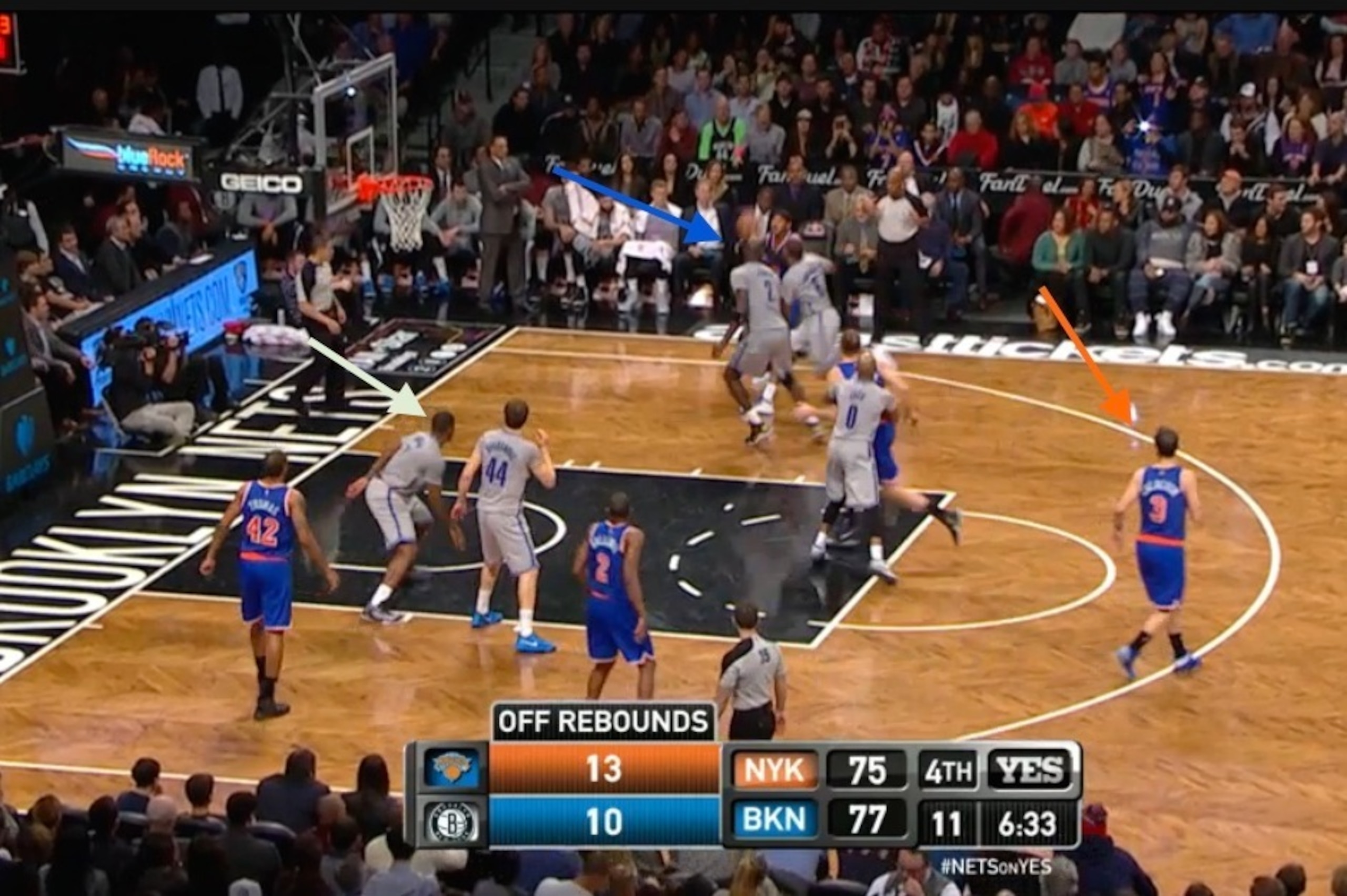
Kevin Garnett and Deron Williams are flanking him, while Joe Johnson and Bojan Bogdanovic are both cheating in his direction. This happens because 1) the Knicks' dearth of tertiary offensive options limits the potential ramifications of double- and triple-teams, and 2) Anthony will actually fire away in these situations, like he did here.
This threat of him firing at will does wonders for the Knicks offense. Teammates are shooting nearly 51 percent off his passes, a far cry from the 43.8 percent clip New York posts overall.
Consider too that nearly 52.6 percent of the Knicks' shot attempts are tightly contested, of which they're hitting just 42.9 percent. Almost 62 percent of Anthony's looks come under similar duress, yet he's putting them in at a markedly higher rate than his team (43.9 percent).
A price cannot be put on having someone who can operate in traffic. The Knicks offense runs through Anthony not just because he can score, but because of how he can score and the manner in which that makes scoring easier for everyone else.
Remove that luxury from the system and it falls apart.
Take a look at this particular offensive set run without Anthony:
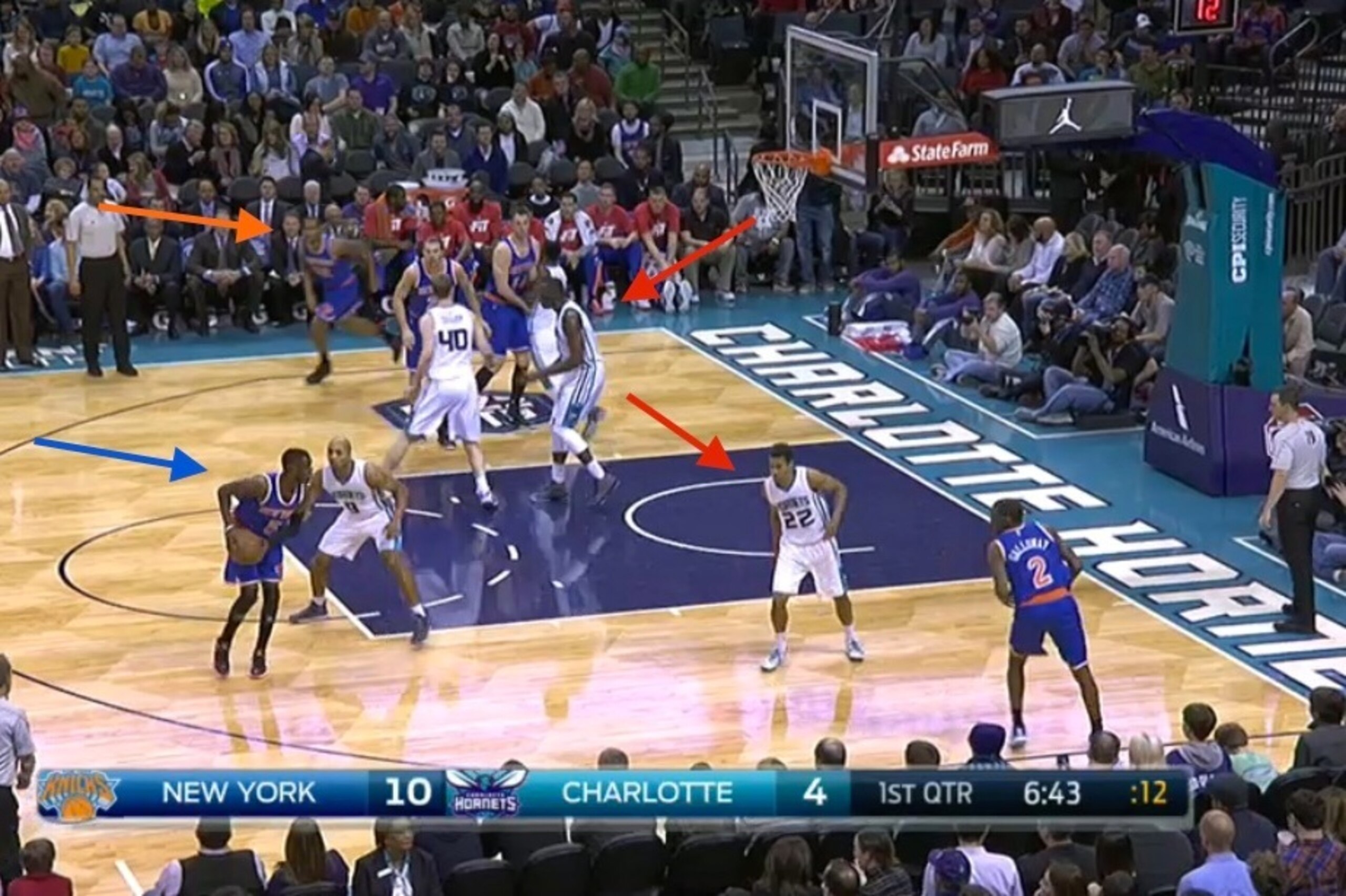
Tim Hardaway Jr. functions as Anthony in this scenario. His deficient feel for passing aside, there isn't a double-team in sight. Most of the Charlotte Hornets' defenders aren't even looking at the ball.
Brian Roberts, one of the exceptions, isn't slinking off Galloway enough to open a backdoor cut. Both Cody Zeller and Bismack Biyombo have their respective paths to the basket clogged. The Knicks' best option becomes Lance Thompson, who comes off a Smith screen and, because of how Charlotte's defense is allowed to stand, throws up a contested hook:
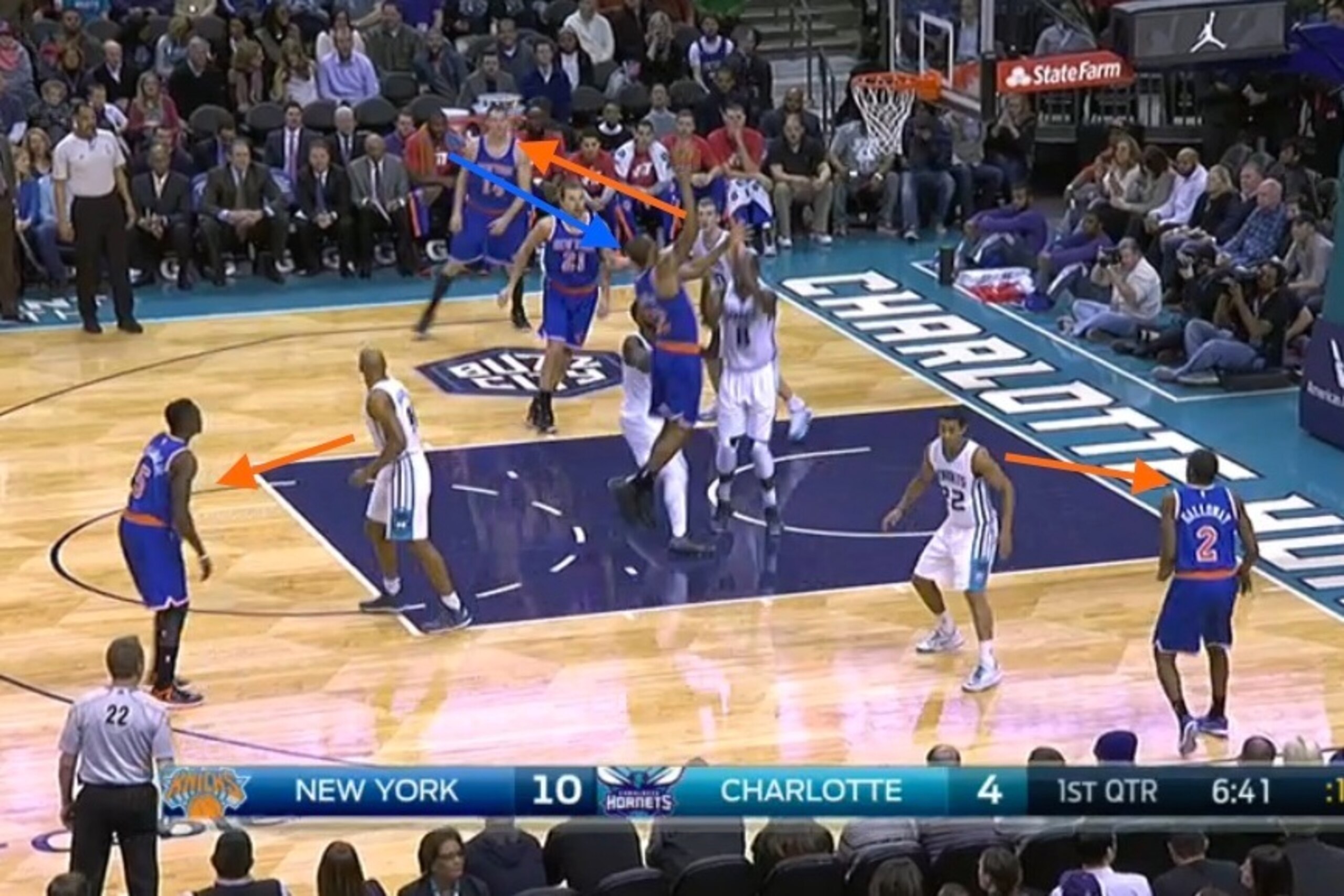
There's little to like about this shot aside from the fact it's coming in the paint and went in. No one is "open" on this play, Thomas doesn't shoot a high percentage on contested looks, and the attempt comes with just eight seconds left on the shot clock.
Those spacing issues don't just disappear. Sometimes defenses relax. Most of the time New York is trying to execute from a starting point like this:

Or this:
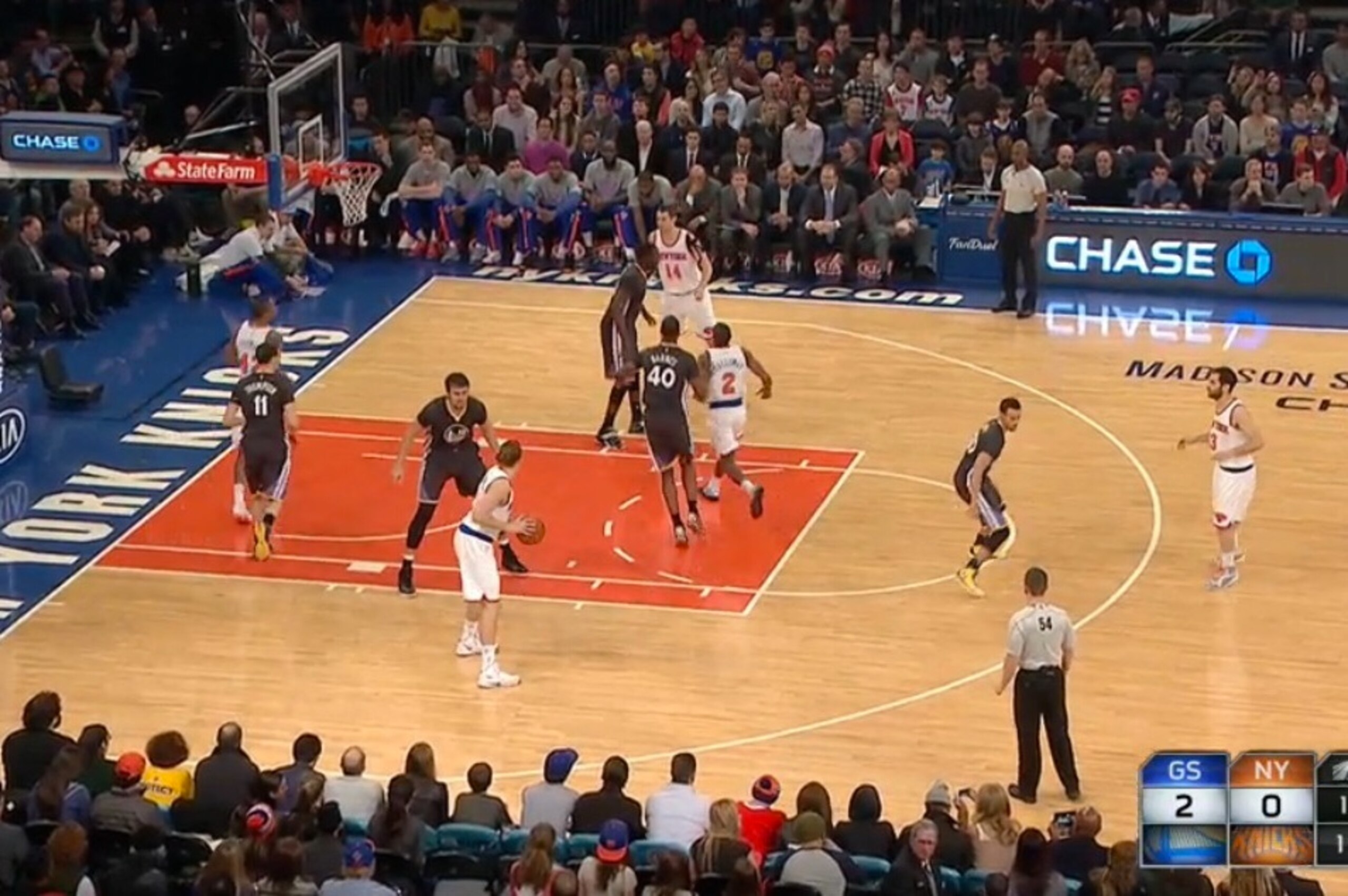
Passing and screening become paramount without Anthony, since defenses no longer have reasons to double-team or collapse. That's why you'll see the Knicks' assist rate climb in Anthony's absence. But it's also why their offense—which already ranks 29th in pace—will slow down. These sets are inherently harder to run without someone who can create his own shots and draw defenses in.
Just look at the difference in spacing and how the defense adjusts against Anthony compared to when he's off the floor:
No in-house cure exists for this issue. Unless Hardaway or Galloway starts torching opposing defenders like he's inherited Anthony's superpowers, defending the Knicks without their lone star is easy. They are slow, burn seconds off the shot clock trying to create separation and are incapable of collapsing defenses so long as they're committed to the dribble-penetration-deterring triangle.
Fear Now, Pine for Later
It is possible for things to get worse for the Knicks.
They're about to.
Some aspects of the offense might change, and those tweaks remain unpredictable. The Knicks are already running more pick-and-rolls, which had bordered on extinction until recently. Personnel can also still shift, seriously altering—and, if the Knicks are lucky, perhaps improving—their offensive methodology.
Stoudemire may ask for a buyout over the All-Star break, and Calderon has been on the chopping block for weeks, according to Yahoo Sports' Marc J. Spears. Any change in resources will force the Knicks to adapt even further.
Whatever happens, it isn't going to be pretty. Losing Anthony will send the New York offense into a downward spiral on its own. There is no way the Knicks supplant his production and function within their attack. He is equal parts decoy, focal point and zero-hour aid. He is irreplaceable, meaning what's happening now is irreversible.
"It takes talent to win with any consistency," Bleacher Report's Zach Buckley wrote, "and the Knicks don't have nearly enough of it. ... There's a cap on how far this team can go. And it sits as low as any in the league."
This is what the Knicks have bargained for in recent weeks. Losses are more valuable than wins as they prepare for the draft lottery, and they're already losing enough.
Little about their plans changes without Anthony. The immediate outlook becomes bleaker, rife with even more losses, but that merely makes Anthony's absence a more cogent extension of what we already know: The Knicks' season is long past over.
*Stats courtesy of Basketball-Reference and NBA.com and are accurate leading into games for Feb. 10, 2015 unless otherwise cited.

.jpg?w=2560 "Grading WWE Raw 🔠")

.jpg?w=2560 "Bijan's INSANE 1st Half 🤩")
.jpg?w=2560 "Viral Rams Coach Vid 🖕")
.jpg?w=2560 "Injury-stricken Seahawks signing veteran RB")

.jpg?w=2560 "2 NFL Officials Suspended")